Showing posts with label Modern Jazz Quartet. Show all posts

Wednesday, October 07, 2015

Listening to Prestige Part 149: Modern Jazz Quartet

This is the first MJQ album with Connie Kay, and the last for Prestige, before they decamped for their long and fruitful association with Atlantic.

Kenny Clarke was beginning to feel a little claustrophobic within the strict confines of the MJQ. One of the pioneers, and one of the most prolific drummers of the bebop era,  He was the original house drummer at Minton's, which means he played with everyone -- and as the modern jazz decade progressed, everyone wanted him, or Max Roach or Art Blakey, to play with them.

In 1955, after severing his ties with the MJQ, Clarke made fouralbums for Savoy as leader of co-leader:a septet session with Ernie Wilkins;  The Trio, in which all three players--Clarke, Wendell Marshall and Hank Jones--go co-credit; Telefunken Blues, for which he enlisted MJQ-mates Jackson and Heath, along with a front line of Henry Coker, Frank Morgan and Frank Wess; and a third album featuring a rhythm section of Horace Silver (Hank Jones on one track) and Paul Chambers, and a front line of Donald Byrd on trumpet and Jerome Richardson on tenor sax and flute. He also gave two young brothers their first exposure on record: a trumpeter and alto sax player named Nat and Julian Adderley. It's safe to say that Cannonball made an impressive debut--impressive enough that Bohemia After Dark has often been re-released under his name.The session was successful enough that two weeks later the same two brothers and the same rhythm section recorded under Cannonball's name, and two weeks after that under Nat's name, with Jerome Richardson replacing Nat's brother.

He also recorded with Gene Ammons (Prestige), Eddie Bert (Savoy), Donald Byrd (Savoy),Milt Jackson (three albums on Savoy), Hank Jones (two more on Savoy in addition to The Trio), Duke Jordan and Gigi Gryce (Savoy),  Lee Konitz and Warne Marsh (Atlantic), Charles Mingus (Savoy), Thelonious Monk (Riverside), and Little Jimmy Scott (Savoy).

And that's just the tip of the iceberg. He also  recorded with:

  • Johnny Mehegan, best remembered for his seminal books on jazz improvisation. 
  • Wally Cirillo (Cirillo's album, also featuring Mingus and Teo Macero, included what is probably the first recorded jazz composition written in a 12-tone scale).
  • Johnny Costa, whom Art Tatum dubbed "the white Art Tatum" and who later became musical director of Mr. Rogers' Neighborhood. It's nice to remember, in this day of disappearing live music, that Fred Rogers employed a live jazz trio, which played (per Wikipedia), "the show's main theme, the trolley whistle, Mr. McFeely's frenetic Speedy Delivery piano plonks, the vibraphone flute-toots as Fred fed his fish, dreamy celesta lines, and Rogers' entrance and exit tunes."
  • Chuz Alfred, who made two albums as leader in 1955, then gave up jazz to play with Ralph Marterie's dance orchestra, then returned to Columbus, Ohio, where he became a charter member of the Columbus Musicians' Hall of Fame. And you thought the only musicians' hall of fame in Ohio was the one in Cleveland.
  • Johnny Coates, who as Jazz King of the Poconos, employed the young Keith Jarrett as a drummer.
  • Mike Cuozzo, described by Marc Myers of Jazzwax as "a gifted player... a Lester Young sound with a Lennie Tristano vibe." He gave up music to become a building contractor in New Jersey, but not before making an album with Mort Herbert, who would become deputy district attorney of Los Angeles,
  • Al Caiola, who branched out from jazz to record hit versions of the themes from The Magnificent Seven and Bonanza, and who recorded with  Elvis Presley, Frank Sinatra, Percy Faith, Buddy Holly, Mitch Miller, and Tony Bennett, among others.
Not only is that just 1955, that's just Savoy.

Clarke might have been able to keep up this prodigious schedule and still make dates with the MJQ, but he was also feeling claustrophobic about America, By 1956, he was a full-time resident of France, where he could make more money and deal with less racism. He played many sessions with visiting American musicians, and led the Clarke-Boland Big Band with Belgian pianist Francy Boland.

Connie Kay had followed Kenny Clarke before he followed him into the Modern Jazz Quartet. He became the house drummer at Minton's.

Before that, as a teenager, he had worked at a club called Ann's Red Rose in his Bronx neighborhood, getting the gig a week after he had bought his first drum kit. The house drummer for the Red Rose had quit suddenly, and someone at the bar said "Well, there's a drummer around the corner because I hear him practicing every night as I come home from work." So he played for comedians, singers, tap-dancers and chorus girls (from the NY Times obituary and a NY Times profile).

He moved from there into the jazz world, playing behind every major figure at Minton's, and also in Lester Young's band for several years. He was also putting his Ann's Red Rose experience to good use as the drummer for various rhythm and blues ensembles, including that of Frank (Floorshow) Culley, who had had a hit for Atlantic Records with "Cole Slaw." Culley brought him in to Atlantic in early 1951 to record a demo for The Clovers, who had just signed with the label. The song was "Don't You Know I Love You," and the bass player didn't show up for the session, so Kay had to double his part on the bass drum. He got paid for the gig, and thought no more about until a couple of weeks later, when "I'm driving my car and hear the tune and I say, 'Wait a minute, that sounds like the tune we made a demo of.' A week later I went to Atlantic and I went into Ahmet Ertegun's office and he said: 'Man, I'm glad to see you. We've been trying to find you. I like the beat you used on that record.' From that time on they kept calling me for record dates. When I couldn't make record dates, they'd postpone them.''

Supposedly, the "concept album" began with Sergeant Pepper's Lonely Hearts Club Band, which began with a vague idea by the Beatles to make an album that would represent a collection of songs by a fictitious village band, an idea which got discarded pretty quickly, but floated around the album sufficiently that "concept album" became the goal of mostly some pretty pretentious rock groups. If you wanted a real concept album, what about My Fair Lady Loves Jazz or Dave Digs Disney, or for that matter any Broadway show original cast album? Or Louis and the Angels? Or Birth of the Cool, which wasn't even made as an album but is still one of the greatest concept albums of all time?

Anyway, Concord is a concept album in that the concept was that it would be an album. It was the third recording session scheduled by Prestige to produce a full 12-inch LP's worth of music: in this case, six selections, and over 36 minutes worth of music.

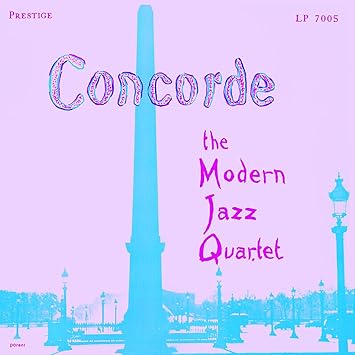
It's an album that's mostly standards. Perhaps in Lewis's mind, the group already had one foot out the door, so they were saving original material for Atlantic--although in fairness, the MJQ tended to be standard-friendly until later in its career, and the first Atlantic album only had three originals. The originals are Jackson's "Ralph's New Blues" and Lewis's title track. I'd wondered if "Ralph's New Blues" was a tribute to Ralph Ellison -- I'd sort of hoped it was -- but appears to be for jazz critic Ralph J. Gleason, which is pretty good too. It's built on an irresistibly bluesy riff, and is the catchiest number on the record.  "Concorde" is another Francophile nod from Lewis, and inspired the Eiffel Tower cover of the album. It has a richness of tone, a catchy melody, and an uptempo swing.

Lewis and Jackson know how to sustain a note for dramatic effect, and they know how to let loose a torrent of notes. But as always, the the MJQ is a quartet, not a leader and sidemen, and you're always aware of the contribution each member is making to the sound.

"Softly as a Morning Sunrise" was released as a two-sided 45. The album's initial release, as noted, was the 12-inch LP.


Friday, July 31, 2015

Listening to Prestige Part 135: Modern Jazz Quartet

I've mentioned that the MJQ was formed in part out of John Lewis's dissatisfaction with the head-solos-head format that had become ubiquitous in bebop, and this recording session, in its own unique way, is a break from that format, in that it's solo-solo-solo-solo.

Well, not exactly. But perhaps Lewis, in his own way, is simultaneously playing tribute to the classic bebop form and standing it on its ear.  "La Ronde" in a shorter version was part of an earlier MJQ session. The shorter version was a reworking of an earlier Lewis composition, "Two Bass Hit,"originally composed for the Dizzy Gillespie orchestra. The newly Europeanized title -- La Ronde is a fin de siecle play by the Viennese playwright Arthur Schnitzler -- is in keeping with the European classical -- and particularly Francophile -- overlay that Lewis was putting on American bebop. Under either title, it's a good piece, and as "Two Bass Hit" it's become a jazz standard.

As "La Ronde," it makes more sense in its extended suite version. The Schnitzler play is a tag team
series of sexual encounters, and "La Ronde Suite" is a sort of tag team, as well. It's in four sections, with each section featuring a different member of the group in an extended solo.

Kenny Clarke is the drummer for the "La Ronde Suite," and it was his last recording with the group. By their next session, in July, Connie Kay had replaced him.

Most people think of Kay as the quintessential MJQ drummer, and with good reason. He was with them for 40 years. He was a perfect ensemble drummer, in a group that emphasized the ensemble sound. Clarke was one of the innovators of bebop drumming, and like his fellow pioneers Max Roach and Art Blakey, he was much more of a soloist. "La Ronde Suite" would have been different without him.

"La Ronde Suite" was first issued on a 10-inch, The Modern Jazz Quartet Vol. 2, but it's most famous as part of the MJQ's Django album.


Wednesday, July 08, 2015

Listening to Prestige Part 130: Modern Jazz Quartet

Given the long and illustrious career of the Modern Jazz Quartet, the many amazing recordings they made, and the fact that most people consider the real MJQ to date with the installation of Connie Kay as drummer, it would be hard to point to any one album as their best.

But Django, the album that includes this session, and which has Kenny Clarke on drums, is the one that frequently makes lists of the hundred best jazz albums.

Perhaps it's because this is an almost mythic era in modern jazz. The late 40s (mostly because of Charlie Parker) and especially the 1950s were the time that really defined it.

Or that's one theory. I decided to put it to a test, so I looked at the New Yorker's list of 100 essential jazz albums, and found that 29 of them were recorded in the 50s, or partly in the 50s. There were a few more that I could have counted because they were released in 1960, and so were probably recorded in 1959, but they were albums like My Favorite Things that really belong to the 60s. Actually, a lot of the albums recorded in the 50s were by artists we don't really associate with the 50s, but what can you do? If I left them out, it would mess up my theory. Anyway, here's the list: Armstrong, Ellington, Basie, Benny Carter, Parker, Monk and Coltrane, Tristano, Davis 2, Powell, Mulligan, MJQ, Tatum, Brown/Roach, Vaughan/Brown, Mingus 2, Fitzgerald, Rollins 2, Puente, Sun Ra, Abbey Lincoln, Blakey, Jamal, Brubeck, Witherspoon, Coleman, Dinah Washington, Betty Carter, Sinatra.

Not every great jazz classic is a great composition. Some of the best -- best performances, best improvisations, best damn records -- are based on simple riffs. Look at Dexter Gordon and Wardell Gray's unforgettable "The Chase." Look at "One Bass Hit," from this session. It was written by Dizzy Gillespie for Ray Brown, and it's a showpiece for bass virtuosity -- one that allows a bass to become the lead instrument for an entire piece of music. Here, it allows Percy Heath to show what he can do, and it's delicious.

But "Django" is a great composition. It's one of the most haunting melodies I've ever heard. It carries a touch of the Eurojazz of Django Reinhardt, a touch of the blues, a touch of...well, here's guitarist Jim Hall describing it:
This tune has a beautifully constructed melody. It starts out with a kind of a simple motive in F-minor. Kind of a slightly sad idea for a melody, and then so it's this, and then there's a sequence, which is up a second, except that goes up instead of down. So first, it's this perfect answer and then it continues. It's going into the relative major key, if anybody cares, now it has some surprises. It has a great arrival point, that high G, and then it winds its way down. Almost sounds like he's saying Django's name here. And then the same thing an octave lower. So that's the tune anyway. It has kind of simple chords, but beautiful.
 "Milano" is the third tune on the session. Another beautiful melody, but there's a reason "Django" became the title cut for the album, and a reason why it's the one that's most remembered. They also recorded "I'll Remember April" that day, and it was never released. It's hard to imagine the MJQ screwing up "I'll Remember April" and maybe they didn't -- maybe it was a technical flaw of some sort. In any event, they re-recorded it successfully the following July.


 "Django" was released as a two-sided 45, and the three tunes made an EP, and were included (with "La Ronde") on a 10-inch LP, before the release of the classic 12-inch album which has made so many top 100 lists.

Friday, March 27, 2015

Listening to Prestige Records Part 94: Sonny Rollins / Modern Jazz Quartet

The Modern Jazz Quartet were a fairly rare phenomenon in jazz in the 50s -- a stable group that had a collective name, as opposed to, say the Gene Ammons Septet or the Stan Getz Quartet, which would be Gene or Stan and whoever else was in town for the recording or club date. The musicians had come together as Dizzy Gillespie's rhythm section, and then had become the MJQ -- that is, the Milt Jackson Quartet. As the MJQ1, they were, as far as anyone knew, three guys whom Milt Jackson had gotten together for a gig. As the MJQ2, they were a different entity, but no one knew what. Certainly, no one knew that they would, with one change, be together for the next 40 years, thus becoming not just rare but unique.

So what had Prestige done with them to date?

John Lewis had done a number of sessions for Prestige, starting in 1949 with J. J. Johnson's
Boppers, when he was 29 and already a veteran of the New York jazz world, from his days newly out of the army with Dizzy Gillespie through his work as one of the major contributors to the Miles Davis nonet. He worked with Zoot Sims, with Miles and Sonny. And even after the first MJQ session--it was pretty clear how good these tunes were, and it had always been clear how good these musicians were, but there was no hint that they were to become. probably rivaled only by the Dave Brubeck Quartet, the most legendary sustained unit in the history of jazz. Yes, there have been other legendary units, like the Miles Davis quintet of the 50s, but that group was only a small part of Miles's career, and only a small part of Coltrane's. So they went on working. Lewis and Kenny Clarke worked on one Prestige recording date with Miles, Lewis and Percy Heath on another. Heath also played on the Miles and Bird (Charlie Chan) session. And they did sound good together, no doubt about it. The three of them were brought in to back up King Pleasure and the Dave Lambert Singers, and the quartet was brought in for a session with Sonny Rollins, and although Rollins was the featured performer on the gig, the Modern Jazz Quartet was credited as such. This would change, a few years later, when Atlantic would bring out The Modern Jazz Quartet at Music Inn, Vol 2 -- guest artist, Sonny Rollins.

The Atlantic album has been in my collection since the 50s, but I'd never heard this earlier collaboration before. It's a fascinating one. This is definitely a Sonny Rollins session, but it's definitely MJQ, too. This is probably the first time all four of them had worked as the MJQ with another artist, and it's an experiment worth listening to.These guys knew how to play together as a rhythm section, and they show that here. But they also knew who they were, and they show that here, too. And all five of
them make a pretty convincing argument that bebop is not dead.

They would go on to make enough tunes for Prestige to fill  two 12-inch albums which are no strangers to Greatest Jazz Albums of All Time lists. But before they were legends, they were working musicians playing the gigs that they got -- sort of unlike the Brubeck Quartet, who pretty much made it clear that they were legends to begin with. And working musicians like these are always worth listening to. 

These came out on 78, 45, EP, 10-inch and ultimately 12-inch LP.


Friday, March 06, 2015

Listening to Prestige Records Part 89: Modern Jazz Quartet

The 1956 12-inch LP that contained this session, Django, was in my collection and on turntable a lot. I don't remember when I bought it -- certainly not 1956, because I wasn't listening to jazz that early. Probably 1959 or so. By that time, the Django LP had been out long enough to become a classic, and the original releases on 10-inch, 45 and 78 had been out even longer, so I don't know what the first critical reaction was. I'm guessing they hadn't heard anything quite like "The Queen's Fancy" before.

But they had, really. It's still Dizzy Gillespie's rhythm section, guys who'd been around since the birth of bebop, guys who were present at the creation of modern jazz and were playing modern jazz--who had, in fact, even named themselves after modern jazz. And if "The Queen's Fancy" starts out with a fugue that could have been written by Bach, why not? The musical tradition that these great musicians came out of was everything that came before them, the music they were looking to make was everything that lay ahead. Dale Turner, the fictional jazzman played by Dexter Gordon, surprises his French host when he acknowledges his debt to Debussy, but there should be no surprise there, either, any more than a debt to Louis Armstrong, Russian Jewish immigrant composers, or the blues. Duke Ellington was exactly right when he said that there are only two kinds of music, good and bad.

So these beboppers developed something beautiful. Tadd Dameron said it always has to be beautiful, and Lewis, Jackson, Heath and Clarke knew that too. They made beauty out of a fugue, and out of a bebopper's tribute to the hot jazz of the Hot Club of Paris, and out of compositions by Vernon Duke and George Gershwin -- transforming beauty into beauty, which may not sound alchemical, but it surely is.

You take what you know, and take it somewhere new. If you're like John Lewis and his cohorts, you know a lot, and you can see the road ahead with clarity and excitement. I interviewed the poet Billy Collins some years ago, and he described what he did as “a kind of travel writing, a genre in which the poet can take the reader on vicarious trips to places that may be otherwise inaccessible...[I find] a common ground that the reader and I can both stand on...and try to deliver pleasure by taking the reader into a state of suspended animation, where the subject matter is left behind, and other explorations begin." The Modern Jazz Quartet does something very similar, and for that experience to be happening for the reader/listener, it has to be happening for the artist as well, whether that artist be a poet like Collins, a composer like Lewis, a master improviser like Milt Jackson.


This comes from a total involvement with your art. Larry Audette, himself a fine jazzman, told me of a conversation he recently had with Tootie Heath about his brother. Percy, on his deathbed, was still listening to music through headphones. Finally, when it was time, his wife took the headphones off, and he slipped quietly away.

"The Queen's Fancy" and "Autumn in New York" were released as a 45 RPM single. The other two songs weren't, although all were released on 78, in a different configuration -- "The Queen's Fancy" b/w "But Not For Me," and "Delaunay's Dilemma" b/w "Autumn in New York." Odd to think that in 1953 the 78 was still the dominant format, but 78s lasted well into the 50s. According to the Yale Library's guide to music cataloging, the 78 was pretty much phased out by 1955, although there's no exact record of the last 78 to be issued -- in fact, according to Yale, some children's records came out on 78 as late as the 70s. I bought my first record in 1954. I was 14, and it was rock and roll -- "Bazoom," by the Cheers, the first rock and roll hit by Jerry Leiber and Mike Stoller, whose songs I would come to worship with a passion. I think that by the end of that summer, I was buying more 45s than 78s, and by the next year nothing but 45s, so my personal history pretty much tracks the Yale Library, The four songs also came out on a 45RPM EP, which seems to have been a form favored early by Prestige, before they'd really embraced the 45 RPM single. There was a 10-inch LP, and then the classic Django in 1956, and many later repackagings and reissues.