Showing posts with label Ed Thigpen. Show all posts

Saturday, July 23, 2022

Listening to Prestige 633: Oscar Peterson


LISTEN TO ONE: Tin Tin Deo

 Between 1964 and 1971 Oscar Peterson made a series of live recordings in Germany at the home of his friend Hans Georg Brunner-Schwer, before a small invited audience. The series as a whole was called Exclusively for My Friends. Brunner-Schwer began releasing them in Europe on his own label, MPS Records, in 1968, and he licensed the first two of them to Prestige for American distribution, which is how Peterson, normally exclusive to Verve and other Norman Granz labels, came under Bob Weinstock's aegis. Which is nice for a follower and chronicler of Prestige, because it gives me the opportunity to spend some time listening to the most acclaimed piano player of his era, perennial poll winner, accumulator of a dizzying number of awards, all of these laurels richly deserved.


The Brunner-Schwer sessions were mostly trio recordings (one is solo piano) made during Peterson's various European tours, so his supporting cast varies, but is always first rate. Peterson's long-term trio with Ray Brown and Ed Thigpen was nearing its finish, but it was still together for the first of these concerts for friends.

Brown had been with Peterson since 1950. As a teenager, he had already found steady work around the Pittsburgh area, but in 1945, when he graduated high school, there was only one place for a young jazz musician with progressive ideas, and that was New York. He bought a one way ticket, and it might just as well have said on it Destination: 52nd Street. He knew Hank Jones, Jones brought him to Dizzy Gillespie, and Gillespie hired him on the spot.

As instant a click as there was with Gillespie, Brown clicked in the same way with Oscar Peterson. He also clicked, musically and otherwise, with Ella Fitzgerald. Musically, their union was a success. Otherwise...they divorced in 1953, after six years of marriage, though they continued to work together.

 Their original trio was piano-bass-guitar, with first Barney Kessel and then Herb Ellis as the third musician, When Ellis departed in 1958, they decided that he was irreplaceable, so they wouldn't try. They would hire a drummer instead, and that's when Ed Thigpen came aboard.


Thigpen had drumming in his genes; his father had been the longtime drummer for Andy Kirk. He brought an impressive list of credentials to the Peterson trio, including quite a history with Prestige, and he would go on to a distinguished career after, including several years with Ella Fitzgerald (no marriage, though).

They would both be moving on not long after this--there would be only one more trio album, that one live from a concert hall in Copenhagen. This session captures them at the peak of their creative and collaborative powers, featuring the standards that Peterson excelled at, a ballad composed by Billy Taylos ("Easy Walker"), and an excursion off the beaten track, "Tin Tin Deo." Composed by the legendary percussionist Chano Pozo, it was first recorded by Pozo with James Moody, and most famously by Dizzy Gillespie. Peterson's trio essays it without Latin percussion, but Peterson's piano is rhythmically tricky, and rhythmically persuasive enough to be completely satisfactory.

Encouraged by the live and intimate audience, Peterson gives a persuasive demonstration of why led all those polls for so many years.

The 1968 German LP was the result of two different house concerts at Brunner-Schwer's home, the first in late 1963, the second in May of 1964. It was entitled Action. The Prestige release, the following year (the year Peter Fonda's Easy Rider was released) was called Easy Walker. Brunner-Schwer produced.


Tuesday, April 27, 2021

Listening to Prestige 564: Gene Ammons


LISTEN TO ONE: Blue Coolade

One of the many sessions Gene Ammons crammed into this period between incarcerations, this one is notable for having Mal Waldron on piano, which also meant the inclusion of some Waldron compositions, which are always welcome. Waldron wasn't playing much in 1962. Like Ammons, he was deep in thrall to heroin, leading to a complete breakdown in 1963. Fortunately, he recovered,and then opted for the expatriate life in Paris, where he was able to recover his health and his career.

Waldron could and did write for anyone, and here he is right up Ammons' alley, with compositions


tailored to his rhythm-and-bluesy accessibility, his ability to make the most of a groove, and his musical inventiveness. The tunes he brought to this session are "Light'n Up," "Short Stop," "Salome's Tune" and "Blue Coolade." There was good reason for Ammons' popularity. He played real jazz, and he played for the people. And Waldron caught all of that.

This session was broken up and parceled out to two albums: Velvet Soul ("Light'n Up," "Salome's Tune," "A Stranger in Town), and Sock! ("Short Stop," "They Say You're Laughing at Me," "Blue Coolade"). Both albums were released in 1964, after Ammons had begun his second prison sentence. "You Go to My Head" and "It's the Talk of the Town" were on a third album, 1965's Angel Eyes, as Bob Weinstock parceled out Ammons' releases over his incarceration period to keep his reputation alive with the jazz public. "A Stranger in Town" came out as one side of a 45 RPM single, with "Velvet Soul" on the flip side. Esmond Edwards produced the session.


Friday, February 10, 2017

Listening to Prestige 242: Webster Young

There's no one who didn't, and doesn't love Billie Holiday, but few with the devotion of Webster Young. In fact, Billie Holiday may have saved his life. Don Alberts, in his book Diary of the underdogs: Jazz in the 1960s in San Francisco, described this episode:
Young trumpeter Webster Young loved Billie Holiday. He knew all her tunes and he could sing the lyrics. Once in Los Gatos at Lorraine Miller's house, Webster was invited into the peyote experience. He was curious and he accepted. The hallucinogenic qualities of peyote cactus are legendary and the comfort mode can go either way. With Webster it may have been disquieting and he became immediately silent, he said nothing to anyone. He listened to Billie's records over and over all that night without moving from a cocoon position in front of the stereo. Billie's voice seemed to gve him peace, help him hold onto reality.

This is an unusual glimpse into the life and psyche of Webster Young. It's surprising that he was out in San Francisco in the 60s, even more surprising that he took this walk on the wild side. One thinks of Young leaving the dangers of Manhattan jazz life behind him, going back to Washington. DC, and beginning his second career as an educator, which would occupy the rest of his life.

But maybe there was a detour. There's Alberts' story, which takes him out to San Francisco, and there's a 1961 three-volume live recording of a tribute to Miles Davis, about which not much is known, but it was made with St. Louis-based based musicians, so that may have been another stop for him.

Davis was his chief influence on the trumpet, but not his only one. As a boy, he corralled Louis Armstrong backstage at the Howard Theater in Washington and convinced the trumpet legend to give him an impromptu lesson. Hearing Dizzy Gillespie for the first time drew him toward bebop. But Miles was the one who took him under his wing in New York, and on For Lady he plays a cornet loaned to him by Miles.

For Lady is one composition by Young, dedicated to Lady Day, and five songs closely associated with her. Of course, the musician most closely associated with Holiday is Lester Young, and for this session, Webster Young does the next best thing and taps Paul Quinichette, the Vice Pres, as his partner. As Marc Myers notes in his JazzWax blog,
What's particularly interesting about this album is you get to hear what Miles Davis and Lester Young would have sounded like had they recorded together in the studio in the '50s. Webster Young's blowing here is often with a mute, and his pacing is distinctly in the manner of Davis. Joining
him on tenor sax was Paul Quinichette, whose playing was a traced sketch of Lester Young's laid back and languid blues-saturated style. 
You don't necessarily associate the guitar with Lady, but Joe Puma fills out the sextet, and does some excellent work, particularly on "Good Morning Heartache." Mal Waldron, who had just started working with Holiday and would be her accompanist for the rest of her career, surrenders his composing duties to the songsmiths associated with her, including herself (with Arthur Herzog) for "God Bless the Child" and "Don't Explain." Ed Thigpen was a frequent occupant of the drum seat on Prestige recordings of this era. He was also working with Billy Taylor, and brought Taylor's bassist Earl May along for this session.

For Lady was Young's only studio session as a leader.

Sunday, January 29, 2017

Listening to Prestige 238: John Coltrane - Paul Quinichette

In general, I try not to look ahead, but to consider one recording session at a time. This isn't exactly a rule, but it's a general preference, and in this case, it's one that I held to. In my last blog entry, on the Mal Waldron sextet with John Coltrane, I wondered if one could chart the seeds of progress toward the revolutionary changes to come -- Giant Steps, My Favorite Things, A Love Supreme, Ascension. And now, in the very next session, or perhaps a continuation of the same session, since they happened on the same day, Trane is paired with swing giant and Lester Young acolyte Paul Quinichette.

So--is Coltrane moving on a steady course toward a more advanced, avant-garde approach to music? Or how about this for an alternate question -- did Trane ever care about that? In 1961, during his Impulse years, when we was making his most advanced music, he recorded an album of ballads, and two years later, in 1963, he collaborated with Billy Eckstine acolyte Johnny Hartman on another album of standards. Coltrane was one of the most important developers of modal jazz, the definitive break from the improvisation around chord changes that was the hallmark of bebop, but his best known modal album--probably his most popular album of all time--was built around one of schmaltz kings Rodgers and Hammerstein's schmaltziest songs. and if he didn't exactly deliver it in a brown paper package tied up with string, he certainly knew that was where it came from.

In other words, Coltrane moved wherever the spirit moved him, and if it moved him to find a groove with the Vice Pres, that's what he was going to do. And there's no star heirarchy in this session. It's two cats blowing together, and finding that groove, and sharing the experience. Neither of them concede anything stylistically, and neither of them has to--Coltrane with a hard-edged, driving sound, and Quinichette sweeter and gentler. It really does give you a sense of what it would have been like if Trane and Lester Young had ever played together, especially on "Cattin'."

Again, Mal Waldron is called upon to supply most of the music here, with four originals and some wonderful solos--again, especially on "Cattin'."

I should, if I haven't recently, stop and give credit to the anonymous scholars who have created so many Wikipedia pages for individual albums. That's where I get most of my information on composer credits for jazz originals, hard to come by anywhere else on the web.

All the tunes from this session except "Tea for Two" came out on album called Cattin' with Coltrane and Quinichette, which for some reason was delayed a couple of years before release. "Tea for Two," where Quinichette takes the lead, eventually surfaced on the Body and Soul compilation album on Status that seems to have handled a lot of the overflow from other sessions.


 Order Listening to Prestige, Vol. 1 here.

Friday, January 27, 2017

Listening to Prestige 237: Mal Waldron

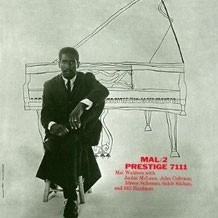
This is the second of two sessions featuring Mal Waldron and a sextet, with basically the same instrumentation but different players. Idrees Sulieman and Sahib Shihab replace Bill Hardman and Jackie McLean, with Shihab doubling on baritone sax.

One of my real joys in the recent era of Prestige releases has been a rediscovery of Mal Waldron. I knew him as a pianist, but I hadn't realized the extent of his contributions as a composer. Virtually every Prestige album he's appeared on has featured at least one of his compositions, generally more, and they've all been striking.

Interestingly, of the three tunes on this session, only one is his. The other two are standards by outstanding composers: Jerome Kern ("The Way You Look Tonight") and Cole Porter ("From This Moment On"). So he wasn't afraid to match himself up against the best. Nor would he need to. All three of these cuts are stellar.

At this point, any Prestige session involving John Coltrane is as important in the history of John Coltrane as it is in the history of Prestige records -- and there will still be a few more. Coltrane left Prestige for Atlantic in 1960, and recorded the groundbreaking Giant Steps. That album, Miles Davis's Kind of Blue, and Ornette Coleman's first albums changed jazz.

And as Giant Steps was a break from jazz past, it was
a break from Coltrane past. So these 1956-59 albums are important because they show the development of one of the most important talents in jazz, as he distinguished himself from the rest while still working within the context of the jazz of that era, whether you call it hard bop or anything else. Can we hear the seeds of the change to come? I'm not good enough to answer that. I know that when I first heard Giant Steps, it sounded like nothing else I'd ever heard.

Meanwhile, here's Coltrane with two other fine horn players, and I love what they do together, especially Coltrane and Sulieman. And with Mal Waldron. If it's a couple of steps short of Giant Steps, it's still important music, and it's an important part of the Mal Waldron story.

The three cuts from this session became part of Mal-2, issued under Waldron's name. They were never specifically rereleased under Coltrane's name, as were a lot of the Prestige sessions Trane took part in,


 Order Listening to Prestige, Vol. 1 here.

Monday, January 23, 2017

Listening to Prestige 234: Paul Quinichette

The name of the group, on the session list, is Paul Quinichette's New Stars, and it lives up to its billing. Even Quinichette, while not altogether a new star, is new to Prestige, and pretty much new to recording in a bebop context. He's not new to recording, having led his first session in 1951, and even when he was new in that context he wasn't altogether new, being 35 years old and with a fairly impressive career behind him, from Jay McShann to Johnny Otis, Louis Jordan, Lucky Millinder, Hot Lips Page, and most notably with Count Basie, where he became known as the Vice President, because of his stylistic similarities to Lester Young, and of course because of taking the lead tenor sax chair in the Basie band. And his debut album with Prestige, with a new label and really a new approach, came when he was 41.

You don't play with bandleaders like McShann, Otis and Jordan without learning something about the importance of entertaining people, and as Quinichette began his association with boppish Prestige, he brought that background with him. Prestige had been started by 21-year-old Bob Weinstock after he had been jolted out of his trad jazz fandom by a Thelonious Monk 78, and his first recording session featured Lenny Tristano, so he was no stranger to the cutting edge of jazz experimentation. But he wasn't afraid of feel-good music either, and both of these tastes are what gave Prestige its vitality and importance for so many years.

Quinichette, on this and subsequent sessions with Prestige, worked in that genre that I've called, writing about artists like Zoot Sims, swing-to-bop (which was also the title of a classic cut by perhaps the original swing-to-bopper, Charlie Christian). The early boppers, of course, came out of the swing bands, but by this time, the young modern players had grown up on bebop. So it's interesting, instructional, and basically just plain delightful to hear a veteran like Quinichette with this group of New Stars.

Of the new stars, the rhythm section isn't entirely new, but is of the bebop-bred generation.

Mal Waldron was the oldest at this point, at 32, but his whole career had been with the moderns. He did begin with Ike Quebec in 1952, but soon moved to Charles Mingus, and aside from a very important stint with Billie Holiday (1957-59) always worked in a modern and even free jazz idiom.

Ed Thigpen was five years younger than Waldron, but came from a traditional background--his father was the longtime drummer for Andy Kirk's Clouds of Joy, and he was perhaps best known for his work with Oscar Peterson, Billy Taylor and Ella Fitzgerald.

Doug Watkins was still only 23, and had made his Prestige recording debut just a year earlier, with Jackie McLean (and in 1955 on a live album with Art Blakey), but he was already a veteran of some 20 sessions on Prestige alone.

John Jenkins had played on a couple of recent sessions (and was also brought up modern, starting out with Art Farmer and Charles Mingus), but he was still a pretty New Star, and Curtis Fuller and Sonny Red were the newest of the New.

Sonny Red was 25, and this seems to have been his debut on record. He was active through the 50s and 60s, never really breaking through as a major figure, but doing some good work. Curtis Fuller was two years younger, one of the Detroit guys, and did go on to make a significant name for himself. They would both come back the day after this session to record under Fuller's name, so I'll hold off saying much more about them, except to note that each of them were at one point caught up in the twin-instruments thing I got into in my last post. Well, not really. Sonny Red is featured on an album called Two Altos, and it has a picture of two altos on the cover, and the names Art Pepper and Sonny Red, but it's actually two completely different sessions, done at different times on different sides of the country. Curtis Fuller...another J.J. and Kai? Blue Note apparently thought so. They recorded him and Slide Hampton as the co-leaders of a quintet in 1958. And then apparently thought better of it, as the session went unreleased until 1980 in Japan, and 1996 in the USA.

So here we have veteran Paul Quinichette with the young cats, and with a young composer - three tunes by Mal Waldron, along with two standards, and the results are uplifiting. Someone calling himself GastonBulbous has posted "Blue Dots" on YouTube, and describes it as "a head by Mal Waldron that cleverly bridges Quinichette's origins as a Basie-ite with the more beboppish ambitions of his sidemen." It's that and more. The head is Waldron's modern-style take on a McShann or Otis-type head, and solo work, taking Quinichette's cue, is joyous swing-to-bop. All of it wonderful, but you can't help but be particularly caught up in Quinichette's solo, and Waldron's brief one at the end.

Bob Weinstock must have been as struck as I was by the infectiousness of "Blue Dots," because he released it as a 45. The album was called Paul Quinichette on the Sunny Side. The British Esquire release has the same title and the same frying pan, but adds "the Vice Pres" to Quinichette's name. The 45 changes the listing of New Stars to the familiar Prestige All Stars. It was released later, so presumably the stars weren't quite so new any more.


 Order Listening to Prestige, Vol. 1 here.


Monday, September 05, 2016

Listening to Prestige 205: Prestige All Stars

Two groups of Prestige All Stars in two days, with only Art Farmer in common--and, curiously, Ed Thigpen. Thigpen's only previous Prestige connection was three sessions with Gil Mellé--although, like another Mellé-to-Ammons handoff, George Duvivier, he would be making funk for earth people with the Prestige funkmaster Gene Ammons in the early Sixties. Were it not for the fact that Thigpen hadn't been on Mellé's session of the previous Friday at Rudy's, one might have guessed that maybe this session had been plotted there, because both Farmer and Hal McKusick were holdovers.

Perhaps "Prestige All Stars" wasn't the best marketing strategy, since this first album is virtually nowhere to be found. Nowhere online. You can buy it from Amazon for $189, which is really weird considering that this isn't even for the vinyl--it's for the CD! And weirder yet, when you consider that you can buy the Complete Kenny Burrell 1957-62, on four CDs, including all the tunes from this session, for $11.99. It's a great lineup, and I wish I could say more about it.

Farmer is back again the next day with a different lineup, this time All Star regular Donald Byrd and All Star newcomer Idrees Sulieman, who'd done Prestige sessions with Mal Waldron and Joe Holiday: Three trumpets! Well, why not? They'd done well with two trumpets on the first All Stars session.

And they do damn well with three, here.

There's an excellent documentary by Stevenson Patti about his attempt to organize a concert featuring three New Orleans piano legends, Tuts Washington, Professor Longhair and Allen Toussaint, titled after a quote from one of them, Piano Players Rarely Ever Play Together. And this is mostly true, due to the unlikelihood of there being more than one piano at any given venue. There are exceptions, of course. We presented Dave and Don Grusin together at Opus 40, with two grand pianos out on the sculpture. The pianos were provided by Yamaha, who told us afterwards that it was the hardest moving and setup job they had ever done. And Daffy and Donald Duck have a memorable piano duel in Who Framed Roger Rabbit? 

But it's much easier to get two or three players of a portable instrument together. J. J. Johnson and Kai Winding achieved their greatest success when they put two trombones together, and although two of the same instrument is not a rarity, it's a little rarer when both the instruments are trombones. Rarer is a group with four of the same instrument, but the World Saxophone Quartet put four saxes together. Even rarer is a group with six of the same instrument, and perhaps even rarer than that is a group composed of multiple tubas, so a rarity of rarities would be Howard Johnson's group Gravity -- six tubas and a rhythm section.

And of course, there was a time when this none of this was at all unusual--the big band era, with its horn sections. And one of those horn sections became particularly famous--Woody Herman's Four Brothers, who would go on to record in a small group setting for Prestige as Five Brothers: Stan Getz, Al Cohn, Zoot Sims, Alan Eager and Brew Moore.

More commonly, in a small group, you'll have representatives from different instrumental families, just as the balanced dinner (in those days) contained representatives of the Four Major Food Groups. Perhaps this was because the archetypal, legendary (even though it was real) bebop ensemble featured Charlie Parker and Dizzy Gillespie. Perhaps it was because for the casual listener, with two or three different instruments as the front line, it was easier to tell who was playing at any given time. Scott Yanow, in his review of the Five Brothers session, admits that with five young Lester Young acolytes, it's hard to tell who's playing what.

Ira Gitler, in his liner notes to many Prestige albums, would list the order of soloists on every cut, and while this may have been a source of mild ridicule for jazz adepts, it was very useful for the casual fan striving to become more than a casual fan.

But I would think a session such as this one must have been very rewarding for the players: three guys using the same tool but finding individual approaches to improvised music, and all starting from the same melody--in this case, original compositions from each of them. And while I am one of those who really can't tell who's playing what part, I can certainly appreciate how one trumpet follows another, with a new approach, a new tonality, These three musicians are pushing and inspiring each other in a way that is perhaps unique to the situation of three or more soloing on the same instrument.

They share the composing chores too, with Sulieman contributing two tunes ("Palm Court Alley," with its opening Charlie Parker lick, and "Forty Quarters"), Farmer ("Who's Who") and Byrd ("You Gotta Dig It to Dig It") one each.
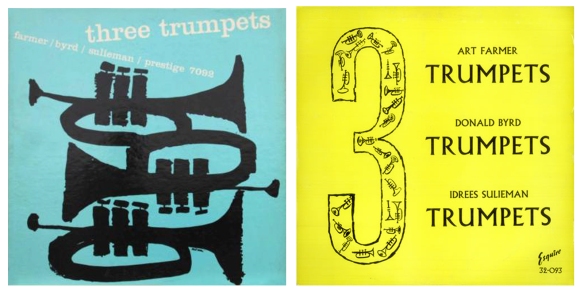
The Prestige cover, and the British Esquire label cover. From the
London Jazz Collector: "Uniquely among US overseas releases, Esquire
Records were pressed in the UK with original US supplied stampers and
not re-mastered locally, so are sonically the same as Prestige,  in most
cases showing van Gelder stamp and originating US matrix and
plant codes. What differs are the alternative covers, a mixture of quirky
native whimsy, kitsch graphics, alternative duotone colourings, and line-
drawings based on the originals: sometimes you can see the original
as inspiration, while others clearly start with different cultural reference
points, the denizens of London’s smoke-filled Soho clubs and  52nd Street
New York, two jazz-loving  communities separated by only  approximately
 the same language. Potayto, pottato. That is one of the things that
make Esquire covers so intriguiging.

The fifth number, "Diffusion of Beauty," was written by Hod O'Brien, who was a newcomer to the Prestige orbit, and did not remain in it for long--I think this is his only Prestige recording. O'Brien is one of those guys who successfully balanced dual careers. After playing with Oscar Pettiford, J. R. Monterose and others in the 50s and early 60s, he got a degree in psychology and mathematics from Columbia, and worked in statistical research in psychology at NYU. "Diffusion of Beauty" is the only composition from this session that has been recorded by others.

The album was released as Prestige All-Stars:Three Trumpets, with the names of the three--and only the three--prominently featured on both the American and British covers.


 Order Listening to Prestige, Vol. 1 here.

Tuesday, May 17, 2016

Listening to Prestige Part 185: Gil Melle

Gil Melle is back in Hackensack two Fridays later, once again trying the experiment of adding three horns to his quartet. The added personnel is a little different this time, perhaps because Art Farmer and Julius Watkins were tied up, perhaps because he still wanted to tinker with the septet sound. Certainly he seems to have had no problems with Farmer, because he brought him back for a 1957 session.

Hal McKusick is back, but Kenny Dorham has replaced Farmer, and Don Butterfield's tuba is in for Watkins's French horn. The result is weirder, and arguably better. Art Farmer brought his own brand of magic to the ensemble, and when he soloed, it became an Art Farmer session. And Lord knows, there's nothing wrong with that. But Kenny Dorham seems to grasp Melle's unique sensibility right away. McKusick has really learned it by this time, and the two of them move from ensemble parts to solos with a full grasp that this is going in a different direction: not a bebop session, or even a hard bop session. That perhaps it's more akin to something that doesn't exist yet: the electronic music that Melle will go on to create.

Don Butterfield for Julius Watkins, tuba for French horn, is an interesting choice, and an inspired one.
Melle had set a deep bottom with his baritone sax, but Butterworth goes deeper and fuller, and in his solos takes Melle's ideas even farther than Melle does.

Butterfield, by 1956, had made the transformation from classical orchestras (and the orchestrated cocktail music to which Jackie Gleason put his name, but not much of anything else) to jazz, and he became a solid part of the jazz scene throughout the 50s and 60s, with beboppers like Dizzy Gillespie, Art Farmer and Jimmy Heath, with funksters like Jimmy Smith, with experimenters like Charles Mingus, Teddy Charles and Rahsaan Roland Kirk, with one-foot-in jazz composers like David Amram -- and I suppose Gil Melle could be included in that last category. In any event, his contribution to this album is inestimable.

All three compositions are unique. Each finds its own direction, and the musicians all find their way along each path. "Sixpence" has actually a sort of head-solo-solo-head structure, but it's not exactly your Uncle Charlie's head-solo-solo-head structure, nor do the musicians treat it as such.

This session completed the tracks for what became the Gil's Guests album. He would record one more album for Prestige, again in two separate sessions, one with guests and one without, and the session with guests was added to the later CD reissue.


Order Listening to Prestige Vol 1: 1949-1963 from Amazon.

Friday, May 06, 2016

Listening to Prestige Part 183: Gil Melle

Art Farmer shows up for an afternoon with the usual Fridays at Rudy's gang to find...

What???

Yes, this is a different sort of Friday. And you have to wonder if this is exactly what Gil Melle was expecting, for that matter, from the name hung on the ensemble. Here's the quartet, and what exactly are we going to do with these other guys?

He probably wasn't taken by surprise. Art Farmer may have been a Rudy's regular, but Julius Watkins and Hal McKusick weren't. In any case, whether he came prepared or had to arrange on the fly, he came up with some interesting arrangements, particularly on "Block Island."

As a baritone sax player, Gil Melle was no Gerry Mulligan. If anything, he was Mulligan's renegade stepbrother. He was probably more interested in the tonal qualities of the baritone sax than he was in improvisation. So how is it that the arrangement on "Block Island" sounds so much like Mulligan? Or the bizarro Mulligan. Or Mulligan's evil twin.

All the musicians on this session are good. One of the things we have Melle to thank for, in addition to The Andromeda Strain, would be giving Joe Cinderella a chance to be heard on one of the important jazz labels.

Vinnie Burke is the newcomer to Melle's quartet. Burke was a solid professional, a guitarist/violinist who had taken up the bass after mangling his little finger on the assembly line at a munitions factory. Through the 40s and 50s he played with a range of musicians, many of them, like Bucky Pizzarelli, the Sauter-Finnegan Orchestra and Marian McPartland, on the not so far out end of the scale. Of course, the same was true of Ed Thigpen, and both of them worked well with Melle. Burke's career would extend well into the 80s, and he could always get work.

Hal McKusick got his start with two bandleaders who were more forward-thinking than a lot of their 1940s dance band contemporaries, Boyd Raeburn and Claude Thornhill. They may have given him a taste for challenging assignments, because he went on to work with the likes of Gunther Schuller,
George Russell, Lee Konitz and John Coltrane. He also co-led a group with Bill Evans in 1958.

But the top soloist here is Farmer. Melle gives him his head, and he contributes some remarkable stuff.

These three cuts went onto an album called Gil's Guests, which also featured, in later sessions, Kenny Dorham, Don Butterfield and Zoot Sims.


Sunday, February 21, 2016

Listening to Prestige Part 173: Gil Melle

Gil Melle is probably best known to jazz history as the guy who introduced Rudy Van Gelder to Blue Note's Alfred Lion. The session never made it to wax, but the recording quality was good enough to draw Lion, and then Bob Weinstock, out to Hackensack.

Melle did eventually record several albums for Blue Note, and a few for Prestige, starting with this one, recorded in two sessions. I wasn't able to listen to any of the April tracks, so I'm getting to the whole album here.

Melle was multi-talented, a graphic artist as well as musician.
Album cover art by Gil Melle
His work was shown in New York galleries, and he designed a number of jazz album covers. His career at this time could be compared to that of Pop artist Larry Rivers, but Rivers was an artist first and a jazz hobbyist; Melle's main focus was music, although he also continued to paint  all of his life, and he eventually moved to the West Coast, where he launched a successful career as a composer of film and TV scores, including The Andromeda Strain and Rod Serling's Night Gallery. The theme music for the 1970 TV show was the first ever to use all electronic instrument, and The Andromeda Strain, in 1971, was probably the first all-electronic movie score.

This quartet session for Prestige uses all traditional instruments, but listening to it, it's not surprising that Melle would grow fascinated with electronic instruments, designing and building many of them himself, and presenting the first ever all-electronic jazz ensemble at the 1967 Monterey Jazz Festival. He's more concerned, especially in "Dominica," with tonal quality, and at first listen, one wonders if he's trying too hard, and intellectualizing the process too much.

On subsequent plays, however,the music becomes much more rewarding, and the ensemble is remarkable.

It's also a little puzzling. The Jazzdisco set list has Melle playing baritone and alto sax, and Bill Phipps playing bass. But Phipps was a baritone sax man, so it could be that he is, in fact, the one on baritone. If he's not, Melle is double-tracking himself, and given his interest in electronic sounds, that's certainly possible. but I think not likely.

So let's give Phipps the credit for some intriguing baritone sax work,  and move on to him, as one of an ensemble of little-known (except for Ed Thigpen) and fascinating musicians.

Except for his work with Melle, Bill Phipps wasn't much of an avant-gardist, although he did once lead a band that featured Grachan Moncur. In fact, he came from a jazz family that was deeply rooted in the tradition. His cousins Ernie and Eugene led a band called the Monarchs of Swing. He and his brother Nat cp-led the group that featured Moncur and Wayne Shorter, and Bill later played with such earthy ensembles as Ray Charles' and Brother Jack McDuff's.

But here with Melle, he understands the demands of the avant garde, and delivers.

Joe Cinderella delivers more than his share, especially on "Ballet Time," my favorite of the set. It also has Melle's strongest soloing.

Where did Melle come up with these guys? Every one of them, it seems, has at least one toe in both the mainstream and avant garde. How avant garde was Joe Cinderella? He worked with John Cage. Avant garde enough for you?  He also worked with Warne Marsh. On the mainstream side of jazz, he worked with Conte Candoli, and deeper into the mainstream of American music, he played on sessions with the Beach Boys and Billy Joel. He's pretty much forgotten today, but he's worth seeking out.

Ed Thigpen is certainly the best known musician in this quartet. Mostly known for his mainstream work with Oscar Peterson, Billy Taylor and Ella Fitzgerald, he also played with Lennie Tristano, who is the godfather of the sort of music Melle plays. He's also from a musical family -- his father played with Andy Kirk's Clouds of Joy.

This album was released, for reasons best known to Gil Melle, as Melle Plays Primitive Modern.