Showing posts with label Lloyd Mayers. Show all posts

Wednesday, January 20, 2021

Listening to Prestige 537: Sam Taylor


LISTEN TO ONE: Love Song from Suzie Wong

Anastasia

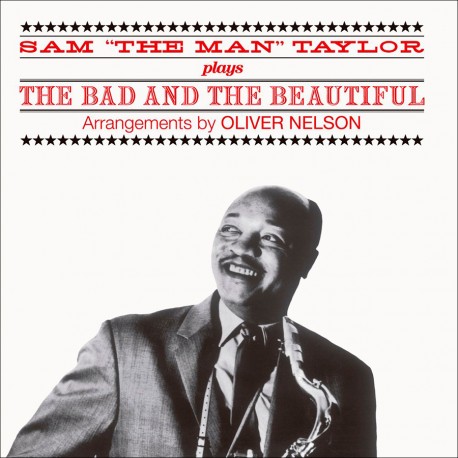
 Prestige adds another rhythm and blues giant to its jazz roster, proving once again that rhythm and blues is a legitimate form of jazz, and that these players fit seamlessly into a more bop-oriented context. Up this time is Samuel Leroy Taylor Jr., known as Sam "the Man" Taylor when he led Alan Freed's stage band, but simply Sam Taylor when he recorded in more respectable settings (similarly, Ellingtonian Al Sears was "Big Al" when he performed and recorded with the Alan Freed band).

Taylor had been something of a pioneer in the sax-organ combo business, having recorded an album with Dick Hyman for MGM back in 1957, with a very different approach from the soul jazz sound that had become popular in 1962. But he


eschews the sax-organ sound here, going instead with a quintet. Pianist Lloyd Mayers's carer spanned decades, and twenty years after this session, he would be named musical director of the Broadway revue of Duke Ellington's music, Sophisticated Ladies. Wally Richardson was a very active session guitarist in those days, with a number of sessions for Prestige. Art Davis, whose reputation as one of the finest bassists of his generation, classical or jazz, was matched only by his social conscience, had appeared on two previous Prestige sessions. And that a classical cat can get down with a rhythm and blues cat is as good as any tribute to the breadth of the language of jazz. And add Ed Shaughnessy to the mix and you have a pro's pro, whose best known gig, with Doc Severinsen's Tonight show orchestra, didn't begin to scratch the surface of his range.


The album's format is a little gimmicky--movie themes that celebrate women's names (or attributes, like "The Bad and the Beautiful," and it was released on Moodsville, which was sometimes accused of being a little gimmicky as a label. But I am here to say I see absolutely nothing wrong with this. It was probably a lot of fun coming up with the gimmick, and then finding the movie themes that would work. This included classics like "Laura," and tunes that had immediate popularity and proved to have legs, like "The Bad and the Beautiful," written by David Raksin and recorded by jazz musicians from Barney Kessel (1957) to Bill Frisell (2016). And a couple of sleepers. "Love Song from Suzie Wong" has never been recorded by anyone else that I know of. It was written by George Duning, a frighteningly prolific

composer with 180 film scores to his credit. In 1960 alone, the year of The World of Suzie Wong, he scored six other movies. But someone had a good ear, and "Suzie Wong" came out well enough to be the 45 RPM single release from the session, with "Anastasia" on the flip side. 

"Suzie Wong" / "Anastasia" was released as a Prestige single, "The Bad and the Beautiful" as a Moodsville single. The album, with the same name, also came out on Moodsville. "Ruby" (written by Heinz Roemheld for the movie Ruby Gentry) was later released on a compilation album for Prestige's budget label, Status, entitled Lusty Moods, and credited to Sam "the Man" Taylor.


Thursday, December 10, 2020

Listening to Prestige 532: Etta Jones


LISTEN TO ONE: Just Friends


LISTEN TO ONE: The Masquerade is Over

Etta Jones probably hit her peak of popularity with Don't Go to Strangers and Something Nice. Scott Yanow, in his review on AllMusic, describes this album as "a too-long-forgotten gem," and Jones herself could easily be described that way. She doesn't make UDiscover.com's list of the 25 greatest female jazz singers, compiled by critic Charles Waring representing a younger generation (although Etta James and Norah Jones do). The voters for Ranker.com, who I suspect are mostly younger, have her at number 24 on the day I checked (this is an ongoing vote, and can change), just ahead of Norah Jones, but considerably behind Etta James. Fortunately, she continued to work, and record companies continued to want her musical stylings, right in the mainstream of vocal jazz and always rewarding. She would do four more recording sessions with Prestige, and she would continue to tour, and perform, and record, her last session (a tribute to Billie Holiday) coming just months before her death from cancer in 2007;

Oliver Nelson was back again with her, arranging two different sessions on two days, the first with strings and the second with horns.


The rhythm section was the same for both dates. Pianist Lloyd Mayers had worked one previous Prestige session, in 1956 with Bennie Green; he would become, in 1981, the pianist and musical director for the Duke (by then Mercer) Ellington Orchestra for the Broadway musical Sophisticated Ladies. Wally Richardson had become an active Prestige participant, appearing with vocalist Betty Roché and with several instrumentalists, most recently Johnny "Hammond" Smith just a couple of weeks prior to the Jones date.  Bob Bushnell brought his bass to a King Curtis session in 1961, but as the decade rolled on he would figure in many more Prestige sessions. And drummer Ed Shaughnessy played across a wide spectrum of jazz groups and styles, before settling into the solid payday of Doc Severinsen's Tonight Show Orchestra.

The string section on day one is unidentified; the horn players of the second day are all Oliver Nelson veterans.

The songs are standards, and they justify the album's title. The sardonic "Makin' Whoopee" doesn't


exactly come from the heart, and it's not Jones's most effective outing, although it's still a pleasure to listen to. "You Came a Long Way From St. Louis," by John Benson Brooks and Bob Russell, also has a wry comic touch, but the wryness is mixed with warmth, and that's more in Jones's comfort zone.

Of particular interest is listening to Oliver Nelson arranging for the same singer, on successive days, with strikingly different instrumentation. Of the songs with strings, I was particularly struck by "Just Friends," a standard that's perhaps best defined by Charlie Parker, also with strings, but has been done by many vocalists. Oliver Nelson gives it a particularly arresting arrangement, starting with a sort of "Wagon Wheels" clippety clop opening, that then gets swallowed up by lush strings. 

For the larger group of songs with horns, it was hard to choose, but I think I'll go with "I'm Afraid the Masquerade is Over," a song that's been done by both Ettas, Jones and James, as well as singers from Sarah to Aretha. The definitive male version is probably George Benson's, and the Cleftones gave it a doowop spin. It's a song that allows for a lot of individuality in interpretation, and Jones and Nelson put their stamp on it, for sure.

From the Heart was a Prestige release, Esmond Edwards producing. "You Came a Long Way from St. Louis" was the 45 RPM single, with "Just Friends" on the flip side.


Wednesday, March 30, 2016

Listening to Prestige Part 176: Bennie Green

I'm guessing that not all that many jazz fans have this record in their collections, and those that do not are missing out on a treat.

Maybe Bennie Green never got his due. One website that makes lists and rankings puts him at #31 on its list of greatest jazz trombonists of all time (Bill Harris, who won several DownBeat polls in the early 50s, is #32). A site called The Trombone Forum has a discussion of the greatest jazz trombone recordings of all time, and Bennie Green is not mentioned by anyone.

This is just wrong. But even so, if you were inspired by my earlier praise, and decided to pick up a Bennie Green album. you probably wouldn't choose this one. You might go for the earlier 1956 session with Art Farmer and Philly Joe Jones. Or the one from 1955 with Charlie Rouse and Paul Chambers, or the one that added Candido to that mix. Or you might go back to 1951 and the session with Eddie "Lockjaw" Davis, Art Blakey and Tommy Potter.

In short, faced with a blind choice of which record to take a chance on, you'd go with the chalk--the sidemen you've heard of.

Don't do it. Well, do it. Those are all terrific albums. But don't overlook this one with the sidemen you've probably never heard of.

Look at it this way. For Blakey or Farmer or even a brand new cat on the scene, 19-year-old Paul Chambers, this was another gig. For these guys, it may well have seemed the opportunity of a lifetime--a small group session on Prestige!

I don't mean that these weren't highly respected professionals. Green didn't pull them out of thin air.

Eric Dixon was 26 when this session went down, and he had a long and productive career ahead of him. He went on to appear, by some counts, on over 200 recordings, including some other small group sessions for Prestige/New Jazz in the 60s: Ahmed Abdul-Malik, Kenny Burrell, Etta Jones and Mal Waldron. But his main gig starting around the turn of the decade and going on for two more decades, including many recordings, was with the Count Basie orchestra. His one record as leader came in 1974, for the Master Jazz Recordings label, and featured both Lloyd Mayers and Bill English.

Lloyd Mayers recorded in the 60s, with Lou Donaldson, Betty Carter, Ray Barretto and others. but his big break didn't come until 1974--and no, it wasn't the Eric Dixon album. Mercer Ellington tapped him to fill the Duke's shoes in the Ellington orchestra. He was musical director for the 1981 Broadway production of Sophisticated Ladies, the musical based on Duke's music.

Sonny Wellesley and Bill English don't have the same extensive pedigrees. Wellesley played on a Blue Note session with Ike Quebec, recorded in 1959, a couple of the tunes released on 45, not released in album form till until 2000. He seems to have played in 1961 with Sir Charles Thompson, but they may not have recorded. I can't find any reference to a record.

Bill English (not be confused with Willie Nelson's drummer Billy English) made one record as leader, for Vanguard, which was primarily a folk label, and probably didn't do much to promote its occasional jazz titles. The jazz collectibles website popsike.com lists it for sale under the heading "Obscure jazz drummer Bill English." Lloyd Mayers played on this one, too. Obscure or no, you can find it on both YouTube and Spotify, and it's good stuff.

So perhaps these guys were playing together when Green tapped them, since they certainly seem to have stayed in touch afterwards. They're tight and simpatico on this session.

So if this was an audition for a big time career, they all passed with flying colors--even if, as with today's law school grads and creative writing MFA's, they didn't all get much professional advancement out of it.

The session starts with "Walkin' (Down)," which is better known without the "(Down)" as the Miles Davis classic. "Walkin'" is credited to Richard Carpenter--not the songwriter with the talented sister. This Richard Carpenter was a gonef perhaps rivaled only by Mo Levy, best known for buying songs from hard-up musicians for 25 or 50 dollars and slapping his own name on them. Sometimes he didn't even buy them. When composer-arranger Jimmy Mundy, best known for his work with the Goodman and Basie bands, died in 1983, a copyright certificate was found at the Library of Congress for a tune called "Gravey." The title, and Mundy's name, had been incompletely erased, and "Walkin'" by Richard Carpenter written over them. Junior Mance, who was with him at the time, has also confirmed that Mundy wrote the song and titled it "Gravey."

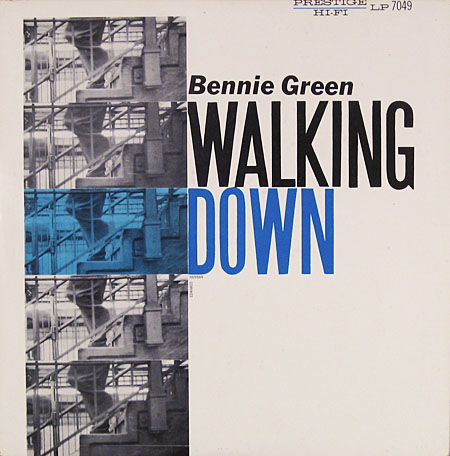
Cover design by Tom Hannan, an abstract expressionist painter
who doubled as a jazz album cover designer.
And this is a good introduction to the session. It begins with a strong drum figure by English,  then a short statement  of the head by Green, then an extended solo by Mayers. Green is generous throughout with solo space: everyone gets an opportunity to show what he can do. "Walking (Down) is also interesting in that about 3 1/2 minutes into it, the two horns seem to be about to come back to the head and wrap it up, but that doesn't happen. Instead, everything changes slightly, and the piece goes on for over 12 minutes. These shifts of tempo and mood happen a few times during the album. It keeps you on your toes.

There's one Green original on the album, the curiously named "East of the Little Big Horn," which seems never to have been picked up by anyone else. Too bad, good tune. And three standards. A favorite cut? It would be hard to choose. "Walkin' (Down) is a contender: it's always a treat to hear Bennie play the blues. But it's hard not to get caught up in the firestorm of traded licks between Green and Dixon on "It's You or No One."

The album takes away the parentheses, puts back the missing "g," and is called Walking Down.