Showing posts with label Quincy Jones. Show all posts

Friday, July 03, 2015

Listening to Prestige Part 128: King Pleasure/Quincy Jones

Every King Pleasure session leaves me with more questions. How exactly did he fit into Prestige's world? How did he fit into anyone's? He has to have been one of Prestige's bestselling artists, but he seems to have been recorded as an afterthought, generally with a rhythm and blues band. This session is unusual in that he has a fantastic array of A-list musicians backing him up, but it also doesn't seem that it was exactly his session.

And we've seen this before, too. In 1952 there's a session by the Charlie Ferguson Quintet. Ferguson didn't exactly become a household word, even in jazz households, although he put together a fine group, including bassist Peck Morrison. And of the eight songs recorded that day, six of them instrumentals, Prestige only released four, and only two of them were Ferguson instrumentals. The other two that did get released featured a vocalist. Yes, it was King Pleasure, and yes, these two have become jazz classics: "Red Top" (also featuring Betty Carter) and "Jumpin' With Symphony Sid."

So here, again. That session is listed in the Prestige discography as "The Charlie Ferguson Quintet" with King Pleasure. For this one, at least Pleasure gets top billing: King Pleasure with Quincy Jones Band. But again, two cuts with vocals, two without.

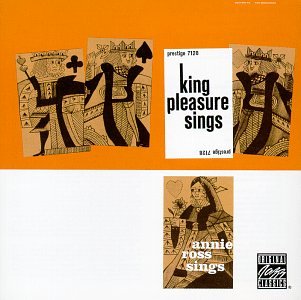
This is the fifth of five sessions Pleasure would do for Prestige. They'd be collected in the now-legendary King Pleasure Sings/Annie Ross Sings LP in 1957. By then Pleasure had gone on to record a couple of singles for Aladdin (including a remake of "Moody's Mood for Love"), then Jubilee, HiFi Jazz, and United Artists ("Moody's Mood" again). Then nothing. He died in 1981, pretty much forgotten. I was only able to find one obituary, on a blog called The People vs. Dr. Chilledair, a reprint of a piece the author had written in 1981 for the LA Jazz Dispatch, and it doesn't add much to what we know about his life, which is close to nothing. But he adds this:
Postscript: Years later, after writing this, I encountered the singer’s last drummer, John Gilbert, on the internet. Here is what he wrote on his website: “This picture of me was taken in 1965 by King Pleasure at a service club in North Carolina. He was traveling through that part of the country using local rhythm sections. [Singer] Earl Coleman recommended me to King Pleasure for the gig, and it turned out to be a lasting friendship. I came to California in 1969 and we played some in L.A. until his health failed badly (emphysema). Pleasure stayed with my wife and I for a while in Sherman Oaks, Ca. My son was an infant and he would serenade him to sleep. I was also associated with Earl Coleman at the time. King Pleasure was initially impressed with the fact that I knew all of the words to 'Moody's Mood For Love' and other tunes that he had recorded. He was a sweet man and very helpful to me. Pleasure related to me that the greatest moment in his musical career came in New England. He was at a low point in his life, sitting at the back of a bus when a group of school children boarded the bus and one was chirping out 'Moody's Mood' which was a hit at the time. They had no idea that the figure in the back of the bus was the man himself. He got a big kick out of this and often happily reflected on that moment in time.”
I had wondered if Pleasure was particularly difficult, and maybe no one could stand to have him around for more than two songs at a time. When one thinks about jazz musicians of this era, one can't help but be aware that addiction is a possibility, but I'll never assume that.

Another possibility: maybe he only had so much material. Vocalese isn't exactly like instrumental improvisation. You're basically not improvising at all. You're following someone else's improvisation, so it has to be learned, and it's a little more complicated than learning a couple of verses and a bridge to standard. Plus, you have to write lyrics to that complex and often labyrinthine musical structure. Which also means finding the solo that'll work, and exposure to too much bad vocalese over the years has certainly shown us all that that's not a guarantee. Annie Ross went home one night and came back in the morning with"Twisted," but it's not that easy. Pleasure was a great singer, but he got his start performing an Eddie Jefferson lyric, and maybe putting together a successful vocalese piece didn't come easy to him.

In this case, he had some pretty serious support-- one of the hottest arrangers in the business, and two backup vocalists who were the royal court of the kingdom of vocalese, in Eddie Jefferson and Jon Hendricks. More backing vocals were provided by the Three Riffs, who weren't a group that went on to  stardom, but they were very good (one of them, Joe Seneca, actually did go on to a distinguished career as an actor).

He also had a powerful group of musicians working under Quincy Jones's direction. J. J. and Kai were really hitting their stride as a trombone team. Lucky Thompson probably never quite the recognition he deserved. This may have been 19-year-old Paul Chambers's first recording session.

The resulting songs may never have quite gotten the recognition of Moody's or Parker's moods, but they should have. "Don't Get Scared" is a Stan Getz solo, from a recording made in Sweden with Bengt Halberg and Lars Gullin. The Getz solo is sung by pleasure, the Gullin solo sung (and written) by Jon Hendricks, whose clever vocalese lyrics once earned him the nickname "the James Joyce of Jive."

"I'm Gone" is a Quincy Jones original, and the lyrics are credited to making Pleasure, but the arranged vocal ensemble parts, to the repeated phrase "I'm gone, I'm gone I'm gone I'm gone" are as important as the solo part.

So maybe this was essentially a Quincy Jones session. Jones wasn't exactly a regular in the Prestige stable, though he had done a couple of other arrangements, and he was a rising star, and maybe he brought the vocalists in as part of it, but the vocal tracks weren't all he wanted to do.

Maybe...but the vocal tracks are the ones that are remembered from this session. King Pleasure really was that good, with the right material, and he didn't record all that much.

But the instrumental tracks are worthwhile too. There's some masterful writing and masterful playing. "Funk Junction," which is sort of a continuation of the ideas in "I'm Gone," shows what happens when this same ideas are given to a bunch of talented improvisers. Of particular note is a solo by young Paul Chambers.

"I'm Gone" came out on 78 b/w "You're Crying." "Don't Get Scared" had two different releases--on 78, b/w "Funk Junction," and on 45, b/w "Red Top."


Tuesday, June 23, 2015

Listening to Prestige Part 122 - James Moody

James Moody is back in the studio with essentially the same band he used in his January and February sessions for Prestige, the first named having particular significance as the first session engineered by Rudy Van Gelder in his parents' newly remodeled living room in Hackensack. The only new face in this session is drummer Clarence Johnston.

This is a band of musicians, who, like Moody, were Dizzy Gillespie big band alumni. They didn't all go on to record as leaders, or even appear on many small group recordings, but as Rudyard Kipling said, referring to the schoolmasters who are often the butt of pranks in his semi-autobiographical Stalky and Co., 
"Let us now praise famous men"--
     Men of little showing--
For their work continueth,
And their work continueth, 
Broad and deep continues,
    Greater then their knowing!
These guys played in big bands, and in small clubs, and they taught, and their legacy runs deep, and deserves to be remembered.

When trumpeter Dave Burns passed away in 2003, other trumpeters whose lives he had touched remembered him on a website.
I studied jazz improv with Dave for a couple of years. He was a real gentleman and a great, if underrated, player. I used to listen to him years ago at Sonny's Place out on Long Island. Classic bop style player. I'm glad to have known him.

I'm a drummer who had the honor of working with Dave in LI clubs in the late 80's early 90's. I was a youngster and he treated me with the respect you would give to other old timers. Peck Morrison often was the bass player and so the breaks were as much fun as the sets. I only wish I could remember all the stories they told. Rest in peace Dave, you gave me some of the greatest experience and memories of my life. I brought my Dad Ted Brown (tenor) to sit in one night and Dave hired him as a regular too. Now I will go look for the recordings we sometimes made.

I was Dave's 2nd student, back in 1970 when he was living in Malverne with his wife Judy. His first Student was Randy Andersen. To say that Dave was a phenomenal player is an understatement. I studied with him on and off for 20 years,and I have never heard incredible playing like his in my life. He was also the same way on the piano and taught you from the piano. He was also the kindest , warmest man you'd ever want to meet. His students always came first. I miss him greatly.

This just breaks my heart- I was a student of Dave's in the '90s and he was one of the finest people/ teachers/ trumpeters I have ever been around. So many good memories of him at the fender rhodes teaching me tunes and phrases. He wasn't playing at all by the time I took lessons from him but one day I finally convinced him to play for me....YIKES! WOW! I still have the recording- it is 16 bars of bebop heaven.
Clarence Johnston is still with us, as of this writing, as far as I can tell.This is from a 2011 interview:
At the age of 86, Clarence Johnston is too busy living in the present to talk much about
his past.  As a world-renowned jazz drummer he has played over 50 years, traveling and performing with jazz artists Miles Davis, John Coltrane and Dinah Washington among many others.  As an Army and Air Force veteran of WWII and growing up in an era where jazz was burgeoning, Mr. Johnston has some colorful stories to share.  But because he remains an active professional musician, teacher, storyteller and intergenerational drum circle facilitator, our conversation focused instead on his current enterprises.

Laura Swett: Given all of your current projects, does your age affect you?
Clarence Johnston: I’ll be a bit frank with you.  Age is not in my mind at all.  I’m a professional musician.  All I think of is the next day.  I don’t think of age.  All I do is work to keep up with what’s going on!  I like going from one thing to the next. I still teach, and I still play.  And some weeks are better than others.

LS: What do the drums mean to you?
CJ: What I get out of it is a world of happiness.  How many people can go through life and do exactly what they feel like doing? You [do] have to discipline yourself for that.  Jazz is the hardest music in the world to play; it takes a lot of time and patience.  It takes years before you learn it.  It’s a particular art, a particular sound and feeling.  It took me about 10 or 11 years before I even got that sound right.  I was playing but I knew the sound I wanted, and it took time.  If you want the instrument to sound the way you want it to, you have to practice.  [When you do] it makes you feel good and is a real accomplishment.  When you don’t practice you can still play, but you get real slow.

...

LS: How long do you practice?
CJ: I have a studio where I practice. I go four hours a day. Sometimes I work a particular piece and need more time and feel I should be doing this for 8 hours.`
This session begins with a lovely version of a particularly lovely ballad, "It Might as Well Be Spring." Two takes were preserved. I've only been able to listen to the first, which is Moody at his romantic best.

"Blues in the Closet" is particularly interesting. It opens with a lengthy, bluesy, boppy duet between Johnston and bassist John Latham. Maybe they were the only ones who could fit in the closet. Then the closet door opens to let in a blast from the ensemble, then back to the duet, then another ensemble fanfare, and Moody doesn't start soloing until past the two minute mark of a four minute song. The second half is Moody and the ensemble, taking off from the groove Latham and Johnston have laid down for them.

The jazzdisco website lists the final cut as "Moody's Mood for Love," but Moody was moody, and had lots of moods, and this is Moody's Mood for Blues, and yes, this cat, and this group, can play the blues. Oh, my, yes. This one also begins with a great walking bass line.

Quincy Jones did the arrangement for the septet, and composed this Moody's Mood.

"Moody's Mood for Blues" was issued on both sides of a 78, and so was "It Might As Well Be Spring." "Blues in the Closet" and "Moody's Mood" were part of an EP entitled James Moody/Eddie Jefferson: James Moody and the Blues. The whole session was on a 10-inch LP, and it was part of a 7000-series LP called Moody, released in 1956 -- and rereleased in 1959 as a 7100-series LP called Workshop. "It Might as Well Be Spring" was included on a 7000-series LP called James Moody's Moods, rereleased as 7100-series Moody's Workshop.


Sunday, March 29, 2015

Listening to Prestige Records Part 96: Quincy Jones


The Lionel Hampton gang still in Sweden, still breaking away from Hamp to play some bebop with the Swedes, still giving Gigi Gryce and Quincy Jones to work out the arrangements they want to hear. This time it's Jones, and these are archetypal Quincy Jones arrangements -- full, melodic, adventurous, great ensemble voicings, plenty of room for improvisation.These Swedish sessions are the first recordings of Jones as an arranger, and they really show him already at a peak of form.

Jones doesn't play any trumpet on this set -- I guess if you've got Art Farmer handling that aspect, you don't really need to. Farmer has plenty of room to stretch out here, and he sounds great.

Jones doesn't play any piano, either, but it turns out that's covered very nicely too. Bengt Hallberg never ventured far beyond his native Sweden, but he made a name for himself that stretched far beyond the Scandinavian borders. Miles Davis, in a 1955 Leonard Feather blindfold test for Billboard, was
played one of these tunes, and said,
The piano player gasses me – I don’t know his name. I’ve been trying to find out his name. He’s from Sweden. . . . I think he made those records with Stan, like “Dear Old Stockholm.” I never heard anybody play in a high register like that. So clean, and he swings and plays his own things…
Hallberg died in 2013, at age 80.


Sunday, March 22, 2015

Listening to Prestige Records Part 93: Gigi Gryce

This is only on the very borderline of qualifying for this blog. Originally a French Vogue recording, it was first released in the US by Blue Note, and only came out on Prestige as one of their 7800 reissue releases in 1971. It was still Bob Weinstock's in 1971, but he was soon to sell to Fantasy, where it would become strictly a reissue label. I haven't been including any of the 7800 reissues, but I'm including this because...well, because by the time I read the small print and realized I shouldn't be including it, I'd already listened to it a couple of times through, and I was hooked.

This is the Hampton touring band, plus a few French musicians, and again it's Gigi Gryce and Quincy Jones taking center stage, as they continue to make their bones as the hot new, young arrangers. Jones is credited as arranger and Gryce as leader. I suspect that being leader, on this session, may have involved more than just standing in front of the bandstand with a baton. It sounds as though some full-scale conducting was needed. This sound is so full, so orchestral, so dynamic. He had begun his studies in classical composition in 1948, and while this is jazz, not some third stream music, it combines the power and sensitivity of classical music with...well, with the power and sensitivity of jazz.

Most of the rereleases, both European and American, have been under Clifford Brown's name, and Brownie is always an important addition to any session he's on, and he has some great solos, but it's Gryce and Jones who make this a singular experience. Shows what a couple of inspired and ambitious young composer/arranger/conductors can do when you give them their head and a 17-piece orchestra. And it's not what these guys were playing with Hampton. These recordings were made "against Hampton's wishes," according to Gryce's web page. There must have been a certain amount of unrest at this point in the tour. Annie Ross was fired, George Wallington either quit or was fired, and the rest of the band was making music that Hamp did not want them to make.

I love Lionel Hampton. I think that as revered as he is as a giant of jazz, he actually doesn't get enough credit for being the true giant he was. But I'm glad Gryce and Jones went against his wishes here.


Wednesday, March 11, 2015

Listening to Prestige Records Part 91:Art Farmer Septet

A septet is an interesting alignment, not quite a big band, but big enough that it's not just two guys and a rhythm section. Even three guys and a rhythm section is still a small combo, but with a septet it's probably a good idea to have charts and an arranger, and this septet had two, by the time it was finished. The 12-inch, 7000-series LP that contains the tunes from this session is called The Art Farmer Septet Plays the Arrangements of Quincy Jones and Gigi Gryce (on the front. On the back it's "Compositions and Arrangements of...) This session seems to be the Quincy Jones, half. The composer credits are Jones and Farmer on three of the songs. The fourth, "Up In Quincy's Room," one might well expect to have been written by Jones, but in fact it was written by Gryce.

Quincy Jones was 20 years old in 1953, and he had been touring with the Lionel Hampton Orchestra, that cradle for so many great jazzmen. He had shown promise as an arranger very young, and had done some arranging for Hampton. I'm trying to figure out if this was his first recording session, both as performer and arranger, and I think it may be.

Art Farmer was only 25, and this was his first session as a leader, and his first session in New York -- his breakthrough had been his West Coast recording with Wardell Gray the previous year. So these were young musicians, guys who had not been around for the birth of bebop, certainly not for the big band era. Jones had played with Hampton; Farmer had had an unsuccessful audition for Dizzy Gillespie's band in 1948, and had played briefly with Jay McShann, before joining the Hampton tour where he met Jones and Monk Montgomery; but basically these were the jazz generation of the 1950s.

Jones, of course, would follow a career trajectory that would take him beyond jazz...if one wants to look at it that way. I don't see jazz as a barrier to creativity that has to be broken through. It was what Jones wanted to do, and he probably wanted to do it from a pretty young age. His first album as a leader, in 1956, was called This is How I Feel About Jazz, which sort of implies "now I've got that out of the way, I'm going to on and tell you how I feel about other things."

It's easy to knock Quincy Jones. Sold out to money and movies and Michael Jackson. One could say of him, in the words of Michael S. Harper's poem,
A friend told me
he'd risen above jazz.
I leave him there.

But he went in the direction, or directions, that his restless talents took him. And his contribution to jazz was real, and significant. His contribution, at age twenty, to his first recording session is pretty damn significant, just as young Art Farmer's was to Wardell Gray, on his first recording session. He's not rising above jazz, whatever that means, in these tunes. He's creating a rich and exciting texture that makes full use of the seven piece band, and makes space for some amazing solos by Farmer.

The only musician over 30 on this date was Monk Montgomery, but he was really just getting started in music. His first professional gig, also with Lionel Hampton, came at age 30. Montgomery was a pioneer of the Fender electric bass, and this session may have been the first use of Fender bass in a jazz recording. "Mau Mau" has some powerful electric bass in the intro, as well as some percussion that seems to be uncredited.

Oh, and I have made a contribution, in a small way, to Oklahoma jazz history. The Oscar Estell page on the Oklahoma Jazz Hall of Fame website says that Estell's only recording session was this one with Art Farmer. I wrote and told them that he had also recorded with Tadd Dameron, and if anyone is actively maintaining the site, hopefully that will be updated.

"Mau Mau" was released as two sides of a 78. "Mau Mau" and "Work of Art" on an EP, and the whole session on a 10-inch LP entitled Work of Art. The later 12-inch release, combined with the Gryce sessions, is described above.