
Friday, May 22, 2020


Thursday, May 14, 2020
Listening to Prestige 485a: Etta Jones

Female singers with strings became a thing after Billie Holiday did it, and it generally wasn't a bad thing, if not necessarily a good thing. In this case, with Oliver Nelson arranging and conducting, the results are good. Jones veers toward the Billie Holiday side of her personality, which is probably understandable, since Holiday more or less set the template for jazz singers with strings.
One song from the July 25th session, "You Better Go Now," is associated with Holiday, and Jones would record again in 2001, on her last studio album, A Tribute to Lady Day. Interestingly, the 1961 version owes a lot more to Lady Day than the later version. She also recorded it in 1994 with Benny Green, the pianist--not to be confused with Bennie Green, the great trombonist, or Benny Green, the British saxophonist. The song had originally been performed in 1936 as part of the Broadway revue New Faces of 1936 (the only new faces of note were Imogene Coca and Van Johnson), but it had not broken out as a hit, and was never recorded again until Holiday found it in 1947.
"And This is My Beloved" is another interesting choice, perhaps dictated by the orchestral instrumentation. From the Broadway show Kismet, it never achieved quite the breakout status of "Stranger in Paradise" or "Baubles, Bangles and Beads," but it's had quite a life as a vehicle for pop singers with operatic ambitions like Jim Nabors or Jackie Wilson (granted, quite a range of styles there) or opera singers with pop ambitions like Richard Tucker, but one thing hasn't particularly beem is a vehicle for jazz singers. or jazz instrumentalists (with one odd exception--Sun Ra). Jones basically sticks to the melody, but she has some nice jazz-tinged phrasing, and it makes for a satisfactory outing,
"Unchained Melody," from the July 28 session, is another unusual choice, although not so unusual when you consider how popular a choice it was, and has become, From the soundtrack of a 1955 grade B movie, it attracted twelve different reco
Dating from 1955, it is one of the most popular songs of all time,, with over 450 versions (and if you think that the mid-1950s were so rock 'n roll dominated that a ballad didn't have a chance, think again. "Unchained Melody" isn't even the most-recorded ballad of 1955; "Cry Me a River" beats it out). It's been recorded by pop singers, rockers, country singers, almost everyone except jazz singers, although one of the biggest hit versions was by Al Hibbler. Even in the hands of an Al Hibbler or an Etta Jones it's not exactly a jazz tune, but Oliver Nelson's string arrangement is one of his most interesting, and Jones works with it in inventive and creative ways. There may not be a whole lot you can do with improvisation on "Unchained Melody" with strings, although Jones makes some interesting choices, but there's a lot you can do with dynamics, and there she comes through.
"Unchained Melody" was the 45 RPM single. On the other side was "Hurry Home," written by Buddy Bernier, Bob Emmerich and Joseph Meyer, not a well-known tune (I'd never heard it before), but a good one. It had been a hit for Kate Smith in 1938, and Ella Fitzgerald recorded it on Verve in 1957. Jones and Nelson give this one a jazz reading, and a good one--I like her version better than Ella's. The album was called So Warm.
Listening to Prestige Vol 4, 1959-60, now available from Amazon! Also on Kindle!Volumes 1-3 are also available from Amazon.The most interesting book of its kind that I have ever seen. If any of you real jazz lovers want to know about some of the classic records made by some of the legends of jazz, get this book. LOVED IT.– Terry Gibbs
Monday, May 11, 2020
Listening to Prestige 486: Lightnin' Hopkins
Partly, this was because he lived and recorded in the LP era. If Blind Lemon Jefferson had been brought into the studio, as Hopkins was, to record whole albums worth of music on the same day, he might have recorded more. Lead Belly died in 1949, before the LP era, which I knew without thinking about it, but I've only seen LP releases of his music, so this actually comes as a little surprise to me. His voluminous recordings for the Library of Congress were released as LPs. But because of his prison time, Lead Belly's recording career was relatively short.

There was a perfect convergence for Hopkins. He lived in the LP era, he lived a long time, he managed--unlike Scrapper Blackwell, for example--to keep himself in the public eye and in the recording studio. But there's another reason why one musician recorded output is plentiful while another's is sparse.
Like Jefferson and Lead Belly, and others who recorded a lot, he knew a lot of songs.
And this is significant. Obvious, if you think about it. But there are reasons why -- in blues, in rhythm and blues, in country, in rock and roll--you see so many brief careers, or one-hit wonders. There are other reasons, early death being right up there. Or addiction, or bad career choices, or prison. But an important reason is simply not having enough songs. You see it a lot in the doo-wop groups of the 50s, groups like the Penguins, whose "Earth Angel" is one of the most beloved and popular recordings of the era, but who never had another hit. And often, if you follow the careers of these groups, as Marv "Unca Marvy" Goldberg has, you discover that these one-hit groups made a number of other recordings, often moving from label to label, trying to catch that lightning in a bottle again. And if you listen to a few of these other, less successful recordings, you often discover that these singers really only had that one idea. That one spark of genius that produced a great harmonic idea wedded to a great beat--and the rest were imitations of that one spark.

Hopkins was as prolific as he was because he knew a lot of songs, because he could improvise moments of his life into song, and because he was subtle. The twelve-bar blues is a constant form, but Hopkins's lyric gifts were such that he could craft a lot of stories, and his variations on guitar licks and vocal approaches made each song a new experience.
This session for Prestige is a perfect example of that. It's just him and an acoustic guitar, which means he can set (and vary) his own tempos. He starts with two songs by others, "Buddy Brown's Blues" by his cousin Alger "Texas" Alexander, and the rhythm and blues standard "Wine Spo-Dee-O-Dee" by Stick McGhee. The lyric is mostly same, let's all get together and drink some wine, but the acoustic accompaniment, and Hopkins's introspective vocal styling, give it a very different feeling.
The rest are listed either as "Traditional" or by Hopkins, and it's sometimes hard to tell where the distinction falls. Some of the songs are little slices of Hopkins's life, like his ride on a DC-7 (His mama says "Son, you almost been to heaven." He says, "What you mean, Mama?" She says "Son, you been ridin' that high-flyin' DC-7.") "My Grandpa is Old Too!" is part sung, part spoken--a tribute to his grandpa who has "been takin' care of me ever since I was a boy," and who now deserves a little peace and quiet, not to be bothered. It's not sentimental wallowing like Eddie Fisher singing the English language version of the German song about my Papa who was so wonderful. or hero worship like Randy Travis thinking that his grandpa walked on water. It's the blues, and the blues are about how things are. And it's very moving.

"Beans, Beans, Beans" is jointly attributed to Hopkins and Traditional, which is really a little odd, since all these traditional songs are given alterations and tailored to fit Hopkins. This one is a mixture of song and story, mostly story, about working in the fields, and I would guess that the traditional part is the smallest. "Goin' to Dallas to See My Pony" run is listed as traditional, but it's new to me. But as I said, Lighnin' Hopkins knows a whole lot more songs than most people.
Houston folklorist Mack McCormick and Kenneth S. Goldstein produced. Since the session took place in Houston, so Hopkins needed no DC-7 to get to it, that probably means McCormick did the hands-on producing, which mostly meant getting a mike and sticking it in front of Hopkins. Well, nothing is ever that simple. But simplicity was the key here, and Hopkins nailed it.
Blues in My Bottle was the title of the album. "Sail On, Little Girl, Sail On" and "Death Bells" were the 45 RPM single.
Friday, May 08, 2020
Listening to Prestige 485: Clark Terry

Then a decade would go by before he connected with the label again--a busy time, starting out with Count Basie, then moving to Duke Ellington and spending the rest of the decade with him. A lot of recording--by the time his career was finished, Terry had appeared on more than 900 records. A lot of time on the road--much of his non-Ellington work was done in studios in LA or Chicago.
Then in 1959, he left Ellington, settled in New York, and took a job as a staff musician for NBC (he was the only African-American in the Tonight show band). This gave him a lot more time for various recording gigs, and he returned to Prestige in September of 1960 as a member of Eddie "Lockjaw" Davis's big band. That was followed by a much more prominent role in a quintet led by Buddy Tate, then in a Jimmy Hamilton ensemble, an Oliver Nelson orchestra backing Gene Ammons, and a session backing vocalist Clea Bradford.
The July session, his only one as leader for Prestige, put him at the head of a quartet Prestige semi-regulars Joe Benjamin and Charlie Persip, and a musician whose history with Prestige was remarkably similar to his own. Jumior Mance had made one recording for the label in 1951, then spent the rest of the decade elsewhere, returning to join Davis's big band. He would record a few more times with Davis for the label.

The music is mellow, as befits a Moodsville session, with emphasis on ballads, and Terry is your man for the job. His approach is intelligent, technically superb, warm and emotional without ever getting cliched or sentimental. He does standards, two originals. and one unusual choice for a jazz album, Brahms's "Lullabye"--not so unusual for Terry, though. It was a particular favorite, one that he played often and recorded more than once.
This is one of those albums where you're glad it's just a quartet, because you can appreciate the intimate time spent with Terry. Junior Mance's solos are also beautiful.
The Moodsville album was titled, appropriately, Everything's Mellow.
Listening to Prestige Vol 4, 1959-60, now available from Amazon! Also on Kindle!
Volumes 1-3 are also available from Amazon.
The most interesting book of its kind that I have ever seen. If any of you real jazz lovers want to know about some of the classic records made by some of the legends of jazz, get this book. LOVED IT.
– Terry Gibbs

Wednesday, May 06, 2020
Listening to Prestige 484: Cliff Jackson

So, not cutting edge. But that doesn't me they aren't worth listening to. The banjo had been retired as a jazz insttrument for about 40 years by this time, and "The Sheik of Araby" as a jazz tune for nearly that long, but listen to what Elmer Snowden does with his solo. Listen to Ed Allen and Rudy Powell. Hell, if you want to hear real jazz played on a kazoo, listen to Floyd Casey. And before long, you realize you're not just tapping your feet, you're pricking up your ears. And you want to play it again.
Cliff Jackson, Rudy Powell and Elmer Snowden are no strangers to us. Snowden was pulled out of enforced retirement by Chris Albertson for that great album with Lonnie Johnson. Jackson made his Prestige debut with the Swingville All Stars in May of 1961, and then teamed up with Johnson and Victoria Spivey a little more than a week before this session. We've heard Powell in a 1960 session with Al Casey.

Ed Allen began his career as an itinerant musician in the 1910s, and by the end of the decade was playing on the Mississippi riverboats and then leading his own riverboat band, the Whispering Gold Band. In the 1920s, he made that classic trad jazz pilgrimage from New Orleans to Chicago, where he worked with Earl Hines, Clarence Williams, Bessie Smith and King Oliver. At the time of this recording, he and Rudy Powell were both playing around the New York area in a dance band led by Benton Heath.
Abe Bolar cut his musical teeth with the Southwestern territorial bands, and recorded in Kansas City with Joe Turner and Pete Johnson--he played bass on the original Decca recording of "Piney Brown Blues." He left KC for New York with Hot Lips Page, and made New York his home from the end of the 1930s on. He played briefly in Count Basie's and Lucky Millinder's ensembles.
Floyd Casey, as a kazoo and washboard player (he also played drums) was limited in the kinds of ensembles he could play for, but he did work regularly in old-timey bands, and went back with Ed Allen to the riverboat days and Allen's Whispering Gold Band.
Three of the Washboard Wanderers' songs date back to the 1920s. Composer Ted Snyder of "Sheik of Araby," one of the most prolific and successful songwriters of the first two decades of the 20th Century, had retired from writing music by 1930. Harry B. Smith, co-lyricist with Francis Wheeler, died in 1936, but by then he had written the lyrics to over 6000 songs, and is said to be, to this date, the most prolific songwriter in the American canon,
"Wolverine Blues" was written by Jelly Roll Morton, and has always been a favorite of traditional bands. Equally popular, and also with a distinguished pedigree, is "I Found a New Baby," written by Jack Palmer and Spencer Williams.
The fourth selection is the trad jazz version of that Rudy Van Gelder favorite, the Five O'Clock Blues. It features the guys jamming on a slow blues, and making some very tasty music.
This session formed one side of a Swingville album, Uptown and Lowdown. The second side went to a group led by Dick Wellstood, in the studio a week later.
Listening to Prestige Vol 4, 1959-60, now available from Amazon! Also on Kindle!
Volumes 1-3 are also available from Amazon.
The most interesting book of its kind that I have ever seen. If any of you real jazz lovers want to know about some of the classic records made by some of the legends of jazz, get this book. LOVED IT.
– Terry Gibbs
Tuesday, May 05, 2020
Listening to Prestige 483: Eric Dolphy - Booker Little

The Five Spot had begun its move toward the cutting edge in 1957-58, when Thelonious Monk, newly reinstated to legal status with a cabaret card, took residence with a group featuring John Coltrane. Then in 1959, it opened its stage to Ornette Coleman's quartet, a group no one wanted to book, and not everyone wanted to hear, but no one could stop talking about.
Probably the three most important figures of the new jazz, or "free jazz" as it came to be called, were Coleman, Coltrane and Eric Dolphy, and in July of 1961, Eric Dolphy brought a quintet to the Five Spot.
The quintet included drummer Ed Blackwell, who had played with Coleman. Bassist Richard Davis had most recently been working with Sarah Vaughan, but he understood what Dolphy was doing. Mal Waldron was on piano, and anyone who's followed this history of Prestige knows what I think of him, both as a player and as a composer. He has one piece here, the fire-breathing "Fire Waltz," which they had played on a Prestige session led by Waldron just a couple of weeks earlier, and which has been recorded a number of times in succeeding years by different artists.

Finally, Booker Little, the brilliant young trumpeter who had played on Dolphy's last studio album, and would be dead within three months of the Five Spot dates. Little was ten years younger than Dolphy, eight years younger than Coleman. He had grown up under the spell of Clifford Brown, and he had played for a few years and made several albums with Max Roach, but he was ready for the new sound, and ready to spread his wings with the new music Dolphy was making.
Dolphy was an interesting musician in so many ways. He was so much in the vanguard of the new music, and one of its most important innovators, but he was able to play in such a wide variety of contexts. He was very often the most advanced musician in whatever ensemble he was playing with--the Prestige albums with the Latin Jazz Quintet are a perfect example--but he left no musician behind.
This club date with Little is not master and student--Dolphy was never like that. But it is Dolphy leading the way. Little has come a long way in the six months since his studio album with Dolphy, and we can only imagine what more he would have had to offer.
The two albums, Eric Dolphy at the Five Spot Vol. 1 (New Jazz) and Eric Dolphy at the Five Spot Vol. 2 (Prestige) were both from the same night at the club, and were recorded by Rudy Van Gelder. "Fire Waltz," "Bee Vamp" and "The Prophet" were on Volume 1, with the alternate take of "Bee Vamp" included on the CD reissue. "Aggression" and "Like Someone in Love" were Volume two, with "Nunber Eight" and "Booker's Waltz" added to the CD reissues. A couple of numbers, "Status Seeking" and Dolphy's unaccompanied "God Bless the Child," were on another album, Here and There.
Esmond Edwards produced.
Listening to Prestige Vol 4, 1959-60, now available from Amazon! Also on Kindle!
Volumes 1-3 are also available from Amazon.
The most interesting book of its kind that I have ever seen. If any of you real jazz lovers want to know about some of the classic records made by some of the legends of jazz, get this book. LOVED IT.
– Terry Gibbs
Saturday, May 02, 2020
Listening to Prestige 482 - Jack McDuff

As Green was exiting, Harold Vick was entering, and he would spend five years--and eleven albums, nine for Prestige--with McDuff.
So this would be the only album the three of them played together on, and you might well think "Wow, just the one session, and they're as tight as any three guys I ever heard," until you remembered all those sessions with McDuff, Willis "Gator Tail" Jackson, and Bill Jennings. So perhaps it's time to give McDuff credit for being able to fit right in the pockets of the cats he played with. Maybe that's partly the blues-based simplicity of McDuff's music -- and Vick, also, had a background in rhythm and blues -- but it's not all that simple, and it is all that tight,

The boys go for a simple melody when they reach into the rhythm and blues catalog for the album's title cut, "Goodnight, It's Time to Go." Originally recorded as "Goodnight, Sweetheart, Goodnight" by the Chicago doowop group The Spaniels, it has become standard for pop, rock and even country vocalists, but this is probably the only jazz treatment. But with some sweet swing, and especially some inventive solos by Green, they make it a satisfying six minute performance, They also take on a Tin Pan Alley standard ("I'll Be Seeing You," by Sammy Fain and Irving Kahal) and some Benny Goodman swing ("A Smooth One"). But for me, the highlight of the album is the McDuff composition "Sanctified Waltz," where McDuff and Vick are two hearts beating as one through a barn burner of a tune.
"Godiva Brown" was held back, and eventually surfaced on a later album, Steppin' Out.
Joe Dukes spent much of his career with McDuff, although he was in demand as a session drummer for both soul jazz and soul music. He would be the drummer when McDuff put together another tighter-than-tight organ-guitar-tenor group with Red Holloway and George Benson. That one impressed Prestige president Bob Weinstock so much that he offered each of the sideman an album as leader. Benson, of course, was well on his way to a mega-career, but that would be Dukes's only album as leader.
Esmond Edwards produced, and Goodnight, It's Time to Go came out on the Prestige label. "Sanctified Waltz" and "Goodnight, It's Time to Go" were the 45 RPM single.
Sunday, April 26, 2020
Listening to Prestige 481 - Lonnie Johnson and Victoria Spivey
Both Johnson and Spivey were consummate entertainers, whose careers lasted beyond the end of the First Blues Craze of the 1920s. As all-talking, all-singing, all-dancing motion pictures began to gain popularity, Spivey was cast in one of the first of them, King Vidor's Hallelujah! She continued with a career on stage (including the hit Broadway musical Hellzapoppin'!), until retiring from show business in 1951. She made her return with this album and a couple for Prestige, then--always a strong, independent woman--started her own record label. She died in 1976.

The three tracks with Spivey are the highlight of the album, but not because there's anything wrong with Johnson's solo tracks, just because she's the new girl in town. Two of those are Spivey compositions ("I Got the Blues So Bad" and "Idle Hours," originally recorded for Okeh in 1926-27). She was one of the great American songwriters. Johnson was no slouch either, and the rest of the songs are his. Never fully committed to the blues as a way of life, Johnson is often much more drawn to romantic love as subject matter, though he manages to fit it nicely into the 12-bar blues format.
Added to the mix is pianist Cliff Jackson, heard once before with the Swingville All Stars.
Welcome back, Miss Spivey.

Friday, April 24, 2020

Thursday, April 23, 2020

Wednesday, April 22, 2020
Listening to Prestige 480: Scrapper Blackwell
But here he is, and here's a little more of Rosenbaum's recollection, this from the liner notes of the Bluesville album:
This is roughly equivalent to buying an Edward Hopper painting at a yard sale because you like the frame. And like the mythical painting buyer, Rosenbaum did not realize what he had, at least not right away. He did bring Blackwell a guitar, but the old bluesman needed one more thing..."Bird food."In the summer of 1958 a Negro woman I know in Indianapolis told me of a man who could "sing blues and Christian songs" and "could play the guitar so it makes the hair stand up on the back of your neck." I went to the address she gave me, a shabby house in the shadow of the big Methodist Hospital on Senate Avenue, and met a slender, soft-spoken man who said that he would play for me if I got him a guitar, as he did not have one. He told me that he had once been a blues recording artist but had quit shortly after his partner's death in 1935. This man was "Scrapper" Blackwell, one of the greatest blues singers and guitarists. and he had been living in obscurity in his home town for more than 20 years.

Bird food?
"You got to get some bird food for the bird, before the bird sings." Rosenbaum still didn't understand, so Blackwell spelled it out..."Beer." Unfortunately, Rosenbaum was too young to buy beer. Fortunately, the patient Blackwell explained, if the kid would buy, the bird would fly. All he had to provide was the money.
Another producer, jazz photographer Duncan Scheidt, also recorded Blackwell in Indianapolis, and his session was released on the British label 77 in 1959.
Blackwell recorded for Rosenbaum and Goldstein in July or 1961. He had mostly stopped playing, and completely stopped playing professionally, when Leroy Carr died in 1935, so his repertoire was essentially from that era--songs he and Carr had played together, or familiar songs like "Nobody Knows You When You're Down and Out."

Blues lyrics in those early days were swapped and hybridized. There was not a powerful sense of ownership of lyrics, and so verses would travel from one blues to another, from one singer to another, and yet so many of these early blues performers produced intensely personal and original work. Blackwell, on an early recording, "Down South Blues," sings about goin' where the Monon crosses the L&N-- the Monongohela and Louisville and Nashville railroads. W. C. Handy reported that his first exposure to the blues came when he was waiting for a train at a small Mississippi depot, and heard someone playing a guitar and singing a song with one line: "Goin' where the Southern cross the Dog." The Southern was the Southern Pacific railroad, the Dog was the "Yellow Dog" -- the Yazoo railroad. Railroads were important to the post-slavery blues culture of the late 19th and early 20th centuries--they were an escape from sharecropping. Crossroads had symbolic importance in African culture, which carried over to blues culture. And for this record, Blackwell put together his old verse with Handy's: "Goin' Where the Monon Crosses the Yellow Dog."
As to whether the Monon did cross the Yellow Dog, I don't know. But this was 1961, not 1921, and Blackwell's new audience was young white college kids, who didn't care. The audience of his younger days would have known, and would have called him out on it.
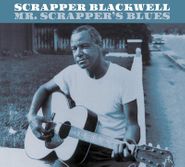
Blues performers may not have felt especially proprietary about their lyrics, but they did about their guitar styles, and Blackwell was one of the very best stylists of the blues guitar, which is why he was chosen as a partner by Leroy Carr, one of the great blues innovators. He may not have owned a guitar by the time the 1960s rolled around, but he had lost none of his virtuoso skills, as he shows everywhere on this album, but especially on the instrumental numbers, "'A' Blues" and "'E' Blues."
He leans heavily on material developed by him and Carr, but one of them in particular is interesting in our context. "Shady Lane" is an Indianapolis blues, written by the two of them during a walk in their hometown neighborhood. They had a lot of help with the lyrics from another neighbor: Flossie Franklin, mother of Guitar Pete Franklin.
Blackwell would make one more record for Bluesville, but his life was tragically cut short. In 1962 he was killed by a mugger in Indianapolis, another unsolved murder of a black man.
Monday, April 20, 2020
Listening to Prestige 479: Guitar Pete Franklin
Much of his career was involved in recording with them, and although he generally recorded in Chicago, and he could play the electric guitar if called upon, he mostly stayed with this older style of blues, rather than getting involved in the electric blues sound

The Bluesville session was his only full length recording session, and one of the very few released under his own name. It was recorded in his hometown of Indianapolis by Kenneth S. Goldstein and another folklorist, Art Rosenbaum, who had grown up in Indianapolis and, as a youngster, had almost accidentally made one of the gret discoveries of the blues revival. As he recalled it years later in an interview with Fred C. Fussell of Georgia Music Magazine:
I rediscovered Scrapper Blackwell, but I honestly didn’t know who I had rediscovered – at least not until I was talking to a friend who was slightly older than me. I said, “Hey, I met this really great guitar player who said he made some records back in the old days. His name is Scrapper Blackwell.” Well, this guy, Ted Watts, just hit the ceiling! “You mean Scrapper’s living here?” he said. Scrapper hadn’t recorded for many years, and was not active as a musician anymore except for going around to play at house parties. But he still could play amazingly well, and he sang with a very poignant voice.

The album was called Guitar Pete's Blues, and it has been rereleased on CD by Concord as part of their Original Blues Classics series. It's worth a listen.
Sunday, April 19, 2020
Listening to Prestige 478: King Curtis
And party time it is. A solid groove for dancing, a tight arrangement, not a lot of room for improvisation, but some goose-bump-inducing solos by two masters if the art of wailing sax, and two of the most in-demand session men in New York. If your saxophone break on the hottest rocker of the moment wasn't by Curtis, it was probably by Taylor.
They were backed up by Curtis's regular group, plus a couple of extra musicians who--uncharacteristically for a Prestige session at Van Gelder Studio--weren't identified in the session log. Those were the trumpeter and the bongo player, both of whom performed on "Slow Motion."
And dig him here, with a tight band, led by a man who knew how to run a tight ship and keep it loose and swinging. Amazingly, nothing from this session was released on 45.
Paul Griffin on piano and Jimmy Lewis on bass were Curtis's regulars. Ernie Hayes played on this and the second Party Time session, and would be called on for other Prestige sessions, but Curtis didn't always use an organ, so he can't really be called a regular.

Billy Butler joined Curtis from Bill Doggett's band, where he had co-written and played the guitar solo on "Honky Tonk." Like all of the other musicians on this session and in Curtis's orbit, he was one of the session players that made the New York sound of the 1950s and early 1960s so powerful. A recent movie has shown us the incredible Detroit musicians who were the anonymous backbone of the Motown sound in the soul era, but the contributions made by the guys in the studios of the Big Apple in the rhythm and blues/rock and roll era of the 1950s were equally important. New York was the jazz center of the world in those days. It's where people came to play.
And it provided its own talent, from its own streets. Drummer Ray Lucas is a case in point.
Lucas grew up in Harlem, where music was everywhere. He recalled those early years in an interview with Jim Payne for Modern Drummer magazine.
I was still in high school when I heard “Yakety Yak” by the Coasters, with King Curtis on sax. At that time I was playing bebop and jazz. I didn’t care nothin’ about rock ’n’ roll. I was born and raised in Harlem. All I knew was New York and bebop. If you didn’t know Blue Mitchell, Miles Davis, Dexter Gordon, you weren’t in my league. But Curtis had a unique style of playing, and when I heard him on that Coasters record, I was knocked out.A few years later, when Belton Evans was leaving and Curtis was auditioning drummers, Eric Gale arranged for Lucas to try out. When he got to the audition, he found that he was to be judged by Curtis and Roy Haynes.
The artists that Lucas played for, and the records he played on, would fill a book. But here's Ron Carter, recalling one session.Afterwards Roy looked at Curtis and said, “That’s a good kid. He’s all right.” I was nineteen or twenty at the time. I played with Curtis from 1961 to 1966, and that was the best band I was ever in.
I got a call to come by and do this record with a young singer named Roberta Flack playing with this New York band. Ray Lucas on drums — an incredible drummer — Bucky Pizzarelli on guitar and some wonderful arrangements. That record ["Compared to What"] put her on the map.His resume would have to include the Beatles, for whom the King Curtis band opened on their second US tour. And here's Lucas remembering a young guitarist-singer whom Curtis hired:
Jimi Hendrix, man, you’re talking about one of the nicest guys. He was so kind and courteous. He played with his teeth and all that, but he could play. Jimi would play Curtis’s tunes and then do some of his own. He would sing more or less down-home blues, rather than the psychedelic things he got into later. We were doing mainly contemporary tunes. He stayed with us for about six months, and then he went on his own.Jimi and I used to play together in the studio, just me and him. He’d try all kinds of different things. He’d plug into the Leslie speaker from the organ. I’d play a backbeat or a shuffle or whatever. This went on for maybe two or three weeks. It was a studio on 54th Street. That’s how he built his recordings. I never heard any of the final versions.One day a little later I ran into Jimi on the street downtown. He said, “Hey, Ray, what are you doing?” I said I was in between gigs. He said, “Man, I got my passport and my papers from the State Department. I’ve been trying to do my thing here, but it’s not working out that great. I just got an offer from England. If you want to do it, I can get the finances together. Do you want to come with me?” Of all the drummers he knew, he asked me. I told him I couldn’t do it, and in less than two years he was the biggest thing out there.
And finally, here are some other musicians reminiscing about playing with Lucas:
Bernard Purdie: Ray was an absolutely phenomenal player. He had no problem doing
what he needed to do. He had great time and a superb touch. He could be the quietest person in the world and be in the groove, and when he had to be fatback, he had no problem. And he had no problem swinging either. That’s why I enjoyed him so much—he could change. Whatever the feel was, whatever the attitude needed, he had it.
:format(jpeg):mode_rgb():quality(40)/discogs-images/R-3458238-1331151565.jpeg.jpg)
Watching Ray, he was like an acrobat. So light on his feet—he danced on the pedals. He could take sticks and make them sound like brushes.
Chuck Rainey: I enjoyed playing with Ray. He had very good time, and he played jazz real well. Ray was always very amusing too. He laughed a lot and told a lot of jokes.
Cornell Dupree and Ray and I went out on the road with the Coasters—who were great—and with the Supremes and Patti LaBelle, and with Jim “Mudcat” Grant, who was a pitcher for the Cleveland Indians. He read poetry while we played.
When we opened for the Beatles, Ringo and Paul did everything they could to stay far away from all the acts from the States. John and George hung out with us on our part of the plane, though. They even came off their floor in the hotel and were very cool. We played cards, took pictures, stuff like that.
Ray played on my first record, The Chuck Rainey Coalition. I used to always get a kick out of him taking drum solos with his bare hands. He was sort of known for that. Not like congas—he played just like he had sticks in his hands. I’m proud to say that I came up with Ray Lucas.
Charles Collins (The O’Jays, MFSB, the Salsoul Orchestra): Ray Lucas was such a sweet cat, and he had a great touch. He could make one snare drum sound like 500 different snare drums, to give the music different colors. We’d do gigs back in ’71, ’72 with Dionne Warwick. [Collins was in a band called the Continentals, which opened for Warwick.] I learned how to play in auditoriums and in concert halls by listening to Ray. I’d go all over the room. Sometimes I’d go way in the back, and I’d still hear that snare drum—bow! bow!—and just different little tasty sounds he could do. He was very creative.
You've heard Ray Lucas, many times over. With Illinois Jacquet, Mongo Santamaria, Bobby Timmons, Shirley Scott, Aretha Franklin, Dionne Warwick--with whom he toured for 12 years, then quit the business. Disco was coming in, and he just wasn't interested.
Friday, April 17, 2020
Listening to Prestige 477: Roland Kirk - Jack McDuff
Even in his rhythm and blues days, he was already experimenting with his exotic instruments, and with playing more than one horn at the same time. And if this was originally presented as a gimmick, it was never a gimmick. Hank Crawford first heard him playing as a 14-year-old on the rhythm and blues circuit, and remembers (quoted in Wikipedia):
The other horns Kirk primarily used were the manzello and the stritch. The manzello is a modification of the saxello, itself a modification of the soprano saxophone. The stritch is a modified alto sax, straight like a soprano rather than curving into a bell like conventional alto (the manzello adds a bell to the conventional soprano structure). Playing all three at once, he could do something no other horn player could do: make chords. But he was also a brilliant flute player, and he made use of all sorts of sound-making devices, in the manner of Yusef Lateef (or Spike Jones), but playing all of them himself.He would be like this 14 year-old blind kid playing two horns at once. They would bring him out and he would tear the joint up...Now they had him doing all kinds of goofy stuff but he was playing the two horns and he was playing the shit out of them. He was an original from the beginning.

Kirk's musical knowledge and influences stretched from rhythm and blues to classical, from ragtime to electronic music. So it was interesting that Prestige paired him, for this outing, with a guy who essentially played one thing, though he did it very well.

But why not? I have a theory: given jazz musicians of quality and imagination, there's no such thing as a bad pairing. Here on Listening to Prestige, we've heard Eric Dolphy paired with Juan Amalbert's Latin Jazz Quintet, a session often criticized as "a mismatch, with Dolphy and the quintet paying little attention to each other," but it's not true. They're listening to each other, and their playing is affected by the context, in interesting ways. The same criticism was leveled by critics at Charlie Parker playing with Machito, or by Sonny Rollins with the Modern Jazz Quartet, and it was never true in either of those cases. Just listen, and you'll hear how they're relating to each other.
One of the most delightful jazz singles ever is "Slim's Jam," featuring a dead serious avant gardist (Parker), an irreverent cutup (Slim Gaillard), and a rhythm and bluesman (Jack McVouty, in Gaillard's language, McVea in anyone else's). And how about the Birth of the Cool nonet, who made some of the tightest, most trailblazing music in jazz history, led by Miles Davis, Lee Konitz (RIP), Gerry Mulligan and John Lewis, all of whom came from very different places and went very much in separate ways? Jazz is all about reaching out of your comfort zone, so putting together great musicians from different schools is always going to be worth listening to.

And in this case, although Kirk could draw on almost any musical language you cared to name, he had a solid grounding in soul jazz. You're certainly going to get things here that you would not necessarily get on any other Jack McDuff album, but you're going to get that "jazz with a beat" and that down home sound. Kirk plays the flute in addition to his big three instrumens, and also uses a siren.
Four of the numbers here are Kirk originals. Two are standards: "Makin' Whoopee," by Walter Donaldson and Gus Kahn, was originally a vehicle for Eddie Cantor in a 1928 Broadway musical. "Too Late Now," by Burton Lane and Alan Jay Lerner, was first sung by Jane Powell in the 1951 Powell-Fred Astaire vehicle, Royal Wedding. And one that you really wouldn't expect to find on a Jack McDuff soul jazz album, "The Skater's Waltz," by 19th century French composer Charles Emile Waldteufel. I'm not sure Waldteufel would recognize what these guys do to it, but he might also be given pause if he could visit the mid-20th century and hear his "Estudiantina Waltz" sung as "My beer is Rheingold, the dry beer."
Joe Benjamin and Art Taylor round out the quartet. Taylor is a veteran of many many Prestige sessions, and if you think of him as primarily a bop era drummer, from his work with Miles, Red Garland and others, prepare to think again. He establishes himself here as a giant of funk drumming.
The album was called Kirk's Work. It was later released as Roland Kirk--Pre-Rahsaan, which in fact it was. The name Rahsaan would come later, not out of Islamic religious leanings (he was never a Muslim), but because the name came to him in a dream. Even this early in his career, though, he had already been named by an oneirological impulse.. His birth name was Ronald, but a dream told him to switch the letters around.
"Kirk's Work" and "Doin' the 68" were the first 45 RPM release from the session, followed by "Funk Underneath," split into two parts, and then "Three for Dizzy," also a two-sider.
Esmond Edwards is listed as "Supervision" rather than as producer. I'm not sure of the difference.
Listening to Prestige Vol 4, 1959-60, now available from Amazon! Also on Kindle!
Volumes 1-3 are also available from Amazon.
The most interesting book of its kind that I have ever seen. If any of you real jazz lovers want to know about some of the classic records made by some of the legends of jazz, get this book. LOVED IT.– Terry Gibbs
Tuesday, April 14, 2020

Friday, April 10, 2020
Listening to Prestige 476: Lightnin' Hopkins
These four songs would be added to a longer 1962 session to make the Bluesville album Walkin' This Road by Myself, and I'll write more about it when we get to that second session.

Three of the songs are credited to Hopkins, but "Baby Don't You Tear My Clothes," a cheerfully bawdy number in the hokum tradition, goes back at least to the 1930s, is generally credited as "traditional," has spawned a number of other songs with the same melody, the best-known being Bob Dylan's "Baby, Let Me Follow You Down." It was first recorded in 1935 by the State Street Boys, a Chicago group that sometimes worked with Big Bill Broonzy and Jazz Gillum.
The fourth, "Good Morning Little Schoolgirl," is credited as "Traditional," but it probably does have a progenitor--the first Sonny Boy Williamson, who recorded it on Bluebird in 1937 and is listed on that record as composer.
Also on July 7, a quintet led by Gene Casey, consisting mostly of guys who had played with the Latin Jazz Quintet plus Ray Barretto, had a recording session at the Van Gelder Studio, but it was never released. Too bad. Anything with Ray Barretto is worth hearing.
Thursday, April 09, 2020
Listening to Prestige 475: K. C. Douglas
The rediscovery of the blues was starting to heat up by 1961. Strachwitz, a German-born blues enthusiast living in northern California, had founded Arhoolie Records, one of the most important blues labels of the era. He had gone to Texas with the idea of

Douglas had performed on one recording before, by his friend and West Coast compatriot, the harmonica player Sidney Maiden. It was recorded in Berkeley, quite likely by Strachwitz, although I haven't been able to find that information. Although Maiden frequently backed him up in performance, and on earlier recordings, Douglas goes solo here. The session notes indicate that it was done in two sessions, both on the same day. The first session, which made up the album K. C.'s Blues, is all original songs. The second, which became Big Road Blues, is largely songs by others.
Douglas is a good enough writer in the blues vein to carry an entire 12-song album, and he doesn't even include his best-known song, "Mercury Blues," which was a minor hit for Douglas in 1948, and a major hit for country singer Alan Jackson in 1993. It has also been recorded by Steve Miller, Jackson Browne, Dwight Yoakam, and several others, including Finnish rocker Pave Maijanen as "Pakko Saada BMW" (where it becomes a foreign import--the title translates as "Gotta Get a BMW").

It does include songs about good women who leave and bad women who don't ("Ain't no tellin' what she might do / She might cut you, and she might shoot you too"). He can go after women like a rootin' ground hog or a watchdog trying to find a bone, which is not likely, because he's been replaced by a younger watchdog. Hey, this is the blues.
The second session begins with Tommy Johnson's "Big Road Blues," which has been widely recorded, and was the subject of a fascinating book by blues scholar David Evans. He gives a little Howling Wolf, and a little Big Bill Broonzy, and Jim Jackson's classic take on "Kansas City." "Bottle Up and Go" has been done by a plethora of bluesmen under a plethora of titles: "Borrow Love and Go," "Step it Up and Go." I know it best by Lead Belly, but it's originally by Mississippi bluesman Tommy McLennnan. When a guy can play and sing all night, it's good that he knows a whole buncha songs.
Listening to Prestige Vol 4, 1959-60, now available from Amazon! Also on Kindle!
Volumes 1-3 are also available from Amazon.
The most interesting book of its kind that I have ever seen. If any of you real jazz lovers want to know about some of the classic records made by some of the legends of jazz, get this book. LOVED IT.
– Terry Gibbs
Wednesday, April 08, 2020
Listening to Prestige 474: Babs Gonzales

However it happened, it's a very worthwhile addition to the Prestige catalog: one romantic ballad and one novelty number with a political bite.
In 1961, the civil rights movement was active and growing. Martin Luther King was at the helm of the Southern Christian Leadership Council, and the Student Nonviolent Coordinating Committee (SNCC) had recently formed, a younger, more impatient group. But humor as a weapon in the civil rights struggle was still in its infancy. Dick Gregory was about to change all that. Discovered by Hugh Hefner in a Chicago nightclub, he became a regular at the Playboy Club, a frequent guest on the Tonight Show with Jack Paar, and a familiar voice on best-selling comedy records. But Babs Gonzales has to be one of the first to knock on that door. It's a shame that the jazz community and the folkie community didn't have much overlap, or "We Ain't Got Integration" could have been a lot better known/
"Lonely One" is the ballad. The guy who calls himself "Little Danny" and runs a very interesting blog about music called Office Naps has a lot to say about this song, and the genre of music it stems from, so I'll give him the floor.
He begins by discussing some of the reasons why jazz-inflected vocalists became so popular starting in the 1960s:
Little Danny's main focus in his blog is individual 45 RPM records, and he goes on to consider "Lonely One":Recording technology had improved enough by the ’50s to effectively capture the
sensitivity of vocal performances on the long-playing album format, most of all its quiet ballad performances. Superlative examples like Helen Carr’s Down in the Depths of the 90th Floor, Johnny Hartman’s Songs From the Heart, Chris Connor’s Sings Ballads of the Sad Cafe and Mel Torme’s It’s a Blue World were hushed expositions of atmosphere and stylized loneliness. They sounded great on hi-fidelity stereos. So did Peggy Lee’s Dream Street, Nat “King” Cole’s Love is the Thing, Frank Sinatra’s In the Wee Small Hours, Jeri Southern’s Coffee, Cigarettes & Memories and all of Julie London’s early small-group releases – releases that, incidentally, sold very, very well.
And so the working reality of smaller, quieter supporting groups, the vogue for torch-y jazz ballads and the affordances of modern recording technology that, made, in turn, these captured performances a rewarding experience for at-home listeners guaranteed that lot of jazz and jazz-inspired vocalists cut records in the ’50s and ’60s. Together they loosely form a fascinating, often obscure, discography of LPs and 45s.

"We Ain't Got Integration" / "Lonely One" was only released on 45, and has never been included in subsequent compilations by Prestige, Fantasy, or Original Jazz Classics.A true original, Babs Gonzales led a fascinating, colorful life, working, in addition to myriad odd jobs, as singer, lyricist and composer, bandleader, poet, manager and active proponent of jazz and jazz culture. However, if it’s hard to pin down exactly what Babs Gonzales was, it’s because he was first and foremost a personality – a scenester, a tireless self-mythologizer and authentically colorful character.
Born Lee Brown in 1919, Babs grew up in Newark, New Jersey. Early on he showed an aptitude for music, growing up playing drums and piano and singing in local clubs barely out of his teens. He had a gift for adopting personae, too, reinventing himself as Gonzales while living in Hollywood, where he famously worked as Errol Flynn’s
chauffeur.
Gonzales returned and inserted himself into the jazz and creative world of post-War New York City, working and living there – singing, writing, recording, collaborating, hustling, generally presiding – on-and-off, with some obligatory spells in Europe, until his passing in 1980....
His most important 78 sides were recorded between the mid-‘40s and the early ‘50s, during which time he sang with top-tier beboppers – including James Moody’s orchestra and Babs’s own group, Three Bips & a Bop – and released some of his best-known compositions, including “Oop-Pa-A-Da,” recorded by Dizzy Gillespie in 1947....
Atmospheric and stunningly beautiful, “Lonely One” belongs among those [his serious, dark songs]. Recorded with an unknown trio for the great Prestige Records in a comparatively late 1961, Babs brings such harrowing, effective feeling that one wishes for more like this, but, sadly, this would be among of his last “serious” recordings as a jazz singer.


Tuesday, April 07, 2020
Listening to Prestige 473: Taft Jordan
Was it really? Or were the rose-hued glasses of nostalgia coloring our vision? After all, we couldn't have listened to everything. And our limited teenage record-buying budget meant that we were mostly spending our money on albums that had gotten four or five stars from Down Beat. And the Jazztone Society's album of the month, during the time of that great but failed experiment. And the

Listening to every single recording session from the entire decade seemed like a pretty good test/ And the conclusion was yes. It was all good.
The 50s were our decade of pure passion, and I wasn't so sure the 60s were going to measure up, but so far, so good. And more of it is new to me. Some of it is surprising, some of it amazing. Mal Waldron, Eric Dolphy, Booker Ervin, Ron Carter...an album I'd never heard, that ascends to the level of greatness. And fresh, orginal, revolutionary--even 60 years later. That shouldn't be so surprising. Charlie Parker, Dizzy Gillespie and Thelonious Monk sound fresh, original, and revolutionary 80 years later. And Louis Armstrong, 100 years later. But this was music I'd never heard of before.
You're not going say the same thing about Taft Jordan playing Ellington. Letting the world know that Mal Waldron was one of his era's great composers is a thrill in itself. If I tell you that Duke Ellington was one of his era's great composers, I'm not exactly going to be in the vanguard, am I? And if I tell you what a service Bob Weinstock performed for posterity by recording some of the older jazz artists on Swingville and Moodsville, this is worth saying, but I've said it before.

So I don't have anything exciting to tell you today, except that the string continues. All good.
How could it not be? Ellington veteran Taft Jordan playing some of the Duke's best-loved tunes, and the reason why they're best-loved is...you can't help but love them.
Kenny Burrell! After a few years' absence, he's back for two Prestige sessions in 1961: Coleman Hawkins in February, and now on board here with Jordan. Always welcome. He'll be back off and on over the decade.
It tool Listening to Prestige to introduce me to Richard Wyands, and now that I know about him I smile whenever I see name on a session. I know he's going to be giving me some good piano.
And what about Joe Benjamin and Charlie Persip? From the angularities and intricacies of Waldron/Dolphy to the sweet swing of Ellington/Jordan. What time is the gig and where is the studio? Thank you, ma'am, and let's play some jazz. Play it pretty for the people. Play it loud, play it clear, for the whole world to hear. Play everything cool for me and my baby. Taft and fellas. You've got me in the palm of your hand.
Listening to Prestige Vol 4, 1959-60, now available from Amazon! Also on Kindle!
Volumes 1-3 are also available from Amazon.
The most interesting book of its kind that I have ever seen. If any of you real jazz lovers want to know about some of the classic records made by some of the legends of jazz, get this book. LOVED IT.
– Terry Gibbs
Subscribe to:
Posts (Atom)