It can be said that the seed for this whole project was planted in 1957, when I heard John Coltrane with the Red Garland trio through the AM radio in my dorm room at Bard College at 2 a.m. So that's why 1957 is particularly important for me. I could finally write about the albums that drew me into jazz. Trane, and Mose Allison. King Pleasure Sings/Annie Ross Sings also came out in 1957, although the recordings had been first issued in the early fifties.
Probably none of these would appear on most lists of the greatest jazz albums of all time. I would never make such a list, myself, but these remain touchstones for me, as I began my journey into the realms of gold, my first exposure to jazz as important to me as looking into Chapman's Homer was to John Keats.
Another of my first purchases, another 1957 release, is or ought to be on anyone's list of the most significant jazz albums of all time, and it goes back to 1949-1950, when 18-year-old Bob Weinstock discovered modern jazz, and went into the studio with Lennie Tristano to record the first release on what would become Prestige Records. Tristano was making some of the most advanced music of that time, and one of his close associates, Lee Konitz, was also in Capitol Records' studio, working with Miles Davis on another set of recordings that may have been too advanced for the time. But the world was certainly ready for Birth of the Cool when 78s were finally gathered into LP form in 1957.
It was a big year for Prestige. Seventy studio sessions were booked, all but three of them in the Van Gelders' living room in Hackensack, NJ. One of the albums that came out of that activity was voted the best album of the year by the idiosyncratic but always interesting voters of rateyourmusic: Saxophone Colossus, by Sonny Rollins.
Here are the jazz albums from rateyourmusic's top forty:
1 Sonny Rollins, Saxophone Colossus
Prestige
Hard Bop
2 Thelonious Monk, Brilliant Corners
Riverside
Hard Bop
3 Thelonious Monk Septet, Monk's Music
Riverside
Hard Bop
4 Miles Davis, 'Round About Midnight
Columbia
Hard Bop
5 The Miles Davis Quintet, Cookin'
Prestige
Hard Bop
7 Ella Fitzgerald with Duke Ellington and His Orchestra, Ella Fitzgerald Sings the Duke Ellington Song Book
Verve
Vocal Jazz, Big Band
8 Charles Mingus, The Clown
Atlantic
Post-Bop
9 Duke Ellington and His Orchestra, Such Sweet Thunder
Columbia
Big Band
11 Art Pepper Meets the Rhythm Section
Contemporary
Cool Jazz
12 Sonny Rollins, Vol. 2
Blue Note
Hard Bop
13 Dizzy Gillespie At Newport
Verve
Bebop, Big Band
14 Cliff Jordan and John Gilmore, Blowing In From Chicago
Blue Note
Hard Bop
15 Billie Holiday, Body and Soul
Verve
Vocal Jazz, Standards
18 Ella Fitzgerald & Louis Armstrong, Ella and Louis Again
Verve
Vocal Jazz, Standards
19 Sonny Rollins, Way Out West
Contemporary
Hard Bop
21 Coleman Hawkins, The Hawk Flies High
Riverside
Hard Bop, Jazz
22 Miles Davis + 19, Miles Ahead
Columbia
Cool Jazz
24 Count Basie and His Orchestra, April in Paris
Verve
Big Band, Swing
25 Count Basie At Newport
Verve
Big Band, Jazz, Swing
27 Sonny Rollins
Blue Note
Hard Bop
29 Horace Silver Quintet, 6 Pieces of Silver
Blue Note
Hard Bop
30 Art Pepper Quartet, Modern Art
Intro
Cool Jazz, Hard Bop
31 Thelonious Monk, Thelonious Himself
Riverside
Hard Bop
32 Anita O'Day, Anita Sings the Most
Verve
Vocal Jazz, Standards
33 Johnny Griffin, A Blowin' Session
Blue Note
Hard Bop
34 Introducing Johnny Griffin
Blue Note
Hard Bop
35 Sonny Rollins, Rollins Plays for Bird
Prestige
Hard Bop
37 Barney Kessel with Shelly Manne and Ray Brown, The Poll Winners
Contemporary
Jazz
40 Lee Morgan, Vol. 3
Blue Note
Hard Bop, Jazz
Hard Bop is definitely the word du jour for 1957's output, sometimes used curiously. Miles Davis is labeled Hard Bop for 'Round About Midnight, Cool Jazz for Miles Ahead. So a musician can do both, but can he do both on the same album? Maybe yes, maybe no. Art Pepper is labeled as Cool Jazz for Art Pepper Meets the Rhythm Section , which is actually a little odd in that the rhythm section he met were East Coast Hard Boppers Red Garland, Paul Chambers and Philly Joe Jones. But on Modern Art he is credited with the bi-coastal, bi-label quinella.
Cool Jazz for Miles Ahead is a bit of a stretch. Perhaps because it was a collaboration with Gil Evans, who was also on the Birth of the Cool album. Other critics have called it Third Stream, which is at least as vague a term as most of the others, so why not? Why not, for that matter, since it involves a 19-piece orchestra, call it Big Band? It's certainly big enough. But that label seems to only apply to bands of the swing era, unless they're led by Dizzy Gillespie.
Speaking of Birth of the Cool, 1957 was the year it finally came out in an LP format, nearly a decade after it had taken the jazz world by storm but had mostly been ignored by critics, the listening public, and executives at Capitol Records. By 1957, Cool Jazz was a thing. Gerry Mulligan had taken his arrangements and concept out to California, where it had been embraced by many, belittled by others. I'm not sure how excited Capitol was about releasing it even in 1957, or exactly how they should market it. "Hey, we were here first!" is not a great marketing strategy, but that's probably what was behind the name of the album. But it wasn't just another Cool Jazz album. It was exciting and groundbreaking, even if it was late to the party. I'd rank it as one of the most important albums of the decade, even more important than Miles' mega-bestseller Kind of Blue.
If a belated realization that were sitting on a masterpiece wasn't what spurred Capitol, what was? What else? Money. By 1957, the LP revolution was complete. Kids still bought 45s, but grownups -- classical music fans, jazz fans, Broadway show fans -- bought LPs to play on their new hi-fi, or even newer stereo equipment. And where there's new technology, there's a buck to be made in reissues, as record companies of the 80s and 90s discovered, when they began reissuing their entire catalogs on compact disc, at premium prices even though CDs cost less to produce than LPs.
Reissues in those days were called "compilation albums." Today, a compilation album is some artist's greatest hits, or the greatest hits of a year, or a genre, or what have you. Back then, it was bunches of old 78s that were being compiled, and this was a heck of a year for vintage jazz collectors to put their precious wax discs away and replace them with LPs, or for new fans to catch up on what they'd missed. Birth of the Cool is actually number three on the rateyourmusic compilation list, behind Muddy Waters and Ray Charles, but the Prestige reissues alone make up a set that could be the cornerstone of any collection: Thelonious Monk/Sonny Rollins; Miles Davis and the Modern Jazz Giants (this actually was originally released on LP, but it was a 10-inch LP, and the 12-inch version added a couple of numbers, so I guess that makes it compilation); Walkin', from the Miles Davis Contractual Marathon sessions, and the first Prestige singles to be released only on 45 RPM; the Modern Jazz Quartet/Milt Jackson Quartet ; Evolution by Teddy Charles, compiling a 1955 session with Charles Mingus and J.R. Monterose that first saw life as a New Jazz 10-incher with two tunes from a 1953 West Coast date featuring Shorty Rogers and Shelley Manne, which had appeared on a 10-inch LP but had been left off the 1956 compilation of two West Coast sessions by Charles; Kaleidoscope, by Sonny Stitt, which goes back to early 78s from 1951 and 1952, including a couple from the mambo craze, When Farmer Met Gryce, compiling sessions from 1954 and 1955.
The 1957 Newport Jazz Festival was surprisingly heavy on traditional jazzers, considering how one thinks of it as a tine when the moderns dominated. But along with the moderns -- Brubeck, Silver, Mulligan, Gillespie, et al -- was one decidedly postmodern name: Cecil Taylor, who may have left some festival-goers scratching their heads a little.
In New York, the big news was Thelonious Monk finally getting a cabaret card, so that he could play in clubs again. John Coltrane did cold turkey in Philadelphia and, in addition to recording with Prestige, joined Monk in a quartet that played a memorable six month engagement at the Five Spot, and perhaps an even more memorable date at Carnegie Hall. The concert, which also featured Billie Holiday, Dizzy Gillespie, Ray Charles, Sonny Rollins, and Chet Baker with Zoot Sims, was recorded, but the Monk/Coltrane sets were not released until their rediscovery in 2005.
If Monk, Trane and the Five Spot were the big news in New York jazz circles, it was news to The New Yorker, which continued to see jazz in terms of Eddie Condon's, Jimmy Ryan's, and the Metropole. They did list the Half Note, with Charlie (sic) Mingus, and the Café Bohemia, with Mose Allison and Horace Silver leading separate trios. And once again, my annual appeal for someone to digitize all of Down Beat.
Jazz deaths included Dean Benedetti, best known for his recordings of Charlie Parker in clubs in 1945 and 1946, which had attained the status of jazz legend by the time they were finally collected and released by Mosaic records in 1990.
Another posthumously released 1957 recording was Jimmy Dorsey's biggest hit, "So Rare." Dorsey died shortly after making the recording, and never saw it go to number 2 on the Billboard charts/
Friday, June 09, 2017


Friday, May 26, 2017
Listening to Prestige 261: Hal McKusick

McKusick's recording career is mostly bounded by the fifties, although he did appear as a sideman on a few sessions in the early sixties. This album for Prestige was his second to last, and perhaps his most atypical. His music is known for theory and advanced arrangement. He worked closely with George Russell when Russell was developing his Lydian Chromatic Concept of Tonal Organization, an important precursor to the modal jazz of Miles Davis and John Coltrane. Probably more typical of his approach to jazz was the album he made the following year for Decca, featuring five, six and seven-piece ensembles and the work of four very different arrangers: Russell, George Handy, Jimmy Giuffre and Ernie Wilkins, each of whom was asked, McKusick said in a later interview, for "their most advanced thinking."
So how did Bob Weinstock's casual, unrehearsed jam session approach fit with McKusick's talents? Very well indeed, and we're lucky to have this album, and this side of McKusick, just as we're lucky to have the Decca Cross Section--Saxes. Everyone likes to just cut loose and blow every now and then, and the bebop improv approach of head-solo-solo-solo-head, with some casual but intricate duets and dialogs thrown in, can yield some wonderful music, especially with musicians like these.
Billy Byers, like McKusick, came out of the swing era, and worked as a section man in bands featuring the best arrangers. He later would become Quincy Jones's assistant at Mercury Records. So he wasn't exactly the typical Prestige guy either--this was his first session for the label, and he would only do one other, in 1963--but like McKusick, he finds that sweet spot, and the stuff they do together is especially rewarding.

Charlie Persip had done only one previous session for Prestige, but he'd been in the studio on at least one other memorable occasion, as a witness to the strange and thorny afternoon with Miles Davis and Thelonious Monk. He would be back several more times, in the course of a long and distinguished career. Eddie Costa was also making his second appearance on Prestige. The first had been on the vibes, accompanying Bobby Jaspar and Tommy Flanagan. He looked to be at the dawn of a major career. In 1957, he would be named Down Beat's new star on both piano and vibes, the first time a musician had gained that honor on two different instruments. But an auto accident would take his life a few years later.
Paul Chambers was, by this time, one of Prestige's stars, and with good reason. His solos, both plucked and bowed (on "The Settlers and the Indians") are musical gems, and that's not by chance. Chambers, as we know, hit New York as a 19-year-old wunderkind, already a master of his instrument. After all, he had started in the jazz cauldron of Detroit, where musicians matured early. His friend, drummer Hindal Butts, remembers (again from Lars Bjorn and Jim Gallert's indispensable Before Motown: A History of Jazz in Detroit 1920-1960):
Paul was determined to make the bass a solo instrument and he practiced, hour upon hour. I waited on Paul to take a couple of girls out, and he wouldn't stop practicing! He loved to bow and he mastered the bow.Butts was a member of a quartet led by Kenny Burrell and Chambers, called the Four Sharps. And, given that this is the early 50s, that would almost sound like a doo-wop group, wouldn't it?
Well, yeah. This was Detroit, where music was music. The group played modern jazz, and they also sang four-part harmonies. We can't exactly know how good the Four Sharps (who also, at various times, included Tommy Flanagan, Frank Foster, Yusef Lateef and Pepper Adams) were as a vocal group, because no records of their music have survived, but we sort of can. Again, from Hindal Butts:
We recorded "The Nearness of You" ... Kenny sang the lead, we sang the backup and we did the bridge in unison ... Kenny called me one day and said, "Turn the radio on." He was mad ... I turned the radio on and the Four Freshmen were singing [our arrangement of] "The Nearness of You" almost note for note.Butts recalled that the Four Freshmen, when they were playing Detroit, used to stop in at Klein's Show Bar when the Sharps were playing there, and request the number over and over.
McKusick composed three of the tunes for this session. He turned to some top composers for a couple of others: Dizzy Gillespie's much-recorded "Con Alma" and Jimmy Dorsey's "I'm Glad There is You."
And some more surprising choices. "The Settlers and the Indians" was written by Bobby Scott, who was, at just about the same time, climbing the Top Forty charts with a rock 'n roll song called "Chain Gang." He would later write "He Ain't Heavy, He's My Brother" for British rockers The Hollies, and win a Grammy for "A Taste of Honey." Incidentally, I've lauded Wikipedia for their excellent entries on jazz albums, but that doesn't mean you can count on the Internet across the board. There are a whole bunch of sites devoted to lyrics, and I don't know who's ripping off who, but if there's a mistake in one, the same mistake will be in all of them. Take, for instance, the lyrics to "The Settlers and the Indians." Every one of these sites features lyrics to "The Settlers and the Indians," and every one of gives what are actually the lyrics to "Don't Worry 'bout Me." Maybe someone was listening to this album, because McKusick also does "Don't Worry 'bout Me," a song by Rube Bloom and Ted Koehler that's a standard for jazz vocalists, my favorite version being King Pleasure's.
"Something New" is credited to Albert Gamse and Ricardo Lopez Mendes, both of whom were lyricists, but someone must have chipped in a melody. And "Saturday Night" is the really interesting one. It was the title song for a musical with a book by Julius and Philip Epstein, who had co-written the screenplay for Casablanca, and had turned the composer job over to an unknown, who remained unknown, as Saturday Night never made it to Broadway, and lord knows where McKusick found it, especially since the young unknown was being told at that point to stick to lyrics, because his melodies weren't quite good enough. And in fact, while McKusick was recording "Saturday Night," Steven Sondheim's lyrics were making their mark on Broadway to Leonard Bernstein's music for West Side Story.
The album was called Triple Exposure. McKusick's "Interim" and "Don't Worry 'bout Me" didn't make the cut, but were later included in the New Jazz compilation album, Bird Feathers.
McKusick lived a long and productive life, dying in 2012 at the age of 87. He composed music for two plays by his friend Edward Albee, "The Sandbox" and "The Death of Bessie Smith." He taught for a number of years at the exclusive Ross School on Long Island, where he moved in the early 1970s. Of his years on the jazz scene of the 1950s, he said this, in an interview with the AllAboutJazz website. He was talking about Cross Section--Saxes, but he could have been talking about Triple Exposure, or indeed, any album by any of the New York jazz musicians:
The sound was a reflection of our lives in New York--the intensity, the art, the optimism all squeezed together.
Order Listening to Prestige, Vol. 1 here.

Friday, May 19, 2017
Listening to Prestige 260: Ray Draper - John Coltrane

All of this works. Coggins is a jagged, percussive piano player, and sets the tone that this is going to be a different kind of session. Draper and Coltrane work well together in the ensemble passages. Draper proves that he's a first rate composer on his originals, particularly "Clifford's Kappa," and he shines as a soloist.
And that's saying a lot, considering what he was up against. Everything from this session is good, better than good. But Coltrane was on fire. When he solos, everything else melts away. I've been following Coltrane's progression here, from the Miles sessions through the wide-ranging array of sideman gigs that Weinstock used him for, through his sessions as leader, looking for clues as to what he would burst forth into come the 1960s, and not really finding them. In each of his Prestige sessions, including this one, he is right there in the present moment, making the music he's brought in to make. And making all the right choices. And listening to his recording sessions in chronological order, all I can say is that he keeps getting better and better.
His solos here virtually stop time and space, and exist in their own dimension. But that doesn't mean he's ignoring what's around him. He's working with Draper and Coggins, building on what they're doing, and they're doing some very, very good stuff.
In spite of all that, it's hard to know what to do with a tuba player, and Weinstock was not going to do more. This is Draper's last session for Prestige, and it was released on New Jazz, which generally meant it was not going to get the promotional push that went behind a Prestige release. Draper would record only sporadically after that, succumbing to heroin addiction and drug-related prison time. He died in 1982, meeting an ironically grisly end for a musical prodigy: he was shot and killed by a hold-up gang led by a 13-year-old.
The original New Jazz release was called The Ray Draper Quintet featuring John Coltrane. A much later Prestige reissue was title The John Coltrane/Ray Draper Quintet.
Order Listening to Prestige, Vol. 1 here.
Thursday, May 11, 2017
Listening to Prestige 259: Red Garland
Well, not quite. And once again the story goes back to Detroit, and Cass Technical High School. As Byrd remembered it in a 1998 lecture at Cornell University, one of the many institutions at which he taught,
I met him in the 11th grade in Detroit. I skipped school one day to see Dizzy Gillespie, and that’s where I met Coltrane. Coltrane and Jimmy Heath just joined the band, and I brought my trumpet, and he was sitting at the piano downstairs waiting to join Dizzy’s band. He had his saxophone across his lap, and he looked at me and he said, ‘You want to play?’
So he played piano, and I soloed. I never thought that six years later we would be recording together, and that we would be doing all of this stuff.

 And in fact, not even close. Byrd and Coltrane recorded together more than I would have guessed. Here's the best I can do for a complete list, relying on information from the amazing New York Public Library Research Desk, Wikipedia, jazzdisco.org, and Amazon:
Elmo Hope All Star Sextet, Informal Jazz (Prestige, May 1956) With Hank Mobley, Paul Chambers, Philly Joe Jones
Paul Chambers Sextet, Whims of Chambers (Blue Note, September 1956). With Kenny Burrell, Horace Silver and Philly Joe Jones.
Art Blakey Big Band (Bethlehem, December 1957). They were featured on two tracks as the Art Blakey Quintet, playihg a composition by Byrd and one by Trane.
Sonny Clark Sextet, Sonny's Crib (Blue Note, October 1957). With Curtis Fuller, Paul Chambers and Art Taylor
John Coltrane Quintet, Lush Life, Black Pearls (Prestige). These were both from the Coltrane compilations issued after Trane had left Prestige. Lush Life included one cut from a January 1958 session with Red Garland, Paul Chambers and Louis Hayes. Black Pearls was a May session with Garland, Chambers and Art Taylor.
Oscar Pettiford All-Stars, Winners Circle - Down Beat Poll Winners from 1956 (Bethlehem, October 1957). With Gene Quill, Al Cohn, Freddie Green, Eddie Costa, Philly Joe Jones and Ed Thigpen in various mix-and-match combinations.
And, since we were just talking, in the context of Mose Allison, about musicians getting duped out of publishing rights, here's another Donald Byrd story, this time with Byrd as the voice of experience, and Herbie Hancock as the callow youth. When Byrd gave Hancock his recording debut on a Blue Note session, Blue Note wanted to sign the young pianist to a recording contract, and Byrd warned him that under no account should he surrender the publishing rights to his music. So of course, that was the first condition Blue Note made.
A recording contract isn't just a temptation to a young musician, it's the temptation. That's why so many young musicians give away so many rights. And it seemed inconceivable to Hancock that he could walk away from it, but he did. Blue Note caved. Hancock kept the publishing rights, and when Mongo Santamaria had a hit with "Watermelon Man"...well, the rest of the story comes not from a music publication, but from Road and Track (by way of Wikipedia). Hancock took the royalties from "Waterm
 elon Man" and bought a Shelby Cobra, which is now renowned as the oldest production Cobra still in the hands of its original owner.
Of course, the real story here is the music. There's one new name, George Joyner, who would not have that name for long. He had come to New York after a stint playing the blues with B. B. King, and recorded first with Phineas Newborn. After converting to Islam, he became first Jamil Sulieman and then Jamil Nasser, and had a long association with Ahmad Jamal, and a career that went well into the 90s;
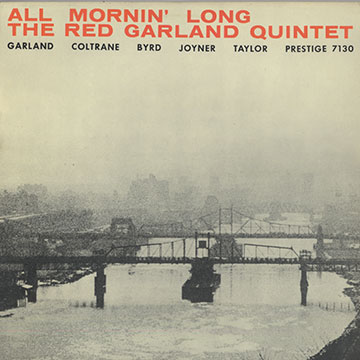
This was a long day in the studio, which would have come as no novelty to Garland and Coltrane, who were both on board for the Miles Davis Contractual Marathon. Ten songs, and one of them, "All Mornin' Long," went on pretty much all evening long, clocked in at 20 minutes, and made up a whole side of one of the LPs to come out of the session. And even after that, they weren't quite willing to call it a day, as they came back the next month to do five more.

"All Mornin' Long" was a Garland composition, and although it was the last piece recorded that day,
it was the first side of the eponymous first album released from the session. It holds attention all the way through, particularly the long piano solo by Garland that features some beautiful dialogue with Joyner/Nasser, leading into a bass solo that makes you understand why this guy was welcomed into the fold. Two other pretty fair composers took up the second half, George Gershwin ("They Can't Take That Away From Me") and Tadd Dameron ("Our Delight").
All Mornin' Long was a pretty quick release, in the spring of 1958. The others were a little longer in coming. Soul Junction saw the light of day in 1960, again with the Garland composition giving the album its title. Garland shared composing space with jazz giants: two by Dizzy Gillespie ("Woody'n You" and "Birks Works") and one by Duke Ellington (I've Got it

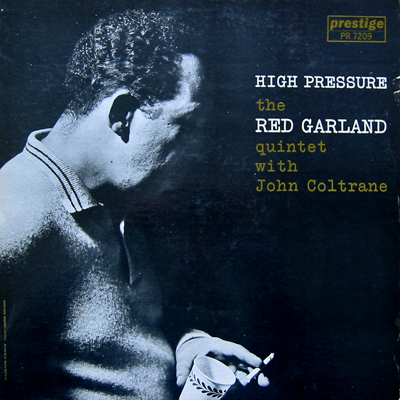
The rest of the November session--"Undecided" (Charlie Shavers) and "What Is There to Say?" (Vernon Duke)--had to wait until High Pressure in 1962, along with three songs from the December session: "Soft Winds" (Benny Goodman / Fletcher Henderson), "Solitude" (Duke Ellington) and "Two Bass Hit" (Dizzy Gillespie/John Lewis). When you're getting together to play that much music, without much rehearsal, it's probably a good idea to mostly choose tunes that everyone knows. Bird's "Billie's Bounce" and Garland's "Lazy Mae" were on a later 1962 LP called Dig It!, which put together numbers from three different sessions.

Tuesday, May 09, 2017
Listening to Prestige 258: Mose Allison
So many jazz greats got their first break with Prestige, then moved on to other labels. Miles, Monk, MJQ, Sonny Rollins, Billy Taylor, just to name a few. Of course, one of the main reasons for moving from a small label to a bigger one is money. Another is creative differences and career management--Monk moved from Blue Note to Prestige to Riverside, all small labels, and stayed with Riverside for years. But money doesn't come easily to jazz musicians, and it never came easily to musicians who recorded for Prestige. I recall reading an interview with Allison some years ago, in which he said that he'd never seen a royalty from Prestige for Back Country Suite. But apparently this was not a rare experience for Mose. In a 1998 interview with Blues Access Magazine, he says that he never got royalties from any of his labels, meaning Columbia and then Atlantic, which in 1962 was an independent on the verge of becoming a major. Allison remembers the first real money he ever made from a recording:

I got a check in the mail from Jazz Editions for $7000. I thought, ‘Man, what the hell is this? This must be some mistake.’ I’d been gettin’ 20 dollars and 30 dollars, and I couldn’t figure out what had happened. I didn’t know anything about ’em [the Who]... the first time I ever made any money off a record.The Who had recorded Allison's vocal vignette from Back Country Suite on their album Live at Leeds as "Young Man Blues." Jazz Editions was George Wallington's publishing company, and yet another source for money that did not come to Allison. Most musicians didn't really understand the concept of publishing rights in the 50s, which is why so many of the early rhythm and blues, rock and roll and doo wop performers, as well as jazz musicians, found that most of their money wound up in the pockets of whoever had taken the publishing rights to their songs. But Wallingford did bring Allison to Prestige, and got his career started.
Local Color was sort of like Back Country Suite, a series of pieces by Allison that reflected his own unique perspective on the blues. Back Country Suite had been short interconnected vignettes, in part inspired by
Bela Bartok. At LSU I heard him for the first time, one of his things, the piano suite, "Hungarian Sketches," or somethin’, just a piano playin’ fairly simple tunes. But they were so evocative. That gave me the idea. I said, "Well, hell, I can do that. With my background, the music I grew up with, I ought to be able to come up with somethin’ like that."The Local Color tunes have the same quality, but they're worked out at full length, as opposed to the vignettes of the first album. And again, the second side of the album is given over mostly to the work of other composers. There's a traditional blues credited to New Orleans musician Richard M. Jones, and songs by Percy Mayfield, Bennie Benjamin/George David Weiss, and Duke Ellington.
The blues is "Trouble in Mind," and Allison plays trumpet on it. He would record a few more trumpet pieces on subsequent albums, but eventually, as he became more and more a singer, it dropped out of his repertoire. I'm not qualified to discuss the technical merits of Mose's trumpet playing. It sounds good to me. And it sounds very much of a piece with his piano and voice.
A while back, I was teaching a course in public speaking at a New York State prison, and one of my students, who I'll call M____, was extraordinary. I had a lot of good students, but M____ had a naturally academic mind. In another, perhaps fairer world, he would have been getting a Ph.D. someplace. When he gave his last speech of the semester, I told him there was nothing I could offer in the way of criticism: subject matter, research, development of argument, delivery. Just one thing, perhaps: maybe it's time you paid attention to conventional subject-verb agreement, and got away from formulations like "he say" and "he be." That sparked a discussion, with good and thoughtful points being made on both sides. At one point, another student in the class said "I want to hear the real M____, not M_____ the intellectual." I said, "I have to disagree with you. I think M_____ the intellectual is the real M_____."
And so with Mose Allison. His trumpet, his piano, his voice -- all carried the down home authenticity of his background in rural Mississippi and the literate sophistication of his degree in English from LSU. That was Mose, and that was Mose. And there was no contradiction.

"Lost Mind" is great, but it was the other vocal, Allison's own "Parchman Farm," that made his reputation as a singer and songwriter. "Blues" (later known as "Young Man Blues") from the first album had been a vignette from the suite, but "Parchman Farm" was full length, fully realized, and ready to me marketed on 45 RPM. Which it was, twice. Once with Duke Ellington's "Don't Get Around Much Anymore (from Young Man Mose) and once with Willie Dixon's The Seventh Son. It became his most popular song, although he eventually stopped doing it, perhaps because it was criticized for being politically incorrect (although on those grounds you'd have to throw out at least three quarters of the blues), perhaps because it just stopped seeming relevant. From an interview in Nine-O-One Network Magazine, quoted in Wikipedia:

I don't do the cotton sack songs much anymore ["One Room Country Shack" also features one]. You go to the Mississippi Delta and there are no cotton sacks. It's all machines and chemicals.
The vocals are so good that sometimes people forget that Mose was first a jazz piano player, discovered and encouraged by Al Cohn and George Wallington. So I've put up one of the instrumental pieces from Local Color as my listening choice for today.
Order Listening to Prestige, Vol. 1 here.
Sunday, May 07, 2017
Listening to Prestige 257: Steve Lacy

Benny Goodman integrated jazz first behind the scenes by hiring Fletcher Henderson as arranger, then out front with Teddy Wilson and Lionel Hampton. Gerry Mulligan took the ideas he had been working out with Miles Davis out to the West Coast and sparked a whole new geographically eponymous school. Veterans like Lennie Tristano and Lee Konitz were developing an avant garde that would soon be taken over and pushed beyond boundaries by younger musicians like Ornette Coleman, Eric Dolphy, Albert Ayler.
The original beboppers came out of the swing era. Most of them had played in swing bands, and many, like Zoot Sims and Wardell Gray, carried a lot of the swing sensibility into their modern playing. That sort of progression was radical, but it was also incremental.
Steve Lacy was another story. Born in 1934, he had his first professional gig at age 16. That's 1950, when bebop had already passed its infancy and entered its mature phase, but Lacy didn't start with bebop, or even with swing. He went back to an earlier era, playing traditional New Orleans jazz with musicians like Henry "Red" Allen and Zutty Singleton. And then, in a quantum bounce, he leapfrogged over the dominant sounds of his generation and the previous generation, and landed foursquare (well, hardly square) in the avant garde, playing on Cecil Taylor's debut album, Jazz Advance, in 1956.

This Prestige session was Lacy's own debut as a leader, and it finds him somewhat more in tune with the times than the visionary work with Taylor would have suggested. But he was playing his instrument of choice, the soprano saxophone, and that in itself set him apart. After John Coltrane took up the soprano sax, others started experimenting with it, but in 1957, it was pretty much Steve Lacy alone. So that sets him apart. He is working with the general structure of improvisation from a melody, but he's already heard the call of a muse in a different room.

Wynton Kelly had made his Prestige debut with Eddie "Lockjaw" Davis on a couple of 78s in 1950, and had appeared on an Art Farmer album in 1954. By 1957 he was seriously in demand, appearing on a couple of dozen albums in that year alone, on virtually every significant jazz label. He would appear on a handful more Prestige albums in the ensuing years, but never a session as leader. Red Garland and Mal Waldron were the label's go-to piano guys.

Kelly was the straight-ahead side of Lacy's debut sound; Buell Neidlinger and Dennis Charles were the avant garde. Both had been on Jazz Advance, and both would have long-time associations with Taylor. Niedlinger would go deeper into the avant garde later, working with composers like John Cage and George Crumb.
Reflecting the uniqueness of Lacy's instrument, the album would be called Soprano Sax.
Sunday, April 23, 2017
Listening to Prestige 256: Paul Quinichette
Prestige also recorded a lot of hard bop and bebop, but because it was so much a one-man operation, Bob Weinstock was able to indulge his enthusiasms across a wide spectrum. Paul Quinichette had come under the Prestige umbrella in 1957, recording bop albums with John Coltrane, with Webster Young (perhaps he misunderstood, and thought Weinstock was saying "Come in for a session with Webster and Young"), and even one under his own name with a group of boppers. That came out as Paul Quinichette's New Stars, and they were all newer than him, for sure. Like his mentor Lester Young, Quinichette was open to new sounds and new ideas, but he was a Basie-
 ite at heart, so why not record him in a Basie context? Prestige was a big tent.
The album is For Basie, the tunes are all from the Basie playbook, and the musicians are Basie veterans.
Shad Collins' ties to Basie go back to the 30s, and the Lester Young days. He also played with Cab Calloway (he replaced Dizzy Gillespie), Benny Carter, Don Redman, Jimmy Rushing, and Sam "The Man" Taylor, another jazz-to-rhythm and blues cat. He had an important reputation as an arranger and considerable success as a composer, including "Rock-a-Bye Basie." He also wrote Cozy Cole's Top Forty hit, "Topsy."
No musicians are more closely identified with Basie than Walter Page and Freddie Green, In fact, Basie was a member of Page's band, the Blue Devils, in Kansas City. Page is credited with being one of the first to shift the primary rhythmic responsibility in a band to the bass, thus freeing up the drummer and piano player to improvise more. When you hear a singer, like Lonette McKee in Round Midnight, talk about the importance of listening to the bass, she has Walter Page to thank for it. This may have been Page's last recording, as he died suddenly and unexpectedly in the winter of 1957.

Freddie Green joined Basie in 1937, and stayed with him for the next 50 years. Jo Jones joined Green and Page as integral figures in the creation of the Basie sound. He played with Basie until 1948, then freelanced with others, including Duke Ellington.
Nat Pierce is best known for his work with Woody Herman, but also for having an uncanny ability to recreate Basie's piano style, so during the late 50s he led a number of groups of Basie veterans.
No one can resist the sounds of Count Basie, and it's pretty damn hard to resist these guys, either.
So...a step backward? No. There's really no backward in jazz. Some may have still been talking about hipsters and moldy figs, but this was an era when Louis Armstrong and Kid Ory were still making music, when Benny Goodman and Lionel Hampton were still making music, Machito and Tito Puente, the Count and the Duke, Dizzy Gillespie and Miles Davis, John Coltrane and Ornette Coleman and Eric Dolphy. Probably no other art form has ever been so inclusive.

Tuesday, April 18, 2017
Listening to Prestige 255: Yusef Lateef
He had not been entirely homebound. He'd started playing professionally at 18, touring with swing bands and eventually with Dizzy Gillespie, but by 1950 concerns for his wife's health brought him off the road and home to Detroit, where he became an important figure, not only for his musicianship but also his cultural leadership. He was a founder and vice president of the New Music Society, an organization that reached out to younger jazz musicians and gave them a place to grow and develop. 1950 was also the year he converted to Islam.

His late arrival on the New York scene is part of the reason why, although he'd been an active musician for over 20 years by the time the decade turned, he is more associated with the jazz of the Sixties than the Fifties. The rest of that reason is his free-flying creativity, which seem like a Sixties thing, but was part of Lateef's creative personality even back in Detroit. Pianist Terry Pollard recalls that
He sometimes had me blow into a pop bottle. He'd fill it with water...to get different sounds, to make the song sound like Yusef wanted it to be. And so I ended up blowing into these pop bottles. I didn't know how, and I would get dizzy every night.*While he was still in Detroit, Lateef began to experiment with Middle Eastern music, turned on to it by a fellow assembly line worker at the Chrysler plant. He
realized I had to widen my canvas of expression. I spent many hours in the library...studying the music of other cultures. I met a man [at Chrysler] from Syria and he asked me if I knew about the rabat.He would bring all of this knowledge, and all the instruments he was experimenting with, to his New

We were so tight we were able to go to New York on off nights and do two albums, easily...We got off Sunday nights and jumped in the...station wagon, and we would drive all the way to Hackensack, New Jersey, and record on Monday and we'd turn right back to Detroit and open up on Tuesday.The October session with its twelve tunes would have been an impressive feat for a group motoring over from Weehawken, let alone five guys and their instruments packed into a station wagon and barreling in from Detroit. Impressive for the sheer amount of work, impressive for how good it was, and really impressive for its range.
"Playful Flute," the first tune laid down, was composed by brass player Wilbur Harden, but it embodies Lateef's love of Middle Eastern music, learned in the library, from his fellow Chrysler worker, and certainly also from his pilgrimages to Mecca. It incorporates the flute and the argol, or arghul, a two-tubed woodwind instrument that dates back to ancient Egypt.

And, of course, I'm not so much interested in a critique of the Lecuona cousins' oeuvre as I am in following my reactions to Lateef's range and the courage of his choices. "Taboo" is a tune that could easily be dismissed as kitsch. Not so here. And it's interesting to consider how it might have been chosen.
This was a quintet that Lateef held together for five years, working a regular five-night-a-week gig in a very hip jazz town. Five nights a week for five years means you work out a lot of material, and sometimes you're just goofing around. Hey, let's take a tune that's straight from Squaresville, and see how we can mess around with it. And if you're Yusef Lateef, and you're playing what some have described as "world music before there was world music," even goofing around can lead to new discoveries.
"Anastasia" might have been another one of those tunes. From an Oscar-nominated movie soundtrack by Alfred Newman, it had become a pop hit for Pat Boone, and you can't go much deeper into Squaresville than that. Here, Lateef does the really unexpected by staying quite faithful to the melody, but giving it a bit of a Middle Eastern twist, and a moody cast. Making it new.
Lateef's own compositions for this date are as eclectic as his covers. "Ecaps," in spite of its spacey title, is pretty much rooted on earth, with bop-influenced flute and tenor playing, and a very nice boppish piano solo by Hugh Lawson. Others range from boppish to proto-world music. And then there's "Love and Humor."


I wonder if Bob Weinstock had entirely been expecting "Love and Humor." But he didn't shy away from it. It went onto his first Lateef release, The Sounds of Yusef, along with "Playful Flute," "Buckingham," "Meditation," and "Take the 'A' Train," and not only that, it was released as a 45 b/w "Meditation."
"Taboo," "All Alone," "Lambert's Joint," "Mahabs," "Minor Mood" and "Anastasia" all went onto the New Jazz album Other Sounds, released in 1959. "Ecaps" was held off until the 1960 New Jazz Cry!-Tender, the rest of which came from a later and much different session.
* This and all the other quotes -- in fact, much of the Detroit information -- from Lars Bjorn and Jim Gallert's amazing book, Before Motown: A History of Jazz in Detroit.
Monday, April 17, 2017
Listening to Prestige 254: Prestige All Stars - John Coltrane

And I've talked more than once about the brilliance of Mal Waldron as a composer, and as an interpreter of his own compositions. Very often, when a group is playing a Waldron tune, he'll take a late solo, or the last solo, and he'll add something that the other brilliant musicians on the take have missed -- something that goes to the heart of the song.
So what to talk about here? Well, one thing that you very rarely find on a Bob Weinstock recording, the existence of alternate takes. Weinstock, as we know, valued spontaneity and didn't encourage a lot of second and third tries on a tune. Also, as we know, he valued recording tape and didn't like to waste it, so most unused takes were taped over.
Alternate takes are often a treasure to the jazz scholar, just as often a pain in the neck to the jazz lover who just wants to hear music, not study it, and whose enjoyment of the CD version of an album he once loved is marred by having to listen to five different takes of some group's version of "Ornithology." But because they are so infrequent on Prestige, and because I am sort of pretending to be a jazz scholar in this project, they're a rare treat.
I listened to the final take of "Wheelin'" first, the alternate take second, wondering if I'd hear the difference, or get why they were dissatisfied with the first. And maybe I did. This is a very swinging group, with two Lester Young acolyte Basie-ites, and a piano player who would be tapped by Pres's soulmate Billie Holiday as her accompanist, and as great as the first version is, maybe they thought that they could swing harder.
Especially Mal Waldron. On the final take, I was blown away by his piano solo, hard as nails, played almost entirely on the topmost end of the piano. The earlier version is mellower, and it seems as though Waldron decided to trade sonority for percussiveness, not unlike what Illinois Jacquet did in his classic recording of "Flying Home" with the Lionel Hampton band, when he created the honking tenor sound, with all its emotional immediacy. Waldron is doing something a lot more complex, but no less immediate.
Other thoughts about this session: I was drawn in by the inescapable beat of the rhythm section on Mercer Ellington's "Things Ain't What They Used to Be," one of the numbers that features Wess on flute. And speaking of Illinois Jacquet, his "Robbins Nest" is one of the great jazz standards, with an irresistible melody and ample room for improvisation, done proud by this ensemble. Jacquet's collaborators on "Robbins Nest" were Sir Charles Thompson and Bob Russell, a fine lyricist (Songwriters Hall of Fame) who seemed to have a penchant for writing lyrics that were rarely used, although there is a version of "Robbins Nest" by Ella Fitzgerald.
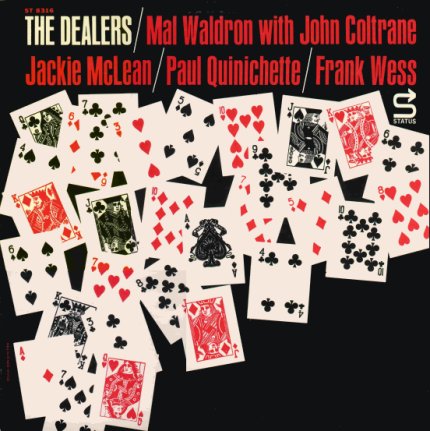
 All of the final takes m this session were on the Prestige album Wheelin' and Dealin', credited to the All Stars. The two alternate takes made it to a budget Status album, The Dealers, credited to Waldron and also featuring two cuts from his April 19 session. The alternate takes inevitably made their way onto the CD reissue of Wheelin' and Dealin'. Weinstock must have been moved as I was by the irresistible beat of "Things Ain't What They Used to Be," because it was released as a two-sided 45, under Coltrane's name.
Tuesday, April 04, 2017
Listening to Prestige 253: Gil Evans

According to the excellent Evans biography Castles Made of Sound, by Larry Hicock, Evans's work with Miles was far more extensive than the album credits would suggest. He had input into virtually every recording Miles made, and during his angriest, most anti-white periods, Miles still spoke to Gil nearly every day.
This is Evans's first album under his own name as leader, and if it doesn't register with the same historical force as the Miles Davis sides, it surely registers musically. Evans works with eleven instruments, including some of the Miles Ahead crew (John Carisi, Louis Mucci, Willie Ruff, Jimmy Cleveland, Lee Konitz and Paul Chambers), and including himself on piano (Wynton Kelly had done the Miles sessions). I hadn't realized what a good piano player he was.
But his greatest strength was as an arranger, and a group this size gives him all the room he needs to work with textures, dynamics, the shifting and balancing of parts.
The first day's work was two songs, Irving Berlin's "Remember," and "Ella Speed," a blues ballad best known in its 1944 recording by Lead Belly, and a continuing favorite of folk singers.
"Ella Speed" was rejected. Not "unissued," meaning put on the shelf, but sooner or later it might turn up on a later album or compilation. Rejected. One imagines Bob Weinstock's response: "Hey, Gil, what is this shit? We're a progressive jazz label. If you want to do folk songs, go over and see Moe Asch at Folkways."
But if such was the case, Evans was not dissuaded. He came back a week later for his second session, and this time led off with "Ella Speed." And this time, it was accepted, and it became a part of the Gil Evans canon.
And rightly so. There's something about a simple folk melody that lends itself to being a showcase for brilliant arrangements. Around the same time that Evans was recording "Ella Speed," British jazzman Johnny Dankworth made a record called "Experiments With Mice," in which he played "Three Blind Mice" in the styles of the great bandleaders and arrangers of the day: Billy May, Benny Goodman, Glenn Miller, Gerry Mulligan, Sauter-Finnegan, Stan Kenton. And Victor Borge, on Broadway, was doing baroque and romantic variations on "Happy Birthday to You." And so "Ella Speed" really shows off Evans at his best.
 |
| Miles Davis and Gil Evans |
 Some of Evans' musicians: Willie Ruff was already starting to make a name for himself as half of the Mitchell-Ruff Duo, a name he was to continue to inhabit for the next 50 years. He and Dwike Mitchell became international ambassadors for jazz, the first jazz group to play in China and the Soviet Union.
Steve Lacy was at the beginning of a career that would make him one of the most versatile and widely recorded jazz stars of all time, and he was already showing his versatility, having recorded with Dixieland groups and with avant-gardist Cecil Taylor. He may have been the first significant musician to bring the soprano sax into modern jazz, well before John Coltrane.
Of the lesser known players, Lou Mucci was revered as a teacher. I particularly loved this story from one of his students:
I went to see Louis Prima at the Paramount Theater. The trumpet players had very shiny trumpets and I wanted one. I asked Mr. Mucci if he would give me a note for my parents so that they would buy me a shiny trumpet. He tried my horn and said that I did not need a new horn and that he was doing the Patti Page TV show and he would use my horn.That is a good man.
Gil Evans and Ten was released on Prestige, and later rereleased on New Jazz as Big Stuff.
Order Listening to Prestige, Vol. 1 here.
Subscribe to:
Posts (Atom)