Wednesday, November 24, 2021

Listening to Prestige 596: Booker Ervin


LISTEN TO ONE: Mooche Mooche

 For as long as there has been small group jazz, there have been artists rebelling against its strictures--the "formula" of head-solo-solo-solo-head. Well, it's not a formula, any more than the sonnet or the ballad or the three-act play is a formula. It's a form, and forms persist because they work. They can also be broken, rebelled against, turned inside out, but in a sense that's just a tribute to their durability.

Of course, the reason why the small group, head-solo-solo-solo-head formula works is twofold. First, it works because American music is full of great melodies and great riffs that are a pleasure to play and a pleasure to listen to, and pleasure is at the


heart of all music that lasts. Second, and most important, it works because it gives wonderful musicians a chance to express themselves -- a showcase to be heard in a supportive context, and space to express themselves through tonal quality and improvisational inspiration.

One such wonderful musician who flowered in the 1960s was Booker Ervin. Ervin had burst onto the scene in 1958 in the ensemble of Charles Mingus, with whom he enjoyed a long and fruitful relationship. He had recorded with Mal Waldron and Roy Haynes for Prestige, and with Horace Parlan for Blue Note, and had made three records as leader (for Bethlehem, Savoy and Candid), so he was hardly an unknown quantity when came to Englewood Cliffs for this session, but it was the beginning of his most fertile period, with ten albums for Prestige. 

Prestige in this period was open to a wide range of music, from the free experiments of Eric Dolphy to the soul fundamentalism of Jack McDuff, and the tradition-maintaining sounds of Swingville and Bluesville, but Ervin came perhaps as close as any to the jazz heart of this label. Working with like-minded musicians, he used this premiere performance of his Prestige years to add a new sound to the library of small group masterpieces.

Frank Strozier had the admiration of his peers. Here's tuba virtuoso Howard Johnson:

No one was ever really up to the task of playing with that much technical proficiency, deep harmonic expression and all the while keeping a foot deeply in the blues. For me, Frank is joined by Harry Carney, Benny Golson, Sonny Red and Paul Gonsalves in the league of players who were never imitated because their way was too hard to figure out, much less execute. And at the same time they were as deeply inspirational as some of the widely acknowledged innovators.

He recorded with a wide variety of musicians, but never quite broke through to the level of popularity he deserved. Finally, in the late 1980s, he gave up playing the saxophone and returned to his first instrument, the piano. He never recorded on the piano, but his concerts were well reviewed and appreciated by those who heard them. Then he left music to become a math and science teacher.


Horace Parlan was also a Mingus associate. It was he who first heard Ervin when he came to New York, and recommended him to Mingus, and Ervin played on two records Parlan made as leader for Blue Note. His unique piano style, marked by heavy emphasis on the left hand, was formed by a childhood bout with polio which robbed him of the use of three fingers on his right hand.

I've written about Butch Warren on his one previous Prestige gig, with Walter Bishop Jr. He was much in demand during the early 1960s, but substance abuse and mental health issues caught up with him, and he left the rat race of big time jazz and returned to his home in Washington, DC, where he played but little. 


Walter Perkins began his career in Chicago with Ahmad Jamal, and as leader of his own ensemble MJT+3, which included Frank Strozier. He came to New York in 1962, and immediately became ubiquitous, with several sessions for Prestige alone before signing on for this gig. They included Gene Ammons, Etta Jones, fellow Chicagoan John Wright, and Dave Pike.

I said earlier that the basic small group jazz form has endured because of good musicians and good music. That's in evidence here. Broadway was still yielding up tunes with the feel of standards, such as Jule Styne's "Just in Time," from Broadway (1956) and Hollywood (1960) hit Bells Are Ringing. Fats Waller was the source for "Black and Blue." The others were originals from either Ervin ("Mooche Mooche" and "Tune In") or Perkins ("Mour," which Ervin liked enough to record again for Blue Note), or the two of them together ("No Man's Land"). All good stuff, but I've chosen "Mooche Mooche" as our "Listen to One" for sustained excitement and top notch solos from all concerned.

Exultation! was the title of the Prestige album. Short versions of "Just in Time" and "No Man's Land" were issued as a 45 RPM single, and later added to a 1971 re-release. Don Schlitten produced.

Monday, November 08, 2021

Listening to Prestige 595: Ahmed Abdul-Malik


LISTEN TO ONE: Sa-Ra-Ga' Ya-Hindi

 Ahmed Abdul-Malik moved out of the mainstream and into a stream of his own. At a time when Coleman, Coltrane, Dolphy and others were redefining the mainstream, he was not following their lead, either, although he had played with Coltrane. 

Critics didn't always know what to call his music--which was, like the music of Yusef Lateef, strongly influenced by Middle Eastern music and by his Islamic belief. Even supporters like Dan Morgenstern, who wrote the liner notes for the album, refer to his "Oriental" music, while correctly noting that Abdul-Malik goes his own way:

Thus he has sometimes had to suffer the criticisms of self-styled musicologists on the one hand, and narrow-minded jazz musicians on the other. "These people would say that I was playing things out of place, and that I couldn't discipline myself."


Perhaps these criticisms are part of the reason why Abdul-Malik's recording career was so short. He had essentially stopped recording after 1964, except for a 1973 appearance on a Randy Weston session, where played the oud and took the part of "narrator."

But seen from a distance, Abdul-Malik's music is very much a part of a broader mainstream that has come to encompass world music. It now needs only to be judged as music; and as music, and as jazz, it holds up  very well. 

Morgenstern quotes Abdul-Malik on his attitude toward music:

When I'm playing with a group, my first concern is to blend with it. The objective is to have an open mind -- to try to understand how others feel about music.

Which is interesting in that in his recordings as leader, he is so clearly the leader, creating his own


sound and his own direction. His most constant collaborator is Bilal Abdurrahman, who did not have much of a recording or touring career outside of his work with Abdul-Malik, although he was to have quite a respected career as an educator. But-- again in conversation with Morgenstern, for the liner notes, he talks about wanting to record an album with stride pianist Dick Wellstood, and if that sounds totally fanciful and unlikely, it actually isn't. While they never recorded an album of their own music (whatever that would have been) together, they did play a number of club dates together, and they were part of a band that backed up Odetta on her Odetta Sings the Blues album.

This is a trio session, very much Abdul-Malik's music, and very much, and constantly interesting. The three of them take different roles on different works. Abdul-Malik, who made his mark in jazz as a bassist with enough flexibility to fit in with both Coltrane and Odetta (he's been on Prestige sessions with Walt Dickerson and Dave Pike), also became, as his fascination with Middle Eastern and world music increased, a virtuoso on the oud, an Arabic stringed instrument which is something like a lute, but can also be played as something like a stiar. Aburrahman was adept at a variety of wind instruments, both Western and Eastern; here, he also plays percussion as needed. William Henry Allen was best known for his work with Mongo Santamaria and Roy Ayers. Here he plays bass on the tracks where Abdul-Malik plays oud, and percussion on the other tracks.

The session included four Abdul-Malik compositions and one standard, George Gershwin's "Summertime." Abdul-Malik plays the bass on this one, with Abdurrahman on clarinet and reed flute, and Allen handling the percussion. Abdul-Malik switches to the oud for much of the Middle Eastern-flavored pieces, including "Sa-Ra-Ga' Ya-Hindi," which really qualifies as world music long before the term was coined. "Sa-Ra-Ga" is more or less the Hindi equivalent of "Do-Re-Mi," the names for notes in sur, the Hindustani classical scale of seven notes--the syllables all corresponding to the names of Hindu deities. Abdul-Malik uses the sur scale, and uses the oud in much the way a raga uses the sitar.

I've chosen "Sa-Ra-Ga' Ya-Hindi" for my "Listen to One," because it's so interesting cross-culturally as well as musically, but the whole album is worth some serious listening time. It's a shame that Abdul-Malik recorded so little, because he had so much to offer. And to me, for all its diverse influences, this is very definitely a jazz album, and every cut shows that.

The Eastern Moods of Ahmed Abdul-Malik was a Prestige release. There appears to have been a New Jazz catalog number assigned to it as well, but it was never released on New Jazz. It doesn't appear to have ever been re-released on CD, under the Original Jazz Classics imprint or anywhere else, which is a damn shame bordering on criminal. Ozzie Cadena produced.


Sunday, November 07, 2021

Listening to Prestige 594: Brother Jack McDuff


LISTEN TO ONE: Rock Candy

 This is a big deal in the Brother Jack McDuff story and the Prestige story: the debut of a young man who will be one of the biggest jazz stars of the rest of the century, and on into the next millennium. George Benson would record several Prestige albums with McDuff, and one under his own leadership. before venturing on to stratospheric fame (there aren't many jazz players who have a star on the Hollywood Walk of Fame).

Benson started out as a child prodigy on the ukulele in his native Pittsburgh, taught by his father, although when he switched to guitar, his father let him go his own way--because, as Benson remembers it, his father thought the guitar began


and ended with Charlie Christian. It wasn't until years later that his father finally agreed to listen to him, and Dad had to agree that Charlie Christian had a rival.

Benson played mainly rhythm and blues in local clubs around Pittsburgh, though he did get nudged into more modern sounds when a certain musician used to come to town courting a woman. Stevie Wonder eventually married the girl, but on his trips to town, he would occasionally come and sit in with George. As Benson recalls it, his audiences refused to believe it was really Stevie Wonder, because what would he be doing in a dinky club in Pittsburgh sitting in with a kid guitarist?

It was another established musician who took him out of Pittsburgh, and brought his musicianship to another level. Benson was 19 when Jack McDuff brought him into his band, and he had a lot to learn. He recalled in an interview,

I had just started playing chord changes or jazz tunes, and I didn’t know very much about what was happening. He would have me play lines in unison or harmony with the saxophone player, and they would be at ridiculous tempos. And by the fact that the saxophone player did them, I didn’t question the fact that they could be done. I decided it was just my ability at fault; I’d go home and practise them, play them sideways, until I came up with a way to play these tunes that I didn’t even understand. And eventually I began to fit into his repertoire, and became a valuable member of the group;

It wasn't always easy. McDuff and his longtime drummer Joe Dukes were solid professionals, and very exacting. They would let him have it with both barrels if he didn't measure up, and with no shortage of obscenities.

Finally, after a particularly nasty rant, I snapped: "If y’all don’t lay off, I’m gonna take y’all outside and beat y’all old men up! I’m nineteen years old! Y’all can’t take me! We’re going out in the alley, right now!" McDuff and Dukes just stared at me for a second, then they both pulled out switchblades. But that didn’t stop me: “I don’t care! Y’all don’t scare me! Bring your switchblades into the alley! I’ll beat y’all up anyhow!” Fortunately, cooler heads prevailed: nobody went into the alley, and nobody got beaten up. But it got them off my back.

By the time they got to the Front Room in Newark in June of 1963, Benson had learned a thing or two.

This is one of those rarities--a Prestige live album. In engineering it, they play up the live aspect, with spoken introductions to the tunes, ad libs and a lot of crowd noise. It was a good choice for a live album, as it turned out, though Bob Weinstock and the Prestige team couldn't have predicted just how good at the time. The recording gives you that "present at the creation" feeling when Benson launches into his solo on "Rock Candy," the first tune of the set. There's even a false ending, as McDuff appears to wrap up the tune, followed by a moment of silence, followed by Benson ripping into it, and one can


even imagine oneself at the Front Room in Newark, suddenly looking up and saying "Who is this guy?"

"Rock Candy" would become a staple of McDuff's live sets. He would record it again in 1996 with Joey DiFrancesco, and Benson would record it with his own group in 2006.

The crowd at the Front Room got their money's worth on this night, as the group pulled out all the stops. Well, McDuff didn't pull out all the stops on Gershwin's "It Ain't Necessarily So," although he gives a bravura performance, restricting the organ to its percussive possibilities, while Benson and Holloway take care of the melodic parts.

McDuff never forgot he was a jazzman, but he also never forgot he was an entertainer--a good lesson for the young guitarist. He always included familiar songs with catchy melodies that people would like -- such as "Whistle While You Work," the dwarves' song from Walt Disney's Snow White, with drum work by Joe Dukes that makes one understand why Benson described him as "such a magnificent drummer that there were times I thought he was one of the greatest things that ever happened to mankind."


And "Undecided," a tune written by Charlie Shavers, who was torn between two poetic and evocative titles for his new composition, so he sent it off to his publishers marked "Undecided" -- title yet to come. They, however, misunderstood, thought that "Undecided" was the title, and sent it off to lyricist Sid Robin. The point of no return was reached for the song when Ella Fitzgerald recorded the lyric, and as "Undecided" it became a huge hit for the Ames Brothers in 1951.

McDuff's own compositions are always riff-based and accessible, and one of them, "Sanctified Samba," is an excellent object lesson in something else Brother Jack told the young guitarist:

I learned the blues from my former boss Brother Jack McDuff. He kept stressing, “Man, put some blues in that stuff, man.” I said, “Wait a minute, man, it’s not a blues song.” He said, “I don’t care! Put some blues in it.” I asked him why he liked the blues so much, and he told me that no matter where you are in the world – you could be in America or in China – if you play blues, they understand it.

So that’s why it’s so valuable to me. I’ve experimented with that philosophy over the years and have found that he’s correct. People like the blues no matter where you are all over the world. So it became something that I decided should be a part of everything I did. The blues is like street music. It’s like the language of the street.

This album is a riveting introduction to a budding superstar, but it's also a tight ensemble album, held together by the always masterful Dukes and featuring stellar playing by Red Holloway.

Production was handled by Lew Futterman, a recent Cornell graduate making his producing debut. He would go on to achieve success as an independent jazz producer, and greater success as a rock producer, and mega-success, ultimately, as a real estate developer, thus answering the question, "How can I make millions of dollars producing jazz?"

Brother Jack McDuff--Live! was the title of the Prestige album, with a few cuts not making it. The alternate version of "Undecided" was held off for 1967's Hallelujah Time!, and "Love Walked In" and "The Midnight Sun" appeared on The Midnight Sun, in the same year.  The session threw off its share of 45 RPM singles -- first "A Real Good 'Un" / "Rock Candy," then "Sanctified Samba" / "Whistle While You Work." A few years later, in 1967, "Rock Candy" would be the A side of a 45, with "Grease Monkey," from a different session. The singles are one indication of McDuff's huge popularity at the time; the number of times Prestige brought him back into the studio is another. But, as the song says, fame if you win it comes and goes in a minute. In recent interviews, greying superstar George Benson has had to explain that Jack McDuff was an organist who gave him his first start.

Friday, November 05, 2021

Listening to Prestige 593: Lightnin' Hopkins


LISTEN TO ONE: Stranger Here


 Sam "Lightnin'" Hopkins recorded any time, anywhere, with any musicians, for any label, and for that matter, under any name. Throw in all the nom de session recordings, and the total is anyone's guess, but he may well have been the most recorded of all blues singers. His last time out for Prestige, he was recorded in Texas with local musicians, some of them his road band at the time, and produced by folklorist Mack McCormick. This time he's in New York -- Englewood Cliffs, New Jersey, to be precise -- with Rudy Van Gelder manning the controls, Ozzie Cadena producing, and two first rate jazzmen, Leonard Gaskin and Herbie Lovelle, backing him up.


Both were versatile musicians, at home in a variety of styles. Closest to Gaskin's heart was probably trad jazz, and Lovelle possibly rhythm and blues, but both had played across the board (they'd played together once before, on Gaskin's Prestige All Stars outing). Hopkins's last session had featured Texas drummer Spider Kilpatrick, who was praised in the liner notes to an Arhoolie album:

Finally here was a musician who could follow Hopkins wherever he went, plus one providing a snappier beat that the guitarist could hang phrases of a bit more aggressive nature than usual on.

That was not going to be the case with Gaskin and Lovelle. The Penguin Guide to Blues Recordings describes their accompaniment thus:

they are propulsive rather than responsive and never allow the music to drag.

Either way, it's still Lightnin' Hopkins: clever, wry, passionate, deep in the tradition, and an inexhaustible source of material, much of it made up on the spot, all of it deeply personal, and yet touching on universal themes.

Hopkins, of course, recorded so prolifically that listening to everything he ever recorded would be a Herculean labor. But just listening to the Bluesville recordings reveals a lot. The musical standards of jazz are exacting in the extreme. The cutting sessions in Kansas City speakeasies, at Minton's Playhouse, were designed to weed out all but the most technically adept. The story of a young Charlie Parker being forced off a Kansas City bandstand by Jo Jones throwing a cymbal at him is one of jazz's most enduring legends. So it's understandable that a jazz critic, praising the work of Gaskin and Lovelle, would comment on their ability to "follow his ramshackle, instinctual sense of rhythm quite dexterously, giving Hopkins' skeletal guitar playing some muscle." Hopkins's guitar playing had plenty of muscle, as the instrumentals on this session and the previous Houston session show. More to the point, Hopkins's professionalism is shown in his ability to adapt to the seat-of-the-pants accompaniment of his Texas cronies and the exacting standards of New York jazzmen. 

Naturally, pros like Gaskin and Lovelle are going to set the tempo, "propulsive rather than responsive" in the Penguin Guide's wonderfully descriptive phrase. As Elvin Jones put it, 

The greatest contribution jazz has made in music has been to replace the role of the conductor with a member of the ensemble who, instead of waving his arms to keep time and convey mood, is an active member of the musical statement. That person is the drummer.


But like the conductor, the drummer is there to serve the music, and the soloist. If you want Lightnin', it's wonderful to hear him in two such different settings. But essentially, if you want Lightnin', you get Lightnin'.

Goin' Away was a Bluesville release, and the two 45 RPM singles that came out of the session were also on Bluesville: "Business You're Doin'" / "Wake Up Old Lady" and "Goin' Away" / "You Better Stop Her." Jazzdisco, my main discographical source, began with its 1963 listings to include release dates, so I know that both the singles were released in 1963, and apparently quite close together: their serial numbers are Bluesville 45-823 and -824. 


Thursday, November 04, 2021

Listening to Prestige 592: Shirley Scott


LISTEN TO ONE: Out of It

 Shirley Scott gives us all we've come to expect from her, in a solid package. Original tunes, solid renditions of standards, Familiar cohorts. Major Holley played on her has album with Stanley Turrentine, and Roy Brooks has become her g0-to drummer, a fixture on her last three albums, and Horace Silver's regular drummer from 1959-64.

Scott, as always, gets all there is out of an organ, including some church licks on "Out of It." There's a reason why Prestige kept bringing her back to the studio--and they weren't the only ones. During 1963, she also recorded for Blue Note (with husband Stanley Turrentine) and for Impulse! She always delivered.


Ozzie Cadena produced, and the album was called Drag 'em Out. "Out of It" and "The Second Time Around" (written by Sammy Cahn and Jimmy Van Heusen for a 1960 Bing Crosby movie) were the 45 RPM single. 

Friday, October 22, 2021

Listening to Prestige 591: Claude Hopkins


LISTEN TO ONE: Stormy Weather


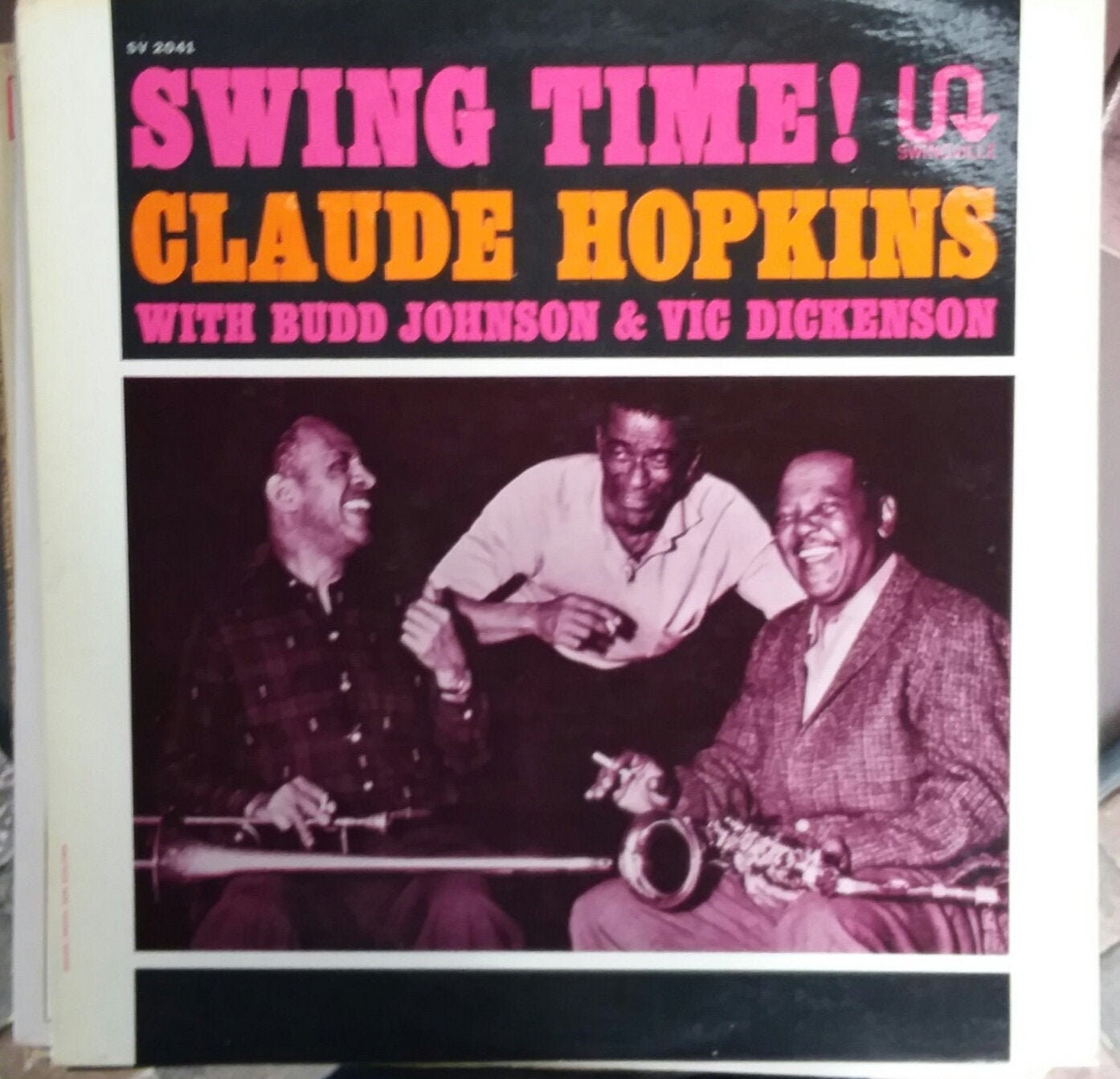
 Claude Hopkins had a long and distinguished career as pianist and bandleader, but live music is evanescent, and so are the reputations based on it. Lasting reputations are built on recorded music, so it'sm thanks to Prestige and Swingville that Hopkins is chiefly remembered today -- with the Swingville All Stars, backing up Bud Freeman and Lonnie Johnson, and most indelibly for the three albums he recorded as leader: Yes Indeed!, Let's Jam, and this final one, Swing Time! Esmond Edwards gave him great support for the first two (Buddy Tate, augmented by Chu Berry on Yes Indeed! and Joe Thomas on Let's Jam), and Don


Schlitten, not to be undone, gives him a masterful group here, led by Vic Dickenson and Budd Johnson.

Hopkins had the kind of career that jazz fans and jazz historians can dream about, and conjure up a mythos around -- musical director of Josephine Baker's ensemble in Paris (which included Sidney Bechet),  leader of a 1930s band which included Vic Dickenson and which had long residencies at the Cotton Club and Roseland. But to actually hear him, these recordings are the place to go. Swing Time! includes two Hopkins originals plus the kind of old chestnuts that, when they're in the hands of masters, you never get tired of hearing. 

New to Prestige are trumpeter Bobby Johnson and drummer


Ferdinand Everett. Johnson was a much-in-demand section man who played with Duke Ellington, Billie Holiday and Erskine Hawkins, among others. Everett's only record date appears to have been this one, but he carries his weight.

Friday, October 08, 2021

All That Jazz quiz

 A quiz about literary jazz references.


Goodreads Quiz
All that jazz
taken 3 times
15 questions

Wednesday, October 06, 2021

Listening to Prestige 590: Jimmy Witherspoon


LISTEN TO ONE: Lonely Boy Blues

 Ah, what says the blues like a song by Mack David ("Bibbidi-Bobbidi-Boo") and Jerry Livingston ("Mr. Ed"), written for Teresa Brewer to sing in Those Redheads from Seattle? And in fact, when Jimmy Witherspoon gets through with David and Livingston's "Baby, Baby, Baby," it would be scarcely recognizable by any redhead from Seattle, or, most likely, by the composers. Witherspoon was the real thing as a blues singer, but he was also eclectic. Even in the rhythm and blues decade of the mid-1940s to mid-1950s, he performed largely with jazz musicians, and for jazz audiences. How many other blues singers started their careers in Calcutta, India?


Witherspoon had left his home in Arkansas as a teenager, for Los Angeles and the music scene on Central Avenue, where he became a protege of Big Joe Turner, and hung out with jazzmen like Buddy Colette, who remembers that whenever Witherspoon sat in with his group, the audiences loved him. Then Pearl Harbor happened, and in 1941 he joined the U.S. Merchant Marine. As a cook--this was still the pre-Harry Truman segregated armed forces. The sea led him to south Asia, where he would meet up with Teddy Weatherford.

Like many African American musicians of his era, Weatherford went the expatriate to Europe, settling first in Amsterdam. Like very few others, he didn't stop there, but continued on to Asia, where joined the band of another peripatetic expatriate, Crickett Smith, then Ceylon (Sri Lanka) and India, where he led his own bands (Smith was now playing for him), and developed a sufficient reputation that he was tapped to make wartime broadcasts for Armed Forces Radio. It was on these broadcasts that young Witherspoon got his first exposure. Weatherford, a wonderful piano player and bandleader, never got a chance to develop the reputation he deserved, dying in Calcutta in 1945 at the age of 41.

Witherspoon did return to the USA, and the West Coast, after the war, where he became a regular feature of Cavalcade of Jazz, an annual all-star jazz festival held in Los Angeles. He performed as part of the Cavalcade in 1948, 1949, 1951 and 1952. 

This outing for Prestige was Witherspoon's first foray into East Coast jazz. His most recent recordings had been for Frank Sinatra's Reprise label,  where he made a record of mostly jazz standards Teddy Edwards and Gerald Wiggins, then a record of blues standards with Ben Webster; and before that with the Bihari brothers' Crown, one of the West Coast's premiere rhythm and blues labels. 

Bob Weinstock and Ozzie Cadena gave him a first-rate lineup of jazz musicians. Leo Wright had distinguished himself on two previous outings for the label, with Dave Pike and Jack McDuff. Gildo Mahones was fast becoming one of Prestige's go-to session musicians, and would record a couple of albums as leader on the label; so was Jimmie Smith. George Tucker had already established himself. And it's hard to heap more praise on Kenny Burrell.

And an eclectic lineup of tunes, tilting toward rhythm and blues. Duke Ellington wrote "Rocks in My Bed," but it's most closely associated with blues shouter Big Joe Turner, who made the original recording with boogie woogie piano player Freddie Slack. 'Bad Bad Whiskey" and "One Scotch, One Bourbon, One Beer" were both hits for Amos Milburn, the former penned by Milburn, the latter by Rudy Toombs, one of the key songwriters for Atlantic Records as the label rose to rhythm and blues supremacy. "Mean Old Frisco" came from another rhythm and blues great, Arthur "Big Boy" Crudup. All of them find the Prestige jazzmen playing that fine R&B behind 'Spoon's hard driving vocals.

Two other blues traditions come front and center with "Sail on, Little Girl, Sail On" and "Lonely Boy Blues." The former comes from traditional Piedmont blues singer Amos (Bumble Bee Slim) Easton, and Witherspoon gives it a heartfelt traditional treatment, with Gildo Mahones providing the appropriate backing. The latter comes from Kansas City swingmaster Jay McShann and his vocalist Walter Brown. It's a twelve bar blues, and Leo Wright's alto winds in and out and around Witherspoon's vocal. The traditional twelve bar form is also heard on 'Spoon's own "Blues and Trouble," with everyone in the band getting a piece of the action.


Prestige filled out the LP with four cuts from a later session back in Witherspoon's old West Coast stomping grounds, under the guiding hand of David Axelrod, who had just begun producing records for Capitol, where he nudged the label in the direction of more black artists, scoring hits for Lou Rawls and Cannonball Adderley (he produced "Mercy, Mercy, Mercy") among others. With some excellent West Coast jazz musicians, they did two Witherspoon originals, a traditional blues, and one outlier, the rockabilly hit "Endless Sleep," a tune which Witherspoon had apparently liked enough to record a few years earlier for a smaller rhythm and blues label.

Most of the West Coasters are off Prestige's normal radar. Bobby Bryant did appear on a 1960 Eddie "Lockjaw" Davis release. Ernie Freeman was the best-known of the group. He boasted a master's degree in music composition from the University of Southern California, and a trunkful of credits as pianist, arranger and bandleader, mostly in the rhythm and blues field. Jimmy Bond was another conservatory trained musician (Juilliard), with extensive jazz credits on the East Coast, who moved to California in 1959 and built a second career there, both as a jazz musician and as a member of the Wrecking Crew, the session musicians who crafted the West Coast rock sound of the 1960s. Arthur Wright was one of the leading West Coast session musicians for blues and R&B, mostly as a guitarist. It's not clear whether Jimmy Miller is the same drummer/arranger who contributed a great deal to the Rolling Stones sound in the late 1960s.

Ozzie Cadena produced the East Coast session. The redheads from Seattle got the album's title, Baby, Baby, Baby, and that was also one of the 45 RPM singles, with "One Scotch, One Bourbon, One Beer" on the flip side. "Mean Old Frisco" / "Sail on Little Girl" also got a single release.

Thursday, September 30, 2021

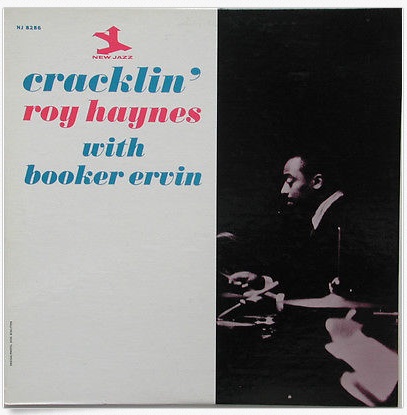
Listening to Prestige 589: Roy Haynes with Booker Ervin


LISTEN TO ONE: Scoochie

Booker Ervin had been in the studio for Prestige earlier in 1963, for a session with Larry Young, that was inexplicably shelved, not to see the light of day until many years later, in the CD reissue era, when it was coupled with an Ervin-Pony Poindexter recording which was made later in the year. He had appeared on one previous New Jazz recording, with Eric Dolphy and Mal Waldron. He was to become a mainstay of Prestige over the next few years.

Roy Haynes was already a Prestige mainstay, appearing with musicians covering the spectrum


from Willis Jackson to Phil Woods to Eric Dolphy. He'd played soul jazz with Shirley Scott, harp jazz with Dorothy Ashby, blues with Sonny Terry and Brownie McGhee, and a little bit of everything with master of eclecticism Jaki Byard. 

He had led his own trio (Phineas Newborn, Paul Chambers) in 1958, for a particularly beautiful album, We Three, and followed it in 1969 with another trio album (Richard Wyands, Eddie de Haas), Just Us. He had put together a couple of earlier sessions as leader with Mercury/EmArcy, and one with a smaller independent label. He told Ira Gitler that wanted to do more work as leader, because he could "set more of a pace," or as Gitler put it, he could "[pick] the tunes, the order they should be programmed in, and the tempo they should follow. The last, of course, is closest to the drummer's domain. Before he can do any of these things, a leader has to make his most important decisions--choosing the men who will play with him. Haynes has chosen well in the past, and his current quartet again reflects his good taste."

For his first Prestige album, Haynes had chosen two of the finest--and most talked about--of the younger musicians on the scene. For his second, he chose musicians who would never have the honors or name recognition of Phineas Newborn and Paul Chambers, but who were bold and sensitive, and delivered the music that Haynes was looking for. A 1962 session for Impulse! featured the rising star Roland Kirk.

Here, in Booker Ervin, he has another rising star, that would blaze forth through the rest of the 1960s on albums for Prestige and Blue Note, before Ervin's untimely death from kidney disease in 1970.

At 28, Ronnie Mathews was another young talent, and one who apparently appealed to the era's finest drummers--he had been discovered by Max Roach, and also worked extensively with Art Blakey. He had made his recording debut for Prestige in 1961 with Roland Alexander, and would lead a session of his own for the label later in 1963.

Larry Ridley was 26 when this record was made, and he had a fine career as a bassist ahead of, playing with Chet Baker, Kenny Burrell, Dexter Gordon and Stephane Grappelli among others, but perhaps an even more important contribution to the music was his work as an educator and administrator. He served as (and I'll just quote his Wikipedia entry here):

chairman of the Jazz Panel of the National Endowment for the Arts (NEA) and was the

organization's National Coordinator of the "Jazz Artists in Schools" Program for five years (1978–1982). Ridley is a recipient of the MidAtlantic Arts Foundation's "Living Legacy Jazz Award", a 1998 inductee the International Association for Jazz Education Hall of Fame (IAJE), an inductee of the Downbeat Magazine Jazz Education Hall of Fame, a recipient of the Benny Golson Jazz Award from Howard University, and was honored by a Juneteenth 2006 Proclamation Award from the New York City Council. Ridley is currently the Executive Director of the African American Jazz Caucus, Inc., an affiliate of IAJE. He is also the IAJE Northeast Regional Coordinator. He continues to actively teach as Professor of Jazz Bass at the Manhattan School of Music. Ridley is currently serving as Jazz Artist in Residence at the Harlem based New York Public Library/Schomburg Center for Research in Black Culture. He established an annual series there dedicated to presenting the compositions of jazz masters that are performed by Ridley and his Jazz Legacy Ensemble.

  Haynes also utilized the composing talents of the musicians he brought in. Ronnie Mathews composed "Dorian" and "Honeydew." Booker Ervin contributed "Scoochie," and Haynes finished the session with his own "Bad News Blues." Randy Weston is represented by his tribute to Melba Liston, "Sketch of Melba."  


They play one semi-standard, "Under Paris Skies," originally composed by Hubert Giraud for the French film Sous le Ciel de Paris, later recorded by Edith Piaf. With English lyrics, it became a favorite of vocalists and mostly of sweet-music dance bands, although it has had some jazz adherents, most prominently Duke Ellington. Art Van Damme and Quincy Jones both also recorded it. Haynes liked the tune, and featured it in his club performances, often with Frank Strozier soloing on flute. Haynes's virtuoso lead-ins are a strong feature of all the tracks on this album, but on this one he really goes to town, driving all thoughts of sweet strings out of your head. Larry Ridley joins him on bass before--over thirty seconds in--Ervin enters, playing the familiar melody, and sticking mostly close to the melody for a full three minutes, as Haynes continues to kick it hard. The real improvisation starts with Mathews, and continues with Ervin, until the head is briefly restated at the end, this time by Mathews, perhaps somewhat sardonically. 

"Bad News Blues" is a first rate example of what sound engineer Rudy Van Gelder used to call a "five-o-clock blues" -- it's the end of a session, we've played all the tunes we came in with, let's just play some blues. Prestige founder and president Bob Weinstock loved a good jam session, and a lot of good ones came out of this approach, with "Bad News Blues" being a prime example, Haynes setting the pace and everyone getting some room to blow.

Mathews's "Dorian" is in the Dorian mode, the minor-key modal structure made most famous by Miles Davis's "So What" and here turned into a moody, emotionally stirring piece, particularly in Mathews's own solo. All of this is taken at a quick tempo, not what you'd think of as the first choice for moody introspection, but it works. "Honeydew" is altogether different, with Ridley playing the blues right out of the gate, with Mathews and Ervin joining to create a full-bore, major scale excursion into rhythm and blues with Haynes providing a complex but driving alternative to the back beat.

"Scoochie" is Ervin's, and it is not only scoochie, it is downright scorchy. Ervin had introduced the tune a few years earlier in the sculpture garden of the Museum of Modern Art, in a group led by Teddy Charles and also featuring Booker Little. If that rendition scooched the statues into life, this one would have scorched and singed them, with Haynes providing the beat, Ervin flying high, and Mathews turning in a piano solo that echoes and extends what Teddy Charles did in the Garden.

Haynes had entered a phase of his career where he wanted to work more as a leader, with his own groups, but he was only to make one more record for Prestige, and then one for Pacific Jazz, and nothing else in the 1960s, though the 1970s were a much more fruitful decade for him in the leader role, and he was to continue as a jazz stalwart, and a jazz legend, into his 90s.

Cracklin' was the title of the New Jazz album release,and the title credit was Roy Haynes with Booker Ervin. The two Mathews compositions, "Dorian" and "Honeydew," were a 45 RPM single. Ozzie Cadena produced.

Monday, September 20, 2021

Listening to Prestige 588: Willis Jackson


LISTEN TO ONE: After Hours


LISTEN TO ONE: Gator Tail

 Willis Jackson worked a series of recording sessions for Prestige in 1963 and 1964 with his working band at the time: Carl Wilson on organ, Frank Robinson on trumpet, Bill Jones on guitar, Joe Hadrick on drums. They weren't musicians who had recording careers outside of these sessions with Jackson, and I could find no biographical material on any of them, but they knew how to play Jackson's kind of music, or they wouldn't have stayed with him, because Jackson's was an ensemble that always found work. 

Jackson's best-known ensemble, the one he brought to Prestige in 1959, featured Jack McDuff as organist, and he was a tough act to follow, but Jackson didn't put his side men into a cookie cutter. Wilson is his own man on organ, and his own man is a wild man.

For the second of these Prestige sessions--and thereafter--Bill Jones was replaced by  a guitar player named Pat Azzara, who would go on to make a name for himself, only the name wasn't Azzara. He was to change it to Pat Martino.

The ensemble, with different bass players, would record five studio sessions and one live, a date that makes Miles Davis's contractual marathon look like the Minute Waltz. This was four sets at the club Allegro in New York City, and Prestige recorded them all, and released them all on four albums. And why not? This was a working band, that toured hard and played hard, and audiences loved them. They could play all night, and it could have been, and should have been, and was saved for posterity.

The LP from the March session was entitled Loose. It followed Jackson's template, and set the pattern for all the sessions to follow--some standards, some recent hits ("When My Dreamboat Comes Home" was both--an old song refurbished for the young crowd by Fats Domino), some riff-based rhythm and blues, or as we now called it, soul jazz. Jazz with a beat. "Secret Love" became a two-sided 45 RPM single, and "Y'All" was the flip side of "Arrivederci Roma" from an earlier session.

The two May sessions were parceled out to two LPs, Grease 'n' Gravy and The Good Life. The 45s were "Gra-a-avy" / "Brother Elijah" and "Troubled Times" / "As Long as He Needs Me." The October session became More Gravy, with the title tune and "Pool Shark" broken out on 45. January of 1964 became Boss Shoutin'. The teenaged Mr. Azzara, making his recording debut, is described in H. G. MacGill's liner notes as "a combination of early Kenny Burrell, Tiny Grimes, a little Jimmy Raney and the beginnings of a highly original style of his own."

Each of the Allegro sets went onto its own album--Jackson's Action! Recorded Live; Live!Action; Soul Night Live!; and Tell It.... "Jive Samba" from the first set, two-sided, was the only 45 RPM release. All of the live sessions, when re-released on CD, were credited to Willis Jackson with Pat Martino.

Ozzie Cadena produced all, including the live sessions.


Sunday, September 19, 2021

Listening to Prestige 587: Rhoda Scott


LISTEN TO ONE: I-Yi-Yi-Yi

Newark's Key Club was a home base for Rhoda Scott, Joe Thomas and Bill Elliot, who were from Newark and had gotten their start there. Scott was destined to make her home, and her career, and her major reputation far from Newark, when she moved to France in 1969 and began a series of performances that would go on for decades and make her one of the most popular entertainers in Europe. But in 1963 she was still one of the most popular entertainers in Newark, and Newark was still a city with a jazz tradition, and her fans were packing the place, ready for that all-systems-go sound that Scott, Thomas and Elliot always delivered.


Scott and her trio were signed to Tru-Sound, Bob Weinstock's "modern rhythm and blues" label, and they delivered--raucous, jarring, uptempo, not necessarily what you'd think of a jazz and not necessarily what you'd think of as rhythm and blues, but Newark was never known for genteel manners, and this trio delivered a solid home town sound--all the more so for being live. Prestige rarely went into live recordings, but it's not hard to see why this one seemed like a good idea. 


The Tru-Sound album was called, of course, Live at the Key Club, and the single from it was "I-Yi-Yi-Yi," parts 1 and 2. Ozzie Cadena produced.

Friday, September 17, 2021

Listening to Prestige 586: Lucky Thompson


LISTEN TO ONE: Who?

 Lucky Thompson was associated with an earlier era of jazz (although he was only 39 at the time of this recording): he'd played with Lionel Hampton, Don Redman, Billy Eckstine, Lucky Millinder and Count Basie. His time with Eckstine coincided with that of Charlie Parker and Dizzy Gillespie, and like so many of that era and that influence, he moved into bebop. He had recorded once for Prestige, a 1954 session with Miles Davis.

Also like many of that era, who grew increasingly frustrated with the racism of American society and the avarice of the music industry, and moved to Paris in the mid-1950s. His debut with Prestige (he would record three albums altogether) came shortly after his return to the States.


His association with the jazz of earlier times (just a few years earlier was already being thought of as earlier times) may have been what prompted Prestige to suggest an album of Jerome Kern, and to release it on Moodsville.

There's nothing wrong with devoting an album to Jerome Kern, one of our greatest and most subtle composers. And nothing wrong with a Moodsville release, either--the subsidiary label was home to some great albums by major artists. But I'm not sure that this really a Moodsville album. Thompson was a true bebopper, and this album is in the tradition--fast tempi, bravura solos. Somewhat outside of the bebop mainstream was his choice of the soprano saxophone as a lead instrument -- perhaps the Paris influence of Sidney Bechet.

Anyway, Moodsville or no, it's great that Thompson is back in the States (he would leave again in a few years), playing with some wonderful musicians.These years of Moodsville and Swingville led to the recording of musicians who might not otherwise have been recorded in this era, by an important independent label with good distribution. Dave Bailey is the new face here, and this was to be his only Prestige session. Best known for his work with Gerry Mulligan, Bailey is another of those jazzers with an interesting day job. In 1969 he retired from music to become a flight instructor.


The album is called Lucky Thompson Plays Jerome Kern and No More because, in fact, there was one more -- a Thompson original entitled "No More." "Who?" and "Lovely to Look At" became a 45 RPM single on Prestige. Don Schlitten produced.

Listening to Prestige 585: Kenny Burrell - Jack McDuff


LISTEN TO ONE: Call it Stormy Monday

 This session has a little something for everyone, with the soul jazz organ of Jack McDuff teamed up with the technical wizardry and stylistic range of Kenny Burrell, and the brilliant Latin percussion of Ray Barretto thrown into the mix for good measure.

Burrell certainly knew how to play with an organ combo, as his long association with Jimmy Smith attests to, and he jumps right in here, starting with the first number on the session, a McDuff composition called "Grease Monkey," which has the fire and energy of the finest rhythm and blues, with Burrell pushing McDuff's riffs, and McDuff creating the kind of riffs that can sustain three and a

half minutes of solid dancing or listening.

"The Breeze and I," by Cuban composer Ernesto Lecuona, is probably more associated with lounge acts than jazz combos, but it's had its share of jazz interpreters too (both Curtis Fuller and Wes Montgomery recorded versions of it at around the same time), and why not? If you have Ray Barretto nailing the mambo beat and Joe Dukes laying down that archetypal soul jazz rhythm, you've got a great start, and then when Kenny Burrell does what he does, which is improvise stunningly while never losing sight of the melody, you come to appreciate what a good melody it it. Lecuona was one of Cuba's leading composers, and the melody which became known as "The Breeze and I" was originally a part of his well regarded Suite Andalucia.

Barretto and Dukes don't stop the carnival, as they tear into "Nica's Dream," Horace Silver's tribute to the jazz baroness and protector of Thelonious Monk. Between the two of them over these two selections, they threaten to turn this into a percussion session to rival Art Blakey at his most intense.


"Call it Stormy Monday" is one of the most recorded of blues songs, but it took a while to get there, and for Walker to start realizing any royalties on what would become his most famous composition. When Woody Herman and his Swinging Herd (then including Bill Harris, Richie Kamuca, Victor Feldman and Vince Guaraldi) released the first cover version in 1957, ten years after Walker first recorded it, there weren't many blues classics because nobody much was recording cover versions of great blues songs. When Herman recorded his Blues Groove album for Capitol, whoever wrote the blues for the back sleeve was had to find a way to sell the concept, and he came up with "Woody Herman and his Herd combine the beat of rock and roll with the dynamic sounds of swinging jazz." Jazz with a beat, as Shirley Scott and Eddie "Lockjaw" Davis described it in the title to their first album together, but not many people were looking to catalog of blues originals for material. Ralph J. Gleason, in the liner notes to Blues Groove, looked forward hopefully but uncertainty: "There may come a time when the blues will be regarded as the true folk art of America."

That was 1957. The blues had already, as Muddy Waters was to point out later, "had a baby and they named it rock and roll," but jazz fans still shunned that birth as illegitimate, and to true music aficionados like Gleason, the mainstreaming of the blues into American culture was still a wistful dream.

Bizarrely enough, the next performer to take it on, in 1960, was Pat Boone. Even more surprising, his version isn't bad, with Boone adding some crooner's touches, but respecting the blues, and a nice band behind him.

But then it was the 1960s, and Ralph Gleason's dream for the blues started to become a reality. And T-Bone Walker's dream of royalty checks for a great song, as it was recorded by Nancy Wilson, Jimmy Witherspoon, Bobby Bland, and Lou Rawls with Les McCann. Kenny Burrell liked the song so much he would record it again for Prestige the following year, with Shirley Scott.

And also in 1964, "Call it Stormy Monday" was recorded by Alexis Korner's Blues Incorporated, the first British blues band, and that brought it all back home, as the showed the Yanks what the true folk art of America was. 

Burrell and McDuff seize on this classic-to-be as a license to play the blues, and that's what they do. This is soul jazz, yes, but at its heart it's the blues, the whole blues, and nothing but the blues.

Most of this session went onto the LP Crash!, credited to Kenny Burrell with the Brother Jack McDuff Quartet. "Moody McDuff" went on to a 1966 McDuff album, Steppin' Out, which is interesting because it pulls together tracks from five different sessions utilizing three of jazz's greatest guitarists, all of whom worked with McDuff at different stages of his career: Burrell, Grant Green, and George Benson. Apparently by the time the album was released, Burrell had already stepped out of his Prestige contract and into an exclusive contract with another label: he is credited as K. B. Groovington. "The Breeze and I" and "Nica's Dream" were released on 45 RPM. Ozzie Cadena produced.


Sunday, September 05, 2021

Listening to Prestige 584: Etta Jones


LISTEN TO ONE: Some Enchanted Evening

 Another artist wrapping up her career with Prestige in early 1963 was Etta Jones, with two sessions in February added to three songs recorded the previous November to put the final touch on this phase of her career, but Prestige would stay with her. After bouncing around a few other labels, she would reconnect in 1975 with Joe Fields, who had been Prestige's sales manager, but had now started a jazz label of his own, Muse. And after two decades and 14 albums, when Fields left Muse to start a new label, HighNote, she went with him, and recorded nine more albums.


Jones never quite hit the heights of popularity of the big four -- Sarah, Ella, Billie and Dinah -- but she maintained a loyal fan base--and the respect of the jazz community--in a career that lasted six decades, and into a seventh, as she made her final recordings in 2000. Her approach blended elements of all four of them, particularly Billie Holiday and Dinah Washington, but her voice was her own, and she never sounded derivative. 

The two sessions used talents of Larry Young, about to break loose as a new and distinctive voice in jazz organ when he signed with Blue Note in 1964, and Kenny Cox, new on the scene. Cox was a Detroiter, too young to have been part of the Detroit influx that made such a huge imprint on the jazz scene of New York, and from there the world, starting in the 1950s, but still very much a product of that scene. This was his first collaboration with Jones, but he was to stay with her until 1966 as pianist and musical director. He later made two albums for Blue Note, but his roots were always in Detroit, and by the 1980s he had returned home to male the rest of his career there.

Kenny Burrell also played on both sessions. The group was anchored by two solid rhythm sections--George Tucker and Jimmie Smith on February 4th, Peck Morrison and Oliver Jackson on the 12th. "Someday My Prince Will Come" and "Old Folks" are taken without the piano and organ.

Jones takes in a nice variety of tunes over the two days, with a nod to Miles Davis, who introduced


"Someday My Prince Will Come" to the jazz lexicon, and also did a definitive version of "Old Folks," and a salute to Rodgers and Hammerstein. This last is particularly noteworthy. Jones possesses that special jazz singer's ability to take a wide range of songs and make them her own, but "Some Enchanted Evening" seems like a real stretch. From South Pacific, the song was originally written for the operatic bass voice of Ezio Pinza, and it's hard to imagine a bluesy jazz arrangement of it, with an improvisation off the melody...until you've heard Jones do it.

"Some Enchanted Evening" did not make a 45 RPM release. The two singles each featured one of the  Miles borrows. "Someday My Prince Will Come" was matched with "A Gal From Joe's," from her November 28, 1962, session; "Old Folks" had "Love Walked In" on the flip.

The album was titled Love Shout. Ozzie Cadena produced.

Saturday, September 04, 2021

Listening to Prestige 583: Frank Wess


LISTEN TO ONE: The Long Road

 This album wraps up Frank Wess's run with Prestige--in fact, it was his last recording session as a leader for the rest of the 1960s, although he continued to work steadily, with Count Basie, whom he had joined in the early 1950s and would stay with until 1964, and then with Clark Terry's big band. He brings two Basie bandmates with him, Thad Jones and Buddy Catlett, and they play a brand of jazz that was not the fashionable soul jazz or the disturbing free jazz of the time, but represented a mainstream of jazz that has never failed to find adherents and listeners, drawing on the Kansas City swing of Basie and Lester Young


and Coleman Hawkins, but even more on the modern sounds that were being explored by Miles Davis and Cannonball Adderley, Stan Getz and Gerry Mulligan. So while these Basie stalwarts bring a lot of Basie with them, they aren't just playing small group interpretations of Basie arrangements. There's a little of that in their music, but more of it is the classic jazz dynamic, head-solo-solo, that people come out to clubs to hear, to sit in close proximity to the musicians and get an intimate glimpse into their voices and personalities, to be present at the creation of improvisational ideas and the immediacy of musicians inspiring each other, as a master jazz player takes an idea, explores it, and hands it off to the next player to continue the exploration.

You get all of that throughout this session, but to particularly good advantage on "The Long Road," one of three Wess compositions (the other two are "Yo-Ho" and "Cold Miner"), where all five musicians have their chances to shine. Wess plays tenor on "The Long Road," flute on much of the rest of the album. Jones contributes one tune, "The Lizard."

The album was somewhat clunkily titled Yo-Ho! Frank Wess, Poor You, Little Me. A 45 RPM single release featured "Little Me," by Cy Coleman and Carolyn Leigh, the title song from the popular Broadway musical of the time, with Wess's "Cold Miner" on the flip. Ozzie Cadena produced.
Thursday, September 02, 2021

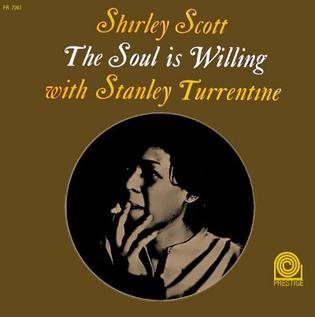
Listening to Prestige 582: Shirley Scott - Stanley Turrentine


LISTEN TO ONE: I Feel All Right

 Shirley Scott returns with a new soul collaborator and a new soulmate—her new husband, Stanley Turrentine. Turrentine was signed to Blue Note, but the two labels were friendly rivals—Blue Note’s Alfred Lion had given Bob Weinstock the push that moved him to start Prestige and get into the jazz recording business. So the two labels worked out a deal whereby the happy couple would record for both of them—Shirley as nominal leader for the Prestige sessions, Stanley for Blue Note. Both labels, of course, utilizing the genius of Rudy Van Gelder in the recording studio. Both continued to have separate careers, as well.


Married in 1960, they began collaborating in 1961, at a point where they had worked out their marital contracts, but not, apparently, their recording contracts to everyone's complete satisfaction. On their first session together, for Blue Note in June, she is listed as Little Miss Cott, with a knowing wink in the liner notes (Stanley and Little Miss Cott "really have something going. It is akin to a musical love affair") and even more knowing wink with the album's title and its title cut (Dearly Beloved). By November, when they made their first recording for Prestige, he was still listed in the session log with a pseudonym (Stan Turner) but by the time the album was released in 1962, an arrangement had been struck, and Turrentine is credited under his real name, with acknowledgment that he appears courtesy of Blue Note Records.

This session was recorded on January 10. Just over a week later, on January 18, the two of them were back in Englewood Cliffs to record for Blue Note (a short session, with two of the four tracks rejected), and in February they were back again for Blue Note.

Major Holley, who had been aboard for an early January Turrentine session with Kenny Burrell, for


Blue Note, played on the Prestige session, sat out the January 18 Blue Note session, and was back again for the February session. Scott liked to work with a bass player, which was not the case with all jazz organists--many of them preferred to take care of the bass line themselves. In fact, during this period, when the organ was becoming really popular as a jazz instrument, many bandleaders preferred to hire an organist as their keyboard player. With the bass part taken care of, it meant one less musician's salary to deal with. Holley was a recent addition to the Prestige stable, having recorded four albums with Coleman Hawkins.


The drummer on this and one more Scott-Turrentine session, but not on the Blue Note sessions, was Grassella Oliphant, a newcomer to Prestige and a new name to me--in fact, I thought at first that Scott had hired a woman drummer, but the first name was misleading. He was generally known by friends and associates as Grass, and that played nicely into the two albums he made for Atlantic as a leader, The Grass Roots and The Grass is Greener. Oliphant was a veteran by the time he hooked up with Scott and Turrentine. He had worked with Ahmad Jamal in 1952, and later with Sarah Vaughan. Vaughan praised him for his nice and easy touch with the brushes, and one imagines he probably was valued by Jamal for much the same reasons. One would not immediately seize on someone with those credentials as a soul jazz drummer, but Oliphant's contributions on this album, particularly his work on the ride cymbal, are exactly what's needed.

Oliphant worked through the 1960s and then basically retired from the jazz world to raise a family. The retirement stretched to nearly 40 years, but he picked up his career again in the new millennium, and was active until his death in 2017.

The most important name in this quartet, of course, is Stanley Turrentine. The Scott- Turrentine marriage lasted ten years, so it must have had some harmony to it, but their musical partnership was definitely harmonious. Scott was one of the pioneers of the soul jazz organ, and, with Eddie "Lockjaw" Davis, one of the pioneers of the organ-tenor sax combo, and as soul jazz became a more and more dominant sound in the early and middle 1960s, her partnership with Turrentine kept her right in the thick of it.

Stanley Turrentine began his career with Earl Bostic, and Bostic's bluesy lyricism was definitely an influence, but he was definitely a man of his time, with a full tenor sound and a soulful bent. All that can really be heard on "Secret Love," the movie ballad by Sammy Fain and Paul Francis Webster, popularized by Doris Day, a tune that Bostic might have recorded but didn't. Turrentine leads off with the head, full-toned and lyrical in the Bostic style, albeit a little more uptempo and with some kicking work by Oliphant. He then goes into an improvisation which keeps much of the same feeling, with some punctuation by Scott. When Scott enters, she brings what only Scott can.

I've always heard a different approach to the organ in Shirley Scott's work. The soul jazz organists, and the were an incredibly talented bunch, mostly played the organ as a keyboard instrument with special properties--which of course it was. But Scott seemed to me, more than the others, to be intrigued with finding out all the different things an organ could do. It made for an exciting blend with Davis's raunch, and it makes for an exciting blend with Turrentine's lyricism.

Much of this album is taken up with an unusual and interesting blend of standards, given the soul jazz treatment. You might not expect "Secret Love" to be all that soulful, but others have done it successfully, including a doo-wop version by the Moonglows, and Scott and Turrentine breathe soul into it. Going back a little further, they pluck a tune by Sy Oliver that was first recorded in 1941. Oliver had just been pirated from Jimmie Lunceford's orchestra by Tommy Dorsey, looking to add some serious swing to his ensemble, and in the 1941 version by Dorsey, with Oliver and Jo Stafford handling the vocals, you can hear the beginnings of soul, that would be developed in the 1950s by Della Reese, the Pilgrim Travelers, Ray Charles (especially!), Pat Boone, Kate Smith...what? OK, maybe not everyone who recorded it gave it soul. But Scott and Turrentine certainly do.

They go back to 1925 for an Irving Berlin favorite, "Remember," which was actually recorded by Earl Bostic in 1955, when Turrentine was in the band (he had replaced John Coltrane). Bostic's version gives him a chance to show his raunchy rhythm and blues side, and Turrentine and Scott take it from there.

They pay homage Wild Bill Davis, the pioneer of soul jazz organ and an early influence on Scott. 

But they reach their soul summit on this album with two Turrentine originals, "The Soul is Willing" and "I Feel All Right." I wonder if they had originally been planning to make 45 RPM single releases out of the two recent chart hits, "Secret Love" and "Yes Indeed." Maybe they did, and maybe "The Soul is Willing" and "I Feel All Right" were just so damn soulful that nothing else would do. Anyway those were the two 45s, and each of them two-sided, Parts 1 and 2, so nothing needed to be edited down.

The Soul is Willing was the name of the album. Ozzie Cadena produced.


originators of the Philadelp

Thursday, August 19, 2021

Listening to Prestige 581: Jack McDuff


LISTEN TO ONE: Somethin' Slick album version


LISTEN TO ONE: Somethin' Slick 45 RPM version

 Jack McDuff welcomed in the new year with a January 2nd session in Englewood Cliffs featuring an eight piece band, which apparently didn't go so well. Only two tunes were recorded, one of which was unissued, the other of which eventually made it onto a compilation album called The Soul Giants. It was one of Prestige's PRST releases of the late 1960s and early 1970s--tracks re-engineered for stereo release, not always successfully. 

He was back again a week later, on January 8, with a different lineup, only tenorman Harold Vick and his regular drummer Joe Dukes. McDuff was by this time solidly into the soul jazz groove that would make him one of the most popular jazz artists of the decade. 

It's hard to say what could have gone wrong with the January 2 octet session, with some first rate musicians aboard, but by the time the following Tuesday had rolled around, he had a tight group of players who knew just what to do. Joe Dukes was steadily building a reputation as one of the premier soul jazz drummers. He would make a career, and a good one, as Brother Jack's drummer, and pretty much fade out of sight as the the soul jazz decade of the 1960s came to an end. 

Harold Vick was to make his first recording as leader later in the year with Blue Note, and would go on to make several albums with as many different labels, never quite seizing the brass ring, but making some solidly good music. He would continue to work with McDuff through 1964. 

Eric Dixon only climbed aboard the McDuff cavalcade for this one session, but he knew how to swing to a solid groove, as his years with Count Basie demonstrate. And Kenny Burrell and Ray Barretto make any session better.

Sometimes it's hard to understand the vagaries of contractual obligations in the recording industry, especially the jazz end of it. Burrell is credited as K. B. Groovington on one track, "Shaky," which was buried until 1969 and finally released on a PRST compilation of McDuff sides from various Prestige sessions, Steppin' Out. . A track from a February McDuff session also ended up on Steppin' Out, so maybe by 1960 Burrell was under contract with a label that precluded the use of his name on compilations? Hard to believe. But I'm not an entertainment contract lawyer.


Five of these tunes--the title tune, "How High the Moon," It's a Wonderful World," "Smut" and "Our Miss Brooks" comprised McDuff's next LP, Somethin' Slick. "Love Walked In" was held over for a subsequent album with Burrell, "Shaky" got shaken down to the stereo compilation, and "Easy Livin' didn't make the cut at all, or at least hasn't yet. It may still end up on some streaming service.

"Somethin' Slick" was released on 45 RPM, at about half the length of the album cut (6:34 to 3:01), and I've included both versions as a sort of Listen to One and Listen to One (a), to demonstrate how a tune was edited down to fit the demands of jukeboxes. There's actually a third version available on YouTunes, a promotional copy sent to DJs, whittled down to 2:53

Saturday, June 12, 2021

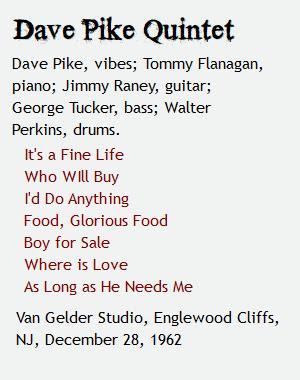
Listening to Prestige 580: Dave Pike


As promised, a new Dave Pike with this, his third and last album for Prestige. Pike would re-invent himself often, like so many jazz musicians in this swiftly moving art form, from Miles Davis on. This, however, is not so much a reinvention as a shift in emphasis, away from the Latin rhythms, on to a more mainstream sound. How much of this was the result of commercial considerations, I can't say. If commercial considerations were the whole story, nobody would be playing jazz, but sometimes a thematic approach -- less tactfully, a gimmick -- may be a way to draw a little more attention to an artist, and sell a few more records.


Nothing wrong with that if, when you get down to making the music, you're there to play and nothing else. Which certainly seems to have been the case with Dave Pike. If you sign a recording contract at height of the bossa nova craze, and management says "Hey, how about a bossa nova album," you might do it just for the contract. That was the case when Bob Weinstock asked Annie Ross if she could write some songs to jazz solos--"I was desperate, so I said 'Sure.' If he'd asked me to learn how to fly, I would have said 'Sure.'" And the rest is history. Two of the greatests jazz vocalese pieces ever -- "Twisted" and "Farmer's Market." And Lambert, Hendricks and Ross. But it seems clear that Pike didn't do it just for the contract. Had that been the case, he wouldn't have chosen to feature the works of obscure (in the United States) composer Joao Donato.


Jazz interpretations of Broadway shows had shown some commercial appeal. Oliver! had been a hit in London, had been on tour in the United States, and was about to open on Broadway, where it would be a success, but would not really spawn any hit songs. "As Long as He Needs Me" had been a British hit for Shirley Bassey, and would later become a minor hit for Sammy Davis Jr. I'm not convinced that a jazz version of Oliver! was a surefire commercial bet in 1963, and I suspect one might not find all that many people today who could hum "As Long as He Needs Me," let alone the rest of the show. So I hope it was a project that really appealed to Pike.

A confluence of reasons--not a huge Oliver! fan base among the jazz crowd, the association of Pike with more out-there genres of music--have converged to make this a not widely remembered album. Also, when one thinks of the vibes in the context of the history of jazz, there's a bit of a temptation to enumerate Lionel Hampton and Milt Jackson and then stop. But there were a lot of very good players, and a lot of individual stylists, and several of them were on Prestige. Teddy Charles, back in the label's early days, who would give it all up to become a charter boat skipper. Lem Winchester, the jazz-playing cop, dead before his time. Walt Dickerson. And Dave Pike. Here, his work with Jimmy Raney and with Tommy Flanagan, two veterans who know how to challenge and support a young player, is well worth a listen.

Dave Pike Plays the Jazz Version of Oliver! is not represented on YouTube by any individual cuts, so I can't give a Listen to One, but the whole album is there, and worth checking out.

Don Schlitten, new to Prestige, produced. Schlitten had started an independent label, Signal, in 1955, then moved on to freelance producing after he and his partners sold the label to Savoy.

Dave Pike played the jazz version of "As Long as He Needs Me" for a 45 RPM single, with "Where is Love?" as the B side.  The album was released on Moodsville.

Pike's next two albums, for Decca and Atlantic, are notable for introducing Chick Corea on the first, and employing the still-new Herbie Hancock on the second.