Tad Richards' odyssey through the catalog of Prestige Records:an unofficial and idiosyncratic history of jazz in the 50s and 60s. With occasional digressions.
Budd Johnson never lacked for work over a five-decade career. The gig he's best known for is Earl Hines, for whom he worked in the 1930-1940s, and then again in the 1960s-1970s, but when he wasn't with Hines he was with someone, from the Kansas City sound of Jesse Stone to the hot jazz of Louis Armstrong to the swing of Roy Eldridge, Ben Webster and Benny Carter. When the Count met the Duke, he was there. When Coleman Hawkins went to 52nd Street to help develop bebop, he was there, and he played with beboppers like Dizzy Gillespie, Bud Powell and Sonny Stitt, with soul jazzers like Cannonball Adderley and Jimmy McGriff, with jazz
singers like Carmen McRae and rhythm and blues singers like Ruth Brown And that just scratches the surface. For a few years in the late 1950s-early 1960s he recorded as a leader (just this one album for Prestige), and again for a few years in the early 1970s. He certainly had the stuff to step out front under his own name, as he proves here, and he shows his range and versatility, from the sweet sound of "Someone to Watch Over Me" to the hard-edged drive of his own "Uptown Manhattan" and "Downtown Manhattan," to the bebop subversion of Harry Warren's "I Only Have Eyes For You." The sentimental, dreamy side of this tune had recently been brought to the fore with the Flamingos' doowop hit; Johnson and his group romp and stomp through it.
The group includes Johnson's older brother Keg on trombone. Budd had the more prominent career of the two brothers, but both claimed their place in jazz history. They started out together in Dallas playing in their father's band and also--an unusual credit--in the ensemble of Portia Washington Pittman, the daughter of Booker T. Washington and a noted music educator in Dallas. They played in bands together in Dallas and later in Kansas City, but then Keg struck out on his own for Chicago, where he joined Louis Armstrong's ensemble. He put together a solid career in music, including 15 years with Cab Calloway. This was his only recording with his brother. Shortly thereafter, he would join Ray Charles's band, and remain in that group until his death in 1967.The rhythm section of Tommy Flanagan, George Duvivier and Charlie Persip is impeccable, and all three are active participants, especially Duvivier and Persip. Duvivier has some memorable exchanges with Budd, and Persip some infectious solos.Duvivier by this time was a solid regular on many Prestige sessions. Persip had done a few others, starting in 1956 with Phil Woods and Donald Byrd. And he had been a spectator at a memorable early Prestige session--the 1954 Miles Davis Quintet, where Miles and Monk almost came to blows. Persip had been invited along as a protégé of Kenny Clarke, the drummer on the session, and his account of the conflict, and the story behind one of Monk's oddest piano solos, is in our entry on the date.
Tommy Flanagan, straight from Detroit in 1956, had made his Prestige debut that same year on a Miles Davis session. In those days, coming from Detroit was virtually all the credential one needed to gain a foothold in New York's highly competitive jazz world, but Flanagan was one of the best Detroit had to offer. He had already played on over two dozen Prestige sessions, and would do many more, including a few as leader later in the 1960s. He is particularly strong here on "Blues by Budd," my favorite cut, and my "Listen to One."
The album was called Let's Swing!, and it was appropriately released on Swingville. Esmond Edwards produced.
Listening to Prestige Vol. 2, 1955-56, and Vol. 3, 1957-58 now include, in the Kindle editions, links to all the "Listen to One" selections. All three volumes available from Amazon. And Vol. 4 is very close to completion. Watch for it! The most interesting book of its kind that I have ever seen. If any of you real jazz lovers want to know about some of the classic records made by some of the legends of jazz, get this book. LOVED IT. – Terry Gibbs
Prestige, for most of the last part of 1960, is in a holding pattern, not looking to break new ground. A lot of Swingville, Moodsville and Bluesville albums with veteran players and vocalists. But if this is a holding pattern, thank God they held onto it for as long and hard as they did. There isn't a one of these albums that you would wish unmade. And if it's a holding pattern in the history of jazz, or in terms of the music industry, it's not a holding pattern for these artists. Jazz musicians are always exploring, and probably no jazz musician ever has gone into the studio so often that he or she runs out of ideas, or the urgency to create.
Al Sears, who had been in Rudy Van Gelder's studio the day before Arnett Cobb, made three albums for Prestige in 1960 and 1961. Too much Al Sears? Too much of a holding pattern? Well, let's put it another way. Al Sears played jazz, and some rhythm and blues and rock 'n roll, on a professional level for over 50 years, which means that over five decades, bandleaders (like Duke Ellington) wanted him in their bands, club owners wanted to book him, people wanted to hear what he was playing. Yet in those five decades, those three Prestige albums were his only albums as leader. Try to tell me that's too much. We're lucky to have them.
Arnett Cobb made eight albums for Prestige in 1959 and 1960, and there's not a one of them that's too much Arnett. There's not a one of them that's not Arnett giving his all, and delivering music of lasting value and lasting joy. Before his "holding pattern" with Prestige, he had recorded a handful of 78s and 45s from the mid-1940s to the mid-1950s, and afterwards, he did not record again until 1970.
Opportunity, or lack of it. is part of the reason for a long hiatus between recording sessions. Another...these guys go into the studio because they have something new to say, and they frequently will stay away if they don't feel that they do. The most famous example of this is Sonny Rollins's two-year sabbatical at a height of popularity, retreating to a solitary woodshed under the Williamsburg Bridge (there's a movement to rename the bridge the Sonny Rollins Bridge, which I support--you can find out more, sign a petition, make a contribution at this website).
Cobb's retreat, before and after this recording, had to do with health. In 1956 he had been in a devastating auto accident, one that left him bedridden and flat on his back for a year, and left him in pain for the rest of his life. His 1959-60 recording burst was heroic.
Cobb was no stranger to injury. When he was a ten-year-old boy in Houston, he sneaked out of his home and took the trolley downtown to go to the movies. Crossing the street, he was hit by a car. He got up and walked away, but told no one, because he didn't want to be punished for sneaking out. But the untreated injury to his hip would lead to lifelong pain until finally twenty years later, in 1948, the hip had to be operated on, leading to his first enforced absence from music. He needed crutches for the rest of his life, and learned to play his powerful driving tenor saxophone while balancing on a crutch.
The auto accident in 1956 crushed both of his legs. They were not reset properly, so he was left with one leg shorter than the other.
On this album he is matched, as on his November session with Red Garland and his trio, George Tucker replacing George Duvivier on bass and J. C. Heard on drums, playing some blues and some standards. Tucker got quite a bit of work from Prestige in those days, and across a range of styles. In 1959-1960 he appeared with Johhny "Hammond" Smith, Shirley Scott, Eric Dolphy, and Oliver Nelson. He was at the beginning of a career that would be shockingly short: He died in 1965 of a brain henhorrage while playing with KennyBurrell.
The session starts out with "The Way You Look Tonight," one of my favorite songs. Lyricist Dorothy Fields said of it that when Jerome Kern first sent her the melody, she cried when she head it. And it is that beautiful. Originally written for Fred Astaire in Swing Time, it has become one of the most beloved of standards, with over 500 recordings, by pop, jazz, doo wop, country, British Invasion and opera singer, and a wide spectrum of jazz instrumentalists.J.C. Heard starts it off setting an intriguing rhythm. Cobb honors the melody, with a warm and sensitive statement of the head and an improvisation that finds new resonance in the melody's beauty.
The other standards are "Sweet Georgia Brown,: everyone's idea of a fun song, so much so that it's also been recorded over 500 times, not to mention the Harlem Globetrotters performing their pre-game workout to it. Cobb has fun with it too, but it's a more sophisticated kind of fun, a little bebop, a little rhythm and blues. Garland and Tucker contribute a bebop-tempoed break, and Heard has some hot licks as well. And "Georgia on My Mind," the Hoagy Carmichael classic that bests both of the others in the popularity, with nearly 600 cover versions--and one that dominates all the others. Ray Charles had released his just a couple of months previous, and it had shot up to Number One on the charts. Everyone knew how good it was, but it had not yet reached the iconic status where it would be named the state song of Georgia, and covering it seemed like a good idea. And it was a good idea. Cobb and the guys do it proud.
Cobb and Illinois Jacquet have always been linked by the two great versions of "Flying Home" with the Lionel Hampton band, and Cobb chooses a Jacquet composition (with prolific composer Jimmy Mundy) for this set, "Black Velvet," which has also become a jazz standard, though on a more modest scale, both under its original title and, with lyrics added, as "Don'cha Go Way Mad." Cobb lets some of his wailin' side loose here, though the melody has a sweetness to it.
His own compositions are "Blue Sermon" (bluesy, funky, a delight, with some great work by Garland) and "Sizzlin' (walking vamp by Tucker sets the pace and the mood; Cobb sizzles).
Sizzlin' was a Prestige release, Esmond Edwards producing.
Listening to Prestige Vol. 2, 1955-56, and Vol. 3, 1957-58 now include, in the Kindle editions, links to all the "Listen to One" selections. All three volumes available from Amazon. And Vol. 4 is very close to completion. Watch for it!
Al Sears in his first Prestige session as leader. He'd co-helmed a Swingville session with Taft Jordan and Hilton Jefferson previously (as the Swingville All Stars), and played on Mildred Anderson's Bluesville recording in September 1960. Here he arrives with a quintet of mostly new to Prestige and mostly unfamiliar names, but they can swing, and as the title of his album declares. Swing's the Thing. Wendell Marshall is the Prestige veteran here, the stalwart of many a Prestige, Moodsville, Bluesfille and Swingville recording session. Drummer Joe Marshall is no relation, and neither of them are related to the earlier Joe "Kaiser" Marshall, also a drummer for virtually everyone from the 1920s
through the 1940s. Or, for that matter, rock drummer John Marshall or British swing drummer Jim Marshall, later to gain fame as the inventor of the Marshall amp. This Joe Marshall kept the name alive starting in the 1940s with Milt Larkin, Jimmie Lunceford and Duke Ellington (the two Joes could almost have overlapped in the Ellington orchestra). In the 1950s, he played on a lot of rhythm and blues recordings, including albums by Ruth Brown and LaVern Baker, and was used on one of the first experiments with doubling up drummers, joining with Bobby Donaldson to provide the punch for a recording by Louisiana swamp rocker Joe Clay. He's on the original cast recording of the Fats Waller Broadway musical, Ain't Misbehavin'.
Guitarist Wally Richardson, born in 1930, came of age in the 1950s, playing jazz (Louis Armstrong), blues ( Willie Dixon -- for Prestige-- and John Lee Hooker), pop (Tony Bennett and Eartha Kitt), rhythm and blues (Frankie Lymon and the Four Tops). and even gospel (Mahalia Jackson). And in 1968, he returned to Prestige to make the recording, Soul Guru, for which he is best remembered.
Soul Guru reflected the fractured and fused music of the late 1960s, but jazz remained his first love. Now retired, he reflected in a recent interview with Pennsylvania's online newspaper The Citizen's Voice:
Jazz will never end. Maybe people won’t listen to it but it will always be there being created in some little club. It may take a curb because it is influenced by different parts of the world — Middle East, Africa, Europe — but it’s wherever Jazz people are. It’s a strong influence but it doesn’t make as much money as rock, but it’ll be there all the time. It’s like the spirit of music, the spirit of ...
Don Abney appeared on Sears' Swingville All Stars session, so he's had experience with Sears before. My guess is that all of them were guys who worked regularly in clubs with Sears. They certainly have an easy swinging familiarity.
The album is divided between originals and compositions by others, starting (taking them in the order of presentation on the record) with one by Walter Bishop, "Moving Out." Bishop was originally
Jamaican--his calypso, "Sex is a Misdemeanor (De More You Miss, de Meaner You Get)," continues to be widely performed--who went on to write songs recorded by Count Basie, Louis Jordan and others. His son, Walter Bishop, Jr., became an important pianist in the bebop era. "Moving Out" sounds as though it might be an Eric Dolphy title, but it's a lovely swing ballad that's given a choice introduction by Richardson before Sears takes over with some beautiful, relaxed, thoughtful swing. Abney has a strong solo also.
Three compositions by Sears follow. "Record Hop" is appropriately danceable, with some boppish elements (mostly provided by Abney). It's a four-and-a-half minute cut, and while that can all fit into the grooves of a four-and-a-half-minute 45 RPM disc, I'm guessing Abney's solo was cut for the jukebox release. "Take Off Road" takes off, from lyrical to harder driving swing, but without ever losing that lyrical feel. "Already Alright" has that lyricism too. As a composer, Sears is really only known for "Castle Rock," but these show him to be a worthy melodist.
Don Abney is also represented with one original, "Ain't No Use," which features a lot of piano and guitar, and which I liked a lot."
The others are standards, which Sears and co. handle with aplomb, particularly the Ellington standby, "In a Mellow Tone."
"Record Hop" is probably my favorite from the session, and it was released on 45 along with "Take Off Road." Esmond Edwards produced.
Listening to Prestige Vol. 2, 1955-56, and Vol. 3, 1957-58 now include, in the Kindle editions, links to all the "Listen to One" selections. All three volumes available from Amazon. And Vol. 4 is very close to completion. Watch for it! The most interesting book of its kind that I have ever seen. If any of you real jazz lovers want to know about some of the classic records made by some of the legends of jazz, get this book. LOVED IT. – Terry Gibbs
Jimmy Oden wasn't St. Louis's most famous blues export to Chicago--that would be Chuck Berry--but he was the one whose name identified him with the city, although he had actually been born in Nashville. Moving to the Gateway City in the 1920s, he entered a musical partnership with Roosevelt Sykes, and they dominated the St, Louis blues scene for a decade, sufficiently that when the two of them moved to Chicago, he brought the city's name with him, and kept it for the rest of his career. He had begun as a piano player, but perhaps because of his association with the piano virtuoso Sykes, he came to concentrate on vocal performance and songwriting. He
wrote a couple for Muddy Waters, and Waters and Sunnyland Slim backed him up on some of his early recordings.
Like another songwriter/vocalist, Percy Mayfield, he is mostly remembered for his songs, especially "Goin' Down Slow," a hit for him on the race records charts in 1941 which went on to become one of the most widely recorded of blues standards. It has been recorded by Chicago blues royalty--Little Walter, Howlin' Wolf, James Cotton, and by acoustic folk blues singers like Mance Lipscomb , Sonny Terry/Brownie McGhee, and Memphis Slim. Ray Charles recorded it twice, once in his early West Coast days and once in the 1960s on a blues album for ABC-Paramount. Jazz versions included Jimmy Witherspoon with Ben Webster. Rhythm and blues stars like Little Junior Parker, Bobby "Blue" Bland and B. B. King recorded. Across the Atlantic, it was picked up by Alexis Korner, the Animals, ex-Animal Alan Price, Procol Harum and others. Movie stars have recorded it (Danny Glover). And new versions are still being recorded, most recently by Dee Dee Bridgewater (jazz) and Peter Frampton (rock).
Also like Percy Mayfield, his career had been spiked by a serious auto accident, in 1957. So this, his first album session, was also his first since recuperating from the accident.
Oden's voice had the rawness we associate with Chicago blues, but it also had a bit of a silken quality--again like Percy Mayfield, but still more Chicago raw than West Coast smooth. And he was used to working with the aggressive, take no prisoners style of the best Chicago bluesmen.
He had one of them on this session--Jimmie Lee Robinson, who had worked the Shakey Jake Harris date for Ozzie Cadena and Prestige just two days earlier. Pianist Robert Banks also comes over from the Shakey Jake session, and plays a much more featured role than he did with Harris. That had been full steam ahead electric guitar and mouth harp blues, this features a more sophisticated
arrangement, built mostly around Banks's piano--similar to the original 1941 version on Bluebird, although Oden's voice has also developed in sophistication over the years.
Listening to Prestige Vol. 2, 1955-56, and Vol. 3, 1957-58 now include, in the Kindle editions, links to all the "Listen to One" selections. All three volumes available from Amazon. The most interesting book of its kind that I have ever seen. If any of you real jazz lovers want to know about some of the classic records made by some of the legends of jazz, get this book. LOVED IT. – Terry Gibbs And Listening to Prestige Vol. 4 is not far off!
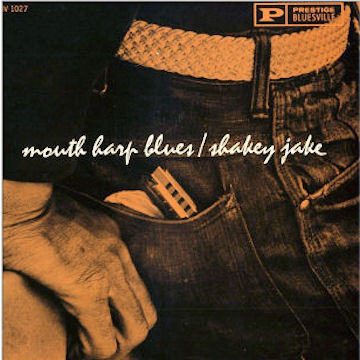
Shakey Jake Harris's first Prestige outing put him together with two of the label's soul jazz all stars, Jack McDuff and Bill Jennings. This time he's given Robert Banks, who has played keyboards on a wide variety of blues recordings for Prestige, and Leonard Gaskin, one of the label's most reliable bassists. But the real sound here is pure Chicago, with Harris's harmonica and vocals, Jimmie Lee Robinson's guitar, and John "Junior" Blackmon's drums.
Prestige had used Robinson once before, on Al Smith's first album, where he also worked with Robert Banks, but this is his real wheelhouse. He was a Chicago bluesman, playing with Freddie King, Little Walter, Howlin' Wolf and Harris's nephew Magic Sam, before retiring to a certainly blues-traditioned career: running a Chicago neighborhood candy store. Blackmon was also from Chicago, and considered a reliable session man for blues recordings. Between the three of them, they bring pure Chicago to Englewood Cliffs, in the style of Magic Sam or Jimmy Reed, but very much his own man.
The songs are mostly by Harris. There's one by Armand "Jump" Jackson ("Angry Lover"), another Chicagoan, and one by producer Ozzie Cadena ("Things Are Different Baby"). There's an unusual instrumental ("Jake's Cha Cha"), a slower and soulful instrumental
("Mouth Harp Blues," which is Robinson's even more than Harris's, and has some nice piano by Banks), and a lot of solid Chicago blues, the sound that had fired up the rhythm and blues charts in the 1950s, and would rule the world as it began to be discovered by a younger generation in far-off England. Shakey Jake would never cash in on the popularity of Chicago blues the way some of his contemporaries did, but he would have a solid career, as musician, nightclub owner and crapshooter.
Mouth Harp Blues is the title of the album.
Listening to Prestige Vol. 2, 1955-56, and Vol. 3, 1957-58 now include, in the Kindle editions, links to all the "Listen to One" selections. All three volumes available from Amazon. The most interesting book of its kind that I have ever seen. If any of you real jazz lovers want to know about some of the classic records made by some of the legends of jazz, get this book. LOVED IT. – Terry Gibbs And Listening to Prestige Vol. 4 is not far off!
Prestige Bluesville released two Memphis Slim albums in 1961, each of them culled partly from an earlier session (April 26, 1960) and partly from this one. Although Slim had, throughout most of the 1940s and 1950s, fronted a rhythm and blues ensemble with a couple of saxophones, and one might have thought that side of him would have appealed to Bob Weinstock's jazz-oriented sensibilities, Prestige--like Folkways, which recorded him at about the same time--decided to emphasize his folk blues persona. The April session put him together with Lafayette Thomas, a rhythm and blues guitarist from the West Coast who was taking a folk blues sabbatical in New York, and jazz bassist Wendell Marshall. For this November session, Marshall is dropped, and Thomas is replaced by Buster Brown, here called Buster "Harpie" Brown, on harmonica.
Both sessions, though, belong to Memphis Slim's inventive boogie-woogie and blues piano playing, and his distinctive vocals.
One of the interesting things about different blues singers, as they expanded their audience from their neighbors in the delta to white folks from the north, is their different levels of intelligibility. Sometimes you didn't even have to be from the north. Early blues scholars and musicologists puzzled over some of Charley Patton's lyrics. Some they had to guess at, some they couldn't get at all. When Patton's friend and blues partner Son House was rediscovered in Rochester, New York, the scholars beat a path to his door, played some of the old records, and asked, "What's Charley saying here? And here? And here?"
House just laughed. "Nobody could ever understand what Charley was saying. You could be standing on the bandstand right next to him and you wouldn't understand."
Muddy Waters is supposed to have told Mick Jagger that too much attention to diction took away from the emotional power of the song, and it's an interesting idea, although Mick--and Elvis before him--were smart enough to know that you can't imitate the unintelligibility of a Delta blues singer, although Elvis himself was from pretty close to the Delta.
And Muddy may have something. People who don't speak a word of Italian can still be moved to tears by grand opera. On the other extreme from Charley Patton, whose music is emotionally searing, you have Josh White, whose diction is supper-club perfect, as opposed to coffee-house casual, and doesn't deliver that much of an emotional punch. Of course, diction is only part of that story. You can understand all the words to both Josh White's and Billie Holiday's version of "Strange Fruit," but only one of them will tear your guts out.
Robert Pete Williams is closer to the Patton end of the spectrum, and if you really wanted to get every word he was saying, you'd have to listen awfully closely, which of course is why you don't. You can get the drift of "Parole Renied Again," and feel the lonesome desperation a prisoner's hopes dashed, without understanding every word.
Muddy Waters' first recordings for the Library of Congress, when he was still in the Delta. By the time he started recording for Chess, even though it was still "race records," he'd spent some time in the North and while he wasn't thinking in terms of communicating with white audiences, his Delta accent has still thinned out some. Chuck Berry came to Chess a few years later. He was from St. Louis, and had grown up listening to Louis Jordan and Cab Calloway, and to the very different accents of the white country and western singers he heard and admired on the radio. The brilliance and wit of his lyrics, the incisiveness of his character development and social commentary, demanded that the words be understood.
Memphis Slim was originally from Memphis, but he made Chicago his home for many years, and, as with Muddy Waters, the North had its effect on his diction, although it's still very much his own, and he's certainly not sacrificing anything on the altar of making sure he's understood, although when the lyric is clever, as in "Beer Drinking Woman." the words come across clearly. By the time he was reinventing himself as a purveyor of folk blues for Bluesville and Folkways, he knew his audience would be the white leftists for whom Lead Belly and Big Bill Broonzy and Brownie McGhee had reinvented themselves, creating a new audience and a new blues style. More power to them. They played their music, and got paid for it. And Memphis Slim was one of the greats.
How much he's adapted himself to a new audience can be heard in his Dragnet intro to an original blues he's been singing for a long time, "Beer Drinking Woman" (it's also on one of his Folkways albums with Willie Dixon).
His version of "My Baby Left Me" is very different from Arthur Crudup's (the one covered by Elvis)., but they have an opening verse in common. There are variations, but the basic structure is the same -- his baby has left him without saying a word, so he doesn't know if it was something he did or something that she heard.
"When Your Dough Roller Is Gone" sounds as though it's going to be another clever one, "dough roller" working as both allusion to sexual and breadwinning prowess, but it turns out to be a pretty straightforward blues about a lost lover. So is "Darling, I Miss You So," for all that the title sounds more like something Perry Como would sing. There's a comedy routine about what blues lyrics can and can't be about. It includes names that would never fit into a blues, like Sierra, Sequioa, Auburn or Rainbow. "Darling" comes close to making that list, but frankly, Memphis Slim could sing a blues about a woman named Sequoia, or even Muffy, and make it work.
And as good as his singing is, his piano playing seals the deal. If there are limitations on the possibilities of blues or boogie-woogie piano styles, you couldn't prove it by Slim. He includes some instrumental numbers in this session, and each of them is a treat.
Slim is the engine that drives this whole session, and Buster Brown doesn't have that much to so. But when he is featured, as in "IC Blues" or "Motherless Child," he more than holds up his end.
These tracks were meshed with the earlier session and put out on two Bluesville albums, Just Blues and No Strain, both released on Bluesville during 1961.
Listening to Prestige Vol. 2, 1955-56, and Vol. 3, 1957-58 now include, in the Kindle editions, links to all the "Listen to One" selections. All three volumes available from Amazon. The most interesting book of its kind that I have ever seen. If any of you real jazz lovers want to know about some of the classic records made by some of the legends of jazz, get this book. LOVED IT. – Terry Gibbs
November of 1960 was pretty much devoted to the blues at Bob Weinstock's label. Robert Pete Williams is another artist brought to Bluesville by folklorist Kenneth. S. Goldstein, Free Again is a more than apt title for the album: Williams had just been released from the Louisiana State Penitentiary at Angola, where he was serving time for murder (he had shot a man in a bar fight in 1956: he claimed self defense).
By that time he had been playing music around Baton
Rouge, Louisiana, since the 1930. while he supported himself by working in a sawmill. He had never made much money from the local fish fries, dances an church picnics he played at, but he was developing a unique guitar style and a powerful if idiosyncratic command of the blues, composing his own material, largely on the spot and improvised. He was discovered in prison by folklorists Harry Oster and Richard Allen.
Oster had found a circuitous route to the Angola prison. The son of Polish-Russian Jewish immigrants, a WWII vet and a Columbia Business School MBA, he then switched directions and took a BA from Harvard and a PhD from Cornell in English, and following the route of the migrant academic, took a position in the English Department at Louisiana State University, Baton Rouge, in 1955. If he didn't exactly travel in the same Baton Rouge social circles as Williams, their paths would cross soon enough as his burgeoning interest in folklore (He co-founded the Louisiana Folklore Society in 1956) took him inside the walls of Angola to record the songs and reminiscences of inmates.
Struck by Williams's talent, as John and Alan Lomax had been by Lead Belly a generation earlier, and like the Lomaxes, he successfully petitioned the governor of Louisiana to give Williams a pardon. But it came with more strings than had been attached to Lead Belly's pardon. He had been able to go to New York (officially listed as the Lomaxes' chauffeur) and create something of a career for himself as a musician. Williams was placed on something called "servitude parole," which was like indentured servitude, only worse. He was ordered to work 80 hours a week on a farm near Baton Rouge, with only room and board for compensation. In "Death Blues," he compares his life in prison to his life of so-called freedom:
You know, they, they do allow a man a break up there. But I ain't had nary here, since I been here.
So there was no flying to New York for a Bluesville recording session in Englewood Cliffs with some of Prestige's finest musicians. Dr. Goldstein had to come down to Baton Rouge to record him there, with just his guitar.
Which for a Delta blues singer like Williams, with a style as idiosyncratic as his, is probably the best way to present him. He doesn't often bother with niceties like rhyme, and his songs often drift between free associative asides and equally free-associative sung parts. "Death Blues" is mostly talking -- addressed to a loved one, confessing thoughts of suicide and revealing that he sometimes feels dead already, before breaking into song with the heartbreaking "I don't blame nobody, nobody but myself."
The early country blues of Charlie Patton, Peetie Wheatstraw and the like are rightly prized for their authenticity. Decades later, the focus of the blues had shifted from the Delta to places like Chicago, and Po' Henry Dorsey, a valued octogenarian blues singer from Louisiana, was to tell a 21st century interviewer that his chief influences had come from John R., the popular rhythm and blues disc jockey from WLAC in Nashville whose shows went out over clear channel starting in the 1950s. Coming a generation after the blues pioneers, Williams's music is still as authentic as it gets. The subject matter of his songs as recorded by Oster and Goldstein is largely his prison experience, with titles like "Parole Renied Again."
One of his most powerful songs. "I've Grown So Ugly," dessribes what prison will do to a man, changing him to the point where his girlfriend no longer recognizes him:
I left Angola
1964
Go walking down my street
Knock on my baby’s door
My baby come out
She asks me who I am
And I say, honey,
Don’t you know your man?
She said my man’s been gone
Since 1942
And I’ll tell you Mr. Ugly,
He didn’t look like you
The song, also called "Grown So Ugly," has been covered a couple of times by more contemporary artists. The iconoclastic Captain Beefheart recorded it in 1967, probably drawn to its dysphoric theme. In 2004, it was recorded by the Black Keys, a white rock duo known for its blues influences.They're a good band, and they do a creditable job on the song, but it is very much the blues filtered through the prism of white privilege. Hopefully Williams got some royalties from the Beefheart version; he died in 1980, so the Black Keys were too late for him. An arrangement of it by the modernist classical composer Steven Mackey has been recorded by the Brentano String Quartet.
Williams's servitude parole ended in 1964, and he was able to play the Newport Folk Festival that year, and continue touring and playing folk and blues festivals in the USA and Europe. He would make several more albums, but Free Again is regarded by many as his best recorded session.
Al Casey's second album for the Prestige family of labels has hum shifted from Swingville to Moodsville, but he's playing the same smart, snappy swing that he learned as a teenager in Fats Waller's band, and brought up to date in a regular gig with King Curtis that began in 1957.
Necessarily in the shadow of the flamboyant Waller, Casey stepped out on his own after the Fat Man's death in 1943, switching from acoustic to electric guitar, playing with Louis Armstrong, and winning the Esquire Magazine jazz critics poll for best traditional guitarist in both 1944 and 1945. He
remained in demand, playing with a wide variety of jazz greats who were looking for a traditional guitar sound (and some who weren't--he played with Charlie Parker). He made his debut for Prestige in 1950 in a group led by Eddie "Lockjaw" Davis, and his debut as leader ten years later.
The rest of the quartet is Belton Evans, who was playing a lot of drums for Prestige's blues and swing sessions in those days; and Jimmy Lewis, who would go on to make a name for himself in soul music. Both of them had played on his first Prestige album, and knew him from the King Curtis days. It's possible that Lee Anderson is from the same pool, but there's little to be discovered about him.
The Los Angeles Times obituary for Casey says that his job with the Fats Waller band was to "keep
the band tight during Waller’s fun yelps and scats," and it's training he didn't lose when allowed to stretch out and take center stage as leader. On this session, comprising standards and one short blues number by Jimmy Lewis, he steps out and plays inventively in a style of his own, but still runs a tight ship.
The album was simply called Al Casey Quartet. It came out on Moodsville, and strangely has never been rereleased on CD as part of Concord's Original Jazz Classics.
Curtis Jones was another blues veteran who had a career in the 1930s, recording for Bluebird, Vocalion and Okeh, all of them budget labels (cheaply pressed, cheaply sold) specializing in race record, then faded from the recording scene sometime in the early 1940s, then resurrected a career in the Chicago folk music coffee houses in the 1950s. He was a little unusual for the folkie coffee house scene in that the tended to favor guys who played portable instruments like guitars, and Jones was a piano man, although he had started out on guitar, and could certainly have returned to it if that was where his bread and butter lay. A working musician does what he has to.
But Chicago had always had a blues piano scene, starting with Leroy Carr and including the likes of Memphis Slim and Champion Jack Dupree. And it was a good town for finding the kind of bluesmen that Bob Weinstock wanted to bring to New York--traditional blues with a touch of jazz thrown in--although Jones didn't stay long. He recorded the one album for Prestige Bluesville, then one back in Chicago in 1962 for Delmark, a latecomer to the jazz and blues independent label scene. Then he headed east again, but didn't stop until he got to Europe, where he would spend the rest of his life, dividing his time between the continent and Morocco.
Bluesville's producer Ozzie Cadena put Jones together with organist Robert Banks, veteran of several Prestige blues sessions, and Johnny "Moose" Walker, a Chicagoan and another fine blues piano player/organist. Organ and piano are pretty well covered for this session, though, so Walker, who also played bass for Muddy Waters. is heard on guitar. The primary instrumental voice, however, belongs to Jones's piano, and he really is one of the top notch blues stylists on the instrument.
Jones's biggest hit in the 1930s was "Lonesome Bedroom Blues," a 1937 recording for Vocalion. He reprises it here, and it would become the title cut for his Delmark album. The title cut for this one is "Trouble Blues," co-writing credit given to Jones and Cadena. Cadena is credited as sole composer for "Please Say Yes," which breaks away from the traditional 12-bar-blues structure often favored by Jones, and uses verse-chorus in a manner reminiscent of Ray Charles. He goes to Armand "Jump" Jackson for two songs, and to Pinetop Smith for "Pinetop's Boogie" (left off the original album, included on the CD reissue). The rest are all his own. Jazzdisco only has "NYC" as the location of the recording studio, while Wikipedia puts it at the Van Gelder studio in Englewood Cliffs.
Listening to Prestige Vol. 2, 1955-56, and Vol. 3, 1957-58 now include, in the Kindle editions, links to all the "Listen to One" selections. All three volumes available from Amazon. The most interesting book of its kind that I have ever seen. If any of you real jazz lovers want to know about some of the classic records made by some of the legends of jazz, get this book. LOVED IT. – Terry Gibbs
Lightnin' Hopkins is back, this time without Sonny Terry, although again with the rhythm section of Leonard Gaskin and Belton Evans is still there;
With Ozzie Cadena producing the session and Rudy Van Gelder at the controls, this is one of the best of the myriad recordings Hopkins produced in his lifetime. The material is familiar--songs by Hopkins, and three blues standards by others which Hopkins had performed often and recorded not infrequently--but here they're heard to their best advantage, and the reason why Hopkins lasted so long, and recorded so often, is that he was very good. This is the blues the way you want to hear it.
The originals are all good. The covers are songs that have become blues standards. "Mean Old Frisco" was written by Arthur "Big Boy" Crudup, and first recorded by him in 1942. It was covered in the 1940s by Brownie McGhee and Champion Jack Dupree, in the 1950s by Snooks Eaglin and B. B. King (both in 1959). Since then, it's become not only a blues standard, but a jazz tune, recorded by both Richard "Groove" Holmes and Junior Mance.
The others have more confused provenances. "Come Back Baby" was written and first performed in 1940 by Walter Davis. It was hit for him on the race records charts, and then became a hit again in 1950 with Lowell Fulson's version. That began its ascent to standard status, but it was really locked into the consciousness of the blues audience and blues performers with the Ray Charles version in 1954, the flip side of his big hit "I Got a Woman." Charles' version was brilliant, inspired, and...with composer credit somehow slid over to Charles.
Since then it's had a double life. It's been recorded by B. B. King, Mance Lipscomb, Snooks Eaglin, James Cotton and others as a straight ahead blues. By white blues revivalists like Dave Van Ronk, Danny Kalb and Charlie Musselwhite. By folkies like Carolyn Hester (with Bob Dylan on
Harmonica), Bert Jansch and Fred Neil. By rockers like Hot Tuna and Jefferson Airplane. Even by present-day rockers like the Lords of Altamont and the Black Sorrows...all as "Come Back Baby" by Walter Davis. It has also been recorded by Stevie Wonder, Junior Parker, Aretha Franklin, Eric Clapton, Etta James,and many others, with jazz versions by Les McCann and George Benson...all as "Come Back" by Ray Charles.
"Back to New Orleans" is credited on Hopkins' Bluesville disc to Sonny Terry and Brownie McGhee, who were Bluesville artists at the time, but where it comes from is anyone's guess. It's more often called "Baby Please Don't Go," and was probably first recorded in 1934 by Big Joe Williams. Hiw often it's been recorded since, and under what titles...pretty close to impossible to guess. French blues historian Gérard Herzhaft (quoted in Wikipedia) reckons that it is "one of the most played, arranged, and rearranged pieces in blues history." It's essentially a traditional blues with origins lost in the past. Williams gets composer credit on his original Bluebird release.
Taken all together, this is a seriously satisfying immersion in the blues. The Bluesville release was called Lightnin', and a Prestige re-release was The Blues of Lightnin' Hopkins.One 45 was released on Prestige -- Mojo Hand" / "Automobile Blues," and three more on Bluesville:
Far too few people remember John Wright, unless they live in Chicago, where he was a local legend of the jazz scene, up until his death in 2017. But he made a series of very fine albums for Prestige, starting with South Side Soul. Bob Weinstock brought him back to do the second of what would be five albums for the label, and since he was on hand, had him contribute to the previous day's blues debut by Arbee Stidham. He played an important role in the artistic, if not commercial success of that album.
For the rest of his life, Wright would be known as "South Side Soul." He plays plenty of soul jazz on this album, and adds some of that South Side soul to everything he plays, but here he opens up his repertoire to show what else he can do. He plays four soulful originals from the South Side, one by Cannonball Adderley with a little New York soul, and three standards.
Bop-loving Joe Goldberg (author of the essential Jazz Masters of the Fifties), fighting a rearguard action against soul jazz, wrote the liner notes for this release, while he dismisses most new soul jazz pianists as hacks playing soul-by-the-numbers (he particularly hates Les McCann and has nothing good to say about Victor Feldman), he has nothing but respect for Wright, who, he says.
has played church music, and has accompanied blues singers [emphasis his]. Living on Chicago's South Side, he has been acquainted with the origins of this style all his life. He does not play soul music because it is currently fashionable, but because he was brought up hearing piano played that way. Never having had much formal training, he naturally turned to the kind of music he was familiar with when he began to play himself.
Goldberg was right about Wright not having had much formal training, but not because it wasn't available. According to a story on him in the Chicago Reader on the occasion of his 80th birthday (most of the rest of the biographical material is also from the Reader):
His siblings studied piano formally, but as Wright remembers it, their instructor refused to give him lessons, telling the family they'd be wasting their money. "Whatever we play, he plays equally as well," the teacher said. "He's not reading music, he's not using the right fingers, but he has God's gift . . . he can play everything he hears."
Wright grew up in the Pentecostal church, but at age 12 he moved over to begin playing for the Baptist church, which had livelier hymns. At 15, he heard jazz for the first time, and was won over to it. The more he learned about jazz, the more he liked it--and not just the music:
I made a vow: I was going to play jazz, drink plenty of whiskey, and chase pretty women. I kept that vow, and it almost killed me.
In 1952, he and a group of friends decided to join the Army to fight in Korea. Korea made a mark on the blues world. It was the first war after Truman integrated the armed forces, and a number of blues songs from the early 1950s contain lines like "My brother's in Korea."
When it was discovered that Wright was a musician, he was put into Special Services and sent to Europe. All his friends went to Korea, and all of them were killed.
Wright played with some top-flight jazz musicians in Europe, became a star in Chicago's jazz firmament, where he played well enough to get invited back by Prestige for five albums, and drank whiskey well enough to knock himself out of contention and back to Chicago, where he eventually pulled himself together.
Of the three standards on the album one ("Witchcraft") was more of a current hit at the time (1957 for Frank Sinatra), but has endured to achieve standard status. It's an endearing number on this album, perky and musical (Goldberg points out that "the introduction to 'Witchcraft' is one that Red Garland has used," and there's certainly a Garland influence on Wright, but overall, this version of the song is his own). "Things Are Getting Better" is the Adderley tune, and its a good funky number that never quite became a jazz standard in spite of a vocal interpretation by Eddie Jefferson.
\
But it's soulful originals that are still the best of Wright. They fit him like an old shoe, and they satisfy like the whiskey and women that ultimately (for a while) got the best of him.
The album was called Nice 'n Tasty, a soul-suggestive title. "You Do It" and "Yes I Know" were the 45. Esmond Edwards produced.
Listening to Prestige Vol. 2, 1955-56, and Vol. 3, 1957-58 now include, in the Kindle editions, links to all the "Listen to One" selections. All three volumes available from Amazon.
The most interesting book of its kind that I have ever seen. If any of you real jazz lovers want to know about some of the classic records made by some of the legends of jazz, get this book. LOVED IT.
Arbee Stidham was commencing a second career with this album, and although he was only 43, it was three decades after the start of his first career. From a musical family -- his father played with Jimmie Lunceford and his uncle with the Memphis Jug Band -- he had started his own band, the Southern Syncopators, by the time he was thirteen. Not too many 13-year-olds start there own band; fewer still get booked to tour with Bessie Smith, but Stidham did.
As a jazz musician, he toured with his own band, first in the south and then in Chicago, and played with Lucky Millinder in the 1930s-40s, . A recording contract in 1947 yielded a hit recording, "My Heart Belongs to You," which went to number one on the Billboard Race Records chart (later to become the Rhythm and Blues chart) in 1948.
Stidham was a tenor saxophone player as well as a vocalist, and thought of himself primarily as a jazz musician until injuries suffered in an auto accident left him unable to play the saxophone.
But, determined to persevere in music, he took up the guitar and became a bluesman. He was aided in this by fellow Chicagoan Big Bill Broonzy, who had undergone a metamorphosis of his own. Originally a jazz guitarist, Broonzy had discovered the newly emerging folk music circuit, and had reinvented himself as a folk blues singer, and as a songwriter of major importance. Following Lead Belly's example of tailoring the blues to appeal to a new audience of white leftists, he wrote a number of protest songs, from the ironic "WPA Blues" to the anthemic "Black, Brown and White."
Stidham learned his new instrument well, and added to his gifts as a blues singer and songwriter, it created new opportunities: a couple of singles for Atlantic subsidiary Abco in 1956, and then this album debut for Prestige Bluesville, followed by a 1961 album for Folkways, and a Folkways collaboration with Jazz Gillum and Memphis Slim that came out under Gillum's name. Then another recording drought until the early 1970s and two more albums, one for Mainstream, primarily a jazz label, and the other for Folkways. The 1970s also saw him venture into the academic world, as a lecturer on the blues at Cleveland State University.
There's plenty on this session to delight a blues lover who may not have heard Arbee Stidham before, and much for a jazz lover to appreciate. King Curtis sits in on saxophone, and on piano, the South Side soul of Chicagoan John Wright, who first recorded for Prestige in August, and would do four more sessions.
Wright is a dominant payer on a seven-minute version of Brownie McGhee's "Pawn Shop Blues," where his piano improvisation stretches out a normally song-length 12-bar blues into something else altogether. Stidham does mostly originals here, but features a few from other composers--why, it's hard to say. "Pawn Shop Blues" is a very good song, and favorite part of McGhee's repertoire, but melodically it's an interchangeable 12-bar blues. I guess it's a nice piece of change in Brownie's pocket, except that nobody ever made any money from having a jazz composition recorded, as Jackie McLean found out when he looked into suing Miles Davis for the composer credit to "Dig."
Two Big Joe Turner songs, the familiar "Wee Baby Blues" and the less familiar "Last Goodbye Blues" are also included, as is a song by drummer Armand "Jump" Jackson, "Teenage Kiss," which sounds more as though it would be given to Frankie Lymon than a fortyish blues singer, and in fact it does give King Curtis room for some hot rhythm and blues honking on the tenor. All in all, it's a fine outing for Stidham, especially if you don't listen to the words too closely, and you really don't have to. I once had a friend who told me that she loved the blues, but she really never listened to the words. I said. "That's like loving Rubens but not noticing the nudes." She said, "I do that too."
The others are all Stidham originals, including a remake of "My Heart Belongs to You," here retitled
"My Heart Will Always Belong to You." Stidham, for a latecomer to the guitar, sure knows how to play the blues on it. And as a veteran jazzman, he knows how to coordinate his blues with a couple of jazz greats. I've picked "You Can't Live in this World by Yourself" as my "Listen to One" because it shows off all of the above -- Stidham as songwriter, guitar player and blues singer, some nice ensemble work by Wright and Curtis.
And for a bonus, if you click through to the YouTube video, it's accompanied by some amazing street photographs -- by whom, I don't know.
Ozzie Cadena produced. The album came out on Bluesville, titled Tired of Wandering.
Listening to Prestige Vol. 2, 1955-56, and Vol. 3, 1957-58 now include, in the Kindle editions, links to all the "Listen to One" selections. All three volumes available from Amazon. The most interesting book of its kind that I have ever seen. If any of you real jazz lovers want to know about some of the classic records made by some of the legends of jazz, get this book. LOVED IT. – Terry Gibbs
A lot of the guys who have the hottest, honkin'est, rhythm-and-bluesiest tone on the tenor sax, also have the most sensitive, soulful approach to ballads, and Arnett Cobb is no exception. With Red Garland's accompaniment, this promises to be a listening treat, and the promise is delivered. This is a Moodsville set, and it could certainly set a mood for me, mixing familiar ballads with seldom-heard tunes.
The less familiar begins the set. "Hurry Home" has been recorded by Ella Fitzgerald, but even with Ella, it's not really a memorable melody. The
composers were Robert D. Emmerich and Joseph Meyer. Emmerich's obit credits him with having written songs for Fats Waller, so doesn't say what they were, so it looks as though he may never have had that breakthrough hit.
He did, however, write a song called "The Big Apple," and while it may not have been a hit, Walter Winchell liked the title so much he started using it for...well, you know the rest. Joseph Meyer is better known for his bubbly, catchy, anthem-y songs like "California, Here I Come" and "If You Knew Susie."
Well, people record songs for a reason. For Ella Fitzgerald, it may have been because she'd recorded everything else that there was to record, and "Hurry Home" is not likely to make anyone's list of her greatest hits. In the case of Arnett Cobb, however, he heard something in this melody that he responded to, and his warm-toned saxophone turns it into something beautiful, that melody that you can't quite place, but you know you've heard it somewhere, even if you haven't. Like that laugh that floats on a summer night, that you can never quite recall. Cobb's warm tone burnishes the melody, and his improvisation takes it ever so subtly into the realm of honking Texas tenor--an oxymoron, but he makes it work. It ends up being one of the highlights of the album.
Well, people record songs for a reason. For Ella Fitzgerald, it may have been because she'd recorded everything else that there was to record, and "Hurry Home" is not likely to make anyone's list of her greatest hits. In the case of Arnett Cobb, however, he heard something in this melody that he responded to, and his warm-toned saxophone turns it into something beautiful, that melody that you can't quite place, but you know you've heard it somewhere, even if you haven't. Like that laugh that floats on a summer night, that you can never quite recall. Cobb's warm tone burnishes the melody, and his improvisation takes it ever so subtly into the realm of honking Texas tenor--an oxymoron, but he makes it work. It ends up being one of the highlights of the album.
Count Basie, in collaboration with movie and TV tunesmiths Mack David and Jerry Livingston, is responsible for "Blue and Sentimental," and that melody has become a favorite of crooners and instrumentalists alike. Mack David, who wrote the songs for Cinderella and other Disney projects, is the older brother of Burt Bacharach's lyricist Hal David. Jerry Livingston and Jay Livingston, in spite of the fact that they dominated TV theme music in the 1960s (Jay wrote "Mr. Ed," Jerry wrote pretty much everything else) are not related. "Blue and Sentimental" appears to have particularly appealed to the ballad side of the hot tenor players of swing/rhythm and blues/soul jazz schools. It has been recorded by Gene Ammons, Georgie Auld, Sam (the Man) Taylor, Bill Doggett with Clifford Scott, Ike Quebec, Illinois Jacquet, Buddy Tate, Eddie "Lockjaw" Davis, Jay McShann...It's a nice melody, sweet with a touch of Basie tartness and little Bibbidy-bobbidy-boo, and Cobb does a nice job on it,
"Darn That Dream" and "Willow Weep for Me" are the best-known songs from the session, the former by Eddie deLange and Jimmy Van Heusen, the latter by Gershwin protégé Ann Ronell. Red Garland is certainly familiar with "Willow," because he recorded it for Prestige in 1956. This is a slower tempo than Garland took it in '56, understandably, because Cobb really likes to caress those notes, so Garland in his solo complements Cobb's approach. Garland has a very nice solo on this number, which at a little over seven minutes long is the longest one from the session, and very limited solo space elsewhere in the session. The other cuts are all jukebox-length, and follow the jukebox formula of one soloist as the dominant sound, although none of the songs from this session ended up being released on 45.
The Gordon Jenkins / Johnny Mercer "P. S. I Love You," written in 1934, had recently been a minor hit for the Hilltoppers, but it's not a memorable song. "Your Wonderful Love" is interesting, because Wikipedia lists it as written by two top-of-the-A-list songwriters, Dorothy Fields and Richard Rodgers, and I didn't know they'd ever written together, and I couldn't find a record of anyone else having recorded this song, except for Cobb himself, on a Columbia 78 in 1950. After way more digging than any sane person would do, I finally found a web reference to the Columbia disc. The song was written by Al Fields and Timmy Rogers (I've corrected Wiki). It's a decent song, and fits Cobb's ballad style nicely. He liked it enough to record it twice. But "Hurry Home" is still the highlight of the album for me.
The album was called Ballads by Cobb, a Moodsville release. Esmond Edwards produced.
Sonny Terry is sprung loose from his usual partnership with Brownie McGhee, and paired with a different blues guitar man. Lightnin' Hopkins was an altogether different proposition. From Texas, he was not at all of the Piedmont school of Blind Boy Fuller-influenced finger picking. He got something from serving as an on-and-off lead boy for Blind Lemon Jefferson on the streets of Houston, and by playing on the streets. He bounced back and forth between playing music, picking cotton, and working on the railroad, until in 1946 he was offered a recording contract by Aladdin Records in Los Angeles (one of his songs on that session was "Rocky Mountain Blues," which he would record again for Prestige). That began a long, strange recording Odyssey for
Hopkins, which made him, by the time he was finished, the most recorded blues musician of all time. Nobody knows how many records he made, or for how many labels? Eight hundred? A thousand? More? You pays your money and you takes your choice.
The first heyday of his recording career lasted from 1946 to 1956, the rhythm and blues years, and the small independent record label years. with a style that was loose, rough, not too overly concerned with time signatures or even staying in tune, but always powerful and authoritative. He was limited in developing a name for himself in that he didn't much like to travel and he didn't much like to leave Houston, but he left a remarkable legacy of recorded music. And he wasn't through yet.
In 1959, he was discovered by Samuel Charters, the first of the
white scholars to take a serious interest in the blues. Charters, who was married to literature professor and Beat Generation scholar Ann Charters, was particularly interested in the richness of blues lyrics. As he put it, "I really got bored with all those damn guitar solos. To me, they all sounded like B.B. King, and what I really wanted to hear was great text."
Hopkins was a perfect choice for Charters. At a time when the blues was going electric, and guitar solos were starting to dominate, Hopkins still played acoustic, and with all those recordings he made, often of the same songs over and over, he would find subtle and improvised variations on the lyrics. Filmmaker Les Blank recalls one such improvised lyric:
You make your bed hard, baby,
and calls it ease.
The blues is just a funny feelin’,
yet some folks calls it a mighty bad disease.
This line was composed late one night while I was filming what started out to be an ordinary interview. I had asked him to tell me what the blues meant to him. He picked up his guitar and started to sing about a woman named Mary who had left him. Earlier that evening his wife had left him after a nasty argument that caused her cousin to attempt to shoot Lightnin’. While the song was being sung, the cousin was lurking outside the apartment door with a loaded pistol. Lightnin’ also had a large loaded gun stuck down the front of his pants. Hardly a situation in which to delve into an academic and linear exploration of the nature of truth and the blues, but I came away feeling I knew a lot more about it than before, but I couldn’t exactly put it in words.
Charters was one of the first to ignite the new interest in the blues that would grow into the blues
explosion of the 1960s, with blues festivals and new recordings. His interest in Hopkins led to a second career for the old bluesman, one that Hopkins himself was reluctant to enter. He had played all his life for black audiences, and was almost completely unknown to whites (not completely--I had his 45 RPM recording of "Good Old Woman" on the Harlem label). But this was suddenly to change. His first appearance, on a bill with young white urban folkies to the Houston Folklore and Folk Music Society, was a huge success, and before long he was appearing in New York on a bill with Pete Seeger and Joan Baez. and recording for new record companies that made LPs and marketed them to white audiences.
Like Bluesville, where he was teamed up with Sonny Terry, a bluesman who had thrived for some years in New York, playing for whites, and put under the supervision of a white producer, Ozzie
Cadena. It was an odd pairing. Terry, no less authentic a bluesman, was technically more organized, and was used to playing with musicians like Brownie McGhee who were similarly more structured. An odd pairing, but not a bad one. Each knew enough to let the other do his thing, so although the same musicians--Terry, Hopkins, bassist Leonard Gaskin and drummer Belton Evans--were there for the whole date, it was really two separate sessions, with Terry front and center for the first one, and Hopkins taking center stage for the second.
There were similarities between the two, beyond a deep familiarity with the blues. While it's probable that no bluesman has ever been as prolifically recorded as Hopkins, Terry was no stranger to the recording studio. And he, too, had often recorded variations on the same material.
Terry begins his session with "One Monkey Don't Stop the Show," one of many songs to have been written under that title. The first recorded version was by Brownie's brother Sticks McGhee, with whom Terry had also recorded, including a Prestige session just two weeks previous. McGhee's "One Monkey Don't Stop No Show" bears no relation to Terry's. His is actually a reworking of a song he and Brownie McGhee performed regularly, and recorded more than once, called "Better Day." Both songs had the same verse-chorus structure, the same melody, and the same theme--things are bad, but that's all right, because they'll get better.
To the early blues musicians, authorship of lyrics was not that important, which is why there are so many "traveling lyrics," verses that pop up in one blues after another -- and part of the reason why their descendants in the 1950s were often a little too casual about nailing down lyricist credit for a song, leading to later lawsuits over the ownership of hits like "Earth Angel" and "Why Do Fools Fall in Love." Guitar styles were a different story. Charley Patton was way ahead of Jimi Hendrix with flamboyant tricks like tossing his guitar in the air, playing with his teeth, playing behind his back. Partly it was showmanship, partly it was so that no would would quite be able to figure out what he was doing. Something not dissimilar was done with Fats Domino's recordings, which were ever so slightly speeded up -- partly to make them faster and livelier for the rock 'n roll crowd, but also so that they were not quite in any key, and couldn't exactly be duplicated.
So both of these blues masters knew a million songs, which were inexhaustible variations on a hundred or so songs, and both of them bring their mastery to this session. And if they weren't exactly made for each other, it would be hard to prove it by either Sonny is King or Last Night Blues. They are two very different sessions, each of them rewarding in its own way.
One unusual cut that showcases both of them is "Lightnin's Stroke," from the Hopkins album, a mostly instrumental number that features guitar, harmonica, and a little lick from "When the Saints Go Marching In."
Sonny is King featured songs from this session and a later one, produced by folklorist Kenneth S. Goldstein. Last Night Blues had a couple of rereleases, as Gotta Move Your Baby on Bluesville and Got to Move Your Baby on Prestige. The Prestige 45, b/w "Sinner's Prayer" (not the Lowell Fulson song also covered by Ray Charles), was "Got to Move Your Baby," Other 45 RPM releases from this session, also combined with tracks from other sessions and released on Bluesville, were "The Walkin' Blues" / "Last Night Blues" and "Hard To Love A Woman" / "Back To New Orleans."
Listening to Prestige Vol. 2, 1955-56, and Vol. 3, 1957-58 now include, in the Kindle editions, links to all the "Listen to One" selections. All three volumes available from Amazon. The most interesting book of its kind that I have ever seen. If any of you real jazz lovers want to know about some of the classic records made by some of the legends of jazz, get this book. LOVED IT. – Terry Gibbs
Buddy Tate began recording for Prestige in 1959, as part of a Shirley-Scott / Eddie "Lockjaw" Davis session, made his first recording as a leader near the end of that year. This was productive period for Tate, who was also leading a group at Harlem's Celebrity Club, a gig that lasted over two decades, from 1953-1774.
Tate's involvement with Prestige was both the with the newer soul jazz sound (Scott-Davis) and the older Swingville sound, both of them connected by rhythm and blues, and both of them connected by the talent scouting and producing abilities of Esmond Edwards.
Edwards, born and raised in Harlem, had first been employed by Bob Weinstock as a photographer. Then Weinstock had him produce a couple of sessions, and by 1958 had put him in the position of recording director, and for the next several years he produced most of Prestige's sessions. Edwards was familiar with the Harlem jazz scene to a degree that Weinstock was not. He knew about places like the Celebrity Club/ He brought Tate and other musicians downtown, and out to Englewood Cliffs, and he found and signed up the younger musicians who were creating the soul jazz sound.
For this session, Tate is joined by Clark Terry, who did not come from uptown in those days. After solid stints with both the Basie and Ellington bands, he had a steady gig as a member of Johnny Tonight Show orchestra. He had appeared on a very early Prestige session, in 1950 with Dexter Gordon and Wardell Gray, and then not again until a September 1960 session with Scott and Davis. Terry is also responsible for the lion's share of the compositions on this session, beginning with "Groun' Hog," a slow blues which, at just over eight minutes, allows all the participants to stretch out and do some beautiful work, particularly Tommy Flanagan early on, and Tate later on. It's eight minutes well spent with some master players.
Carson's
20 Ladbroke Square is credited to Tate and Esmond Edwards as composers, and it's another blues, one that opens up and allows for some inspired blowing. The address is for an apartment building in the Notting Hill section of London, not an area traditionally associate with the blues. Well, maybe there's another Ladbroke Square. The rest of the session belongs to Duke Ellington, in ballad ("All Too Soon") and swinging ("Take the A Train") tempos. The combination of Ellington and these old pros is every bit as good as you would have imagined it to be.
Having dropped back in after a decade's hiatus, Clark Terry would stick around for the next couple of years and make a number of recordings for Prestige, New Jazz, Swingville and Moodsville.
Larry Gales was relatively new on the scene in 1960, and new to Prestige with this album, although he would hook up with Eddie "Lockjaw" Davis and Johnny Griffin for several Prestige sessions, then move on to a career that found him playing with many of the greats, particularly Thelonious Monk for several years. He would take quite a while before making his own album as leader, however. His Monk tribute album, A Message from Monk, came out in 1990.
With Edwards producing, this Swingville release was titled Tate-a-Tate, after one of the other Clark Terry contributions. If it was Clark who came up with the pun, Buddy certainly liked it, as later projects were called Tete-a-Tate and Tate-a-Tete.
Listening to Prestige Vol. 2, 1955-56, and Vol. 3, 1957-58 now include, in the Kindle editions, links to all the "Listen to One" selections. All three volumes available from Amazon. The most interesting book of its kind that I have ever seen. If any of you real jazz lovers want to know about some of the classic records made by some of the legends of jazz, get this book. LOVED IT. – Terry Gibbs


:format(jpeg):mode_rgb():quality(40)/discogs-images/R-3566386-1335542835.jpeg.jpg)


:format(jpeg):mode_rgb():quality(40)/discogs-images/R-4618738-1530585718-8243.jpeg.jpg)


:format(jpeg):mode_rgb():quality(40)/discogs-images/R-9264130-1477607588-1208.png.jpg)


:format(jpeg):mode_rgb():quality(40)/discogs-images/R-3070442-1314306501.jpeg.jpg)

:format(jpeg):mode_rgb():quality(40)/discogs-images/R-10097907-1491571013-3320.jpeg.jpg)


:format(jpeg):mode_rgb():quality(40)/discogs-images/R-10097950-1491571408-6361.jpeg.jpg)


:format(jpeg):mode_rgb():quality(40)/discogs-images/R-6956841-1430380315-6447.jpeg.jpg)


:format(jpeg):mode_rgb():quality(90)/discogs-images/R-6142161-1447171760-8532.jpeg.jpg)
