Tad Richards' odyssey through the catalog of Prestige Records:an unofficial and idiosyncratic history of jazz in the 50s and 60s. With occasional digressions.
The trouble with putting a label on a form of music is that it creates the temptation not to listen to it too closely. "Oh, yeah, that's [fill in the blank -- trad, bebop, hard bop, soul jazz], with all the clichés of the genre." What clichés? "Oh, you, know...just listen." But if you really just listen, without burdening yourself with a label, maybe they aren't clichés. Maybe every time a group of talented musicians go into a recording studio, they're there to find something that makes their getting together, and getting it down on wax or vinyl or tape or digital, worth the doing. That's why Cannonball Adderley so firmly resisted having his music called "soul jazz," for all the good it did him. Or, for that matter, why so many musicians resist having their music called "jazz."
Johnny "Hammond" Smith plays soul jazz. It's gotta be. For a start, it's got that organ, right? Like Jimmy Smith. He even has Jimmy Smith's guitar player. And he's got that bluesy-gospely feeling like Ray Charles, right? He even does a jazzy version of "Swanee River," just like Ray.
Well, yeah, except no. As the new decade found its voice, the organ was a large part of that voice, and jazz labels were signing up organists because people wanted to hear them, but they no more sounded alike or played the same clichés than did tenor saxophone players in the 1940s and 1950s.
And OK, the label is not so bad. If someone came to you and said they wanted to start a soul jazz collection, and who are some of the musicians they should collect, you'd certainly include Johnny "Hammond" Smith. But hopefully you would tell the neophyte collector, "Once you've started to pull your collection together, sit down and listen to each record separately." Just as, if you listen closely to a boxed set of Tito Puente, you'll quickly realize that no two rhythms are alike, in your soul jazz collection you'll hear some virtuosi of the Hammond organ, each of them finding his or her own way to explore it. And there are a lot of possibilities in that organ.
All but "Swanee River," on this album, are Smith originals, and "Swanee River" might as well be, in its unique deviations from anything that Stephen Foster or Ray Charles had in mind. Smith can do it as a composer, from catchy melodic hooks to intriguing development, to opening up avenues for his bandmates to explore, to finding, like Jimmy Smith, Shirley Scott and other premiere organists of the day, his own intricacies of tonality and percussive experimentation.
Smith worked for the first time here with Eddie McFadden, who had come from working with Jimmy Smith, and had come from the soul jazz cauldron of Philadelphia, where, like Thornel Schwartz, he had developed a great sense of what a guitar and organ could do together. And he worked for the only time with Lem Winchester, who came from just a hop and a jump south of Philadelphia. How much Winchester might have continued to explore the soul jazz idiom we'll never know.
Smith tosses him right into the cauldron with "Dementia," giving
him the first chorus, then following him with a McFadden solo, before entering with his own. Jazz is many things, but always it's hospitable to soloists, and with "Dementia," the first tune of the day although not the first on the album, Smith serves notice that a range of solo voices, and the flexibility to play off each other, will be what he's looking for. I liked "Dementia" a lot--the way it developed, and the part that each musician played in that development. And I found the same thing happening, in different ways, through each tune on the album.
Yes, original. Yes, unique voices finding ways to challenge and blend with each other. And...soul jazz to the bone, and to the marrow in the bone. That seductive sound that tells you you're gonna dig this. You're gonna tap your feet, you're gonna get up and dance, you're gonna--in Charles Mingus's phrase--git it in your soul.
Esmond Edwards produced. The album was called Gettin' the Message and the 45 off it was "Swanee River Parts 1 and 2."
Prestige Bluesville gave Sonny Terry solo billing on an album one week after they had done the same for his partner Brownie McGhee. Brownie is not present at all on this album, but his brother "Stick," best known for the 1947 Atlantic hit "Drinkin' Wine Spo-dee-o-dee," plays on a few tracks, as does Sonny's nephew, J. C. Burris. Burris is also a harmonica player, but augments the mouth harp with a percussion instrument, the African rhythm bones. The bones are two smooth sticks played like castanets. Percussion is also provided by Belton Evans. heard previously on Bluesville sessions with Sunnyland Slim and Roosevelt Sykes, and on jazz sessions with King Curtis and Al Casey.
The Piedmont blues of Sonny Terry and Brownie McGhee was an interesting phenomenon. The Great Migration of early and mid-20th Century had its own blues migration subdivisions. Bluesmen from Texas like T-Bone Walker tended to migrate to the West Coast. The Delta blues singers like Muddy Waters came north to Chicago and Detroit, where they created the urban blues style which was most widely disseminated by Chicago's Chess records, and which strongly influenced the British blues rockers. The east coast blues musicians tended to find their way to New York, which had its own music traditions, and they weren't necessarily about the blues. New York was a jazz town--it became the jazz town. For a while, when the entertainment world had not yet settled on a name for the kind of music that Charlie Parker and Dizzy Gillespie were making, that was being developed in the cauldrons of Harlem and the firepits of 52nd Street, it was called New York Music, and I half wish that name had stuck. It became a doo wop town. And was certainly a Latin music town, with Machito and Tito Puente and others making great music that is still undervalued by jazz audiences and jazz historians. But it never developed the kind of blues sound and blues audience that a town like Chicago did. Atlantic stepped into the void in its own way. When Jerry Wexler and Ahmet Ertegun scouted Ruth Brown singing in a jazz
club, and they went to talk to her afterwards, they told her they wanted her to sign with a new blues label they were starting. She said. "What do you want with me? I don't sing the blues. I hate the blues!" They assured her, this would be a new kind of blues. And it was. Ahmed and Nesuhi Ertegun, jazz lovers anxious to start a label that would be commercially viable, were among the pioneers of jazz with a beat--rhythm and blues.
So where did this leave the traditional blues players from what came to be known, for no discernible reason, as the Piedmont area-- the southern Atlantic coastal states? Their music was Finian's Rainbow.
finding a limited market, at best, with the sophisticated black audiences of New York, and blues-based music was as yet of not much interest to mainstream white audiences. Stick McGhee signed with Atlantic and had one big rhythm and blues hit (Brownie McGhee played on the recording, as did jazz bassist Gene Ramey). Other Piedmont musicians took different paths. Josh White smoothed his style, adjusted his diction to fit white audiences, and played supper clubs. Sonny Terry made his mark as a featured performer in a long-running Broadway musical that had race relations as a sub-theme,
Lead Belly had made a path for "old-fashioned" blues singers in New York. It wasn't a music that sophisticated black audiences were interested in, so Lead Belly and Alan Lomax created a new audience of white leftists who wanted to hear "the people's music." Terry often played and recorded with Lead Belly and Woody Guthrie for Folkways, a label that combined the field recordings of musicologists with the urban folk revivalists, and for Stinson, a label founded by American Communists originally to release recordings by the Red Army Chorus.
Lead Belly was a mentor to Terry. Brownie McGhee's song "Me and old Sonny....Sonny Terry is my best friend" (he wasn't) is taken from Terry's "Me and Huddie Ledbetter...." Terry's other mentor was Piedmont blues pioneer Blind Boy Fuller, who died in 1941. Those two mentorships come together on this album in the song "High Powered Women." The melody and the structure come from Fuller's "Step it Up and Go," which later, as essentially the same song, was Lead Belly's "Borrow Love and Go" (sometimes "Bottle Up and Go"). Lead Belly framed his song as a tribute to "the high powered women of today. You got women who can fly airplanes...you got radio women...they can do anything a man can do." Terry takes some of both for his version.
The 1960s blues revival may have centered around the Chicago blues musicians and their Delta forebears, but the Piedmont bluesmen, especially Sonny Terry and Brownie McGhee, did all right by themselves. They continued to work as a duo, playing blues festivals and college dates and European tours, until 1980, and Sonny kept on working until he died in 1986, one of his last gigs being a recording of his version of Robert Johnson's "Crossroads Blues" for the movie Crossroads.
Listening to Prestige Vol. 2, 1955-56, and Vol. 3, 1957-58 now include, in the Kindle editions, links to all the "Listen to One" selections. All three volumes available from Amazon. The most interesting book of its kind that I have ever seen. If any of you real jazz lovers want to know about some of the classic records made by some of the legends of jazz, get this book. LOVED IT.– Terry Gibbs
Reliving these jazz years through Prestige recording sessions is living in a dual reality. Part of you knows full well that you're looking back in time through the lens of age and distance, remembering your youthful excitement, appreciating the artists, and the recordings, that a perspective only brought by time and experience. But part of you is back then, 20 again, hearing the new sound from Symphony Sid or Ed Beach or Speed Anderson or Chuck Niles, buying the new album at Sam Goody's (or the 45 at Sam Goody's Annex), thinking that was solid, Jackson...what comes next?
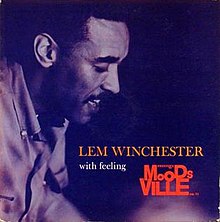
But that flight of imagination comes to a crashing halt with Lem Winchester. Because you've known, from the moment he burst on the scene the year before, that this was going to happen. Each of his sessions feels, to the contemporary listener following this chronology, like sands through a very small hourglass. It feels that way when we listen to Eric Dolphy, who's also just arrived on the scene with Prestige, and Booker Little, who would make his Prestige debut shortly. And with Lem Winchester, for whom the sands are running out. This was his last session as leader; he would appear in a week with Johnny "Hammond" Smith, and then no more. In January the ex-cop would be dead of a self-inflicted gunshot wound, reportedly showing off a trick where you pretend to play Russian Roulette.
Winchester went out casual but tasty. No fireworks here. instead a quartet session of ballads intended for the Moodsville label. But they're all good tunes, and each one of them gets a swinging treatment, with lots of improvisational delights, and especially the pleasure of hearing some wonderful interplay between Winchester and Richard Wyands, where ideas are begun on piano and brought to fruition on vibes, or vice versa. This is Wyands' only recording gig in a group led by Winchester (he had joined Lem on an Oliver Nelson session), but they have a strong connection.
There's one Winchester original ("The Kids"). The rest are a mix of standards and current pop tunes. "Why Don't They Understand" was a 1957 hit, recorded by country singers as well as pop. Winchester's is the only known jazz interpretation. "To Love and Be Loved" is the Academy Award-nominated theme song from the 1958 movie Some Came Running, again not widely added to the repertoire of jazz musicians. It's a good mix. We may not have the same recognition for late 1950s pop hits that they received at the time (had they only thought of posterity, they might have taken on "Blue Suede Shoes" and "Sh-Boom" instead). but they still make for some very tasty jazz in the hands of Winchester and cohorts. And it's always a pleasure to hear a great jazz group's interpretation of beloved standards.
Esmond Edwards produced the session. The Moodsville release was titled Lem Winchester with Feeling.
Winchester got his start when a young trio, John Chowning's Collegiates, added him for a record date arranged by Chowning's father. The group planned to send the record to Leonard Feather as an audition for the 1958 Newport Jazz Festival. Feather passed on the group, but invited Winchester, then a Wilmington, Delaware police officer. Fifty years later, the three Collegiates reminisced about their sometme bandmate for the Current Research in Jazz website. Here's Chowning:
One can speculate whether Lem’s extraordinary talent would ever have been “noticed” at the level where it mattered if the recording had not been made. Perhaps not. Lem impressed us a man whose first love in music was the playing of it, not being a “name” in it. He had, we thought, more ambition for his notes than for himself.
At the time of the recording Lem was a successful officer in the Wilmington, Delaware, police force, assigned to what we now can call the African American community, where he was beloved by its inhabitants. The options for a smart and intelligent African American then were limited, especially one with a wife and young children. It was Lem’s mother, knowing that a police officer was at the pinnacle of power in her community, who persuaded him to join the police force in the first place. And she later was able to convince him to remain with the force, rather than joining his teenage friend and trumpet player, Clifford Brown, in the professional jazz scene.
...
To all of us Lem seemed content in a rewarding and stable career as a policeman — enriched by his stunning music on the side. He was revered by his community both as a police officer and by those who knew his music: he was welcomed into every musical setting he encountered.
In the spring or summer of 1958 my father, always our most unabashed supporter and spokesman, sent the LP to Leonard Feather... He was disappointed, I am sure, when the invitation came to Lem alone, but the three of us were not surprised. We were good enough players to recognize that Lem was a truly great jazz talent.
To my father’s credit, he maintained contact with Lem during the transition from police officer to professional jazz musician, and it was through him that the three of us learned of Lem’s tragic death in 1961.
George Lindamood
[I remember the first time Lem jammed with us. He] wore a gray sports jacket over his uniform so it would not be obvious that he was a policeman, but we kidded him about his regulation shirt, a shade of blue considerably darker than what was fashionable for business dress in those days. And then there was the bulge on his right hip that we knew to be his service revolver.
...a few weeks later...Lem had just finished one of his energetic solos and had lathered up a pretty good sweat in the process. When he took off his “plain clothes” jacket his police badge winked gold in the spotlight and the audience gasped in surprise... Without missing a beat, he laid the jacket on the piano top, unstrapped his holster and revolver, and dived back in for another chorus. The applause was at least fifty percent louder than before.
It often took me a couple hours to come down after a gig, so it was pointless to try to sleep. Often I borrowed John’s car, a well-worn brown Kaiser, and tracked Lem down where he was walking his midnight-to-dawn beat in one of the poorer sections of Wilmington. Lem did not seem to mind having a scrawny not-quite-19-year-old white kid tagging along in that all-black neighborhood, although occasionally he had me wait at a distance while he handled a difficult situation. Most of the time we just walked and talked, with him providing stories and advice from his perspective as a black man ten years older. It was a wonderful education for me.
And David Arnold:
The summer of 1957, our summer with Lem, was one of those years when the nation was in the throes of determining whether social tolerance would follow from the strengthening decisions that there must be legal tolerance.
It is within that context that I most easily place Lem. I remember his music, of course, but he comes striding with it out of that dark part of Wilmington, that dark part of national history, carrying the bright light of refutation. He was a good man. An unforgettable man.
As George has recalled above, we — who were the John Chowning Collegiates — had thrown open the doors of Marshalls Restaurants for Monday night jam sessions.
The Collegiates, a musically literate trio learning new things with every performance, played what we hoped was jazz — and very often it was. But with Lem and his group there was no question. Marshalls lit up like fireworks. We were hearing what jazz was all about. He might call his style “down home” (another bit of modesty in a way) but it swung with a rhythmic curl and driving force that threatened the walls of the place. On top of it all was Lem’s intricate cascade of notes, at times more than could possibly come from just two mallets, and at other times simply and quietly a delicate, laid-back, slightly off-the-beat sounding of simple melody played in octaves. Push hard and pull back.
Lem was uncommonly gentle and forgiving. And he had that best thing of the best in music: the desire to teach, to pass it on.
It is that last thing I remember most — that and his matter-of-fact and unforced tolerance. Of all the musicians in Marshalls on those nights, I was by far the most unaccomplished... Yet Lem took the time to help, to give me some ideas. He might have seen promise. Or he might have been kind.
...certainly we could see his gift to us: the benefit, like a windfall, of being fronted by a genius on the vibes. He was among the very best, had friends among the very best — Clifford Brown for one — and so how did we deserve him? I have never stopped wondering.
The recording tells the story. On Lem’s cuts his playing transforms us into a different group. He lifts and drives, lightens the load, inspires. There is promise for us all....
In the end we Collegiates had graduations and careers to think about. But for Lem the recording made all the difference. We were both disappointed and relieved when Leonard Feather’s Newport nod went to Lem and not the rest of us but, as John says, we knew who the star was.
... In January of 1961 Lem was on the road, a professional musician, commercial recordings to his credit. But he carried with him a relic of his policeman days: a trick with a revolver in which all bullets but one were removed from their chambers. Gun to his head, bar-sitters watching, he would pull the trigger and the hammer would click as the cylinder rotated to an empty chamber. But that night in Indianapolis he used a different gun. The cylinder rotated in the opposite direction.
John Chowning went on to an unheralded but significant career in music. He studied composition with Nadia Boulanger in Paris. Later, he discovered FM synthesis, "a very simple yet elegant way of creating time-varying spectra. Licensed by Stanford to Yamaha, FM synthesis led to a family of synthesizers (DX7) that became the most successful of all time."
Lem Winchester left a small but significant body of work. He touched lives both as a policeman and a musician.
This is listed in Prestige's Bluesville catalog as a Brownie McGhee session, although longtime partner Sonny Terry is omnipresent, at least omnipresent on harmonica--all the vocals are Brownie's.
Prestige's Bluesville presentations of traditional blues performers are generally given that Prestige touch by the addition of jazz musicians. Shirley Scott accompanied Al Smith, and she was joined by Eddie "Lockjaw" Davis for Mildred Anderson's first album. King Curtis accompanied Smith on his second album, and Al Sears and Robert Banks on her second. They brought in Harold Ashby to play with Memphis Slim and Willie Dixon, Hal Singer to play with Lonnie Johnson (who already was as much jazzman as bluesman), and Jack McDuff and Bill Jennings to back up Shakey Jake,
Although Brownie McGhee had tried his hand at rhythm and blues in younger days, he was solidly established in the folk blues tradition, and producer Ozzie Cadena chose not to mess with that. He does bring aboard a third musician, but it's guitarist Bennie Foster, who appears to be from the same Piedmont school of blues as McGhee and Terry, and may just have an old friend Brownie brought along to the session. He's good, and he adds some fullness to the sound, but doesn't take it in a new direction. And I can find out no further information about him.
So this is a Brownie McGhee-Sonny Terry session, of which there were many, mostly for Folkways but a surprising number for Prestige Bluesville--and more surprisingly, one each for Roulette and World Pacific. You probably wouldn't need to own all of them, even if you were a hard core blues fan, but it's nice to know they're all there, and each one delivers satisfaction with solid professionalism and blues feeling.
Professionalism? Hell, yes. These were working class guys who depended on music to make a living and put food on the table. In fact, like many blues singers of their generation, they got into music because physical disabilities made it impossible for them to work in the fields. They were going to rehearse, to show up on time, to earn their paychecks.
This Bluesville release was entitled Brownie's Blues.
* * *
I wrote a lot about the Blue Bird Inn in Detroit when I was covering the mid-1950s, and the arrival in New York--and Prestige--of one Detroit jazz great after another. Nearly all of them had gotten their start at the Blue Bird. So it was wonderful to see, in a news story today, that the Blue Bird Inn, at 5021 Tireman Street in Detroit, abandoned since the bar's last owner passed away in 2003 (it had stopped presenting jazz much earlier), is being restored.
The Detroit Sound Conservancy, a nonprofit f ocused on music preservation in the city of Detroit, is restoring the building,which will eventually serve as a home to the nonprofit, a depository for its archives of Detroit music history, as well as a live music venue. This is a major piece of America's history, a cultural treasure, and it's great to see it being recognized.
This is part of an urban renaissance in this once-desolate city. As so often happens, artists paved the way. The city set up special low-cost housing for artists. Once they moved in and started creating, and galleries and cafes sprang up, the yuppies and hipsters followed. Now, of course, the artists can no longer afford to live there and they are being evicted.
Listening to Prestige Vol. 2, 1955-56, and Vol. 3, 1957-58 now include, in the Kindle editions, links to all the "Listen to One" selections. All three volumes available from Amazon. The most interesting book of its kind that I have ever seen. If any of you real jazz lovers want to know about some of the classic records made by some of the legends of jazz, get this book. LOVED IT. – Terry Gibbs
This is my 400th entry in this Listening to Prestige project, and I started it almost exactly five years ago--June 14, 2014. I've learned a lot, listened to a lot of great music, brought myself up to a new decade, and still enthusiastic. The artists and the music of the 1950s, the bebop and hard bop eras, are the most familiar to me, so now I'm venturing into uncharted waters.
The organ was the hot new sound as the decade rolled over, and soul jazz gained prominence. Shirley Scott was Prestige's big organ star, either with her trio, as in the September 27 session we just listened to, or in a quintet with Eddie "Lockjaw" Davis -- and still to come, with Stanley Turrentine. Prestige also introduced Jack McDuff, who came to the label with Willis "Gator Tail" Jackson, but went on to
become a major star in his own right, and Johnny "Hammond" Smith, who added the organ to his name to differentiate himself from guitarist Johnny Smith, and ultimately dropped the Smith part altogether and became Johnny Hammond.
And Larry Young, the youngest of these new organists, 19 when he made his debut album for Prestige and still a week shy of his 20th birthday on this session, for his second album. Young was really just passing through Prestige--he would only make one more album for the label--and for that matter, he was just passing through this phase of his career, the Jimmy Smith-influenced popular soul jazz sound of the day.
Young's muse was to be a restless one, taking him into Coltrane-influenced free jazz and then into fusion, but these Prestige albums, though not predictive of the explosive changes he was going to go through, certainly give us a healthy serving of his youthful talent. Guitarist Thornel Schwartz and drummer Jimmie Smith are back from the previous session, joined by Prestige veteran Wendell Marshall on bass. They play some Young originals, one standard ("Little White Lies," by Walter Donaldson, dating back to 1930), and three tunes by his contemporaries: Ray Draper, Horace Silver, and Morris "Mo" Bailey, Philadelphia-based saxophonist-composer-arranger.
That's enough variety to keep a session interesting, and though this is generally thought of as being Young's Jimmy Smith apprenticeship period, and although he's working in the soul jazz idiom that he would leave behind, there's plenty of individual voice here, and plenty of excitement.
"African Blues" is a good representative of his composing skills, and how he works with his own material. Soul jazz is supposed to be a sort of simplified form, and certainly there's a danceable groove here, but Shirley Scott has shown how much experimentalism an organist can bring to a solid beat, and so does Young. His groove is, if anything, even solider and funkier, and his inventiveness -- and that of Thornel Schwartz, whose rapport with him is always centered -- is a thing to enjoy.
"Little White Lies" is a cute tune, and vocalists like it, but it hasn't drawn all that much attention from jazz musicians. Maybe vocalists like it because the negativity of the lyrics makes a nice contrast to the bouncy tune, and that gets lost in an instrumental. But Young and Schwartz have some evil fun with it, and make the journey very worthwhile.
Nobody knows funk better than Horace Silver, and he has few peers as a composer, so "Nica's Dream" is a solid choice for young Mr. Young. It's become a jazz standard, mostly instrumental, although DeeDee Bridgewater wrote a vocalese lyric to it and killed it in performance, and a few others have essayed her version, notably Yvonne Sanchez, a Cuban-Polish jazz singer now making an expat career in Czechoslovakia. Silver first recorded it in 1956 with the Jazz Messengers. In 1959 Art Farmer and Blue Mitchell each did it, and then in 1960, as soul jazz was gaining a foothold, it was really discovered, and recordings were made by Young, Sabu Martinez, the Mastersounds (the Montgomery brothers), Curtis Counce, and Horace Silver again. Since then, it's become a beloved standard. Young does it proud.
He also showcases a Philadelphia comrade and not so well known composer, Mo Bailey, whose career as a saxophonist was cut short by illness, but who remained active as a successful composer and arranger into the disco era and beyond. His "Midnight Angel," as interpreted by Young, is haunting but funky.
This was released as an album on New Jazz, Esmond Edwards producing. No singles were released from the session.
Listening to Prestige Vol. 2, 1955-56, and Vol. 3, 1957-58 now include, in the Kindle editions, links to all the "Listen to One" selections. All three volumes available from Amazon. The most interesting book of its kind that I have ever seen. If any of you real jazz lovers want to know about some of the classic records made by some of the legends of jazz, get this book. LOVED IT.– Terry Gibbs
Shirley Scott is back with her trio and some timeless standards from the best: Rodgers and Hart, Cole Porter, Johnny Mercer. In other words, more Moodsville than soul jazz, and this was in fact a Moodsville release.
Of course, just because it's on Moodsville, that doesn't make it easy listening. Producer Chris Albertson has said that when you went in to the studio, you weren't thinking Moodsville, Swingville or Bluesville, you were making a jazz album for Prestige, and that's what Esmond Edwards and Scott are doing here. The album leads off with a Scott original, "Like Cozy," and while George Duvivier and Arthur
Edgehill lay down a solid groove, Scott gets off some of the swooping experimental voicings that she's so fond of, before settling into a soulful melody.
"Little Girl Blue" was already a solid standard by 1960. Written by Rodgers and Hart for a 1935 musical, it really entered the pop/jazz lexicon when Margaret Whiting recorded it in 1947. It was the title song from Nina Simone's 1958 album on Bethlehem, and while "I Loves You Porgy" was the hit single off that album, "Little Girl Blue" was also released as a single, got a lot of air play, and became the definitive vocal version for many. Bud Shank made the first jazz instrumental version in 1954, and after that the floodgates opened. in 1955 alone it was recorded by Dave Brubeck, Tal Farlow, Johnny Smith and Gerry Mulligan, and it's still being brought into the studio by vocalists and instrumentalists alike. Scott gives us a smoky piano veraion here, very much suggesting that she'd absorbed a lot of what Simone was doing, but still very much Shirley.
Johnny Mercer's "Laura," from the movie of the same name, is one of the most widely recorded songs in the canon--in 1960 alone, there were at least a dozen versions. So if you're going to play it, you've got a double task. First, if you put "Laura" on your album, your audience is going to want to hear "Laura," because it's a beautiful, haunting melody, and second, you've got to distinguish your version from the others. Scott manages to meet both demands, with every note sustained virtually forever, giving the haunting melody a haunted quality, and changing the tone from the wistful single notes of "Little Girl Blue" into something rich and strange.
Then she snaps that mood again with Cole Porter's "You Do Something to Me" - piano again, upbeat and percussive, lotsa improvisatory flights, lotsa room for Edgehill and Duvivier, with some very nic stuff by Duvivier.
And that's how the album goes--some organ, some piano, some experimental, some reassuring, a variety of moods, and all Shirley. Good stuff for her fans, good stuff to listen to years later, when the organ trios have faded into history. No single releases from this session, I guess on the theory that Moodsville fans were album fans. The album was released as "Like Cozy."
Listening to Prestige Vol. 2, 1955-56, and Vol. 3, 1957-58 now include, in the Kindle editions, links to all the "Listen to One" selections. All three volumes available from Amazon. The most interesting book of its kind that I have ever seen. If any of you real jazz lovers want to know about some of the classic records made by some of the legends of jazz, get this book. LOVED IT. – Terry Gibbs
This was Mildred Anderson's second and last album for Prestige, and after that...nothing. Nothing at all. Never recorded again for another label. There is virtually no record of her existence after this session, not even an obituary. I can find no record of where or when she was born. There is only a small handful of recordings, best documented by the French novelist and blues scholar Gerard Herzhaft in his blog, Blue Eye. A 78 RPM single with Albert Ammons, another one with Hot Lips Page and one with Bill Doggett, that last one in 153. Then nothing till the two Prestige sessions, and then nothing. Herzhaft offers this
further information sent to him by blues scholar Bob Eagle:
Post-recording info re Mildred Anderson: Mildred and Hortense worked together at the Key Club, 1325 Washington Street, Minneapolis, Minnesota during April 1961, backed by Gene (Bowlegs) Miller and his band. Mildred married Philadelphia-based businessman Bob Freeman in about September 1961. Hortense Allen was also involved with Rufus Rockhead at Montreal, Quebec, Canada, during July 1962, also featuring Mildred Anderson. Mildred almost lost her voice in the 1960s. In November 1970, having recovered her voice, she substituted for Candy Rae at Cyrus Scott’s Sahara Supper Club, Philadelphia.
And that's it. Of the people named by Eagle: Gene (Bowlegs) Miller was a trumpeter whose resumé stretches back as far as working with Ma Rainey, but his biggest success as a bandleader came in the 1960s. He is credited with discovering and launching the careers of Peabo Bryson and Ann Peebles. But his whole career seems to have been centered in Memphis, so what he was doing in Minneapolis it's hard to say. Rufus Rockhead opened his jazz club, Rockhead's, in Montreal in 1928, and until it closed in 1980, it was the jazz club in Montreal. Everyone who was anyone played there, so if he booked Mildred, it shows that someone was still paying attention. The only Hortense Allen I could find was Hortense Allen Jordan (married Mr. Jordan in 1955), a choreographer who created and worked with an African-American chorus line, so she might have brought Mildred from Minneapolis to Montreal. The Sahara Club in Philadelphia featured local jazz talent, of which there was an abundance, but I can find nothing on Candy Rae. So maybe she was settled in Philadelphia, happily married to Bob Freeman, and singing the occasional night when called upon to sub for a friend.
The Ammons recording, "Doin' the Boogie Woogie," was a minor hit. Her own composition, "No More in Life," a torchy ballad, was one of the Bill Doggett cuts, and is the title track for this album.
And it's impossible to say why. As a showcase for her talents, you couldn't ask for better than these two Prestige albums. The first, with Eddie "Lockjaw" Davis and Shirley Scott, was amazing, with two jazz musicians who were unparalleled in their approach to working with singer. And this one is pure gold. I love everything about it.
Her backing band is led by Al Sears, the tenorman who replaced Johnny Hodges with Chick Webb and Ben Webster with Ellington. and who led Alan Freed's stage bands for his all star rock and roll shows. His one earlier Prestige date was with the Swingville Allstars, co-led with Taft Jordan and Hilton Jefferson, and he would be back for a couple more Swingville dates.
Organist Robert Banks would do a lot of Prestige blues sessions. He was best known for his work in the 1960s with Solomon Burke. Guitarist Chauncey "Lord" Westbrook made his Prestige debut here. He was an active session man across the spectrum of jazz, pop and rhythm and blues.
Mildred Anderson takes on a broad spectrum of songs and handles them all in a way that is both direct and artful. Her first obligation is always to the song, and that means that simplicity and directness can take different forms, depending on the demands of the song. Her musicians do the same.
Her musicians? She was a nobody, with a career that had been not much of anywhere and was destined to go absolutely nowhere after this late summer day in 1960. Prestige had given her its A list of musicians for her debut album; for this one, musicians with not quite the same marquee value, although of undeniable quality, brought in for a gig. But yes, her musicians is what it feels like, because you get the sense of dedication to the song from all of them.
Here's a look at each, in the order in which they appear on the album.
She starts with a tune of her own composition, one of two on the album. Her first session, Person to Person, had also included two originals, which seems to suggest that Prestige was taking her seriously as an all-around talent, which once again makes you wonder what happened. "Everybody's Got Somebody But Me" is a torchy 12-bar blues with a bridge, a good, satisfying lament. It starts with a lengthy opening vamp by Banks with a solid backbeat by Gaskin and Donaldson that sets a modern, 1960 feel for a more traditional, 1940s-style vocal, all of which fits together. Al Sears comes in for a searing instrumental break in which he interacts with Banks's organ in much the same way Anderson has been interacting with it, and then she comes back with powerhouse final verse to tell the world in no uncertain terms that it's a lowdown dirty shame the way her lover treats her.
"I Ain't Mad at You," credited Count Basie, Freddie Greene, and Milton Ebbins, a music business professional who was Basie's manager, and whose own musical background suggests that he was a lot more than just one of those guys who slaps his name on someone else's work. He was highly respected in the industry, and he was also the guy who escorted Marilyn Monroe onstage at Madison Square Garden to sing "Happy Birthday, Mr. President," and how many of us can make that statement? This is a classic riff and vocal line, put together in a song first by Dwight "Gatemouth" Moore in 1943, then by Jesse Price in 1946. Basie, Ebbins and Greene take a songwriting--and given that Ebbins was involved, almost certainly a publishing credit. Well, why not? It's one of those traveling blues that comes up different every time someone does it, and credit was fluid back in that more innocent era. In any event, the riff pops up all over. It's interpolated into Sarah Vaughan's scat classic, "Shulie a Bop." It's the basis of Huey "Piano" Smith's "Roberta," also recorded by the Animals. And it becomes the refrain of a very strange patter song by Frances Faye, a daisy chain of unrequited lust, LGBTQS-style (that's Lesbian-Gay-Bi-Trans-Queer-Straight). In other words, it's about fun, even though the guy is every bit as rotten as the one in the previous song ("Just as soon as my back was turned / Another chick stepped in") and if anything, even worse. He takes out insurance on her, hoping that she'll soon die. Anderson and her boys know that a no-good, mistreating man can be funny as well as tragic, and they hit it, Basie-style.
Lord Westbrook steps forward on "Hard Times," another 12-bar blues, and Anderson gets into into it, answering the elaborate guitar-blues improvisations with some straightforward blues wailing. The song is credited to Esmond Edwards, so he must have been around, even though he does not take producer credit for the session, and it shows that you can have hard times even without a no-good man ("My rent is overdue, landlord is gonna put a padlock on my door / But it don't make no difference nohow, 'cause I ain't got no clothes no more").
So, the picture is starting to become clear. Anyone can take a straightforward approach to a song about a foggy day in which even the British museum has lost its charm, trusting in the musical and lyric genius of the Gershwins to carry the day. Anderson and her cohorts are finding the simple truth in songs where you have to look for it. Good songs. But not ones where half the work is done for you.
"No More in Life" is the other Anderson original, and she does seem to gravitate toward songs of lost love, this one with an "I Will Survive" vibe. It's short (2:42), showcasing the vocal, and it builds up to a belting finish.
"Roll 'em Pete" was written by boogie-woogie pianist Pete Johnson and blues shouter Big Joe Turner, and it's inextricably tied to them, although in latter years it's become a blues standard. Not so in 1960. It had been recorded twice more, once (superbly) by Count Basie and Joe Williams, once by Jimmy Witherspoon with Gerry Mulligan and Ben Webster. In other words, plenty macho stuff from some of the best male blues shouters. Anderson takes them on and comes out unscathed, using the new sound of the soul jazz organ instead of the Kansas City piano of Johnson or Basie. She takes the leering seduction invitation of "You're so beautiful but you've got to die some day / Gimme a little lovin' before you pass away" straight on--with a sliding note along "die" which will stop you in your tracks. Turner's happiness comes from his baby buying him a brand new choo-choo toy, which i s undeniably salacious. Williams--and Anderson follows his lyric--gets, instead, a Hydramatic kiddie car, which certainly must be salacious, because this is the blues, after all, and anything can be a metaphor for sex, but it's less clear how, exactly. Al Sears has an appropriately dirty solo, and this is one of the highlights of the album.
"What More Can a Woman Do? was written by Peggy Lee and her husband, guitarist Dave Barbour, so you might think Lord Westbrook would be stepping more out in front, but it's primarily Banks. Lee's version does feature Barbour's guitar, and it's cool where Anderson is hot, but both of them tell the story.
"That Old Devil Called Love" is by the songwriting team of Allan Roberts and Doris Fisher, who had a string of hits in the 1940s, most notably "You Always Hurt the One You Love." This one has the lilting arrangement of a 1930s collaboration between the young Billie Holiday and Lester Young, with Anderson capturing some of the vulnerable yet plucky spirit Billie had. "Mistreated"is the third Anderson original, and it has a nice blues vocal part, but it's mostly the showcase for Lord Westbrook that "Old Devil" turned out not to be. And the title alone should tell you that it's another reworking of Anderson's favorite theme.
"I'm Lost" was a hit for Nat "King" Cole. It was written by Otis René, best known for "When It's Sleepy Time Down South," and founder, with his brother Leon, of one of the first West Coast rhythm and blues labels. They were also one of the first independents to purchase their own record pressing plant, which turned out to be a spot of bad luck for them. Their plant pressed 78s, and they coudn't afford to have it retooled for 45s, so when the new format took over, they went broke. "I'm Lost" is a sweet torch song. Cole did it with his trio in 1944, the Mello-Moods in 1953 for Prestige (one of the label's rare forays into group harmony) and Sarah Vaughan with strings in 1958. Anderson does it as essentially a duet with Robert Banks. He takes a very short solo, but it's mostly the two of them back and forth.
Ozzie Cadena produced No More in Life, and it was released on Bluesville. Most Prestige releases got recycled in one way or another, but neither of the Mildred Anderson releases did. Person to Person did yield one 45 RPM single; none from this session. Maybe stepping away from Davis and Scott meant that Weinstock had already decided not to extend a two-record deal. Concord's Original Blues Classics line has released both of them on CD, but my guess is they'd be hard to find. So goodbye, Mildred Anderson, and I hope you found joy in your anonymous life. Those who find your recordings will be rewarded.
Listening to Prestige Vol. 2, 1955-56, and Vol. 3, 1957-58 now include, in the Kindle editions, links to all the "Listen to One" selections. All three volumes available from Amazon. The most interesting book of its kind that I have ever seen. If any of you real jazz lovers want to know about some of the classic records made by some of the legends of jazz, get this book. LOVED IT. – Terry Gibbs
Down Beat's review of this album says, in part, "Perhaps the most significant aspect of this set is saxophonist Nelson's debut as a big-band arranger on four tracks."
That doesn't begin to tell the story. My writeup of this session was slowed down because I had to stop everything and listen the second tune of the day, "Trane Whistle," several times, to get a full appreciation of the arrangement, the way Davis's tenor takes on a horn section with the power of Joe Louis, the versatility of Bert Campaneris and the stamina of John Havlicek, and excitement enough to make a listener go crazy trying to find
comparisons. And what Nelson has the horns doing inspires Davis to get even crazier, with results that will make the hair on the back of your neck stand up.
The over-the-top excitement of "Trane Whistle" made me go back and listen again to the first cut of the day, "Walk Away," another Nelson composition/arrangement, and I was glad I had. The arrangement isn't as bombastic, but it is as inventive, with an intriguing piano vamp by Richard Wyands to start things off, and some wonderful call-and-response work between tenor sax and horn session.
Next up is "Whole Nelson," and if one soloist working against amazing big band horn arrangements is good, how about two? Turns out that's good too, especially when you consider that the other one is Clark Terry.
The most celebrated cut on the album is "The Stolen Moment," because Nelson used it again on his most celebrated album (and with one of the great album titles of all time), The Blues and the Abstract Truth, As "Stolen Moments," it became the most celebrated cut on that milestone album, famed for being the most notable use in jazz of the
symmetrical augmented scale, an alternative scale which I can't begin to explain but which was an important innovation in the work of early modernist composers like Bela Bartok, Milton Babbitt and Arnold Schoenberg. No augmented scale in this version, but some top-notch soloists, including a trumpet player I wasn't familiar with, Bobby Bryant, who was just passing through. He had come to New York from Chicago in 1960, and by the following year was out in Los Angeles, where he built a substantial career, including working on a number of albums with Oliver Nelson.
The arrangements on the last two tracks of the day were turned over to veteran arranger Ernie Wilkins: the Rodgers and Hart standard "You Are Too Beautiful" and the Davis original Jaws." Prime stuff. And one would be remiss not to mention the extraordinary caliber of musicians who make up this big band. But Oliver Nelson is really the story.
Ttane Whistle was a Prestige release. A later re release capitalized on the later fame of the Nelson composition and was called Stolen Moments. Esmond Edwards produced, Don Schlitten did the photography and cover design, and come to think of it, that's also how Edwards got his start at Prestige.
Listening to Prestige Vol. 2, 1955-56, and Vol. 3, 1957-58 now include, in the Kindle editions, links to all the "Listen to One" selections. All three volumes available from Amazon. The most interesting book of its kind that I have ever seen. If any of you real jazz lovers want to know about some of the classic records made by some of the legends of jazz, get this book. LOVED IT. – Terry Gibbs
I always had this fascination with jazz and with rhythm and blues. I grew up in a time and place where the adults I knew, at least the ones I was trying to emulate, were artists and intellectuals, who listened to classical music if they were old guard, jazz if they were on the cutting edge, rock and roll not at all. And if you were part of that world, or on the fringes of that world, and you loved rock and roll, you had a bit of an inferiority complex. You probably had it anyway.
I was never going to do what I really wanted to do, which was drop out of school, go to New York, find the Brill Building, camp out in front of Jerry Leiber and Mike Stoller's office, and pester them until they took me in as an apprentice. Other teenagers like Carole King and Neil Sedaka were actually doing it, but I was so locked in to a certain world view that it not only never occurred to me to do it, it never occurred to me until much, much later that I had really wanted to do it.
So the part of me that was turning to jazz was looking for approval, the part that still loved rock and roll was still defensive. And the part that loved rhythm and blues...well, no one much noticed of cared about that part. Norman Mailer, in "The White Negro," described, in Nelson George's summary,
a new white outlaw...wandering the landscape, a "hipster," a "philosophical psychopath," whose primary inspiration was the music and sexuality of Afro-Americans...Yet in perpetuating the romance of blackness, supporting the notion that black juazzmen, for example, were in touch with some primal sexual energy, Mailer was as guilty of stereotyping blacks as the rednecks and social mainstreamers his white Negro opposed. While liberals hailed and debated Mailer's provocative rhetoric, many working class white teens were already living out the ideas Mailer articulated, infatuated as they were with black style and culture. But Mailer saw jazz as the crucial element in this new modern white personality; he had no idea of what most Negroes, or their white teenage fans, were really recording or buying.
I had a foot in both worlds. I read Norman Mailer, and I read Jack Kerouac's "Jazz of the Beat Generation" -- and I realize now, in hindsight, what Sal Paradise and Dean Moriarty must have been really listening to in Oakland on that sweaty summer night in 1947. Charlie Parker's jazz revolution had not made it as far as Oakland; his 1946 gigs in Los Angeles had been pretty much of a fiasco, and had let to a six-month relaxation at Camarillo State Mental Hospital. Sal and Dean were most likely listening to rhythm and blues--someone like Big Jay McNeely. And they thought it was jazz because, dammit, they were right. It was jazz.
I didn't have Nelson George and his great book, The Death of Rhythm and Blues, as a guide then. My other foot was with the white teenagers listening to Fats Domino and Little Richard (a music that in 1960, post-payola, was running very thin) and a ways deeper, with the Negroes that George describes, listening to Muddy Waters and Willis "Gator Tail" Jackson and Amos Milburn. And with no brilliant theoretician like George to give me intellectual support, I remember how thrilled I was to buy this album when it came out: one of my rhythm and blues heroes, King Curtis, playing real jazz along with card-carrying modern jazzmen like Nat Adderley. Playing Ellington!
Soul Meeting is the name of the album (on a re-release intensified to Soul Meeting!), and it precedes the other, somewhat better known Soul Meeting between Ray Charles and Milt Jackson by a year. And certainly, soul is the meeting ground for these diverse and considerable talents. They do take on Ellington: "Jeep's Blues." written with Johnny Hodges and originally recorded in 1938 under his name, later and most famously on the 1956 Ellington at Newport album. Ellington knew his way around the blues, and so do these guys. They also show their skill with standards and pop ballads (Cole Porter's "What Is This Thing Called Love?" and the Sammy Cahn/Jimmy Van Heusen hit for Frank Sinatra, "All the Way"). But they really find their groove, and their bliss, in the three Curtis originals, which bring out the best in both lead instruments and in Wynton Kelly, who contributes solid accompaniment and some smashing solos.
Production credit is shared by Esmond Edwards and Ozzie Cadena, who would take over as chief of A&R for the label when Edwards left a couple of years later. The album was something of a Prestige producers' convention, as Don Schlitten, who produced two sessions for the label in 1957 and would do a bunch more later on, provided the art direction and album cover design to go with Edwards' photo of Curtis.
"Soul Meeting" and "All the Way" were released as a 45 RPM single on New Jazz.
Listening to Prestige Vol. 2, 1955-56, and Vol. 3, 1957-58 now include, in the Kindle editions, links to all the "Listen to One" selections. All three volumes available from Amazon. The most interesting book of its kind that I have ever seen. If any of you real jazz lovers want to know about some of the classic records made by some of the legends of jazz, get this book. LOVED IT. – Terry Gibbs
Prestige got behind Etta Jones, whose career had been slow in developing, putting Frank Wess and a standout group of musicians behind her for her debut recording for the label in June, and it paid off, making her an overnight success at age 32, with the better part of two decades of performing behind her. Bob Weinstock and Esmond Edwards wisely brought her right back for this session with two of their brightest new jazz stars, Lem Winchester (this was to be his next-to-last session) and Oliver Nelson,
This was a session of mostly familiar standards, and why not? If you're trying to advance the career of a singer who decidedly deserves it, why not give her a bunch of songs that people like to here. "The More I See You." by Harry Warren and Mack Gordon, was very popular with jazz chanteuses, and even some chanteurs, in those days. A 1945 hit for Dick Haymes, it received ten other renditions in 1959-60 alone, plus four instrumental versions: interpreters included Sarah Vaughan, Nancy Wilson, Julie London, Brook Benton and the Four Freshmen. Celebrities liked it too, including Tony Perkins and Maureen O'Hara. Jones is deliciously torchy on this one, with Winchester functioning as her alter ego and Nelson providing a short but moving solo near the end.
The Gershwins' wonderful "They Can't Take That Away From Me," originally recorded by Fred Astaire, is often a plaintive lament, but Jones belts it as a defiant album--nobody better try and take it away from me. This one is mostly Jones, but Winchester has an arresting, rhythmically interesting solo.
"That's All There Is to That" had been a recent hit for Nat "King" Cole, who had recorded a song called "That's All" several years earlier, and would recall another called "That's All There Is" a few years later. He sang "That's All There Is to That" for President Eisenhower at the 1956 Republican convention, but there doesn't seem to be any political message to it. It's a sensitive song of lost love and heartbreak as Cole sings it, and fatalistic in the extreme in Jones's version. No sentimentality. You love, you lose, and that's all there is to that. Richard Wyands is the instrumental star on this one. The song was written by Clyde Otis, who went on to a distinguished career as a songwriter and producer, but this was how it started for him: the Nat "King" Cole version of this song was his first hit.
"Easy Living" was written by movie composer Ralph Rainger, but it's become a jazz standard, thanks in great part to the 1937 version by Billie Holiday with Lester Young and Teddy Wilson. Jones stays close to what Lady Day did with the song--it's virtually an homage to the great singer who had died just months before.. The main solo here is Winchester, but Nelson very nearly steals the show with a much briefer one. It's interesting to compare Jones's 1960 recording with Holiday's 1937 recording, an era when the band, not the singer, was the star, and Holiday doesn't enter until more than halfway through the recording.
The Eddie Heywood "Canadian Sunset" was a big instrumental hit for Heywood in 1956, and many vocal versions followed. The lyrics by Norman Gimbel ("Killing Me Softly with His Song," English lyrics for "The Girl from Ipanema") sound a little tacked on, but not the way Jones sings them. Winchester propels her along for a snappy two and a half minutes, just the right length for a 45 RPM single, which this was.
Jones returns to Harry Warren for "I Only Have Eyes For You." a 1930s song which had been a big hit in a 1959 doowop version by the Flamingos. Jones echoes the Flamingos as she starts into the song, but soon takes it in her own direction, which is solid jazz singer. This is another 45-length cut, at just over three minutes, and I would have released it as a single. It's a great song, it's been a hit, and Jones takes it that step farther. But "That's All There Is to That" (not so short) and "Canadian Sunset" were the only singles from the album ("Canadian Sunset" would be rereleased as a single on the flip side of "Don't Go to Strangers"), and they didn't chart, so maybe Bob Weinstock decided that Jones was more an album kinda gal.
This is an interesting album in that some of 1960's finest jazz soloists (Nelson is sparingly used) are on the session, but there aren't any extended solos. And it works. Nothing wrong with tight. And when they do solo, as in Lerner and Loewe's "Almost Like Being in Love," which is about evenly divided between Jones's vocals and an instrumental break by Wyands and Winchester, the improvisation is tight, inventive, and...killer.
Much has been made of Jones's Billie Holiday influence. I didn't hear it so much in the first session--Dinah Washington came more to mind-- but it's definitely happening here, and it's all to the good.
The session would see daylight in two parcels, the 1961 release Something Nice ("That's All There Is to That," "Easy Living," "Canadian Sunset," "I Only Have Eyes for You") and 1963's Hollar.
Listening to Prestige Vol. 2, 1955-56, and Vol. 3, 1957-58 now include, in the Kindle editions, links to all the "Listen to One" selections. All three volumes available from Amazon.
The most interesting book of its kind that I have ever seen. If any of you real jazz lovers want to know about some of the classic records made by some of the legends of jazz, get this book. LOVED IT.
The day after backing Roosevelt Sykes, King Curtis and his group were back in the studio with another blues piano man, Sunnyland Slim.
It was a contrast in styles Both were from the Delta area--Sykes from Elmar, Arkansas, and Slim (Albert Luandrew) from Vance, Mississippi. They were they same age--54 at the time these recordings were made. Both called Chicago home, and were part of that Chicago blues scene, Slim even more than Sykes. He played, over the years, in the bands of Muddy Waters (Muddy was his guitar player for his first recording session), Sonny Boy Williamson, Little Walter, Howlin' Wolf, and Robert Jr. Lockwood, whereas Sykes eschewed the electric blues sound,
decamping from Chicago to New Orleans in the early 1950s, as that style gained the ascendancy on the South Side.
But Sykes, who first came north in 1929 to record for Okeh Records in New York, adopted a more urban style. Slim's journey to Chicago led through Memphis in the 1920s, where he worked with Ma Rainey among others, and while his piano style reflected the modernity of his associations, his voice stayed in the Delta, with that rich rawness we associate with the Delta blues singers.
This makes for a different kind of collaboration with Curtis and his urban jazz/rhythm and blues musicians. On two cuts, "I'm Prison Bound" (by Brownie McGhee) and "Harlem Can't Be Heaven," Curtis sits out, leaving the field to Slim and Robert Banks, whose organ brings the arrangement up to 1960, while at the same time carrying that Delta feeling. By contrast, on "Shake It," a Big Joe Turner composition but a standard part of Slim's repertoire, he brings a lot more Chicago into his vocal, and Curtis provides a foot-stomping solo.
This admixture of styles makes for a fascinating album, where you never quite know what mixture you're going to get net. "Decoration Day" starts out with a moody blue intro from Curtis, and then Slim enters with his Delta voice and a real down home twelve-bar blues that nonetheless fits with what Curtis had started. Curtis returns with another sax solo, followed by Banks pulling out all the stops (or the equivalent on an electric organ). In other words, this is a session that gives the participants a chance to explore every possible way of playing together.
Of particular interest, the Leroy Carr classic "How Long Blues." just because it's such a great tune and it's interesting to hear anyone play it. And the two instrumental numbers, "Slim's Shout" (co-composer credit, Ozzie Cadena) and "Sunnyland Special," both of which feature just some great blowing. Chicagoan Slim pays an affectionate tribute to the Big Apple with "Harlem Can't Be Heaven."
Robert Banks should have had more of a prominent career than he did.
This is a great album.
A curiosity: Most of Slim's originals are credited to Sunnyland Slim, but one ("Sunnyland Special") is under his birth name, Albert Luandrew. And even odder. on "Every Time I Get to Drinking," co-composer credit is given to Luandrew and Slim.
Two Bluesville 45s came from the session: "Baby How Long" / "It's You Baby" and "I'm Prison Bound" / "Slim's Shout." Slim's Shout was also the name of the Bluesville album. "Every Time I Get to Drinking" and "Tired of You Clowning" were left off the LP, but added to the CD reissue.
Listening to Prestige Vol. 2, 1955-56, and Vol. 3, 1957-58 now include, in the Kindle editions, links to all the "Listen to One" selections. All three volumes available from Amazon.
The most interesting book of its kind that I have ever seen. If any of you real jazz lovers want to know about some of the classic records made by some of the legends of jazz, get this book. LOVED IT.
This is Roosevelt Sykes' second album for Prestige. The first used a rhythm and blues lineup of tenor sax and rhythm section such as Sykes had used on his biggest hit, "The Honeydripper." That seemed to work well, so they've returned for it with this outing, but this time the Chicago session men from the first outing are replaced by King Curtis and a crew of some of New York's finest musicians from the rhythm and blues side of the jazz spectrum. Curtis regular Robert Banks, who joined the King or an Al Smith session on Prestige, is here on the organ, and Belton Evans, previously used by Prestige on a Swingville session with Al Casey, plays drums. The bassist is bebop veteran Leonard Gaskin, who
appeared on one of Prestige's first recording sessions with J. J. Johnson and Kenny Dorham, and more recently joined Curtis and Banks to back up Al Smith.
He's still in good form here, playing and singing the blues with a flair for double entendre, a powerful voice and a steady rolling piano that sets the tone.
What's really new here comes on the fourth cut of the day (and the third on the album), "Yes Lawd." It's the only song not written by Sykes--it was supplied by Ozzie Cadena, who would in a couple of years become a producer and head of Artists and Repertoire for Prestige. I've remarked before that the main practical difference between jazz and rhythm and blues in the 1950s was that jazz became an LP art form, while rhythm and blues was still essentially a singles art form. Jazz recordings opened up to take advantage of the greater length of the LP record, and so it is here with "Yes, Lawd." Every other track on the album is short -- "Miss Ida B.," at 4:57, is the only one that pushes the limits of the 45 RPM
single. "Yes, Lawd," is over 9 minutes, and allows for extended solos by Banks and Curtis, and one by Sykes as well.
Esmond Edwards produced. The album came out on Bluesville, and was titled The Honeydripper, although Sykes's signature song was not on it. A Bluesville 45 had "Miss Ida B." as the A side, "Satellite Baby" as the flip side.
Listening to Prestige Vol. 2, 1955-56, and Vol. 3, 1957-58 now include, in the Kindle editions, links to all the "Listen to One" selections. All three volumes available from Amazon. The most interesting book of its kind that I have ever seen. If any of you real jazz lovers want to know about some of the classic records made by some of the legends of jazz, get this book. LOVED IT. – Terry Gibbs
On the YouTube page for "Soul Street," the person who uses the nom de tube NAFTALI2 says:
Those who heard Jimmy Forrest in person said the most dreaded position on stage is being another tenor player along side of him.
NAFTALI2 may be a little biased in favor of Forrest:
In this cut, standing with jazz stalwarts, not amateurs by any means, guys who are more critically acclaimed, guys who got more studio time, guys you've heard of--from Jimmy's first flourish, you can sense they just want to go home. He continues his solo showing his harmonic complexity, incredible sense of rhythm and groove, the ability to move effortlessly from the beautiful to the honking blues, and the ability to build his solo.
That's going a little overboard. Nelson and Curtis contribute wonderfully to this session too, but he's not wrong about Forrest, an unjustly overlooked jazzman. I've checked a few internet lists of greatest jazz saxophonists, and he doesn't make any of them (well, he makes the Ranker.com list now, because I added him). And this is a real oversight.
Forrest is probably best known for "Night Train," one of the best-known rhythm and blues instrumentals. Forrest takes composer credit for the tune, developed from a Duke Ellington riff, and all in all he probably deserves it. He made the first recording of "Night Train," and it's been recorded over 120 times since, mostly but not always as an instrumental, including a 1982 version by Forrest with Shirley Scott.
Forrest's first appearance on Prestige was a 1952 session recorded live in a nightclub in his native St, Louis, with Miles Davis sitting in on trumpet. I wrote about it:
A few online reviews of this session tend to give it short shrift -- recording quality not all that great, playing competent but uninspired.
They couldn't be more wrong...this session, recorded live in a St. Louis nightclub, is the real thing. This is jazz in 1952, a piece of living history, jazz as it was, and played by working musicians in small clubs in the Midwest, music that came out of the legacy of the territorial bands of the 20s and 30s, the nighttime wail of America that John Clellon Holmes captured so vividly in The Horn, still the greatest jazz novel.
He returned to the label in 1958, with the Prestige Blues-Swingers ensemble, then joined with fellow Midwesterners Jack McDuff and Bill Jennings to back up singer Betty Roché, made an album with McDuff and Lem Winchester, and just a month before this session, an album as leader with young organ phenom Larry Young. He would continue to record for Prestige through 1962.
This is mostly an Oliver Nelson album, and I'll get on to him, but NAFTALI2's praise of Forrest's contribution to "Soul Street" is not misplaced. His solo is lyrical and raunchy, inventive and deeply satisfying.
NAFTALI2 finishes his encomium to Forrest with these words:
For years there were alto players in St. Louis who were disciples of Nelson, all the while never having heard Jimmy Forrest, who lived just around the corner. Upon hearing Forrest for the first time, they always asked why they hadn't heard of him before, shaking their heads in awe.
Forrest wrote "Soul Battle," and it was left off the original release of the album, only added as a bonus track for the CD release, perhaps another nail in the coffin of Forrest's legacy.
Nelson wrote all the rest of the tunes on the album except for Juan Tizol's "Perdido." He was rightly becoming recognized as a rising star and a brilliant composer. As I said in my notes to his previous Prestige session, it's amazing that his compositions really haven't broken through to become jazz standards. There are some terrific ones here.
"Blues at the Five Spot" opens with an evocative interplay between Gene Casey and George Duvivier, then introduces a repeated riff that morphs into some blues figures that are just right for three saxophone players who each have a feeling for the blues.
Nelson stays with the blues, and stays in New York, moving from the legendary downtown jazz club to the radio, with "Blues for M. F. (Mort Fega). Fega was one of New York's early champions of jazz on the radio, with a show that ran opposite the better-known Symphony Sid Torin on radio station WEVD. Nelson's tribute is a real atmospheric blues, with plenty of room, at nearly ten minutes, for soloists to explore all its possibilities.
"Anacruses" are the series of unstressed notes that come before the first complete measure of a composition, which makes an interesting title for this composition, because there aren't any. After a complex but driving drum roll by Roy Haynes, Nelson and cohorts hit the ground running in this very different take on the blues, powerful and aggressive.
"In Passing" begins as an almost nostalgic blues, and then becomes very modern--a striking and powerful transition.
Esmond Edwards produced the session. Except for "Soul Street," the tunes comprised the Prestige album Soul Battle, credited to the three tenormen. "Soul Street" appeared as the title track on a New Jazz album, a 1964 release joining numbers from different sessions.
Listening to Prestige Vol. 2, 1955-56, and Vol. 3, 1957-58 now include, in the Kindle editions, links to all the "Listen to One" selections. All three volumes available from Amazon.
"The most interesting book of its kind that I have ever seen. If any of you real jazz lovers want to know about some of the classic records made by some of the legends of jazz, get this book. LOVED IT." – Terry Gibbs


:format(jpeg):mode_rgb():quality(40)/discogs-images/R-2155343-1290835708.jpeg.jpg)


:format(jpeg):mode_rgb():quality(40)/discogs-images/R-3953630-1351231036-3297.jpeg.jpg)




:format(jpeg):mode_rgb():quality(40)/discogs-images/R-12201874-1530374993-9392.jpeg.jpg)


:format(jpeg):mode_rgb():quality(40)/discogs-images/R-9099794-1474857968-5970.jpeg.jpg)


:format(jpeg):mode_rgb():quality(90)/discogs-images/R-11364066-1516045515-2606.jpeg.jpg)

:format(jpeg):mode_rgb():quality(90)/discogs-images/R-3422279-1417632729-4514.jpeg.jpg)


:format(jpeg):mode_rgb():quality(90)/discogs-images/R-12511787-1536719093-5111.jpeg.jpg)


:format(jpeg):mode_rgb():quality(90)/discogs-images/R-11984272-1525996627-6907.jpeg.jpg)