Tad Richards' odyssey through the catalog of Prestige Records:an unofficial and idiosyncratic history of jazz in the 50s and 60s. With occasional digressions.
This is Red Garland's 39th album for Prestige, either as leader or sideman, and no, that's not too many. Garland always delivered, either as part of an ensemble, leader of a trio, or solo. He began as a member of the original Miles Davis quintet, and in 1956, on one of the Contractual Marathon sessions, Miles and John Coltrane sat out and let the trio play a number, as sort of an audition for Bob Weinstock. It worked: after Miles left for Columbia, Weinstock signed Garland, Paul Chambers and Art Taylor to continue to record for Prestige.
Garland returned to Prestige after making four albums for Riverside subsidiary Jazzland, for what would be not only his last Prestige session, but his last recording for the next decade. When the Beatles invaded America, he saw the handwriting on the wall for jazz, and went back to Texas to take care of his invalid mother. He would make a comeback in the 1970s, recording a number of albums -- some for Galaxy, a subsidiary of Fantasy, which by this time owned Prestige, and some for Muse, a label started by one-time Prestige executive Joe Fields.
Garland's albums were always distinguished by his eclectic choice of tunes, and this one was no exception, as here he gives us a cross section of familiar tunes that have hardly been touched by musicians from the progressive jazz fraternity. Too familiar? Too corny? Not the way Garland, Wendell Marshall and Charlie Persip play them.
He starts out with the Al Jolson standard "Sonny Boy," written by DeSylva, Brown and Henderson, giving the tune rather more subtlety and thoughtfulness than Jolson ever gave it.
"My Honey's Lovin' Arms," composed by Joseph Meyer, also dates back to the Jolson era. Originally recorded by Isham Jones in 1922, it's become a staple over the years, but a staple of traditional and Dixieland groups. I can't find a record of any other modern jazz artist recording it. Garland relishes the corny but catchy melody, hits that downbeat, and still turns it into something altogether different, with the powerful collaboration of Persip.
"St. James Infirmary" is the old familiar blues ballad, and it's been recorded by everyone from jazz musicians to blues singers to folkies to rock and rollers to country singers, and even a Latin band (Perez Prado). But again, Garland stands out as one of the rare -- and probably the first -- modern jazz musicians to give it a whirl. As with "My Honey's Lovin' Arms," he starts out in a traditional style, nudged on by Wendell Marshall, and then proceeds--with Marshall and Persip--to make something new.
"I Ain't Got Nobody" goes back even further, to 1915, composed by Spencer Williams. New Orleans born, New York bred, ultimately European expatriate. The song became a huge hit in 1956 when Louis Prima recorded it as part of a medley with "Just a Gigolo." Prima and Sam Butera put it on an album called The Wildest; Garland, Marshall and Persip make it just as wild, in their own way.
"Baby Won't You Please Come Home" is another Spencer Williams tune, and a hugely popular one over the years. This one has had at least one other modern jazz version--by Garland's old boss, Miles Davis. Davis's version is dark and moody. Garland's isn't quite an uptempo romp, but the comparison of the two really brings home how much Garland likes these old chestnuts, and how much he enjoys playing them and making something new out of them.
The traditional spiritual "Nobody Knows the Trouble I've Seen" (first published in 1867 but much older than that) rounded out the album. One more song -- and one more old chestnut -- was 1927's "My Blue Heaven," which did not make the LP, which was titled When There Are Grey Skies, but was included on a later CD re-release. "Sonny Boy" and "Baby, Won't You Please Come Home?" were two sides of a 45 RPM single. Ozzie Cadena produced.
This session, half of a Bluesville LP that has a 1960 session with Lightnin' Hopkins on the other side, is vintage Sonny Terry. Brownie McGhee backing him up on guitar, Sonny handling harmonica and vocals. Vocals on three of the cuts, the other two Sonny's trademarked harmonica-and-whoop. It's Sonny in his prime, but his prime lasted a very long time. From his 1938 appearance in John Hammond's Carnegie Hall "Spirituals to Swing" concert to his featured solo in the 1986 movie Crossroads, recorded not long before he died, he did what he did, and he was a master.
This would be his last Bluesville session, and it's a good one
Of tangential interest -- the liner notes were written for Bluesville by Leroi Jones. whose book Blues People would be released at around the same time as the album, the first major study of American musi by an African-American author. Jones, who would become Amiri Baraka, had this to say of Terry:
Sonny wheels and deals, just as he always does, coming quite close, sometimes, to convincing any interested listener that his blues is really a new kind of expression, unheard of before this album.
"Callin' Mama" has one of Sonny's virtuoso touches, hardly unheard of before this album but always a crowd pleaser. At Brownie's urging, the harmonica plaintively pleads: "I want my mama."
Kenneth S. Goldstein is credited as producer on the album cover, Goldstein and Ozzie Cadena on Wikipedia's page. The Bluesville LP, Sonny is King, has this session on one side and a 1960 session with Lightnin' Hopkins on the other side. The Brownie side was recorded at an unnamed New York City location, the Lightnin' side, also featuring a jazz bassist and drummer, at Van Gelder Studio. So if I had to guess, I'd put Lightnin' with Ozzie and Brownie with Kenny.
This is Walt Dickerson's fourth and final album for Prestige. This is the work for which he remains best known. He would take a ten-year break from jazz starting in 1965, then return in 1975 to active playing and recording, a second act to his career that would last another decade. Most of these later recordings were for the Danish label Steeplechase.
Of his four Prestige sessions, this one is in many ways the iconic achievement of his career, partly because of its musical direction and partly because of its theme. Dickerson was always considered one of the most individual stylists on the vibes (his unique sound is discussed here), but in this album, abetted by long-time collaborator Andrew Cyrille, he strays farther from his bebop-oriented roots to create a freer and more distinctive personal style.
The album, entitled To My Queen, is also a deeply personal statement. The title track, which takes up one full side of the LP, is dedicated to his wife Liz, and the emotional resonance continues to move listeners. Dickerson talked about it in a 2003 interview with Hank Shteamer:
Well, there is a way to talk about a person that you find ineffable through music, and my queen [Dickerson’s wife, Liz], being that ineffable person, music was the way that I could express those very beautiful, poignant, intellectual, brilliant, beautiful sides of her. So therefore it couldn’t fall in the realm of most songs or most compositions in the genre but had to escape those restrictions in order to exemplify her. And it doing so, it did open up a new vista of explorations, followed later by several not-to-be-mentioned musicians. It was a very, very happy experience, and I go back to that periodically. I return to that periodically, restating that which is ongoing in our relationship, which is forever.
The individuals that I chose for that outing knew my queen, and their artistic projections spoke of that. Andrew Hill: beautiful projections. George Tucker [sighs]: a rock, sensitive. And of course Andrew [Cyrille]: flourishings, nuances, bracketing the different motifs; he was awesome, and remains to this day, as does Andrew Hill. Two awesome, creative musicians. I don’t consider them musicians; I consider them artists in the highest sense. They’ve surpassed that category, “musicians.” Periodically those are the individuals I miss because now I do more, just about exclusively, solo performances.
This was Andrew Hill's only appearance on Prestige. He's best known for his work on Blue Note in the
1960s, although he continued to play and record until shortly before his death in 2007. He was equally highly regarded as a composer, which gave him the ear and the "artistic projections" that Dickerson valued.
George Tucker was an interesting choice for this session. Much of his previous work on Prestige had been funky, with organists Shirley Scott and Johnny (Hammond) Smith, but he was also on call for avant-gardists like Eric Dolphy.
To My Queen was a New Jazz release. Esmond Edwards, who was getting ready to move on after a stunning career as a producer for Prestige, produced.
Richard Brody, summing up Dickerson's career in an obituary in The New Yorker, wrote:
Dickerson is, simply, the most innovative vibes player after Lionel Hampton and Milt Jackson; his rapid-fire barrage of short, metallic notes, reminiscent of John Coltrane’s “sheets of sound” and Eric Dolphy’s frenetic flurries (Dickerson and Dolphy were close friends), extracted surprising harmonic riches from familiar tunes, and often did so with a puckish humor that belied the tenderness with which he could caress a melody.
Finally, here's something Dickerson was never quite able to achieve, more's the pity. From a 1995 interview with Mike Johnston:
I have asked a couple of the individuals that make the instruments to make a set of vibes in only one or two octaves, and to break it down it down into quarter tones. So you would augment the instrument so the instrument would be twice the size. But, it would only be one or two octaves. And of course they looked at me like I was a bit crazy and said we’ll get back to you. But of course they never got back to me.
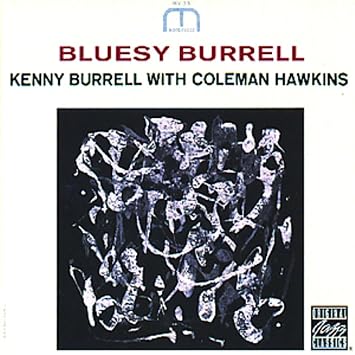
This is Coleman Hawkins' swan song to Prestige, and it's hard to imagine a better way to go than with Kenny Burrell. I've written extensively about both of them, and there's not much more to add, except that they mesh, and make beautiful musical together.
Hawkins comes in about halfway through the session, and is featured on"Montono Blues," "I Thought About You," "Las Palabras," and "It's Getting Dark."
The album is about evenly divided between standards and Burrell compositions, with one interesting choice--a tune that would become a standard of the jazz repertoire, but was only just being introduced. "Tres Palabras," by Cuban composer Osvaldo Farrés, had first been recorded in Cuba in 1943, but had never had a norteamericano rendition until 1962, when two things happened, probably unrelated.
First, Farrés and his wife left what had become Fidel Castro's island, never to return. They settled in New York, where they became known to the New York music community--Cuban-born Chico O'Farrill, long a part of the New York music scene, was already an admirer, having record "Las Palabras" in 1958. But also in 1962, on the West Coast, Nat "King" Cole was making his third album of Spanish-language songs. More Cole Español. Cole was already an admirer of Farrés--two of his songs had been featured on 1958's Cole Español.
Cole's vocal version (followed not long after by Johnny Mathis) and Burrell/Hawkins' jazz take brought "Las Palabras" to the attention of mainland artists, and it became a standard, recorded by many--Bill Perkins, Tete Montoliu, Joe Henderson and Bobby Hutcherson, to name a few. Whatever Burrell's reason for recording it. the promotions depart of Prestige knew how to promote it--if not to spell it. The album cover heralds "a new BOSSA NOVA - Tres Talbras." The liner notes on the back also give the tune as "Tres Talbas," but the label on the disc itself has the name correct.
The liner notes, by Robert Levin, also give a little plug to the Prestige philosophy of recording. After recounting how, on "Montono Blues, Hawkins
padded over to his recording position in a deceptively disinclined manner after the take was already underway, seated himself next to Burrell and, after Holley's bowed solo, got a nod from Burrell to begin his own...
Levin offers this observation:
Casual jazz sessions such as this frequently produce music of greater and more durable quality than do sessions of extensive preparation and lofty design.
Tommy Flanagan, Major Holley and Eddie Locke were Hawkins' regular group in these days. Flanagan had also been a member of teenager Burrell's first group, back in Detroit. Ray Barretto, perhaps added for the Latin numbers, is always an asset in any context.
Bluesy Burrell was a Moodsville release. "Out Of This World / Montono Blues" and "I Thought About You / It's Getting Dark" were the two 45 RPM singles. The album was re-released on Prestige in 1968 Ozzie Cadena produced.
Gene Ammons jumps on the bossa nova bandwagon, which may sound like a putdown but is not, because any wagon Ammons jumps on is a cause for celebration, especially if you're following the progression of Prestige recordings and putting yourself back into 1962, in which case, you've been listening with the dark foreboding awareness that each session is drawing him closer to cruel incarceration for drug possession, and seven years in prison for a sickness, not a crime. And we have now reached that point. This would be his final recording session for seven years.
And if you're starting to feel that Ammons' swan song was a gimmicky commercial album, don't. The bossa nova is not a bad bandwagon to be on. The Brazilian samba provides a great framework for jazz improvisation, and no one went into Rudy Van Gelder's studio, with one of Prestige's producers, to make anything less than a real jazz album.
Don't forget, also, that secret to Ammons' enduring critical and popular success was twofold: the serious jazz community loved him because he was a real musician's musician, and the public loved him because he played music that people loved to listen to. So if the public wanted the bossa nova, Ammons would have had no problem giving them--in the company of some stellar musicians--the bossa nova.
This is pretty much a new crowd. Hank Jones and Oliver Jackson, no strangers to Prestige, are matched with Ammons for the first time. Kenny Burrell, even less of a stranger, made one Ammons session back in 1957.
Bucky Pizzarelli is new to Prestige with this session, and he would hang around for a few more during the decade. At the time of this recording he was a still relatively obscure, though respected, session guitarist, often called upon for recordings across a range of genres. When you move away from jazz, musicians on a session are frequently uncredited, so it's impossible to even come close to listing his credits. He worked with Benny Goodman, and was part of Johnny Carson's Tonight show orchestra. In 1972, when Carson left for the west coast, Pizzarelli elected to stay behind, and his reputation blossomed. Performing solo or duet in New York clubs, he started garnering rave reviews, and began to be in even more demand. Around 1980, he started playing regular duets with his son John.
The session was produced by Ozzie Cadena, who had just taken over for the departing Esmond Edwards as head of A&R for Prestige, having filled the same role at Savoy. Between Cadena and Ammons, they came up with an interesting selection of tunes for the bossa nova treatment--I'd guess mostly Cadena, because Ammons, severely heroin-addicted, overworked to pay for his habit, and headed for a lengthy prison sentence, was not likely to be reaching so far out of the jazzman's standard repertoire.
The result is a very different route from Dave Pike's exploration of the work of one contemporary composer. There's one Ammons original ("Molto Mato Grosso"), but the rest are a curious and
fascinating collection--and with the Ammons touch, they all fit together.
"Pagan Love Song" was written in 1929 by Hollywood tunesmiths Nacio Herb Brown and Arthur Freed for a silent film, The Pagan, starring Ramon Navarro. It later became the title song for a 1950 film with Esther Williams and Howard Keel. It became something of a staple for pop singers and exotic ethnic bands (The Hawaiian Islanders), but did not much make it over to the jazz repertoire.
Anna was a 1951 Italian film starring Silvana Mangano. Its title song, also known as "El Negro Zumbon," was written by Armando Trovajoli, a well-known composer, under the pseudonym R. Vatro. The movie was released in the US in 1953, and the song--although written by an Italian, with lyrics in Spanish by another Italian, Francisco Giordano-- is credited by some as igniting the first spark of interest in Brazilian rhythms. It was covered by Tito Puente with Abbe Lane, and by Xavier Cugat. It may have been brought to this session by Pizzarelli, as it had been recorded a year earlier by his frequent guitar partner George Barnes.
"Ca' Purange (Jungle Soul)" was composed by Natalicio Moreira Lima. He and his brother, performing as a duo, had been popular in Latin America since the early 1940s. As Los Indios Tabarajos, they would finally find success in the US and worldwide in the mid-1960s, with a gold record for 1963's "Maria Elena."
"Cae, Cae" was probably known to Cadena from Carmen Miranda's rendition of it in 1941's That Night in Rio, but the song had already been a hit in Brazil. Its composer, Roberto Martins, was (according to biographer Alvaro Neder on the Allmusic web site), "the composer of several classics of the Golden Age of the Brazilian song, recorded by many of the best interpreters of the period"--the period being the 1930s. "Cae, Cae," written for the 1940 carnival in Rio, "having been included in 12 foreign films, [became] an all-time carnival classic, even if it only achieved third place in the annual municipal contest of that year." It hasn't really caught on with recording artists, which is surprising, since it's hard to imagine a catchier tune.
"Yellow Bird" is of an earlier vintage altogether--a 19th-century poem, "Choucoune," by Haitian Oswald Durand, set to music in 18923 by Haitian composer by Michel Mauléart Monton. Katharine Dunham recorded it in 1946, and folk trio The Tarriers (featuring Alan Arkin) sang it in a 1957 movie, Calypso Heat Wave. They sang the original French lyric, but in the same year, Hollywood songwriters Alan and Marilyn Bergman put English lyrics to the melody. As "Yellow Bird," and rebranded as a calypso, it would have a new life, most successfully for Arthur Lyman on the newly invented Billboard Easy Listening charts in 1961. Ammons and co. make it something more than Easy Listening.
Bad! Bossa Nova was a Prestige release. It would be rereleased as Jungle Soul! and later as Jungle Soul, without the exclamation point. There were four 45 RPM singles. "Pagan Love Song" and "Anna" were on one of them. The others were all two-sided: "Ca' Purange" Parts 1 and 2, "Molto Mato Grosso" Parts 1 and 2, and "Jungle Soul" (which was, of course, deja vu all over again on "Ca' Purange") Parts 1 and 2.
And after this, silence for seven years. That wound is still raw.
It's been noted that one of the most remarkable things about jazz in the 20th century was the rapidity with which it morphed and transfigured itself. The progression from folk art to popular art to high art is common to almost all modes of expression, but with jazz the creative explosions and transfigurations happened with dizzying speed. Previous genres had no time to die out before their successors, and their successors' successors, grew from liminality to full flower. In mid-century New York City, it was possible to hear early New Orleans jazz from artists like Bunk Johnson and Baby Dodds, and of course Louis Armstrong when he was not off on a world tour as ambassador of American culture. Clubs like the Metropole Cafe and
Eddie Condon's thrived through the mid-1960s (Metropole) and even the mid-1970s (Condon's). The swing era was widely represented, with artists like the Dorsey Brothers and Benny Goodman playing venues like the Rainbow Room and the Roseland Ballroom, Count Basie at Birdland (and his style of music represented at Count Basie's in Harlem), Coleman Hawkins playing the Village Vanguard and the Village Gate. Rhythm and blues could be heard at the Apollo, and at Alan Freed's rock 'n roll shows, where his house band was led by jazzmen like Al Sears and Sam "the Man" Taylor. Bebop was everywhere, and soul jazz and free jazz and Latin jazz all had their venues,
Small wonder that a younger generation of musicians had a veritable smorgasbord of styles to choose from, and some chose to graze up and down, sampling here and there. A young Ray Bryant would play traditional jazz in the afternoon at the Metropole with Henry "Red" Allen, then head downtown to play with the moderns in the evening. Steve Lacy skipped right over the prevailing sounds of his own era, starting with trad jazzers like Allen, Zutty Singleton, Buck Clayton and Jimmy Rushing, and then moving straight into the avant garde with Cecil Taylor.
Dave Pike was another. Always a confessed bebopper at heart, he had a restless spirit that responded to restless times, and he experimented over a range of musical styles. Born in Detroit in 1938, he was not to become a part of that still-fertile musical scene, as his family moved to Los Angeles when he was fourteen. He had begun playing the drums at age 8. Inspired by Lionel Hampton and especially by Milt Jackson, he gravitated toward the vibes, and by the time he was in his late teens, he was playing with West Coast musicians like Curtis Counce, Dexter Gordon and Harold Land.
His first recording, however, was with avant gardist Paul Bley, in 1958. In 1961, after a move to the East Coast, he made his first recording as leader, and as proof that you can't altogether take Detroit out of the boy, Barry Harris was his piano player. This was a bebop session, with Harris and such bebop standards as "Green Dolphin Street" and "Hot House." A second album, for Columbia's Epic subsidiary, featured Bill Evans on piano and more straight ahead jazz.
By this time he had begun playing with Herbie Mann, whose group featured a lot of Latin music, so when he signed with Prestige in 1962, that became the focus of his work,
Brazilian music was the hot Latin sound at that time, and Antonio Carlos Jobim was the hot composer. Pike elected to go in a different direction, turning to another composer, one who was renowned in Brazil but whose reputation had not made the leap to the northern hemisphere. Joao Donado had worked with both Jobim and Joao Gilberto, but he perhaps got a little too experimental, and his popularity in Brazil started to decline as people complained they couldn't dance to his music. Relocating to the US, he played with Mongo Santamaria, Tito Puente, Bud Shank, and Cal Tjader, and had some minot hits for Sergio Mendes, and a handful of songs fairly widely recorded by Latin bands, but he never did make that big time status reached by Jobim and Gilberto.
Pike and his group spent two days out at Englewood Cliffs, the first of which seems to have not been a complete success, in spite of having Clark Terry in the group. Two tunes, "Samba Lero" and "Serenidade," were rejected, and re-recorded the next day without Terry.
The other headliner, Kenny Burrell, was there for both days, as were the rest of the musicians.
Rudy Collins had made his Prestige debut a couple of weeks earlier, with Ahmed Abdul-Malik. He would play on a few more Prestige sessions over the decade, but was mostly known for his work with Dizzy Gillespie and Herbie Mann.
This was Chris White's only Prestige recording, but not his only bossa nova recording, and not his only bossa nova recording in 1962. In June, he had recorded bossa nova albums with Lalo Schifrin for Audio Fidelity and with Quincy Jones for Mercury. In September, he was called back to finish the Quincy Jones project, and in October, more bossa nova with Schifrin for MGM. White was one of those young players, like Pike, Bryant and Lacy, who was drawn to different schools of jazz. He worked with Cecil Taylor in the 1950s, then with Nina Simone, and then for several years with Dizzy Gillespie. He also had a distinguished career as an educator, where one imagines his open-minded approach to musical schools must have stood him in good stead.
Brazilian percussionist Jose Paolo also played the two Lalo Schifrin recording date, and recorded with Stan Getz. He also recorded a couple of albums under his own name for a budget label, Evon.
The album was released on New Jazz as Bossa Nova Carnival -- Dave Pike Plays The Music Of Joao Donato With Clark Terry And Kenny Burrell. "Samba Lero" and "Melvalita" were released on 45, with an interesting twist. Instead of just editing down the album cut to 45 RPM length, they recorded "Samba Lero" twice, a full length version and a 45 version. They also seem to have recorded a third version with vocals, which was not released. There's no mention of a vocalist on the session log, so I'm guessing it was probably Pike, who was known to vocalize -- and dance -- along with his solos. No second version of "Melvalita."
Elliot Mazer produced. Mazer's family were neighbors of Bob Weinstock's in Teaneck, NJ, and Weinstock first hired him as a gofer, gradually working him into the music end. Mazer would go on to be a successful producer of pop and rock acts, most notably with a long association with Neil Young. This was one of the few Prestige studio albums not recorded by Rudy Van Gelder.
One of the many sessions Gene Ammons crammed into this period between incarcerations, this one is notable for having Mal Waldron on piano, which also meant the inclusion of some Waldron compositions, which are always welcome. Waldron wasn't playing much in 1962. Like Ammons, he was deep in thrall to heroin, leading to a complete breakdown in 1963. Fortunately, he recovered,and then opted for the expatriate life in Paris, where he was able to recover his health and his career.
Waldron could and did write for anyone, and here he is right up Ammons' alley, with compositions
tailored to his rhythm-and-bluesy accessibility, his ability to make the most of a groove, and his musical inventiveness. The tunes he brought to this session are "Light'n Up," "Short Stop," "Salome's Tune" and "Blue Coolade." There was good reason for Ammons' popularity. He played real jazz, and he played for the people. And Waldron caught all of that.
This session was broken up and parceled out to two albums: Velvet Soul ("Light'n Up," "Salome's Tune," "A Stranger in Town), and Sock! ("Short Stop," "They Say You're Laughing at Me," "Blue Coolade"). Both albums were released in 1964, after Ammons had begun his second prison sentence. "You Go to My Head" and "It's the Talk of the Town" were on a third album, 1965's Angel Eyes, as Bob Weinstock parceled out Ammons' releases over his incarceration period to keep his reputation alive with the jazz public. "A Stranger in Town" came out as one side of a 45 RPM single, with "Velvet Soul" on the flip side. Esmond Edwards produced the session.
Ahmed Abdul-Malik had a brief recording career but an enduring legacy. Raised in New York, he entered the jazz scene in 1956, recording with enigmatic German pianist Jutta Hipp, and contributing to three albums by Randy Weston. Both Abdul-Malik and Weston would go on to develop jazz styles that drew heavily on African and Middle Eastern music, becoming, like Yusef Lateef, pioneers in what would become an increasingly important strain of jazz. He made two albums as a leader in 1958 and 1959, then in 1961 began his association with Prestige, which would last for four years and four albums, after which he essentially quit the recording business. He remained active in music, with a South American tour sponsored by the US State Department and a 1973 performance in Morocco at the first major African
jazz festival. In 1970 he began a teaching career at NYU and Brooklyn College. In 1984, he was honored with BMI's Pioneer in Jazz award for his work in bringing Middle Eastern music into the jazz lexicon.
In this session, he brought together a ten-piece group composed of musicians with solid jazz reputations (Richard Williams,Caio Scott) and others who have no other jazz recording credits (Rupert Alleyne, Edwin Steede). Bilal Aburrahman, like Abdul-Malik, was an early explorer of Middle Eastern sounds in jazz. Taft Chandler is a swing era veteran (Luis Russell), but not much recorded in a small group setting. Together, they made up the sound Abdul-Malik was looking for.
With three percussionists, each of different backgrounds, he got a rhythmic synthesis that combined traditions. If the weaving together of threads from the jazz and classical worlds is known as third stream music, then maybe this is fourth stream. A better name for it would not come until years later, but surely this is an important precursor: world music.
Rudy Collins utilized the traditional trap drum kit that has always been the backbone of jazz combos.
Entering the scene in the late 1950s, he would become a fixture on the jazz scene of the next three decades, playing with traditional (Hot Lips Page, Roy Eldridge), mainstream modern (Dizzy Gillespie, Gene Ammons) and avant garde (Cecil Taylor) musicians. James Hawthorne (Chief) Bey was an African folklorist as well as a jazz percussionist. Roger "Montego Joe" Sanders took a Caribbean name, but his interests were also deeply African. He had recorded with Babatunde Olatunji, and with Art Blakey's Afro-Cuban group, the Afro-Drum Ensemble.
Abdul-Malik's parents had migrated to Brooklyn from the Caribbean, although he would later invent as Sudanese heritage. and the cradle of world music, as jazz and Africa and Brazil are melded, can be heard in "African Bossa Nova," a rhythmic delight with some superb blowing and a bravura pizzicato cello from Caio.
Sounds of Africa included one track from an earlier (May 23, 1961) session. Esmond Edward produced both this session and the previous one. The album was released on New Jazz.
The folks at Prestige took the rest of July and half of August off, returning with this Moodsville session.
When one thinks of the Prestige subsidiary labels of the early 1960s, one is more likely to extol the virtues and the contributions to the library of recorded jazz made by Swingville and Bluesville. But let us not forget Moodsville and its contributions. Mood music? That's generally sort of a putdown, but all music has the power to affect our moods, and as producer Chris Albertson has asserted, the music that was released on Bluesville was held to the same standards as all Prestige albums.
Coleman Hawkins made recordings for both Swingville and Moodsville, and one can only be grateful for any album made by Coleman Hawkins, still at the top of his form in 1962 and still prolific. In that year he recorded two albums for Verve (both live appearances at New York's Village Gate), three albums for Impulse!, including the widely celebrated Duke Ellington Meets Coleman Hawkins, and three albums for Moodsville, all of them Broadway show tunes.
No problem with that as a unifying theme. Most of the classic songs from the Great American Songbook were written for musical shows, either Broadway or Hollywood. and if by 1962 the greatest era of the Broadway musical was fast fading, it wasn't quite gone yet, and some very good composers were still creating music for the Great White Way. The title song is from a modestly successful musical of two years earlier (the full title of the album is Coleman Hawkins Plays Make Someone Happy from Do Re Mi), which featured music by Jule Styne, lyrics by Betty Comden and
Adolph Green. "Make Someone Happy" was the hit from the show; Hawkins and Co. include a second song from Do Re Mi, perhaps to justify the album title, perhaps because it really is an overlooked gem from a master tunesmith. And when I say overlooked, I mean overlooked--the Hawk's is the only jazz instrumental version of "Cry Like the Wind." June Christie recorded it, and so did Margaret Whiting and Mel Torme, but beyond that, not much of anything. Too bad--it deserves better. But at least we have this one.
A brand new musical, just opened in the spring of 1962, provided another song. The musical was I Can Get It for You Wholesale, music and lyrics by Harold Rome, and if Hawkins and Esmond Edwards were guessing at what might be the hit from the show, they guessed wrong with "Have I Told You Lately?" If anyone else has ever recorded it, I haven't been able to find it. In fact, there weren't really any breakout hits from I Can Get It for You Wholesale, but there was a breakout performer--teenaged Barbra Streisand, in her first Broadway role.
How to Succeed in Business Without Really Trying had opened a few months earlier, in late 1961, and "I Believe in You" had established itself as the hit song from the show.
For the rest of the album, they went back to earlier mega-hits--Oklahoma, My Fair Lady, The Sound of Music--all good stuff, all wonderfully done here, particularly "Wouldn't It Be Loverly," in which the melody is played by Major Holley on bass.
Holley, Tommy Flanagan and Eddie Locke were Hawkins's regular touring group in these days, and had backed him on the other two Broadway albums for Moodsville.
Jimmy Grissom is not the first name that springs to mind when one thinks of jazz vocalists, but he had an active career that spanned a good decade and a half from the late 1940s to the early 1960s, and even included -- sort of -- one of the most important live performances of the era to be captured on record -- Duke Ellington's 1956 performance at the Newport Jazz Festival.
Sort of, because of course Grissom is not on the famous Ellington at Newport LP. But, as we now know, that LP wasn't exactly Ellington at Newport. The Duke was not completely satisfied with the Festival suite, and elected to redo it in the studio. The actual live concert was pieced together from various tapes and issued as a 1999 CD release, and Grissom is on that version, singing the Rube Bloom / Johnny Mercer standard, "Day In, Day Out."
Duke Ellington was not known for working with the A-list vocalists of his day. Although he wrote some of the greatest songs in the Great American Songbook, his focus was always on his orchestra and its extraordinary soloists, and the singers were secondary. Nonetheless, you didn't get hired by Ellington without being very good.
Grissom, the nephew of Jimmie Lunceford vocalist Dan Grissom, performed and recorded around the Los Angeles area starting in the late 1940s, appearing on various independent rhythm and blues labels. He had a minor hit with "Once There Lived a Fool," written by Jessie Mae Robinson, an underappreciated (but widely recorded) songwriter. "Once There Lived a Fool" was covered by Jimmy Witherspoon, Charles Brown, Savannah Churchill, and later Tony Bennett and Dakota Staton.
He joined Ellington in 1953, and was with him through the Newport concert. He only made a few recordings after that, and his Prestige association was a brief one. It would seem that Bob Weinstock and Co. had initial high hopes for him, putting him together with Oliver Nelson, and it would also seem that they changed their minds rather quickly. They only cut four songs on this date. Two of them were released as a 45 RPM single, the other two were shelved, which seems a shame. One of the shelved songs, "Get Yourself Another Fool." is a lovely blues ballad, recorded by a number of first rate performers, including Charles Brown, Sam Cooke, and even Paul McCartney.
Nelson brought along Hank Jones, Wendell Marshall and Ed Shaughnessy, all of whom he had worked with often, and a string section, and organist Dick Hyman, an unusual choice. Hyman was a keyboard wizard who could play in nearly any style, but one that he was rarely accustomed to was the trendy soul jazz style of the moment, and in fact he stays away from that genre here, working in a more mainstream style, providing fills and swirls around the complex rhythmic patterns laid down by Marshall and Shaughnessy. All of this takes just over two minutes, backing up Grissom's rhythm and bluesy ballad vocal. It's on the short side even for a pop single, and it's hard not to wonder if there wasn't a more extended LP-intended version somewhere, edited down for 45 RPM release. Why else call in Oliver Nelson and a rhythm section as gifted as Jones, Marshall and Shaughnessy, and strings, and especially why else bring in Dick Hyman? Weinstock and Esmond Edwards (I'm guessing -- no producer credit here) must have had something different in mind, and maybe they decided it was too different (why put an organ on a record in 1962 if you're not going for the soul sound?) or not different enough. Grissom's delivery is excellent, but maybe they decided it was too 1950s, and it wasn't going to make a dent in the new market of the Kennedy era. If only they had known. Within a year, the Kennedy era was over, and a group of rock and rollers from England were going to change everything about what music was listened to, and how it was listened to.
So there's just this one single. And it's good. And worth a listen.
Clarksdale, Mississippi, is one of the most important addresses in the history of the blues, having been home to Muddy Waters, Son House, John Lee Hooker, Ike Turner, Sam Cooke, Junior Parker, and many others. Today it is a tourist destination, as people come from around the world to visit the Delta Blues Museum or the crossroads where Robert Johnson had his famous mythic meeting with the Devil. But in the early and mid-20th century it was a place to leave, a jumping-off point for the Great Migration, as its future blues legends were to depart for Memphis or Chicago, where they could find audiences and radio stations and record companies.
LISTEN TO ONE: Council Spur Blues
One who stayed was Wade Walton, who would build a life and a business in Clarksdale, and become a civil rights leader and an early member of the NAACP.
It was a decision grounded in reality. Even most successful blues singers made a very uncertain living from the blues, and creative accounting meant that they saw little or no royalties from even a hit record. But Walton's barbershop became a Clarksdale institution. The barbershop was a community center in those days, and Walton's presence made whatever shop he worked in, from the Arnold Brothers and the Big Six barbershops in the center of Clarksdale, to eventually owning his own shop.
And he was more than a local institution. Blues superstars like Ike Turner and Howlin' Wolf and Sonny Boy Williamson would come back to Clarksdale to get their hair cut, and poet Allen Ginsberg got a haircut from Walton.
One of the reasons Walton's shop was so popular, in addition to his skill with the razor and scissors, was the music. Walton had grown up playing music. His boyhood home was the Goldfield plantation in Lombardy, Mississippi, in the shadow of Parchman Farm, and he and his brothers used to play impromptu concerts outside the prison fences. When he moved into town and chose barbering as a career over music, he kept his guitar and harmonica close at hand in the barbershop, and would give impromptu concerts there, too, on those two instruments and a third -- a straight razor and razor strop, used as a rhythm instrument.
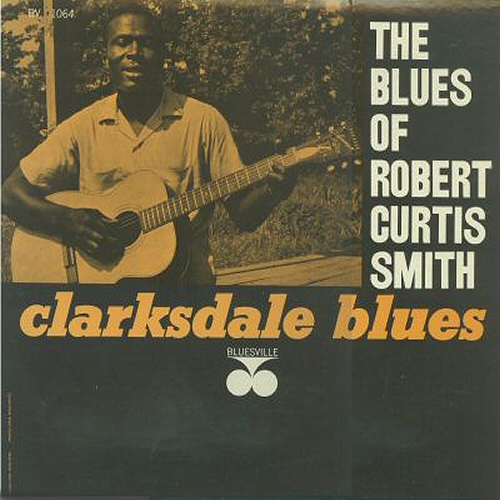
Walton came to be known to the blues collectors who began combing the South as the blues revival got under way. Chris Strachwitz of Arhoolie Records and British blues scholar Paul Oliver came to Clarksdale in 1960 to record him in the Big Six barbershop. They got a bonus from a customer at the time, Robert Curtis Smith, who also played and sang the blues, and whom they also recorded.
In 1961, both Walton and Smith recorded for Prestige Bluesville. The recordings appear to have been set up by blues collector Dan Mangurian, who had first met Walton on a trip to Clarksdale in 1958. The jazzdisco website, a remarkably accurate source for studio recordings by most of the independent jazz labels, is sometimes a little vaguer on field recordings. They list both Walton's and Smith's sessions as having taken place in Clarksdale in the summer of 1962, but it seems almost certain that Walton, with Mangurian, came north to Bergenfield, NJ, by then the office headquarters of Prestige. Did Smith come with them? There's no indication that he did, although why would Prestige have recorded Smith independently of Walton? Stephan Wirz, the German blues scholar whose research is very thorough, says that Smith was recorded in Memphis on July 28, 1961 by Chris Strachwitz, and this would not have been the only Strachwitz session to have been licensed to Bluesville. Production credit, according to Wirz, is given to Strachwitz and Bluesville's Kenny
Goldstein, although Goldstein would not have been likely to have been in the field. Wirz lists the Walton session as having been recorded in Bergenfield in 1962, by Rudy Van Gelder, and that seems unlikely. If Van Gelder recorded it (he is also credited on the album sleeve), it certainly would have been done in Englewood Cliffs. The album cover credits Goldstein as the producer. Wirz notes Mangurian and his partner Don Hill as uncredited producers.
Mangurian's and Hill's first meeting with Walton is documented in the song "Parchman Farm," on the album. This is very different from Mose Allison's "Parchman Farm," and much more up close and personal. Mangurian describes the genesis of the song in the album's liner notes:
"Parchman Farm" is a dramatization of a very real incident involving Wade, myself, and Don Hill...on our summer vacation [from Pomona College in California], Don and I traveled to the South to record folk music and blues in the field. We found Wade in Clarksdale and, while recording, we mentioned that we wanted to go down to Parchman Farm...to record the prisoners singing their work songs. Wade generously offered to take the next day off from work and ride down with us, since he was familiar with Parchman Farm from his childhood days.
Late the next morning we drove the 25 miles down Highway 49 to Parchman. We got a visitor's pass at the main gate and drove down to the chaplain's house figuring he would know the prisoners better than anyone else and help us out. The chaplain, however, was very uncooperative and sent us down to the administration building to wait for the educational director to return from lunch.
We didn't wait long before a stocky man with a .38 at his side stormed in. This was Mr. Harpole, a staunch segregationist as it turned out, who was then assistant warden and noted for his cruelty toward the convicts with his three foot leather strap. He asked us a few questions, then turned on Wade, saying "Boy, if you know'd like I know, you'd be out of here runnin'," and bluntly ordered Don and me to leave with the advice that "we should have known better to come in here with a n*****."
...The incident made a lasting impression on Wade, who later made up this song, weaving together the events in a loose rhyming way. The guitar depicts the seriousness of the situation (which Don and I were naively unaware of) he felt when Mr. Harpole arrived...He ends by saying "We left Parchman Farm, didn't get no race relations done."
Mack McCormick wrote the liner notes for Robert Curtis Smith's Bluesville album. Although
McCormick was unable to resist one more little gratuitous dig at Lightnin' Hopkins ("Unlike many a more fortunate blues singer, there is little self pity in this man"), he did paint a vivid and detailed picture of Smith's life as a Black laborer in Mississippi of the 1940s and 1950s, with a few telling but gruesome asides (Smith's home is a few miles from where Emmett Till was murdered). He describes in some detail the background to Smith's "Council Spur Blues," starting with a landowner named Roy Flowers, "whom Smith describes as 'rich man, but he don't pay nothin.'" Flowers followed what was then a common course of action -- wait for a Black man to get arrested, then go his bail, then tell the Black man that he was indebted to pay off the bail expense -- at a rate dictated by the white man.
Smith had to work for Flowers on the Council Spur plantation.
There he is kept on short rations, in debt to the plantation store and subject to the antics of an overseer who... refuses to let tenants have private vegetable gardens.
Smith's album is called The Blues of Robert Curtis Smith--Clarksdale Blues. His repertoire is bluse songs picked up from local bluesmen and the radio. Walton's is The Blues of Wade Walton--Shake 'em on Down. "Memphis Mango," credited as second guitar on the album, is Dave Mangurian. His songs are familiar blues material and some of his own composition, including two instrumentals. On both these albums, the original compositions referenced in "Listen to One" are powerful socio-historical documents as well as being powerful songs. Both are on Bluesville.
Walton's leadership in the local NAACP and his advocacy for civil rights led to his barbershop being bombed, but he rebuilt, kept working for the cause, and kept cutting hair, making a decent living from a Black-owned business that he never would have gotten from the recording industry. He was voted into the Clarksdale Hall of Fame in 1989, and died in 2000.
Rhoda Scott does not have the same name recognition as other soul jazz organists of her generation, but that's only true if you confine your attention to this side of the Atlantic. Shortly after recording two Prestige sessions, she set sail for France, where she has lived and performed ever since, and where she has become a major star.
This first date in Englewood Cliffs was a brief one, so I'll make this brief, and treat Scott at greater length later on. She recorded four songs with a quartet and vocal group. The second session was just the quartet. Two of the songs from June made
the album that was completed in October; two were released separately on a 45 RPM single. Both the LP and the 45 are credited to the Rhoda Scott Trio, never mind the number of musicians who actually played, and the album is titled Hey! Hey! Hey!, although that song is only on the 45.
The Shouters are presumably the same Buddy Lucas vocal group that recorded for Prestige in April, but augmented here with a male voice (perhaps Lucas; the individual singers are not identified here). If it's an entirely different group called the Shouters, then we have a really odd coincidence, because the combo that recorded with Lucas for Prestige in April, included trumpeter Joe Thomas, not to be confused with tenor saxophonist Joe Thomas who played on this set, although both were born in the same year (1909). had solid careers as swing era musicians, and died within a couple of years of each other in the 1980s.
"Hey! Hey! Hey!" and "If You're Lonely" were the 45, released on Tru-Sound, as was the album.
It seems inevitable that two of Prestige's most dependable soul jazz stars would get together, and for this session, the inevitable happened. Willis Jackson had been one of the pioneers of the organ/saxophone combo with Jack McDuff, who had moved on to a solo career. Johnny "Hammond" Smith was one of the hottest new organ talents around. So the pairing of the veteran and the hot newcome was a natural.
For a veteran and a newcomer, they weren't exactly far apart in age--Jackson was 30, Smith 29. But Jackson had made his first hit record in 1948, as the 16-year-old saxophone soloist of the Cootie Williams hit, "Gator Tail." Williams was the
bandleader, but Jackson was the star, and that hit record gave him the nickname he would carry with him for the rest of his life.
This would be their only joint venture. Smith had already been working with Seldon Powell, another veteran whose career in rhythm and blues went back to the 1940s, and would soon hook up with Houston Person, launching that soul jazz titan's career. Both Jackson and Smith were well into careers that would place each of them among Prestige's most-recorded stars. They are accompanied here by two of Smith's regulars, Eddie McFadden and Leo Stevens, and most of the cuts are Smith compositions. "Y'All" is by Jackson. "Besame Mucho" is the Latin standard, and "Nobody Knows the Trouble I've Seen" the traditional spiritual. What better vehicle for soul jazz than a spiritual? And they get down with it, making it my favorite cut on the album, and one that I'm surprised they didn't pull out for a two-sided 45 RPM single.
In fact, there were no singles from the album, which is a bit of a surprise. Esmond Edwards produced, and the album's title was Johnny "Hammond" Cooks with Gator Tail. the title reflecting the name by which the young organist would eventually be known, as he would drop the "Smith."
LISTEN TO ONE: Experiment in Terror Soft Summer Breeze
An abbreviated session for Jimmy Forrest: three tracks to be added to some leftovers from earlier sessions and released in 1962 as Soul Street. You wouldn't think they'd bring in Oliver Nelson and a nine-piece band for a few add-ons to an album by a less than A-list musician (in marquee recognition, not in quality), but they did, and we are the richer for it.
Maybe Weinstock and Edwards decided, "Hey, look what we did with Oliver Nelson and those songs from All American! Let's see what he can do with some even less promising material."
Maybe, and maybe not. There's only one really unlikely tune. Eddie Heywood's "Soft Summer Breeze" never became the jazz standard it might have, but it's a pretty tune, and quickly recognizable. Duke Ellington is always a good choice, and "Just a-Sittin' and a-Rockin'" is good solid Ellington.
Henry Mancini's "Experiment in Terror" is the odd choice, and liner notesmith Dan Morgenstern seems a little embarrassed by it:
Jimmy gives the rather slight melody more breadth and depth than this Mancini-made slickie really deserves.
"Experiment in Terror" hasn't made the cut as one of Mancini's major works, certainly, but it's an interesting tune, and it's had an interesting, if slight, history. Its 12 interpretations (per Secondhandsongs) suggest that this little ditty had something for everyone, or else that no one could quite decide what to make of it.
Experiment in Terror was a Hollywood thriller, and Mancini's orchestral version for the soundtrack came out as an album of music from the movie. Every cut on the album is jukebox-lengthed two to three minutes, though none of them took the jukeboxes by storm. The melody has a spooky quality, befitting the title, and it also also has a walking bass line, befitting Mancini. Subsequent renditions took it one
way or another, but Mancini had it both ways, a walking bass under swelling strings, at a stately, spooky pace.
It was next taken up by rock and roll instrumentalists the Champs, still looking for a followup to their big hit "Tequila," and in 1962 having added two young musicians named Seals and Crofts, who would go on to make their own name. The Champs went all out Peter Gunn, walking it hard and picking up the tempo.
And still in 1962, Oliver Nelson and Jimmy Forrest. Here the walking bass part is assigned to guitarist Mundell Lowe, and the rhythm starts to swing, and it's very easy to forget that one started out to do a survey of curious versions of this song, and simply get caught up in what these wonderful musicians do with it. The swelling strings are replaced by brass and reeds, and Jimmy Forrest's saxophone gives the rather slight slickie a reading that reminds you that this is Henry Mancini, and he did know how to write a melody. This is a very satisfying outing.
1963 saw terror move to the elevator with versions by Spanish orchestra leader Fernando Orteu and the Living Strings. Then dormant until the 1990s. when it was taken up by La Muerta, a Belgian band who specialized in music for "those abandoned by love or devoid of hope," unsurprisingly a version that emphasized the spooky elements. It was then taken up by surf rockers and pop rockers who also chose spooky over rhythmic. Most recently, contemporary jazzer Ted Nash gave it the Earl Bostic "Harlem Nocturne" treatment. Eclectic instrumentalists Reverend Organdrum returned it to the Peter Gunn sound (with organ and drum doing the walking part), and so did eclectic guitarist Al Caiola.
Maybe if more people had listened to the Jimmy Forrest version, the tune would have become more widely recorded. For one thing, it's the only collaboration I know of between the talents of Henry Mancini and Oliver Nelson.
And it has the guitar work of Mundell Lowe, in his only Prestige session. Lowe is associated more with the West Coast, but actually he was an Easterner until 1965, and recorded frequently for Riverside. Before that, interestingly for such a sophisticated stylist, he was a 16-year-old member of the Grand Ole Opry house band (not an easy gig to get in the city known as Guitar Town). A tour of duty in the army during WWII led to a friendship with John Hammond, who steered him toward jazz.
"Experiment in Terror" was the B side of a 45 RPM Prestige release, the popular "Soft Summer Breeze" on top. And all three tunes became part of Soul Street, a 1962 release on New Jazz.
Was the world really panting for a jazz version of All American? They hadn't exactly been panting for the original version of All American. The musical by Lee Adams and Charles Strouse, who had hit it big with Bye Bye Birdie, ran for 80 performances on Broadway, panned by critics and unloved by audiences. An account of the show's history in Wikipedia is a compendium of wrong moves.
First, the show's producers hired Mel Brooks to write the book, which doesn't sound like a bad idea, except that Brooks was then young and inexperienced. He'd had some success as a TV gag
writer, but didn't know much about writing a play. For one thing, he discovered, plays are longer than sketches for Your Show of Shows, and you had to sustain momentum all the way through them. This proved too much for Brooks to handle, and he gave up when he discovered that after you'd finished the first act, you had to write a second act. So the producers brought in Joshua Logan, who had lots of experience as a successful Broadway director and script doctor, but not so much with the kind of broad sketch comedy favored by Brooks, so the second act ended up not exactly meshing with the first act. Then the producers, sensing trouble, brought in a star--Ray Bolger, the Scarecrow from The Wizard of Oz and a veteran Broadway star. So the script was rewritten around Bolger, which might have been a good idea except for two things: the story wasn't much of a fit for Bolger, and in 1962 no one cared about Bolger any more. Nothing good came out of all of this for the producers of All American, but something eventually did for Brooks: The Producers, inspired in part by this experience.
For all that, a musical can at least sort of succeed if it produces a few hit songs, though by 1962, that was also pretty much an idea whose time had passed. And the score of All American was not the most memorable. The website secondhandsongs.com lists cover versions of over 100,000 songs -- it's not complete by any means, but it's pretty comprehensive and a good resource. Only two of the songs from All American are listed at all on the site, so if there are any covers of the others, they are slim and scattered. "Once Upon a Time." first recorded by Tony Bennett, has had a good run of action among crooners, both pop and country, although not even the Bennett version cracked the Billboard Top 100. Instrumentally, it has mostly been picked up by orchestras like Lester Lanin's and Percy Faith's, with very little jazz interest. Charlie Byrd has recorded it, and Kenny Barron.
The only other song from the score to get any cover action at all is "I've Just Seen Her," which has ten recordings, per secondhandsongs...and all by jazz performers. Terry, followed by Gary Burton, Pepper Adams, Scott Hamilton, Bill Charlap, Scott Hamilton with Bill Charlap.
Nothing for any of the others. Perhaps they weren't very good songs. Certainly, they weren't the hippest of the hip. Nat Hentoff, in the album's liner notes, says rather charitably of Strouse and Adams:
Both are knowledgeable writers for the current state of the Broadway musical, but no one would claim that either or both has more than a peripheral acquaintance with jazz.
One wonders who thought this was a good idea in the first place. Esmond Edwards? Bob Weinstock? Did Weinstock get such a cut rate deal on the score that he couldn't refuse? In any event, a silk purse had to be made out of a sow's ear.
The history of sow's ears into silk purses, in American culture, is an interesting one, and there have been some notable successes. Louis Armstrong turned a fairly pedestrian tune, "Sweethearts on Parade," by square's square Carmen Lombardo, into one of the most sublime jazz vocals of all time. Some would argue that history repeated itself, if not quite as sublimely, with "Hello, Dolly."
There's that great story of film director Howard Hawks trying to convince Ernest Hemingway to write for the movies. Hemingway said he didn't like movies, and every time he saw a movie based on a good book he hated it. "That's because good books don't make good movies," Hawks told him. "But sometimes a bad book can make a great movie. I'll prove it to you. I'll take the worst piece of garbage you ever wrote and turn it into a great movie."
"What's the worst piece of garbage I ever wrote?" Hemingway demanded.
"No question about it. To Have and Have Not."
Hawks, like virtually everyone else, shortchanged To Have and Have Not, which is a pretty interesting novel. But he did make a great film of it.
The poet and classicist David R. Slavitt, who has been praised for his translations of Seneca and Ovid, also published a collection of a little-known Roman author, The Fables of Avianus. Because Avianus was an undiscovered gem? "Heavens, no," Slavitt told me. "Avianus was a terrible writer. This way, all the credit for quality is mine alone."
And it's been reported that Clint Eastwood wanted the challenge of making a quality film out of a perfectly awful novel. Hence, The Bridges of Madison County.
"It was clear to me," Oliver Nelson told Hentoff,
...that without the action on state, Ray Bolger's dancing, and the comedy, the music by itself needed quite special treatment to stand up on a jazz date.
In short, Nelson was nearly as accomplished a diplomat as he was an arranger.
So, did he do it? Did he make the silk purse?
Oh, my yes. It was silk, it was silk and satin and linen that shows, rings and things and buttons and bows. "I've Just Seen Her," the one tune from the show that intrigued some jazz musicians, may be the weakest track here. Nelson has crafted a pure delight, and unexpected delight. Probably no one much took this album seriously. The contemporary website AllMusic.com gave it three stars; there are no listener reviews at all on Amazon, no comments on the cuts on YouTube. So this is one of those gems of a golden age of American that's just waiting there for you to discover it. And it may not be the equivalent of David R. Slavitt and Avianus, because Strouse is certainly an adequate tunesmith, but this is Nelson's music.
Clark Terry must have been scratching his head when Prestige contacted him about this gig. Also the diplomat, he describes, not his first reaction, but his second:
I was surprised at how much Oliver had been able to do with the tunes, not only with regard to making them more interesting harmonically, but also in terms of the naturally flowing rhythm patterns he set them in. And once we all got into it, it turned out to be a thoroughly enjoyable date. As I think the recording shows, we all had a ball.
It does. There's no guarantee that a bunch of performers having a ball will translate into a good time for the audience--look at the Rat Pack's version of Ocean's Eleven -- but in this case, you can hear them having a ball, and you can also hear them digging into miraculous arrangements, and doing right by them.
The band was quite likely a Nelson-Terry collaboration. Les Robinson was a veteran section man with a number of big bands, and was probably known to both men--certainly to Terry, who had played with him on the West Coast. George Barrow was frequently called upon by Nelson, both on baritone, as here, and tenor. He played on Nelson's Prestige sessions, and on The Blues and the Abstract Truth.
Of Budd Johnson, Terry told Nat Hentoff:
It was a great help, of course, to have Budd Johnson along. First of all, no matter what you give him, Budd will swing it. And he has such a solid knowledge of chords that you can't lose him. He always knows what's happening and what can be done to make the proceedings more interesting. You listen to him here. He's like an old pitcher -- he's got so much "stuff" going for him, not only a fast ball, but curves and twisters and changes-of-pace. And always there's that big tone.
This comes back to Nelson again. Not to put down the excellent musicians, including some jazz greats tired of the road, who play in the pit orchestras of Broadway musicals, but the score of a show like All American isn't going to have chord changes so unexpected that they might lose a lesser musician than Budd Johnson.
Eddie Costa played on a couple of Prestige sessions in 1957. Terry singles him out for much-deserved praise as well.
The man simply can't go wrong rhythmically. Eddie also contributed a lot to the good feeling that pervaded the session.
Costa's rhythmic brilliance, especially on the vibes, and his good camaraderie were both approaching a tragic end. In July of that year, just two months later, he would die in an auto accident at age 32.
Esmond Edwards produced. The album was recorded over two sessions. It was released on Moodsville, although it was far from being a Moodsville album. The title, and I appreciate the gentle irony, is Clark Terry Plays the Jazz Version of All American.
Percy Mayfield wrote and recorded "Please Send Me Someone to Love" in 1951, and its quality as a song was recognized pretty quickly. Dinah Washington recorded it in the same year (so, for that matter, did Dale Evans, showing the wide range of the song's appeal--after all, even cowgirls get the blues). And while jazz snobs might look down on rhythm and blues, at least some jazz musicians had more open ears. Count Basie and Joe Williams recorded it in 1955.
I first heard the song, and fell in love with it, in the 1957 doowop version by the Moonglows. That same year, Red Garland introduced an instrumental version of it. Somewhere around that time, I was beginning to fall in love with jazz. That's not quite right. It implies a gradual process. Somewhere around that time, I fell passionately in love with jazz in the space of five minutes and one song. And somewhere not long after that, I heard Red Garland's "Please Send Me Someone to Love."
If you were a teenager in the 1950s, at some point you were supposed to outgrow rock and roll, or so we were told. And rhythm and blues, which was lumped together with rock and roll, and indeed shared many overlaps/ Well, I had heard the clarion call from John Coltrane's horn (and Red Garland's piano, as I would find when I bought the Prestige album). Did that mean that, like the babies in Mary Poppins who spoke their first words in human language and from that instant on could no longer talk to or understand the birds, that I had heeded the cry of battle, crossed the Rubicon, and forever left those other musical genres behind, as I was supposed to.
But I hadn't. And hearing the Moonglows' song (as I knew it then) transformed by Garland, but still the same haunting memory, went a long way toward reassuring me that I was all right.
And I learned to trust my taste. And other jazz musicians were listening, too. Ramsey Lewis recorded it in 1958, Les McCann in 1961. Both had a pop music following, but both were respected jazz musicians. I make that point because, at that time, all these gradations mattered, and to the real purists, any record on the charts was a sellout.
Some other Prestige artists gravitated toward the tune. Davis's frequent collaborator, Shirley Scott, recorded it with an organ trio in 1958. Gene Ammons recorded it on his Argo session in 1962. And Davis included it, along with standards and originals, on this session.
By 1962, Percy Mayfield had endured a long and painful convalescence from an auto accident in which he had been pronounced dead at the scene. He no longer had a career as a rhythm and blues hitmaker, but one of his songs, "Hit the Road, Jack," had been picked up by Ray Charles, and on the strength of that hit, Charles had hired him as a full time staff writer, and would eventually record 15 of his songs.
He had become known as "the Poet of the Blues," and while "poet" is a term that's often thrown around too loosely, it has some validity in Mayfield's case. Specialty Records owner Art Rupe, for whom Mayfield made most of his hit records, praised his artistry while lamenting that he never had the confidence to present himself on a larger stage: "If he could have been encouraged more, he would have been seen as great as Langston Hughes.” I believe Rupe was right.
I haven't posted a "Listen to One" because it would have to be "Please Send Me Someone to Love," and as of this writing, it's not on YouTube. You can find it, however, on Amazon and Spotify (and probably iTunes, but I don't use that service, so can't be sure). Davis plays it beautifully, finding all the yearning, for the fate of mankind and his own happiness, that Mayfield put into both the words and the melody.
I'm glad that Davis was sufficiently drawn to this tune to record it, because he too was affected by the stigma attached to rhythm and blues in those days. In the liner notes, he explains his choice of a piano- over an organ-led ensemble:
I got to the stage where I'd had enough organ. It was always controversial, because a lot of people thought it belonged to R&B, and there's a faction that still refuses to accept the organ as a definite contribution to jazz. I made up my mind to go back to the conventional rhythm section.
This is Art Taylor's 68th appearance on a Prestige recording session, and he is a welcome addition every time. The other three musicians are all making their Prestige debut.
Abandoned on the steps of an orphanage at birth, Horace Parlan developed polio at the age of five, which left him with the use of only two fingers. His adoptive parents encouraged him to play the piano to strengthen his hands, and it was thus that he discovered his true calling in life, though he also studied pre-law at the University of Pittsburgh. He is perhaps best known for his work with Charles Mingus. He would only make one other Prestige session (with Booker Ervin), but he worked and recorded widely with a number of musicians, including a stint in the 1960s as "house pianist" for Blue Note. He also made 31 records as leader--with Blue Note in the 1960s. with the Danish label SteepleChase after his move to that country in 1972, and with other European labels.
Bassist Buddy Catlett built a significant regional reputation, living and working in primarily in Seattle, but also in Denver and other western cities, but he also had his share of the big time, including Louis Armstrong, Quincy Jones, Ella Fitzgerald and Count Basie. Willie Bobo was one of the foremost Latin jazz percussionists of his era, working with Perez Prado, Mongo Santamaria and Tito Puente while still a teenager, later with Mary Lou Williams, Cal Tjader, Herbie Mann and others. He recorded several albums for Verve as leader.
Goin' to the Meeting was the title of the Prestige LP release, and it was also the flip side of the 45 RPM single--"Please Send Me Someone to Love" was the A side. Esmond Edwards produced.
These were tough times for Gene Ammons. His 1960 release from prison had thrown him back onto the mean streets unprepared to battle his addiction, and the need for money and drugs had him working at a fever pitch, in the clubs and in the studio, to support his habit, with the law dogging his heels and finally, late in 1962, arresting him again--a frameup, according to Prestige producer Bob Porter.
Porter, in his important book Soul Jazz: Jazz in the Black Community 1945-1975, describes the arrest:
The arrest warrant charge this time was possession with intent to sell. The case against Ammons was built with all the subtlety of an inquisition. In today's judicial climate, the case would clearly be one of entrapment, but that didn't help Ammons in the Illinois of 1962. He spent more than seven years behind bars.
Ammons, for all the desperation of his private life, was playing wonderfully in those days, and his reputation was burgeoning. Bob Porter states that "Black people began to plan their vacation schedules around his personal appearances. In 1962 alone, he had 13 recording sessions, mostly for Prestige.
The exceptions were a February session for Verve with Sonny Stitt, and some curious recording dates in Chicago in late April and early May. There was a four-song session with Howard McGhee which yielded one 45 RPM single released on Winley, a New York doowop label, and two other songs which came out on Winley compilation albums.
Then there were a series of sessions recorded for Chess, but never released on Chess, because Ammons had an exclusive deal with Prestige, and Bob Weinstock sued and won the rights to the masters. The first of these, on April 27, featured Clarence "Sleepy" Anderson on organ, and unidentified personnel. The next, on May 3, featured Anderson, bassist Sylvester Hickman, and drummer Dorral Anderson. The next day, he recorded with Dodo Marmarosa (piano), Sam Jones (bass) and Marshall Thompson (drums). Some of these recordings were released by Prestige during the seven years of Ammons' incarceration, as Weinstock carefully spaced out releases to keep Ammons's name alive; others only came out in the early 1970s, after Prestige had been sold to Fantasy.
A 45 RPM single, with "I Can't Stop Loving You," recently featured on Ray Charles's Modern Sounds in Country and Western Music, on one side, and "My Babe," a 1955 smash for Chess artist Little Walter, on the other, did get released on Chess subsidiary Argo Records, and later again on Prestige/Fantasy compilations. Also released on Argo, and later on Prestige, was a trio album Just Jug, with Eddie Buster on organ and Gerald Donovan on drums.
In the early 1960s, Prestige experimented with a bunch of subsidiary labels. The significant ones, of course, were Bluesville, Swingville and Moodsville, but there were others.
Prestige Lively Arts mostly featured spoken word recordings. Here are a few: Roddy McDowall Reads the Horror Stories of H.P. Lovecraft, Burgess Meredith Reads Ray Bradbury, Larry Storch Reads Philip Roth, James Mason Reads Edgar Allen Poe, James Mason Reads Herman Melville’s Bartleby, The Scrivener, Morris Carnovsky Reads Dostoevsky’s Notes From Underground. These really are as fascinating as they sound, and YouTube has most of them.
Prestige Irish was what it sounds like, and it was the shortest-lived of the bunch, with only three titles; much more complete was Prestige International, which had folk music of many different countries, but mostly the British Isles. There was some American folk music also, but then a new label, Prestige Folklore, was started in response to the folk boom. One of the folk artists featured was Dave Van Ronk, and it's hard to pass him by without a mention. He recorded an extensive list of the traditional folk and blues songs he loved, 13 of which were released on a Prestige International LP, 12 more on Prestige Folklore.
In 1963 he was back in the studio, this time the Van Gelder studio, to record again, with a traditional jazz band, and that gets him back into the purview of this blog, so we'll take it up when the time comes.
Not much to add here about Van Ronk. He was a powerful figure in the folk music revival of the 1960s, known as "the Mayor of McDougal Street" for his presence on the New York folkie coffee house scene, and he made some wonderful records. Oh, and an anecdote. At about the time he was making these records for Prestige, he did a concert at Brown University, where my brother, Jonathan Richards, was the resident cartoonist for the campus newspaper. They asked him to do a drawing of Van Ronk to promote the concert, but did not provide him with any pictures. So he did the best he could. He drew a burly guy hunched over a guitar, head down, so that all you could see was hair and beard. Van Ronk must have liked it. He used it on his business card for several years after that.
In 1964, Prestige closed all its subsidiary labels.




:format(webp):mode_rgb():quality(40)/discogs-images/R-3060866-1339586709-2356.jpeg.jpg)




:format(webp):mode_rgb():quality(40)/discogs-images/R-6190628-1435635634-4479.jpeg.jpg)


