Tad Richards' odyssey through the catalog of Prestige Records:an unofficial and idiosyncratic history of jazz in the 50s and 60s. With occasional digressions.
Mal Waldron was recognized in his time by those who paid attention, and for more than just being Billie Holiday's pianist on the night that Frank O'Hara immortalized in "The Day Lady Died," even though he didn't get the votes in the Playboy or Down Beat reader's polls. Billboard, in reviewing this album, said, "As a composer and pianist in avant garde jazz, Mal Waldron has few peers." The Billboard reviewer put "composer" first, and that's no mistake. For whatever reason, the general public, even the Down Beat reading public, never got the message, but musicians and jazz record producers surely did. On virtually every session that Waldron was called to play on, he was asked to compose a few tunes (look at my comments for his sessions of May 2 or September 26, 1958.
"Soul Eyes," written for John Coltrane, is his best known composition, but "Fire Waltz," from this session, written for Dolphy, has attracted its share of musicians, especially in recent years. One of the many pleasures of this album is getting the chance to reconsider and re-appreciate Waldron as a composer. All the pieces recorded this day were his.
Billboard puts Waldron with the avant garde, and although his talents and interests covered the breadth of modern jazz, being asked to compose for a session with Eric Dolphy certainly gives him an opportunity to spread his avant garde wings, and he's up to the task.
There were two important jazz musicians in this era who were named after the pioneering African American educator Booker T. Washington, and both died of illness way before their time. Trumpeter Booker Little, whose collaborations with Dolphy can only leave us wondering what more the two of them might have achieved, died on October 5, 1961, at age 23.
Ervin died at age 40, in 1970...both of them of kidney failure. He had a chance to leave behind a substantial body of work, much of it on Prestige.
Originally from Texas, he got his start in the southwestern territorial band of Ernie Fields, then moved to New York in 1958, where he very quickly caught the attention of Charles Mingus. Although Dolphy and Ervin were both part of the Mingus family, they only appeared together on one recording, the Complete Town Hall Concert. This appears to be their only other joint outing.
I won't comment on each selection individually. I'd like to, but I don't have the knowledge or the vocabulary. I will say that this session made me stop and listen over and over again, and not want to go on. Charlie Persip's drumming kicks and drives and complicates the rhythm. Joe Benjamin's solid bass makes it possible for Ron Carter to move his cello up to the front line. The cello is always a touchy instrument for jazz, but Waldron finds a place for it that works. And while Waldron always adds something unique and valuable to any group that he's in, his solos on his own compositions are particularly expressive. This is a beauty of an album.
It was released on New Jazz as The Quest. Esmond Edwards produced. It would later be rereleased on Prestige under Dolphy's name as Fire Waltz. The tune, "Fire Waltz," was also played by Dolphy, Booker Little and Waldron on the Dolphy/Little Live at the Five Spot sessions, and in recent years, it has gone into the repertoire of a number of jazz musicians.
Listening to Prestige Vol 4, 1959-60, now available from Amazon! Also on Kindle! Volumes 1-3 are also available from Amazon. The most interesting book of its kind that I have ever seen. If any of you real jazz lovers want to know about some of the classic records made by some of the legends of jazz, get this book. LOVED IT. – Terry Gibbs
John "South Side Soul" Wright adds some uptown soul to the mix for his third Prestige album, in the person of Eddy "Cat-Eye" Williams, and some Detroit soul with drummer Roy Brooks, and they mesh to find a universal language.
I'm guessing that the new quartet was more Esmond Edwards' idea than Wright's, because according to Wright, he had never played with a horn before, and wasn't quite sure what to do. "I didn't know how to really play with horns then," he said later, "so I just started to comp behind Eddy Williams."
Wright may have been exaggerating a bit about his inexperience with horns. In an interview with Rebecca Zorach for the blog Never The Same: Conversations About Art Transforming Politics and Community in Chicago and Beyond, Wright recalled his first gig upon returning from the army after the Korean War, back when he could expect to get paid $7.50 a night:
When I came home from the military, my first job was on the West Side of Chicago at a place called, Fifth Jack, it was located at Fifth Ave. and Jackson Blvd. and it was operated by two prominent gangsters, they’re deceased now, I guess I can use their names: Butch English [this must be Charles Carmen "Chuckie English" Inglesia--TR] and Tony Accardo. I played there for one month. They told me to bring in a couple of horn players on the weekends! Well, I had met a couple of good horn players and I had invited them to play with me one weekend, they were the famous Gene Ammons, and Dexter Gordon, both tenor saxophonists.
Listening to Wright and Williams together, you'd find it hard to believe that Wright didn't know how to play with a horn player, particularly this horn player. Wright's percussive attack and Williams' hard-edged tone complement each other nicely. And they must have worked out a few ideas for the session together, because two of the best tracks on the album, "Makin' Out" and "Back in Jersey," have the two of them listed as co-composers. Two more ("Sparkle" and "Soul Search" are credited to Williams alone, and two ("Street" and "Kitty") are Wright alone.
Eddy "Cat-Eye" Williams was one of those unsung heroes, one of those guys who could play, and who could always get a job because everyone knew he could play. We know that in the 1930s and 1940s he played with Claude Williams, Tiny Bradshaw, Billy Kyle, Don Redman, Jelly Roll Morton, Lucky Millinder, Ella Fitzgerald, Wilbur De Paris, and James P. Johnson. \
Then nothing until 1958-59, when he recorded a couple of albums on Blue Note with Bennie Green. Marc Myers of the Jazzwax blog, who can track down pretty much anybody and anything, can only say
Puzzlingly, there are huge gaps of time in Williams' discography in the '50s—perhaps a result of a prolific R&B sideman career or some other reason.
The sides with Green were memorable, and were followed up by this session with John Wright. Later in the decade, a record with Pee Wee Russell and Oliver Nelson, and one with Earl Coleman.
And then? A couple of different internet bios say he "disappeared without a trace."
So this small window between 1958 and 1961, two albums with Bennie Green and one with John Wright, may be the apex of Williams's career, and if so, they give us more than a glimpse--a really good look into a really solid jazz performer, one who deserves to be remembered. We talked a lot about the swing-to-bop musicians like Zoot Sims and Coleman Hawkins, and what they gave to jazz, but the rhythm-and-blues-to-bop musicians, like Gene Ammons, King Curtis, and David "Fathead" Newman, were important too, and surely Williams was one of those.
You can hear it all on "Makin' Out," one of the Wright/Williams collaborations. Williams as a soloist, Wright as a soloist, and Wright as an inventive, intelligent and sympathetic musical collaborator with the right horn player. One of the few things we do know about Williams is that he was from Chicago, so maybe he and Wright had more of a history of playing together.
In "Makin' Out" you can also hear what a difference Roy Brooks makes. Brooks, from the jazz-intensive workshop that was Detroit, got his start with Yusef Lateef and Barry Harris. One of the more innovative drummers of his generation, he suffered from crippling bouts of mental illness that finally got the best of him. But he is certainly one of the reasons this whole session is as good as it is.
Esmond Edwards produced. The album was called Makin' Out, and it was released on Prestige. The title track, at a little less than five minutes long, could almost have made one side of a 45, but it was split and spaced over two.
Listening to Prestige Vol 4, 1959-60, now available from Amazon! Also on Kindle! Volumes 1-3 are also available from Amazon. The most interesting book of its kind that I have ever seen. If any of you real jazz lovers want to know about some of the classic records made by some of the legends of jazz, get this book. LOVED IT. – Terry Gibbs
Clea Bradford's obituary (2008, conflicting reports as to her age) describes her as a perfectionist and a
Renaissance woman of sorts—a world class chef (her culinary skills were documented in the Washington Star), a formidable painter, social activist, and composer, even penning blues numbers like “One Sided Love Affair” and “I’ve Found My Peace of Mind” for famed guitarist Pee Wee Crayton.
Bradford, of Choctaw-Cherokee-Ethiopian descent, was the daughter of a minister whose parish was in rural southeastern Missouri, but when she was seven, her parents separated and she moved with her mother to St. Louis. She'd been exposed to church music at home, and had loved to sing it, but St. Louis opened up a new door for her. That door was next door, and her next door neighbor in the Gateway City was Jimmy Forrest.
Forrest's house was more or less an ongoing jam session, and when Clea ventured next door, she was likely to meet other young St. Louisans like Oliver Nelson and Miles Davis. Or Clark Terry, down on a pass from Great Lakes Naval Base. And gradually, as a young teenager, she began to join in. By 17, she was a part of the St. Louis club circuit, and then, hearing that there were more musical opportunities, she moved to Detroit--a great apprenticeship for any young musician. She made her first recording, a 45 RPM rhythm and blues single, for Detroit's Hi-Q label.
Then on to New York, and a reunion with old friend Oliver Nelson, who got her a recording date with Prestige. and brought Clark Terry along to play on the gig, a collection of standards. It's a curious record, in that neither Nelson or Terry does a lot on it. It is musically interesting, because Bradford is a good singer, but mostly because of the piano work of newcomer Patti Bown.
Bown was 29 at the time of the session. She had made a record for Columbia in 1958. This was her second recording session, and her first for Prestige. She would go on to be very much in demand throughout the decade, frequently on Bob Weinstock's label. Like Clea Bradford with Oliver Nelson, Bown was able reconnect in New York with an old friend from childhood, who would hire her for his big band and connect her to others. In her case, it was Quincy Jones.
Bradford reportedly was not satisfied with her performance on the album, which I guess is one of the problems with being a perfectionist. She actually sounds quite good. There's a debt to Dinah Washington, but that's hard to avoid for a young jazz and rhythm and blues singer coming up in the 1950s. But in later interviews, she never spoke of it. But the dissatisfaction appears to have been just with herself, not with Oliver Nelson. She remained close friends with him, and they would work together years later in Los Angeles.
The album was released on Tru-Sound as These Dues, that being one of the two new songs from the session. I think a Bradford original; I'm not sure. Tru-Sound being Prestige's pop and "modern rhythm and blues" label, most of their recording sessions yielded at least one single, and "These Dues" would have been the logical choice, but no single was released, so maybe Weinstock wasn't excited enough with the results either. It would later be rereleased on New Jazz as Clea Bradford with Oliver Nelson and Clark Terry.
There would be one more jazz record for a New York label, Mainstream (Clark Terry was involved in that session too), and then at the end of the decade, a session for Cadet, a subsidiary of Chicago's Chess Records, By that time, she had become a mainstay of the various Playboy Clubs, a door opened for her by another old friend from St. Louis, comedian Dick Gregory. The Playboy Clubs, a very hot franchise in the 1960s, did not cater to a musically sophisticated audience but did feature top jazz names. Bradford had worked with, and become friendly with Kenny Burrell, who was on Cadet at the time.
Her album for Cadet was called Her Point of View. It was essentially a soul album, and its single, "My Love's a Monster," got good air play, and might have been a hit. Might have been, but it turned out that while Bradford may not have been satisfied with her performance on the Prestige album, the musical selections represented what she wanted to sing. On the strength of "My Love's a Monster," she got booked for soul reviews...where she refused to sing "My Love's a Monster," instead delivering jazz standards to a dissatisfied audience.
She continued to tour and sing through the 1970s and 1980s, then coming in off the road, she took a degree at Jerry Falwell's Liberty University, and became a minister. Also in these years, she grew more in touch with her Native American heritage, changing her name to Clea Bradford-Silverlight.
This is Ron Carter's debut as a leader, but he had already begun to make a considerable name for himself as a skilled and original bassist who could play in almost any context. He had already appeared on six sessions for Prestige alone, and had showed his prowess on the cello in one of those sessions, with Eric Dolphy. Dolphy was just coming into his own at this juncture, and he would be bound to come in for a large share of the attention any time he appeared on a session (some later reissues bill this as an Eric Dolphy album), but Carter has the presence to justify his billing as leader, including two tracks where Dolphy sits out.
"Bass Duet," as advertised, is exactly that, featuring Carter on pizzicato cello and George Duvivier on bass, counterpointing each other with shifting tempos and melodic lines. "Where?", a Randy Weston composition, features Carter's bowed cello and Mal Waldron's moody piano.
"Saucer Eyes" is another Weston composition, one that's been in the repertory of a number of groups. "Yes Indeed" is the Sy Oliver gospel-tinged rhythm and blues classic that's probably best known in the 1958 rendition by Ray Charles, and you can almost hear the call-and-response as you listen to Carter and Dolphy.
The Sigmund Romberg melody, "Softly, as in a Morning Sunrise," has Carter soloing on bowed bass and accompanying Dolphy pizzicato. They take a lot of adventurous liberties with the old operetta aria, and they make it all work. And this is as good a place as any to mention Charlie Persip's drumming, which adds so much to the session, but is particularly striking here.
"Rally" is a Carter composition and a powerful showcase for everyone involved in the session. Carter is on cello, so George Duvivier gets in on the action. Mal Waldron has solo space, and I've certainly had plenty of occasion to write about how highly I regard Waldron, as this is his 33rd Prestige session. My only regret is that none of his original compositions are featured here.
Esmond Edwards produced for New Jazz. The album was titled Where?
Tenor saxophonist Roland Alexander cut this session for Prestige in 1961, and his only other date as leader, for the short-lived avant-garde label Kharma, in 1978. He would record once more after that, with James Spaulding in 1991. Because his work grew more and more free form, it didn't always command a large audience or cause record companies to beat down his door, but it had the respect of his contemporaries.
And in the middle of all that, in 1973, his first recording was released. It was dated 1956, and his bandmates were John Coltrane, Curtis Fuller, Pepper Adams, Paul Chambers and Philly Joe Jones.
Wait a second. Who was on piano?\
Oh, yes, that. That was 20-year-old Roland Alexander.
So perhaps we'd better start at the beginning. Alexander was born and grew up in Boston and Cambridge, where he studied composition at the Boston Conservatoryy, and his first instrument was piano, although he took up the saxophone quite early. While he was still a conservatory student, he began playing local gigs around (this was not unheard of--Makanda Ken McIntyre was a fellow student).
Apparently Miles Davis, with his new young wunderkind Paul Chambers on bass, must have been playing a gig in Boston, when Blue Note decided they wanted to feature Paul Chambers as leader on an album. Fuller and Adams must also have been playing gigs in Boston at the same time, so they were called in on the session, but for whatever reason, Red Garland didn't show up. They played two numbers without a piano, but called upon the conservatory kid who happened to be in or around the studio to fill in on piano for the third tune, "Trane's Strain." He sounds good--appropriately for the session, very much in the Garland vein.
Blue Note shelved the session, although they did record Chambers again later that summer, in the Van Gelders' living room. So by the time it was finally released, it bore little or no resemblance to the music Alexander was making,
But when Alexander made his debut on Prestige in 1961, this session, with his idols from New York and the jazz world that the young conservatorian dreamed of entering, must still have been very much a part of his maturing self. He had come to New York in 1958. He had started building a reputation, and had played on two sessions for Bethlehem, one led by Howard McGhee and the other by Charlie Persip. And stylistically, he was still very much under the influence of Coltrane--not so much the Coltrane of Giant Steps as the Trane of the Prestige sessions with Red Garland. It was a sound that was starting to be superseded by newer styles, but it never went away completely, and it still sounds good.
Alexander's bop-time band was made up of young players, all new to Prestige. Of them, trumpeter Marcus Belgrave would go on to make the biggest impression in the music world. Belgrave had joined the Ray Charles band in 1957, and while off the road, in between tours with Charles, began to make a reputation in New York, working with Charles Mingus and Max Roach, among others. But not long after his session with Alexander, he moved to Detroit, reversing the trend of so many great Detroit musicians who had come east to New York. Many years later, he explained his motivation in an interview. “This was just a natural place for me to come.This was probably the only place in the country where music was No. 1.”
Although many of Detroit's top jazz musicians had left, there was still an active jazz scene, and the Motor City was about to become a music center all over again, with the arrival of Berry Gordy and Motown Records. Detroit's jazz musicians formed the core of the Motown house band celebrated in the documentary Standing in the Shadows of Motown, and Belgrave was one of the key players. When Motown Records decamped for Los Angeles, Belgrave stayed in Detroit, where he taught and mentored young musicians.
This was Ronnie Matthews' first recording session, and the beginning of a distinguished career. Unusually for a pianist, he didn't make all that many sessions as a leader, but he was a longtime member of Max Roach's group, of Art Blakey's Jazz Messengers, and for another generation, with T. S. Monk. He played with Dizzy Gillespie, Dexter Gordon, and many others.
Gene Taylor came to Alexander on loan from the Horace Silver Quintet, with whom he played from 1958-63. Among his other considerable accomplishments was writing the "Why? (The King of Love is Dead)," about the assassination of Martin Luther King, which Nina Simone recorded (he was working with Simone at the time).
They were all young. Roland Alexander was 26, Marcus Belgrave 25, Ronnie Mathews 26, “Scoby” Stroman 29. Gene Taylor was the senior citizen of the bunch at 32.
For Clarence Stroman, in the session log, "Scoby" is given as nickname, but for his 1996 obituary in The New York Times, it's his middle name: C. Scoby Stroman. Either way, he built a fine reputation not only as a drummer but also as a dancer, and as performance poet before that appellation was widely used. He called what he did "drummetry" -- a combination of drumming and poetry.
"Dorman Road" is a good example of Alexander's talent, and of his debt, at this stage of his career to Coltrane. An original Alexander composition, it's a tribute to Coltrane and takes its name from the road that ran past Coltrane's home. It develops off a riff that owes a lot to Trane. You can hear echoes of "Moment's Notice," on Blue Train, and a couple of other Trane riffs.
Ozzie Cadena produced, and the album was released on New Jazz.
As with Miles Davis and John Coltrane, Bob Weinstock seemed, as 1961 wound on, to be trying to get as much as possible out of Oliver Nelson before he moved on, and in as many combinations as possible. Here, four days apart, he goes from arranging strings and French horns for Etta Jones, to arranging a full jazz orchestra to support headliner Gene Ammons, Prestige's most prolific performer--this is his third session in 1961 alone. Ammons was a victim of the heroin plague, and this activity in 1961 was sandwiched between two prison sentences, one from 1958-60 and one from 1962-69.
We're hearing some musicians for the first time. Nelson was looking for a sound, not soloists, so he picked experienced section men: guys who could read music, who could follow a conductor's lead and get it right the first time, who would show up on time and ready to play.
Trumpeter Hobart Dotson had a lot of experience in big bands. He was in the dance bands of Gerald Wilson and Dan Belloc--and not all dance bands are alike. Wilson, who came up with Jimmy Lunceford (he replaced Sy Oliver), and played in the ensembles of Basie, Ellington, Dizzy Gillespie and Benny Carter, was in the tradition of black dance bands; Belloc, who owned and operated a ballroom in Chicago, and worked with some rock and roll groups (including the Buckinghams, later), catered essentially to white audiences. Dotson also worked with edgier jazz orchestras, including Charles Mingus, Slide Hampton, and (edgier still) Sun Ra.
Red Holloway would also find plenty of work for Prestige in the 1960s, particularly with Jack McDuff. Chicago was his home base for most of his career, where he worked with blues, rhythm and blues, rock and roll and jazz artists, recording with them and backing up touring artists.
Bob Ashton (baritone sax here; he also played tenor) made his Prestige debut in a 1960 recording of a big band led by Eddie "Lockjaw" Davis, which also marked Oliver Nelson's debut as an arranger. He would also find his way onto a number of Prestige sessions during the 1960s.
George Barrow is in the tenor sax section for this session, but he was better known for his work on the baritone sax, which he played on Nelson's arranging debut with Davis, and on The Blues and the Abstract Truth. With the ensemble of jazz superstars (Eric Dolphy, Freddie Hubbard, Bill Evans) that Nelson put together for that recording, he was to single out Barrow for praise: "His baritone parts were executed with such precision and devotion that I find it necessary to make special mention of his fine work." Barrow would become a fixture on a number of Prestige recordings over the next few years.
Ammons has always liked the well-loved standards, and he does his share of them here, in front of Nelson's arrangements, along with some surprises from outside of the Great American Songbook catalog, like Savannah Churchill's rhythm and blues hit, "I Want to Be Loved." It's always worthwhile to hear a good song get the Ammons treatment, and even more so in this context,
"Too Marvelous for Words" is a good example. Written by Richard A. Whiting and Johnny Mercer in the 1930s, it was always popular with both vocalists and instrumentalists, but reached a zenith in the late 1950s with Frank Sinatra's vocal and Nelson Riddle's arrangement. Ammons sings this one on his saxophone, with a lovely brief solo from Richard Wyands. Nelson's arrangement satisfies--it does all the things one wants from a big band supporting a soloist--and it also surprises.
Esmond Edwards produced. As with Coltrane, Prestige did not release all its Oliver Nelson product all at once, and this session in particular was sliced and diced, as they also had to parcel out Gene Ammons's recordings after he was sent back to prison.
"Love, I've Found You" (another rhythm and blues ballad written by Gwen and Harvey Fuqua) and "Too Marvelous for Words" were first to appear, on a 1963 compilation album, Soul Summit, Vol. 2, which also included tracks from an Etta Jones session with Ammons and two Jack McDuff sessions, one with Ammons and one without.
"Things Ain't What They Used to Be," "I Want to Be Loved," "Makin' Whoopee" and "Lullabye of the Leaves" were all on 1964's Late Hour Special.
Jerome Kern's "The Song is You" waited until later in 1964, and was released on Velvet Soul.
"I Want to Be Loved" and "Love, I've Found You" were released on 45 RPM, though it would be a stretch to think that the Ammons-Nelson versions could be aimed at the rhythm and blues market, especially since by 1964 there was no rhythm and blues market.
Listening to Prestige Vol 4, 1959-60, now available from Amazon! Also on Kindle! Volumes 1-3 are also available from Amazon. The most interesting book of its kind that I have ever seen. If any of you real jazz lovers want to know about some of the classic records made by some of the legends of jazz, get this book. LOVED IT. – Terry Gibbs
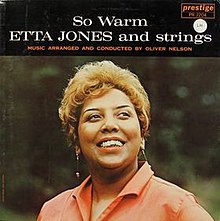
This is the first of three sessions involving a collaboration between Etta Jones and Oliver Nelson. That only four songs were recorded on this session is a pretty good indication of the complexity of the project. It must have cost a lot more than Bob Weinstock was accustomed to paying for an album,what with three days of studio time and the cost of a string section. And were they able to put all this together with no rehearsal time at all? It seems unlikely. This was no jam session. Since Weinstock didn't believe in keeping alternate takes, we have no idea how many takes were discarded, but the fact that they only got through four songs, all of them fairly short (2:02 to 3:40), should tell us something.
I hope this proved to be a good investment for Weinstock. Jones had some popularity at the time--Don't Go to Strangers sold a million copies, though she never attained that level of success again. And her place in the pantheon of jazz singers, to today's jazz audience, is iffy. One internet poll of top female jazz singers places her at number 38, another (a list of the top 25) leaves her out altogether. And yet another one places her 7th, just behind the acknowledged queens of the field.
So it depends on who you ask; but she is for the most part, I would guess, only marginally remembered. And it's hard to understand why this is so. She had a long career, and in fact issued her last record, a tribute to Billie Holiday, just before her death in 2001.
And she really was that good. You can hear the influences of all the singers that she absorbed--chiefly Billie Holiday and Dinah Washington--but she's not derivative. The influences are absorbed, learned from, and channeled into a voice that is distinctively her own.
And whether or not Bob Weinstock made back his investment in this album, we're lucky to have it, both for Jones's beautiful interpretations of songs by a variety of composers, and for yet another demonstration of the range of Oliver Nelson's talents.
Working with a deliberately limited palette--a French horn section, a string section--Nelson produces a sound that's striking and unique, but always does its primary job of supporting the singer.
Classical musicians, in general, don't get the kind of recognition that jazz musicians do. Even in a big orchestra like Duke Ellington's or Count Basie's, you know the names of all the players, and if you're a serious jazz fanatic, you know what each one of them sounds like. Here, the stringed instruments, which play such an important role in Oliver Nelson's sound, are anonymous.
The French horn players do get individual credit, and while they aren't names we would recognize as readily as the reed players like Jerome Richardson and Eric Dixon, other musicians knew who they were. Richard Berg was called on for sessions by Dizzy Gillespie and Jimmy Heath in 1960-61, and a dozen years later, when Charles Mingus needed a French horn player, Berg was the one he called. John Denver and Neil Sedaka both used him, and he has a previous Prestige association, though he's not listed on the session log: he helped out Moondog on that eccentric genius's Prestige recordings. I don't find Joe Singer's name attached to any other recording sessions, though I'm sure he did many, but he is the author of the standard instructional book on developing an embouchure for French horn,
Esmond Edwards produced the session. The album, about which we will be hearing more, was called So Warm.
This is a new turn in the career of Shirley Scott, as her organ-tenor sax partnership shifts from Eddie "Lockjaw" Davis to Stanley Turrentine, and this one is a partnership that extended beyond the recording studio: Scott and Turrentine were married in 1960, and their marriage lasted until 1971, dissolving right around the time that Bob Weinstock dissolved his connection with Prestige, and the label wrote the last chapter in its history as a presenter of new jazz recordings.
What's the difference between the two combos? I hear more warmth in the Scott-Turrentine pairing, but perhaps that's just the romantic in me. Or maybe it's the romantic in Turrentine, stemming from his apprenticeship with Earl Bostic, with whom he served an apprenticeship (replacing John, Coltrane as the tenor sax chair in Bostic's band) in 1953.
Turrentine entered the upper echelons of jazz society in 1959, when he and his older brother Tommy joined Max Roach. Their first session with Roach, for EmArcy, was one of those oddities that could have come into being in those years when stereo was still an oddity. It was a gimmick album called Rich vs. Roach, the gimmick being that each drummer brought his quintet with him, and each quintet occupied a separate stereo channel. This is not a gimmick you'd want to see repeated a whole lot. Ornette Coleman did it on his album Free Jazz, with two quartets split over two stereo channels. but Coleman was a complex genius, and Free Jazz was an important musical experiment, not a gimmick. Still, it's fun in a weird sort of way to have this one.
Turrentine went on to record several more albums with Roach over a very short period of time. A session with Dizzy Reece brought him to Blue Note in April of 1960. He then did two Blue Note albums with Jimmy Smith, and in June, he recorded his first Blue Note album as leader. That same year, he married Shirley Scott. Like Romeo and Juliet, Scott and Turrentine came from two households. both alike in dignity, but unlike milords Montague and Capulet, Alfred Lion and Bob Weinstock did not with civil blood make their civil hands unclean. The course of true love was allowed to run smooth for the better part of a decade, and Scott and Turrentine were able to make a number of albums together--under her name as leader for Prestige, under his for Blue Note. This session, however, came before the contractual swap was ironed out, and the new Mr. Shirley Scott is billed as Stan Turner.
Scott had a new rhythm section to go with her new husband and musical partner. Bassist Herbie Lewis was a West Coaster who had broken in with Les McCann in 160, then come east to join Chico Hamilton. He was to stay in New York for a decade, then return to California, where he became director of the music program at the New College of California, in San Francisco. Roy Brooks was yet another musician to bubble out of the jazz cauldron of Detroit, playing with Yusef Lateef, Barry Harris, and Sonny Red, with whom he had his first recording session.
Stanley Turrentine provides two of the tunes for Stan Turner and Scott to play. "Hip Soul" is the more jukebox-oriented of the two, with a solid, danceable riff, and it's the one that made the jukeboxes as a two-sided 45 RPM single. "Stanley's Time" gives them more room for improvisation, but it's catchy as well.
Harold Arlen/Johnny Mercer's "Out of this World" and "By Myself," by Howard Dietz and Arthur Schwartz, are the two standards, and one would think these would give them plenty of room to explore their romantic side, but not so, especially "By Myself." This is the weeper best known for Judy Garland's
rendition, which pulls out every stop of heartbreak. Here Turrentine and the rhythm section start it off a tempo a little to brisk for tormented introspection, and then Scott comes in and takes it to the wild places that only she knows. And she's not by herself, as Turrentine catches up with her. and they chase each other through the vast unknown, with Lewis and Brooks as their beaters.
Benny Golson and John Coltrane are the jazz composers called upon for the session. Golson's tune is "411 West," and if it' been recorded elsewhere, even by Golson, I can't find it. A shame. It's up to Golson's high standards as a composer, melodic enough to be instantly accessible, complex enough to bring out the best in two gifted improvisers. "Trane's Blues" is instantly recognizable in versions by Trane and by the Miles Davis Quintet with Trane. It's a good choice to take on, and they prove themselves worthy of it.
Esmond Edwards produced. Hip Soul is the title of the album, as well as the single.
Annisteen Allen, as she was known through most of her career, had a good run in the 1940s and early 1950s, singing with Lucky Millinder and other top rhythm and blues ensembles. She was discovered singing in a club in San Antonio one night when Duke Ellington and Louis Jordan went out clubbing, and wouldn't you like to have been along for that ride? They both dug her singing, but as neither was in the market for a girl singer, they recommended her to Lucky Millinder, who hired her without even hearing her on the strength of their recommendations. Wouldn't you?
Her recording career with Federal/King ended on an odd note, when King Records was sued by another rhythm and blues label, Apollo, for copyright infringement over one of Allen's recordings. She did have a minor hit for Capitol in 1955 with "Fujiyama Mama," outsold, as many songs were in those days, by white pop singer Eileen Barton, later covered most successfully by Wanda Jackson. Still later, the Clash would perform it live in Tokyo with a vocal by bassist Paul Simonon's wife, Pearl Harbour.
She would continue to record, for Capitol and Decca and a couple of very small independents, but in 1958 she gave up touring and performing, taking a job in a hospital office.
The session for Prestige was her first full length album session, and the first under her real name. Perhaps her career over the previous five years had been obscure enough that Prestige felt "Annisteen" no longer had any drawing power, or perhaps she simply convinced Bob Weinstock not to use a name which she had acquired from a typographical error on an early press release, and which she had never liked. In any event, this resurrection, and this album, is one more thing we can thank Prestige for.
Allen had always played with first rate musicians, so this is not a rarity for her, but her producer--perhaps Ozzie Cadena, who worked most of the Tru-Sound sessions--surrounds her with an excellent supporting cast here, starting with King Curtis, and musicians who played with him regularly: Paul Griffin on piano, guitarists Al Casey and Chauncey "Lord" Westbrook, bassist Jimmy Lewis and drummer Belton Evans.
The session was released on Tru-Sound rather than Bluesville, and that makes sense. Tru-Sound was variously described as modern R&B or Prestige's pop label. The King Curtis combo gives it rhythm and blues credentials, and while there are some blues in the mix -- her Lucky Millinder hit, "Let it Roll," the R&B standard "I Want a Little Boy" (or girl, as in the best-known versions by Big Joe Turner and Ray Charles) and an original, "Miss Allen's Blues" -- most of the selections come from Broadway and Tin Pan Alley.
We have a lot to thank Prestige Records for--being in the center of some of the most important jazz movements of the American Century in music, creating a record of the creative growth of older musicians who were not part of the bebop revolution...and mixing it up. In so many ways. Weinstock's decision to record Miles Davis with different musicians, rather than having form a regular group as he was to do later, gives us a different and important context for this giant of 20th Century music. Bringing in contemporary jazz musicians
to record with blues singers. And sessions like this one. King Curtis's band brings a new bite to some old standards. With their kicking tempo and Allen's exuberant vocal, they give a new twist to the Gershwin brothers' "The Man I Love." In the classic versions by Billie Holiday and Ella Fitzgerald, there's such yearning for an unrealizable ideal. Both of these great singers give us hope against hope--that big and strong man is never going to come along, and they know it. Allen, with Curtis and the boys, are out for a good time. She kinda likes the idea of the man she'll love coming along, but she's having a good time now, and she doesn't really care all that much if he never does.
But the remake of "Let it Roll" is where they really let it roll. And rock. And they throw in some scat. And they stretch it out to nearly seven minutes, so while this is clearly the jukebox pick from the session, they have to put it on both sides of a 45.
Let it Roll is also the title of the Tru-Sound album. It was to be her last recording, In 1986, after she retired from her hospital job, she did play a few dates with Bull Moose Jackson (as Annisteen Allen). She died in 1992.
Listening to Prestige Vol 4, 1959-60, now available from Amazon! Also on Kindle! Volumes 1-3 are also available from Amazon. The most interesting book of its kind that I have ever seen. If any of you real jazz lovers want to know about some of the classic records made by some of the legends of jazz, get this book. LOVED IT. – Terry Gibbs
This is an unusual session for Juan Amalbert's Latin Jazz Quintet, in that the personnel hasn't changed from the group's last recording session. And in fact, the tunes from the two sessions mixed and matched over two different albums, and over two different imprints--Prestige and Tru-Sound.
Tru-Sound was a short-lived curiosity in the Prestige stable. I had described it earlier as a budget imprint, but that's not exactly right. Billboard, in chronicling the debut of a new label, describes as a
pop label [that] concentrates on what the company president, Bob Weinstock, calls modern r&b--that is, rhythm and blues with a strong modern jazz feeling.
This is, of course, nothing like the glossy pop which is passed off today as modern r&b, but the nomenclature didn't stick, and the label didn't, either. To some extent it lived up to Weinstock's initial salvo--King Curtis was its principal artist. But it also became the home for the small gospel catalog that Prestige assembled.
It would be a stretch to call the Latin Jazz Quintet modern r&b, but the title of the fruits of this session on New Jazz was Latin Soul, and that's not a bad description.
Latin jazz has always gotten the short end of the stick from the jazz establishment. Every year since I started this project, when I get to the year end review, I rail against the way the Down Beat readers' poll ignores the great Latin musicians--not even giving them votes for dance band, at a time when everyone in the world was doing the mambo and the cha-cha-cha!
So it's to Weinstock's credit that he gave the Latin Jazz Quintet as much of a chance as he did--albums on their own, with his new rising star Eric Dolphy, and later with his soul jazz superstar, Shirley Scott.
It's a more usual session for them in that they typically don't worry too much about how many people there are in a quintet, and I won't go over the personnel of the group here, because I just did that for their last session the past November. The selections are the kind of mix we've seen before: a pop standard, a jazz standard, and a bunch of originals from different members of the group. "Monk's Bread" is by Bill Ellington, "Mambo Bobbie" by Juan Amalbert. "Sunday Go to Meeting" is by Gene Casey, a sometime quintet member not along for this session.
"Milestones" is the Miles Davis tune, and the Latin edge serves it very nicely. "Out of This World" is the standard (Harold Arlen/Johnny Mercer), and it was the tune picked for a two-sided 45 RPM release.
I think I would have picked "Ain't Dat Right." It has a strong riff and that Latin soul feel that made hits out of tunes like "Watermelon Man" and "Grazing in the Grass."
Hot Sauce was the Tru-Sound release, Latin Soul was New Jazz.
Listening to Prestige Vol 4 is now available! Order the paperback version here, and the Kindle here.
Ahmed Abdul-Malik, like Yusef Lateef and Randy Weston, was one of the first jazz musicians to incorporate Middle Eastern and North African influences. Lateef found his way into Middle Eastern music in Detroit, through his conversion to Islam, and his friendship with Arab immigrant factory workers on the auto assembly lines. Weston and Abdul-Malik grew up in Brooklyn, where there was an Arabic population and its own musical scene, overlapping with Manhattan's (the offices of Max Roach and Charles Mingus's short-lived but influential Debut Records were in Brooklyn, over the Putnam Central jazz club), but separate.
Brooklyn in the 1950s was part of the city, but it still had a provincial feel. It wasn't the Big Apple. Old time residents recall the days when the Brooklyn Dodger stars lived in the neighborhood, would carpool to the games and go to neighborhood block parties. The big stars played clubs in Brooklyn--especially Thelonious Monk, who had been stripped of his cabaret card and couldn't play any of the well-known Manhattan clubs like the Five Spot. They couldn't advertise him when he played in Brooklyn, but no one was looking, and he could get away with it. Jazz Historian Jimmy Morton, a fixture on that Brooklyn scene, once photographed Miles Davis, Monk, Mingus and Roach backing up Etta Jones at Tony's, one of Brooklyn's most popular jazz spots.
Brooklyn also has a long African-American tradition. Urban archaeologists have only recently rediscovered Weeksville, one of the first neighborhoods of black homeowners in America.
And it was the borough where young men like Ahmed Abdul-Malik and Bilal Abdurrahman met, discovered Islam, discovered jazz, and did their apprenticeship. Abdurrahman, in his memoir In the Key of Me, lists 24 jazz clubs active in Brooklyn at that time.
Abdul-Malik, as a young violin and viola prodigy at New York's High School of Music and Art, played in the All-City Orchestra. Switching to the bass, and taking up jazz in the 1940s, he played with Art Blakey, Coleman Hawkins and Don Byas.
He got his first recording gigs in 1956 with Weston, on Riverside and on the short-lived Dawn label; in the same year, he recorded with ultra-hip German pianist Jutta Hipp for Blue Note. The following year, he joined Thelonious Monk's quartet--perhaps they had met during Monk's sojourns in Brooklyn.
He also paid his dues in the Arabic music scene, with two Lebanese vocalists, Mohammed el Bakkar and Djamal Aslan, both of whom were also known for their virtuosity on the oud, a Middle Eastern instrument similar to the lute, one that Abdul-Malik would take up and master. El Bakkar, in particular, was a huge star throughout the Middle East, and had played a featured role (as an Oriental rug seller) in the hit Broadway musical Fanny. And to further his immersion in what would come to be called world music, a field in which he was certainly a pioneer, he worked in the 1940s with the popular calypso artist MacBeth the Great (his parents were immigrants from the British West Indies, although he claimed for a while that they were from Sudan).
In 1957, he began working regularly at the Five Spot in New York, most notably a five-month gig in a group led by Monk and featuring John Coltrane, during a period when Monk had regained his cabaret card (he would lose it again in 1958). Both Monk and Coltrane encouraged him to pursue his interest in Middle Eastern and North African music, and Coltrane particularly encouraged him to keep studying the oud. Later in the year, he formed his first group, using both mainstream jazz musicians and Arabic musicians.
This group, being predominantly Muslim, mostly eschewed the usual jazz clubs--that is to say, places where liquor was served. That made gigs hard to come by, so in early 1958, they came back to Brooklyn, as Abdurrahman and his wife opened an African restaurant--Brooklyn's first--called the African Quarter.
By the time he made his first album as leader (for Riverside) later in the year, his apprenticeship on the oud had borne fruit, and it had become an essential part of his music. The titles of his Riverside album and one in 1959 for RCA Victor are evocative of the kind of music he was already making: Jazz Sahara and East Meets West.
With this album, Prestige would become his home for most of his career as leader. He had experimented with different groupings of musicians on his first two albums, and for this sessionhe pulled together a different and striking combination.
Bilal Abdurrahman had been with him from the beginning, playing the duf (tambourine) on Jazz Sahara, the darabeka (or darbouka, or goblet drum) on East Meets West, the clarinet and various percussion on this session. Abdurrahman would go on to teach and record several albums of Middle Eastern music for young people.
Tommy Turrentine, older brother of saxophonist Stanley Turrentine, had pretty much of a mainstream background, playing in the bands of Benny Carter, Earl Bostic, Charles Mingus, Billy Eckstine, Dizzy Gillespie, and Count Basie. He had not recorded a lot before this album, but Abdul-Malik was crafting his sound carefully, and liked what Turrentine could contribute. Eric Dixon, best known for a long career with Basie, had appeared on two Prestige albums in the mid-1950s, with Bennie Green and Mal Waldron.
Andrew Cyrille, a Brooklyn native, was new on the scene, but already establishing a reputation of one of the most inventive drummers of the jazz experimentalism, a reputation that would only grow through his work with Walt Dickerson, Cecil Taylor, Oliver Lake, David Murray and others.
Cuban-born Caio Scott's jazz career was limited by his choice of instrument--a cello doesn't fit into every jazz ensemble. But when he was used--by Gato Barbieri, Carla Bley, Archie Shepp, Mal Waldron and others--he delivered. We have heard him once before on Prestige, with Waldron in 1958. Perhaps inspired by his jazz cohorts, he frequently played the cello standing up (he used a saxophonist's neck strap to help steady the instrument). He was in demand for a wide range of avant garde venues in New York, particularly working with dance troupes.
It's hard to pick a Listen to One for this album, because Abdul-Malik does so many things, even dipping into his calypso background for "Hannibal's Carnivals," featuring some strong solo work from Dixon and Turrentine, and and "The Hustlers." Both of these are Abdul-Malik's blending of calypso with high-life, an jazz-influenced updating of a traditional West African folk form which had burst into popularity in Nigeria in 1960, and the latter features Aburrahman on clarinet. "Oud Blues" is interesting because it is just that -- a blues played on the oud, primarily a duet between Abdul-Malik and Scott's pizzicato cello. "Nights in Saturn" is a space age workout that gives the horn players an opportunity to flex their avant garde muscles, but also gives the lead to Abdurrahman on a Korean percussion instrument so obscure, according to the album's liner notes, that neither he nor Abdul-Malik knew exactly what it was. There's even a standard ballad on the set, "Don't Blame Me," by Jimmy McHugh and Dorothy Fields, recorded by many in the jazz and pop fields, including another Afrocentric performer, Randy Weston. This version has a beautiful bowed cello solo by Scott, and some intricate duet work between Abdul Malik and Scott playing pizzicato. But I think I'll leave you with the real Middle Eastern feel of "La Ibkey," adapted from a traditional Arabic folk song, full of rhythmic ingenuity, broken down by University of Hawaii professor Njoroge Njoroge in his book Chocolate Surrealism: Music, Movement, Memory, and History in the Circum-Caribbean: "the drums play in 7/4 while the soloists alternate between 3/4 and 4/4 and multiples thereof."
Esmond Edwards produced for New Jazz, and the album was called The Music of Ahmed Abdul-Malik. "The Hustlers" and "La Ibkey" were released on 45. I don't know if they got much jukebox play, or if they were too far out. I like to think they commanded a few nickels in Brooklyn.
This is the third album to be released under the Swingville All Stars banner, and the second in a little over a month. The April lineup is completely replaced, although there's a fairly close consistency as to the structure of the group. Joe Thomas replaces Joe Newman on trumpet; Vic Dickenson for J. C Higginbotham on trombone; Pee Wee Russell for Jimmy Hamilton on clarinet. The first go-round had an alto (Hilton Jefferson) and tenor sax (Coleman Hawkins); this one has two tenors (Buddy Tate and Al Sears). Both sessions had a guitar (Tiny Grimes then, Danny Barker now). Claude Hopkins, Wendell Marshall and Billy English rounded out the first
rhythm section; Cliff Jackson, Joe Benjamin and J. C. Heard were the second. In other words, heads you win, tails you can't lose.
I've commented that none of the Swingville groups are playing the music of the 1920s and 1930s. They're not playing bebop, postbop or hard bop, but they're not stuck in the past either. That's somewhat less true of this group, maybe because more of their repertoire is swing era standards. But they're still making music that sounded good in 1961, and still sounds good in the 21st century.
There are identifiable differences. The Swingville All Stars are making music in the LP era, which means that they can stretch out in ways that the cats making 78 RPM records couldn't, "Years Ago" is ten minutes long, with room for extended solos for everyone. "Phoenix" is over seven minutes. Even super-traditional swing melodies like "I May Be Wrong" go over six. And that does make a difference.
Better recording equipment and techniques make a difference. In the late 1940s, Baby Dodds made a series of videos demonstrating his phenomenal technique on a drum kit. But recording with Johnny Dodds and with King Oliver, he had to use just a block of wood, because real drums would make the needle on the primitive recording machine jump.
And as I've noted before, these are some of the greatest musicians the world has ever seen. They may not have chosen the paths blazed by Charlie Parker, but they didn't stand still, either.
Nevertheless, there's more nostalgia here than we've heard on some of the other sessions, and the only explanation I can give for that is that's how they felt like playing on this particular day. The first session is wonderful music, lifted to another level by Coleman Hawkins. This session is wonderful music, lifted to another level by Pee Wee Russell -- who, if anything, was more progressive than Hawkins. So go figure.
New to Prestige on this session were Cliff Jackson and Danny Barker. Jackson was close to 60 when this recording was made, and had built his reputation as a stride piano player. He had been well known in New York for four decades, doing some recording, but mostly known as a fixture on the
night club circuit. He did not have a lot of experience playing with the younger cats, and he may have been partly responsible for the more traditional sound on this date. But he was very good at what he did, and Prestige would use him on several more Bluesville and Swingville sessions. He died in 1970.
New Orleans-born Danny Barker lived until 1994, long enough to be revered as both a musician and a seminal figure in the revival of jazz in New Orleans. The Fairview Baptist Church Marching Band, which he founded, gave a number of young New Orleans musicians their start, including Wynton and Branford Marsalis, Nicholas Payton, Lucien Barbarin and many others. Wynton Marsalis has credited him with being one of his most important teachers. He would continue to play, both guitar and banjo, until shortly before his death.
The Hawkins All Stars and the Russell All Stars were mixed and matched for marketing. Swingville released the material on two albums. The first, Things Ain't What They Used to Be, contained the title song, "I May Be Wrong," and "Vic's Spot," along with two numbers from the Hawkins session. The others joined the remaining two Hawkins numbers on Years Ago. Both sessions were reunited on a Prestige double album (and later CD) called Jam Session in Swingville.
This was recorded in St, Louis, where Henry Townsend came in his youth, and spent most of his life. It wasn't his first recording (it was his first LP) and it wasn't his last. In fact, it didn't even come close in either direction. Townsend is perhaps the only, certainly one of the only recording artists to make records in nine decades, starting in 1929, and finishing up with a last session in 2006, shortly before his death.
When I said Townsend came to St. Louis in his youth, I was understating the case. Born in Mississippi, he was raised in Cairo, Illinois, until the age of nine, when he hopped a freight in order to avoid a beating from his stepfather, and headed south. He got by doing the sort of odd jobs available to a small boy in the city, shining shoes, serving as a runner for bootleggers, and cleaning theaters. It was while cleaning the Booker T. Washington Theater that he heard Lonnie Johnson play and decided to become a blues musician.
He was in the army during World War II, spent some time in Chicago after the war, and toured Europe in the 1950s when interest in his kind of blues was on the wane stateside, but St. Louis continued to be his home base, and the city to which he always returned.
Townsend was recorded in his home city by Kenneth S. Goldstein and Samuel Charters, with the assistance of Ann Charters, as part of their continuing commitment to finding and recording original blues musicians for Bluesville. His repertoire seems to come partly from his head, partly from recordings: "Cairo's My Baby's Home," though it references the city that he too once called home, was originally recorded in 1929 by Henry Spaulding, with whom Townsend hung out in the early days, and who recorded for Brunswick around the same time Townsend was making his first recording for Columbia.
Townsend described his recording process in a 2002 interview with Steve Pick:
I don't (decide what songs to record). It's all up to me. I don't decide, I just ad lib. I don't have anything written down, I don't know what I'm gonna do until I do it. I carry a little tape recorder with me. It will pick up whatever I sing. To keep it from getting stolen, I do a quick copyright on it. I go to the Post Office and mail it back to me, sealed in an envelope.
If something goes wrong, I've got that proof."
Townsend worked a lot with other blues musicians, like Roosevelt Sykes and Walter Davis. For this session, he was accompanied by St. Louisan Tommy Bankhead, a cousin of Elmore James and a popular fixture on the St. Louis blues scene.
Jon Pareles of The New York Times described Townsend, aftera 1993 New York concert:
Townsend sang epic-length blues, many stretching far beyond 10 verses, that presented a landscape of unending desolation and betrayal.
He sings in weary, plaintive tenor, with quavers and slides that make remembered pain sound immediate. His gentle vocal lines, and a silently tapping left foot, hold together music that always seems on the verge of shattering.
Samuel Charters, who wrote the liner notes for the album, used his soapbox to get in a few digs at blues trends he deplored:
Already [by the late 1930s] there was considerable commercial exploitation of the blues, particularly by the Bluebird label, and it seemed for a number of years that the music had lost its vitality. Instead of the individual performance of the single performer, there were "jump" or "jive" blues bands ...and so-called "rhythm and blues"... rushing the singer along with an incessant rhythm and with reiterated accompaniment patterns that became almost banal. It was during this period, too, that the electric guitar first [became] widespread, and techniques developed on the acoustical guitar, the variations in tone and the use of string sounds to emphasize the vocal line, were replaced by the flat, blaring tone of the mechanical instrument.
Charters may have had the purist's tunnel vision in his inability to recognize the artistic validity of newer trends in the blues (and even Henry Townsend used an electric guitar), but God bless him for it. His purist's vision enabled him to rescue an important American art form that was in danger of being forgotten. Folklorists John and Alan Lomax, in an early generation, did much the same thing. At a time when the blues were at a pinnacle of popularity, the folklorist-purist Lomaxes viewed the blues much the way a blues purist would view disco. They were looking for a singer who recalled the ballads and play-party songs of an earlier era. That's how they found Lead Belly, who had spent most of the years of the blues explosion in prison, and that's how they were able to give us one of the great talents of the twentieth century.
The Bluesville release was called Tired of Bein' Mistreated. The same album would be rereleased some years later by Folkways as The Blues in St. Louis, Vol. 3.
If Don Ellis gave us an album in which virtually everything was unexpected, Prestige brings us back to familiar ground with Johnny "Hammond" Smith. In those days, it seemed that people couldn't get enough of that soul jazz organ sound, and Smith was one of the most reliable of the bunch, solid for listening or dancing. He used the same Philadelphia cohorts he'd been using, came up once again with a nicely chosen mixture of originals and standards--and, in point of fact, distributed the results of this session over the same two albums as the last session, Stimulation, which was released right away, and Opus de Funk, which waited until 1966.
So I don't have a lot to add to my commentary on the February 14th session. This is an extension of that one, and it's still good music.
Esmond Edwards produced both dates. "Sticks and Stones" became the flip side of "The End of a Love Affair." from the February session, as the first 45 RPM single off the album. "Sad Eyes" was the A side of a 45 with "Opus de Funk," released in tandem with the 1966 release of the second album.
There comes a time in every long book, novel or nonfiction, when you're trapped in the middle. You can barely remember starting it, you can't imagine ever finishing it, you can no longer imagine why anyone would want to read it. I guess I'm pretty much at that stage now. It's been five years of my life, twelve years in the history of Prestige. And yet my enthusiasm hasn't flagged. I can thank the music for that, and the incredible musicians who made it. I still look forward to every session, and I still find myself spurred to write about it by the freshness of the music, the stories of the unique individuals who made the music, my own memories of who I was when I first heard it or the excitement of hearing it and discovering it for the first time.
The 1960s, which we are just nosing into here, were a time of great social change, and a time when a number of musicians chafed at calling the music they were playing "jazz." It was a name that grew out of a music that was disrespected, a name associated with back-alley sexual encounters, a name that does not reflect on the importance of what many have called "America's classical music." But to me, whatever its origins, the name has been hallowed by Louis Armstrong and Sidney Bechet, consecrated by Charlie Parker and Dizzy Gillespie, immortalized by Miles Davis and Sonny Rollins and Stan Getz...and Don Ellis and Johnny "Hammond" Smith and Shirley Scott and Willis "Gator Tail" Jackson and Walt Dickerson and people like Al Francis or Eddie McFadden who made brief contributions and disappeared, and the name of "jazz" is ennobled by their presence.
You can't necessarily count on it that an album that calls itself "new ideas" will actually deliver new ideas, but this one does. Don Ellis not only presents a departure from anything Prestige has been doing in this new jazz era, each track of the album is a departure from the track before.
Ellis came from very nearly out of nowhere. He had played with the Glenn Miller Orchestra. He had played with the Maynard Ferguson Orchestra, which was a good deal more progressive, but still a dance band. Then suddenly he was in the center of the avant garde, working with George Russell, Paul Bley, Steve Swallow. He made one album in 1959
with Charles Mingus (Mingus Dynasty) and a couple in 1961 with George Russell. One was with Russell and Eric Dolphy for Riverside, but that one wasn't released until years later.
Even the photos of him follow the same out of nowhere pattern. The earliest shows him crew cut, chubby faced and whiter than Wonder Bread. A photo taken around the time of New Ideas shows him gaunt, still white, but looking more like Andre Gregory than Glenn Miller.
His first album as leader in 1960 was How Time Passes, for the Candid label, with Jaki Byard, Ron Carter and Charlie Persip. A second album for Candid, featuring Paul Bley and Steve Swallow, was recorded in April of 1961, just three weeks before New Ideas, but it would not see the light of day until 1988. Time Passes was all Ellis originals. The second album came to be called Out of Nowhere, and in 1988 it must have really seemed to be coming out of nowhere. And it came out of nowhere considering the direction Ellis's music was taken, because this was an album of standards, and ones that were so standard they were virtually chestnuts -- "My Funny Valentine," "I'll Remember April," "Just One of Those Things." Perhaps Candid didn't release the album because they were expecting something more like How Time Passes, a real Don Ellis album, not a bunch of standards. Or perhaps they decided not to release it because they were expecting an album of standards, and they got...certainly not something Glenn Miller or even Maynard Ferguson would have recorded. In other words, a real Don Ellis album.
Whatever that nay be. Ellis's muse was forever dancing on ahead. This was his only album for Prestige, and as he moved through record labels (pausing for a few years and several albums on Columbia), he moved through ideas and formats. Much of his later and best-known work was for larger ensembles.
At this point in his career. the George Russell influence is certainly there. There are suggestions of Tristano, still a powerful influence on the jazz avant garde. Suggestions of Gil Mellé, though he's more of a musician than Mellé was. Like Mellé, he would go on to film scoring, The French Connection being his best known. He was known for his experiments with time signatures, but he's nothing like Dave Brubeck. For one thing, he had a sense of humor. One of his compositions is called "Beat Me, Daddy, 7 to the Bar;" one of his time signatures is 3½ / 4 and another is 15/16. One can hear in his work suggestions of avant garde composers like Moondog (he somehow manages to suggest some of Moondog's ambient street noises on the trumpet). How Time Passes was subtitled Third Stream Jazz, and no less an authority on the third stream than Gunther Schuller said of him, when Ellis was his student in 1960 at the Lenox, MA, School of Jazz:
[Ellis] represents one of the few true syntheses of jazz and classical elements, without the slightest self‐consciousness and without any loss of excitement and raw spontaneity that the best of jazz has always had.
By the time of New Ideas, the Third Stream was no longer a dominant force in Ellis's development, but you can hear it.
We've heard Jaki Byard on three earlier Prestige sessions, one with a trio and two with Eric Dolphy. Equally at home in mainstream or avant garde settings, he was also one of the first to bring jazz to the world of higher education, creating the Jazz Studies program at the New England Conservatory of Music.
Ron Carter and Charlie Persip are more associated with mainstream than avant garde, but they both make important contributions. Persip is inventive and unexpected. So is Carter, but he's also the pulse of the ensemble, keeping it on track through time signature changes.
New Ideas features a remarkable vibes player named Al Francis, and his entire recorded output seems to have been this album and a trio session from 1986 called Jazz Bohemia Revisited. Why there's not more, or why Ellis didn't go on working with him, it's impossible to say, but the jazz world lost a distinctive and original voice when they passed over Francis. It's painful to think of all the music he made between 1961 and 1986 that we'll never hear.
Ellis would go on working with small groups for a couple of years, often with Paul Bley. In 1963, he was trumpet soloist for the New York Philharmonic with Leonard Bernstein conducting, and again with Gunther Schuller conducting, for Schuller's composition Journey into Jazz.
In 1965 he put together his first orchestra, and the work with large ensembles became his best known. He's also known for an instrumental innovation, the four-valve trumpet, which was more than just a gimmick: it allowed him to play quarter-tones.
Ellis died young, at 44, leaving behind him several lifetimes worth of experimentation.
Esmond Edwards produced the session, and New Ideas was released on New Jazz.
I'm making a Listen to Two for this Ellis session, because it's the only album he made for Prestige, and since one track is not enough to do justice to his range. Neither are two, actually.


:format(jpeg):mode_rgb():quality(40)/discogs-images/R-4720056-1447471969-8263.jpeg.jpg)




:format(jpeg):mode_rgb():quality(90)/discogs-images/R-2884782-1305631390.jpeg.jpg)


:format(jpeg):mode_rgb():quality(90)/discogs-images/R-4219801-1482257390-1358.jpeg.jpg)

:format(jpeg):mode_rgb():quality(40)/discogs-images/R-11390588-1515458714-9611.jpeg.jpg)


:format(jpeg):mode_rgb():quality(40)/discogs-images/R-8969957-1478838084-9370.jpeg.jpg)


:format(jpeg):mode_rgb():quality(40)/discogs-images/R-7840668-1449932142-6386.jpeg.jpg)


.jpg)