Tuesday, November 14, 2017

Listening to Prestige 284: Basie Reunion

You could say that Weinstock and co. are still marking time, but that would be wrong. Bringing a collection of some of Count Basie's greatest sidemen together, along with pianist Nat Pierce, who did Basie better than anyone except Basie, in a group led by Paul Quinichette, who did Lester better than anyone except Lester, and what you've got is a recipe for nothing less than a soufflé of great music.

And this is one soufflé that doesn't collapse as you're taking it out of the oven.

But...if you're offered a recording of Basie musicians paying Basie's tunes, why not just pass it up and buy a Basie record?

Well, for one thing, you can never have enough good music. And if the musicians are this good, it's always going to be different. Nat Pierce can be Basie the piano player, but he can't be Basie the bandleader, so that role seems to fall to Paul Quinichette, who may not have seniority as a Basie-ite, but who has Prestige seniority as an on-and-off regular. And it's all worth having, and it's all worth listening to, and I am a better, more fulfilled person for having listened to it.

And besides, while this may be a Basie dream band (or dream small group), it isn't the current Basie band, or even precisely any one Basie aggregation.

Jo Jones goes back the farthest. He was already with the band when Basie took it over on the death of Bennie Moten, and remained behind the drums until 1948. Jack Washington, not so well known as the others but with the reputation of a jazzman's jazzman on baritone sax, was with Basie from the beginning, and stayed till 1950. Freddie Green came along just a little later, in 1937, and never left. He anchored the Basie rhythm section for five decades.

Buck Clayton spent some great years with Basie, from 1936 until he was drafted into the army in 1943. Earlier in the 1930s, he had a rather remarkable expatriate career, not in France or Sweden, but in China, where he led a group called the Harlem Gentlemen, and mentored the Chinese composer Li Jinhui, who revolutionized Chinese music before the revolution. After the revolution, Li's music was banned in China as decadent and western, and he became an enemy of the people.

So none of these guys played with Eddie Jones, who joined in 1953 and was the only active Basie-ite when this session was cut, remaining with the band until 1962, after which he went to work for IBM, which means he probably overlapped with me at IBM, though not in the same city. As a Basie-ite, he overlapped with Quinichette (1952-56).

When they get together, latecomers, early-leavers and lifers alike, they all know what to do. As ex-Marines are fond of saying, you're never an ex-Marine, and it seems you're never really an ex-Basie man either. The tunes are Basie classics. With a smaller group, there's more room for soloists, especially compared to the late 1950s version of Basie's group, where the emphasis was more on arrangements and ensemble play. It's hardly necessary to say how good Buck Clayton and Paul Quinichette are. Nat Pierce has some very nice solo moments, where he does more than just play the Count note for note. He has a musical persona of his own. There's just a great drum solo by Papa Jo Jones on "John's Idea."

I'm not exactly sure what qualifies this is a Prestige All Stars session. More like a Prestige Guest Stars session. But they are all stars, and I'm glad to have them.

The album was released on Prestige as Basie Reunion, and was later rereleased on Swingville when Weinstock started branching out into those subsidiary labels that appealed to diverse specialized tastes.


Order Listening to Prestige Vol 2


Listening to Prestige Vol. 2, 1954-1956 is here! You can order your signed copy or copies through the link above.


Tad Richards will strike a nerve with all of us who were privileged to have lived thru the beginnings of bebop, and with those who have since fallen under the spell of this American phenomenon…a one-of-a-kind reference book, that will surely take its place in the history of this music.

                                                                                                                                                --Dave Grusin

An important reference book of all the Prestige recordings during the time period. Furthermore, Each song chosen is a brilliant representation of the artist which leaves the listener free to explore further. The stories behind the making of each track are incredibly informative and give a glimpse deeper into the artists at work.
                                                                                                                --Murali Coryell

Monday, November 13, 2017

Listening to Prestige 283: The Prestige Blues-Swingers

It's those lazy hazy crazy days of summer in 1958, and we're coming close to wrapping up our first decade of recording music for a new label that's come along at the right time, and made its mark in jazz. Look at the musicians who've passed through our door. We brought Miles back to New York and restarted his career. We were the first to record the Modern Jazz Quartet (well, after one tentative start on Savoy). Sonny Rollins and Stan Getz and Lenny Tristano and Thelonious Monk have all made significant recordings with us. John Coltrane is soon to move on--he'll be gone as we start our tenth anniversary--but he's still doing some great stuff for us. We've been an important part of the jazz of the fifties, and that's an era that's giving way to change. What will the new jazz of the sixties be? How are we going to prepare for it, to position ourselves in it?

Meanwhile, who cares? Let's have some fun!

Let's get a bunch of the finest modernists around, and let them loose on some classic trad jazz tunes, and just blow, blow, blow. In fact, that's a good idea for a tune.

Of course, when the dust has settled, and you have six horns, plus a guitar and a rhythm section, you've got a pretty good sized aggregation, and you can't just blow, blow, blow. You're going to need an arranger.

Bob Weinstock brought in a new addition to the Prestige catalog, Jerry Valentine, who had been a trombonist in the Billy Eckstine band, and had arranged for Earl Hines. Valentine's credentials were a bit scattered, but he turned out to be the right man for the job, writing several of the tunes for the session, and finding a sound that was trad and modern at the same time.

The classic tunes were by Andy Razaf (Fats Waller's longtime collaborator) and Will Weston ("I'm Gonna Move to the Outskirts of Town"). Billy Eckstine and Earl Hines ("Jelly, Jelly") and Count Basie with Eddie Durham and Jimmy Rushing ("Sent for You Yesterday"). The ensemble has a Basie feel, except that it doesn't. The musicians are virtuoso modern jazz players, and Valentine has given them a solid ensemble footing and room to wail.

The other newcomer is trombonist George "Buster" Cooper, who generally went just by "Buster,," who knew how to entertain and knew how to swim with the big fish. He had been in the house band at the Apollo Theater, had accompanied Josephine Baker in Paris, and had played with Lionel Hampton (he was with him for the legendary 1953 European tour) and Benny Goodman. He also contributed to jazz history when a friend from the younger days in Florida  arrived in New York, and Cooper took him down to sit in with the house band at the Café Bohemia. The friend was Julian "Cannonball" Adderley.

Later, in the 1960s, he would join the Duke Ellington orchestra, where he would be a featured soloist.

Jimmy Forrest was another one of those guys who played the style of jazz known as bebop and the
style of jazz known as rhythm and blues. He brought the two together when he turned a Duke Ellington riff into "Night Train." He was also the leader of a group which was recorded live in a small club in 1952, with Miles Davis sitting in: to my mind, a significant recording, He gets some solo space on "I'm Gonna Move to the Outskirts of Town," and shows that he knows what to do with it.

Outskirts of Town was the name of the album, and the tune also became the A side of a 45 RPM release, b/w a Valentine original, "Blue Flute."


Order Listening to Prestige Vol 2


Listening to Prestige Vol. 2, 1954-1956 is here! You can order your signed copy or copies through the link above.


Tad Richards will strike a nerve with all of us who were privileged to have lived thru the beginnings of bebop, and with those who have since fallen under the spell of this American phenomenon…a one-of-a-kind reference book, that will surely take its place in the history of this music.

                                                                                                                                                --Dave Grusin

An important reference book of all the Prestige recordings during the time period. Furthermore, Each song chosen is a brilliant representation of the artist which leaves the listener free to explore further. The stories behind the making of each track are incredibly informative and give a glimpse deeper into the artists at work.
                                                                                                                --Murali Coryell

Friday, November 10, 2017

Listening to Prestige 282: Red Garland

Not much available from this album from any of my usual sources, and it's too bad, because from the couple of cuts I was able to listen to, Red Garland and Ray Barretto together just keep getting better and better.

Maybe the folks who select things for streaming gave this a lower priority because Paul Chambers and Art Taylor gave it a pass, but that hardly seems reason enough. George Joyner and Charlie Persip are more than up to the job of giving these guys the rhythmic support they need, and "Ralph J. Gleason Blues" shows that Persip and especially Joyner can deliver original and inventive solos.

"Ralph J. Gleason Blues" and "Mr. Wonderful" were the two cuts I was able to listen to, and I've put up "Ralph J. Gleason Blues" as my "Listen to One" selection because...because, well, everything. The Joyner and Persip contributions I mentioned above, and the ways that Garland and Barretto play off each other -- as always, perfectly balanced by Rudy Van Gelder's sound engineering.

Ralph J. Gleason, the dedicatee of Garland's blues, was one of the leading jazz critics of the 1950s, an associate editor of Down Beat. And as I've mentioned, another term for "leading jazz critic of the 1950s" was "snob."

Gleason, perhaps, less than most. While he might not have been so open as to recognize rhythm and blues as a legitimate form of jazz, because no one was, he was open to the new music that was being created by hippies and rockers of the 1960s, to the extent when in 1967, Jann Wenner started Rolling Stone, Gleason was one of its first editors.

"Mr. Wonderful" was the title song from a Broadway musical of 1956, which starred the Will Mastin Trio. In case you're not quite sure you remember the name, this was an act put together by vaudevillian Will Mastin, featuring his brother, Sammy Davis, and his nephew, who had been given the same name as his father. Yes, mega-star though he was already, Sammy Davis. Jr., continued to perform with, and feature, the vaudevillians who had nurtured them. Family acts from the Everly Brothers to Creedence Clearwater Revival have festered grievances to the point of coming to blows onstage, but Sammy stayed faithful to his two mentors until they retired, and today they are buried alongside each other. I saw Mr. Wonderful on Broadway, and yes, it wasn't much of a show, but yes, Sammy lit up the theater. The song wasn't the hit from the show, because it was sung about Sammy, not by him -- "Too Close For Comfort" got that honor. But it had a sweet melody, and Garland and his group get a lot out of it.


The session log has this as the Red Garland Quartet, but it was actually released under Red Garland Trio plus Ray Barretto (or con Ray Barretto to the Latin market). To either market, it was Rojo.

Order Listening to Prestige Vol 2


Listening to Prestige Vol. 2, 1954-1956 is here! You can order your signed copy or copies through the link above.


Tad Richards will strike a nerve with all of us who were privileged to have lived thru the beginnings of bebop, and with those who have since fallen under the spell of this American phenomenon…a one-of-a-kind reference book, that will surely take its place in the history of this music.

                                                                                                                                                --Dave Grusin

An important reference book of all the Prestige recordings during the time period. Furthermore, Each song chosen is a brilliant representation of the artist which leaves the listener free to explore further. The stories behind the making of each track are incredibly informative and give a glimpse deeper into the artists at work.
                                                                                                                --Murali Coryell

Monday, November 06, 2017

Listening to Prestige 281: Mose Allison

Once again, listening to the Prestige recordings by Mose Allison, I'm reminded that the later recordings, which made him justly a cult legend as a singer-songwriter, are not the whole story. Allison was a brilliant composer, and this album, though it went a long way toward establishing his reputation as a vocalist, both with his own and other songwriters' material, is an excellent place to reflect on just how good he was. "Creek Bank," in particular, is a gem, one of my favorites of his jazz compositions.

But the whole group of composed pieces, the Creek Bank Suite, as it could legitimately be called, although he only gave the name of "suite" to his Back Country compositions from his first album, is worth many listenings. Back Country Suite is a suite because the interlocking compositions are short and gain their power by accumulation. Here, as in Local Color, we have a series of pieces tied to back country Mississippi by their titles and by a certain feeling, to New York by the bebop influence of Bud Powell and George Wallington and Allison's own musical sophistication.

As to the titles, "Dinner on the Ground" is so back country that would be easy for a picnic-fancying Easterner, perhaps accustomed to listening to Mose while spreading a repast on the ground at a jazz festival. I might not have gotten its significance without having listened to Merle Haggard's account of an impoverished family in his song "Daddy Frank":
I don't remember ever going hungry,
But I remember Mama cooking on the ground.

Unlike Back Country Suite and Local Color, this album, as it was pressed, does not lead with the instrumental sequence, although the session log has the  four tunes recorded first. That's relegated to the "B" side, not that "A" and "B" sides are a particularly important concept on an LP. But "The Seventh Son," which did lead off the "A" side of the album, was also the "A" side of two different 45 RPM singles, where the hierarchy of sides does matter, "If You Live," Allison's self-penned song, was on the other side of the first release, and "Parchman Farm" was on the second. Both of these songs are favorites of Allison fans and collectors, and both of them were gradually dropped from his performing repertoire. As he would explain to an interviewer in later years, he started to find that he couldn't really sing about cotton sacks any more, in a world where even the deep South was all mechanized mega-farms. "The Seventh Son" is by Willie Dixon, perhaps the first bluesman to become famous primarily for writing songs for others, in this case Chess recording artist Willie Mabon.

Another difference -- no trumpet track on this one. I miss it. I liked the trumpet tracks. But the trumpet was not Mose's strongest card.

Addison Farmer and Ronnie Free both get some well-deserved solo space here. Farmer, by this time, was primarily playing with Allison, although he did continue to work on and off with twin brother Art, including the first Jazztet album. He would continue with Allison until his death in 1963.

Creek Bank was the name of the album. Allison's material, especially his songs, made it onto various compilation albums. One, of sort of random instrumentals, was called Mose Allison Plays for Lovers, which seems to have been a mid-1960s marketing notion of Bob Weinstock's. He had Yusef Lateef and John Coltrane playing for lovers, too, although in the movie Jerry Maguire, Tom Cruise vehemently rejects Trane as an aid to lovemaking.


Listening to Prestige Vol. 2, 1954-1956 is here! You can order your signed copy or copies through the link above.


Tad Richards will strike a nerve with all of us who were privileged to have lived thru the beginnings of bebop, and with those who have since fallen under the spell of this American phenomenon…a one-of-a-kind reference book, that will surely take its place in the history of this music.

                                                                                                                                                --Dave Grusin

An important reference book of all the Prestige recordings during the time period. Furthermore, Each song chosen is a brilliant representation of the artist which leaves the listener free to explore further. The stories behind the making of each track are incredibly informative and give a glimpse deeper into the artists at work.
                                                                                                                --Murali Coryell

Saturday, November 04, 2017

Listening to Prestige 280: J. C. Higginbotham - Tiny Grimes

I love it that the unexpected keeps cropping up in the Prestige catalog. J. C. Higginbotham was an unreconstructed swing trombonist, best known for his work in Luis Russell's orchestra in the late 1930s,  but also with Chick Webb, Fletcher Henderson and Benny Carter. The late 1950s saw him resuming his career after losing several years to the bottle. He played a regular gig with Henry "Red" Allen at the Metropole Café in Times Square, the traditional jazz club next to which Bob Weinstock had opened the record store which commenced his jazz Odyssey--an Odyssey that very quickly took him away from the Metropole's brand of nostalgia and into the newer world of bebop. But here Higginbotham is, playing with an eclectic group of musicians, and fitting in quite nicely, thank you.

If Higginbotham was unreconstructed, Tiny Grimes was almost continually reconstructed. He played swing, and even sang with a swing vocal group (The Cats and the Fiddle). He played Art Tatum's almost unclassifiable brand of jazz when Tatum, for a short period, formed a trio. He played with Charlie Parker. He played rhythm and blues.

Tiny Grimes came to the guitar late in life--as he put in an interview with Stanley Dance, "when I was very, very old." In other words, about 20. In his youth he had played the drums until they were washed away in a flood, and then the piano. He was self-taught on the guitar. As he told Dance for his book of interviews, World of Swing (quoted in James Lester's biography of Art Tatum. Too Marvelous for Words):
No one ever learned me nothing! ... The way I learned my chords, I used to find sheet music with ukulele diagrams on them. I got my own little system going, found out how to make certain things, and just translated the music my way... I used to lock myself in my room all day, every day... after three months of sitting up in that room day in and day out, I could make little gigs.
Perhaps learning from ukulele diagrams is why Tiny chose the four-string tenor guitar? Perhaps, but it would have been tricky. Tiny played the standard tenor guitar, tuned just like the four high strings on a standard guitar. Ukulele in standard tuning has essentially the same intervals, but three steps higher, so you could more or less transpose the chords, but it would still sound a little different, because the highest string on the uke jumps up an octave. In any case, Tiny was going for a different sound, and he found it, because within a few years, he had taken the place of the Air Force-bound Slim Gaillard in Slam Stewart's guitar-bass duo, and when Tatum decided, in 1943, that it would be to his economic advantage to form a piano-guitar-bass trio along the lines of Nat "King" Cole's, he called on Stewart, which meant he also got Grimes.

In 1944, he had a recording session as leader for Savoy, and his band included a cat who was making his recording debut for Savoy, although there would be a lot more: Charlie Parker.

Eddie "Lockjaw" Davis would be doing a lot with Prestige, both with and without Shirley Scott. His Prestige years coincide with the soul jazz years, but his complete discography is a lot more than that...and here again, I have to go against the accepted wisdom. The writer of Davis's Wikipedia entry, and it's a good, knowledgeable piece of writing, says that "he played in the swing, bop, hard bop, Latin jazz, and soul jazz genres. Some of his recordings from the 1940s also could be classified as rhythm and blues."

So why is rhythm and blues the poor stepsister, hunched up beside the cinders? Why not say "he
played in the swing, bop, rhythm and blues, hard bop, Latin jazz, and soul jazz genres"? Why is the work Wilbur Harden did with Ivory Joe Hunter less important than the work he did with Curtis Fuller?

So put them together, you have three  cats who can play the blues. Two of them could walk into any room in the world where musicians were playing in any blues-based genre, sub-genre, or alt-genre, and sit right in.

And they had the right three guys in the rhythm section, especially Ray Bryant, who was as progressive as they come, but could just as easily be found sitting in with Red Allen and J. C. Higginbotham at the Metropole.

And what would you call this music? I don't know. I'd just listen to it. Although Higginbotham gets co-leader credit, it's Tiny's session--all the tunes except "Air Mail Special" are his--but everyone makes it work. It's got the blues, it's got rhythm, it swings, it bops, it's got some great improvisation, it's got what it takes.

"Grimes Times," "Air Mail Special," "Callin' the Blues" and "Blue Tiny" were all included on the album Callin' the Blues, released in 1958. It would also be rereleased when Weinstock started his Swingville subsidiary in 1960. The other two ultimately were folded into a compilation album called Guitar Soul, on Prestige's budget Status label,


Order Listening to Prestige Vol 2


Listening to Prestige Vol. 2, 1954-1956 is here! You can order your signed copy or copies through the link above.


Tad Richards will strike a nerve with all of us who were privileged to have lived thru the beginnings of bebop, and with those who have since fallen under the spell of this American phenomenon…a one-of-a-kind reference book, that will surely take its place in the history of this music.

                                                                                                                                                --Dave Grusin

An important reference book of all the Prestige recordings during the time period. Furthermore, Each song chosen is a brilliant representation of the artist which leaves the listener free to explore further. The stories behind the making of each track are incredibly informative and give a glimpse deeper into the artists at work.
                                                                                                                --Murali Coryell

Friday, November 03, 2017

Listening to Prestige 279: John Coltrane

In 1955-56 Miles Davis had one foot out the door of the Prestige mansion, and he made his farewell by hurrying through three marathon sessions, playing familiar ballads, getting his contractual obligations out of the way. You certainly couldn't say he was just going through the motions, because this was Miles, and he always played for real, but he was in and out of each tune, then in and out of the studio. And he produced a series of unforgettable masterpieces.

In 1957 and 1958, John Coltrane crossed the threshold to the Van Gelders' living room some 20 times, recording as leader or sideman, and he produced a lot of very great music, not all of which is remembered quite as vividly as those Miles albums. Maybe this is because their release dates are stretched out over such a long period. Maybe it's because a lot of the sessions were sliced and diced and released here and there in various formats. Or maybe it's a function of age (mine). I was just looking at someone's album-by-album discography of Miles Davis on rateyourmusic.com, and he doesn't think anything that Miles recorded on Prestige was any good. But then, he doesn't think Birth of the Cool holds up particularly well, either, so I'll stick with my opinions.

But if Standard Coltrane or Bahia or The Stardust Session don't stick in your mind the way Workin' or Relaxin' do, the reasons are for sure not to do with musical satisfaction. These sessions, for me, come under the heading of discovery rather than revisiting old friends, and the discoveries are rewarding.

Jimmy Cobb is back to fill out the rhythm section along with Red Garland and Paul Chambers, and Coltrane has brought along Wilbur Harden on both trumpet and flugelhorn. Harden had come to New York from Detroit with Yusef Lateef, and he had quickly established a kinship with Coltrane. Before this July session for Prestige, he had recorded three sessions as leader of a quintet and sextet for Savoy, featuring Trane and, for the sextet sessions, Curtis Fuller. For his Savoy recordings, he stuck with the flugelhorn--he was one of the first musicians to introduce this European concert instrument into American jazz.

This is a lengthy session, if not quite as lengthy as the Contractual Marathon sessions, and like them, it leans heavily on standards, albeit an eclectic mix of standards. Four of them, in fact, found their way onto an LP entitled Standard Coltrane, released in 1962. They were:

"Spring is Here," a Rodgers and Hart ballad, originally written for a 1938 musical,  and a favorite of vocalists. Frank Sinatra had just recorded it for his 1958 album Only the Lonely. Interestingly, all the instrumental jazz versions of it up to this point seem to have emanated from the West Coast, most notably versions by Stan Getz/Bob Brookmeyer and Shelly Manne. There's no aid-back West Coast feel to Coltrane's version, and I'm not sure the lonely would take much solace in it either. Trane isn't really doing the sheets of sound in this session, but he comes close here, and Paul Chambers adds his own sheet of sound with some incredibly fleet-fingered bass plucking. Here, as everywhere on this session, Harden is well-matched to Coltrane on the ensemble work. He was a good choice.


"I'll Get By" (melody by Fred E. Ahlert) goes back to the 1920s, but really reached public consciousness in 1944, with recordings by Harry James/Dick Haymes and the Ink Spots. It became a reliable standard for vocalists, but Coltrane was one of the few jazz instrumentalists to delve into it. Coleman Hawkins had recorded it earlier, which made it a serious tenor saxophone vehicle, and oddly enough, it was part of Sun Ra's repertoire. Coltrane treats the head as tenderly as if he were crooning it before he takes off into the stratosphere, and when he returns to it at the end, the tempo is more urgent, but the tenderness is still there. The urgency is well supplied by Jimmy Cobb. Jazz is about excitement, and a master drummer like Cobb never forgets that. Bebop took the beat away from the steady bass drum and gave it to the shimmering ride cymbal, and those who developed the bebop tradition could bring the beat from anywhere, and add so much more.

Henry Nemo wrote "Don't Take Your Love From Me" and the lyrics to Duke Ellington's "I Let a Song Go Out of My Heart," but he was chiefly known as a master of jive talk - perhaps the West Coast version of Harry "the Hipster" Gibson. Again, this was a tune that few jazz musicians had worked with--and again, one of the was Coleman Hawkins. But it drifted over into all sorts of genres, with recordings from country (Faron Young) to heavy metal (Ronnie James Dio).

"Invitation," by refugee German composer Bronislaw Kaper, who like several of his contemporaries fled Hitler and the European classical music scene to become a composer of Hollywood film scores, really did become a widely recorded jazz standard, as did Kaper's "On Green Dolphin Street." This isn't as obviously melodic as the other tunes, and Coltrane's solo work is thoughtful.

Those are the songs that made Standard Coltrane, and that's as good place as any to stop with the details. "Spring is Here" was also included on a compilation album called Miles Davis and John Coltrane Play Richard Rodgers.

Hoagy Carmichael's "Stardust" (great bowed bass solo by Chambers and, of course, great melody) and Richard Whiting's "My Ideal" are the best-known standards from the session. "Stardust" was the title tune on an album that included "Love thy Neighbor" (Mack Gordon, Harry Revel) and also featured music from Coltrane's final Prestige session, in December. It was released in 1963. "My Ideal," along with DaSylva, Brown and Henderson's "I'm a Dreamer, Aren't We All" were on the Bahia album (1965 release). "Stardust" and "Love Thy Neighbor" also came out on 45.


Order Listening to Prestige Vol 2


Listening to Prestige Vol. 2, 1954-1956 is here! You can order your signed copy or copies through the link above.


Tad Richards will strike a nerve with all of us who were privileged to have lived thru the beginnings of bebop, and with those who have since fallen under the spell of this American phenomenon…a one-of-a-kind reference book, that will surely take its place in the history of this music.

                                                                                                                                                --Dave Grusin

An important reference book of all the Prestige recordings during the time period. Furthermore, Each song chosen is a brilliant representation of the artist which leaves the listener free to explore further. The stories behind the making of each track are incredibly informative and give a glimpse deeper into the artists at work.
                                                                                                                --Murali Coryell


Monday, October 30, 2017

Listening to Prestige 278: Red Garland

Red Garland's music is intelligent, melodic, clever, passionate, daring, eclectic, and rooted in the blues. His long time partners Paul Chambers and Art Taylor, work in perfect sync with him and add their exquisite musicianship. And if that's not enough to make any session they set themselves to a worthwhile listening experience, how about adding Ray Barretto to the mix?

The mambo had passed its peak as a form of interest to modern jazzers, although it was still a seller on the pop charts, with Perez Prado's "Patricia" going to Number One in 1958. Garland always drew from a multiplicity of sources, and with this ensemble, what better choice than to blend the mambo with the blues? And Barretto, equally adept at rhythms from north and south of the border, was a natural for  tune called "Blues in Mambo."

Except that it very nearly went unheard. This was something of a forgotten session. Nothing was released from it until 1963, and then only four tunes. The rest were to languish until 1977, when they were rediscovered and issued on a CD called Rediscovered Masters. And one, "I've Got You Under My Skin," is apparently still languishing unissued.

And the first four to see daylight were all recorded with just the trio, no Barretto. Some sort of contractual issue? It can't have been. Barretto was a regular with Prestige in this era. But be that as it may, such was the case.

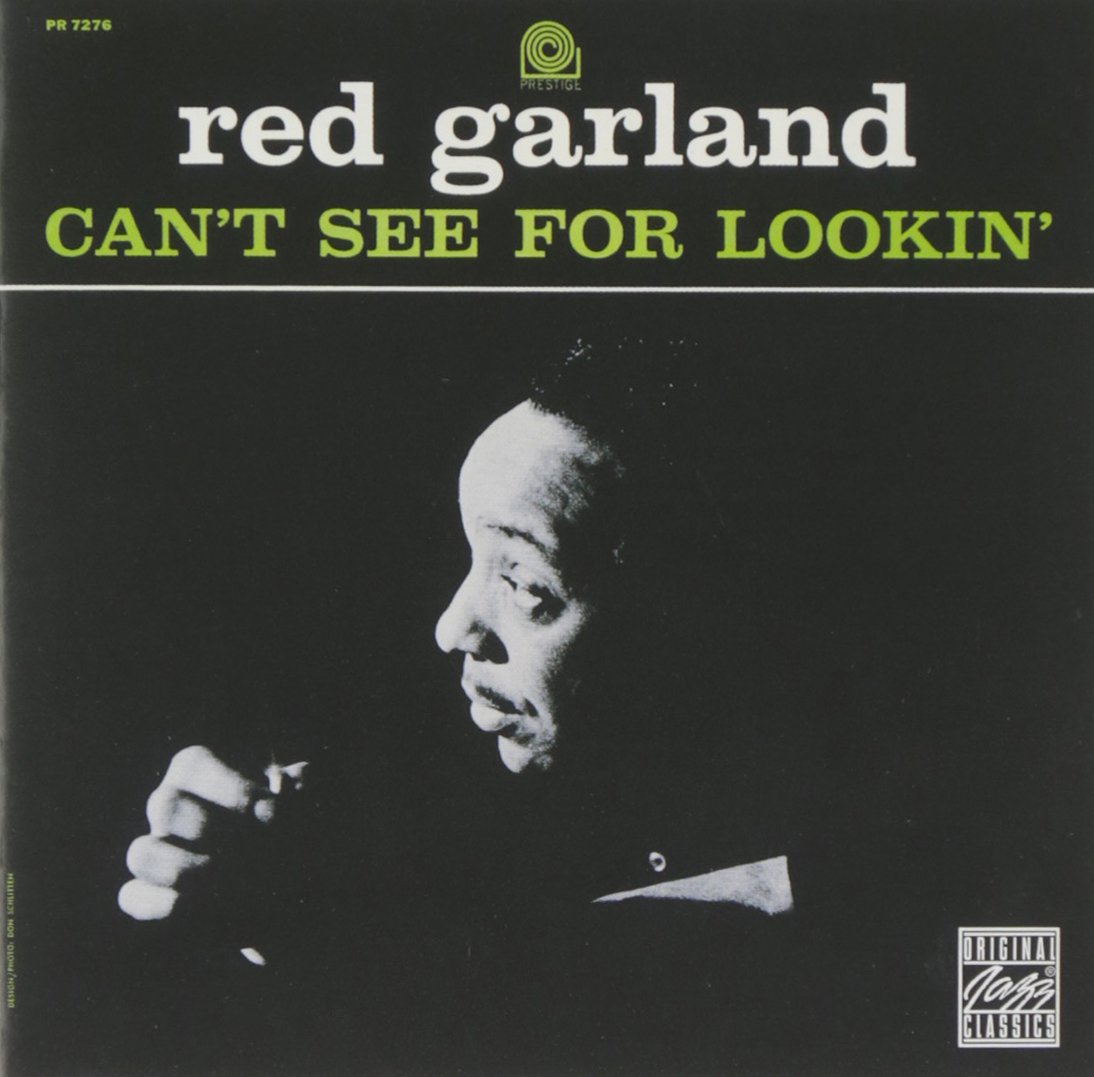
The four songs on the 1963 release demonstrate Garland's usual eclectic taste. "I Can't See For Lookin'" was co-written by Nat "King" Cole's first wife, and was one of Cole's early vocal recordings, much bluesier than his later style. "Soon" is the Gershwins. "Blackout" was written originally for Erskine Hawkins by two of his bandsmen, Avery Parrish and Sammy Lowe. Lowe went on to have a distinguished career as an arranger, with credits ranging from Benny Goodman to Nina Simone to Sam Cooke to the Platters, and perhaps most famously, to James Brown with the arrangement for "It's a Man's Man's World." Parrish had his career cut short by an injury suffered in a bar fight, and he drifted away from music.

Maybe jazz and rhythm and blues had gotten a divorce by 1958, but just as with some ex-marrieds who can't always resist the old chemistry, they could still get together for a little hanky panky. Alan Freed loved jazz, and hired jazz stars for his stage show band, including Ellington stalwart Al Sears, who continued to play his own brand of fiery tenor sax, whatever the ensemble was called. His composition, "Castle Rock," was first recorded with a group he co-led with Ellingtonian Johnny Hodges, and released under Hodges' name, although he would later re-record and release it under his own. Initially, Sears got Ellingtonian Leroy Lovett and crooner Ted Travers to write a lyric, which was performed but never recorded, and was apparently unsatisfactory, because a month later he turned to Erv Drake and Jimmy Shirl, best known for the lyrics to "I Believe," a song not exactly associated with either jazz or rhythm and blues. Frank Sinatra and Harry James recorded that version. Garland's is witty and inventive, and you could dance to it. Garland's piano carries most of the freight
in a ten-minute improvisation, but there's a Paul Chambers solo that's much admired by bass students.

Listening to a lot of Red Garland -- this 12-tune session, and the others that the prolific pianist recorded for Prestige during this period -- one really gets a chance to slow down and listen to the full extent of his talent. This would undoubtedly be true of listening to any jazz great, and I'm not just talking about the giants like Miles or Bird. But it's Garland I'm listening to right now, and marveling how a having a distinctive style doesn't mean repeating oneself or falling into a rut. In every one of these cuts, it's always Garland, but it's always a fresh and new experience, always surprises, always little unexpected thrills, always a cumulative satisfaction.

The quartet cuts with Barretto--you can't say they're better, because the trio cuts are as good as it gets--but they're superb in a different way, with a different ambience. There are standards and originals, even novelty numbers like "Five O'clock Whistle." And, as always with Garland, the unexpected, "Estrellita" is a lovely ballad written in 1912 by Manuel Ponce, a Mexican composer credited with rediscovering Mexican folk music as an inspiration for classically composed music.

Rediscovered Masters didn't come out till 1977, first as a double LP and then, with more cuts from later sessions, as a 2-CD set. It was a cause for rejoicing then,


Order Listening to Prestige Vol 2


Listening to Prestige Vol. 2, 1954-1956 is here! You can order your signed copy or copies through the link above.


Tad Richards will strike a nerve with all of us who were privileged to have lived thru the beginnings of bebop, and with those who have since fallen under the spell of this American phenomenon…a one-of-a-kind reference book, that will surely take its place in the history of this music.

                                                                                                                                                --Dave Grusin

An important reference book of all the Prestige recordings during the time period. Furthermore, Each song chosen is a brilliant representation of the artist which leaves the listener free to explore further. The stories behind the making of each track are incredibly informative and give a glimpse deeper into the artists at work.
                                                                                                                --Murali Coryell

Thursday, October 19, 2017

Listening to Prestige 277: Eddie "Lockjaw" Davis

Eddie "Lockjaw" Davis connected with Shirley Scott in 1953, when he went looking for a jazz organist to form a group with. Which is interesting, because this wasn't exactly a common lineup at that time. Count Basie had recorded on organ with his big band, but the more usual formation, the one favored by Jimmy Smith, was a trio. Bill Doggett's recordings in the early 50s were trio recordings. Perhaps he got the idea of the organ-saxophone combo that shook the world with "Honky Tonk" from Davis and Scott.

It certainly turns out that Davis was onto something. This was a powerful sound for the nascent movement that would come to be known as soul jazz, and given an added richness with the presence of Jerome Richardson.

Differences between this and the previous week's trio session: for a start, while Scott  went for the under-three-minute format best suited to 45 RPM discs for the pop market, the quintet stretched out in the way that jazz groups became accustomed to as soon as it was clear that the LP revolution was here to stay.

There was a new producer in the Van Gelder control room and on the Prestige roster. Esmond
Edwards had been hired as a photographer in 1954, and he had done significant work in that role, contributing to a number of album covers. But his musical acumen combined with Bob Weinstock's readiness to ease up a bit on the production reins, brought him into the actual recording process. He would remain a prolific producer for Weinstock over the next decade, before moving on to Verve, Chess, and other labels. He would also continue his career as an important jazz photographer. And it's worth noting that he was one of the first African-American producers in the New York jazz recording world.

"In the Kitchen" became one of Davis and Scott's best known recordings, and it sparked the culinary theme that was announced with the release of this album as The Eddie "Lockjaw" Davis Cookbook. It would be the first of three. Davis would get top billing on their Prestige releases;
later, when she teamed with Stanley Turrentine both at the altar and in the recording studio, she would be listed as leader on their Prestige recordings, he on their Blue Note discs.

"In the Kitchen" came out as a two-sided 45, as did "But Beautiful" (like Gene Ammons, Davis had two sides, funkmeister and sensitive interpreter of ballads.) "In the Kitchen" also was the B side of a 45 RPM release of "Misty," from a later session. "The Chef" and "Three Deuces" made for another single release.


Order Listening to Prestige Vol 2

Listening to Prestige Vol. 2, 1954-1956 is here! You can order your signed copy or copies through the link above.


Tad Richards will strike a nerve with all of us who were privileged to have lived thru the beginnings of bebop, and with those who have since fallen under the spell of this American phenomenon…a one-of-a-kind reference book, that will surely take its place in the history of this music.

                                                                                                                                                --Dave Grusin

An important reference book of all the Prestige recordings during the time period. Furthermore, Each song chosen is a brilliant representation of the artist which leaves the listener free to explore further. The stories behind the making of each track are incredibly informative and give a glimpse deeper into the artists at work.
                                                                                                                --Murali Coryell


Monday, October 09, 2017

Listening to Prestige 276: Shirley Scott

This was the beginning of a long and fruitful association between Prestige Records and Shirley Scott, who would record for them both as leader of her own trio and in partnership with Eddie "Lockjaw" Davis. Her other important partnership was marital as well as musical--to Stanley Turrentine, with whom she recorded a series of successful albums for Blue Note before they divorced in the 1970s;

The jazz of the 1930s that had been created by Count Basie and Jimmie Lunceford, Erskine Hawkins and Chick Webb, morphed into a style of music called swing, and swing was essentially the province of white bandleaders like Benny Goodman and Artie Shaw, Tommy Dorsey and Harry James and Glenn Miller. When they talk about the golden era when jazz was America's popular music, that's what they're talking about.

So did bebop really kill jazz's popularity? I'm not so sure. Black American music was restless in the 1940s. Black artists knew they couldn't compete in the marketplace with the white swing bands, and they were chafing at the limitations of a music they heard as growing increasingly formulaic. So they either made it gutsier and bluesier and blacker (Louis Jordan) or more inventive and more musically challenging (Bird and Diz). And maybe jazz, the music of African Americans, was still as popular as it had ever been, if you count both tines of that bifurcated style. Louis Jordan wasn't jazz? Joe Liggins and Willis "Gator Tail" Jackson and Big Jay McNeely weren't jazz, and Tommy Dorsey and Harry James were? The Ravens and the Clovers weren't jazz, and the Pied Pipers and the Hi-Los were? Gimme a break.

So then we came up to the mid-fifties, and it was happening again. The music that black artists created had morphed again, gotten whiter again, and rhythm and blues had become America's popular music under the new name of rock 'n roll. And once again black music, the creative epicenter of American culture, was moving on, and once again bifurcating.

Bebop, modern jazz, that scary new sound of the 1940s, was still not selling as many records as Benny Goodman in his prime, perhaps, but it was selling its share, and it mostly wasn't scary any more. With artists like Miles Davis and Dizzy Gillespie, but very much with white artists like Stan Kenton and Stan Getz and Gerry Mulligan and Dave Brubeck, it had entered the mainstream of American music. And a newer generation of black musicians, John Coltrane and Eric Dolphy and Ornette Coleman and Cecil Taylor, were finding sounds that were adventurous and challenging and once again a little scary. And the spiritual descendants of Jordan and Liggins and Jackson and McNeely were finding their way to a jazz that was funkier and bluesier and blacker.

No one person led that new sound, but it's pretty clear that Ray Charles was one of the most important figures. He pioneered a sound that embraced rhythm and blues and modern jazz, but most excitingly embraced the street and the church, blues and gospel. And that was the genesis of what became hard bop or soul jazz or jazz funk.

And if you're going to church for the new jazz sound you're going to bring into the streets, what could be more logical than wheeling an organ out the door?

That was the sound that Shirley Scott found.

Scott was born and raised in Philadephia, a hotbed of jazz rivaling Detroit in its experimentation and technical virtuosity. Her father ran a jazz club, and she grew up listening to players like Red Garland and Philly Joe Jones. She began to play piano because her brother had taken up the tenor sax and needed someone to accompany him, in much the same way that hockey Hall of Famer Tony Esposito became a goalie because his brother Phil needed someone to practice shooting at.

But Philadelphia was also home base for Jackie Davis, who was finding the jazz possibilities latent in the Hammond B-3 organ, an instrument hitherto relegated to storefront churches and roller rinks. And Davis was to inspire another Philadelphian, Jimmy Smith. And, of course, young Shirley Scott.

Scott started recording with Eddie Davis in 1953, when Davis had heard what Smith and Jackie Davis were doing with the B-3, and was looking for an organist to form a group with. Fortunately, he was able to look beyond the jazz world's male chauvinism.

The two first recorded together in 1956 for King Records, in Cincinnati. King was an interesting label. It had begun as strictly country and western, then added rhythm and blues. It was never a jazz label, though a couple of jazz artists like Hot Lips Page are on their roster. And artists like Earl Bostic and Bill Doggett who played in both jazz and rhythm and blues formats. The Scott/Davis album on King was called Jazz with a Beat, which is not a bad definition of rhythm and blues.

Count Basie was also a presence on the rhythm and blues/race records charts of the era, and Scott/Davis were also featured on a Roulette album called Count Basie Presents Eddie Davis Trio + Joe Newman. Neither of these was released until 1958, so the Prestige album may have been Scott's first exposure.

For her first session, she chose very familiar tunes: "Brazil," "Cherokee," "Ebb Tide," "Slaughter on Tenth Avenue." When you think about it, these are tunes you'd associate with a jazz popularizer/R&B bandleader like Earl Bostic. She also tackles a couple of Miles Davis originals, "Four" and the tune that Miles called "The Theme," but which becomes, in someone else's hands, "Miles' Theme." Each tune is compact, 45 RPM length, appropriate for an R&B audience, and in fact, Prestige released five 45s out of this session.

This is unquestionably jazz, and certainly jazz with a beat. It's also jazz with an organ, which was still relatively uncommon. In Down Beat's 1957 jazz poll, the organ does not rate a category of its own. There are four organists who got votes in the Miscellaneous Instruments category, and Scott was not one of them.

She announces her presence on the scene, and ensures that she won't be left out the next time, by using this session to show off her command of the instrument, pulling out all the stops -- literally, since it's an organ. She is helped by two sidemen who know what they're doing (listen to what they give her on "Cherokee"), and know the difference between jazz and rhythm and blues, or else know that there's no difference.

George Duvivier played on two previous Prestige sessions, both with Gil Mellé, whose work can be described in a number of ways, none of which have anything to do with rhythm and blues.  He could, and did play pretty much everything, from R&B (Lucky Millinder) to swing (Jimmie Lunceford) to bop (Bud Powell) to pop (Lena Horne, Frank Sinatra) to avant garde (Eric Dolphy). He was the bassist on the Basie album that featured Davis and Scott.

Arthur Edgehill  recorded for Prestige on a 1956 session with Mal Waldron. He specialized in funk and hard bop, and with Duvivier, had a long run with Scott and Davis.

Eight of these tunes were released right away on an LP titled Great Scott! More came out in 1961 (Shirley's Sounds) and 1964 (Workin'). It's harder to find release dates for 45s.


Order Listening to Prestige Vol 2

Listening to Prestige Vol. 2, 1954-1956 is here! You can order your signed copy or copies through the link above.


Tad Richards will strike a nerve with all of us who were privileged to have lived thru the beginnings of bebop, and with those who have since fallen under the spell of this American phenomenon…a one-of-a-kind reference book, that will surely take its place in the history of this music.

                                                                                                                                                --Dave Grusin

An important reference book of all the Prestige recordings during the time period. Furthermore, Each song chosen is a brilliant representation of the artist which leaves the listener free to explore further. The stories behind the making of each track are incredibly informative and give a glimpse deeper into the artists at work.
                                                                                                                --Murali Coryell


Wednesday, October 04, 2017

Listening to Prestige 275: John Coltrane

Coltrane and Donald Byrd are a great combination, back together again after a January session, so Bob Weinstock must have really liked what he heard, and what's not to like? But it's Coltrane who really holds the interest right now. The "happy young man," in Ira Gitler's words, was on a creative tear. Just five months into the year, he was already on his sixth studio session for Prestige, and that was only part of it. He had done two dates with a group led by Wilbur Harden for Savoy, and don't forget, he still had his bread and butter gig, with Miles Davis. By May 23rd, he had recorded two studio sessions and two live sessions with Miles. And when he went out to Rudy's for his Friday Prestige date on May 23rd, he had another recording scheduled with Miles for the following Monday, in New York, at Columbia's 30th Street studio.

Turning your life around, getting off drugs, gives you energy to burn, and Coltrane was burning it. But it wasn't just energy. He was burning with musical ideas, too, which is what makes this period so exciting.

The music was exciting. What Gitler called "sheets of sound," a phrase that's become firmly implanted in the jazz lexicon. It meant Coltrane playing every note associated with every variation on a given chord, more or less at the same time. Or something. It was sort of like the rapid-fire runs through variations on chord changes that the beboppers had pioneered, except that it wasn't. But it had that same questing urgency, that sense of listening for something new, just beyond the horizon. Listening to it now in the chronological order of the music being made (this session was not released until 1964), one can really feel a part of that quest.

"Black Pearls" is a Coltrane original, "Lover Come Back" is the Sigmund Romberg melody that's

become such a favorite of jazz modernists. "Sweet Sapphire Blues" is credited to Bob Weinstock as composer, and that might raise eyebrows, since it was such common practice in those days for DJs or record company executives to put their name on songs they had not in fact written. This one was a little different. They had gone through the first two tunes, and they still had studio time, and they did not yet have enough to fill out an album. This could have been OK--Weinstock wasn't planning to release the session right away anyway, and he could always have found other ways to fill it out. Or they could have done what they so often did: what Rudy Van Gelder called the "Five O'clock Blues," an impromptu improvisation on a familiar blues riff, or a half-finished idea by one of the musicians. In this case, when Weinstock asked Trane for one more tune, Trane responded, "Why don't you write one?" As Weinstock recalled, he recoiled from the idea--one thing he was sure of, he didn't know how to write a song. But Trane kept teasing him: "How about this?" and he'd play a few notes. If Weinstock said OK, he'd play a few more: "How about this?" Before long, they had strung something together, and Trane said, "OK, you wrote it."

The result is a little like the routine Steve Allen used to do on TV. He'd call up four people from the audience, have each of them strike a note on the piano, and then do a jazz improvisation based on those four notes. A little like that, except better. The melody is jagged but interesting, and five supremely gifted musicians were able to improvise on it for 18 minutes, or one full album side.

Why "Sweet Sapphire Blues"? That's lost to history, unless they'd been watching Amos 'n Andy before the session. In any case, it wasn't likely to be the title of the album, nor was the Romberg melody. So Black Pearls it was. It was also released as a two-sided 45.


Order Listening to Prestige Vol 2

Listening to Prestige Vol. 2, 1954-1956 is here! You can order your signed copy or copies through the link above.


Tad Richards will strike a nerve with all of us who were privileged to have lived thru the beginnings of bebop, and with those who have since fallen under the spell of this American phenomenon…a one-of-a-kind reference book, that will surely take its place in the history of this music.

                                                                                                                                                --Dave Grusin

An important reference book of all the Prestige recordings during the time period. Furthermore, Each song chosen is a brilliant representation of the artist which leaves the listener free to explore further. The stories behind the making of each track are incredibly informative and give a glimpse deeper into the artists at work.
                                                                                                                --Murali Coryell