Tad Richards' odyssey through the catalog of Prestige Records:an unofficial and idiosyncratic history of jazz in the 50s and 60s. With occasional digressions.
This is the last round of the Contractual Marathon: twelve tunes, one afternoon, and Miles is out the door. And what more is there to say about what was...well, one can't say one of the most fruitful periods of Miles's career, because they were all fruitful, but probably one of the most beloved?
What's not to love? Miles with one of jazz's storied quintets, playing timeless tunes. "I'll play it and tell you what is after," Miles says at the beginning of the session, but there's scarcely any need. We always know what it is. Classic tunes from the Great American Songbook. Jazz standards from Monk and Rollins and Miles himself.
So rather than think a lot about it, I just listened to them. A lot. In the car, in the house. In a box, with a fox. And I did like them, Sam-I-Am.
Music that has been orchestrated into the sound track of your life, that you first heard when jazz was becoming as necessary to you as a pulse, can become one with that pulse over time and resolve itself into background music, but not in a bad way. It's never going to be elevator music. But it has the warm familiarity of a thirty year marriage. And then, suddenly, it will surprise you in a new, unexpected and challenging way, like...well, like a thirty year marriage.
So goodbye, Prince of Darkness. Like Tristano, and Getz, and Monk, and the MJQ, you're moving on from Prestige, although your bandmates will still be here for a while, Kind of Blue lies ahead of you, and Sketches of Spain, and In a Silent Way, and Bitches Brew, and Big Fun, and Jack Johnson, and the Fillmore. Thanks for the memories and the music.
After the last of the Contractual Marathon sessions had been recorded, Miles was free to pursue his career with Columbia. Her didn't have to wait for the records to be released, and in fact, their release dates were spread out.
"My Funny Valentine," "Blues by Five" (by Red Garland), "Airegin" (by Sonny Rollins, first
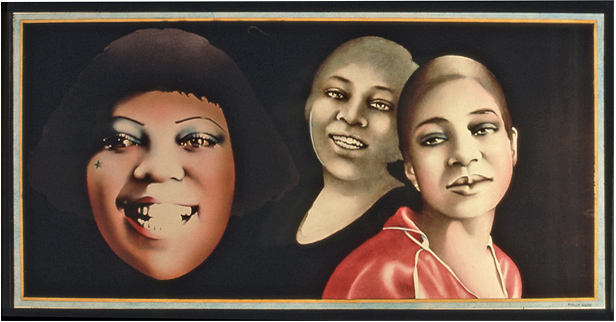
recorded by Miles in 1954 and already on its way to becoming a jazz standard), "Tune Up/When Lights Are Low" (presented as a medley, the first a Miles original and the second by Benny Carter and Spencer Williams) made up Cookin' with the Miles Davis Quintet, released in July 1957 as the first album in this series. The cover art was by Phil Hays, who, like Miles, would move on to Columbia, where he became noted for his album cover portraits of Bessie Smith and others.
Standards "If I Were a Bell," "You're My Everything" and "I Could Write a Book," along with Rollins's "Oleo," were on the second album, Relaxin', released in February, 1958. "Half Nelson" saw daylight two years later, on Workin', February, 1960. "Well, You Needn't" was on Steamin', not released until August, 1961.
Prestige also got several 45 RPM releases from this session: "If I Were A Bell," Part 1&2, "Airegin / 'Round Midnight," "Tune Up / Oleo," and "My Funny Valentine / Smooch," the last one perhaps a Valentine's Day special.
I was sitting with Margaret Whiting one day when she got a call from the organizers of the Kool Jazz Festival, asking her if she'd perform.
"But I'm not a jazz singer," she said. "I only sing the melody."
"We know," the festival guy said, "and do you know how hard it is to find someone who can really do that?"
What is a jazz singer, exactly? Someone who improvises around the melody? What about Frank Sinatra? Some would call him one of the greatest of all jazz singers, and he pretty much sang the melody, although he did improvise around the beat.
Some people, most notably Mel Tormé, have said that "jazz singer" is an oxymoron, there's no such thing as a jazz singer.
But if there is, what makes a jazz singer? Why is June Christy a jazz singer and Jo Stafford not? Why is Peggy Lee sometimes a jazz singer and sometimes not? How about Eartha Kitt? Why was Rosemary Clooney not a jazz singer until she was one? It was said of Sarah Vaughan, whose jazz credentials even Mel Tormé would have a hard time denying, that she used her voice like a horn, but what does that mean, exactly? Annie Ross sang dizzyingly difficult jazz solos, but in a way she was singing the melody -- a melodic line established by an instrumentalist like Wardell Gray. Her famous version of "Twisted," a jazz classic, has been covered by non-jazz singers like Bette Midler, or does singing "Twisted" make Midler a jazz singer? Edie Hart was a jazz singer, but she only sang the last few bars of songs, and then only when Peter Gunn was in the room.
It doesn't get any easier if move into the contemporary postmodern world, where you can probably be everything if you set your mind to it, like Amy Winehouse or Cassandra Wilson or Esperanza Spalding.
Google "what makes a jazz singer a jazz singer," and you get not much of any definitions at all, but you do get advice to aspiring jazz singers, and that advice boils down to: listen to a lotta jazz.
So is a jazz singer someone who sings and listens to a lotta jazz? That's hard to quantify.
So I'll offer this as a definition: a jazz singer is a singer who sings with jazz musicians.
And even that isn't enough. Connie Kay played drums on most of Atlantic's rock and roll sessions, but that didn't make those performers jazz singers. Margaret Whiting is a self-described non-jazz singer (although she did play that Kool Jazz Festival, and knocked 'em dead), but her greatest hit and signature song, "Moonlight in Vermont," was recorded with Billy Butterfield.
So I'll revise my definition. Taking off from the "listen to a lotta jazz" advice, I'll say that a jazz singer is someone who sings with a lotta jazz musicians.
I suppose even that is dodgy. Margaret Whiting recorded "Moonlight in Vermont" with Billy Butterfield and his orchestra, but not really. It was Les Brown's dance band, but for contractual reasons they couldn't use Brown's name.
Which brings us to Barbara Lea, who came into Rudy Van Gelder's studio for two consecutive days
to record a group of songs with a jazz group led by Johnny Windhurst, although the supporting personnel changed between one day and the next. And what makes her a jazz singer, and a very good one, is that she sings with jazz musicians, and connects with them. You can feel the chemistry. This comes through on every song, but if you really want to hear her interacting with jazz musicians, listen to "My Honey's Loving Arms" or "I'm Coming Virginia."
The session is a little unusual for Prestige, especially in the mid-50s, in that the musicians are essentially old school, which was generally Lea's choice. And if it wasn't to Bob Weinstock's mainstream taste, it was an inspired detour. The album was critically acclaimed, and Lea was named Best New Vocalist of the year by Down Beat, which tended to be more than a little snobbish about what was jazz and what wasn't.
Her first New York recording session was two songs released on the Cadillac label (not the Chicago label that later became Chess) in 1954, with a band led by Eddie Barefield, Pee Wee Erwin, and Cutty Cutshall. In 1955 he recorded for Riverside, with a band that included Billy Taylor regulars Earl May and Percy Brice. The songs were included on an album that threw together a hodgepodge of groups,
and came out under Mundell Lowe's name.
Then the Prestige sessions, and she would record for them through 1957, after which her recording career would come to a standstill until the late 1970s, when she made a number of records for Audiophile over the next decade, and Whitney Baillett declared in The New Yorker that "Barbara Lea has no superior among popular singers."
The groups on both of the October sessions are led by trumpeter Johnny Windhurst, with whom Lea worked frequently. Windhurst's career went back to 1944, when Sidney Bechet tapped him to replace Bunk Johnson in his group. Trad jazz giant Ruby Braff has listed him as his major influence. He's little remembered today, partly because he was a trad jazzer after trad jazz had mostly faded into critical irrelevance, partly because he seemed not to have wanted the spotlight. He left New York and moved upstate to Poughkeepsie, in my native Hudson Valley, where he lived with his mother and played in the house band at Frivolous Sal's Last Chance Saloon. Frivolous Sal's, which later became The Chance, one of the Hudson Valley's major music venues, was a place where they played Dixieland jazz and the waiters wore ersatz Gay Nineties outfits. In short, the kind of place that I would not have been caught dead at, which means I missed hearing a great trumpet player. The moral
of this story -- don't turn up your nose at any place that plays live music, especially with musicians who are a little older.
The October 18th session featured Richard Lowman on piano. "Richard Lowman" was a pseudonym -- if you think about it for a minute, you can probably figure out for whom. Ready? Thinking?
.......
Dick Hyman.
Only four songs were recorded the first day: "Baltimore Oriole," "I Had Myself A True Love," "Nobody Else But Me" and "Thursday's Child."`Perhaps Van Gelder had to spend some adjusting for the presence of a vocalist, because the next day they came back and did eight more.
On the 19th, Lowman/Hyman had bowed out, and Dick Cary, who had played alto horn (not to be confused with alto sax) the first day, doubled on horn and piano. He was equally adept at both instruments. He had made his first mark as a pianist in 1947, when a promoter wanted to present Louis Armstrong, who had been leading a big orchestra for years, in a small group setting, including Jack Teagarden and Bobby Hackett. Cary was the rehearsal pianist. Armstrong didn't actually show up for any of the rehearsals, and on the night of the first performance at Town Hall, there was no one else, and Cary stayed on piano. That turned out to be the beginning of the Louis Armstrong All-Stars, and when they began booking regular gigs, Armstrong remembered "the kid who did the concert," and Cary became the All-Stars' first piano player. His first recordings on alto horn were with Billy Butterfield, and he also played trumpet at Eddie Condon's. According to his obituary,
Unlike the Dixielanders, he was a progressive musician and his apartment became the centre for jam sessions with players like Zoot Sims, Bob Brookmeyer, Bill Evans and Jimmy Raney. From 1956 he worked in the progressive band led by Bobby Hackett.
Al Hall and Osie Johnson were the rhythm section on both sessions, and both were respected music veterans who could play bebop as well as older styles. Hall is best known for his work with Errol Garner, but he also played bebop with Bud Powell, swing with Teddy Wilson, and rock and roll with Frankie Lymon and the Teenagers. Johnson also moved deftly between swing and bebop, no mean feat for a drummer since the demands were so different, and he was a favorite of jazz singers (whatever that means) like Carmen McRae and Dinah Washington.
The second session adds Al Casamenti on guitar, and he had, if anything, an even wider range, from easy listening (Enoch Light) to rhythm and blues (King Curtis) to rock and roll (Screamin' Jay Hawkins) to jazz (Billy Taylor, Wes Montgomery) to Latin (Tito Puente) to pop (Johnnie Ray, Frankie Laine -- including "Rawhide") to jazz singers (Ella Fitzgerald). His lead-in to "My Honey's Loving Arms" is particularly tasty.
The Prestige album is self-titled.
I've had to skip over an album recorded by Herbie Mann in Sweden because I can't find it anywhere.
Everything that every jazz musician plays is, at root, a tribute to Bird. Today, those tributes are most often paid by musicians who were not yet born when Bird died, but they're nonetheless sincere, and those younger musicians still feel that closeness to Bird. But this session was recorded in 1956, when Bird was only one year and a few months dead, and he was still very much a living presence to every jazz musician, and much more profoundly than the ubiquitous "Bird Lives" graffiti of those days (my favorite legend is the one that said at the moment of Bird's death, a single feather fell from the rafters of Carnegie Hall.
Sonny Rollins had played with Charlie Parker on the 1953 Miles Davis session which would ultimately be part of the Collector's Items album, not to be released until December of 1956. He remembered Parker's powerful personal influence when interviewed by Art Taylor, for Taylor's powerful book Notes and Tones: Musician-to-Musician Interviews:
Bird was not only great to me as far as music goes; he also befriended me at a very important time in my life. You know that Bird helped me get off drugs when I was younger. When I made Collector's Items...Bird found out that I had been indulging. He really didn't like it. I saw for the first time that he didn't dig my doing that. I realized I must be doing the wrong thing. Up until that time I had thought it was all fun and games and that it was okay to use drugs. I subsequently got myself off drugs, when he showed me that wasn't the way to go. Unfortunately, when I did get myself straight, I was anxious to let him see I had dug his message, but as life would have it, he passed away before I was able to meet him again,
Rollins entered the federal drug treatment center in Lexington, Kentucky in 1955. Charlie Parker died in March of 1955, probably while Rollins was still at Lexington, so one can only imagine the extent that Parker was still on his mind.
Max Roach played on a number of Parker sessions, including his first Savoy recordings in 1945, and the legendary Massey Hall concert. He would record his own Parker tribute album a year later, for EmArcy.
Kenny Dorham must have had Parker very much on his mind. He had played with Bird on the great altoist's last gig, on March 5, 1955, at Birdland. Bird would be dead only a week later.
George Morrow never recorded with Bird, but he did play with him, on a number of gigs during Bird's 1946 California sojourn. Morrow, who was 30 at the time of this session, had played with the Roach-Clifford Brown quintet on all their recordings.
Wade Legge, at 22, was the youngest musician to be tabbed for this session, and though he had never
played with Bird, he had gotten his start in Dizzy Gillespie's orchestra. Dizzy, recognizing his talent, originally hired him as a bassist, but then heard him suggesting some innovative changes to the piano player. The bebop great liked what he heard, and immediately installed Legge on piano, the instrument he would play for the rest of his short career. He was highly sought after in the late 1950s, appearing on more than 50 recording sessions, and making one album under his own name (for French Vogue, reissued on Blue Note). By 1959 he had retired back to his native Buffalo, probably for reasons of health. He died at 29 of a bleeding ulcer.
The Bird medley begins with the classic "Parker's Mood" opening riff, then goes into standards closely associated with Parker, and original Parker compositions. "I Remember You" (written by Victor Scherzinger as a vehicle for Dorothy Lamour) is from a 1948 Savoy recording (with Max Roach on drums) and features Rollins as chief soloist. The musicians take turns as leader in each part of the medley. Kenny Dorham is up next on "My Melancholy Baby," recorded in 1950 for the Clef album Bird and Diz, the last studio Parker/Gillespie collaboration, a recording which rescued the 1912 melody from the provenance of weepy drunks in late night piano bars.
"Melancholy Baby" has an odd story, which I'll digress to share. From Wikipedia:
Ernie Burnett, who composed the music, was wounded fighting in the First World War, and he lost his memory together with his identity dog-tags. While recuperating in hospital, a pianist entertained the patients with popular tunes including "Melancholy Baby". Burnett rose from his sickbed and exclaimed: "That's my song!" He had regained his memory.
"Old Folks" is sweetly sentimental, and it comes from the ill-fated Charlie Parker with Voices collaboration with Dave Lambert. The criticism of this session is not unfair, but Bird's solo has a lot of feeling, and it's not hard to see why the guys picked it to be part of this tribute. The medley is not so much an attempt to play like Bird as it is an expression of how musicians felt about Bird, and this one goes to Wade Legge, both horns sitting out. "They Can't Take That Away From Me" is the gorgeous Gershwin melody, recorded by Bird on the Charlie Parker with Strings album, controversial at the time, now pretty universally beloved. Rollins takes the lead. Dorham comes back for "Just Friends."
"My Little Suede Shoes" is one of the catchiest of Bird's original compositions, originally recorded with a Latin percussion, which would seem to make it a natural for Rollins, but Legge takes the lead, and listen to this if you want to appreciated just how good this largely forgotten pianist was. The whole ensemble comes in for the finale. "Star Eyes."
The rest of the album is less Bird-oriented. "Kids Know" is a Rollins original, and one might wonder if a title like "Kids Know" in 1956 was a suggestion that Sonny was going to try rock and roll, but no. Sonny did try rock and roll years later, with the Rolling Stones. When he played a concert at SUNY New Paltz one time, it was promoted as "Sonny Rollins (from the Rolling Stones' Tattoo You album)," so maybe kids don't know everything. My Fair Lady opened on Broadway in 1956, so Bird would never have heard "I've Grown Accustomed to Her Face." "The House I Live In" was written as a leftist anthem by Earl Robinson, became a patriotic anthem when recorded by Frank Sinatra, and here serves as a reminder of Rollins's far-ranging ears. It's one of those tunes you can't hear without having the lyrics run through your head, so you can take it as leftist or patriotic, or both.
"They Can't Take That Away From Me" was plucked out of the medley for release as one side of a 45.
Prestige is generally considered to lag behind Blue Note in the artistry of its album covers, but this is often unfair. The cover for Rollins Plays for Bird, by Reid Miles. is stunning. It's only fair to note, however, that Miles was a Blue Note artist.
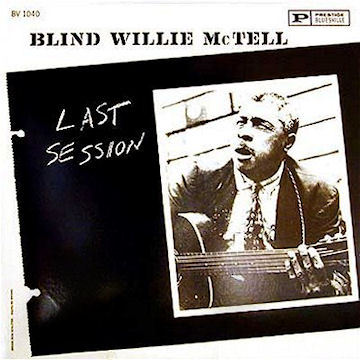
In 1956, Blind Willie McTell was singing on the streets of Atlanta. He was recorded by a local record store owner, but before the recordings could ever find a label or be released, McTell was dead.
He died in 1959. Bob Weinstock founded his Bluesville subsidiary in 1960, which was actually a little ahead of the curve. King of the Delta Blues Singers, the rerelease of Robert Johnson's Vocalion recordings of 1936 and 1937, didn't come until 1961. Charley Patton, one of the earliest pioneers of Delta Blues, had his reissue in 1962, 28 years after his death.
The Blues Hall of Fame started recognizing the titans of the Blues in 1980, did not get an actual building until 2015.
In 1940, John Lomax had recorded McTell for the Library of Congress Archives. He would do very little recording in the intervening years.
Recorded blues had an odd and spotty history. The first blues recording came out in 1920. An African American songwriter, Perry Bradford, one of the very few composers working on Tin Pan Alley, the tight cluster of New York music publishing firms that produced most of America's popular music in the first quarter of the 19th Century. had written a song called "Crazy Blues." He first offered it to Sophie Tucker, one of the most popular singers of her day, but she wasn't looking at any new material just then. A couple of other singers passed on it, so Bradford suggested recording it with a colored singer. The response: Bradford was crazier than his blues. No one would ever by a record by a colored singer. But they did take a chance and record "Crazy Blues" with Mamie Smith, and it was a smash, and it started the blues craze of the 1920s. But the Depression forced cutbacks in the recording industry, and the black performers were the first to be cut.
The real return of recorded blues was post-World War II, and it was part of the developing interest in
folk music (the vital electric blues being recorded in Chicago, Detroit and Los Angeles was considered commercial and inauthentic by the folkies). And this made for an interesting development, since the blues was essentially a music of realism, with the underlying message that things were never going to get better, and the white leftists who were a great part of the folkie audience believed that we could get together and make a better world.
The blues that were to become the center of the new blues explosion were from the Mississippi Delta. Delta musicians like Muddy Waters and Sonny Boy Williamson made their way north to Chicago, where they created an electric blues style that folk purists wanted nothing to do with. Musicians from Oklahoma and Texas went to Los Angeles, where they created their own electric style (T-Bone Walker was one of the pioneers of the electric guitar). There was much less of a blues scene in New York, always more of a jazz town, hospitable to jazz-based blues singers like Bessie Smith. The blues musicians who came to New York were mostly from the East Coast, and played in a style that came to be known as Piedmont blues, which was characterized by many things, but one of them was that many of its exponents, like Sonny Terry and Brownie McGhee, sang in accents that were easier for the mostly white folkie audience in New York than the heavier accents of Delta bluesmen like Charley Patton. The Delta bluesmen would soon be championed by a new group, the blues purists, who were different in many respects from the folk purists. Brownie McGhee had been recorded by Bob Weinstock early in his career, when he was trying to make a name as a rhythm and blues singer.
All of this would change with the nascence of the blues purists, who were a different breed altogether from the folk purists, and the British blues imitators, who were not purists at all.
Blind Willie McTell was a Piedmont bluesman, and although Bob Weinstock was a jazzer rather than a folkie, this seems to have been one of the styles he gravitated toward. But I actually probably shouldn't be spending anywhere near this much time on McTell, since he wasn't one of Weinstock's recordees, or one of his first Bluesville releases, for that matter.
But he was a good pickup for Bluesville, and it's good that these late recordings are available. Bob Dylan sang that no one could sing the blues like Blind Willie McTell, but it may have been more true that no one's name fit the rhythm and rhyme scheme of his song like Blind Willie McTell's. McTell in many ways hearkened back to an earlier age. The black street singers in the South were "songsters," and they sang a bit of everything, including the blues. When the blues craze of the 1920s hit, the songsters became bluesmen. By 1956, McTell was still singing on the street, and he had some of the repertoire of the old songsters, like "Wabash Cannonball," a 19th century ballad popularized by country and western pioneer Roy Acuff. It was cool to hear it done with a blues twist.
Also on the session, "Beedle Um Bum," which had been recorded by Tampa Red and McKinney's Cotton Pickers.
The Bluesville album was released in 1962 as Last Session. The following year, "Beedle Um Bum" made a reappearance on a compilation album called Bawdy Blues.
Anyway, more about Bluesville and Bob Weinstock's blues when we get to 1960.
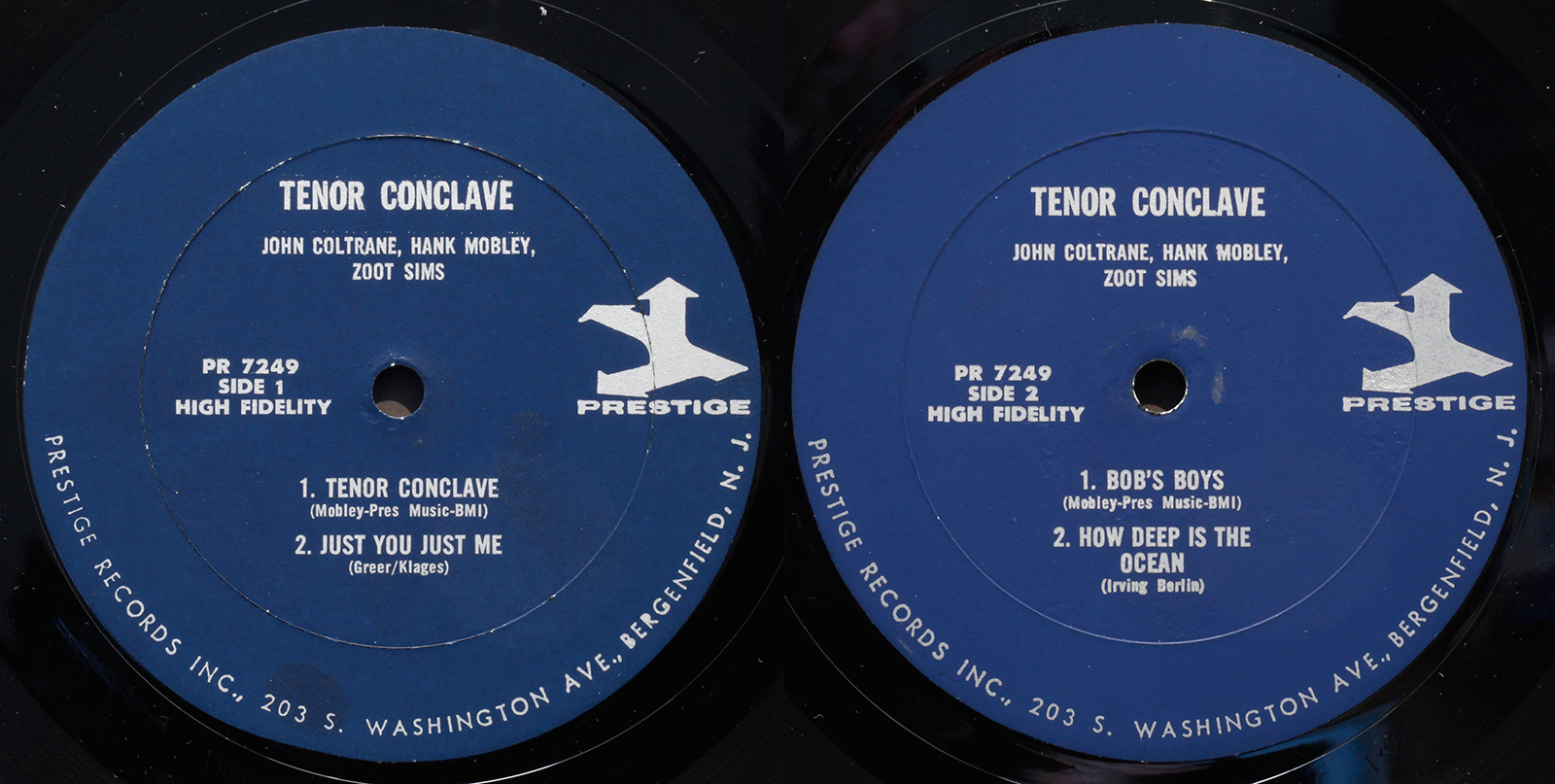
John Coltrane, Hank Mobley, Al Cohn and Zoot Sims together as the sax section for one recording session. What could possibly go wrong?
Nothing, as it turns out. Talk about four brothers! These are four of the all-time greats on the instrument that became the heart and soul of jazz and rhythm and blues of the 40s and 50s.
No one is listed as the leader on the session, although it may have sort of been Hank Mobley, who contributed two original compositions (the other two tunes are standards). Eventually, as John Coltrane's star continued to rise, the album was reissued under his name. Interestingly, although that star continued until Trane had risen to the firmament populated by Miles, Bird and Armstrong, it's the leaderless Tenor Conclave cover that adorned the CD reissue.
And no one takes over as leader, or tries to. in her liner notes to the reissue, Ann Giudici* says
As opposed to the popular "cutting session" of years gone by, this date merely offers four different players a chance to display their ideas. No one was out to blow the other off the stand. The atmosphere is one of forceful but relaxed blowing."
Maybe this is a characteristic of jazz of the Fifties. Certainly we've heard competitive sessions, like the Coltrane/Sonny Rollins Tenor Madness. But as often as not, the leitmotif is camaraderie. We heard it in the earlier Prestige All-Stars session, with Art Farmer, Donald Byrd and Jackie McLean. Or the Phil Woods session from back in June, with Woods and Gene Quill paired on altos, Donald Byrd and Kenny Dorham on trumpets.
How good an album is this?
Very, very good.
Is it four times as good as an album with one of them?
The answer is yes and no.
No, because if you compare it with albums featuring any one of them -- say, John Coltrane with the Red Garland Trio, one of my all time favorites, and also on Prestige, you wouldn't want to even consider the question of which one is better. It would be like choosing between your children.
But yes, because it's mythic. Like knowing that "Tenor Madness" is the only recorded collaboration between Coltrane and Sonny Rollins. Like the discovery, five decades after the fact, of a live recording of Coltrane and Thelonious Monk at Town Hall.
The myth is important. One of the wonders of art is that it stays with you, and gestates inside your mind and your soul until it becomes a new entity, the offspring of you and the artist(s). And that new enitycomes out into the world and plays with new friends, half-sisters and brothers, the offspring of the artist(s) and your friends, or people you meet in online forums, or people you meet by reading their books and articles and liner notes and poems (like Michael S. Harper's paeans to Dear John, Dear Coltrane). Imagine making love to someone after listening, together, to Stan Getz or Louis Armstrong or Ornette Coleman. You're imagining (or better yet) remembering three very different experiences, aren't you? And each one with a special richness that would not be there without Stan or Louis or Ornette. **
Part of that gestation is the art itself, and part is the history, the personalities, the stories--especially in jazz, which is such a collaborative art, and such an endless melding and blending and separating of personalities and sensibilities, the Miles Davis nonet or J.J. and Kai or James Moody and Tito Puente or the musicians Norman Granz brought together for Jazz at the Philharmonic or Ella Fitzgerald and George Gershwin.
In a review of the album on allmusic.com, Lindsay Planer says that " It takes a couple of passes and somewhat of a trained ear to be able to link the players with their contributions," and this is certainly true to my not very trained ear, but the sense of those different voices and sensibilities coming together is palpable and intoxicating. The London Jazz Collector, in his blog, characterizes the four voices as "Mobley’s tone is pure chocolate, Coltrane is spiced lime, Sims is a good Claret, Cohn is mocha garnacha." Which is beautiful and allusive and mysterious, especially since I had no idea what mocha garnacha is.
Ira Gitler, always helpful, runs down the solos in his liner notes to the original album:
* Always interested in new names that crop up on the periphery of the music and the scene, I looked up Ann Giudici and found not very much. In the early 60s, she was apparently producing plays off-Broadway, and Hackensack station WJRZ, which was having success with old time radio dramas, hired Ann Giudici to produce original dramas and adaptations of short stories with a local repertory company. JRZ had a varied format including jazz (Les Davis was a DJ), but shortly afterwards they switched to an all-country format.
** Here's an imagined look at jazz and lovemaking. This will be included in my forthcoming collaboration between me (poems) and Nancy Ostrovsky (drawings), She Took Off Her Dress.
SHE SAID
She said jazz
is how life should be
flexible rhythm but
you count it off
beyond that
improvisation
melody left behind
now it’s your call
you know where
the roots are you don’t
know where it’s taking you
she herself was
Chet Baker
Gerry Mulligan
touching where you didn’t
know you tingled
or she was
Thelonious Monk
threading her way along
narrow pathways
with broad steps
on either side are
Arizona cactus
long spined blooming
Bill Hardman was a youthful 23 when Jackie McLean presented him as his pal/protégé, which was actually two years older than Paul Chambers, who was already a veteran...but Chambers started mighty young. Hardman did too, even though this is is first jazz recording. Even in high school, he was playing with Tadd Dameron's orchestra. After graduating, he joined Tiny Bradshaw's rhythm and blues ensemble, and he can be heard on some of Bradshaw's recordings, although not as a soloist.
He was with Bradshaw from 1953-55, and after that, he was hired by Charles Mingus for a short time -- long enough to become friends with fellow Mingus bandman Jackie McLean (Mal Waldron was also in that group). He would make two more albums with McLean for Prestige, and shortly after this first session, both pals were grabbed up by Art Blakey, who had signed with Columbia, for the second version of his Jazz Messengers.
Hardman would do three different tours with Blakey. And he would endure. Long after bebop and hard bop had gone out of fashion, Hardman kept the flame alive, forming a bop quintet with tenor sax player Junior Cook that was still getting gigs, and appreciative audicnces, through the 70s and 80s.
Hardman died in Paris in 1990, and the headline of his obituary in the New York Times read,
curiously, "Bill Hardman, 57, Trumpeter Known For Improvisations." What did they think jazz musicians did?
Peter Watrous, who does know what jazz musicians do, wrote the obit, and what he actually said was "A fiery but lyrical improviser, Mr. Hardman was one of the last surviving major trumpeters to come out of the 1950's. " This was Watrous's third sentence, and I guess the headline writer didn't feel he needed to read any further.
The composition credits are democratically spread around the group (Jackie was no Miles Davis). "Sweet Doll" is McLean's, "Just for Marty" and "Sublues" are by Hardman, and Mal Waldron brings in "Dee's Dilemma," making for a nice mix and a nice consistency at the same time.
The session is rounded out by Charlie Parker's "Steeplechase" and the standard "It Could Happen To You," which had also recently been recorded by Miles in one of his Contractual Marathon sessions. Listening to both versions back to back is more enjoyable than instructive. The only thing I learned was that when you give a great melody to great improvisers, the results are going to be different. Miles's group takes it at a brisker tempo, even though the tempo-setters on bass and drums are the same for both sessions.
By this time Paul Chambers was established as the bassist in one of the most recognizable ensembles in the history of jazz, and although at this time jazz history was being made, not considered in hindsight, people already knew how important this quintet was.
What people don't always remember is how short-lived it was. Miles formed it in late 1955, recorded pretty heavily with it in 1956, and disbanded it in 1957, not getting it back together until 1958, and then as a sextet. Its rhythm section recorded independently, together or separately, and continued to grow as musicians -- one of the big differences between the Miles and the Jackie versions of "It Could Happen to You" is Paul Chambers' solo. Chambers is developing, and asserting himself.
The album was first released as Jackie's Pal: Introducing Bill Hardman, which is a little odd. New guys make album debuts all the time. But generous of Jackie. It was later rereleased on New Jazz as Steeplechase, a title that looked back to Bird rather than forward to the burgeoning career of young Hardman.
Gil Melle is back in Hackensack two Fridays later, once again trying the experiment of adding three horns to his quartet. The added personnel is a little different this time, perhaps because Art Farmer and Julius Watkins were tied up, perhaps because he still wanted to tinker with the septet sound. Certainly he seems to have had no problems with Farmer, because he brought him back for a 1957 session.
Hal McKusick is back, but Kenny Dorham has replaced Farmer, and Don Butterfield's tuba is in for Watkins's French horn. The result is weirder, and arguably better. Art Farmer brought his own brand of magic to the ensemble, and when he soloed, it became an Art Farmer session. And Lord knows, there's nothing wrong with that. But Kenny Dorham seems to grasp Melle's unique sensibility right away. McKusick has really learned it by this time, and the two of them move from ensemble parts to solos with a full grasp that this is going in a different direction: not a bebop session, or even a hard bop session. That perhaps it's more akin to something that doesn't exist yet: the electronic music that Melle will go on to create.
Don Butterfield for Julius Watkins, tuba for French horn, is an interesting choice, and an inspired one.
Melle had set a deep bottom with his baritone sax, but Butterworth goes deeper and fuller, and in his solos takes Melle's ideas even farther than Melle does.
Butterfield, by 1956, had made the transformation from classical orchestras (and the orchestrated cocktail music to which Jackie Gleason put his name, but not much of anything else) to jazz, and he became a solid part of the jazz scene throughout the 50s and 60s, with beboppers like Dizzy Gillespie, Art Farmer and Jimmy Heath, with funksters like Jimmy Smith, with experimenters like Charles Mingus, Teddy Charles and Rahsaan Roland Kirk, with one-foot-in jazz composers like David Amram -- and I suppose Gil Melle could be included in that last category. In any event, his contribution to this album is inestimable.
All three compositions are unique. Each finds its own direction, and the musicians all find their way along each path. "Sixpence" has actually a sort of head-solo-solo-head structure, but it's not exactly your Uncle Charlie's head-solo-solo-head structure, nor do the musicians treat it as such.
This session completed the tracks for what became the Gil's Guests album. He would record one more album for Prestige, again in two separate sessions, one with guests and one without, and the session with guests was added to the later CD reissue.
As far as I'm concerned, the music is the great legacy of this era, and everyone who played a part in the creating and presenting of it is a hero. Artists left Prestige for Columbia, and Atlantic, and Impulse, and other labels, because they got better deals, because of creative differences, because of reasons lost to history, and who really cares. The music was made, and recorded, and released, and it's there as long as people care about The American Century in music, and all its greatness.
Miles Davis needed a bigger stage--he was on his way to becoming a larger-than-life performer, the superstar that was evolving from the chrysalis of Prestige and taking wing as he shared top billing with Neil Young at the Fillmore in 1970 (captured in photos by Glen Craig).
But if Miles was leaving Prestige, he was leaving a little of himself behind. In his May 11 session, he cut 14 tunes -- 10 of them with the quintet, three more with just himself and the rhythm section, and one--"Ahmad's Blues" -- in which he bowed out, and let Red Garland, Paul Chambers and Art Taylor have center stage, as a way of auditioning the trio for Prestige, and it worked, Bob Weinstock signed them, and this is the first fruit of that signing.
The trio play eight songs, six of them standards from The Songbook. It's always interesting to hear jazz versions of these standards for any number of reasons, but certainly one is the fresh focus they give to the songs themselves. Lester Young said that whenever he played a standard, he always had the words in his mind, and certainly a listener is going to be mindful of a familiar lyric. (Well, most listeners. I had a friend who told me she loved the blues, but she never listened to the words. I said, "That's like loving Rubens, but not noticing the nudes." She said, "I do that too.")
So Garland starts off the set with "A Foggy Day," and it's not Fred Astaire's softly melancholy fog. Garland, with his hard-charging block chords, has his fog lights on, and he's not letting a little clammy low visibility stop him, or even slow him down.
"Makin' Whoopee" is a gleeful expression of arch cynicism, but Garland slows it down to an almost stately pace, and you have to listen to it for a bit before you start noticing that the dry archness is there, but subtly.
"September in the Rain" starts with an extended walking bass, which leads to a very brief piano solo, which leads to a bowed bass solo, and if you don't believe a bowed bass can walk, listen to this one. As a result, the head sort of isn't there. and we're really just walkin' in the rain.
The bowed bass solo is a frequent and welcome participant throughout this session. But if you really want to hear a bass solo, listen to "Blue Red," which opens with two and a half minutes of bass, walking, jumping and standing still. A tour de force, and when Garland comes in, you know that this is a blues played by someone who knows how to play the blues. The number also includes a Garland tour de force -- a repeated figure (repeated 16 times) of the sort that one associates more with the saxophone than the piano, and more with rhythm and blues than modern jazz, but since I refuse to recognize any clear line of demarcation between rhythm and blues and modern jazz, why not?
The other non-Songbook tune is a Charlie Parker composition, and it's another interesting departure. Garland's style is generally noted for block chords of the sort that I associated with Thelonious Monk, but on "Constellation" he turns to a nimble style more reminiscent of Bud Powell (whom Garland named as his chief influence). We also hear boppish overdrive on a bowed bass solo, and some nifty soloing by Art Taylor.
The session was appropriately album-length, and was released as A Garland of Red. "Blue Red" also came out as a two-sided 45; the original track, at nearly eight minutes, is a little long for even two sides of a single, so I wonder if they cut the bass intro. "Makin' Whoopee" also came out on 45, but a few years later, as the B side of Garland's cover of Count Basie's theme music for the TV show M Squad.
I was asked by Gerry Pallor to interview photographer Glen Craig at the opening, at Soho's Morrison Hotel Gallery, of Craig's exhibit entitled "A Day in the Life of Miles Davis." The day, we discovered in talking to Craig, actually lasted several months, as he explains in the interview.
I've been deep into Miles in my Listening to Prestige odyssey, as he wrapped up his contractual obligations to the label with a series of marathon sessions in 1956, so this was a rare treat for me. I got to talk to Glen and to Nell Mulderry, project director for Sony's release of the Miles at the Fillmore sessions, and--a particularly pleasant surprise--to reconnect with old friend Peter Knobler, who originally commissioned the Craig photo essay.
Miles's extended day in the life came well after his Prestige era, when began his campaign to win over the counterculture and the rock audience with his historic Fillmore appearances.
Art Farmer shows up for an afternoon with the usual Fridays at Rudy's gang to find...
What???
Yes, this is a different sort of Friday. And you have to wonder if this is exactly what Gil Melle was expecting, for that matter, from the name hung on the ensemble. Here's the quartet, and what exactly are we going to do with these other guys?
He probably wasn't taken by surprise. Art Farmer may have been a Rudy's regular, but Julius Watkins and Hal McKusick weren't. In any case, whether he came prepared or had to arrange on the fly, he came up with some interesting arrangements, particularly on "Block Island."
As a baritone sax player, Gil Melle was no Gerry Mulligan. If anything, he was Mulligan's renegade stepbrother. He was probably more interested in the tonal qualities of the baritone sax than he was in improvisation. So how is it that the arrangement on "Block Island" sounds so much like Mulligan? Or the bizarro Mulligan. Or Mulligan's evil twin.
All the musicians on this session are good. One of the things we have Melle to thank for, in addition to The Andromeda Strain, would be giving Joe Cinderella a chance to be heard on one of the important jazz labels.
Vinnie Burke is the newcomer to Melle's quartet. Burke was a solid professional, a guitarist/violinist who had taken up the bass after mangling his little finger on the assembly line at a munitions factory. Through the 40s and 50s he played with a range of musicians, many of them, like Bucky Pizzarelli, the Sauter-Finnegan Orchestra and Marian McPartland, on the not so far out end of the scale. Of course, the same was true of Ed Thigpen, and both of them worked well with Melle. Burke's career would extend well into the 80s, and he could always get work.
Hal McKusick got his start with two bandleaders who were more forward-thinking than a lot of their 1940s dance band contemporaries, Boyd Raeburn and Claude Thornhill. They may have given him a taste for challenging assignments, because he went on to work with the likes of Gunther Schuller,
George Russell, Lee Konitz and John Coltrane. He also co-led a group with Bill Evans in 1958.
But the top soloist here is Farmer. Melle gives him his head, and he contributes some remarkable stuff.
These three cuts went onto an album called Gil's Guests, which also featured, in later sessions, Kenny Dorham, Don Butterfield and Zoot Sims.
On the session index, this is listed as the Prestige All Stars, the first but not the last time this designation would be used. Presumably, a bunch of contract players were rounded up for the Fridays at Rudy's session, but none of them were specifically signed on as leader, so they let the producer (can't find out who produced this session) select the tunes and organize the session.
Not sure how this differs from other sessions. Did they tell Hank Mobley, "Hey, we want you to put together a combo for a recording session this week -- oh, but you'll be using Watkins and Taylor"? Or maybe these were all basically Prestige All Stars sessions, but only now did they decide to call it that. Presumably the leader would bring in the tunes, or most of them. In this nominally leaderless session, they included a tune that was composed by a contemporary jazzer who's not on the session: Kenny Drew's "Contour." Probably Jackie McLean brought it in--he had an affinity for the tune, had played it just recently on one of his 4, 5 and 6 dates (Donald Byrd was on that session, too). In any event, it's a fine tune, and more people should record it, and actually, several have.
Certainly, McLean must have brought "Dig" to the session, given that it's his composition, even though Miles grabbed the composer credit for it, and whatever royalties it accrued, but this is jazz, so there probably weren't many, as McLean was told when he looked into suing Miles -- it wouldn't be worth it.
"The Third" is a Donald Byrd composition, so one figures he brought it in. He probably also brought "'Round Midnight," since he's the only horn on that track. Art Farmer takes "When Your Lover Has Gone" on his own, so it's likely his choice.
"Dig" is the centerpiece of the album, at nearly 15 minutes. I was interested to see how it compared to the version that was laid down the day Jackie first brought it into the studio to record with Miles and Sonny Rollins. The Davis-Rollins-McLean version is more melodic, the Prestige All Stars more intense--and at this length, that intensity has to be sustained, and it is. All the soloists are powerful. I started to try to name a favorite, but I can't.
However far afield an improvisation goes, if there's going to be enough meat to sustain it for 15 minutes, it's got to be a very good tune to start with, and "Dig" is. I'm surprised it hasn't been covered more often.
When the album was actually pressed and given a cover and released, it was called 2 Trumpets and credited to Farmer and Byrd. A rerelease was again Farmer and Byrd, and called Trumpets All Out, and a much much later rerelease just had Byrd's name above the title, which was House of Byrd.
For the rest of the summer, Fridays at Rudy's is scaled back to one session a week, and Hank Mobley is back for this one, with partly changed supporting cast -- Doug Watkins and Art Taylor are still there, and still showing why they're there--Art Taylor's playing on "Message From the Border" is one of the major highlights of this session.
Kenny Dorham was an active presence on Prestige recordings in 1956—with Tadd Dameron in March
and Phil Woods in June. He would be back again with Gil Melle in August.
Barry Harris had perhaps decamped for Detroit, because Walter Bishop, Jr., is here on piano. I had wondered if Harris might have left a couple of songs to remembered by, since two of the cuts fro this session are credited to "Harris" as composer, but it turns out to have been two other guys. "These Are the Things I Love" has lyrics by Lewis Harris, and for all I can discover this may have been the only song he ever wrote. The lyrics actually aren't much, but the melody is what counts to a jazz player,
and the melody is a nice one. It's by Harold Barlow, who parlayed his music knowledge into a second career as a consultant on plagiarism. Since one of his clients was George Harrison, you have to wonder how good at it he was.
The other Harris was Benny Harris, who wrote "Crazyology." He has some excellent jazz credentials, including being the guy who convinced Dizzy Gillespie to partner up with Charlie Parker. As a composer, he was favored by Parker, and as a composer, he seemed drawn to the "ology" suffixes. He also wrote "Ornithology" (who knew what wasn't a Bird original?)
So let's get back to Walter Bishop, Jr., whose father. Walter Bishop, Sr., was no slouch as a composer either, with tunes including "Jack, You're Dead," a number one hit for Louis Jordan in 1947, the year that his son got out of the army and into his first gig with Art Blakey. Bishop survived heroin addiction to become an important educator as well as a significant jazz musician. He studied at Juilliard with Hall Overton in the 1960s, taught music theory at several colleges, and wrote a book on jaazz improvisation, A Study in Fourths. He can be seen explaining his theory of fourths in some excellent videos, available on YouTube.
This was Mobley's second Prestige album as leader, and was titled Mobley's 2nd Message (somewhat more formally, on rerelease, as Hank Mobley's Second Message).
Here's something I wrote a few years ago. It's from a series of poems about a young woman, the daughter of an obscure jazz musician, who has left her husband and is trying to understand who she is, finding much of that understanding in jazz.
THE WEATHER CHANNEL
A front of warm air reached our region around
noon today. During
the
afternoon, it will ooze on in,
probe
with sticky, eighty degree fingers,
so
that, she supposes, she could drive
in
and out between yesterday’s clammy cold
and
the oozing certainty of muggy heat,
like
a county with local option on daylight saving,
or
the sound from her rain-drenched speakers,
a
few bars of Hank Mobley’s reassuring bebop,
then
silence. She imagines the missing solo,
how
Walter Bishop might have picked it up,
brought
it to where the sound kicks in again.
Kenny
Dorham is a harder read. Lost,
she
moves inside to the weather channel.
The
front is squatting now, threatening
impossibly
heavy storms – or did he say
possibly
heavy storms?
A guy calls,
she
met him last week. He just wants
to
make sure she has candles on hand.
Hurricane
lanterns are better. She asks him if
he
could fill in the missing parts of a Hank Mobley solo.
Hank Mobley is mostly associated with Blue Note, but he did show up for a handful of Prestige sessions in 1956, starting with Elmo Hope in May, and continuing on into the summer, including two sessions as leader, this being the first.
He shows a healthy respect for the classics here, from pop and particularly from bebop, choosing tunes by Rodgers and Hart, Bud Powell, Thelonious Monk and Charlie Parker--and two of his own compositions, which shows a healthy ego. Neither "Minor Disturbance" nor "Alternating Current" have become jazz standards, but Mobley did go on to become a composer of some note.
Monk composed "52nd Street Theme" in 1944, when 52nd Street was the nerve center of bebop, and Mobley was 14 years old. Powell composed "Bouncing With Bud" in 1946, the year that Mobley took up the tenor saxophone--late, for a guy who mastered it as fully as he did, and almost by accident. He had played the piano before that, as had his mother and grandmother before him, but when he was 16 he was housebound for several months with an illness, and an uncle gave him a saxophone to occupy his time.
He picked it up very quickly -- by 19 he was working with Paul Gayten's rhythm and blues band, and as yet another demonstration of how good those R&B bands of the late 40s and early 50s were, this one included Cecil Payne, Clark Terry, Aaron Bell, Sam Woodyard and Walter Davis, Jr. And young Mobley stood out even in that all-star aggregation. Recalling those days, Gayten said, "Hank was beautiful, he played alto, tenor and baritone and did a lot of the writing. He took care of business and I could leave things up to him." The tenor sax solo on Gayten's recording "Each Time" may or may not be Mobley--opinions differ.
By 1951, when Bird wrote and recorded "Au Privave," Mobley was a full-fledged member of the elite jazz community--not bad for a late starter. He and Davis were backing jazz stars like Miles Davis, Dexter Gordon and Lester Young as the house band in a Newark jazz club, and one of those visitors, Max Roach, hired the two of them and brought them to New York, where Mobley's gigs included bebop heaven -- Minton's, as part of a Horace Silver-led house band which also included Doug Watkins.
So with tunes by Monk, Bud, and Bird, Mobley embraces bebop in this session, though he was later to become known as the pre-eminent hard bop tenor player--a distinction which I don't particularly care to recognize, as I've made clear before. But that's OK, I don't particularly care to recognize a firm distinction between bebop and rhythm and blues, either.
It's great to hear these classic tunes brought into the framework of a straight-ahead Prestige jam session, particularly "Au Privave." It's always good to be reminded of what an amazing artist Bird was, as composer as well as soloist.
Mal Waldron may have had other plans, because Barry Harris is in as the piano player for this second
July 20th session. Harris would eventually settle in New York, but in 1956 he was on loan from Detroit's jazz hotbed, and among the places I'd go to if I could time travel, Detroit's Blue Bird Inn in the 40s and 50s would be high on the list. Harris is solid throughout, and contributes some hot solos.
Prestige released this session as Mobley's Message,and it's billed as the Hank Mobley Sextet, though it's only a sextet for "Au Privave," when Jackie McLean joins the group. And Donald Byrd drops out on "Little Girl Blue," making that a quartet number. It was later rereleased as Hank Mobley's Message, perhaps so no one would confuse the tenor player with Miss America Mary Ann Mobley.
But then...do they seem to be saying that jazz is an undemanding sort of music, so you can put it on as background while you're studying, and that makes you smarter? I couldn't exactly swear to it. I didn't quite read the article all the way through. Maybe I'm not smart enough. So I should listen to more jazz.
And more creative? Absolutely. I always listen to jazz when I write this blog. But maybe I'm not a representative sample. As Etta Place told Butch Cassidy and the Sundance Kid, "your line of work requires a specialized vocabulary."
But I am listening to jazz at the moment, and I am writing, and it's another Friday at Rudy's, and once again the day begins with Breakfast with Jackie, and the same quartet: Mal Waldron, Doug Watkins, Art Taylor.
And once again with a ballad. "When I Fall In Love" was written by Victor Young, who is best known for writing lush movie scores like Around the World in Eighty Days, but who actually had something of a jazz connection, which probably shouldn't be surprising, considering the wonderfully tangled family tree of American music, and which leads me to a convoluted digression, which also shouldn't be surprising, because listening to jazz has made me creative. Young's first big break was something of a reverse spin on jazz, when he was hired by bandleader Isham Jones to take an uptempo jazz number and rearrange it as dreamy ballad. The tune was Hoagy Carmichael's "Stardust," and one would have to say the rearrangement was a success.
It led to Young's being signed by Brunswick records to record more dance music. The recordings were strictly for squares, featuring waltzes and semi-classics, but he was able to give employment to up-and-coming jazz musicians like Bunny Berigan, Tommy Dorsey, Joe Venuti and Eddle Lang. His Wikipedia entry mentions that one of his most interesting recordings of this period was "Goopy Geer (He Plays the Piano and He Plays By Ear," composed and performed by Herman Hupfeld, who also wrote "When Yuba Plays the Rhumba on the Tuba." Oh, and a little thing called "As Time Goes By."
Back to "When I Fall in Love," which has the syrupy quality one might expect from the composer of "Around the World in Eighty Days," but also seems to have the jazz possibilities one could expect from the employer of Berigan, Dorsey, Venuti and Lang, not to mention the Boswell Sisters and Lee Wiley. At any rate, it has a remarkable jazz pedigree, with recordings by any number of the giants. Here it's given a rendition that's less reverent than McLean's "Sentimental Journey," and hits just the right tone for the material. Great stuff.
"Abstractions" is one of Mal Waldron's first recorded compositions, and he would go on to establisn himself as a significant jazz composer, best known for John Coltrane's "Soul Eyes."
As with the previous Friday, McLean roped in a couple of the cats who were on tap for the next session: Donald Byrd, who had sat in with them the previous week as well, and Hank Mobley, new to the Fridays with Rudy gang. So what do you play if you're getting together for a jam session? How about Charlie Parker? With musicians like this, and a tune by Bird, you can't miss.
This is billed in the discography as a sextet session, even though only one track features the sextet. That track is also the "6" in the title of the album that conjoined the two Fridays: Jackie McLean -- 4, 5 and 6. It was released on both Prestige and New Jazz.
Art always involves a series of contracts or promises between artist and audience, and that is particularly true in the narrative arts like literature or music, when one momentary experience follows another in time. The reader of a poem is always going to read the first line first, then the second, then the third, and so on. If a poet writes a line in iambic pentameter, he's making a promise to the reader that the next line will also be ten syllables long, with an accent on every other syllable. If someone strikes a bluesy chord on the guitar and sings a line, he's promising that he'll sing the same line over again, and follow it with a line that rhymes. If someone starts playing a blues in B-flat, the promise is that the notes that follow will be consonant with the key of B-flat.
Sometimes these promises are strictly kept. Boudleaux Bryant, who wrote (with wife Felice) most of the Everly Brothers' hits, believed in whole rhymes, and obvious rhymes, because, he said, them made the listener a sort of co-composer. If you listen to
There goes my baby, with someone new,
She sure looks happy, I sure am...
...you can sing the end of the line before you even hear it.
Other times--and this is what makes art so exciting--the promise is broken. T. S. Eliot famously broke one at the beginning of "The Love Song of J. Alfred Prufrock," when he promised the reader a tetrameter line, rhymed couplets, and a dreamy romanticism with
Let us go then, you and I,
When the evening is spread out against the sky
and then he breaks all three of those promises with
Like a patient etherized upon a table.
If you break a promise, you have to break it with purpose. not like the young saxophone player who jumped up on the Jazzmobile stage in New York and wanted to jam with Frank Foster. Foster graciously welcomed him, and called for a blues in B-flat. The young guy burst into a cacophony of yawps and screeches.
"What are you doing?" Foster asked.
"I'm just playing what I feel."
"Well, feel something in B-flat, motherfucker."
The beboppers would famously promise a romantic ballad from the Great Americam Songbook, then break that promise by upping the tempo as they began to improvise, playing it, in Chuck Berry's words, "too darn fast," and "changi[ing] the beauty of the melody until it sounds just like a symphony."
And that broken promise became the promise, one that the fan who really had no kick against modern jazz came to expect.
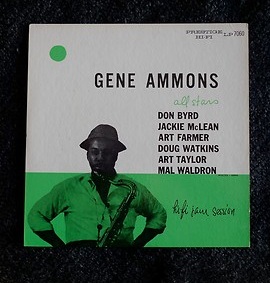
And so it is with Gene Ammons, on the second session of this Friday at Rudy's. Jackie McLean is still there, and so is Donald Byrd, and so is the rhythm section. Art Farmer has joined the merry crew.
And on the second song of the session, which is "We'll Be Together Again," Ammons knows that you know he's going to keep the promise to break the promise, so he teases a bit, drawing out notes almost to the breaking point. The song was written by an unlikely contributor to the Great American Songbook: Frankie Laine, with music by his pianist and music director Carl T. Fischer. It's a beautiful melody, one that found its way into the repertoires of some of our finest singers. Ammons, a great ballad player, gives us the beauty of the melody, but the tease is there too. And with McLean, Byrd and Farmer along for the ride, there's plenty of adventure ahead, enough to make ten minutes of wonderful music, coming back in the end to the melody, and Ammons' drawn-out notes.
The session also has "Jammin' with Gene," a version of "Red Top" that allows for fourteen minutes of jammin', and "Not Really the Blues," another Ammons tease, because anything he plays is really the blues. One odd choice: Donald Byrd is identified on the album's front cover (though not the back) as Don Byrd.
This was the beginning of a very busy summer in Mr. and Mrs. Van Gelder's living room. Let's hope they'd gone to Grossinger's for a summer vacation.A core group of musicians was constantly in and out of the studio in shifting combinations--Friday at Rudy's.
The festivities started on Friday the 13th--July 13, 1956--with two separate sessions. Jackie McLean was the nominal leader on the first one, though he played on both.
McLean starts the session with "Sentimental Journey," an interesting choice in that bebop's journeys were rarely sentimental. And it was a tough one to unsentimentalize. Written by dance band leader Les Brown and his arranger Ben Homer, recorded by Brown and Doris Day, it had been a huge hit in 1945, as ir became a sort of unofficial theme song for returning GIs. Only a decade later, as veterans were still having a painful time readjusting to civilian life (and this was not really recognized back then), the painful, bittersweet (at best) nature of that sentimental journey was still very real.
McLean's take on the song isn't sentimental, but it isn't exactly unsentimental, either. He plays it with a feeling for the melody that's not ironic. The improvisations are a little more hard-edged, but still in keeping with the feeling. McLean would have been 14 when the war ended, an age when boys are romantics and secretly hope the war will go on a little longer, so that they can get into it. You outgrow those feelings, but they're always part of you.
Two members of the rhythm section were to become no strangers to the Prestige studios. Art Taylor
already wasn't, having made his label debut in 1954, and having played on nine sessions already. Mal Waldron was making his Prestige debut. Both would go on to appear on a plethora of Prestige albums. In recent biographical material, they are often referred to, respectively, as the"house drummer" and "house piano player" for the label. It's not altogether clear what this means. Alan Dawson has been described as the house drummer for Prestige during part of the 60s, but he says this is nonsense -- they called him for a lot of gigs, but he was never the house anything.
Doug Watkins rounded out the rhythm section, and he was very much a presence on Prestige recordings in those days, too.
Bebop altered the concept of the rhythm session, as drummers like Max Roach, Kenny Clarke and Art Blakey took the beat away from the bass drum and shifted it to the lighter ride cymbal. The bass took over the principal responsibility for keeping the beat, and jazz singers learned to listen to the bass, not the drums, as their guide for keeping the beat. As drummers became virtuosi, bass players like Curly Russell and Tommy Potter, who could provide a solid foundation for the shifting intricacies of bebop, were in demand.
By the 1950s, bass players, though still anchoring the rhythm section, were becoming virtuosi too.
Players like Charles Mingus, Paul Chambers and Oscar Pettiford soloed as Russell and Potter never did.
How much could you do with a bass solo? Listen to Doug Watkins on "Sentimental Journey" and
you'll hear just how much. Watkins's career was cut short by the auto accident that claimed his life in 1962, but he made a lasting mark.
Donald Byrd joined the group for "Contour" (and stuck around for the afternoon session with Gene Ammons, and changed the mood dramatically. "Contour" is full-out bop, with the two horn almost percussive as they chop away at notes.
This session would be part of a McLean album called Jackie McLean -- 4, 5, and 6, covering both the 4 and 5 parts. It was issued on both Prestige and New Jazz.


:format(jpeg):mode_rgb():quality(90)/discogs-images/R-2273503-1393390308-4239.jpeg.jpg)







:format(jpeg):mode_rgb():quality(90)/discogs-images/R-2070641-1322345159.jpeg.jpg)