Tad Richards' odyssey through the catalog of Prestige Records:an unofficial and idiosyncratic history of jazz in the 50s and 60s. With occasional digressions.
By 1961, Yusef Lateef had completed his move from Detroit to New York. In 1960, he enrolled in the Manhattan School of Music. He would continue his studies off and on, eventually getting a BA (1969) and and MA (1970), then going on to get his Ed.D. And he was, although still playing in a jazz context, using jazz musicians and recording for a jazz label, already moving counter to a lot of what jazz was expected to do, perhaps more toward what he would come to call autophysiopsychic music --“music from one's physical, mental and spiritual self.” He was continuing to work a lot with musicians who had come with him from Detroit--in this case, Barry Harris and Ernie Farrow,
half-brother of Alice McLeod, who became Alice Coltrane--and who had become accustomed to his middle eastern influence and his often unusual instruments. But he had begun working with a New Yorker on drums--Lex Humphries, who had been with him on two previous albums for Riverside.
Lateef called this one Eastern Sounds, and that's a fitting title. Most of the compositions are his, and they reflect his love for Arabic music, but not just that. The sounds are truly eclectic. "Blues for the Orient" is a good example of this, starting with the two-worlds yoking in the title. Lateef plays the flute, and to my ear it's more Near Eastern than what we used to call "the Orient" - China, Japan, Korea, etc. But it's haunting and multicultural. And at the same time, Barry Harris, accompanying him, is playing the blues.When Harris takes an extended solo, he starts off on his own world music tangent, but then brings it around to the blues--and not the soul jazz, funk-drenched blues that were becoming so popular in the early 1960s, but very boppish, very Detroit-ish blues, earthy and cerebral at the same time. He and Lateef complement each other in unconventional but undeniable ways.
"Plum Blossom" is in a way more western, in other ways not. Harris is definitely in a boppish mood, and Lateef is not far away, but he's working with a most unusual instrument. The session notes call it a bamboo flute, but that it is not. It's sometimes called a xun, sometimes a Chinese globular flute. It looks a little like an ocarina, with it's globular shape, but it's played more like a jug from a rural jug band, by blowing into the top, but with finger holes around the ovoid shape.
It's not hard to tell why Lateef reached out of his Detroit orbit to pull in Lex Humphries. Probably best known in 1961 as the drummer on Art Farmer and Benny Golson's immensely popular and solidly hard bop Meet the Jazztet album, but he was capable of reaching outside what were usually thought of as jazz time signatures, which is what made him so valuable to Lateef and later to Sun Ra. His drumming on this session is a revelation, outside the box but always on point.
So you have three musicians, two from Detroit and one from New York, two searching outside the normal traditions of jazz and one working creatively within those traditions. Redefining jazz, yes, but jazz is always about redefinition, so it's not so far-fetched to say that Lateef, Harris, Humphries and Farrow are working in the tradition, playing jazz, finding new ways, and the old ways, to play jazz.
Ernie Farrow contributes importantly as well, playing bass and also an instrument called, in the session log and liner notes, a rabat, but Rabat is the capital of Morocco, not a musical instrument. He seems to have been playing a rabab, an Arabic stringed instrument played with a bow. Both the xun and the rababare ancient instruments.
But the biggest splash was not made by one of Lateef's compositions, but by an unlikely selection. One of the three non-Lateef numbers was Jimmy McHugh's "Don't Blame Me," from an obscure 1932 Broadway revue called Clowns in Clover, but that's not the unlikely one. Obscure Broadway revues or obscure grade B films often produced memorable tunes (like the melody from the forgotten
prison break movie Unchained), and "Don't Blame Me" had already entered the jazz repertoire, with recordings by Teddy Wilson, Coleman Hawkins and J. J. Johnson. No, much more unlikely for an against-the-grain jazzman with a taste for the Near East were two lush orchestral themes from big-budget movies, "Love Theme from The Robe" and "Love Theme from Spartacus."
And even more unlikely, not only did "Love Theme from Spartacus" become the breakout hit from the album, it remained one of Lateef's most popular numbers, and a lot of other jazz musicians subsequently had a go at it, including Bill Evans, Ramsey Lewis, Gabor Szabo and Ahmad Jamal. And it's not hard to see why. It has a good groove from Harris, very full and very beautiful, and exotic flute solos from Lateef. It gets to you.
Eastern Sounds came out on Moodsville, and it certainly sets a mood. It generated three 45 RPM singles, although two of them were "Love Theme from Spartacus," once with "Snafu" from this session, and once with "Sea Breeze" from the earlier Cry! -- Tender. The other 45 was "Blues for the Orient," which was coupled with the standard "I'll Remember April," from Into Something, recorded in December of 1961. Esmond Edwards produced.
One of the interesting things about this album is Forrest's choice of tunes--all of them good, all of them open for improvisation and development, and most of them not on the set list of any other modern jazzman.
"Tuxedo Junction" was written and premiered by Erskine Hawkins in 1939; then, after a 1940 cover by the Andrews Sisters, it became a favorite of white dance bands--Glenn Miller, Harry James, Ray Anthony. From that time to this, you could count on the fingers of one hand the number of modern jazz musicians who've covered it, and you'd have fingers left over if you left out the white musicians. Why? because it's strictly from
Squaresville? Glenn Miller? You might not think that if you listened to Erskine Hawkins's original, and you would certainly start doing some serious rethinking after listening to what Jimmy Forrest and his crew do to it.
And that's the key to this session--Forrest and his band having a good time and making some good music with some tunes that might well be regarded as guilty pleasures--like "Moonglow," the old Benny Goodman warhorse, which has been recorded by pretty nearly everyone, with the exception of most modern jazz artists (Dizzy Gillespie was one exception), or "Organ Grinder's Swing," composed by Will Hudson, who also wrote "Moonglow."
Detroiter Hugh Lawson worked often with Yusef Lateef, so he was used to doing unusual things with unexpected material.
Calvin Newborn never achieved the recognition that his brother Phineas did, but he had an interesting career. He and Phineas started out in a family band organized by their father, Phineas Sr., and the Newborns became B.B. King's backup band on his first recordings. They went on to become staples of the Memphis music scene, where they were the house hand for Sun Records, and Calvin gave Chester Burnett his first guitar lessons--lessons that would serve young Burnett well when he became Howlin' Wolf. They also befriended a young white kid who used to come and listen to them play in a local club, and was a frequent dinner guest at their home. He also followed their lead to Sun Records, at a time when label owner Sam Phillips was saying "If I could find a white man who had the Negro sound and the Negro feel, I could make a billion dollars." The Newborns' protégé, Elvis Presley, was that white man.
Tommy Potter, one of the original bebop bassists, was near the end of his recording career, and his sessions with Forrest were among his last.
Clarence Johnston often worked with Forrest. His association with Prestige goes back to the mid-1950s, and two albus with James Moody, at which point I wrote about him extensively.
Esmond Edwards produced. Six of these tracks appeared on the Prestige album Sit Down And Relax With Jimmy Forrest. The seventh, "That's All," was included on a later New Jazz album, Soul Street.
This was recorded in 1961 for Argo as Dig Him!, but then was rereleased in 1968 on Prestige as We'll Be Together Again. If it were just a Prestige/Fantasy or Prestige/Concord Original Jazz Classics rerelease, I wouldn't count it, but this was Prestige vinyl from the 1960s, so it counts.
Sonny Stitt and Gene Ammons are together again for this outing. They were mainstays of Prestige in the early days, with eight albums together, but there had been a ten year hiatus. The title song (at least for the Prestige release) is appropriate for their partnership, and they do right by this romantic ballad, led by Ammons, whose approach to romantic ballads was always spot on.
Who was the most romantic balladeer in jazz? That question will get wide variety of answers. Miles Davis. Wynton Marsalis. Bill Evans. Bobby Hackett. Chet Baker. Gerry Mulligan. Erroll Garner. But most of the answers will be tenor sax players. That instrument was brought into its own by Coleman in the 1930s. Along with the violin, it is said to be the instrument closest in emotional nuance to tie human voice. So of all the romantic ballad voices in jazz, the tenor sax is the one you're going to keep coming back to. Coleman Hawkins, who staked out the territory with "Body and Soul" n 1939. Ben Webster. Lester Young. Dexter Gordon. Earl Bostic.
And as I've written before, some of the sweetest romantic sounds to be coaxed out of the tenor sax have come from guys who are more associated with the frantic, honking, driving sounds that cone from the rhythm and blues end of jazz. David "Fathead" Newman. Willis "Gator Tail" Jackson. Hal "Corn Bread" Singer (still going at 103, and a survivor of the terrible 1921 Greenwood massacre in Tulsa, OK), Big Jay McNeely, Arnett Cobb.
And Gene Ammons.
He and Stitt, who can also handle a ballad, do some pretty ones here. "We'll Be Together Again" was written by Frankie Laine's musical director, Carl T. Fischer, with lyrics by Laine. Laine, it turns out, was quite a prolific lyricist, but this was the only one for which he had much of a hit.
"Red Sails in the Sunset" was written by Jimmy Kennedy and Wilhelm Grosz (as Hugh Williams). Grosz was a refugee from Nazi Germany and known as an avant-gardist, but he had a number of successful collaborations in the pop field with Kennedy. Kennedy is also known for a couple of not-so-romantic songs, "Teddy Bears' Picnic" and "Istanbul (Not Constantinople)."
"But Not For Me" is by the Gershwins, who need no introduction, and "My Foolish Heart" is by Ned Washington and Victor Young, who don't need much of one, especially if you're a movie fan. "Autumn Leaves" is one of the most familiar songs in the pop music canon, even if its composer, Hungarian Joseph Kosma, isn't a household name. Jazz historian Phillippe Baudoin has labeled it the eighth-most recorded song by jazz performers, which is either some nifty research or an interesting guess. And "Time on My Hands" is by three solid pop music professionals, Harold Adamson, Mack Gordon, and Vincent Youmans.
The rest are Stitt compositions. "New Blues Up and Down" is Ammons and Stitt, and is a followup to their popular "Blues Up and Down," from a 1950 Prestige album. And they add up to a hell of a showcase for the talents of these two saxophone wizards, from romantic to wild, with some swinging mid-tempo ("Red Sails," "But Not for Me") in the middle.
This session was recorded in Chicago, with a group that Ammons and Stitt had on the road. John Houston goes back a long way with Sonny Stitt--he was on a 78 RPM session for Prestige in 1952 that cut two songs, "Blue Mambo" and "Cool Mambo." And he has another interesting historical mention. In 1957, John Coltrane led a quartet at the House of Jazz in Philadelphia. This group must have been preparing some of the ideas that would emerge full blown a few years later, because McCoy Tyner and Reggie Workman were in it. But on the nights when Tyner couldn't make it, the pianist who filled in was Houston.
So perhaps this band was put together in Philadelphia, because that's where they also picked up Buster Williams, heard here on his first recording session. Charles "Buster" Williams is credited as "Charles Williams" here, and that's interesting, because the bassist with Ammons and Stitt was nearly another Charles Williams--Buster's father.
Charles Williams, Senior, was a bass player called on for a lot of gigs around Philadelphia and his hone town of Camden, NJ -- sometimes more than he could make, and he started recommending his son, then in high school, when he was double booked. Young Buster was a recent high school graduate when Dad recommended him to Ammons and Stitt for a Philadelphia gig, and the two jazz legends liked the kid enough to take him along on the road. It was the beginning of a successful career in jazz for Buster, which would bring him back to Prestige late in the decade.
Drummer George Brown is a little harder to trace, partly because there's another George Brown who who achieved more fame as a drummer, with the funk group Kool and the Gang. Brown the jazz drummer spent most of his career in France, but he did record with Wes Montgomery among others.
Ammons recorded a second session in Chicago a few days later for Argo, with an organ trio, but that one was only rereleased as Original Jazz Classics.
The Prestige release came in 1968, at which point the title was bittersweet, as Ammons was in prison for a second time for narcotics possession, and we can only imagine what music was lost to these terrible laws and their racist enforcement.
It's hard to listen to this one directly after the Joe Newman-Oliver Nelson-Shirley Scott session and not miss Shirley, but of course, that's not the way anyone would have listened, especially since the album with Scott wouldn't actually be released for another five years. And once you shake your head free and listen to this one for its own sake, it has much to offer. A great deal to offer.
It has Newman and Nelson, of course. But it also has Ray Barretto, who brings a certain something to every session he plays on. And it has Hank Jones.
This is Jones's sixth session for Prestige, but he had been on the scene since the mid-1940s, when he joined Hot Lips Page at the Onyx Club on 52nd Street. Like Newman, he was of the swing-to-bop school, a style of music that may not have been cutting edge in 1961, but was, and is, timeless. Nelson could play straight-ahead jazz too, and write for a straight-ahead group. but his abilities as a composer always kept him around the cutting edge.
Nelson composed four of the six tunes on this album ("Main Stem" is Ellington; "Tangerine" is Johnny Mercer and Hollywood composer Victor Schertzinger), and they're very much tailored to this group. "Tipsy" is my favorite, tuneful and inventive, with room for solos by Oliver, Newman and Jones, with propulsive backing by George Duvivier, Charlie Persip and Barretto (with an inventive solo bt Duvivier).
I've written about Joe Newman's later work as an educator with Jazz Interactions. But here's a little about where he came from: New Orleans, where "I thought that jazz had been here ever since the world began." In an interview for the national jazz archive, he talks about his father, who he knew as a chauffeur, until he suddenly discovered he was also a musician, and the music his father brought into the house, and how he became part of it.
started playing trumpet when I was six years old, and I learned to play it within two years, by myself. At eight, I had my first formal lesson.
That came about when some musicians were having a band rehearsal at my house with my father; I was out on the back step, blowing along with them. They heard me, and they stopped, but I was still out there blowing. I didn’t see them standing there at the screen door; next thing I heard was: “Why don’t you give that kid some lessons?” That’s really how I got started.
Before that, I’d wanted to play tenor saxophone. I used to have a lead pipe plumbing fixture, and it was sort of shaped like a saxophone; I blew that and made music with it.
Another kid played a banjo, my brother had a trumpet made from some tubing and a funnel, and we used to play little parties. Then one of my playmates stole my lead pipe; so I had another one made, that looked more like a saxophone.
At eight years old, I could play some songs, and I started to do gigs with some of the same men my father had worked with. My mother would let me go if they’d come get me and bring me home. These were three and four piece bands; then after a while I started working with some bigger bands around New Orleans—about thirteen pieces, something like that. Such as Henry Hart, Bill Phillips. Richard Gray and his Society Syncopators—that was one of the first bands that operated in the Carlton area, what they called Uptown in New Orleans.
All that was just part of his life, just part of growing up in New Orleans.
It wasn’t until recently, when I started to put together lectures on Louis Armstrong, for colleges and different places, and I was reading books to gather material, that I saw these names of so many guys that I grew up around—playing with my father, friends of our family. These guys were creating it then, man, and I didn’t know it. Some of the earlier history was being made.
The album was called Main Stem, and the 45 RPM single that came from the album was the title track, split over two sides. Esmond Edwards produced for Prestige.
The jazzers are back from vacation, and back at Rudy's, and who better to start with than Shirley Scott, Prestige's reliable breadwinner in those days. And this time with some solid collaboration from two of the best in the business, Joe Newman and Oliver Nelson.
Scott continues to draw inspiration from, and give inspiration to, the players around her. And in the tune that they started the day with, they draw inspiration from another source as well. "Blue Seven" was originally recorded by Sonny Rollins for his 1956 Prestige album, Saxophone Colossus. It was one of those improvised-on-the-spot numbers that Rudy Van Gelder used to call the "five o'clock blues," but this one clicked. Scott was the first to pick it up, but it has become a minor jazz standard since then.
Rollins gave Scott and Co. a lot more than just a few variations on standard blues changes, and they were able to pick it up and run with it. At 11:17, it was the longest cut on Saxophone Colossus, giving Rollins plenty of room to demonstrate the scope of his improvisatory genius. Scott is much tighter, at seven minutes and with three soloists, so it's a very different interpretation, and a highly satisfying one. Scott had some formats that she worked well in: organ trio, quartets with Eddie "Lockjaw" Davis and Stanley Turrentine. Familiarity can mean growth in jazz, and we're lucky to have those albums with her regulars, but we're also lucky that Bob Weinstock and Esmond Edwards put her in new situations from time to time. Newman and Nelson and Scott weave in and out and around each other in a gorgeous piece of music. The history of this era, session by session, is the discovery of so many brilliant pieces of music that were written or improvised for one recording session, and never played again. This is one that escaped that scrap heap of time.
These folks do pretty well with more familiar tunes, two, like Rube Bloom and Harry Ruby's "Give Me the Simple Life" and Phil Silvers/Jimmy Van Heusen's "Nancy (With the Laughing Face"). In fact, you don't have to get very far into this album before you realize that this is exceptional work, jazz the way it should be played by artists of the first rank, connecting with each other to an unusually well-attuned degree, even for jazz, which is always about that.
Shirley Scott's output was so prodigious that maybe an album or two got lost in the shuffle. And she isn't played now as often as she once was, and women have never quite gotten their due in the jazz world--Scott did better than most, but even so, she probably never really got her due. This album may have been one of those that got lost in the shuffle. It wasn't released until 1966. Today, when almost everything makes its way to YouTube, you can only find a couple of tracks from Blue Seven. But it is worth seeking out. Oh, my, yes.
Esmond Edwards produced. One track, "How Sweet," was left off the LP, but made it onto another Scott album, Now's the Time, and later onto the CD reissue of Blue Seven. "Blue Seven" was also released as a 45 RPM single, and I hope it got some jukebox play.
Victoria Spivey had been brought back to recording in July, by Chris Albertson and Lonnie Johnson, to record three tracks on Johnson's Bluesville album, Idle Hours (the title track a Spivey composition). That session was all the encouragement Spivey needed to get back in the saddle, and recording for Bluesville was just the beginning. In 1962 she would form her own label, and become one of the most active participants in the blues revival, recording classic blues artists and newer artists alike. On one occasion in 1962, she did both. She put together an album called Three Kings and the Queen, featuring herself, Lonnie Johnson, Roosevelt Sykes and Big Joe Williams (not the one who
recorded with Count Basie). The Williams cuts feature a young harmonica player and backup vocalist named Bob Dylan, on one of his first recording sessions.
For this Bluesville date, Albertson and Spivey rounded up a couple of Spivey's old friends, who like her had been out of the limelight for a while.
Lucille Hegamin, born in 1894 in Macon, Georgia, began singing in traveling tent shows around the South when she was in her early teens. In 1914, she moved to
LISTEN TO THREE
Chicago, where she became a successful cabaret singer, working with the jazz musicians (including Jelly Roll Morton and Tony Jackson). She claims to have been the singer who popularized "St. Louis Blues" in Chicago, and while old-time entertainers have been known to claim all sorts of things, this is quite likely true. "St. Louis Blues" was written by W. C. Handy in 1914, and it would have been a perfect vehicle for a cabaret singer like Hegamin. It was a typical Handy composition in that it incorporated strains of tunes and snatches of words that were in circulatation at the time, but it was unusual in that it also brought together two newly popular musical forms: the blues and the tango. Probably the version of "St. Louis Blues" that she sings on this session is very close to the version she sang in Chicago--more cabaret than blues, owing little to Bessie Smith's later recording which became a kind of template for most of the versions that followed it.
It's a staple of American musichistory that Mamie Smith's "Crazy Blues" was the first commercial recording by an African American singer. Less widely known is that Hegamin came second, with a recording of "Jazz Me Blues" (more jazz than blues) which also became a hit, as did her followup recording, "Arkansas Blues," which she repeats on this album.
By the early 1930s, Hegamin had packed it in as performer. She got a degree in nursing, and worked in that profession until she was summoned out of retirement by Spivey. She would record again for Spivey's album, and continue singing for a few more years until ill health stopped her.
Alberta Hunter was born in 1895 in Memphis. Her father, a Pullman porter, left soon after she was born and her mother supported the family by working as a maid in a brothel. Like Hegamin and so many others, Hunter left home for Chicago to try and make it as a singer, but she did it earlier than most. She was eleven years old. Her mother followed her after a few years.
She worked when she had to, sang when and where she could, including brothels, until she came under the mentorship of Tony Jackson.
The first half of the twentieth century is dotted with the names of African Americans who contributed in ways we can never know. Josh Gibson is said by many who saw him to have been the greatest baseball player who ever lived, yet he never played a game in the major leagues. Buddy Bolden may have been one of the greatest innovators in jazz, but he never recorded.
Tony Jackson is one of those. A New Orleans transplant to Chicago, like Jelly Roll Morton, King Oliver and Louis Armstrong, he was legend to anyone who ever heard him. It's said he could sing a whole opera, from the soprano to the bass parts, and get it all right. He could sing the blues. Even Jelly Roll Morton, famous for never giving credit to anyone but himself, credited Jackson with teaching him, and said that the only musician he ever met who was better than him was Tony Jackson. And this is a real sidebar to history, but the sartorial stereotype of the cabaret entertainer--arm garters, checkered vest, derby hat? That was Jackson.
He was also openly gay, at a time when that was not easy.
He is also said to have written dozens of songs that were stolen by others, and while there's no proving it, it's probably true. The one song he was able to retain credit for was "Pretty Baby," although co-credit was taken by Gus Kahn and Robert Van Alstyne when they used it in a Broadway show.
And he coached and encouraged young Alberta Hunter as a songwriter as well as a performer, and she became one of the best and most successful composers of the first blues era--her "Downhearted Blues" was one of Bessie Smith's best-known recordings.
Hunter had one of the most successful blues careers of the 1920s, and remained in show business until 1957, when her mother died. Her mother had been her biggest supporter, and as Hunter explained later, with her gone, the urge to perform went away. She lied about her age, faked a high school diploma, and enrolled in nursing school. Although she heeded Spivey's call to make this album, she was essentiallu out of show business. She would work as a nurse for the next twenty years, until she reached the mandatory retirement age of 70...so they thought, She was actually 82.
She decided to start singing again, although she wasn't convinced that she had much of a career ahead of her. As she described her chances in an interview with Billy Taylor:
If somebody had walked in and said to you, "I know a woman that can sing," you say "Well, ah, what does she look like?" and, well, maybe you wouldn't tell him exactly what I look like because I'm kind of ugly, you know, but you'll say, "She's all right." "OK, how old is she?" "82." "Man, you must be crazy."
But she found an ally in Barney Josephson, the entrepreneur who had opened Cafe Society, New York's first integrated nightclub, back in 1938. Billie Holiday first performed "Strange Fruit" there. Hunter had performed there often, and in 1976 Josephson had opened a new club in Greenwich Village, The Cookery, and he booked Hunter for a two week engagement. Josephson would later say:
Alberta came out and did her first show and I knew this was it. This lady was going to be big, big great star. Even better and bigger than she was before in her life.
He was right. The two week engagement lasted six years. She sang her classic hits, and new songs she had just written, like the one about the two fisted, double jointed man:
I don't want a man who'll bring his kids no dog or cat,
But will bring home a skunk or a lion, and say, "Here kids, play with that."
And you could tell it would take a man like that to be man enough for this woman, even in her mid-eighties.
I went to see Alberta Hunter at the Cookery several times, once with my mother. She was in town to meet up with some Italian friends, so we all went. They loved the music, of course, but the highlight of the night for me was when my mother spotted the elderly Barney Josephson across the room. She went over, said hello and introduced herself, and reminded him that they had met before, at Cafe Society.
"Chirpin' the Blues" is one of her classics, first recorded in 1923. "I've Got Myself a Workin' Man" is from her new repertoire.
It takes a woman who's pretty confident to invite two scene-stealers like these to share her debut album with her, and Victoria Spivey was all of that. Her straight-ahead blues belting makes a nice contrast to her two friends' cabaret styles. "Let Him Beat Me" is a song you wouldn't find many women singing today, but to a singer from certain generation it was a badge of toughness. Ma Rainey and Bessie Smith both sang songs on the same theme. "Black Snake Blues" is a familiar theme in the blues, but Spivey, another strong composer, twists it a little. Her black snake is both the snake-in-the grass woman who steals her man and the penis by which he's led away. Spivey also contributes some piano backing to her songs.
Hegamin is accompanied by a group led by Willie "the Lion" Smith, Hunter and Spivey by Buster Bailey Blues Busters. That means that some very fine veteran musicians were gathered together for this day of music making in an New York recording studio.
Willie "the Lion" Smith served in France during World War I, and he got the nickname for his bravery and ferocity in battle (his version), or he gave it himself (the version of others). Regardless, he was a lion at the piano, one of the innovators of the stride style of playing.
Trumpeter Henry Goodwin started young in the music business, touring Europe with Claude Hopkins at the age of 15. He played with Cliff Jackson and Elmer Snowden, two musicians also later brought to Bluesville by Chris Albertson, and with Lucky Millinder, Cab Calloway, Kenny Clarke, Sidney Bechet and others. Clarinet/tenor sax player Cecil Scott led his own bands in the 1920s and 1930s, hiring such luminaries as Dicky Wells, Roy Eldridge, Johnny Hodges and Chu Berry. Drummer Gene Brooks was younger. Born in 1920, he arrived on the New York scene in the 1940s, and was much in demand for studio work, playing behind jazz, blues and rhythm and blues singers.
Smith's group gave way to Buster Bailey's for the next two sessions. Clarinetist Bailey comes from as distinguished a pedigree as you can get. Starting with W. C. Handy when he was just 15, he went on to play with King Oliver, Fletcher Henderson and Louis Armstrong. His band had some all stars too: J. C. Higginbotham, Cliff Jackson and Zutty Singleton have all been heard on previous Prestige recordings. Trumpeter Sidney de Paris was one of the masters of his instrument and his era. He played with Benny Carter, Art Hodes, Jelly Roll Morton, Sidney Bechet, and in later years led a group with his brother, Wilbur.
The Bluesville release was called Songs We Taught Your Mother.
August 1961 seems to have been blues month in the Prestige family. Perhaps all the jazz musicians (and producers) were over in Europe at jazz festivals. In any event, we don't see any jazz until near the end of the month, but lots of good blues, from various points south and then from New York City (but except for Gary Davis, not Englewood Cliffs--maybe it was Rudy Van Gelder who was on vacation). August 14 saw Sam Charters returning to Spartanburg, South Carolina, where he had first recorded Pink Anderson for Bluesville back in April.
LISTEN TO TWO
Anderson is another rediscovery by Charters of a bluesman from the 1920s, although he wasn't entirely lost (folklorist Paul Clayton recorded him for Riverside in 1950) and for that matter wasn't entirely a bluesman. Unlike Memphis Willie B. and many of the other old-timers, Anderson had never abandoned music. He continued through the decades to scrape out a living by busking, playing the streets and backyard barbecues, and doing something that really does seem to belong to a much earlier time: traveling with a medicine show.
The medicine show was a feature of the American countryside in the 19th and early 20th centuries. In a time when doctors were scarce and not always reliable. traveling peddlers, giving themselves bogus medical credentials, would travel through rural areas selling magical elixirs to cure anything--mostly harmless herbal concoctions with maybe some alcohol or opiates thrown in. And they would draw a crowd with entertainment, so that the snake oil salesman could start to work his wiles.
Remarkably, these traveling medicine shows lasted a lot longer than most people realize--certainly more than I realized. The one Pink Anderson toured with didn't fold up until the mid-1940s. And the tradition lasted longer than that. The "jig shows" that Buck Clarke describes touring with in the 1950s were essentially medicine shows without the snake oil.
So although Pink Anderson's professional career dates back to the late 1920s, the era of the first blues craze, he followed a tradition that went back much further--the tradition of the songster, the street singer, the medicine show performer, the entertainer who would sing anything passersby wanted to hear. Willie Nelson talks about getting his start playing rural honky tonks in Texas where audiences were so country that they didn't know what country was. They'd request an Ernest Tubb song and then one by Irving Berlin--they'd heard it on the radio, or in someone's parlor, and they liked it, so sing it, young feller.
And that describes Pink Anderson's repertoire. He certainly didn't learn "Wreck of the Old '97" from any blues record, because no blues singer ever recorded it. More likely, it came from Vernon Dalhart, one of the first recorded country music stars. Anderson gives it his own tempo, is own intonation, his own guitar part, and it comes out with a bluesy feel, but still not exactly the blues, and what does it matter? Anderson played for the people, and that's a noble undertaking.
Lead Belly did a version of "The Titanic," one that included the ship's racist (and apocryphal) denial of passage to Jack Johnson, and the heavyweight champion's revenge when the ship sank. Anderson does the more familiar folkie version, the one his streetcorner audiences--later, folk festival and coffehouse audiences--would have known, and could sing along with on the chorus.
The danger of tailoring your material and your delivery too closely to the tastes of your audience is an obvious one. When that audience dries up, you may find yourself irrelevant. The great blues singers like Charley Patton and Robert Johnson were singing for themselves, of private frustrations and miseries and demons, and their songs have a universality that others may lack. But Anderson's warmth and professionalism, and especially his guitar playing, hold up.
Charles Henry "Baby" Tate was another South Carolinian who frequently performed with Anderson (and with Blind Boy Fuller and Peg Leg Sam), but on this particular day, Charters chose to record each of them separately. Tate is much more of a traditional 12-bar bluesman, but it's not hard to imagine them performing together: both play in that Atlantic coast blues fingerpicking style known as "Piedmont blues," well known in New York folkie circles through the playing of the Reverend Gary Davis and Brownie McGhee.
Each plays his own version of "Betty and Dupree," called "Dupree Blues" on Tate's album. The versions are similar, with more guitar fills from Tate, and some variations in the lyrics, but the same story of the poor Joe who can only get his girl a diamond ring by robbing the jewelry store. Tate does "
Both sessions were supervised and engineered by Charters, with Charters and Kenny Goldstein sharing the producer credit. Anderson's Bluesville session was released as The Blues Of Pink Anderson - Ballad And Folksinger, Vol. 3. Tate's was The Blues Of Baby Tate - See What You Done Done.
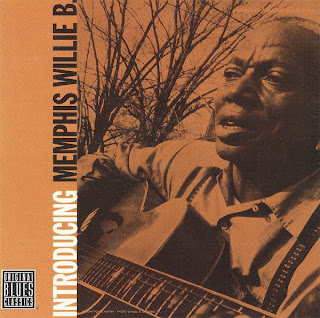
Memphis Willie B., as he was generally known, was one of those forgotten bluesmen who had dropped out of music, then got a second chance at a career as white America rediscovered the blues in the 1960s. He had begun his career as an ensemble harmonica player in jug bands, notably the Memphis Jug Band, but when he added guitar to his repertoire he began playing solo, working around Memphis and up and down the Delta, playing with Robert Johnson and Rice Miller (Sonny Boy Williamson II) among others. He made it to New York in 1934, where he recorded for Vocalion accompanying fellow Memphis Jug Band performer Hattie Hart.
He joined the Army during World War II, and saw action in North Africa and Italy, then finished up his army duties as the driver for a colonel in the quartermaster corps, where his actual main job was playing the guitar and entertaining the troops. After the war, though, he found he hadn't much of a career to pick up, as his old style didn't mesh well with the new rhythm and blues, so he gave up on music, and thus it stayed until 1961, when Sam Charters, in Memphis and still blazing a mostly lonely trail rediscovering the classic blues musicians, got into a conversation with Will Shade of the old Memphis Jug Band, and Shade told him about a blues singer from the old days whom he'd run into a couple of weeks previous:
His name's Willie B....that's what we call him. He's one of those real hard blues singers like you're always asking about.
Willie B. was invited to a Saturday night gathering at Shade's. Charters got to hear him play "the real old hard blues," liked what he heard, and got Willie into a Memphis recording studio.
It was a long session, yielding enough material for two LPs. Borum drew on a range of material. It included many original blues, some dating back to earlier times. "Overseas Blues" was written in 1945 while he was still in the army in Italy, in response to a rumor that his unit, which had already seen plenty of action, was to be deployed to the Pacific to engage in the war against Japan.
Others were songs that had entered his repertoire at one time or another. "Every Day I Have the Blues" had achieved considerable popularity in the 1950s with recordings by Count Basie with Joe Williams and by B. B. King, but it's a much older song than that, going back to Borum's heyday in the mid-1930s. It was first recorded in 1934 by Aaron "Pine Top" Sparks of St. Louis, then in the late 1940s by Memphis Slim as "Nobody Loves Me," and with Slim taking the composer credit. The many subsequent versions generally changed the title back to "Every Day I Have the Blues," giving composer credit to both artists. It's likely that Slim picked up the song in the earlier decade, had been performing it ever since, and had made it his own. It's likely, also, that Borum, who would certainly been exposed to a lot of Slim's music around Memphis and the blues circuit that they both traveled, would have been playing the song since way back when.
"The Stuff is Here" is one of that urban genre of blues that playfully glorified drugs. It was written in 1934 by Clarence Williams and first performed by his wife, Eva Taylor. Most of its recorded versions are by women in the "classic blues" style with jazz accompaniment, but Borum does it with harmonica and guitar, and makes his own song out of it.
Sam Charters produced along with Kenneth S. Goldstein, by now heading up the Bluesville label for Bob Weinstock. The two Bluesville albums were called Introducing Memphis Willie B. and Hard Working Man Blues. Willie B. was not afraid to get a little raunchy, and his "Car Machine Blues" was included in Bluesville's Bawdy Blues compilation.
Memphis Willie B.'s first recorded session was to be his last, although he did have a successful career renaissance at blues clubs and festivals through the 1960s, before slipping quietly back into obscurity until his death in 1993. But he seems to have liked what he accomplished on that day. Charters reports that when he listened to the playback, he said:
I was kind of nervous, you know, but that's really the blues. That's the blues just like we were talkin' about.
This is the second Prestige Bluesville session for the Reverend Gary Davis. He was billed for the previous one as Blind Gary Davis, which was also accurate, but his blindness is probably less significant in an understanding of his importance, when compared with (a) his spiritual message, and (b) his tremendous influence on younger blues guitarists, as discussed in my earlier essay.
Probably the best known of the gospel songs that Davis recorded on this day in Rudy Van Gelder's studio is "You Got to Move," a traditional spiritual that had first been recorded in 1944 by the Baltimore gospel quartet, the
Willing Four (not to be confused with a later gospel group, the Willing Four of Chicago). "You Got to Move" is probably best known to modern audiences from the 1971 version by the Rolling Stones, a virtually note for note cover of Mississippi Fred McDowell's 1969 recording. McDowell, in turn, followed a recording of the song by Davis, but not this recording. Davis had done it previously, in 1953, with Sonny Terry. His 1961 version of the song is more uptempo, which actually makes sense. If you've got to move when the Lord calls you, maybe you'd want to move to a rhythm like this. I've included a bonus Listen to One here--the 1953 version with Terry.
Listening to the 1961 Bluesville version, it's easy to tell why so many aspiring young guitarists made that pilgrimage to Harlem in the 1950s-1960s to study with, or at least get a few pointers from, the Reverend. His guitar sings, it rings, it talks, it moves. And that's true of every song on this album. Given its best possible showcase with the recording genius of Rudy Van Gelder, we can hear every nuance of one of the blues guitar masters.
The songs are mostly traditional gospel songs or original compositions by Davis, and if you had to guess which are which, you'd be hard pressed. His own songs have the depth and the spiritual fervor of songs that have moved the faithful for a hundred years.
The one other modern composed gospel song is "I'll Fly Away," written in 1929 by Albert E, Brumley, and often noted as the most widely recorded gospel song of all time. Most commonly a bluegrass number, it adapts winningly to Davis's blues-gospel style.
"Motherless Children" is listed as "traditional" on the album's credits, but it was recorded in 1927 by Blind Willie Johnson, and may well have been written by him, at least in its current form. Other sources list Johnson as composer. It has also been widely recorded, though not nearly as widely as "I'll Fly Away." Bob Dylan, Steve Miller and Eric Clapton are among modern rockers who have taken it on. Rosanne Cash, Ralph Stanley, Lucinda Williams and others have done it from the country/bluegrass/Americana side. It's another one that was first done on the 1953 Stinson album with Sonny Terry.
And I like the cautious hope expressed in "There's a Bright Side Somewhere" and "I'll Be All Right Someday."
The Bluesville album, produced by Kenneth S. Goldstein, was called A Little More Faith. "You Got to Move" and "I'm Glad I'm in That Number" were released as a 45 RPM single.
This was Willie Wilson's only recording session. He had played in Dizzy Gillespie's big band, but had not recorded with them. He would die not long after this session was recorded. The 1961 session was originally recorded for Jazzline, but the label folded before the album could be released. It would come out in 1966, under Freddie Hubbard's name, in Europe from the Dutch Fontana label. Prestige released it under Duke Pearson's name in 1970, and Black Lion in 1988 under Hubbard's.
Yeah, there'd be no point in the subsequent releases coming out under Wilson's name. He was dead...and forgotten.
But he was respected enough by his peers to be able to call on some front line talent for his shot at the brass ring. In addition to Hubbard and Pearson, Pepper Adams is on board. So is Lex Humphries, who had been the original drummer with the Art Farmer/Benny Golson Jazztet, and had worked with John Coltrane on the Giant Steps sessions (the tracks featuring Humphries were not included on the album, but did appear on a subsequent album called Alternate Takes). Bassist Thomas Howard is obscure, though he did record again with Pearson.
Maybe Howard was from Atlanta. That was the hometown of Pearson and Wilson. Pearson remembered him:
Willie and I grew up together from kindergarten in Atlanta. We also took piano lessons from the same teacher. We were as brothers and his death came as quite a shock to me.
But no jazz journalist was interested enough in Wilson to probe Pearson for more stories about his friend, so this is all we have. A reputation in Atlanta of 70 years ago, a short time with Dizzy, and this album. I like to look into the lives of wonderful musicians whom fame has passed by, b
The Willie Wilson Sextet cut seven tunes on this August afternoon at Bell Sound Studios in Manhattan. Because this wasn't a Bob Weinstock production, and they weren't frowning om retakes and reusing every scrap of tape, there are several takes of each cut. (We can thank Bell Sound for that, but not for the sacrilege they committed when they closed shop in 1976, and destroyed hundreds of priceless original masters.) Five of the tunes featured the sextet. The two Great American Songbook ballads on the session, "The Nearness of You" (Hoagy Carmichael, Ned Washington) and "Time After Time" (Sammy Cahn, Jule Styne) were a quartet, Wilson and the rhythm section. In both of them, it's just Wilson and the rhythm section, and he shows himself capable of handling the front line on his own. He's warm and sensitive and romantic, and he swings.
But I really loved the sextet numbers. How could you go wrong, with Freddie Hubbard and Pepper Adams joining you? The format is your classic bop small group, ensemble playing on the head, solo solo solo, then the ensemble again. You know, that old cliched format that John Lewis killed off, and Miles Davis killed off, and John Coltrane killed off, but no one has ever really been able to kill off, because it can be a template for such wonderful music.
Pearson ("Miss Bertha D. Blues," also known as "Number 5"). Adams ("Apothegm") and Wilson ("Blues for Alvina") all contributed tunes to the session, and they also used the composing talents of Tommy Flanagan ("Minor Mishap," which has become something of a jazz standard) and Donald Byrd ("Lex"). but for my "Listen to One" I'll give you "Blues for Alvina," and Wilson's one chance to shine as composer before an early death and undeserved obscurity.
If you want to listen to more than one, which I strongly recommend, it takes some digging. "Willie Wilson Sextet" finds nothing, either on Spotify or YouTube. A search for "Willie Wilson Quartet" will take you to the two quartet numbers. You can find everything from the Prestige album on either Spotify or YouTube by searching "Duke Pearson Dedication" or "Duke Pearson" and the individual songs. Some searching under "Freddie Hubbard" and individual titles on YouTube will get you to the Black Lion cuts, though not necessarily all of them--each tune except for "The Nearness of You" and "Time after Time" is represented by two different takes. Or, as always, buy the music. The Prestige album is still readily available, and the Black Lion album is findable.
Fred Norsworthy, who engineered the session, is listed as producer on the Prestige release, titled Dedication! Black Lion founder Alan Bates gets producer credit for the Black Lion rerelease, called Minor Mishap. The European release on Fontana was titled Groovy!, so two of the titles included exclamation points.
It's very easy, as a fan who's become a student of Prestige's history, to think Wow, everyone who is anyone has played on a Prestige record at one time or another. But of course that's not true. There are are lots of the all time greats who have never recorded for Prestige. But just as you resign yourself to that, another name from your bucket list pops up. And lo and behold, it's Zutty Singleton. The drummer who anchored Louis Armstrong's Hot Five after Baby Dodds left. The drummer on "West End Blues." And the drummer who kicks this ensemble along smartly, especially on a tune written for him, "Brush Lightly" (one of his specialties, but that's not all he does).
And he's in good company here, for a session that completes the LP project begun by Cliff Jackson's Washboard Wanderers. Wellstood and the gang also have a colorful name, if not quite as colorful: Dick Wellstood's Wailerites. For the Wailerites, Herman Autrey and Sedric are both new to Prestige, and both made their first entry into the big time with Fats Waller. And how did they get from there to Prestige? One never knows, do one? And they can play jazz, and they can play the music the way Wellstood wants it played.
And how are we to describe what that music is? Well, given what Wellstood had to say about it:
You see, there are really two musics--the one the musicians think they are playing and the one the audience thinks it is hearing.
I'm almost afraid to say anything at all. Wellstood's Wailerites are closer to the tradition established by Coleman Hawkins and other Swingville labelmates than they are to Cliff Jackson and the other side of this record. Jackson and his bandmates could have come right out of the 1930s, or even the 1920s. Wellstood and his group are in that Swingville style--musicians who've listened to bebop, and absorbed what it has to offer, but who have chosen not to play it.
Wellstood probably couldn't go back to the music of the 1920s even if he wanted to...not that he wasn't musician enough. For one thing, when the guys in his band were busy making their mark with Fats Waller and others, Wellstood was busy being born. Born in 1927, he was seven years younger than Charlie Parker, a full decade younger than Dizzy Gillespie. And he was living proof that bebop wasn't the only way to be inventive. As guitarist Marty Grozs described him, he “was always doing these little things that were going against the grain.”
On this album, or one side of an album, he plays three tunes, two his own compositions and one, "Yacht Club Swing," credited here to Herman Autrey, but in other places to Autrey, Fats Waller and J. C. Johnson. It was first recorded by Waller and Autrey in 1938, and there had only been a couple of other recordings before Wellstood; it has since become something of a standard for trad bands, especially ones with an international flavor.
Although Wellstood was frequently compared to Waller, and although here he uses two Waller sidemen to excellent effect, he did not particularly like the comparison. His idol had been stride pianist James P. Johnson, and he preferred to say he was playing in the style of Johnson. But the truth is, he has his own style, rooted in stride, but not bound by it. Listen to variations on stride, and the improvisations on the melody, that he runs through in "Yacht Club." The earlier musicians, bound by the limitations of 78 RPM, made brevity a virtue: Waller's recording of "Yacht Club" is three minutes of sustained brilliance. Wellstood is able to open it up to seven minutes--more room for solos all around, more room for exploration, and Wellstood's Wailerites take full advantage of it.
Wellstood played with Odetta, played with Bob Dylan, and also took a ten-month break from performing to practice law (yes, he had a law degree). But he came back to the keyboard. ''The firm liked my work, and I could have stayed there,'' he told John S. Wilson of the New York Times. ''But I realized that all those years in music had ruined me for something like the law.''
Going back in time, to pick up a session I had not been able to find at the time: Willis Jackson with his original partners, Jack McDuff and Bill Jennings.
Conguero Buck Clarke makes an interesting addition to this version of the Jackson group. Clarke, born and raised in Washington, DC, is not a percussionist in the Latin tradition--perhaps more Afrocentric. He contributes strongly to the group's sound, particularly on the showpiece of the session, the ten-and-a-half-minute "Keep on a-Blowin'." Jackson, of course, made his reputation as a hard-blowing rhythm and
blues tenor man, with titles like "Blow, Jackson, Blow." The classic honking tenor instrumentals of rhythm and blues were cut for the 78 and later 45 RPM jukebox market, and their intensity was tailored to three minutes and generally one soloist. "Keep on a-Blowin'" is very different from that. There's enough blowin' by the Gator, with some solid fills and call-and-response by McDuff, to make for a very satisfactory two-sided 45, and in fact Prestige did release one. But there's more, and appropriately so, with two sidemen as good as McDuff and Jennings. In fact, the over ten-minute cut is more or less divided into thirds, with Jennings soloing in the middle and McDuff at the end. I don't know how the tune was edited for the 45 RPM release, but they certainly could have done it the way it was done on Bill Doggett's classic two-sided "Honky Tonk": tenor sax solo on one side and guitar on the other.
Rudy Van Gelder keeps Buck Clarke's conga beat prominent throughout the number, and it's a welcome addition. Even with Ray Barretto's work on a number of recordings for Prestige and other labels, hand-propelled drums were still a rarity in jazz, and were rarely thought of in any context other than Latin music, which is why Buck Clarke didn't get a lot of dates.
A fact acknowledged by Clarke in a 1988 interview, looking back on his career. He had fallen in love with the congas early, and had never been tempted to switch to a more popular instrument.
The interview, by James Graves, and now posted on YouTube, gives another fascinating look into a less-known life in the jazz business. Clarke, born and raised in Washington, DC, went to work as a young teenager for a man who owned a sign company, and was Duke Ellington's cousin. His boss used to play jazz records for him -- the Duke, of course. and Oscar Peterson. "Then Dizzy Gillespie, and I was hooked."
The hook was sunk in deeper when his boss played him records of Gillespie with Chano Pozo:
and knew I wanted to play percussion. Something spiritual happened to me, as though someone had said to me “this is what you will do.” It was tough, because there was little or no interest in bongos or congas for jazz at that time [the late 1940s].
Clarke started out playing the black vaudeville circuit, known at the time as "jig shows," then started to get gigs around the DC area with dance bands who wanted to include a few rhumbas -- this was before the mambo and cha-cha craze. On one of those dance gigs, with a band called Wesley Anderson and his Washingtonians (not Duke Ellington's Washingtonians), he found that the band was to be augmented by a guest star:
I was excited to be asked because they had some great musicians in that band, including Eddie Jones who had played for several years with Count Basie. But I was really excited when I found out who else had been hired for that one gig—Charlie Parker.
Bird and I hit it off right away. There were even moments on the stage when it was no one but me and him playing. It didn’t get recorded, but it’s recorded in my head, and it will be until I leave this world.
I never saw Bird again, but in my mind I could hear him telling me, OK, kid go for it. You got it, now go for it. So I hit the road.
Clarke hit the road, playing his congas and bongos, playing everywhere someone would let him, still resisting the temptation to switch instruments:
And still I had people asking me, “When are you going to play a real instrument? You want to play jazz, you need to pick up a saxophone or something.” But for me, playing percussion was like touching the earth.
A highlight of those days included a gig with Arnett Cobb when he was 19 or 20, where he says he really learned how to play with a band, and finally arriving in New York, where he got a chance to play with Art Blakey and the Jazz Messengers.
Clarke made an album for the tiny Offbeat label in 1960, and two more for Argo in 1961 and 1963, but as far as getting called by name jazz musicians went, the Willis Jackson gig was pretty much of a one-off. But when a new decade rolled around, and percussion became the staple of jazz music that Clarke had always predicted it would, things changed, He recorded in the 1970s with Les McCann, Cannonball Adderley, Jimmy Smith, Herbie Hancock, Freddie Hubbard, Nina Simone, the Isley Brothers, John Mayall and others.
The session, produced by Esmond Edwards, ended up all over the place, which is probably one reason that it didn't create much of a calling card for Clarke. "Sportin'" (by Jackson and Jennings) and "Where Are You?" went to Cookin' Sherry. "Keep on a-Blowin'" (Jackson and McDuff) went on Cool "Gator." "This Nearly Was Mine" was on Blue Gator. "It Might as Well Be Spring" and "This'll Get to Ya" were on Together Again!, which had put together leftover tracks from various sessions, and was released in 1965, after Jackson, Jennings and McDuff had gone their separate ways. "Dancing on the Ceiling" was held off until 1966 and Together Again, Again!
"Keep on a-Blowin'" was one two-sided single, and "This'll Get to Ya" was the other.
Esmond Edwards and Oliver Nelson put Etta Jones together with a string section over three recording sessions. The first one had been back on June 9. This one was followed by another three days later.The string sections were anonymous; the other players, except for George Duvivier on the bass, are all new from the June session. A reed section is added, and the two French horn players from June are cut down to one.
This French horn belongs to Ray Alonge, mostly a classical musician (he was first chair in the Indianapolis symphony while still in high school), but with some impressive jazz credentials too: Louis Armstrong, Miles Davis, Quincy Jones, Dizzy Gillespie, Milt Hinton. And going farther afield, he played on recordings by Elvis Presley, the Beatles and the Rolling Stones.
Female singers with strings became a thing after Billie Holiday did it, and it generally wasn't a bad thing, if not necessarily a good thing. In this case, with Oliver Nelson arranging and conducting, the results are good. Jones veers toward the Billie Holiday side of her personality, which is probably understandable, since Holiday more or less set the template for jazz singers with strings.
One song from the July 25th session, "You Better Go Now," is associated with Holiday, and Jones would record again in 2001, on her last studio album, A Tribute to Lady Day. Interestingly, the 1961 version owes a lot more to Lady Day than the later version. She also recorded it in 1994 with Benny Green, the pianist--not to be confused with Bennie Green, the great trombonist, or Benny Green, the British saxophonist. The song had originally been performed in 1936 as part of the Broadway revue New Faces of 1936 (the only new faces of note were Imogene Coca and Van Johnson), but it had not broken out as a hit, and was never recorded again until Holiday found it in 1947.
"And This is My Beloved" is another interesting choice, perhaps dictated by the orchestral instrumentation. From the Broadway show Kismet, it never achieved quite the breakout status of "Stranger in Paradise" or "Baubles, Bangles and Beads," but it's had quite a life as a vehicle for pop singers with operatic ambitions like Jim Nabors or Jackie Wilson (granted, quite a range of styles there) or opera singers with pop ambitions like Richard Tucker, but one thing hasn't particularly beem is a vehicle for jazz singers. or jazz instrumentalists (with one odd exception--Sun Ra). Jones basically sticks to the melody, but she has some nice jazz-tinged phrasing, and it makes for a satisfactory outing,
"Unchained Melody," from the July 28 session, is another unusual choice, although not so unusual when you consider how popular a choice it was, and has become, From the soundtrack of a 1955 grade B movie, it attracted twelve different reco
Dating from 1955, it is one of the most popular songs of all time,, with over 450 versions (and if you think that the mid-1950s were so rock 'n roll dominated that a ballad didn't have a chance, think again. "Unchained Melody" isn't even the most-recorded ballad of 1955; "Cry Me a River" beats it out). It's been recorded by pop singers, rockers, country singers, almost everyone except jazz singers, although one of the biggest hit versions was by Al Hibbler. Even in the hands of an Al Hibbler or an Etta Jones it's not exactly a jazz tune, but Oliver Nelson's string arrangement is one of his most interesting, and Jones works with it in inventive and creative ways. There may not be a whole lot you can do with improvisation on "Unchained Melody" with strings, although Jones makes some interesting choices, but there's a lot you can do with dynamics, and there she comes through.
"Unchained Melody" was the 45 RPM single. On the other side was "Hurry Home," written by Buddy Bernier, Bob Emmerich and Joseph Meyer, not a well-known tune (I'd never heard it before), but a good one. It had been a hit for Kate Smith in 1938, and Ella Fitzgerald recorded it on Verve in 1957. Jones and Nelson give this one a jazz reading, and a good one--I like her version better than Ella's. The album was called So Warm.
Listening to Prestige Vol 4, 1959-60, now available from Amazon! Also on Kindle!Volumes 1-3 are also available from Amazon.The most interesting book of its kind that I have ever seen. If any of you real jazz lovers want to know about some of the classic records made by some of the legends of jazz, get this book. LOVED IT.– Terry Gibbs
Lightnin' Hopkins may have produced more blues recordings than any other artist.
Partly, this was because he lived and recorded in the LP era. If Blind Lemon Jefferson had been brought into the studio, as Hopkins was, to record whole albums worth of music on the same day, he might have recorded more. Lead Belly died in 1949, before the LP era, which I knew without thinking about it, but I've only seen LP releases of his music, so this actually comes as a little surprise to me. His voluminous recordings for the Library of Congress were released as LPs. But because of his prison time, Lead Belly's recording career was relatively short.
There was a perfect convergence for Hopkins. He lived in the LP era, he lived a long time, he managed--unlike Scrapper Blackwell, for example--to keep himself in the public eye and in the recording studio. But there's another reason why one musician recorded output is plentiful while another's is sparse.
Like Jefferson and Lead Belly, and others who recorded a lot, he knew a lot of songs.
And this is significant. Obvious, if you think about it. But there are reasons why -- in blues, in rhythm and blues, in country, in rock and roll--you see so many brief careers, or one-hit wonders. There are other reasons, early death being right up there. Or addiction, or bad career choices, or prison. But an important reason is simply not having enough songs. You see it a lot in the doo-wop groups of the 50s, groups like the Penguins, whose "Earth Angel" is one of the most beloved and popular recordings of the era, but who never had another hit. And often, if you follow the careers of these groups, as Marv "Unca Marvy" Goldberg has, you discover that these one-hit groups made a number of other recordings, often moving from label to label, trying to catch that lightning in a bottle again. And if you listen to a few of these other, less successful recordings, you often discover that these singers really only had that one idea. That one spark of genius that produced a great harmonic idea wedded to a great beat--and the rest were imitations of that one spark.
Hopkins was as prolific as he was because he knew a lot of songs, because he could improvise moments of his life into song, and because he was subtle. The twelve-bar blues is a constant form, but Hopkins's lyric gifts were such that he could craft a lot of stories, and his variations on guitar licks and vocal approaches made each song a new experience.
This session for Prestige is a perfect example of that. It's just him and an acoustic guitar, which means he can set (and vary) his own tempos. He starts with two songs by others, "Buddy Brown's Blues" by his cousin Alger "Texas" Alexander, and the rhythm and blues standard "Wine Spo-Dee-O-Dee" by Stick McGhee. The lyric is mostly same, let's all get together and drink some wine, but the acoustic accompaniment, and Hopkins's introspective vocal styling, give it a very different feeling.
The rest are listed either as "Traditional" or by Hopkins, and it's sometimes hard to tell where the distinction falls. Some of the songs are little slices of Hopkins's life, like his ride on a DC-7 (His mama says "Son, you almost been to heaven." He says, "What you mean, Mama?" She says "Son, you been ridin' that high-flyin' DC-7.") "My Grandpa is Old Too!" is part sung, part spoken--a tribute to his grandpa who has "been takin' care of me ever since I was a boy," and who now deserves a little peace and quiet, not to be bothered. It's not sentimental wallowing like Eddie Fisher singing the English language version of the German song about my Papa who was so wonderful. or hero worship like Randy Travis thinking that his grandpa walked on water. It's the blues, and the blues are about how things are. And it's very moving.
"Beans, Beans, Beans" is jointly attributed to Hopkins and Traditional, which is really a little odd, since all these traditional songs are given alterations and tailored to fit Hopkins. This one is a mixture of song and story, mostly story, about working in the fields, and I would guess that the traditional part is the smallest. "Goin' to Dallas to See My Pony" run is listed as traditional, but it's new to me. But as I said, Lighnin' Hopkins knows a whole lot more songs than most people.
Houston folklorist Mack McCormick and Kenneth S. Goldstein produced. Since the session took place in Houston, so Hopkins needed no DC-7 to get to it, that probably means McCormick did the hands-on producing, which mostly meant getting a mike and sticking it in front of Hopkins. Well, nothing is ever that simple. But simplicity was the key here, and Hopkins nailed it.
Blues in My Bottle was the title of the album. "Sail On, Little Girl, Sail On" and "Death Bells" were the 45 RPM single.