Tad Richards' odyssey through the catalog of Prestige Records:an unofficial and idiosyncratic history of jazz in the 50s and 60s. With occasional digressions.
On the session index, this is listed as the Prestige All Stars, the first but not the last time this designation would be used. Presumably, a bunch of contract players were rounded up for the Fridays at Rudy's session, but none of them were specifically signed on as leader, so they let the producer (can't find out who produced this session) select the tunes and organize the session.
Not sure how this differs from other sessions. Did they tell Hank Mobley, "Hey, we want you to put together a combo for a recording session this week -- oh, but you'll be using Watkins and Taylor"? Or maybe these were all basically Prestige All Stars sessions, but only now did they decide to call it that. Presumably the leader would bring in the tunes, or most of them. In this nominally leaderless session, they included a tune that was composed by a contemporary jazzer who's not on the session: Kenny Drew's "Contour." Probably Jackie McLean brought it in--he had an affinity for the tune, had played it just recently on one of his 4, 5 and 6 dates (Donald Byrd was on that session, too). In any event, it's a fine tune, and more people should record it, and actually, several have.
Certainly, McLean must have brought "Dig" to the session, given that it's his composition, even though Miles grabbed the composer credit for it, and whatever royalties it accrued, but this is jazz, so there probably weren't many, as McLean was told when he looked into suing Miles -- it wouldn't be worth it.
"The Third" is a Donald Byrd composition, so one figures he brought it in. He probably also brought "'Round Midnight," since he's the only horn on that track. Art Farmer takes "When Your Lover Has Gone" on his own, so it's likely his choice.
"Dig" is the centerpiece of the album, at nearly 15 minutes. I was interested to see how it compared to the version that was laid down the day Jackie first brought it into the studio to record with Miles and Sonny Rollins. The Davis-Rollins-McLean version is more melodic, the Prestige All Stars more intense--and at this length, that intensity has to be sustained, and it is. All the soloists are powerful. I started to try to name a favorite, but I can't.
However far afield an improvisation goes, if there's going to be enough meat to sustain it for 15 minutes, it's got to be a very good tune to start with, and "Dig" is. I'm surprised it hasn't been covered more often.
When the album was actually pressed and given a cover and released, it was called 2 Trumpets and credited to Farmer and Byrd. A rerelease was again Farmer and Byrd, and called Trumpets All Out, and a much much later rerelease just had Byrd's name above the title, which was House of Byrd.
For the rest of the summer, Fridays at Rudy's is scaled back to one session a week, and Hank Mobley is back for this one, with partly changed supporting cast -- Doug Watkins and Art Taylor are still there, and still showing why they're there--Art Taylor's playing on "Message From the Border" is one of the major highlights of this session.
Kenny Dorham was an active presence on Prestige recordings in 1956—with Tadd Dameron in March
and Phil Woods in June. He would be back again with Gil Melle in August.
Barry Harris had perhaps decamped for Detroit, because Walter Bishop, Jr., is here on piano. I had wondered if Harris might have left a couple of songs to remembered by, since two of the cuts fro this session are credited to "Harris" as composer, but it turns out to have been two other guys. "These Are the Things I Love" has lyrics by Lewis Harris, and for all I can discover this may have been the only song he ever wrote. The lyrics actually aren't much, but the melody is what counts to a jazz player,
and the melody is a nice one. It's by Harold Barlow, who parlayed his music knowledge into a second career as a consultant on plagiarism. Since one of his clients was George Harrison, you have to wonder how good at it he was.
The other Harris was Benny Harris, who wrote "Crazyology." He has some excellent jazz credentials, including being the guy who convinced Dizzy Gillespie to partner up with Charlie Parker. As a composer, he was favored by Parker, and as a composer, he seemed drawn to the "ology" suffixes. He also wrote "Ornithology" (who knew what wasn't a Bird original?)
So let's get back to Walter Bishop, Jr., whose father. Walter Bishop, Sr., was no slouch as a composer either, with tunes including "Jack, You're Dead," a number one hit for Louis Jordan in 1947, the year that his son got out of the army and into his first gig with Art Blakey. Bishop survived heroin addiction to become an important educator as well as a significant jazz musician. He studied at Juilliard with Hall Overton in the 1960s, taught music theory at several colleges, and wrote a book on jaazz improvisation, A Study in Fourths. He can be seen explaining his theory of fourths in some excellent videos, available on YouTube.
This was Mobley's second Prestige album as leader, and was titled Mobley's 2nd Message (somewhat more formally, on rerelease, as Hank Mobley's Second Message).
Here's something I wrote a few years ago. It's from a series of poems about a young woman, the daughter of an obscure jazz musician, who has left her husband and is trying to understand who she is, finding much of that understanding in jazz.
THE WEATHER CHANNEL
A front of warm air reached our region around
noon today. During
the
afternoon, it will ooze on in,
probe
with sticky, eighty degree fingers,
so
that, she supposes, she could drive
in
and out between yesterday’s clammy cold
and
the oozing certainty of muggy heat,
like
a county with local option on daylight saving,
or
the sound from her rain-drenched speakers,
a
few bars of Hank Mobley’s reassuring bebop,
then
silence. She imagines the missing solo,
how
Walter Bishop might have picked it up,
brought
it to where the sound kicks in again.
Kenny
Dorham is a harder read. Lost,
she
moves inside to the weather channel.
The
front is squatting now, threatening
impossibly
heavy storms – or did he say
possibly
heavy storms?
A guy calls,
she
met him last week. He just wants
to
make sure she has candles on hand.
Hurricane
lanterns are better. She asks him if
he
could fill in the missing parts of a Hank Mobley solo.
Hank Mobley is mostly associated with Blue Note, but he did show up for a handful of Prestige sessions in 1956, starting with Elmo Hope in May, and continuing on into the summer, including two sessions as leader, this being the first.
He shows a healthy respect for the classics here, from pop and particularly from bebop, choosing tunes by Rodgers and Hart, Bud Powell, Thelonious Monk and Charlie Parker--and two of his own compositions, which shows a healthy ego. Neither "Minor Disturbance" nor "Alternating Current" have become jazz standards, but Mobley did go on to become a composer of some note.
Monk composed "52nd Street Theme" in 1944, when 52nd Street was the nerve center of bebop, and Mobley was 14 years old. Powell composed "Bouncing With Bud" in 1946, the year that Mobley took up the tenor saxophone--late, for a guy who mastered it as fully as he did, and almost by accident. He had played the piano before that, as had his mother and grandmother before him, but when he was 16 he was housebound for several months with an illness, and an uncle gave him a saxophone to occupy his time.
He picked it up very quickly -- by 19 he was working with Paul Gayten's rhythm and blues band, and as yet another demonstration of how good those R&B bands of the late 40s and early 50s were, this one included Cecil Payne, Clark Terry, Aaron Bell, Sam Woodyard and Walter Davis, Jr. And young Mobley stood out even in that all-star aggregation. Recalling those days, Gayten said, "Hank was beautiful, he played alto, tenor and baritone and did a lot of the writing. He took care of business and I could leave things up to him." The tenor sax solo on Gayten's recording "Each Time" may or may not be Mobley--opinions differ.
By 1951, when Bird wrote and recorded "Au Privave," Mobley was a full-fledged member of the elite jazz community--not bad for a late starter. He and Davis were backing jazz stars like Miles Davis, Dexter Gordon and Lester Young as the house band in a Newark jazz club, and one of those visitors, Max Roach, hired the two of them and brought them to New York, where Mobley's gigs included bebop heaven -- Minton's, as part of a Horace Silver-led house band which also included Doug Watkins.
So with tunes by Monk, Bud, and Bird, Mobley embraces bebop in this session, though he was later to become known as the pre-eminent hard bop tenor player--a distinction which I don't particularly care to recognize, as I've made clear before. But that's OK, I don't particularly care to recognize a firm distinction between bebop and rhythm and blues, either.
It's great to hear these classic tunes brought into the framework of a straight-ahead Prestige jam session, particularly "Au Privave." It's always good to be reminded of what an amazing artist Bird was, as composer as well as soloist.
Mal Waldron may have had other plans, because Barry Harris is in as the piano player for this second
July 20th session. Harris would eventually settle in New York, but in 1956 he was on loan from Detroit's jazz hotbed, and among the places I'd go to if I could time travel, Detroit's Blue Bird Inn in the 40s and 50s would be high on the list. Harris is solid throughout, and contributes some hot solos.
Prestige released this session as Mobley's Message,and it's billed as the Hank Mobley Sextet, though it's only a sextet for "Au Privave," when Jackie McLean joins the group. And Donald Byrd drops out on "Little Girl Blue," making that a quartet number. It was later rereleased as Hank Mobley's Message, perhaps so no one would confuse the tenor player with Miss America Mary Ann Mobley.
But then...do they seem to be saying that jazz is an undemanding sort of music, so you can put it on as background while you're studying, and that makes you smarter? I couldn't exactly swear to it. I didn't quite read the article all the way through. Maybe I'm not smart enough. So I should listen to more jazz.
And more creative? Absolutely. I always listen to jazz when I write this blog. But maybe I'm not a representative sample. As Etta Place told Butch Cassidy and the Sundance Kid, "your line of work requires a specialized vocabulary."
But I am listening to jazz at the moment, and I am writing, and it's another Friday at Rudy's, and once again the day begins with Breakfast with Jackie, and the same quartet: Mal Waldron, Doug Watkins, Art Taylor.
And once again with a ballad. "When I Fall In Love" was written by Victor Young, who is best known for writing lush movie scores like Around the World in Eighty Days, but who actually had something of a jazz connection, which probably shouldn't be surprising, considering the wonderfully tangled family tree of American music, and which leads me to a convoluted digression, which also shouldn't be surprising, because listening to jazz has made me creative. Young's first big break was something of a reverse spin on jazz, when he was hired by bandleader Isham Jones to take an uptempo jazz number and rearrange it as dreamy ballad. The tune was Hoagy Carmichael's "Stardust," and one would have to say the rearrangement was a success.
It led to Young's being signed by Brunswick records to record more dance music. The recordings were strictly for squares, featuring waltzes and semi-classics, but he was able to give employment to up-and-coming jazz musicians like Bunny Berigan, Tommy Dorsey, Joe Venuti and Eddle Lang. His Wikipedia entry mentions that one of his most interesting recordings of this period was "Goopy Geer (He Plays the Piano and He Plays By Ear," composed and performed by Herman Hupfeld, who also wrote "When Yuba Plays the Rhumba on the Tuba." Oh, and a little thing called "As Time Goes By."
Back to "When I Fall in Love," which has the syrupy quality one might expect from the composer of "Around the World in Eighty Days," but also seems to have the jazz possibilities one could expect from the employer of Berigan, Dorsey, Venuti and Lang, not to mention the Boswell Sisters and Lee Wiley. At any rate, it has a remarkable jazz pedigree, with recordings by any number of the giants. Here it's given a rendition that's less reverent than McLean's "Sentimental Journey," and hits just the right tone for the material. Great stuff.
"Abstractions" is one of Mal Waldron's first recorded compositions, and he would go on to establisn himself as a significant jazz composer, best known for John Coltrane's "Soul Eyes."
As with the previous Friday, McLean roped in a couple of the cats who were on tap for the next session: Donald Byrd, who had sat in with them the previous week as well, and Hank Mobley, new to the Fridays with Rudy gang. So what do you play if you're getting together for a jam session? How about Charlie Parker? With musicians like this, and a tune by Bird, you can't miss.
This is billed in the discography as a sextet session, even though only one track features the sextet. That track is also the "6" in the title of the album that conjoined the two Fridays: Jackie McLean -- 4, 5 and 6. It was released on both Prestige and New Jazz.
Art always involves a series of contracts or promises between artist and audience, and that is particularly true in the narrative arts like literature or music, when one momentary experience follows another in time. The reader of a poem is always going to read the first line first, then the second, then the third, and so on. If a poet writes a line in iambic pentameter, he's making a promise to the reader that the next line will also be ten syllables long, with an accent on every other syllable. If someone strikes a bluesy chord on the guitar and sings a line, he's promising that he'll sing the same line over again, and follow it with a line that rhymes. If someone starts playing a blues in B-flat, the promise is that the notes that follow will be consonant with the key of B-flat.
Sometimes these promises are strictly kept. Boudleaux Bryant, who wrote (with wife Felice) most of the Everly Brothers' hits, believed in whole rhymes, and obvious rhymes, because, he said, them made the listener a sort of co-composer. If you listen to
There goes my baby, with someone new,
She sure looks happy, I sure am...
...you can sing the end of the line before you even hear it.
Other times--and this is what makes art so exciting--the promise is broken. T. S. Eliot famously broke one at the beginning of "The Love Song of J. Alfred Prufrock," when he promised the reader a tetrameter line, rhymed couplets, and a dreamy romanticism with
Let us go then, you and I,
When the evening is spread out against the sky
and then he breaks all three of those promises with
Like a patient etherized upon a table.
If you break a promise, you have to break it with purpose. not like the young saxophone player who jumped up on the Jazzmobile stage in New York and wanted to jam with Frank Foster. Foster graciously welcomed him, and called for a blues in B-flat. The young guy burst into a cacophony of yawps and screeches.
"What are you doing?" Foster asked.
"I'm just playing what I feel."
"Well, feel something in B-flat, motherfucker."
The beboppers would famously promise a romantic ballad from the Great Americam Songbook, then break that promise by upping the tempo as they began to improvise, playing it, in Chuck Berry's words, "too darn fast," and "changi[ing] the beauty of the melody until it sounds just like a symphony."
And that broken promise became the promise, one that the fan who really had no kick against modern jazz came to expect.
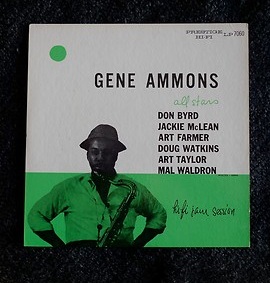
And so it is with Gene Ammons, on the second session of this Friday at Rudy's. Jackie McLean is still there, and so is Donald Byrd, and so is the rhythm section. Art Farmer has joined the merry crew.
And on the second song of the session, which is "We'll Be Together Again," Ammons knows that you know he's going to keep the promise to break the promise, so he teases a bit, drawing out notes almost to the breaking point. The song was written by an unlikely contributor to the Great American Songbook: Frankie Laine, with music by his pianist and music director Carl T. Fischer. It's a beautiful melody, one that found its way into the repertoires of some of our finest singers. Ammons, a great ballad player, gives us the beauty of the melody, but the tease is there too. And with McLean, Byrd and Farmer along for the ride, there's plenty of adventure ahead, enough to make ten minutes of wonderful music, coming back in the end to the melody, and Ammons' drawn-out notes.
The session also has "Jammin' with Gene," a version of "Red Top" that allows for fourteen minutes of jammin', and "Not Really the Blues," another Ammons tease, because anything he plays is really the blues. One odd choice: Donald Byrd is identified on the album's front cover (though not the back) as Don Byrd.
This was the beginning of a very busy summer in Mr. and Mrs. Van Gelder's living room. Let's hope they'd gone to Grossinger's for a summer vacation.A core group of musicians was constantly in and out of the studio in shifting combinations--Friday at Rudy's.
The festivities started on Friday the 13th--July 13, 1956--with two separate sessions. Jackie McLean was the nominal leader on the first one, though he played on both.
McLean starts the session with "Sentimental Journey," an interesting choice in that bebop's journeys were rarely sentimental. And it was a tough one to unsentimentalize. Written by dance band leader Les Brown and his arranger Ben Homer, recorded by Brown and Doris Day, it had been a huge hit in 1945, as ir became a sort of unofficial theme song for returning GIs. Only a decade later, as veterans were still having a painful time readjusting to civilian life (and this was not really recognized back then), the painful, bittersweet (at best) nature of that sentimental journey was still very real.
McLean's take on the song isn't sentimental, but it isn't exactly unsentimental, either. He plays it with a feeling for the melody that's not ironic. The improvisations are a little more hard-edged, but still in keeping with the feeling. McLean would have been 14 when the war ended, an age when boys are romantics and secretly hope the war will go on a little longer, so that they can get into it. You outgrow those feelings, but they're always part of you.
Two members of the rhythm section were to become no strangers to the Prestige studios. Art Taylor
already wasn't, having made his label debut in 1954, and having played on nine sessions already. Mal Waldron was making his Prestige debut. Both would go on to appear on a plethora of Prestige albums. In recent biographical material, they are often referred to, respectively, as the"house drummer" and "house piano player" for the label. It's not altogether clear what this means. Alan Dawson has been described as the house drummer for Prestige during part of the 60s, but he says this is nonsense -- they called him for a lot of gigs, but he was never the house anything.
Doug Watkins rounded out the rhythm section, and he was very much a presence on Prestige recordings in those days, too.
Bebop altered the concept of the rhythm session, as drummers like Max Roach, Kenny Clarke and Art Blakey took the beat away from the bass drum and shifted it to the lighter ride cymbal. The bass took over the principal responsibility for keeping the beat, and jazz singers learned to listen to the bass, not the drums, as their guide for keeping the beat. As drummers became virtuosi, bass players like Curly Russell and Tommy Potter, who could provide a solid foundation for the shifting intricacies of bebop, were in demand.
By the 1950s, bass players, though still anchoring the rhythm section, were becoming virtuosi too.
Players like Charles Mingus, Paul Chambers and Oscar Pettiford soloed as Russell and Potter never did.
How much could you do with a bass solo? Listen to Doug Watkins on "Sentimental Journey" and
you'll hear just how much. Watkins's career was cut short by the auto accident that claimed his life in 1962, but he made a lasting mark.
Donald Byrd joined the group for "Contour" (and stuck around for the afternoon session with Gene Ammons, and changed the mood dramatically. "Contour" is full-out bop, with the two horn almost percussive as they chop away at notes.
This session would be part of a McLean album called Jackie McLean -- 4, 5, and 6, covering both the 4 and 5 parts. It was issued on both Prestige and New Jazz.
I'm guessing that not all that many jazz fans have this record in their collections, and those that do not are missing out on a treat.
Maybe Bennie Green never got his due. One website that makes lists and rankings puts him at #31 on its list of greatest jazz trombonists of all time (Bill Harris, who won several DownBeat polls in the early 50s, is #32). A site called The Trombone Forum has a discussion of the greatest jazz trombone recordings of all time, and Bennie Green is not mentioned by anyone.
This is just wrong. But even so, if you were inspired by my earlier praise, and decided to pick up a Bennie Green album. you probably wouldn't choose this one. You might go for the earlier 1956 session with Art Farmer and Philly Joe Jones. Or the one from 1955 with Charlie Rouse and Paul Chambers, or the one that added Candido to that mix. Or you might go back to 1951 and the session with Eddie "Lockjaw" Davis, Art Blakey and Tommy Potter.
In short, faced with a blind choice of which record to take a chance on, you'd go with the chalk--the sidemen you've heard of.
Don't do it. Well, do it. Those are all terrific albums. But don't overlook this one with the sidemen you've probably never heard of.
Look at it this way. For Blakey or Farmer or even a brand new cat on the scene, 19-year-old Paul Chambers, this was another gig. For these guys, it may well have seemed the opportunity of a lifetime--a small group session on Prestige!
I don't mean that these weren't highly respected professionals. Green didn't pull them out of thin air.
Eric Dixon was 26 when this session went down, and he had a long and productive career ahead of him. He went on to appear, by some counts, on over 200 recordings, including some other small group sessions for Prestige/New Jazz in the 60s: Ahmed Abdul-Malik, Kenny Burrell, Etta Jones and Mal Waldron. But his main gig starting around the turn of the decade and going on for two more decades, including many recordings, was with the Count Basie orchestra. His one record as leader came in 1974, for the Master Jazz Recordings label, and featured both Lloyd Mayers and Bill English.
Lloyd Mayers recorded in the 60s, with Lou Donaldson, Betty Carter, Ray Barretto and others. but his big break didn't come until 1974--and no, it wasn't the Eric Dixon album. Mercer Ellington tapped him to fill the Duke's shoes in the Ellington orchestra. He was musical director for the 1981 Broadway production of Sophisticated Ladies, the musical based on Duke's music.
Sonny Wellesley and Bill English don't have the same extensive pedigrees. Wellesley played on a Blue Note session with Ike Quebec, recorded in 1959, a couple of the tunes released on 45, not released in album form till until 2000. He seems to have played in 1961 with Sir Charles Thompson, but they may not have recorded. I can't find any reference to a record.
Bill English (not be confused with Willie Nelson's drummer Billy English) made one record as leader, for Vanguard, which was primarily a folk label, and probably didn't do much to promote its occasional jazz titles. The jazz collectibles website popsike.com lists it for sale under the heading "Obscure jazz drummer Bill English." Lloyd Mayers played on this one, too. Obscure or no, you can find it on both YouTube and Spotify, and it's good stuff.
So perhaps these guys were playing together when Green tapped them, since they certainly seem to have stayed in touch afterwards. They're tight and simpatico on this session.
So if this was an audition for a big time career, they all passed with flying colors--even if, as with today's law school grads and creative writing MFA's, they didn't all get much professional advancement out of it.
The session starts with "Walkin' (Down)," which is better known without the "(Down)" as the Miles Davis classic. "Walkin'" is credited to Richard Carpenter--not the songwriter with the talented sister. This Richard Carpenter was a gonef perhaps rivaled only by Mo Levy, best known for buying songs from hard-up musicians for 25 or 50 dollars and slapping his own name on them. Sometimes he didn't even buy them. When composer-arranger Jimmy Mundy, best known for his work with the Goodman and Basie bands, died in 1983, a copyright certificate was found at the Library of Congress for a tune called "Gravey." The title, and Mundy's name, had been incompletely erased, and "Walkin'" by Richard Carpenter written over them. Junior Mance, who was with him at the time, has also confirmed that Mundy wrote the song and titled it "Gravey."
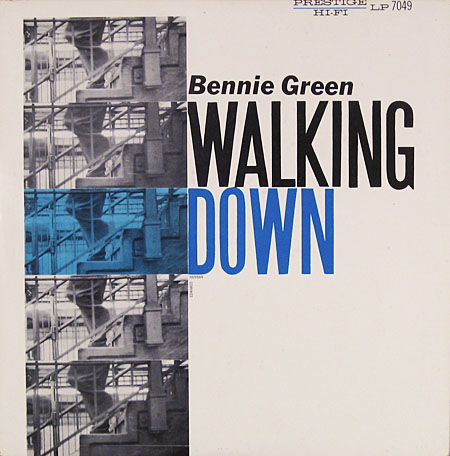
Cover design by Tom Hannan, an abstract expressionist painter
who doubled as a jazz album cover designer.
And this is a good introduction to the session. It begins with a strong drum figure by English, then a short statement of the head by Green, then an extended solo by Mayers. Green is generous throughout with solo space: everyone gets an opportunity to show what he can do. "Walking (Down) is also interesting in that about 3 1/2 minutes into it, the two horns seem to be about to come back to the head and wrap it up, but that doesn't happen. Instead, everything changes slightly, and the piece goes on for over 12 minutes. These shifts of tempo and mood happen a few times during the album. It keeps you on your toes.
There's one Green original on the album, the curiously named "East of the Little Big Horn," which seems never to have been picked up by anyone else. Too bad, good tune. And three standards. A favorite cut? It would be hard to choose. "Walkin' (Down) is a contender: it's always a treat to hear Bennie play the blues. But it's hard not to get caught up in the firestorm of traded licks between Green and Dixon on "It's You or No One."
The album takes away the parentheses, puts back the missing "g," and is called Walking Down.
If Prestige records in general have been underserved by critics and historians, there are exceptions, and this album would have to be one of them. It was released under the title Saxophone Colossus, and if Rollins was still only on the verge of meriting that distinction, this recording cemented the deal. Saxophone Colossus he became, and saxophone colossus he remained, and remains to this day. It became the title of a 1986 documentary by Robert Mugge (half of it filmed at a concert at Opus 40).
The recording has remained to this day a favorite of jazz fans and of Rollins fans. Many consider it his best work, and it ranks high on virtually every list of top jazz albums of all time.
The one track that stands out even in this all-around stellar session is "St. Thomas," which has become virtually a signature song for Rollins. The tune is based on a Caribbean folk song which in tune was based on an old English folk song. It had previously been recorded in a jazz version as "Fire Down There" by Randy Weston, and was a staple of the repertoire of a young calypso singer called The Charmer, who would later become much better known as Louis Farrakhan.
The composer credit for "St. Thomas" is given to Rollins, although he has disavowed that, and has said that he would have preferred not to take composer credit, but the management of Prestige insisted.
Well, we know that composer credit in American popular music is a weird business. Performers added their names to songs that they recorded (Elvis Presley adding his name to Mae Axton and Tommy Durden's "Heartbreak Hotel"). Music industry professionals like Alan Freed and Mo Levy did it regularly, taking shared composer credit, and more importantly, publishing rights, in return for a record deal or the promise of radio promotion.
Jazz musicians wrote new melodies over existing chord progressions, and since chord progressions are not copyrightable, there was no plagiarism issue. Tunes or riffs brought into the studio for recording at a particular session were sometimes given the session leader's name for composer credit, no matter who had brought it in. Often that didn't much matter -- the finished product was a group effort, and the tune wasn't likely to be re-recorded anyway.
Sometimes it did. It seems pretty clear that Jackie McLean wrote "Dig" -- Miles Davis has even acknowledged this -- but Miles has the composer credit. McLean looked into bringing a lawsuit, but was told there wasn't enough money in it to make it worthwhile.
And "St. Thomas"? That is so completely a Sonny Rollins tune that it's hard to imagine giving credit to anyone else.
Latin rhythms have always been a part of jazz, going back to Jelly Roll Morton's assertion that all true jazz needed a Spanish tinge, through Artie Shaw doing the Carioca, through Charlie Parker with Machito and Dizzy Gillespie with Chico O'Farrill, through Joe Holiday's mambo jazz. through the girl from Ipanema and James Moody inviting "Tito Puente you can come on in and you can blow now if you want to." The island rhythms of calypso were getting to be a craze in the mid-50s, as Harry Belafonte's classic album became the first LP to sell a million copies. Rollins's parents came from the Virgin Islands, and he grew up with the infectious island rhythms that he would continue to explore in tunes like "Brown Skin Girl," "Hold em Joe" and "Don't Stop the Carnival." The challenge of "St. Thomas" was to sustain the joyous lilt of calypso with the sophisticated musical demands of bebop, and its enduring popularity shows how how successful he was.
Prestige captured both Rollins and John Coltrane at moment in time when both were becoming recognized as the preeminent tenor saxophonists of the day, and a time when both were getting ready to move on to new stages of their careers. They match up musically and stylistcally on "Tenor Madness;" in the next decade they would have found it difficult to play together.
Coltrane would go his own way. Rollins would stay closer to the mainstream, but still forge new musical paths, in clubs, on record, and under the Williamsburg Bridge, where he was to retreat a couple of years after this recording, dissatisfied with his music and wanting to rediscover himself before he recorded or played in public again.
The new Coltrane was probably not going to be playing "Traneing In" or "Blue Train" on the same set with "A Love Supreme." The new Rollins would still play "St. Thomas," but it would be metamorphosed into the new Rollins.
This is probably one of the advantages of being a jazz musician. The disadvantage, of course, is that you don't make the money a rock star does. But you're allowed to go on evolving. If you're someone like, say, Clarence "Frogman" Henry, then as long as you go on touring you're going to have to keep singing "Ain't Got No Home" every night, and make it sound exactly the way it did on the record. Rick Nelson said that if memories were all he sang, he'd rather drive a truck, but he never did go into truck driving, and his audiences went on wanting to hear "Hello Mary Lou."
Sonny Rollins could play "St. Thomas" differently every time he played it. A friend remembers hearing him with Jim Hall in the mid-60s, and the rhythm had become bossa nova. It could go on changing, reflecting his evolving musical understanding, and still remain a fan favorite.
But the version on Saxophone Colossus remains a jazz icon, preserved on record like Dorian Gray in reverse.
An important part of the reason for the iconic status of the tune, and the album, is the presence of Max Roach, at an amazing midpoint of his amazing career.
Roach was 32, compared to compared to Rollins's 26 (Tommy Flanagan was also 26; Doug Watkins was 22). Those six years encompassed a lot of experience, and a lot of jazz history. He had been one of the pioneers of bebop, playing on 52nd Street and at Minton's, recording (in the days when limitations in recording technique severely limited what a drummer could do) on many of the seminal sessions of modern jazz. With Clifford Brown, he had formed one of the most influential quintets of the early 50s. He had been the natural choice for "the greatest jazz concert ever," the one given at Massey Hall in Toronto in 1953, featuring Roach with Charlie Parker, Dizzy Gillespie, Bud Powell and Charles Mingus.
Rollins and Roach had become partners when Sonny joined the Brown-Roach ensemble, and they continued together after Clifford Brown's tragic death. They are certainly partners on this session, with Roach setting the tone as well as the tempo with his lead-in to "St. Thomas," and remaining a force throughout.
"You Don't Know What Love Is" has become a jazz standard, but it has an odd genesis for a ballad associated with the Great American Song Book. It was originally written (by Don Raye and Gene dePaul) for an Abbott and Costello movie, but was cut from it, and eventually saw daylight in an even less likely debut for a beautiful ballad, a movie featuring the Ritz Brothers. It's one of the other places where Rollins and Coltrane touch base with each other. Trane recorded it in 1961 on his first album for Impulse. Five years was a generation in the jazz of this era, and Trane, with McCoy Tyner, Elvin Jones and Jimmy Garrison, was already exploring new dimensions. This album, Ballads, was his first for Impulse, and he may have been taking a break from the avant-garde to give them something that might sell a few copies, but it still makes a striking contrast to Rollins in 1956.
"Strode Rode" is a riff-derived composition that's become something of a standard, and well-deserved. It's very nearly as catchy as "St. Thomas." Gary Bartz has recorded it, and so have a lot of contemporary jazz musicians, particularly Europeans. Rollins revisited it in 1990, with George Duke, Stanley Clarke and Al Foster.
I wonder if Rollins had known what a worldwide hit song "Moritat" was going to be, if he would have approached it differently. The first statement of the theme is reserved, as if someone had managed to reconfigure Miles Davis's Harmon mute for the tenor saxophone. By mid-improvisation, though, he's found the swagger that one expects from Mack the Knife.
"Blue Seven" has also been covered a number of times, which is interesting in that it doesn't really have a melody or main theme. It builds off a long bass intro by Doug Watkins, and has all kinds of good playing by everyone in the quartet. The title? Perhaps it was a long day in the studio, and they finished up with a seven o'clock blues.
Saxophone Colossus was the album. Two singles were released on 45: "St. Thomas" and "Moritat."
All right, it's mid-1956, which means we are smack dab in the middle of the hard bop era, and I haven't really talked about hard bop, or what makes it different from bebop, or where one leaves off and the other starts, and actually don't really intend to, because I don't know and don't care. There are two pretty standard definitions of hard bop. One is "what the Miles Davis Quintet played," and that obviously isn't much of a definition, but it more or less means the 1955-56 sessions for Prestige, which makes Prestige the quintessential hard bop label. The other definition has to do with getting funky, and mostly centers around Horace Silver and Art Blakey, which makes Blue Note the quintessential hard bop label, which is probably closer to the target.
One definition of the distinction is that bebop is more of a player-centric music, and hard bop a more listener-centric: "players like Diz, Bird, and Monk would play through a tune without playing the "head" first. They approached the music thinking that the listener had already digested the standards of the day and would recognize them by their chord structure. Hard Bop is based more around the melody in that you usually hear the melody at least one time, then the performer(s) will start in on a (usually) technically challenging solo."
And there may be something to be said for that, although musicians of the bebop era who were trying to pull away from it, like John Lewis, were specifically trying to move away from the head-solo-solo-solo-head template, and in a way the hard boppers, or neo-beboppers,were actually coming back to it. But the idea of hard bop being a more listener-friendly music makes sense.
It's a truism of jazz history that jazz went from being America's popular music, in the 30s, to being an art form that was not especially popular in the 40s. And like many truisms, it's mostly true. The musically and intellectually challenging concepts of the beboppers were not likely to go to the top of anyone's hit parade. It's even harder to imagine Snooky Lanson or Dorothy Collins singing "Scrapple from the Apple" or "Moody's Mood for Love" than it was to hear them singing "Sh-Boom" or "Heartbreak Hotel."
But it's less commented on that jazz made something of a commercial comeback in the 50s. It still wasn't challenging Elvis and Fats Domino, or even Eddie Fisher and Connie Stevens, for top 40 ascendancy, but it wasn't scaring people away in droves.
Jazz was still a hipster's music, but as the Eisenhower era moved on, the hipster (not today's gourmet chocolate makers in Brooklyn, but the real hipster) became a more approachable outlaw. Jack Kerouac became the Errol Flynn of a new generation, the buccaneer with a twinkle in his eye, living outside the mainstream, and Charlie Parker and Miles Davis were the Erich Korngold and Bernard Hermann of the Beat Generation soundtrack.
Jazz came to television with Peter Gunn, to Hollywood with Anatomy of a Murder. Steve Allen featured jazz musicians on his popular network show.
Playboy played a big part in bringing modern jazz into the mainstream. Playboy in the 50s offered its readers a shortcut to sophistication, and jazz was a part of that sophistication.
And it worked, for one reason or another. George Wein opened up a new audience by bringing jazz to Newport, Dave Brubeck by bringing jazz to college. Did it make a difference that a lot of white people were playing jazz? Probably. It certainly made a difference to the popularity of what had once been called rhythm and blues. But there weren't any Fabians in jazz. It was essentially a meritocracy. Was Brubeck really better than Oscar Peterson? It's a fair question, and the answer is no, and that's an important answer. The economic story of American music is inextricably tied up with racism. But in another way, it's the wrong question. Here's another one: was Brubeck deserving of the accolades and rewards he got? Yeah, he was. I applaud every dollar that went into Dave Brubeck's pocket as opposed to Dick Cheney's, and people aren't going to forget his music in a hurry.
Brubeck, Playboy, Peter Gunn, the Beats, Steve Allen. In 1955, Billboard reported that jazz was loud at the cash register. And a 1959 album, Miles Davis's Kind of Blue, is by most accountings considered to be the biggest selling album of all time, although it's also considered to be a break from all things bop, although that's a bit of an overstatement.
So, the difference between bebop and hard bop? Maybe it's a generational thing? The beboppers grew up playing big band swing, and for them modern jazz was a revolution...for a younger generation, it was just what they played. Which doesn't explain Art Blakey.,
Or how about this? If it made money, it's hard bop. If it didn't, it's bebop. Or free jazz.
Or how about this? It mox nix. It's all music.
This Phil Woods septet is made up of musicians from either side of the divide. Woods, Kenny Dorham, Gene Quill and Philly Joe Jones on the older side, Donald Byrd and Tommy Flanagan on the younger. So is their music bebop or hard bop?
Two answers. (a) I don't care, and (b) this is the last time I will ever raise that question.
I'm more interested in comparing this session to two others we've listened to recently -- the Sonny Rollins/John Coltrane duet of May 24, and the Elmo Hope Sextet session of May 7. Coltrane stayed around from that session to record with Miles and then with Sonny; Donald Byrd didn't stray far either. And Philly Joe Jones virtually never left the studio.
But it's the horns that mostly hold my interest here. Three of them on the Hope session, four of them here with Woods. You'd think that would require some serious arranging, especially here, with mini-reed and mini-brass sections, but the casualness of the Hope session seems to be the order of the day here, too. Maybe there's something about getting a bunch of musicians together that inspires a sort of collective camaraderie. There's a brotherhood in the Coltrane-Rollins collaboration, but at the same time a competitive edge. They each know what the other is doing, and neither is going to be left behind. Here, as in the Hope session, there's that fluidity. And perhaps as a result, though there's great virtuoso playing, and I mean great virtuoso playing, by all concerned, you're not really going to walk away whistling any one of the horn parts in particular. You might, instead...all right, you can't walk away whistling a drum solo, but Philly Joe Jones gets the real bravura parts.
Cover design by Harry Peck, who did some very nice work for the
British Esquire label releases of Prestige product.
Three of the tunes are Phil Woods compositions. They're vehicles for jamming: none of them has seen much recording by other artists. So it's worth noting how good some of these composed-on-the-spot vehicles for jamming in the modern jazz era were. Each of these has an arresting melody, and each provides a framework for inspired soloing by seven different guys,
'Suddenly It's Spring" is the one standard here, and if you were doing a blindfold test, and were asked to pick out the standard, you might not guess it. The guys here do all the things that give Chuck Berry his kick against modern jazz: they play it pretty darn fast, and they don't worry much about the beauty of the Jimmy Van Heusen melody. They come into it jamming, horns blazing, maybe more than on any of the spur-of-the moment compositions. There's none of the yearning romanticism that you get from the vocal versions, and it's not missed.
"Pairing Off" is the tune that gave the album its title, appropriately referencing the instrumentation.
This is the second half of the Earl Coleman Returns session, with Art Farmer and Hank Jones returning along with Earl. Gigi Gryce is absent, and there are a new bass and drums.
The more I listen to Earl Coleman, the more I like him. I'm hearing a much more modern sound than I did before, and I expect that has to do with me more than Earl. The Mr. B. and Al Hibbler influences are still there, as is probably appropriate from a singer returning from the Forties, but I'm hearing a little Jon Hendricks as well, and maybe a little Joe Williams, Mostly, I'm hearing a distinctive singer.
Gigi Gryce hasn't left the building completely. "Social Call," probably the gem of the session, is a Gryce composition. And there's perhaps a reason for the Hendricks echo. He wrote the lyrics. "Social Call" has become a favorite of jazz instrumentalists and singers alike.
This version of "Social Call" also has beautiful solos by Art Farmer and Hank Jones, and that, I would say, tells you something about Coleman's musicianship.
Wendell Marshall was a veteran of the Ellington band, but I hadn't known his other Ellington connection -- he was the second member of his family to play bass for the Duke. His cousin was Jimmy Blanton. He had steady work as a Broadway pit musician, and was also one of the most sought-after session bassists.
Wilbur Hogan, also known as Wilbert Hogan and G. T. Hogan. like Marshall, could play both bop and R&B, and did a lot of work in the 50s and 60s, until health issues slowed him down..
Nothing from this album on YouTube, but I found "Social Call" here. It is very much deserving of a listen. This is a singer who should not be forgotten.
Gil Melle is probably best known to jazz history as the guy who introduced Rudy Van Gelder to Blue Note's Alfred Lion. The session never made it to wax, but the recording quality was good enough to draw Lion, and then Bob Weinstock, out to Hackensack.
Melle did eventually record several albums for Blue Note, and a few for Prestige, starting with this one, recorded in two sessions. I wasn't able to listen to any of the April tracks, so I'm getting to the whole album here.
Melle was multi-talented, a graphic artist as well as musician.
Album cover art by Gil Melle
His work was shown in New York galleries, and he designed a number of jazz album covers. His career at this time could be compared to that of Pop artist Larry Rivers, but Rivers was an artist first and a jazz hobbyist; Melle's main focus was music, although he also continued to paint all of his life, and he eventually moved to the West Coast, where he launched a successful career as a composer of film and TV scores, including The Andromeda Strain and Rod Serling's Night Gallery. The theme music for the 1970 TV show was the first ever to use all electronic instrument, and The Andromeda Strain, in 1971, was probably the first all-electronic movie score.
This quartet session for Prestige uses all traditional instruments, but listening to it, it's not surprising that Melle would grow fascinated with electronic instruments, designing and building many of them himself, and presenting the first ever all-electronic jazz ensemble at the 1967 Monterey Jazz Festival. He's more concerned, especially in "Dominica," with tonal quality, and at first listen, one wonders if he's trying too hard, and intellectualizing the process too much.
On subsequent plays, however,the music becomes much more rewarding, and the ensemble is remarkable.
It's also a little puzzling. The Jazzdisco set list has Melle playing baritone and alto sax, and Bill Phipps playing bass. But Phipps was a baritone sax man, so it could be that he is, in fact, the one on baritone. If he's not, Melle is double-tracking himself, and given his interest in electronic sounds, that's certainly possible. but I think not likely.
So let's give Phipps the credit for some intriguing baritone sax work, and move on to him, as one of an ensemble of little-known (except for Ed Thigpen) and fascinating musicians.
Except for his work with Melle, Bill Phipps wasn't much of an avant-gardist, although he did once lead a band that featured Grachan Moncur. In fact, he came from a jazz family that was deeply rooted in the tradition. His cousins Ernie and Eugene led a band called the Monarchs of Swing. He and his brother Nat cp-led the group that featured Moncur and Wayne Shorter, and Bill later played with such earthy ensembles as Ray Charles' and Brother Jack McDuff's.
But here with Melle, he understands the demands of the avant garde, and delivers.
Joe Cinderella delivers more than his share, especially on "Ballet Time," my favorite of the set. It also has Melle's strongest soloing.
Where did Melle come up with these guys? Every one of them, it seems, has at least one toe in both the mainstream and avant garde. How avant garde was Joe Cinderella? He worked with John Cage. Avant garde enough for you? He also worked with Warne Marsh. On the mainstream side of jazz, he worked with Conte Candoli, and deeper into the mainstream of American music, he played on sessions with the Beach Boys and Billy Joel. He's pretty much forgotten today, but he's worth seeking out.
Ed Thigpen is certainly the best known musician in this quartet. Mostly known for his mainstream work with Oscar Peterson, Billy Taylor and Ella Fitzgerald, he also played with Lennie Tristano, who is the godfather of the sort of music Melle plays. He's also from a musical family -- his father played with Andy Kirk's Clouds of Joy.
This album was released, for reasons best known to Gil Melle, as Melle Plays Primitive Modern.
This is two weeks after the May installment of the Contractual Marathon, and Miles may be resting up for the next assault, but the guys are still hanging around, and here is Teddy Charles's "best rhythm section in jazz" back in the studio to support Sonny Rollins.
And here, for one track, is the tenor player Miles hired when he couldn't get Sonny. These are two young men who are poised to become the dominant tenor saxophone players in jazz, the heirs apparent to Coleman Hawkins, Ben Webster and Lester Young.
I realized, as I wrote that, that I had never been quite sure what "heir apparent" meant, so I looked it up. An heir apparent is the next in line for succession to a throne or a title, and is next in line no matter what. This is distinguished from an heir presumptive, who is next in line until someone comes along with a better claim. So in jazz, one would have to say that all heirs are heirs presumptive--they are one cutting contest away from being displaced as next in line to the throne. For that matter, jazz royalty are kings presumptive.
But these were the two, and time and history have moved them from presumptive to apparent to jazz royalty, and this one track, from this one recording session, is their only appearance on record together. Ever.
The tune is "Tenor Madness," and it has become a jazz standard...and not just for tenor players. On YouTube, you can find amazing renditions of it by Emily Remler and Toots Thielemans. Tenor players who have recorded it include Arnett Cobb and Joe Henderson, Dexter Gordon,Joe Lovano and George Adams, Eddie Harris--and if you're learning jazz saxophone, you'll learn this.
Sonny and Trane are truly heirs presumptive on this recording. I wrote about the seamless weaving together of solos by Coltrane, Donald Byrd and Hank Mobley on the Elmo Hope session of a few weeks earlier. Not so here. These guys are kicking each other, challenging each other, every step of a twelve-minute journey, and the winner...well, the listener, for a start. But also both sax men. They both emerge triumphant. Wikipedia quotes jazz critic Dan Krow as saying that "the two complement each other, and the track does not sound like a competition between the two rising saxophonists," and that's sort of true, in that there are no losers. Turns out they both really are heirs apparent, if not royalty already.
On the left, the Prestige cover. On the right, the British Esquire
label cover, far more imaginative. The cover design is credited
to Sherlock, about whom I can find nothing.
The rest of the session is Rollins and the rhythm section. The music is completely different, but no less rewarding: a thoughtful, delicate jazz impression of a piece by impressionist composer Claude Debussy. Rollins is outstanding on it; so are Garland and Chambers, in their solos. Rodgers and Hart's "The Most Beautiful Girl in the World" is kicked harder, and gives Philly Joe Jones some space to swing, and has a particularly nifty closing statement of the melody by Rollins.
"Paul's Pal" is a Rollins composition, and unsurprisingly enough, gives a showcase to Paul Chambers. But Sonny also shows what a pal he is by playing one part in such a low register that he's nearly down there with the bass. He also proves to be a pretty good pal to Garland and Jones. This is a true quartet session, with everyone getting solo space, and everyone contributing to the whole experience.
Tenor Madness became the title of the album. It's on lots of lists of greatest jazz albums of all time--mostly for the title track, but even without it, the album would rank way up there.
Now we're entering the Miles Davis Contractual Marathon in earnest. His November session was only six songs. This one has thirteen--fourteen if you count the two versions of "The Theme." By way of comparison, three separate recording sessions for Columbia at around the same time period yielded seven tunes.
What's now known as the First Quintet jelled in the fall of 1955, when John Coltrane replaced Sonny Rollins, They appeared on the Steve Allen show in October, did their first studio session for Columbia a week later, and made their first recording for Prestige in November.
So by the time they got together for their first Contractual Marathon, they'd been working together for half a year. How long does it take a group of brilliant jazz musicians to coalesce? Well, we've just listened to the Elmo Hope session with Coltrane, Hank Mobley and Donald Byrd, so we know the answer is that you can just all wander into Rudy's parents' living room on a nice spring day and start playing seamlessly intuitive jazz right off the bat. Of course it helps if you have a great rhythm section, and one was there that day: Elmo Hope, Paul Chambers and Philly Joe Jones.
How much does it help? Jack Maher, in the liner notes to one of the LPs to come out of this session, recalls a club date where Miles and Coltrane were hopelessly out of sync, and the music was almost unlistenable. Maher recalls that, sitting with Teddy Charles, he commented on it. Charles's response:
"Watch the rhythm section. This is the best rhythm section in jazz the hardest swinging rhythm section, watch out when they loosen up."
At this point Miles and Coltrane abruptly walked off the stand. This was the usual cue for Red Garland to his featured number-trio style. Miles did this regularly when he was bored, felt he needed a break or a beer. I don't remember what tune it was exactly, something like "Ahmad's Blues" in this album, if I'm not mistaken, a medium tempo that more or less plays itself.
From the beginning the three men relaxed. Alone on the stand Red, Paul and Philly Joe relaxed and fell into a smooth spirited swing. The trio drew more applause for that one tune than the whole group had for the entire evening. When Miles and Coltrane returned to the bandstand the atmosphere in the club had changed. Somehow the tension had gone, and, on the next tune, "It Never Entered My Mind", which is also performed in this album, Miles played one of the most beautiful choruses I've ever heard him play.
If it doesn't take long for a bunch of great jazz musicians to find a groove, it takes a little longer to simply know this many tunes in common. And that's where six months of club dates starts to matter. Most, if not all of the songs played on this and the following marathon session were ones that the group had played on the road, in clubs. A bunch of them were pieces that Miles had recorded before, including the one they started the session with, "In Your Own Sweet Way," which he had just done two months earlier in an abbreviated session with a quintet featuring Sonny Rollins. This version is maybe better -- starting right off with Miles and his Harmon mute, setting a tone for the whole session.
I don't think he'd ever recorded "Diane" before. It wasn't exactly a jazz standard, and hasn't exactly become one, although Pete and Conte Candoli did a West Coast version a few years later. It was composed by Erno Rapee, primarily a symphonic composer. Its best known recording was by Mario Lanza, and it's not one of Lanza's best numbers. In fact, although it's been widely recorded by vocalists as far-ranging as country singer Jim Reeves, it really doesn't seem like a very good song. Until Miles gets hold of it. And Coltrane, who'd had a lovely solo on the first cut, really steps out and wails here, as he does on "Trane's Blues," which sort of makes its recorded debut here--that is, first recording under this title. It was called "Vierd Blues" when Miles and the same rhythm section, plus Sonny Rollins, recorded it in March, and composer credit was given to Miles. And also in March, it was recorded for a West Coast label by a group under Chambers' name, featuring Coltrane, Jones and Kenny Drew, as "John Paul Jones," for reasons that should be self-explanatory.
Going back and listening to both versions of "In Your Own Sweet Way" again, something occurs to me. Rollins is capable of as much romanticism as Davis is. So is Tommy Flanagan, actually. And Miles holds back a little. In the quintet version, he's matched with John Coltrane, who is following his own muse, which will take him, as we know, into remarkable places. But even here, he's into his own explorations, and this gives Miles license to completely open up to the romantic side of his nature. Listen to the way Miles comes back in at the end "In Your Own Sweet Way," after Coltrane's solo, simplifying, finding all the sweetness in the melody.
And I think this is one of the reasons why the albums that came out of these sessions were so popular at the time, and remain so popular. We've listened to the Davis/Charlie Parker recording session of 1953, where they ran out of studio time, and had to record "Round Midnight" in fifteen minutes. I said of that recording, "No time to be clever, no time to intellectualize it. Just go with the emotions closest to the surface, and for Parker pain was never far below."
Miles doesn't have a lot of time here, and maybe he's taking the most direct route. He's doing what Chuck Berry says modern jazzers don't do: trust the beauty of the melody.
But maybe he's doing it because he knows he can. He's been playing with Coltrane, Garland, Chambers and Jones for six months now, and he trusts them to provide a framework. Maybe that's one of the reasons why he chose so many ballads for this session.
"Something I Dreamed Last Night" is the first of these. It's a Sammy Fain melody that's been done
often by vocalists, starting with Marlene Dietrich, who is never simply romantic. There's always the subtext that she knows more about life than you'll ever know. Sarah Vaughan is surrounded by strings for her version, which makes for romance, but Sarah always has an edge, too. She always sings the song, and does it justice--more than justice--but she's also always singing the music, making a statement about it. Miles does that too, of course, but somehow he stays closer to the emotional purity. Johnny Mathis is all about beauty and emotion, but Mathis, as good as he is, is a bit of a one-trick pony -- beauty and emotion is what he's always going for. For Miles, it's a choice. And that brings a special kind of intensity.
There's probably no one who's never recorded "It Could Happen to You," starting with Dorothy Lamour in a 1944 movie. There's probably no way to sentimentalize a song more than Lamour does, even though she sings it to Fred MacMurray, and Miles finds a drier, more emotionally ambiguous approach, as he does with "Surrey With the Fringe on Top," the Rodgers and Hammerstein paean from Oklahoma to a bucolic life that Miles never knew nor wanted to know. In both of these, he sets up Coltrane for adventurous and bopworthy solos.
He gets back to the achingly beautiful with "It Never Entered My Mind," a song from the other side of the Richard Rodgers songbook, the dark side that Lorenz Hart explored, as opposed to Oscar Hammerstein's sunny side. Hart's lyrics capture the devastating loss of love to a guy who maybe deserved it, but that doesn't make the loss any less painful, especially since he knows he deserves it. Miles gives us the loss, in its purest form. He lets Red Garland explore other emotions, and then he brings it back to the melody, and the simple emotion. "When I Fall in Love," written by Victor Young for a forgettable 1952 movie, is nowhere near as good a song, but Miles finds the pathos in it, and makes the melody better than it perhaps has a right to be. There'll be more ballads in the next and final chapter of the Contractual Marathon, and they'll be beautiful too.
Then there are bebop classics (Dizzy Gillespie's "Woody'n You" and "Salt Peanuts," Miles's "Four"). They're treated like old friends, and they give all the satisfaction of hanging out with old friends...who have something new to say. Philly Joe Jones takes over "Salt Peanuts" and leaves you breathless. There's no chanted "Salt Peanuts! Salt Peanuts!" but Miles's horn gives a pretty good approximation.
Garland, Chambers and Jones are given the spotlight on "Ahmad's Blues," including a gorgeous bowed bass solo by Chambers. They demonstrate what Teddy Charles was talking about, and they demonstrated it to Bob Weinstock too -- he signed them as a trio.
Miles was a huge fan of Ahmad Jamal, and a lot of jazz critics thought Miles was crazy. Jamal played a lot of gigs in Chicago, which automatically put him the Second City second rank, and he mostly played with a trio in cocktail lounge settings, which made it easy to dismiss him as cocktail pianist. It should come as no surprise to find out that Miles was right.
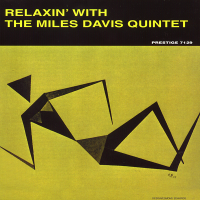
The contractual sessions were cut up and released on four different albums over the next few years. "Woody'n You" and "It Could Happen to You" were on the March 1958 release, Relaxin' with the Miles Davis Quintet (the first release, Cookin' in 1957, was all tunes from the later session).
"In Your Own Sweet Way," "Trane's Blues," "Ahmad's Blues," "It Never Entered My Mind," "Four" and the two versions of "The Theme" came out on the 1959 release, Workin' with the Miles Davis Quintet.
"Diane," "Something I Dreamed Last Night,""Surrey with the Fringe on Top," "When I Fall in Love" and "Salt Peanuts" were all held off until 1961 and the final LP from the 1956 sessions, Steamin' with the Miles Davis Quintet.
A number of these tunes also eventually found their way to 45 RPM singles, as Prestige really entered that game in the 1960s. "It Never Entered My Mind" came out in early 1960, divided onto two sides of a 45, and July of 1960 saw "When I Fall in Love"/"I Could Write a Book." The marketing folks at Prestige had apparently decided that two songs were a better sell than Parts 1 and 2, which meant that These long form LP improvisations were released in edited versions. "When I Fall in Love," at 4:21, could easily have been split in half, but instead it was cut down to 2:25. Same with "I Could Write a Book," which went from 5:11 t0 3:37.
"Surrey with the Fringe on Top"/"Diane" was released in April or May of 1963, as Prestige continued to space out the contractual sessions as far as they could. Both of these were in severely edited versions -- the originals had been 9:05 and 7:49 respectively. For that matter, on "Surrey With the Fringe on Top," they edited the "e" out of "Surrey."






:format(jpeg):mode_rgb()/discogs-images/R-5246474-1388644697-6124.png.jpg)