Tad Richards' odyssey through the catalog of Prestige Records:an unofficial and idiosyncratic history of jazz in the 50s and 60s. With occasional digressions.
Bob Brookmeyer, during this time period, was somewhat bicoastal. He had replaced Chet Baker in Gerry Mulligan's famous pianoless quartet, and he was still making dates in New York. This is another four song, 10-inch recording date, perhaps because Prestige already had one such session (with Teddy Charles), and needed one more to fill out a full length LP.
This New York session is also a pianoless quartet, except when it isn't. On two of the tunes, Brookmeyer plays piano. Actually, Brookmeyer had started as a pianist, with the Tex Beneke and Ray McKinley bands, before switching to valve trombone full time. This was actually true of the Mulligan-Brookmeyer quartets, as well--they were pianoless except when they weren't, since both Mulligan and Brookmeyer played piano.
To my ears, there's no falling off in technique or imagination when Brookmeyer switches to piano. He's great on both instruments, and the four tunes together, with the piano and trombone alternating, make a cohesive unit.
The quartet makes a cohesive unit, too. I believe this is Mel Lewis's debut on record. His first
important professional gig had come in just the previous year, when he had joined Stan Kenton's orchestra. Teddy Kotick had also played on the Teddy Charles session.
I continue to be impressed with Jimmy Raney, who's been on several Prestige sessions before this. His solos are beautiful, and his duet exchanges with both Brookmeyers, the trombonist and the pianist, are dazzling. He does a very cool duet with Teddy Kotick, as well, on his own composition, "Potrezebie," the title of which tells me that in addition to his other accomplishments, Raney was an early fan of Mad comics. Mad's resident genius, Harvey Kurtzman, had run across the word in a set of Polish instructions for a bottle of aspirin (and who among us hasn't read aspirin labels in Polish?) and decided he liked thesound of it as a nonsense word (it actually means "need"). Looking on
Allmusic.com to see if anyone else had recorded "Potrezebie," I
discovered that although it hasn't been picked up by any other Mad-loving jazzmen, there are a number of Polish songs that use it in the title. The Polish songs spell the word correctly: Potrzebie, with no "e" between the "r" and the "z." Actually, the root word is an inflected noun, and "potrzebie" is the dative case of the noun. The various Polish songs usually use "potrzebuje" or "potrzeba," which, as near as I can make out, are verb forms. "kilkanaScie przedsiEbiorstw potrzebuje nowych dochodOw" translates as "Over a dozen of enterprises need new incomes," which seems somehow appropriate for a discussion of jazz. I like to think that Jimmy Raney was a real Mad fan, and knew the correct spelling, but was done in by the label maker for Prestige's pressing plant.
The original 10-inch release in 1955, and the later 12-inch release, were both titled The Dual Role of Bob Brookmeyer, referencing two different sessions with two different Hall Overton students, or more likely Brookmeyer as trombonist and pianist. The same album was also given a New Jazz release, as Bob Brookmeyer -- Revelation!
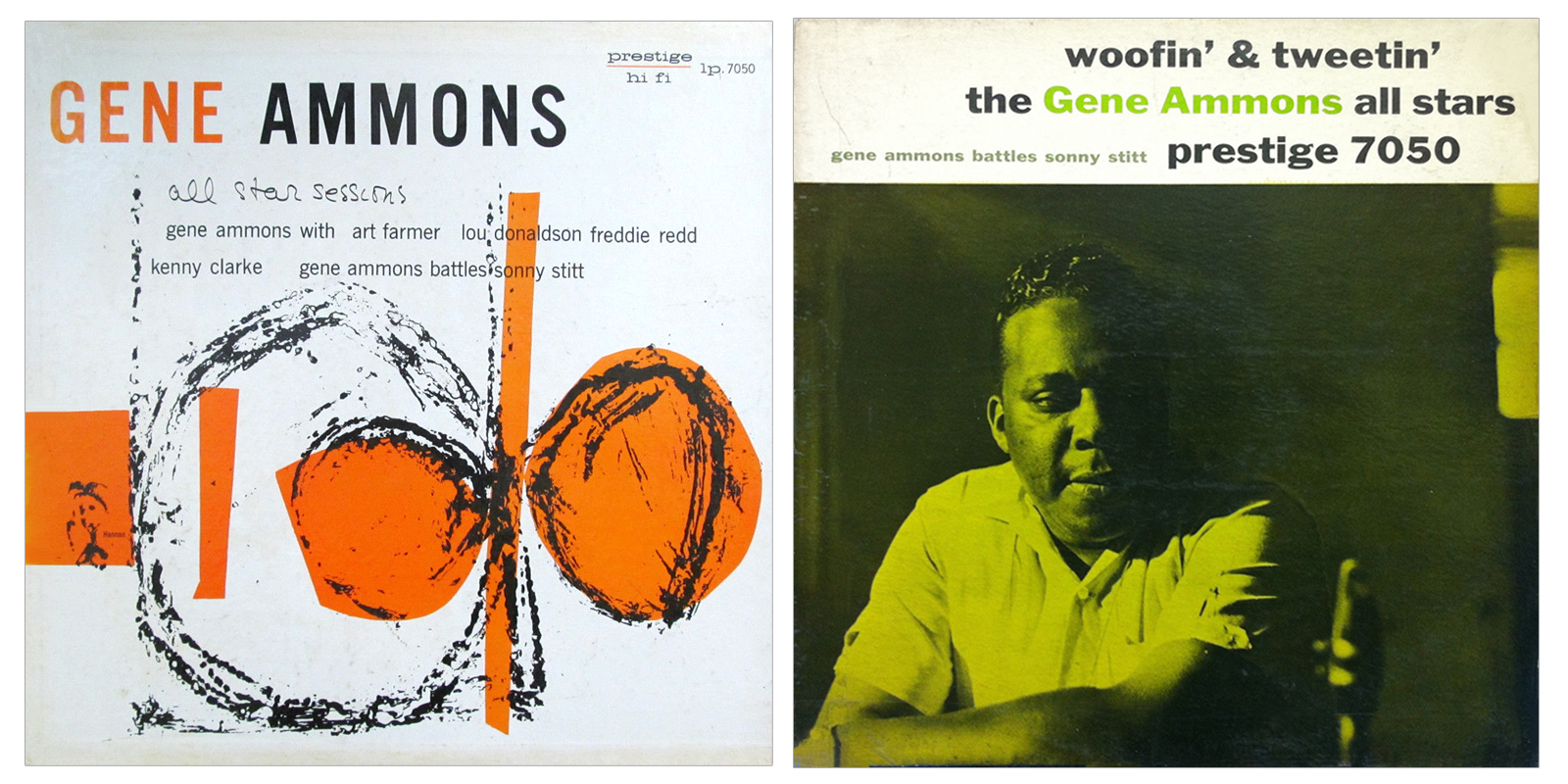
This is a curious session, and I'm trying to puzzle it out. It's certainly not designed to produce a 12-inch LP--they only cut two tunes that day. So...a 45, maybe? One for the jukeboxes? But this isn't exactly a rhythm and blues aggregation. It's a whole new group. None of them have recorded with Ammons before, and they're all serious modern jazz musicians, the cream of the crop.
But that's OK. All these cats can play rhythm and blues. Addison Farmer may have studied at Juilliard and Manhattan School of Music, but he also played in the house band for the Bihari brothers' Modern Records, one of the premier R&B labels on the West Coast. Lou Donaldson became famous for playing the funky side of jazz, and as he said in a recent interview with jazz blogger Larry Appelbaum , "If you can’t play the blues, you can’t play no jazz, I don’t care who it is or how much you study."
But no, that doesn't seem to be the case, either. No rhythm and blues here. These are jazz cats playing straight ahead jazz, and very tasty stuff at that. With soloists like Donaldson and Art Farmer filling out the front line with Ammons, there's a lot of jazz to play, and both selections run long - "Juggernaut" checks in at 10:31, "Woofin' and Tweetin'" at 15.06. Plenty of time for extended solos, and enough music to fill up both sides of a 10-inch LP. So who needs to worry about a 45 for the jukeboxes?
Except...they did release "Woofin' and Tweetin'" as a 45. And not an EP, apparently. How? I have no
idea. Maybe they did two versions, one for the album and one for the single. But then there'd be an indication of that on the session record. Maybe they just truncated it. I looked for playing time on the 45's label, but no such luck.
I'm pleased to see that the bebop trope of punning on the artist's name (or in this case nickname) hasn't disappeared altogether: hence, "Juggernaut." And I also like "Woofin' and Tweetin'." It has the suggestion of an old time rhythm and blues title, like "Rockin' and Rollin'" or "Rollin' and Tumblin'" or "Shuckin' and Jivin'," updated to the new jargon of the hi-fi world.
This session did eventually make it to 12-inch, but here again there's a curiosity. Prestige did often rerelease material, but in this case it doesn't seem to be so much a rerelease as a release of the same thing twice. Gene Ammons All-Star Sessions and Gene Ammons - Woofin' and Tweetin' are both PRLP 7050, same catalog number. But they have two different names and two different covers.
The 45 RPM seems to have been released more or less at the same time as the album. The label reads From the 12" LP 7050 "Woofin' and Tweetin'." So maybe it went something like this:
Hey, why don't we put out a 45 on this one. It's not exactly rhythm and blues, but it is Gene Ammons. I bet we can get it on a few jukeboxes.
Isn't it a little long?
We'll just cut it down some. On the jukeboxes, who'll care? But you know...if we're putting out the 45, maybe we should change the name of the album, so if someone hears it on a jukebox and likes it, they'll know what album to buy.
Sure, why not? In that case, let's change the album cover too. I never liked that original art much.
Actually, it wasn't unusual for Prestige to put out an album with alternate covers -- in fact, there's a whole website devoted to just that. Often the difference was just one of a different color scheme, less often a whole different design. Two different names is rarer yet, although not quite unique.
The Prestige commitment to 12-inch LPs was not yet complete. This session did eventually get included in a full-length album, but its initial release was one of the last of the 200-series 10-inchers (there'd be four more), and even more surprisingly, one of the last of their 78 RPM releases (there'd be four more of them, including another by Green from a later 1955 session).
Which means that a recording session is changing. This Bennie Green session is four songs, totalling about 20 minutes of music, or just enough for a 10-inch LP, or a couple of singles. Not exactly perfect for singles, but the two cuts that were released on 78 and 45 ("Say Jack!" and "Sometimes I'm Happy") were the shortest ones.
Compare that with the Miles Davis session of a few days earlier, which produced about 36 minutes of music, and an entire 12-inch LP. Or the MJQ's session of a few weeks later, the same. Or the first Prestige 12-inch, recorded by Billy Taylor the previous April. All of Taylor's tunes were single-length, in the three minute range, but there were 12 of them, adding up again to about 36 minutes, and none were ever released as singles.
And compare all of those to this 1949 session by Stan Getz, which produced four songs, all of them in the 3 1/2 minute range, all of them released on 78.
And, of course, even with Bob Weinstock's famous no-rehearsal, few-alternate takes philosophy, one wasn't always going to be able to record a whole album in one day. But great jazz didn't necessarily require endless studio time. Kind of Blue was recorded in two days. Compare that with some of the 70s rockers with endless budgets and endless studio time. And...no accounting for tastes...but compare the results.
Anyway, back to Bennie Green. As I've noted earlier, Green could play anything, and he continues to demonstrate it. And he could do it on the trombone. Here he takes on three ballads, including "Body and Soul," which Coleman Hawkins pretty much owns as one of the definitive tenor sax solos. But Green manages to get the same depth of emotion on the trombone. "Laura" as a jazz standard is probably most closely associated with Charlie Parker with strings. Green gives it his own delicacy and sensivity.
"Laura" also features an unexpected and utterly entrancing solo by Cliff Smalls, hitherto unknown to
me, but a veteran of some ensembles with strong pedigrees, including Jimmie Lunceford and Erskine Hawkins. Perhaps he had a particular rapport with Green because he was also a trombonist. He had played trombone in the Earl Hines band that also featured Dizzy Gillespie and Charlie Parker, and he was the backup pianist for Hines. Actually, Hines used several backups, including Teddy Wilson, Jess Stacy and Nat "King" Cole, but Smalls was reportedly his favorite.
On "Say Jack!" Green's trombone takes on the job of a rhythm and blues tenor sax man -- and also vocalist, leading the ensemble in a ragged-but-right rhythm-and-bluesy chorus, which is not repeated anywhere else in the song, as the group gradually forgets that it's playing R&B, and moves into bebop territory -- particularly Charlie Rouse's solo.
Rouse and Smalls get a lot of solo time on "Sometimes I'm Happy," but what really kicks that number into high gear is the conga playing of Candido, whom Rudy Van Gelder moves to the forefront, and a good move it is. The 10-inch LP was simply titled Bennie Green Sextet. When the session found its way to 12-inch, a year or so later, it was called Bennie Green Blows His Horn in Hi-Fi; by the time it was reissued as part of a 7100-series LP a couple of years later, perhaps Hi-Fi was no longer quite such an exciting new technology, because the album became simply Bennie Green Blows His Horn.
This is an interesting period in Miles's career. This session was recorded in June of 1955, and he was still working with Bob Weinstock's philosophy:
So, our basic idea was just to make records with different people, to record with the best people around...we would sit down and talk about it. Miles would mention who was in town, who he would like to record with. I'd say who I'd like to hear him record with.
That was about to change. Miles was healthy by this time, free from heroin addiction, working out regularly. Although he did not mix it up with Thelonious Monk during their session of the previous December, as was rumored at the time, he was working out in the gym regularly, including sessions on the light punching bag.
In July, he played the Newport Jazz Festival with an all-star group, including Thelonious Monk, although they would never record together after the December dustup. The rest of the group was Gerry Mulligan, Zoot Sims, Percy Heath and Connie Kay, who had just joined the Modern Jazz Quartet to replace expatriate-to-be Kenny Clarke. Miles doesn't appear to have been a part of the official festival lineup, but Columbia producer George Avakian heard him and his group jamming on Monk's "Round Midnight," and immediately recruited him for Columbia. Avakian had exactly the opposite to Weinstock's philosophy. He wanted Miles to put together a regular and recognizable group. Avakian's idea turned out to be the stroke of genius that put Miles over the top, but we can only be grateful, as well, for Weinstock's "jam with Miles" sessions.
It appears that, without necessarily planning it that way, Miles was already assembling that regular group. Oscar Pettiford wouldn't remain--reportedly his personality clashed with Miles's--but Red Garland and Philly Joe Jones would.
Jones had only recorded once before with Miles, but the two had spent time on the road together during Miles's self-imposed exile from New York. Garland had played on various dates with Billy Eckstine, Roy Eldridge, Coleman Hawkins, Charlie Parker, Lester Young and Eddie "Cleanhead" Vinson (John Coltrane was also in Vinson's band), but he was pretty much unknown when Miles tapped him. They had boxing in common as well as music--Garland, as a welterweight, had actually fought Sugar Ray Robinson.
Ira Gitler, in preparing the liner notes for the Prestige album from this session, talked to Miles about musicians he admired. This must have been after Newport, so Miles must already have been thinking about who he wanted in the group he'd be forming.
I asked Miles who his current favorites were. On his own instrument he quickly named Art Farmer and Clifford Brown as the new stars and Kenny Dorham as one who has come into his own. Then he spoke lovingly of Dizzy Gillespie. "Diz is it, whenever I want to learn something I go and listen to Diz." In the piano department two Philadelphia boys, Red Garland (heard to good advantage in this LP) and Ray Bryant were mentioned along with Horace Silver, Hank Jones, and Carl Perkins, "a cat on the Coast who ploys bass notes with his elbow'. The talk shifted to saxophone and to Sonny Rollins and Hank Mobley who are carrying on the tradition of Charlie Parker. This naturally started us talking about Bird. Miles credited his most wonderful experiences in jazz to his years with Bird. He stared slowly ahead *Like Max said, New York isn't New York anymore without Bird." Max's name being mentioned directed the conversation to drummers. "Art Blakey and Philly Joe Jones; Max For brushes." Miles is very conscious of drummers. Many times he will sit down between the drummer and bass player and just listen to what the drummer is doing.
Miles did actually play with Kenny Dorham once, in a 1949 all-star big band in Paris, Le Festival International de Jazz All-Stars.
He recorded a few times with Dizzy Gillespie, first on a 1945 session with Charlie Parker, but Diz mostly played piano on that session. He was supposed to strictly play piano, but the youthful Miles was so nervous about playing with his idols that he broke down completely on "Ko-Ko," and Dizzy had to step in. He played in a trumpet session with Dizzy and Fats Navarro in 1949. Fats was gone, of course, by the 1955 conversation with Gitler. This was the 1949 edition of the Metronome Allstars, a group of Metronome Magazine's poll-winners that was gathered for a recording annually throughout most of the Forties and well into the 50s. Metronome would gather together as many of the poll winners as they could, and fill in the rest with runners-up. 1949's group was more than a little impressive: Miles Davis, Dizzy Gillespie, Fats Navarro (trumpet); J.J. Johnson, Kai Winding (trombone); Buddy DeFranco (clarinet); Charlie Parker (alto saxophone); Charlie Ventura (tenor saxophone); Ernie Caceres (baritone saxophone); Lennie Tristano (piano); Billy Bauer (guitar); Eddie Safranski (bass); Shelly Manne (drums). There was another session with Bird in 1953, and then nothing until 1989, where they appeared as the trumpet session on a very strange Quincy Jones recording that features vocals by Ella Fitzgerald, Sarah Vaughan, and rappers Big Daddy Kane and Kool Moe Dee. I'm not certain it's an entirely successful experiment, but I'm sure as hell not certain it isn't.
But he wasn't looking for another trumpet player to round out his new quintet. He was looking for a tenor sax, and actually, Sonny Rollins was his first choice. Rollins played with the new quintet in July, right after Newport, but the arrangement wasn't to last. Sonny had his own heroin habit to kick. John Coltrane was not yet on Miles's radar. Hank Mobley would play with the quintet, but not until years later.
Miles would use Ray Bryant on piano a month later, in another one of his Prestige pickup groups, but
Red Garland was to be his man. At the time of this recording, and this interview, Garland was the least-known of the piano men that Miles admired--even including Carl Perkins, who would die too young to establish much more of a reputation, and who really did play bass notes with his elbow, his left arm having been crippled by polio. But Miles clearly had his eye on Garland already.
When you think of answer songs, you're more likely going to think of country ("It Wasn't God Who Made Honky Tonk Angels") or rock ("Sweet Home Alabama" answering Neil Young's "Southern Man," and then Warren Zevon's "Play it All Night Long" answering Lynyrd Skynyrd), or even blues (Rufus Thomas's "You Ain't Nothin' But a Bearcat"). But here's one turning up in jazz: Miles's "I Didn't" as an answer to Monk's "Well You Needn't" (a tune that Miles also recorded). "I Didn't" is sharp, crisp and sardonic. You have to be awfully good to take on the premier composer of his generation, but Miles is up to the task.
"A Night in Tunisia" is one of the most famous of all bebop standards, and "Green Haze" a Davis original that showcases Garland, his new piano discovery. The others are all odd choices that Miles puts his indelible stamp on. "Will You Still Be Mine" was written by pop singer and swing era tunesmith Matt Dennis. The other two are by composer Arthur Schwartz, and were both songs that one would not have chosen to be present at the birth of the cool, or even at its confirmation. "I See Your Face Before Me" was best known in versions by Guy Lombardo and Glen Gray. Coltrane and Brubeck would both record it later.
"I've Got a Gal in Calico," written by Schwartz and Leo Robin for a movie musical, is one of those completely cornball, white-bread numbers, like "Surrey With the Fringe on Top," that no one could consider as the basis for a hipster jazz improvisation. But Miles worked the same magic with "Surrey With the Fringe on Top," didn't he?
Both "Green Haze" and "A Night in Tunisia" were released as two-sided 45s. The Musings of Miles became Davis's first 12-inch LP, Prestige PRLP 7007. Before it were two reissues, PRLP 7004, Lee Konitz With Tristano, Marsh And Bauer, from four sessions (1/11/49, 6/28/49, 9/27/49, 4/7/50) in 1949-50; and PRLP 7006, Mulligan Plays Mulligan (original session 8/27/51). In between was an MJQ session recorded after Miles, but released before.
After making his commitment to 12-inch LPs and his soon-to-be-legendary 7000 series, Bob Weinstock backtracked a bit with this session, releasing it only as a 10-inch, entitled Art Farmer Quintet. It became a 12-inch LP, along with the earlier Farmer-Gryce session for Prestige, as When Farmer Met Gryce, but that was a while later.
Actually, Farmer had met Gryce a while earlier, when they had both been part of the Lionel Hampton European tour of the summer of 1953--a tour that had kickstarted the careers of two brilliant arrangers, Gryce and Quincy Jones. Jones would go on to a legendary career as arranger and producer; Farmer would go on to a legendary career as an instrumentalist. Gryce would cut his carer short, essentially retiring from the public eye by the end of the 1950s, for a number of reasons, not the least of which may have been disillusionment with the music industry. David Griffith, who maintains the Gigi Gryce web page, points out:
It is often overlooked that Gryce was one of the first black musicians to form his own publishing company in order to have control over his and fellow musicians' creative output - many of the prominent black jazz musicians of the day were with Gryce's Melotone publishing company. It became clear, however, that Gryce couldn't buck the deeply ingrained system of record companies controlling (at least in part) music publishing rights as part of recording deals.
The first Farmer/Gryce session had featured a familiar Prestige rhythm section of Horace Silver, Percy Heath and Kenny Clarke. This one brings in some newer faces. Freddie Redd had made his Prestige debut in February, leading a trio. Farmer's brother Addison was also making his second session: he had played with Art in a quartet the previous November. Art Taylor may or may not have recorded with Art Farmer in June 1954; he definitely appeared on Thelonious Monk's last session for Prestige.
Gryce was an important composer, and his compositions take center stage here. "Social Call" probably became the best known. With lyrics by Jon Hendricks, it was a hit at least in jazz circles for Betty Carter, and has been covered by Dianne Reeves among others. It's also become a favorite with instrumentalists, including Donald Byrd, Cal Tjader, Art Blakey and the Jazz messengers, Cannonball Adderley and Wes Montgomery. If I were picking one tune from this session to write lyrics to, I'd pick "Social Call" too. It's melodic, structured, and expressive.
But Gryce's other two tunes are nearly as good, perhaps just as good. "Capri" has been recorded by J. J. Johnson, Clifford Brown and Benny Golson. Here it moves from a brief but intriguing vamp by red to a swinging head by Farmer, to some nimble torch-passing between the two soloists. "Blue Lights" begins with a blue fanfare, and then stays bluesy and driving. It numbers Coleman Hawkins, Hank Jones and Clifford Jordan among its interpreters. Art Farmer's contribution, "The Infant's Song," is a particularly beautiful melody. All in all, this is a very strong group of originals to bring to one recording session.
Again the other MJQ, with Horace Silver instead of John Lewis, and yes, it's a very different sound. Not necessarily funkier, however, even though the session was rereleased in 1962 on album called Soul Pioneers. Silver had not yet made the fists-first commitment to funk that would bring him his greatest acclaim, and this was a session heavy on ballads, composed by some impressive balladsmiths.
"I Should Care" was co-composed by orchestra leaders Axel Stordahl and Paul Weston, with lyrics by Sammy Cahn.. Stordahl had been an arranger for Tommy Dorsey when Frank Sinatra joined the band, and he became the arranger and orchestra leader for Sinatra's Columbia recordings. The Modern Jazz Quartet would later record the same tune, so it's interesting to look at the differences. The MJQ's arrangement is, unsurprisingly, the more intricate, with some very closely worked-out duet work between John Lewis and Milt Jackson. The version by the other MJQ is much more built around Jackson, and he explores different territories, with a lot more reverb and a lot more pushing the upper register.
One significant difference between the Milt Jackson Quartet and the Modern Jazz Quartet is the part given to Percy Heath. Heath certainly gets solo time with Lewis's MJQ, but he seems more assertive here, particularly on Rodgers and Hart's "My Funny Valentine." "Valentine," as well as Hoagy Carmichael's "The Nearness of You," are very familiar tunes, and with good reason. There are two ways a jazz player can handle a melody like this, both with value. You can get outta the way, and give the melody a chance to express itself. Or, like Jackson and Silver, you can count on everyone knowing the melody, and just use it as a point of departure and a point of reference.
The group gets more uptempo, too, for instance in "Stonewall," with a lot of walking bass and and lot of virtuoso vibing. I do love the ballads, but I might take "Stonewall" as a favorite from this session.
"Stonewall," in two parts, was released as a 45. Milt Jackson Quartet was Prestige PRLP 7003. Before it (PRLP 7002) came a Stan Getz reissue, featuring one session from 1949 and twosessions from 1950.
This is a landmark in Prestige history. 1955 must have been the year that Prestige made the switch to the 12-inch LP format, and began their 7000 series of recordings, and this was the first one made for that release -- Prestige PRLP 7001. From here on, the 7000 series will be a mixture of new recordings and repackagings of recordings made for 78, for 45 RPM EP, and for 10 inch LPs.
This is the classic Billy Taylor Trio, with Percy Brice handling the drum duties.
If you were building a well-rounded jazz collection, you might not include every Billy Taylor album in it. Not that they aren't all worthwhile, but if you got all of them, you might not have time to listen to all of them, while still maintaining your status as well-rounded jazzophile. But you would certainly want to have at least one representative album--maybe at least two, so that you'd have one Latin and one straight-ahead. And whichever ones you picked, you really couldn't go wrong.
Certainly you wouldn't be going wrong with this one--and it has the added historical value of being Prestige's first 12-inch LP. Taylor's playing is technically impeccable, emotionally compelling. I'd be hard pressed to pick a favorite track, but maybe "Day Dreaming" as a ballad, and "A Grand Night For Swingin'" for a livelier tempo. "Swingin'" is a Taylor original. He's a prolific composer, and one of the best. "Day Dreaming" is Jerome Kern.
The album is entitled A Touch of Taylor, and that was a formulation that seemed to appeal -- a later album for Atlantic is called The Taylor Touch.
Before we get to Eardley, a mention of a couple of sessions lost to the haze of time. On March 10, the Tony Luis trio cut four tunes, which were released on EP format only, and four more tunes backing up vocalist Terry Morel (also EP only). I can find nothing at all on Luis anywhere. I did find one mention of his drummer, Hank Nanni, in the autobiography of a Wall Street trader turned vagabond, who briefly went to work for Nanni, who was playing drums in a Las Vegas lounge. But not as a musician. Nanni had also opened up a business selling vacuum cleaners door to door.
Terry Morel apparently had two recording sessions in 1955, the one for Prestige which sank without a trace, and one for Bethlehem, which has survived. All I know about her I found on a German Wiki page -- there's no Wiki entry in English for her. Herbie Mann and Ralph Sharon played on the Bethlehem album, which is a live recording. She made one more live album with Gerald Wiggins in 1957, and appeared on a TV show with Bud Shank and Gary Peacock in 1962. Nothing else, although she lived until 2005. The Bethlehem sides are very good.
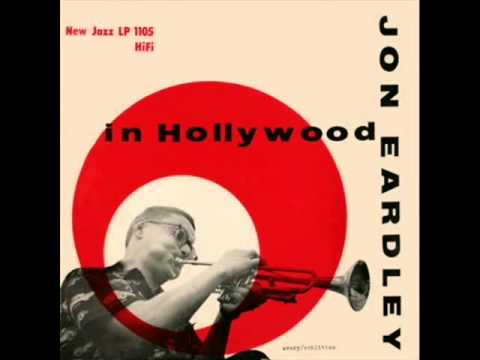
Jon Eardley had cut a quintet session in the Van Gelder studio a month earlier with Phil Woods, under Woods's name. This session features the same rhythm section, but with J. R. Monterose's tenor replacing Woods's alto.
Monterose is a favorite of mine, and was a good friend. He came out of that hotbed of jazz that was Detroit, but he didn't have much time to absorb that city's influences. When he was only a few months old, his family moved to Utica, New York, and upstate New York would always exert its pull on him. His first major gig was with the Buddy Rich band, but after six months he decided it wasn't the music he wanted to play, so he went back to upstate New York, where, he says, he "spent the next couple of years working in little joints but with good men."
J.R. worked with some more good men on his return to New York, including Claude Thornhill, Teddy
Charles, Kenny Dorham and Charles Mingus. But the jazz scene in New York changed in the late 60s and early 70s, with more of a racial divide than there had been previously--a situation with which he was not comfortable. He retreated to Europe, and then back to upstate New York, where he became a legend in his own time with a long-time engagement (the better part of a decade) at the Lark Tavern in Albany. He was back playing little joints with good men, including Teddy Kotick. The others in his most frequent ensemble were pianist/attorney Walter Donnaruma and drummer Eddie Robinson.
This is Jon Eardley's session, though, with Monterose as an able partner. There's one Eardley original ("Demanton") and two by Tadd Dameron, one of the finest composers in the jazz idiom. Dameron once said that he strove for beauty above all else in his composition, and he certainly achieves it here, especially in "If You Could See Me Now," which also has a haunting solo by George Syran.
The fourth piece, "Hey There," is by Richard Adler and Jerry Ross, and comes from the 1954 musical "The Pajama Game." It was a pop hit in 1955, for both Rosemary Clooney and Sammy Davis Jr.
The pages had pretty well been turned on the Great American Songbook by the mid-Fifties. There were still crooners like Eddie Fisher, and band singers from the Forties like Jo Stafford and Perry Como and even Bing Crosby, but the great songs had pretty much all been written, which is why pop singers like Margaret Whiting and Tony Bennett were covering Nashville songs, particularly those by Hank Williams. But the news hadn't quite reached Broadway yet, and the Fifties were actually a pretty strong decade for Broadway musical scores. "Hey There" is a very lovely melody, and if it didn't quite become a jazz standard, it had some very good jazz interpretations by Grant Green and Phil Woods. It was recorded by a number of jazz as well as pop singers, most notably Sarah Vaughan, who was given an arrangement involving a weird and not entirely successful Danish choir, but still managed to create one the great jazz vocals.
"Hey There" was written as a moody, torchy ballad, and is generally played that way, but Eardley and Monterose take it uptempo and urgent, and it's a good change from the expected.
These tunes were released on a 10-inch from Prestige, and a 12-inch from New Jazz.
One of the special joys of this blog is discovery. Someone I hadn't heard before...someone I didn't know enough about. And that's the case here. This is a treasure. This is music for real lovers of jazz. No pyrotechnics, no drama, just wonderful piano playing by a real artist. It's funky, it's melodic, it's inventive, it goes right into you.
Freddie Redd is probably best known for Jack Gelber's 1959 play about junkies waiting for their pusher Godot, The Connection. The play focused on a bunch of junkies sitting around a New York crash pad, waiting to get high. The cast includes four jazz musicians, most notably Redd and Jackie McLean. Gelber's original script had called for the musicians to just be sitting around noodling odd scraps of music, but Redd convinced the playwright to let him compose a real score. This was a good idea for all sorts of reasons. It was certainly stronger artistically. It was better for Freddie, because a composition meant steady...income, that is. Beyond what he was getting for acting, which in those days Off Broadway was not much. When you think about it, whatever the producers paid Freddie for the score, it was a good investment, because if the quartet had just had to sit around noodling night after night,,they would have been noodling something, and ASCAP would have been on them like a ton of bricks.
The Connection was made into a movie by Shirley Clarke, with Redd again featured, and an album of the music from the play was released on Blue Note, but none of this made Redd into a star of the jazz world. If you were to mention his name to someone from that era--like me, for instance--you'd probably get "Oh, yeah, The Connection. Did he ever do anything else?" And because in The Connection, he plays a heroin addict, the person you were talking to would probably assume he had died young.
The Connection
In fact, Redd is still with us, and as recently at 2013, according to his Facebook page, he was performing in Baltimore (his Facebook page only has 683 likes -- not enough).
But let's get back to this single session of four tunes for Prestige. His playing is simple and complex. straightforward and adventurous, bluesy and boppish. It engages the mind and goes straight to the heart. "Debut" is ornate in the manner of Bud Powell or even Art Tatum. In "Blues for Lady J" he plays the blues, elaborates on the blues, returns to the blues. "The Things We Did Last Summer" is a 1946 hit for Jo Stafford, by Sammy Cahn and Jule Styne, that's become a jazz standard. Redd gives it a beautiful, moody rendition that stays close to the melody but always offers something more. It comes in at just under six minutes, which gives Redd plenty of space to explore all its possibilities. "Ready Freddie" is taken at a faster tempo, and is a bravura piece for the pianist.
The trio is filled out by stellar musicians. John Ore worked with several of the best piano players of his time, including Bud Powell, Elmo Hope, Earl Hines, and most significantly Thelonious Monk, from 1960-63. Ron Jefferson and Ore both played with Lester Young, and Jefferson also backed up Coleman Hawkins, Roy Eldridge and Oscar Pettiford, among others. He was one of the original members of Les McCann's trio.
Ore has some solo space on both "Things We Did Last Summer" and "Blues for Lady J," and he takes full advantage of it. He also does some wonderful duet work with Redd on "Ready Freddie."
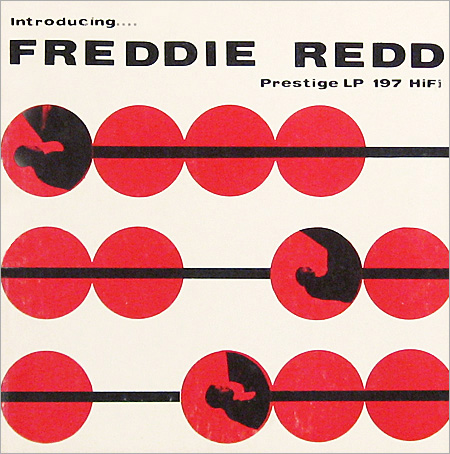
These tunes appear on a 10-inch LP, Introducing...Freddie Redd. There wasn't enough material for a 12-inch LP, so Prestige combined them with a Hampton Hawes session as Piano: East/West.
All can be heard on Spotify. I trust I don't need to tell you to listen.And if he gets booked at the Falcon, in my neck of the woods, I'm going.
Jimmy Raney was back in the studio twice in the winter of 1955, February 18 and March 8, with the same lineup. It included his mentor Hall Overton, who had not been part of his session from the previous August, which had featured two horns but no piano. One of the two had been Phil Woods, who went on, as we know, to have one of the most distinguished careers in jazz history, although he and Raney were not to record together again. The trumpet player for that earlier gig, John "Doc" Wilson, who is back for these next two, also went on to have a career no less admirable, if less acclaimed, as an arranger and educator.
Wilson's first recordings were on these Jimmy Raney sessions. He went on to record with Bob Brookmeyer and Gerry Mulligan, but recording with famous names was not to be his major contribution to the jazz world. And interestingly, though he played with one of jazz's great arrangers, he does not list Mulligan as one of his most important influences.
Wilson's first big time gig was with the interesting but short-lived bebop aggregation that Benny Goodman put together with Zoot Sims and Wardell Gray. He would learn a lot from Goodman, including, as he told Nate Guidry in a profile in the Pittsburgh Post-Gazette, the way that
...when the band wasn't swinging the way he wanted, Benny would have a rehearsal early in the morning without the rhythm section so we could get our own swing thing going...I found later in my career that that's a great technique. If you've got a great rhythm section and the music isn't swinging, it's not the rhythm section's fault.
After Goodman, he played in bands led by Pete Rugolo, Neal Hefti and Claude Thornhill, all top arrangers. But he says his most rewarding experience was playing in the band led by Eddie Sauter and Bill Finegan, who first made their reputation arranging in the golden years of swing, Sauter for Red Norvo, Benny Goodman and others, Finegan for Glenn Miller:
Those guys had some really novel ideas when it came to arranging. The effects of that band are still felt today. They used woodwind doubles, extra percussions that are now commonplace. But when they started doing it, it was new.
The Sauter-Finegan orchestra was swimming upstream against the rock and roll tide of the 1950s, and Wilson found himself swimming against the same tide in the 1960s, as the Beatles swept away everything in their path, including jazz. Wilson recalls
...things in New York were getting bad. Musicians were going from working six days a week to one or two days. I ran into Kenny Dorham working in a music store on 48th
Street. The great Kenny Dorham couldn't find work. I had my trumpet stolen, so I go into this store, and I'm in the basement trying these different horns, and here comes Kenny and he said, 'I heard some of those licks you were playing, and I had to come down and see who was playing that.'
Wilson went back to school, got a doctorate in music from NYU, and landed a teaching job at Duquesne University in Pittsburgh in 1972. There wasn't much call for jazz in higher education then -- in 1972, only 15 colleges in the US offered degrees in jazz studies. But Wilson had his Ph.D., so he was able to get hired as Duquesne's band director, conducting classical music and wind ensembles, and eventually to set up a jazz program.
Wilson and Raney mesh beautifully here. Raney had a wonderful sense of how to coordinate a guitar and horn, and it didn't hurt to have Rudy Van Gelder engineering the sessions. Replacing Bill Crow and Joe Morello are Teddy Kotick and Nick Stabulas.
The tunes are originals and standards on the first session, all standards on the second. Mostly Raney takes a fairly loose approach to the melodies, even on the head, and he makes it work. With the exception of "Someone to Watch Over Me," where the pure beauty of the melody engages him briefly.
I wanted to do a portrait of John "Doc" Wilson, but I can find no pictures of him anywhere on the Internet.
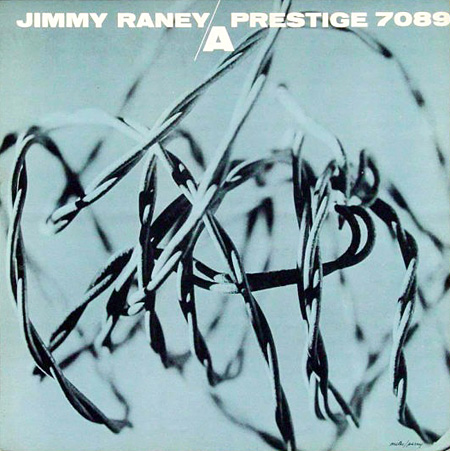
These sessions were combined on a 10-inch LP, and later included on the 12-inch Jimmy Raney - A.
This is Gene Ammons's second recording session with this new group, so time to take a look at some of them. I can't find any information on Nat Howard, except to say that he sounds good here.
Henderson Chambers is one of those guys who straddled the fence between jazz and rhythm and blues, not that there was ever really much of a fence. He played with Al Sears and Tiny Bradshaw in the 30s, then Chris Columbus at the Savoy Ballroom in 1939-40, and then a few years with Louis Armstrong in the early 40s, followed by gigs with Don Redman, Sy Oliver, Lucky Millinder, and Count Basie. In the 50s, he played with Cab Calloway, Doc Cheatham, Duke Ellington, and Mercer Ellington. In the 60s, Ray Charles and Basie again. This was a cat who never lacked for work. He died in 1967.
I can't find much on Gene Easton, but he played with Duke Ellington, Dinah Washington, Sun Ra and Muhal Richard Abrams, so he had some range.
Earl Coleman was a singer in the Billy Eckstine mode, which as I've said, was going out of fashion by this time, although it had its adherents, including Mr. B. himself, who was still going strong into the 1980s, when he made a Grammy-winning recording with Benny Carter. Probably the most successful post-1940s work by a rich-toned baritone in the Eckstine tradition was Johnny Hartman's 1963 collaboration with John Coltrane.
Coleman recorded two tunes on this session with Ammons. One of them, "This is Always," a Harry Warren/Mack Gordon composition, was his attempt to recapture lightning in a bottle. He had had a minor hit with the song in 1947, but the success of that version may have had something to do with the other musicians on the date: Charlie Parker and Erroll Garner.
Probably the two instrumental tracks are the really memorable ones from this session, though. Ammons does a beautiful version of a great ballad: George Gershwin's "Our Love is Here To Stay." The other tune, "Blues Roller" (or "Blue Roller") is not exactly a blues rock and roller, although Ammons does take off from an easy rolling ensemble part to do some old fashioned Texas tenor honking.
In this second session pairing Phil Woods and Jon Eardley, you can really hear why Woods was so often compared to Charlie Parker. There's that same feeling for the roots of swing with a daring tonality that pushes the edges of atonality, that same sense of the delight in adventure. But you can also hear how different they are.
And they'd have to be. Bird came from Kansas City, from Jay McShann's Kansas City blues band, and he felt the blues as only someone who grew up with the blues can. Woods was born in Massachusetts, took his first lessons from Lennie Tristano, and was schooled at Juilliard.
Like Bird, he paid his dues, but they were different dues. Juilliard and the Manhattan School of Music, where he also studied, are not for slouches. They didn't teach jazz back in those days -- did not even have a saxophone major, so he studied clarinet. But they taught a lot.
He came out of Juilliard knowing a lot, but unprepared to be thrown into the sort of apprenticeship that Parker, or John Coltrane, or Ornette Coleman would have taken for granted. He had a lot to learn, and some of it he learned from the master: Charlie Parker. Here's a story he told to Marc Myers of JazzWaxabout those early days:
I had just graduated from Juilliard in 1952 and was playing at the Nut Club on Seventh Ave. and Sheridan Square in the Village. After all of that great education, here I was playing "Harlem Nocturne" 10 times a night...I wasn’t happy with myself. I was saying to myself, “My god, I’m a Juilliard graduate, and I can play great jazz, and here I am playing "Night Train" and "Harlem Nocturne." I didn’t like my mouthpiece. I didn’t like my reed. I didn’t like my horn. I didn’t even like the strap.
...One night somebody came into the club and said, “Hey, Charlie Parker’s playing across the street. He’s jamming.” ...I was going on my break so I rushed over. When I walked in, there was this 90-year old guy playing a piano that was only three octaves long [laughs]. His father was on drums using a tiny snare and little tiny pie plates for cymbals. And there was the great Charlie Parker—playing the baritone sax. It belonged to Larry Rivers, the painter. Parker knew me. He knew all the kids who were coming up.
...I said, “Mr. Parker, perhaps you’d like to play my alto?” He said, “Phil, that would be great. This baritone’s kicking my butt.” So I ran back across the street to the Nut Club and grabbed the alto sax that I hated. I came back and got on the bandstand, which was about as big as a coffee table. I handed my horn to Bird and he played "Long Ago and Far Away."...As I’m listening to him play my horn, I’m realizing ...nothing was wrong with the reed, nothing was wrong with the mouthpiece—even the strap sounded good. Then Parker says to me, “Now you play.” I said to myself, “My God.” So I did. I played a chorus for him... When I was done, Bird leaned over and said, “Sounds real good, Phil.” This time I levitated over Seventh Avenue to the Nut Club. And when I got back on the bandstand there, I played the shit out of Harlem Nocturne. That’s when I stopped complaining and started practicing. That was quite a lesson.
There's more than a little Parker in "Horse Shoe Curve," from the bluesy riff-based head through the blistering solos. But it, and the rest of the session, are solid Phil Woods, and once again, he and Jon Eardley sound as perfectly matched as...well, as Bird and Diz. But it seems as though Woods could match up with anyone and sound great.
Seeing James Moody later in his career, after his seven-year stint in Vegas, was a show and a half. He was slick, his patter was hip and glib, he told jokes, he would have fit right in with Frank and Dean and Sammy. And did his musicianship suffer? You had better believe it did not.
What's the place of showmanship in art? In jazz? In modern jazz? The greatest showman (perhaps) in American show business history was also the greatest artist (beyond debate) in the history of American culture. By the time the beboppers came along, no one questioned the greatness of Armstrong, although they thought it was time for further explorations of the possibilities of jazz, but they did question his showmanship. Black entertainers in the first part of the last century played to cultural stereotypes. That doesn't mean they weren't good, or very good. Tim ("Kingfish") Moore was a comic genius, Eddie "Rochester" Anderson a gifted comic, but they're known for their iconic--and stereotypic--roles as a grifter and a butler. Tim Moore, in 1908, did a one-man show adaptation of Uncle Tom's Cabin, for which he
painted one side of his face white and the other black, and turned one profile or the other to the audience depending on whether he was portraying Uncle Tom or Simon Legree. I would have paid to see that--certainly I would have paid the nickel that it probably cost then, especially because the bill would probably also have included Bill "Bojangles" Robinson or Eubie Blake or Bert Williams or even Bessie Smith.
Bill Robinson, still a legend among dancers, played a shuffling butler in Shirley Temple movies. Ethel Waters always played a maid. And Louis Armstrong, to some extent, played the smiling, always ingratiating stage Negro.
And by itself, there's nothing wrong with being ingratiating, or making people feel good. Billie Holiday recognized this, when she said of Armstrong, "Sure Pops Toms, but he Toms from the heart."
But it wasn't what the be boppers were about. They were intellectuals, they were serious artists, and they wanted their music to be recognized for the important art form that it was.
They succeeded. Jazz is taught and studied at conservatories and universities, theory, appreciation and practice.
And they succeeded in another way. Serious artists are never going to be as entertaining as popular artists, on as broad a stage. Jazz has, by this juncture in the 21st century, taken its place alongside grand opera as the least listened-to music in America.
But grand opera is not bad company.
Through all of this, showmanship never completely disappeared. Dizzy Gillespie knew its value. He created the stereotypical image of the 1940s hipster, with the bop beret, goatee and shades, which raised the visibility, and therefore the audience, of jazz. And it didn't hurt that he was one of the greatest artists of his or any other generation.
Showmanship in jazz takes many forms. Monk getting up and dancing around his piano bench was a great show, but it wasn't showmanship, it wasn't consciously playing to the audience. It was just Monk being Monk. Miles Davis, playing the role of the anti-showman, displaying his contempt for the audience by turning his back to them when he soloed...that was showmanship. And you can bet that Miles knew it.
And one went to see James Moody for the music, because he was one of the all time jazz greats, and one went away loving the Rat Pack stage patter, as well. And it was equally easy to love his vocal interpretation of King Pleasure/Blossom Dearie's interpretation of his "Moody's Mood for Love," in which he sang both parts ("and then the chick say..."). Or "Bennie's from Heaven."
Moody caught on quickly to the entertainment value of really good vocalese. He might have resented this messing around with his improvisation, but he was too musically hip and too show-biz savvy to do that. I'm reminded of the story Tito Puente told about how for a while he used to get irritated when people requested "Oye Como Va" by saying, "Hey, can you play that Santana tune?" His irritation, he said, lasted until the day he walked down to his mailbox and found his first royalty check for Santana's version. After that, it was "Hey, can you play 'Oye Como Va'?" "Oh, you mean that Santana tune!"
Which is why Moody has Eddie Jefferson singing on this early session. And why it sounds so good, as does the rest of the session.
I've mentioned that the MJQ was formed in part out of John Lewis's dissatisfaction with the head-solos-head format that had become ubiquitous in bebop, and this recording session, in its own unique way, is a break from that format, in that it's solo-solo-solo-solo.
Well, not exactly. But perhaps Lewis, in his own way, is simultaneously playing tribute to the classic bebop form and standing it on its ear. "La Ronde" in a shorter version was part of an earlier MJQ session. The shorter version was a reworking of an earlier Lewis composition, "Two Bass Hit,"originally composed for the Dizzy Gillespie orchestra. The newly Europeanized title -- La Ronde is a fin de siecle play by the Viennese playwright Arthur Schnitzler -- is in keeping with the European classical -- and particularly Francophile -- overlay that Lewis was putting on American bebop. Under either title, it's a good piece, and as "Two Bass Hit" it's become a jazz standard.
As "La Ronde," it makes more sense in its extended suite version. The Schnitzler play is a tag team
series of sexual encounters, and "La Ronde Suite" is a sort of tag team, as well. It's in four sections, with each section featuring a different member of the group in an extended solo.
Kenny Clarke is the drummer for the "La Ronde Suite," and it was his last recording with the group. By their next session, in July, Connie Kay had replaced him.
Most people think of Kay as the quintessential MJQ drummer, and with good reason. He was with them for 40 years. He was a perfect ensemble drummer, in a group that emphasized the ensemble sound. Clarke was one of the innovators of bebop drumming, and like his fellow pioneers Max Roach and Art Blakey, he was much more of a soloist. "La Ronde Suite" would have been different without him.
"La Ronde Suite" was first issued on a 10-inch, The Modern Jazz Quartet Vol. 2, but it's most famous as part of the MJQ's Django album.
This is my first Prestige encounter with an old friend -- J. R. Monterose, who spent many years of his career upstate New York, where he played with the same passion and flair that he brought to his big apple gigs with musicians like Teddy Charles and Charles Mingus. And Teddy Charles could not have chosen a better cat for the saxophone part in this session, which is marked throughout by the closeness of communication between those three principals. So let's talk about the music.
"Violetta" gives good solo space to everyone, and some really interesting duet interplay between Charles and Monterose.
"I Can't Get Started" is taken at a slow tempo, and for about the first half is a meditative solo by Charles. Then Mingus comes in, and stays around for a while -- a longer bass solo than one is used to in recorded jazz, and his musicality never flags--nor does it when he remains prominent, weaving in and out of J. R.'s solo. J. R. would work again with Mingus on his classic Pithecanthropus Erectus album on Atlantic.
"Jay Walkin'" starts with a solo by Mingus, then turns into a three-way conversation between Charles, Mingus and Monterose, sort of like the strands of a lanyard.
"Speak Low," I've just discovered after playing a small role in a production of Much Ado About Nothing, was actually written by Shakespeare. Well, the first line is. The rest of the song is a collaboration between very European Kurt Weill and very American Ogden Nash. The collaboration was an odd one, but it worked for the musical One Touch of Venus, which produced this song. Actually, the
collaboration between the mostly far-out Teddy Charles and the mostly
straight ahead J. R. Monterose is an interesting one, too, but Charles
often sought out collaborators who kept him grounded. This one starts
off with a haunting solo by J. R. on Weill's haunting melody, gives
Jerry Segal a chance to show what he can do, and ends with something
almost like a restatement of the head.
(Still filling in gaps from 1952. This incredible session just showed up on YouTube).
Al Cohn and Zoot Sims had played together a lot, starting with Woody Herman, and they would go on to be one of the most satisfying saxophone pairings in jazz history, but this was their first session together in a group led by one of them, and they hit the ground running. Having Kai Winding along doesn't hurt either.
"Tangerine" is a beautiful melody by movie composer Victor Schertzinger. It was given its most popular treatment in 1942 by Jimmy Dorsey, around the time that Zoot was joining the Benny Goodman orchestra as a teenager. It gets a swing to bop treatment here, starting with some amazing counterpointing by Cohn and Winding behind a Sims lead on the head, and then giving plenty of solo room to all three of them.
"Zootcase" begins with a complex lead-in by George Wallington to a simple but catchy unison riff by the three horns, terrific solo work by each of them, with the continued strong presence of Wallington, culminating in a piano solo, then a Blakey solo, after which the ensemble riffs it out.
"The Red Door" is a composition by Gerry Mulligan and Zoot Sims. As with "Tangerine," it starts with an intricate interplay between solo and ensemble, leading into a beautiful, lyrical solo by Zoot, followed by Kai and Al. One expects Al and Zoot to know just how to play together, and how to bring out the best in each other, but Kai adds one more piece of complete understanding to the mix.
"Morning Fun" is an Al and Zoot composition, played by the quintet after Kai Winding had packed up for the day, and it's more of a blowing session, starting with vivid, uptempo cadenza leading into a two-horn riff, leading into lots more good stuff. George Wallington only takes a brief solo at the end, but his presence is felt throughout.
"Tangerine" and "Zootcase" were released on an eponymous EP. All four tunes came out on a ten-inch entitled Zoot Sims All Stars, and again packaged with a Stan Getz session (and continuing to trade on the Woody Herman classic) as The Brothers. Modern jazz did have a sense of humor--witness Dizzy Gillespie and Slim Gaillard, among others--but modern jazz packaging was not generally noted for much of a sense of humor, so it's interesting that Prestige had Don Martin as one of its album cover artists. Martin only did about a half dozen covers for them, and I don't know if the association ended because it turned out there was no room in jazz packaging for a sense of humor, or just because he went to work full time for Mad.
(Filling in holes - sessions I wasn't able to find and listen to before. This one goes back to 1952.)
I said in my previous Bennie Green entry that "Bennie Green could play anything, and he pretty much proves it on this set." Well, he didn't quite show everything he could do on that October 1951 session of "big band swing ...
gutbucket blues ... supercharged bebop with some R&B
honking thrown in for good measure... a standard with a bebop treatment... a
honk-a-thon with two classic honkers, and ... rhythm
and blues if the rhythm section were a little more predictable, but
it's not. What else could you possibly want?"
What else? What about a string section?
There was a mini-vogue for jazz and strings, kicked off by Charlie Parker's 1950 recordings. Green was one of the first. Chet Baker would follow in 1953 (and later, with 50 Italian strings, in 1959). Clifford Brown in 1955, Billie Holiday in 1958. But there wasn't exactly a pattern set for it, and Green wasn't much for following patterns anyway.
I was able to find and listen to two tracks from this session. Gershwin's "Embraceable You" begins with a lush string passage that could have come from a Jackie Gleason album, but doesn't stay that way. As soon as Green's trombone enters, the strings move into a dialog with him that takes some unexpected and pleasurable turns. Gershwin's songs lend themselves to almost endless possibilities of interpretation. Green's solo work is soulful, sweet, and sometimes even a little dirty. Hey. there are all kinds of embraces.
Tommy Potter never soloed much, and he doesn't exactly solo here, but on "Serenade to Love" he plays a very cool bass line against the string section.
Bill Harris won most of the trombone polls in that era, and then J. J. Johnson. J. J. and Kai were the big story on trombone, once they got together and formed an unforgettable quintet. Scott Yanow, reviewing a reissue for AllMusic.com, notes that "trombonist Bennie Green is heard on four ballads from 1952 while backed by a rhythm section and six strings. However, the more significant selections are eight songs that for the first time matched together trombonists J.J. Johnson and Kai Winding..." and he's right. They're historically more significant, and musically very important. But so was Bennie Green, although this session with strings is nearly impossible to find.
The four selections from this session were issued on a 45 RPM EP and two 78s. Prestige liked to package Bennie, JJ and Kai together, with a little confusion as a result. There are two different albums called Trombone by Three. Prestige PRLP 7023, with a magnificent cover by Don Martin before his Mad magazine days, features selections by the Bennie Green Septet along with selections from separate Johnson and Winding quintets. PRLP 7030 has the tunes from this session, and is titled Kai and Jay - Bennie Green with Strings. But then there's a 16 2/3 album, also called Trombone by Three, with a cover by Andy Warhol before his Campbell's Soup can days, that includes selections from both Bennie Green sessions. If you have a copy of the 16 2/3 version, you probably won't be able to play it, but you'll have some neat cover art.


 I continue to be impressed with Jimmy Raney, who's been on several Prestige sessions before this. His solos are beautiful, and his duet exchanges with both Brookmeyers, the trombonist and the pianist, are dazzling. He does a very cool duet with Teddy Kotick, as well, on his own composition, "Potrezebie," the title of which tells me that in addition to his other accomplishments, Raney was an early fan of Mad comics. Mad's resident genius, Harvey Kurtzman, had run across the word in a set of Polish instructions for a bottle of aspirin (and who among us hasn't read aspirin labels in Polish?) and decided he liked thesound of it as a nonsense word (it actually means "need"). Looking on
Allmusic.com to see if anyone else had recorded "Potrezebie," I
discovered that although it hasn't been picked up by any other Mad-loving jazzmen, there are a number of Polish songs that use it in the title. The Polish songs spell the word correctly: Potrzebie, with no "e" between the "r" and the "z." Actually, the root word is an inflected noun, and "potrzebie" is the dative case of the noun. The various Polish songs usually use "potrzebuje" or "potrzeba," which, as near as I can make out, are verb forms. "kilkanaScie przedsiEbiorstw potrzebuje nowych dochodOw" translates as "Over a dozen of enterprises need new incomes," which seems somehow appropriate for a discussion of jazz. I like to think that Jimmy Raney was a real Mad fan, and knew the correct spelling, but was done in by the label maker for Prestige's pressing plant.