Tad Richards' odyssey through the catalog of Prestige Records:an unofficial and idiosyncratic history of jazz in the 50s and 60s. With occasional digressions.
Jimmy Grissom is not the first name that springs to mind when one thinks of jazz vocalists, but he had an active career that spanned a good decade and a half from the late 1940s to the early 1960s, and even included -- sort of -- one of the most important live performances of the era to be captured on record -- Duke Ellington's 1956 performance at the Newport Jazz Festival.
Sort of, because of course Grissom is not on the famous Ellington at Newport LP. But, as we now know, that LP wasn't exactly Ellington at Newport. The Duke was not completely satisfied with the Festival suite, and elected to redo it in the studio. The actual live concert was pieced together from various tapes and issued as a 1999 CD release, and Grissom is on that version, singing the Rube Bloom / Johnny Mercer standard, "Day In, Day Out."
Duke Ellington was not known for working with the A-list vocalists of his day. Although he wrote some of the greatest songs in the Great American Songbook, his focus was always on his orchestra and its extraordinary soloists, and the singers were secondary. Nonetheless, you didn't get hired by Ellington without being very good.
Grissom, the nephew of Jimmie Lunceford vocalist Dan Grissom, performed and recorded around the Los Angeles area starting in the late 1940s, appearing on various independent rhythm and blues labels. He had a minor hit with "Once There Lived a Fool," written by Jessie Mae Robinson, an underappreciated (but widely recorded) songwriter. "Once There Lived a Fool" was covered by Jimmy Witherspoon, Charles Brown, Savannah Churchill, and later Tony Bennett and Dakota Staton.
He joined Ellington in 1953, and was with him through the Newport concert. He only made a few recordings after that, and his Prestige association was a brief one. It would seem that Bob Weinstock and Co. had initial high hopes for him, putting him together with Oliver Nelson, and it would also seem that they changed their minds rather quickly. They only cut four songs on this date. Two of them were released as a 45 RPM single, the other two were shelved, which seems a shame. One of the shelved songs, "Get Yourself Another Fool." is a lovely blues ballad, recorded by a number of first rate performers, including Charles Brown, Sam Cooke, and even Paul McCartney.
Nelson brought along Hank Jones, Wendell Marshall and Ed Shaughnessy, all of whom he had worked with often, and a string section, and organist Dick Hyman, an unusual choice. Hyman was a keyboard wizard who could play in nearly any style, but one that he was rarely accustomed to was the trendy soul jazz style of the moment, and in fact he stays away from that genre here, working in a more mainstream style, providing fills and swirls around the complex rhythmic patterns laid down by Marshall and Shaughnessy. All of this takes just over two minutes, backing up Grissom's rhythm and bluesy ballad vocal. It's on the short side even for a pop single, and it's hard not to wonder if there wasn't a more extended LP-intended version somewhere, edited down for 45 RPM release. Why else call in Oliver Nelson and a rhythm section as gifted as Jones, Marshall and Shaughnessy, and strings, and especially why else bring in Dick Hyman? Weinstock and Esmond Edwards (I'm guessing -- no producer credit here) must have had something different in mind, and maybe they decided it was too different (why put an organ on a record in 1962 if you're not going for the soul sound?) or not different enough. Grissom's delivery is excellent, but maybe they decided it was too 1950s, and it wasn't going to make a dent in the new market of the Kennedy era. If only they had known. Within a year, the Kennedy era was over, and a group of rock and rollers from England were going to change everything about what music was listened to, and how it was listened to.
So there's just this one single. And it's good. And worth a listen.
Clarksdale, Mississippi, is one of the most important addresses in the history of the blues, having been home to Muddy Waters, Son House, John Lee Hooker, Ike Turner, Sam Cooke, Junior Parker, and many others. Today it is a tourist destination, as people come from around the world to visit the Delta Blues Museum or the crossroads where Robert Johnson had his famous mythic meeting with the Devil. But in the early and mid-20th century it was a place to leave, a jumping-off point for the Great Migration, as its future blues legends were to depart for Memphis or Chicago, where they could find audiences and radio stations and record companies.
LISTEN TO ONE: Council Spur Blues
One who stayed was Wade Walton, who would build a life and a business in Clarksdale, and become a civil rights leader and an early member of the NAACP.
It was a decision grounded in reality. Even most successful blues singers made a very uncertain living from the blues, and creative accounting meant that they saw little or no royalties from even a hit record. But Walton's barbershop became a Clarksdale institution. The barbershop was a community center in those days, and Walton's presence made whatever shop he worked in, from the Arnold Brothers and the Big Six barbershops in the center of Clarksdale, to eventually owning his own shop.
And he was more than a local institution. Blues superstars like Ike Turner and Howlin' Wolf and Sonny Boy Williamson would come back to Clarksdale to get their hair cut, and poet Allen Ginsberg got a haircut from Walton.
One of the reasons Walton's shop was so popular, in addition to his skill with the razor and scissors, was the music. Walton had grown up playing music. His boyhood home was the Goldfield plantation in Lombardy, Mississippi, in the shadow of Parchman Farm, and he and his brothers used to play impromptu concerts outside the prison fences. When he moved into town and chose barbering as a career over music, he kept his guitar and harmonica close at hand in the barbershop, and would give impromptu concerts there, too, on those two instruments and a third -- a straight razor and razor strop, used as a rhythm instrument.
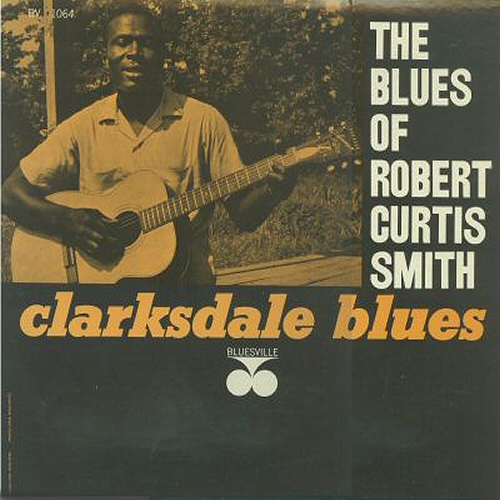
Walton came to be known to the blues collectors who began combing the South as the blues revival got under way. Chris Strachwitz of Arhoolie Records and British blues scholar Paul Oliver came to Clarksdale in 1960 to record him in the Big Six barbershop. They got a bonus from a customer at the time, Robert Curtis Smith, who also played and sang the blues, and whom they also recorded.
In 1961, both Walton and Smith recorded for Prestige Bluesville. The recordings appear to have been set up by blues collector Dan Mangurian, who had first met Walton on a trip to Clarksdale in 1958. The jazzdisco website, a remarkably accurate source for studio recordings by most of the independent jazz labels, is sometimes a little vaguer on field recordings. They list both Walton's and Smith's sessions as having taken place in Clarksdale in the summer of 1962, but it seems almost certain that Walton, with Mangurian, came north to Bergenfield, NJ, by then the office headquarters of Prestige. Did Smith come with them? There's no indication that he did, although why would Prestige have recorded Smith independently of Walton? Stephan Wirz, the German blues scholar whose research is very thorough, says that Smith was recorded in Memphis on July 28, 1961 by Chris Strachwitz, and this would not have been the only Strachwitz session to have been licensed to Bluesville. Production credit, according to Wirz, is given to Strachwitz and Bluesville's Kenny
Goldstein, although Goldstein would not have been likely to have been in the field. Wirz lists the Walton session as having been recorded in Bergenfield in 1962, by Rudy Van Gelder, and that seems unlikely. If Van Gelder recorded it (he is also credited on the album sleeve), it certainly would have been done in Englewood Cliffs. The album cover credits Goldstein as the producer. Wirz notes Mangurian and his partner Don Hill as uncredited producers.
Mangurian's and Hill's first meeting with Walton is documented in the song "Parchman Farm," on the album. This is very different from Mose Allison's "Parchman Farm," and much more up close and personal. Mangurian describes the genesis of the song in the album's liner notes:
"Parchman Farm" is a dramatization of a very real incident involving Wade, myself, and Don Hill...on our summer vacation [from Pomona College in California], Don and I traveled to the South to record folk music and blues in the field. We found Wade in Clarksdale and, while recording, we mentioned that we wanted to go down to Parchman Farm...to record the prisoners singing their work songs. Wade generously offered to take the next day off from work and ride down with us, since he was familiar with Parchman Farm from his childhood days.
Late the next morning we drove the 25 miles down Highway 49 to Parchman. We got a visitor's pass at the main gate and drove down to the chaplain's house figuring he would know the prisoners better than anyone else and help us out. The chaplain, however, was very uncooperative and sent us down to the administration building to wait for the educational director to return from lunch.
We didn't wait long before a stocky man with a .38 at his side stormed in. This was Mr. Harpole, a staunch segregationist as it turned out, who was then assistant warden and noted for his cruelty toward the convicts with his three foot leather strap. He asked us a few questions, then turned on Wade, saying "Boy, if you know'd like I know, you'd be out of here runnin'," and bluntly ordered Don and me to leave with the advice that "we should have known better to come in here with a n*****."
...The incident made a lasting impression on Wade, who later made up this song, weaving together the events in a loose rhyming way. The guitar depicts the seriousness of the situation (which Don and I were naively unaware of) he felt when Mr. Harpole arrived...He ends by saying "We left Parchman Farm, didn't get no race relations done."
Mack McCormick wrote the liner notes for Robert Curtis Smith's Bluesville album. Although
McCormick was unable to resist one more little gratuitous dig at Lightnin' Hopkins ("Unlike many a more fortunate blues singer, there is little self pity in this man"), he did paint a vivid and detailed picture of Smith's life as a Black laborer in Mississippi of the 1940s and 1950s, with a few telling but gruesome asides (Smith's home is a few miles from where Emmett Till was murdered). He describes in some detail the background to Smith's "Council Spur Blues," starting with a landowner named Roy Flowers, "whom Smith describes as 'rich man, but he don't pay nothin.'" Flowers followed what was then a common course of action -- wait for a Black man to get arrested, then go his bail, then tell the Black man that he was indebted to pay off the bail expense -- at a rate dictated by the white man.
Smith had to work for Flowers on the Council Spur plantation.
There he is kept on short rations, in debt to the plantation store and subject to the antics of an overseer who... refuses to let tenants have private vegetable gardens.
Smith's album is called The Blues of Robert Curtis Smith--Clarksdale Blues. His repertoire is bluse songs picked up from local bluesmen and the radio. Walton's is The Blues of Wade Walton--Shake 'em on Down. "Memphis Mango," credited as second guitar on the album, is Dave Mangurian. His songs are familiar blues material and some of his own composition, including two instrumentals. On both these albums, the original compositions referenced in "Listen to One" are powerful socio-historical documents as well as being powerful songs. Both are on Bluesville.
Walton's leadership in the local NAACP and his advocacy for civil rights led to his barbershop being bombed, but he rebuilt, kept working for the cause, and kept cutting hair, making a decent living from a Black-owned business that he never would have gotten from the recording industry. He was voted into the Clarksdale Hall of Fame in 1989, and died in 2000.
Rhoda Scott does not have the same name recognition as other soul jazz organists of her generation, but that's only true if you confine your attention to this side of the Atlantic. Shortly after recording two Prestige sessions, she set sail for France, where she has lived and performed ever since, and where she has become a major star.
This first date in Englewood Cliffs was a brief one, so I'll make this brief, and treat Scott at greater length later on. She recorded four songs with a quartet and vocal group. The second session was just the quartet. Two of the songs from June made
the album that was completed in October; two were released separately on a 45 RPM single. Both the LP and the 45 are credited to the Rhoda Scott Trio, never mind the number of musicians who actually played, and the album is titled Hey! Hey! Hey!, although that song is only on the 45.
The Shouters are presumably the same Buddy Lucas vocal group that recorded for Prestige in April, but augmented here with a male voice (perhaps Lucas; the individual singers are not identified here). If it's an entirely different group called the Shouters, then we have a really odd coincidence, because the combo that recorded with Lucas for Prestige in April, included trumpeter Joe Thomas, not to be confused with tenor saxophonist Joe Thomas who played on this set, although both were born in the same year (1909). had solid careers as swing era musicians, and died within a couple of years of each other in the 1980s.
"Hey! Hey! Hey!" and "If You're Lonely" were the 45, released on Tru-Sound, as was the album.
It seems inevitable that two of Prestige's most dependable soul jazz stars would get together, and for this session, the inevitable happened. Willis Jackson had been one of the pioneers of the organ/saxophone combo with Jack McDuff, who had moved on to a solo career. Johnny "Hammond" Smith was one of the hottest new organ talents around. So the pairing of the veteran and the hot newcome was a natural.
For a veteran and a newcomer, they weren't exactly far apart in age--Jackson was 30, Smith 29. But Jackson had made his first hit record in 1948, as the 16-year-old saxophone soloist of the Cootie Williams hit, "Gator Tail." Williams was the
bandleader, but Jackson was the star, and that hit record gave him the nickname he would carry with him for the rest of his life.
This would be their only joint venture. Smith had already been working with Seldon Powell, another veteran whose career in rhythm and blues went back to the 1940s, and would soon hook up with Houston Person, launching that soul jazz titan's career. Both Jackson and Smith were well into careers that would place each of them among Prestige's most-recorded stars. They are accompanied here by two of Smith's regulars, Eddie McFadden and Leo Stevens, and most of the cuts are Smith compositions. "Y'All" is by Jackson. "Besame Mucho" is the Latin standard, and "Nobody Knows the Trouble I've Seen" the traditional spiritual. What better vehicle for soul jazz than a spiritual? And they get down with it, making it my favorite cut on the album, and one that I'm surprised they didn't pull out for a two-sided 45 RPM single.
In fact, there were no singles from the album, which is a bit of a surprise. Esmond Edwards produced, and the album's title was Johnny "Hammond" Cooks with Gator Tail. the title reflecting the name by which the young organist would eventually be known, as he would drop the "Smith."
LISTEN TO ONE: Experiment in Terror Soft Summer Breeze
An abbreviated session for Jimmy Forrest: three tracks to be added to some leftovers from earlier sessions and released in 1962 as Soul Street. You wouldn't think they'd bring in Oliver Nelson and a nine-piece band for a few add-ons to an album by a less than A-list musician (in marquee recognition, not in quality), but they did, and we are the richer for it.
Maybe Weinstock and Edwards decided, "Hey, look what we did with Oliver Nelson and those songs from All American! Let's see what he can do with some even less promising material."
Maybe, and maybe not. There's only one really unlikely tune. Eddie Heywood's "Soft Summer Breeze" never became the jazz standard it might have, but it's a pretty tune, and quickly recognizable. Duke Ellington is always a good choice, and "Just a-Sittin' and a-Rockin'" is good solid Ellington.
Henry Mancini's "Experiment in Terror" is the odd choice, and liner notesmith Dan Morgenstern seems a little embarrassed by it:
Jimmy gives the rather slight melody more breadth and depth than this Mancini-made slickie really deserves.
"Experiment in Terror" hasn't made the cut as one of Mancini's major works, certainly, but it's an interesting tune, and it's had an interesting, if slight, history. Its 12 interpretations (per Secondhandsongs) suggest that this little ditty had something for everyone, or else that no one could quite decide what to make of it.
Experiment in Terror was a Hollywood thriller, and Mancini's orchestral version for the soundtrack came out as an album of music from the movie. Every cut on the album is jukebox-lengthed two to three minutes, though none of them took the jukeboxes by storm. The melody has a spooky quality, befitting the title, and it also also has a walking bass line, befitting Mancini. Subsequent renditions took it one
way or another, but Mancini had it both ways, a walking bass under swelling strings, at a stately, spooky pace.
It was next taken up by rock and roll instrumentalists the Champs, still looking for a followup to their big hit "Tequila," and in 1962 having added two young musicians named Seals and Crofts, who would go on to make their own name. The Champs went all out Peter Gunn, walking it hard and picking up the tempo.
And still in 1962, Oliver Nelson and Jimmy Forrest. Here the walking bass part is assigned to guitarist Mundell Lowe, and the rhythm starts to swing, and it's very easy to forget that one started out to do a survey of curious versions of this song, and simply get caught up in what these wonderful musicians do with it. The swelling strings are replaced by brass and reeds, and Jimmy Forrest's saxophone gives the rather slight slickie a reading that reminds you that this is Henry Mancini, and he did know how to write a melody. This is a very satisfying outing.
1963 saw terror move to the elevator with versions by Spanish orchestra leader Fernando Orteu and the Living Strings. Then dormant until the 1990s. when it was taken up by La Muerta, a Belgian band who specialized in music for "those abandoned by love or devoid of hope," unsurprisingly a version that emphasized the spooky elements. It was then taken up by surf rockers and pop rockers who also chose spooky over rhythmic. Most recently, contemporary jazzer Ted Nash gave it the Earl Bostic "Harlem Nocturne" treatment. Eclectic instrumentalists Reverend Organdrum returned it to the Peter Gunn sound (with organ and drum doing the walking part), and so did eclectic guitarist Al Caiola.
Maybe if more people had listened to the Jimmy Forrest version, the tune would have become more widely recorded. For one thing, it's the only collaboration I know of between the talents of Henry Mancini and Oliver Nelson.
And it has the guitar work of Mundell Lowe, in his only Prestige session. Lowe is associated more with the West Coast, but actually he was an Easterner until 1965, and recorded frequently for Riverside. Before that, interestingly for such a sophisticated stylist, he was a 16-year-old member of the Grand Ole Opry house band (not an easy gig to get in the city known as Guitar Town). A tour of duty in the army during WWII led to a friendship with John Hammond, who steered him toward jazz.
"Experiment in Terror" was the B side of a 45 RPM Prestige release, the popular "Soft Summer Breeze" on top. And all three tunes became part of Soul Street, a 1962 release on New Jazz.
Was the world really panting for a jazz version of All American? They hadn't exactly been panting for the original version of All American. The musical by Lee Adams and Charles Strouse, who had hit it big with Bye Bye Birdie, ran for 80 performances on Broadway, panned by critics and unloved by audiences. An account of the show's history in Wikipedia is a compendium of wrong moves.
First, the show's producers hired Mel Brooks to write the book, which doesn't sound like a bad idea, except that Brooks was then young and inexperienced. He'd had some success as a TV gag
writer, but didn't know much about writing a play. For one thing, he discovered, plays are longer than sketches for Your Show of Shows, and you had to sustain momentum all the way through them. This proved too much for Brooks to handle, and he gave up when he discovered that after you'd finished the first act, you had to write a second act. So the producers brought in Joshua Logan, who had lots of experience as a successful Broadway director and script doctor, but not so much with the kind of broad sketch comedy favored by Brooks, so the second act ended up not exactly meshing with the first act. Then the producers, sensing trouble, brought in a star--Ray Bolger, the Scarecrow from The Wizard of Oz and a veteran Broadway star. So the script was rewritten around Bolger, which might have been a good idea except for two things: the story wasn't much of a fit for Bolger, and in 1962 no one cared about Bolger any more. Nothing good came out of all of this for the producers of All American, but something eventually did for Brooks: The Producers, inspired in part by this experience.
For all that, a musical can at least sort of succeed if it produces a few hit songs, though by 1962, that was also pretty much an idea whose time had passed. And the score of All American was not the most memorable. The website secondhandsongs.com lists cover versions of over 100,000 songs -- it's not complete by any means, but it's pretty comprehensive and a good resource. Only two of the songs from All American are listed at all on the site, so if there are any covers of the others, they are slim and scattered. "Once Upon a Time." first recorded by Tony Bennett, has had a good run of action among crooners, both pop and country, although not even the Bennett version cracked the Billboard Top 100. Instrumentally, it has mostly been picked up by orchestras like Lester Lanin's and Percy Faith's, with very little jazz interest. Charlie Byrd has recorded it, and Kenny Barron.
The only other song from the score to get any cover action at all is "I've Just Seen Her," which has ten recordings, per secondhandsongs...and all by jazz performers. Terry, followed by Gary Burton, Pepper Adams, Scott Hamilton, Bill Charlap, Scott Hamilton with Bill Charlap.
Nothing for any of the others. Perhaps they weren't very good songs. Certainly, they weren't the hippest of the hip. Nat Hentoff, in the album's liner notes, says rather charitably of Strouse and Adams:
Both are knowledgeable writers for the current state of the Broadway musical, but no one would claim that either or both has more than a peripheral acquaintance with jazz.
One wonders who thought this was a good idea in the first place. Esmond Edwards? Bob Weinstock? Did Weinstock get such a cut rate deal on the score that he couldn't refuse? In any event, a silk purse had to be made out of a sow's ear.
The history of sow's ears into silk purses, in American culture, is an interesting one, and there have been some notable successes. Louis Armstrong turned a fairly pedestrian tune, "Sweethearts on Parade," by square's square Carmen Lombardo, into one of the most sublime jazz vocals of all time. Some would argue that history repeated itself, if not quite as sublimely, with "Hello, Dolly."
There's that great story of film director Howard Hawks trying to convince Ernest Hemingway to write for the movies. Hemingway said he didn't like movies, and every time he saw a movie based on a good book he hated it. "That's because good books don't make good movies," Hawks told him. "But sometimes a bad book can make a great movie. I'll prove it to you. I'll take the worst piece of garbage you ever wrote and turn it into a great movie."
"What's the worst piece of garbage I ever wrote?" Hemingway demanded.
"No question about it. To Have and Have Not."
Hawks, like virtually everyone else, shortchanged To Have and Have Not, which is a pretty interesting novel. But he did make a great film of it.
The poet and classicist David R. Slavitt, who has been praised for his translations of Seneca and Ovid, also published a collection of a little-known Roman author, The Fables of Avianus. Because Avianus was an undiscovered gem? "Heavens, no," Slavitt told me. "Avianus was a terrible writer. This way, all the credit for quality is mine alone."
And it's been reported that Clint Eastwood wanted the challenge of making a quality film out of a perfectly awful novel. Hence, The Bridges of Madison County.
"It was clear to me," Oliver Nelson told Hentoff,
...that without the action on state, Ray Bolger's dancing, and the comedy, the music by itself needed quite special treatment to stand up on a jazz date.
In short, Nelson was nearly as accomplished a diplomat as he was an arranger.
So, did he do it? Did he make the silk purse?
Oh, my yes. It was silk, it was silk and satin and linen that shows, rings and things and buttons and bows. "I've Just Seen Her," the one tune from the show that intrigued some jazz musicians, may be the weakest track here. Nelson has crafted a pure delight, and unexpected delight. Probably no one much took this album seriously. The contemporary website AllMusic.com gave it three stars; there are no listener reviews at all on Amazon, no comments on the cuts on YouTube. So this is one of those gems of a golden age of American that's just waiting there for you to discover it. And it may not be the equivalent of David R. Slavitt and Avianus, because Strouse is certainly an adequate tunesmith, but this is Nelson's music.
Clark Terry must have been scratching his head when Prestige contacted him about this gig. Also the diplomat, he describes, not his first reaction, but his second:
I was surprised at how much Oliver had been able to do with the tunes, not only with regard to making them more interesting harmonically, but also in terms of the naturally flowing rhythm patterns he set them in. And once we all got into it, it turned out to be a thoroughly enjoyable date. As I think the recording shows, we all had a ball.
It does. There's no guarantee that a bunch of performers having a ball will translate into a good time for the audience--look at the Rat Pack's version of Ocean's Eleven -- but in this case, you can hear them having a ball, and you can also hear them digging into miraculous arrangements, and doing right by them.
The band was quite likely a Nelson-Terry collaboration. Les Robinson was a veteran section man with a number of big bands, and was probably known to both men--certainly to Terry, who had played with him on the West Coast. George Barrow was frequently called upon by Nelson, both on baritone, as here, and tenor. He played on Nelson's Prestige sessions, and on The Blues and the Abstract Truth.
Of Budd Johnson, Terry told Nat Hentoff:
It was a great help, of course, to have Budd Johnson along. First of all, no matter what you give him, Budd will swing it. And he has such a solid knowledge of chords that you can't lose him. He always knows what's happening and what can be done to make the proceedings more interesting. You listen to him here. He's like an old pitcher -- he's got so much "stuff" going for him, not only a fast ball, but curves and twisters and changes-of-pace. And always there's that big tone.
This comes back to Nelson again. Not to put down the excellent musicians, including some jazz greats tired of the road, who play in the pit orchestras of Broadway musicals, but the score of a show like All American isn't going to have chord changes so unexpected that they might lose a lesser musician than Budd Johnson.
Eddie Costa played on a couple of Prestige sessions in 1957. Terry singles him out for much-deserved praise as well.
The man simply can't go wrong rhythmically. Eddie also contributed a lot to the good feeling that pervaded the session.
Costa's rhythmic brilliance, especially on the vibes, and his good camaraderie were both approaching a tragic end. In July of that year, just two months later, he would die in an auto accident at age 32.
Esmond Edwards produced. The album was recorded over two sessions. It was released on Moodsville, although it was far from being a Moodsville album. The title, and I appreciate the gentle irony, is Clark Terry Plays the Jazz Version of All American.
Percy Mayfield wrote and recorded "Please Send Me Someone to Love" in 1951, and its quality as a song was recognized pretty quickly. Dinah Washington recorded it in the same year (so, for that matter, did Dale Evans, showing the wide range of the song's appeal--after all, even cowgirls get the blues). And while jazz snobs might look down on rhythm and blues, at least some jazz musicians had more open ears. Count Basie and Joe Williams recorded it in 1955.
I first heard the song, and fell in love with it, in the 1957 doowop version by the Moonglows. That same year, Red Garland introduced an instrumental version of it. Somewhere around that time, I was beginning to fall in love with jazz. That's not quite right. It implies a gradual process. Somewhere around that time, I fell passionately in love with jazz in the space of five minutes and one song. And somewhere not long after that, I heard Red Garland's "Please Send Me Someone to Love."
If you were a teenager in the 1950s, at some point you were supposed to outgrow rock and roll, or so we were told. And rhythm and blues, which was lumped together with rock and roll, and indeed shared many overlaps/ Well, I had heard the clarion call from John Coltrane's horn (and Red Garland's piano, as I would find when I bought the Prestige album). Did that mean that, like the babies in Mary Poppins who spoke their first words in human language and from that instant on could no longer talk to or understand the birds, that I had heeded the cry of battle, crossed the Rubicon, and forever left those other musical genres behind, as I was supposed to.
But I hadn't. And hearing the Moonglows' song (as I knew it then) transformed by Garland, but still the same haunting memory, went a long way toward reassuring me that I was all right.
And I learned to trust my taste. And other jazz musicians were listening, too. Ramsey Lewis recorded it in 1958, Les McCann in 1961. Both had a pop music following, but both were respected jazz musicians. I make that point because, at that time, all these gradations mattered, and to the real purists, any record on the charts was a sellout.
Some other Prestige artists gravitated toward the tune. Davis's frequent collaborator, Shirley Scott, recorded it with an organ trio in 1958. Gene Ammons recorded it on his Argo session in 1962. And Davis included it, along with standards and originals, on this session.
By 1962, Percy Mayfield had endured a long and painful convalescence from an auto accident in which he had been pronounced dead at the scene. He no longer had a career as a rhythm and blues hitmaker, but one of his songs, "Hit the Road, Jack," had been picked up by Ray Charles, and on the strength of that hit, Charles had hired him as a full time staff writer, and would eventually record 15 of his songs.
He had become known as "the Poet of the Blues," and while "poet" is a term that's often thrown around too loosely, it has some validity in Mayfield's case. Specialty Records owner Art Rupe, for whom Mayfield made most of his hit records, praised his artistry while lamenting that he never had the confidence to present himself on a larger stage: "If he could have been encouraged more, he would have been seen as great as Langston Hughes.” I believe Rupe was right.
I haven't posted a "Listen to One" because it would have to be "Please Send Me Someone to Love," and as of this writing, it's not on YouTube. You can find it, however, on Amazon and Spotify (and probably iTunes, but I don't use that service, so can't be sure). Davis plays it beautifully, finding all the yearning, for the fate of mankind and his own happiness, that Mayfield put into both the words and the melody.
I'm glad that Davis was sufficiently drawn to this tune to record it, because he too was affected by the stigma attached to rhythm and blues in those days. In the liner notes, he explains his choice of a piano- over an organ-led ensemble:
I got to the stage where I'd had enough organ. It was always controversial, because a lot of people thought it belonged to R&B, and there's a faction that still refuses to accept the organ as a definite contribution to jazz. I made up my mind to go back to the conventional rhythm section.
This is Art Taylor's 68th appearance on a Prestige recording session, and he is a welcome addition every time. The other three musicians are all making their Prestige debut.
Abandoned on the steps of an orphanage at birth, Horace Parlan developed polio at the age of five, which left him with the use of only two fingers. His adoptive parents encouraged him to play the piano to strengthen his hands, and it was thus that he discovered his true calling in life, though he also studied pre-law at the University of Pittsburgh. He is perhaps best known for his work with Charles Mingus. He would only make one other Prestige session (with Booker Ervin), but he worked and recorded widely with a number of musicians, including a stint in the 1960s as "house pianist" for Blue Note. He also made 31 records as leader--with Blue Note in the 1960s. with the Danish label SteepleChase after his move to that country in 1972, and with other European labels.
Bassist Buddy Catlett built a significant regional reputation, living and working in primarily in Seattle, but also in Denver and other western cities, but he also had his share of the big time, including Louis Armstrong, Quincy Jones, Ella Fitzgerald and Count Basie. Willie Bobo was one of the foremost Latin jazz percussionists of his era, working with Perez Prado, Mongo Santamaria and Tito Puente while still a teenager, later with Mary Lou Williams, Cal Tjader, Herbie Mann and others. He recorded several albums for Verve as leader.
Goin' to the Meeting was the title of the Prestige LP release, and it was also the flip side of the 45 RPM single--"Please Send Me Someone to Love" was the A side. Esmond Edwards produced.
These were tough times for Gene Ammons. His 1960 release from prison had thrown him back onto the mean streets unprepared to battle his addiction, and the need for money and drugs had him working at a fever pitch, in the clubs and in the studio, to support his habit, with the law dogging his heels and finally, late in 1962, arresting him again--a frameup, according to Prestige producer Bob Porter.
Porter, in his important book Soul Jazz: Jazz in the Black Community 1945-1975, describes the arrest:
The arrest warrant charge this time was possession with intent to sell. The case against Ammons was built with all the subtlety of an inquisition. In today's judicial climate, the case would clearly be one of entrapment, but that didn't help Ammons in the Illinois of 1962. He spent more than seven years behind bars.
Ammons, for all the desperation of his private life, was playing wonderfully in those days, and his reputation was burgeoning. Bob Porter states that "Black people began to plan their vacation schedules around his personal appearances. In 1962 alone, he had 13 recording sessions, mostly for Prestige.
The exceptions were a February session for Verve with Sonny Stitt, and some curious recording dates in Chicago in late April and early May. There was a four-song session with Howard McGhee which yielded one 45 RPM single released on Winley, a New York doowop label, and two other songs which came out on Winley compilation albums.
Then there were a series of sessions recorded for Chess, but never released on Chess, because Ammons had an exclusive deal with Prestige, and Bob Weinstock sued and won the rights to the masters. The first of these, on April 27, featured Clarence "Sleepy" Anderson on organ, and unidentified personnel. The next, on May 3, featured Anderson, bassist Sylvester Hickman, and drummer Dorral Anderson. The next day, he recorded with Dodo Marmarosa (piano), Sam Jones (bass) and Marshall Thompson (drums). Some of these recordings were released by Prestige during the seven years of Ammons' incarceration, as Weinstock carefully spaced out releases to keep Ammons's name alive; others only came out in the early 1970s, after Prestige had been sold to Fantasy.
A 45 RPM single, with "I Can't Stop Loving You," recently featured on Ray Charles's Modern Sounds in Country and Western Music, on one side, and "My Babe," a 1955 smash for Chess artist Little Walter, on the other, did get released on Chess subsidiary Argo Records, and later again on Prestige/Fantasy compilations. Also released on Argo, and later on Prestige, was a trio album Just Jug, with Eddie Buster on organ and Gerald Donovan on drums.
In the early 1960s, Prestige experimented with a bunch of subsidiary labels. The significant ones, of course, were Bluesville, Swingville and Moodsville, but there were others.
Prestige Lively Arts mostly featured spoken word recordings. Here are a few: Roddy McDowall Reads the Horror Stories of H.P. Lovecraft, Burgess Meredith Reads Ray Bradbury, Larry Storch Reads Philip Roth, James Mason Reads Edgar Allen Poe, James Mason Reads Herman Melville’s Bartleby, The Scrivener, Morris Carnovsky Reads Dostoevsky’s Notes From Underground. These really are as fascinating as they sound, and YouTube has most of them.
Prestige Irish was what it sounds like, and it was the shortest-lived of the bunch, with only three titles; much more complete was Prestige International, which had folk music of many different countries, but mostly the British Isles. There was some American folk music also, but then a new label, Prestige Folklore, was started in response to the folk boom. One of the folk artists featured was Dave Van Ronk, and it's hard to pass him by without a mention. He recorded an extensive list of the traditional folk and blues songs he loved, 13 of which were released on a Prestige International LP, 12 more on Prestige Folklore.
In 1963 he was back in the studio, this time the Van Gelder studio, to record again, with a traditional jazz band, and that gets him back into the purview of this blog, so we'll take it up when the time comes.
Not much to add here about Van Ronk. He was a powerful figure in the folk music revival of the 1960s, known as "the Mayor of McDougal Street" for his presence on the New York folkie coffee house scene, and he made some wonderful records. Oh, and an anecdote. At about the time he was making these records for Prestige, he did a concert at Brown University, where my brother, Jonathan Richards, was the resident cartoonist for the campus newspaper. They asked him to do a drawing of Van Ronk to promote the concert, but did not provide him with any pictures. So he did the best he could. He drew a burly guy hunched over a guitar, head down, so that all you could see was hair and beard. Van Ronk must have liked it. He used it on his business card for several years after that.
In 1964, Prestige closed all its subsidiary labels.
People tend to remember how the British invasion of the mid-1960s, starting with the Beatles in 1964, changed the face of popular music and put an end to the careers of a lot of American performers. But it's worth noting how it changed the perception of blues. Blues performers had been a part of the acoustic folk music revival that had put down roots in the 1940s with folk singers like Woody Guthrie and Cisco Houston, and had begun to blossom in the 1950s, with folk music coffee houses in northern cities and college towns, and folk festivals, the most significant of which was the 1959 debut of the Newport Folk Festival in Newport, RI, site of the already well-established Newport Jazz Festival. Amplified blues performers like
Muddy Waters or B. B. King were relegated to the "chitlin' circuit" of rhythm and blues and jazz acts whose audiences were primarily, often exclusively Black.
But if white audiences in America weren't listening to Black electric blues people, young British audiences, and especially young British musicians, certainly were, starting with Muddy Waters' first trip to England in 1958. When those electric blues-influenced British musicians started touring America, they were bringing it all back home, to borrow a phrase from another American folk musician turned electric. By the time of the first all-blues festival, in Ann Arbor, MI. in 1969, the electric acts were in the ascendant.
So performers like Sonny Terry and Brownie McGhee, who had once been supporting acts to performers like Pete Seeger, the Kingston Trio, Joan Baez and Bob Dylan (Sonny and Brownie were part of the 1959 Newport Folk Festival), became supporting acts to performers like Howlin' Wolf, B. B. King and the Paul Butterfield Blues Band.
But they always had their audience, and there are many recordings made by the duo over the years to
prove it. They also had the good sense, borne of hardship and working class values, to know not to break up a successful act, so they remained working together for many years, although they famously did not particularly get along with each other. They worked the folk festivals, and the blues festivals, and the college gigs, and...as in the case of this live recording...the coffee houses. The Second Fret was a fond favorite of Philadelphia folk music fans up through the early 1970s, and Sonny and Brownie were always welcome there.
The two singers' repertoire was extensive, with blues written themselves (Sonny's "Me and Huddie Ledbetter") or reworked to fit them ("Brownie's "Me and Sonny," reworked from Sonny's song), or remembered from childhood, or picked up along the way. Or learned from other recordings, as with Bessie Smith's "Backwater Blues," a song about refugees from a devastating flood. It has become associated with the great flood of the Mississippi Delta in 1927, and has been by blues singers who witnessed that flood, and blues singers who didn't--Terry was born in Georgia, McGhee in Tennessee. However, it was written and recorded by Bessie Smith two months before that disaster happened. It's believed to be describing an earlier flood of the Cumberland River near Nashville. Regardless, it is a devastating account of a natural disaster.
Brownie McGhee and Sonny Terry at the 2nd Fret was recorded live, Kenneth S. Goldstein producing the record. It was released on Bluesville.
This was the last Prestige album for Juan Amalbert and the Latin Jazz Quintet, and very near to the end of Tru-Sound Records. It featured Bobby Capers and Bill Ellington, but otherwise a different lineup for this ever-shifting group. Manny Ramos, who played on the Eric Dolphy and Shirley Scott sessions, returns. New on board are vibraphonist Willie Bivens, pianist Willie Gardner, and percussionist Victor Allende.
Bivens, whose father was also William Bivens and also a vibist with swing bands in the 1940s, would go on to play with Pucho and the Latin Soul Brothers. a late 1960s group that recorded for Prestige and merits a footnote in jazz history as the group where Chick Corea got his start. Bivens also was part of one Grant Green album for Blue Note.
Victor Allende played with other Latin groups, and on a couple of Prestige albums later in the decade--one with Willis Jackson, and the other with George Braith, and album that would become a cult favorite.
It's hard to chart Willie Gardner's career. He seems to have recorded with Johnny Hodges in 1968. Beyond that, it gets murky. There are a number of credits for pianist/organist Billy Gardner, but it's not at all clear whether they're the same person. In most sources, they seem to be divided. Billy Gardner is credited on Allmusic.com as recording with Dave Bailey, George Braith, Charlie Rouse and others, but not with Hodges or Amalbert, so that would suggest two different artists. On the other hand, though the personnel list on the album credits Willie Gardner, Billy Taylor, in his liner notes, calls him Billy.
Amalbert's Latin Jazz Quintet was very much a jazz ensemble. Taylor describes him as:
...multilingual verbally as well as musically, [so] he has an unusually large heritage of rich, expressive and exciting sounds and rhythms to choose from. By carefully selecting musicians whose talents he admires and whose feelings are compatible with his own, the energetic leader of the LJQ has blended what he considers the best musical elements of the North and South American musical traditions and emerged with his own conception of "Latin Jazz."
Amalbert and Ellington appeared with Pharaoh Sanders on an extremely obscure album called Oh! Pharaoh Speak, which was credited to The Latin Jazz Quintet - Featured Guest Artist Pharoah Sanders - Under The Direction Of Juan Amalbért. There was a second collaboration between the LJQ and Eric Dolphy, but this one was without Amalbert.
The Tru-Sound release was entitled The Chant, and the group was credited as Juan Amalbert's Latin Jazz Quintet Esmond Edwards produced.
One of the wonderful things about jazz is its capacity, more than in almost any other music, to surprise you. Sometimes it surprises you with how unexpected it is, and it doesn't have to be on today's cutting edge to do that. You can listen to Charlie Parker and still be seized by a phrase that sounds as if it had been recorded this morning. You can listen to Louis Armstrong for the hundredth time and suddenly understand all over again what Miles Davis meant when he said that there's nothing you can play on the trumpet that Armstrong hasn't played already, including the modern stuff.
And sometimes it just surprises you with how right it is.
That's the case with this Swingville album by three guys who come to play, and who know how to play. And for many of them, with not much chance to record any more, which is why we're so grateful for this Swingville series. Verve was another label that kept classic jazz alive, but it tended to concentrate more on a few major stars.
That last was not so true of Ben Webster. He, Coleman Hawkins and Lester Young formed the legendary triumvirate of classic tenor sax, and although Young lost the battle to illness and addiction, Hawkins and Webster went on recording prolifically throughout the 1950s and 1960s.
Surprisingly, though Webster's career as a leading jazz artist goes back as far as the 1930s, he doesn't seem to have recorded as a leader until the mid-1950s. But he made up for lost time, first with a number of albums for Verve/Norgran, then with a variety of labels right up until his death in 1973 (his last is one of my personal all-time favorites, recorded in Spain three months before his death with the Belgian pianist Tete Montoliu, released as Gentle Ben on the Spanish Ensayo label and as Did You Call? in the US on Nessa).
Ben Webster
Benny Carter lived to be a national treasure and also sustained an active recording career, making his last recording in 1995 at age 87. Like Hawkins, he made a number of recordings for Norman Granz, for Verve and Norgran in the 1950s, and later, in 1970s-80s, for Granz's Pablo Records. For both Carter and Hawkins, this was their only Prestige session.
Webster and Carter developed reputations that were not bound by an era or a genre. Barney Bigard, best known for his stints in the Ellington (1927-42) and Armstrong (1947-55 and 1960-61) orchestras--so closely associated with these two giants that is autobiography was entitled With Louis and the Duke--was much more associated with jazz nostalgia. In this session, he's able to join the other two B's in what I've come to think of as the Swingville style -- music played by swing era veterans with a modern touch, although Bigard, on clarinet, edges them a little more toward nostalgia.
The session was recorded in Los Angeles, so it features some West Coast musicians not customarily heard on Prestige recordings. One such is trumpeter Shorty Sherock, who did a lot of West Coast studio work, particularly with Nelson Riddle, with whose orchestra he can be heard backing up Frank Sinatra, Dean Martin, Ella Fitzgerald and others. He also played with Jimmy Dorsey and Gene Krupa, and was a charter member of Norman Granz's Jazz at the Philharmonic in 1944. Another full-time denizen of the West Coast was bassist Leroy Vinnegar, best known as one of the trio, with Andre Previn and Shelley Manne, who created the mega-selling hit record My Fair Lady Loves Jazz.
Jimmy Rowles was more West Coast than not, although as one of the most sought-after accompanists of female jazz singers (Carmen McRae described him as "the guy every girl singer in her right mind would like to work with") he traveled a lot. His reputation as an accompanist almost overshadows his work in instrumental settings, but a healthy cross section of major jazz instrumentalists, and he recorded prolifically as a leader, in trio settings or with larger groups, even singing on at least one album.
Dave Barbour was the one girl singer in particular wanted to work with. After a busy career in the 1930s, he married Peggy Lee and was her arranger/bandleader/co-writer ("Mañana," "It's a Good Day") until their 1951 divorce. After that he more or less dropped out of music--this session was one of his rare appearances.
Mel Lewis was more bicoastal, and is probably best known for the big band he co-led with Thad Jones for many years at the Village Vanguard in New York. He had played a couple of earlier Prestige gigs.
Leonard Feather produced, and wrote two of the numbers on the album ("Opening Blues" and "You Can't Tell the Difference When the Sun Goes Down Blues." Carter wrote the other two. The album was entitled BBB and Co., and was released on Swingville.
This was John Wright's last album for Prestige, before retreating back to Chicago and the inside of a bottle, finally emerging from that trap to become a legendary figure in that neighborhood which he had apotheosized with his first album, South Side Soul, and in doing so he had created a persona that would remain with him for the rest of his life. He was Mr. South Side Soul, and a beloved figure on the South Side of Chicago.
Musical Chicago is probably most associated in the public mind with the guitar and harmonica-based blues of Muddy Waters, Howlin' Wolf, Little Walter, Junior Wells and Buddy Guy, But the piano had its place in Chicago blues, too, with performers
like Memphis Slim, Champion Jack Dupree, Big Maceo Meriwether, and Otis Spann. One of the chief architects of the Chicago blues sound was Willie Dixon, and he got his start playing the bass in a jazz trio led by Leonard "Baby Doo" Caston, a pianist in the Nat "King" Cole style that was so popular in the early 1940s.
The piano jazz faces of Chicago in the modern era were Ahmad Jamal and Ramsey Lewis, and John Wright could well have made them a triumvirate, but for the alcoholism that took so many years from him. Even so, though he never broke out to national recognition like the other two, Chicago knew him, and his Wright Gatherings became a local musical tradition.
Like Jamal and Lewis and Caston, the piano trio was his favored lineup, and for this album, in addition to Prestige regular Wendell Marshall, who had worked with before, he used drummer Walter "Baby Sweets" Perkins, a Chicagoan who had gotten his start with Jamal.
The album features four Wright compositions and one by Esmond Edwards, whose compositional
contributions were extremely rare on the many records he produced, for Prestige and elsewhere. The other three are by composers not close to the center of modern jazz, although "What's New?" by trad jazz stalwart Bob Haggart has become a much-loved standard for a wide range of jazz performers down to the present day. "Our Waltz" is by David Rose and "Blue Prelude" is by Gordon Jenkins, both pop music orchestra leaders. "Our Waltz" is not completely unknown to the world of jazz musicians always with open ears to a good melody with improvisational possibilities: both Gary Burton and Rahsaan Roland Kirk recorded it in the early 1960s. "Blue Prelude" has a little something for everyone. In addition to the many pop singers and
orchestras that have recorded it, it's been country (Bob Wills, David Houston), rhythm and blues (Sam "the Man" Taylor), and Latin (Candido, Jack Costanzo). Outside of Wright, the closest it's come to a modern jazz interpretation is George Shearing, who recorded it twice, once as an instrumental and once with Peggy Lee. Wright finds good things to explore in it, taking it somewhat more percussively and explosively than it's used to being taken--and, in fact, it became the 45 RPM single release from the session, along with his own composition "Strut."
Edwards produced, and the Prestige release was entitled Mr. Soul.
Etta Jones's career followed a familiar arc: Apprenticeship, a breakthrough and a pinnacle of success, a period of decline. For Jones, the toiling in the fields stage was a long one--her first recording in 1944, with Barney Bigard. Her rise was meteoric when it finally came. After recording singles off and on through the 1940s and 1950s, and one little noticed album for King in 1957, she broke out with her debut album for Prestige, 1960's Don't Go to Strangers, which sold a million copies, made Billboard's top 40 with the single, and was nominated for a Grammy. She would remain on Prestige's roster for the next five years, and record eight albums, but would never have another hit like Don't Go to Strangers, would never make a significant dent in the DownBeat and Playboy polls. So...an unusually long gestation period, a brief moment of glory (sadly, not all that unusual) and then a long period of declining popularity. But that long period was super-long, as a core of devoted listeners never went away, as her career spanned six decades, until he death in 2001, just after she had recorded her last album. After leaving Prestige, she began a collaboration with saxophonist Houston Person which lasted 29 years. And while she may never have
gotten the recognition she deserved, there was always enough demand for the music she and Person made to keep her working. Nor was she completely overlooked--there were further Grammy awards in 1981 and 1998.
Jones recorded three sessions for Prestige in April and May of 1962, the middle one of which was logged as a Gene Ammons session.
The two sessions were mingled together on the album, Lonely and Blue. The tunes from the April 13 Ammons session (Bown, Duvivier, Walter Perkins on drums) were included on a compilation album. Soul Summit No. 2, and later added to the CD reissue of Lonely and Blue.
It's a wonderful album. The songs are a mix of standards and little known tunes, ballads and blues, all of them good songs with intelligent lyrics that Jones understands and conveys from the inside out. The songs Ammons's and especially Johnson's tenor sax presage her work with Houston Person, warm, romantic, meticulously phrased and passionately delivered, voice and saxophone meshing and playing off each other.
Because her songs with saxophone and piano/guitar are each so distinctive, I have to give a Listen to Two for this album, and even then it's hard to choose. I went with two of the more obscure cuts. "Gentleman Friend" was written by Richard Lewine and Arnold B. Horwitt for a 1948 Broadway Revue called Make Mine Manhattan, which had a decent run and is best known for being the Broadway debut of Sid Caesar. It was pretty much the highlight of Lewine's an Horwitt's careers, though they both did respectable work in the music business. "You Don't Know My Mind" is by Clarence Williams, prolific tunesmith and one of the first successful Black music publishers.
Jones is featured on the three tracks of the Gene Ammons session, recorded shortly before he began his second prison term. The session was split over two compilation albums also featuring cuts by Jack
McDuff: Soul Summit and Soul Summit, Vol. 2. Among their other significant virtues, these albums showcase how good, and how underused, Patti Bown was. A second Ammons session, the next day, this one with Shaughnessy, was released on Moodsville.
Lonely and Blue was a Prestige release. Esmond Edwards produced both days, and the Ammons sessions. The Jones / Richardson session produced a 45 RPM single, "And I'll Be There" / "In the Dark." The 45 RPM single off the first Ammons session was "The Party's Over / "I Want to Be Loved;" off the second, "On the Street of Dreams" / "You'd be So Nice to Come Home To."
This is a fascinating and nearly unclassifiable piano trio outing with a strange and totally unclassifiable parentage. It was originally part of an album on two British labels, Operators and Stateside. The album was called A Pair of "Naturals," and it was a most unnatural pairing indeed: on the one hand, Walter Bishop Jr., known as a bebop pianist; on the other, the Peter Yorke Orchestra featuring the London Strings and the Top Brass of London. Yorke was, as you may have surmised from his billing, a conductor and composer primarily of light classical music, also noted for his orchestrations for dance bands. So
perhaps they got together when Bishop was over in London playing a gig with a dance band? No, they don't seem to have gotten together at all. Yorke's contributions to the album were recorded in London, Bishop's in New York.
Perhaps a clue in the labels they recorded for? Not much there, either. Operators was a short-lived label that brought out a handful of 45 RPM singles by singers so obscure that I can find no biographical information on them (except one, "Johnny Lindy," only because he gave up singing and became a successful TV producer under his real name). They recorded no other light classical music, no other jazz, and no other LPs. Stateside was more successful, but equally un-oriented toward either light classical or jazz. They basically did the same thing Operators did -- licensing American pop records for British release, but they had quite a few hits, starting with Freddy Cannon's "Palisades Park" and grabbing the early Motown catalog, before Motown established its own British presence.
Peter Yorke had a fine and successful career in Britain, having nothing to do with either jazz or Prestige, but Walter Bishop's contribution, from this and a later session, was eventually brought out by Prestige as The Walter Bishop Trio/1965, although the recordings were made in 1962 and 1963, and the record was released in 1970.
So, nothing more to do but talk about the music itself, and it deserves mention, although I'm not quite sure what to say about it except that it's wonderful. Bishop's main claims to fame are as a bebopper, but this is a long way away from bebop. It's almost jarring and perverse enough to be free jazz, but it can in no way be remotely compared to what Coleman or Coltrane, Dolphy or Ayler or even Cecil Taylor, were doing. Bishop's left hand lays down a solid groove, but this is not remotely soul jazz. So...bebop but not bebop, free but not free jazz, solid groove but not soul jazz, and not exactly a solid groove, either...throw in some block chords and it's sort of like Thelonious Monk, then? Yes, except for not being at all like Monk. Best to take a listen for yourself, and then talk it over with a real musical expert.
Wilbert Hogan, also known as Wilbur Hogan, Granville Hogan and G. T. Hogan, has appeared on Prestige a couple of times before, with Earl Coleman and Jesse Powell. He was working regularly with Bishop in the early 1960s. Butch Warren was a youngster of 22 who had already collected quite a resume. The son of a part time musician in the Washington DC area, he grew up in a house full of musicians, and began playing the bass when an instrument got left behind in his father's music room by Billy Taylor (the Ellington bassist, not the piano player). At 14, he started playing in his father's band. At 19, he was asked to sub for a bassist who didn't show up for a Kenny Dorham gig, and Dorham invited him to come to New York, where he made his first recording on an album initially released on a tiny label as The Arrival of Kenny Dorham, and later, sadly, as The Kenny Dorham Memorial Album. Drug addiction and mental illness cut Warren's career short, and by the mid-1960s he had retreated from the jazz scene.
You have the history of this recording session. Time to check out the music.
Tru-Sound, Bob Weinstock's "modern rhythm and blues" label, was not one of his more successful ventures, although it did hang on until 1963, when Weinstock folded most of his subsidiary labels (Bluesville and New Jazz hung around another year). But there weren't that many releases, and most of them--certainly the most successful--were by King Curtis. Buddy Lucas was one of the last artists to sign with the label, and if Weinstock was looking for a genuine rhythm and blues professional, he had come to the right man. Lucas had been recording R&B since joining Wynonie Harris in 1950, and had started recording with his own combo for Jubilee Records in 1951. An early two-sided hit for Jubilee set the pattern for his 78
RPM singles: a ballad on one side and an uptempo, honking blues on the other. That he was prized for both can be demonstrated by two of the biggest hits he played on: Frankie Lymon and the Teenagers' "Why Do Fools Fall In Love" and Little Anthony and the Imperials' "Tears on My Pillow." He was one of the most in-demand session men for rhythm and blues and rock and roll throughout the decade, and into the 1960s. Around the same time that he recorded this album for Tru-Sound, he played one of his best-known tenor sax solos, on Dion's "The Wanderer."
The 1960s also saw him getting calls for jazz recordings, with Clark Terry, Seldon Powell, Illinois Jacquet, Jack McDuff and others, one of the most unusual being free jazz pioneer Albert Ayler, on New Grass, an album Ayler made for Impulse! to show that he had a more poppish, commercial side, not entirely successfully. Unusually for a saxophone player, Lucas also doubled on the harmonica. He recorded on that instrument with King Curtis, Lou Donaldson, Thad Jones (also jaw harp), Yusef Lateef, Johnny Hodges, George Benson and many others. A number of female singers used his harmonica sound, including Laura Nyro, Aretha Franklin, Roberta Flack, and, most notably, Nina Simone on her recording of "Since I Fell For You." He was even called in to overdub a harmonica part on a posthumous Jimi Hendrix recording.
Lucas recorded his Tru-Sound albums over two Englewood Cliffs sessions in March and April. He
surrounded himself with good players for his first dates as a leader with a jazz label that had prestige in more than just its name, and some remarkable singers. Wally Richardson, Bob Bushnell and Herbie Lovelle were Prestige veterans. Al Williams (piano for the March 31 session) had been playing professionally since the 1930s; his resume included Henry "Red" Allen, Buck Clayton and Johnny Hodges. Robert "Bobby" Banks's career stretched from 1950s to the 1980s; during the period of this recording and through much of the decade he worked with Solomon Burke. He replaced Williams on piano for the the April 22 session. Carl Lynch was one of New York's most sought-after session guitarists from the 1940s through the 1970s. one of the mainstays of Phil Spector's sound, and featured on such anthemic recordings as James Brown's "Say It Loud (I'm Black and I'm Proud)" and Nina Simone's "Young, Gifted and Black."
Both sessions were logged in as Buddy Lucas and the Shouters, but the Shouters, Lucas's vocal trio, were only there for the April 22 date. They were three girl singers better known in those days as members of Cissy Houston's vocal group, the Sweet Inspirations. One of them, Sylvia Shemwell, remained with the Inspirations as they backed up Aretha Franklin and Elvis Presley, among others. The other went on to solo careers. They were a pair of sisters named Warwick -- DeeDee and Dionne.
The Tru-Sound release was titled Down Home Turn Around. It was also released on Prestige's budget label, Status, as That's the Blues Man. Two 45 RPM singles came from the session, "Hocus Pokus" / "Show Down" and "Down Home Turnaround" / "April Showers."
Question: What's the difference between classic rhythm and blues and soul jazz?
Answer: About three minutes.
That's the difference between the Lester Young-influenced, Illinois Jacquet-influenced, Texas roadhouse-bred, Apollo-developed, blues-based sound tenor saxophone wailing and improvising over a rock-solid groove in the 78-45 RPM era, and the LP era. Jazz With a Beat, jazz with a funky beat. And with, in the soul jazz era, a little more room to open up and try different improvisational attacks over that groove.
What about the organ, that distinctive signature sound for soul jazz? Doesn't that make it different?
Not entirely. Bill Doggett, Sil Austin, Doc Bagby and others had had rhythm and blues hits. Jack McDuff had joined the Gator to play rhythm and blues, and when the group signed with Prestige, they brought their saxophone-organ-guitar sound with them, and used it to play the longer form jams--in other words, the ones they had always played on the chitlin' circuit, but had had not been able to bring to the recording studio.
Willis Jackson had brought McDuff into his group as a bass player, and had made the inspired choice to convert him to an organist, so he knew something about nurturing organ talent. That means it's no surprise to find Freddie Roach, on the cusp of a breakout career, joining Jackson's band for this session. Roach had recorded two albums with Ike Quebec for Blue Note, and by midsummer of 1962 he was back at Blue Note to record four albums as leader. He would return to Prestige for a couple more sessions in the late 1960s, after which he stopped recording. He lived in France for a while, then California, by which time his interest had switched from jazz to the theater, where he gained something of a reputation--apparently under another name--as a playwright. He died in 1980.
Roach, along with frequent Jackson collaborators Bill Jennings, Wendell Marshall and Frank Shea, create the groove. Ray Barretto, in his second sax-organ soul jazz gig, adds the extra touch that he always does. And Jackson provided the rest. All of this comes together most emphatically on the Jackson composition "Thunderbird." When you put "Bird" in the title of a jazz composition, it's always going to suggest one thing. Bird With a Beat certainly became a rhythm and blues staple, with "Now's the Time" becoming the basis for Paul Williams's hit instrumental "The Hucklebuck." Here, there's no one Parker tune that "Thunderbird" takes off from, but Bird's improvisations on the blues are a strong inspiration.
Willis Jackson had become a mainstay of Prestige records and would remain so throughout the 1960s. This, produced once again by Esmond Edwards, was his seventh album for the label. It was released on Prestige, as was the 45 from the session, "Thunderbird," also the title of the album, "Thunderbird" was the flip side of Jackson's version of "Jambalaya."




:format(webp):mode_rgb():quality(40)/discogs-images/R-6190628-1435635634-4479.jpeg.jpg)


:format(jpeg):mode_rgb():quality(40)/discogs-images/R-3153323-1318204458.jpeg.jpg)


:format(jpeg):mode_rgb():quality(90)/discogs-images/R-4254366-1380052923-8496.jpeg.jpg)


:format(jpeg):mode_rgb():quality(90)/discogs-images/R-7814698-1460576211-9729.jpeg.jpg)


