Tad Richards' odyssey through the catalog of Prestige Records:an unofficial and idiosyncratic history of jazz in the 50s and 60s. With occasional digressions.
Gigi Gryce had a short but influential career. Besides his groups co-led with Art Farmer, he worked with Thelonious Monk, Oscar Pettiford and Donald Byrd. He was conservatory-trained, and as good an alto player as he was. he was perhaps even more highly regarded as a composer than as an instrumentalist, in the classical as well as the jazz world.
He had started to make his reputation on the 1953 tour with the Lionel Hampton band, which contained a number of rising young moderns who made several recordings on their own in Sweden, Switzerland and France (Hamp was not pleased, but they weren't entirely pleased with the wages he was paying, so that balanced out). Gryce and Quincy Jones were the two hot new composer/arrangers to come out of that tour, and in fact Gryce paid tribute to the competition with one of his originals, "Keepin' Up With Jonesy."
Art Farmer was one of the other young guns on the Hampton tour, and he and Gryce stayed close after the tour ended.
This session showcases Gryce as a composer. "A Night at Tony's," "Deltitnu" and "Blue Concept" are all Gryce originals. "Stupendous-Lee" is variously credited, depending on which site you look at, to either Gryce or Farmer. Allmusic has it variously credited to each of them on different pages of its site. But I'd say the evidence points to Gryce. Most jazz titles ending in "-Lee" are either written by or tributes to Lee Konitz, but this one was written for Gryce's wife, Eleanor "Lee" Sears.
These are all terrific tunes, and they've had some traction. Dizzy Gillespie recorded "A Night at Tony's"; so did Art Blakey and the Jazz Messengers, and Art Farmer and Horace Silver have recorded it with their own groups. "Blue Concept" was also recorded by Horace Silver, and the song itself can boast of an all-star section of trumpeters, each of whom has recorded it with his own group: Art Farmer, Donald Byrd, Nat Adderley, Clifford Brown. "Deltitnu" has become a favorite of Postmodern jazz-rock bands, as well as a go-to tune for a number of the musicians who played on its premier recording, with Gigi Gryce et son Orchestre.
Speaking of jazz compositions, there is one thing that drives me a little nuts, and generally ends up making me feel really ignorant, and that is the genealogy of songs. Why is "based on the chord changes" so important to jazz writers? Here's from the Jazz Lead Sheets website, and I don't mean to single them out, because everyone does it:
Like many other jazz composers, Gigi often liked to borrow a "standard" chord progression, then create his own melody. That often led him to adjust the original chord progression, in places, to fit his new melody. The bridge of A Night At Tony's is a good example of this, since Gigi's bridge melody alters the original chord progression of Charlie Parker's Yardbird Suite. However, on the recording the musicians play solos on the original Yardbird Suite 'changes.'"
OK, so it's a different melody AND different chord changes, so why is it still "Yardbird Suite?" Why is it even based on "Yardbird Suite"? I'm just a simple lyricist, but if I write a song based on the chord changes to Heartbreak Hotel, I'm also writing a song based on the chord changes to "You Are My Sunshine" or "Sink the Bismarck" or "Hoochie Coochie Man" or about a million other I-IV-V songs. And if the soloists play solos based on different chord changes than the changes Gryce wrote the melody to -- and obviously they're playing a different melody, or it wouldn't be an improvisation...in other words, why does everyone who writes about jazz make such a big deal out of this "based on the chord changes" thing? And "Yardbird Suite" may or may not be based on the chord changes to Earl Hines's "Rosetta," which has the same chords, only different.
If I write a sonnet, am I basing it on Petrarch's chord changes?
Anyway, if I were going to write a song called "A Night at Tony's," and base it on the chord changes to a jazz classic, I'd base it on "A Night in Tunisia."
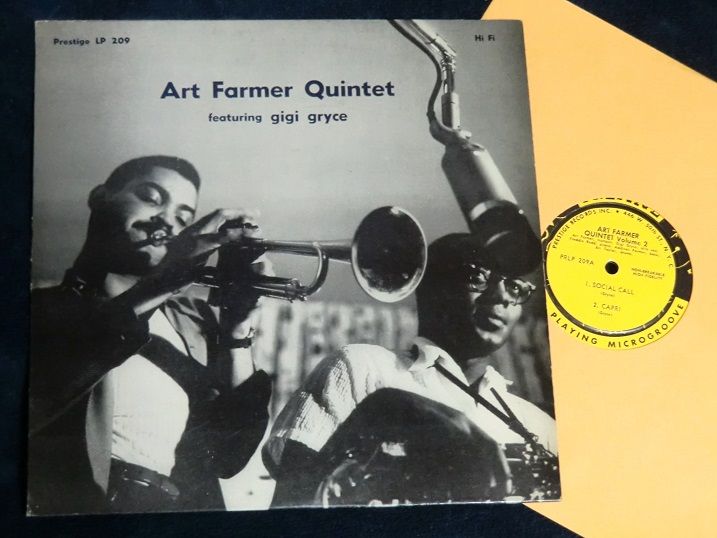
This one only came out in LP format, first on a 10-inch under Farmer's name, then as the 12-inch LP When Farmer Met Gryce.
Perhaps the only thing better than listening to Thelonious Monk is listening to Monk play with someone who really gets him, who is in perfect harmony with Monk's moods and Monk's ideas and Monk's tempi. That's why it's such a moment of pure satisfaction to hear the tenor sax take his solo at around 2:20 of "We See," and realize that yes, yes, he's got it, and he gets Monk.
And sometimes -- as was the case this time -- you listen to the music before you read the set notes, and then you go back to check the personnel, and the identity of Monk's soulmate both surprises and delights you.
If there's any musician who is inextricably connected with one bandleader, it would be Frank Foster and Count Basie. Foster played with a variety of musicians who encompassed a variety of styles, but it's hard to think of him without thinking of Basie. He joined the Count in 1953, the year before this session with Monk, and his final bow as leader of the Count Basie Orchestra came in 1995.
But listen to him here, especially on "We See," which may be my favorite, by a close margin, of four great cuts. Foster and Ray Copeland play the head in a jaunty fashion -- swing filtered through Monk. Monk takes an extended solo, with some powerful assistance by Art Blakey and Curly Russell, and then close to two and a half minutes in, Foster hits with his solo, and there's no way to miss being struck by how right it is. Ray Copeland follows -- and he's right too -- and then Foster again.
I should say something about Copeland, too. He was one of the unsung but in-demand sidemen of this era, and later a valued jazz educator before his early death in 1984. He had played with Monk before, and was supposed to be on the earlier Prestige date with Sonny Rollins and Julius Watkins.
I love to hear Monk's originals -- he's one of the greatest jazz composers -- and I love to hear him play standards. "Smoke Gets in Your Eyes" has it all. Great work with the melody, great ensemble work, completely unexpected and always appropriate piano work from Monk, beautiful solos by the others.
"Locomotive" builds of a "Now's the Time"-reminiscent riff. "Hackensack" is a tribute to Rudy Van Gelder's hometown, and Van Gelder comes through on this entire session, making every instrument clear and vivid (you really get a sense of how good Curly Russell is). "Hackensack" has a blistering solo by Copeland, and a wonderfully creative solo by Blakey.
But finally, the lasting impression from these four tunes is: for all Monk's deserved reputation as an eccentric genius and iconoclast, he was one hell of a bandleader. These arrangements, the unison parts, the way Monk counterpoints the unison parts, the way he sets up the others for their solos...just listen.
These were released on a 10-inch and a couple of 12-inch LPs, Monk and We See.
This is James Moody's second stateside session for Prestige, and again he's surrounded himself with the same group of fellow Dizzy Gillespie big band alumni, including trombonist William "Shep" Shepherd, not to be confused with trombonist Shep Shepherd, one of the composers of "Honky Tonk," and not to be confused with trombonist William Shepherd, contemporary musician and music educator. And while we're at it, not to be confused with "Shep" Sheppard, doowopper of "You're a Thousand Miles Away" and "Daddy's Home." Moody's band also includes sax player and Gillespie alumnus PeeWee Moore, but he's an easy one. He only has to not be confused with the PeeWee Moore who was a sax player and a Dizzy Gillespie alumnus.
The only thing I can say for certain about Jimmy Boyd is that he's not to be confused with the Jimmy Boyd who sang "I Saw Mommy Kissing Santa Claus." Google references a 2006 club date in Phoenix by Jimmy Boyd, "one of the best jazz pianists around," and I hope it's the same guy. Maybe not. Vocalist George Townes recalls playing with Coltrane in the early days in Philly, and a bass player named Jimmy Boyd, who he says is now out of music and selling real estate in California. And Grant Green died on the way to a 1979 gig at Jimmy Boyd's Breezin' Lounge in Harlem.
I know I have a penchant for obscure digressions, but this is a stretch even for me. But it's all part of the great warp and woof of American music.
1954 is a little late for the golden era of bebop-rhythm and blues crossover, but Moody has spent a few years in Sweden, so maybe no one told him. Or maybe he didn't care. Moody always had the rare ability to satisfy the purists and entertain the young 'uns. So the first cut here features an R&B vocalist, Iona Wade, who cut several sides for fairly obscure R&B labels, but never really broke through. She has a Dinah Washingtonesque style, and she's good.
Moody's also catching the latter part of the bebop meets mambo era, and
again he's a welcome addition, playing a Quincy Jones composition..
Drummer Joe Harris, Dizzy alum and house drummer at the Apollo Theater,
carries the responsibility of an entire Latin percussion section, and
pulls it off.
These tunes were released on two 78s, on an EP, a 10-inch LP, and later as part of a 7000-series LP, Moody's Workshop.
1956 was the big Miles Davis marathon, in which Miles finished up his obligation to Prestige in a blaze of glory, one session after another, so that he could move on to Columbia. But he was almost as busy in 1954. His March quartet session at Beltone was followed by two in April at the Van Gelder studios, and there'd be more before the end of the year.
Each of these sessions featured a different front line (well, the first one was just Miles, which may not exactly make a line), but mostly the same rhythm section. Horace Silver, Percy Heath and Kenny Clarke had come together for the Art Farmer session. Miles had used Art Blakey for the March quartet session, but Clarke was on drums for these two.
The quintet for the April 3 session included Davey Schildkraut on alto. Schildkraut was a veteran at
29, having gotten his first major professional gig at 16, with Louis Prima. He had early on heard the siren song of bebop, and mastered it to the point that when Charles Mingus was given "I'll remember April" on a Leonard Feather blindfold test, he identified the alto player as Charlie Parker.
Actually, Parker and Schildkraut overlapped a few times in the early 50s. There's a live recording of Bird with Stan Kenton -- I had never known they played together -- from a couple of months before the Miles session, with a Kenton reed section that includes Schildkraut. And there's a session from 1953, released on the Roost Jazz label in 1990 as More Unissued, Vol 2. That is, more unissued Charlie Parker sessions. But the alto player on that date has since been authoritatively confirmed as Davey Schildkraut.
Bill Holman, who was Kenton's arranger while Schildkraut was with the band, sees no similarity between the two. In an interview with Schildkraut student Rob Derke, Holman said:
Dave had a completely introspective way of playing...and played according to how he felt at any particular time. A lot of guys take the easy way out and say ‘Oh, another bebop alto player so we’ll compare him to Bird.’ I never heard [Schildkraut] using Bird’s or anyone else’s licks, it was all completely original and I really enjoyed hearing his playing for that reason.
"Solar" is based on the chord changes for "How High the Moon," and as I've stated before, I never know quite what to make of "based on the chord changes." Pretty much every blues, country and rock and roll song is based on the same three chords. I looked up "How High the Moon chords" on Google, and the chords to the Les Paul version, which is the most familiar one, are a little different from the chords in another jazz standards fake book. Anyway, I don't always hear the melody in a bebop "based on the chords" version of a standard, but I can hear "How High the Moon" in "Solar." The same chord changes were used by Chuck Wayne in a composition called "Sonny," recorded in 1946 and unissued (and uncopyrighted). Wayne claimed that Miles had ripped off his melody, and maybe he did. The general consensus is yes. I don't know the difference between ripping off a melody and basing a melody on chord changes. Anyway, here's a bit of the Chuck Wayne tune on a scratchy acetate, if you're interested. "Solar" became a jazz standard, although Miles never recorded it again.
"Love Me or Leave Me," based on the chord changes to "Love Me or Leave Me," is so firmly ensconced in the public consciousness as a pop song, thanks to great pop renditions by Doris Day and Sammy Davis, Jr. (I'm too young to remember Ruth Etting), that I had never really thought of it as a jazz standard until I heard the Miles Davis version. After that, I spent a little time seeking it out, and found jazz vocal versions by Nina Simone, Billie Holiday, Anita O'Day and others; instrumental versions by Benny Goodman, Lester Young, Gerry Mulligan--and, in a more modern setting, Tuba Skinny. I've always loved the Sammy Davis, Jr., version, with its rapid-fire faux scatting, ending with the exhortation, "Blow, Sam!" I always thought he was cheering himself on, but recently it's occurred to me that it must be Sam Butera coming in with the sax solo.
But ever since I first heard the Miles recording, it's been the definitive version for me, and I was glad to spend some serious time listening to it and absorbing it in preparing this blog entry.
Miles is best known, for most of his career, for playing with a Harmon mute, but he experimented with different mutes before settling on the Harmon. On this session he used a cup mute, and it suits "Love Me or Leave Me" perfectly. The tune is taken at an uptempo bebop pace, and yet it still maintains a plaintive, bluesy tone. There are two ways of approaching "Love Me or Leave Me."
There's the torchy, moody Doris Day/Billie Holiday way, the lost lover who'd rather be lonely than happy with someone else, or the slap-happy Sammy way, you can love me, you can leave me, what do I care? I'm here for the rhythm and the chord changes and the chance to wail out, and "blow, Sam!" Miles manages to do both.
The sextet session came at the end of the month, with the same rhythm section and a new front line.It became immediately, and remains, one of the most potent sessions in the Davis canon. New Yorker jazz critic Whitney Balliett called it "some of the best jazz improvisations set down in the past decade." Both cuts are amazing, but "Walkin'" will send nonstop chills up and down your spine.
Davis bolted Prestige for Columbia for a number of reasons. One of them was money. One was that Columbia had...well, more prestige than Prestige. But one was that Columbia wanted him to put together a regular group, while Bob Weinstock had wanted him to play with a variety of musicians:
So our basic idea was just to make records with different people, to record
with the best people around. That's what we did until the end, when he
had the quintet with John Coltrane, Red Garland, Paul Chambers, and
Philly Joe Jones. But everything up to that point developed from where
we would sit down and talk about it. Miles would mention who was in
town, who he would like to record with. I'd say who I'd like to hear him
record with. We'd kick ideas around.
If I sound like a cheerleader for this entire era of music, and for everything that Bob Weinstock, Ira Gitler, Rudy Van Gelder and the Prestige record company did, I'm OK with that. These are a fan's notes, and this era, this label, stands as one of the great gifts to American culture and the American Century in music. So I'll say it. The Miles Davis quintets and sextets were inspired, and the source of great art. But we are just as lucky to have these records with different people, with the best people around, with the ideas that were kicked around. One suspects, from what one knows about Miles, that after a while he didn't want to kick ideas around with anyone, except maybe Gil Evans.
But we have these records. This rhythm section, with Horace Silver really starting to come into his own. And different front lines for Miles to jam with--and jamming was what it was. Jamming was the Bob Weinstock philosophy,
J. J. Johnson was one of the true beboppers, there from the beginning.
I knew very little about Lucky Thompson. I have his Tricotism album, so I knew he was good. I knew that he'd played the expatriate game for a spell. Allmusic.com has an excellent bio by Jason Ankeny, which I recommend.
I discovered that Thompson was called "Lucky" because "of a jersey, given him by his father, with the word "lucky" stitched across the chest," not because he ever had any luck in his life. His mother died when he was five, and from that early age, he became responsible for taking care of his younger siblings. He always loved music, and always wanted a saxophone, with such passion and dedication that he "carved imitation lines and keys into a broom handle, teaching himself
to read music years before he ever played an actual sax. According to
legend, Thompson finally received his own saxophone by accident -- a delivery company
mistakenly dropped one off at his home along with some furniture."
Thompson was one of those guys who moved from swing to bop -- he played with Erskine Hawkins and Lionel Hampton before arriving on 52nd Street, where he was asked to fill in for Ben Webster at the Three Deuces, and "Webster, Coleman Hawkins, Lester Young, and Art Tatum were all in attendance at Thompson's debut gig, and while he deemed the performance a disaster (a notorious perfectionist, he was rarely if ever pleased with his work), he nevertheless quickly earned the respect of his peers and became a club fixture."
Ankeny describes Thompson's sound as "never fit[ting] squarely within the movement's paradigm -- his playing boasted an elegance and formal power all his own, with an emotional depth rare among the tenor greats of his generation."
It was battles with the jazz establishment, particularly record label owners, more than racism that drove Thompson to Paris, and that would drive him in and out of the music business.
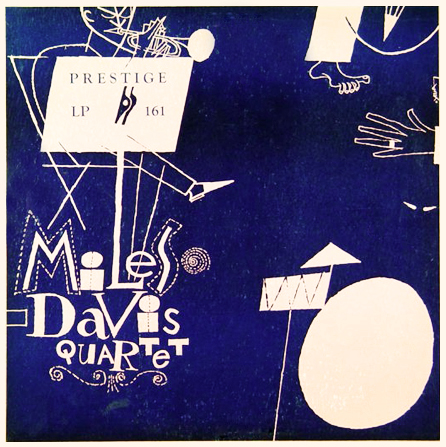
"You Don't Know What Love Is" was the flip side of "Old Devil Moon" on a 45, and "Walkin'," split in two, made both sides of a 45. These would be the first Prestige singles to come out on 45 and not 78. The sextet sessions were also released on 45 RPM EPs and a 10-inch LP. The quintet sessions also had a 10-inch, and the two sessions were combined on the 12-inch Walkin'.
Horace Silver and Percy Heath packed up from their session with one of the noblest peers of the trumpet realm and moved on to the Dark Prince himself, this time with Art Blakey on drums.
You look back at these years and you can see how often a small label like Pre stige or Blue Note, or Dial or Roost, was able to get Art Blakey or Kenny Clarke or Max Roach to anchor a session. No wonder jazz was so great back then.
Miles didn't seem to care for the Prestige studio. His early recordings tended to be somewhere else, often the WOR radio studios, but he had used Beltone, located at 1650 Broadway, across the street from the Brill Building and nearly as legendary in the music business, before. No Rudy Van Gelder, and I had imagined this whole scenario when Silver and Heath showed up for the gig.
"Say, man, you gotta check out this cat's pad in Hackensack."
"Oh, yeah? What's in Hackensack?"
"This cat. He built a recording studio in his folks' living room."
"Huh."
"No shit, Miles, this dude got a sweet little setup. He made Art Farmer sound better than you."
"No motherfucker sounds better than me. What'd you say this cat's name was?"
Nice bit of fancy. And it could have happened that way, except for one thing. Miles had recorded at the Van Gelder studio the previous week. So why not for this session? Who knows? Maybe Blue Note had already booked the space, or maybe the senior Van Gelders were having folks over for dinner, or maybe Rudy had optometry patients scheduled for that day (he still made his living as an optometrist, getting amazing quality of sound for the legends of jazz not exactly paying the bills).
This is an important session because of course it's an important session. It's Miles Davis. It's still the period of experimentation -- Bob Weinstock recording Miles in different settings, before the quintet. It's the first recording of "Four," which was to become a staple of the Davis repertoire.
"Old Devil Moon" is a lovely, moody ballad by Burton Lane and E. Y. Harburg which has been recorded by nearly every jazz singer (including, a little surprisingly, Mose Allison), and by some of the best ballad interpreters in jazz, including Sonny Rollins, Stan Getz and Chet Baker. Miles, working in a quartet setting, has ample space to explore its smoky beauty.
"Blue Haze" is another Miles composition, and while it didn't become the staple that "Four" did, it's an equally beautiful tune, and it's a showcase for the other members of the quarter, particularly Percy Heath, who opens the piece with an extended solo.
Prestige, in 1954, was still wedded to the 78 for single release. "Blue Haze" came out on one 78 as parts I and II. The 78 of "Four" was b/w "Old Devil Moon," unaccountably retitled "That Old Devil Called Love." "Old Devil Moon" also made it to 45 RPM, under its real name, b/w "You Don't Know What Love Is" from a later session. The EP continues to be the 45 format of choice, though, and the whole session did come out on an EP, and on a 10-inch LP, as well as various reissues, including Miles Davis Plays for Lovers.
There are the trumpet players who one listens to with reverence. The ones who changed the face of American music with their vision and their talent. Louis Armstrong, Dizzy Gillespie, Miles Davis. They would be pretty much everyone's list. Then there are the trumpet players who seem to capture the essence of jazz music: the ones you listen to and say "yes, that's what I love about jazz." A jazz fan will have her/his own list here, but a whole lot of those lists would include Bix Beiderbecke. And Roy Eldridge. And Clifford Brown.
And Art Farmer.
And all I can think, listening to this oddly forgotten session (released on a 10-inch and then buried, not included on any of the 7000-series Prestige releases of the 50 sort of brought out on the less-distributed New Jazz label in 1961, then not again until the 7600 reissue series in 1969, pretty much the end cycle for Prestige) is what a wonderful session this is. It's everything that makes me love jazz.
Art Farmer broke in with Wardell Gray on the session that introduced "Farmer's Market." He did the septet session with Quincy Jones arrangements for Prestige in the summer of 1953, then headed for Europe on the Lionel Hampton tour that produced a series of recordings. This was his first session back in the States, as a leader, and it should have been his breakthrough to jazz stardom, and maybe it was. He certainly was back in the studio a number of times in 1954.
Sonny Rollins was with him on this date, and Rollins is another of those everything that makes me love jazz guys.
If there's ever an artist whose name is synonymous with a jazz label, it's Horace Silver and Blue Note.
He had actually started with Blue Note in 1952, first with Lou Donaldson and then as leader, and Blue Note kept him pretty busy, but during 1953-54 he also found time to record with Lester Young (released on the Italian Philology label and on Ambrosia), Sonny Stitt (Roost), Al Cohn (Savoy), both Art Farmer and Miles Davis on Prestige, and a few others. He had already started what became one of Blue Note's most famous groups, the Jazz Messengers, with Art Blakey. Blakey was to lead the group for years, but originally it was Horace Silver and the Jazz Messengers.
The session kicks off with "Wisteria," an achingly beautiful ballad (I believe an Art Farmer original) that has wonderful work by everyone, but perhaps especially Horace Silver. "Soft Shoe," again by Farmer (there's a Gerry Mulligan composition called "Soft Shoe," but it's different) picks up the tempo, with the boppish ensemble riffing and inspired soloing that presages Farmer's work with Benny Golson in the Jazztet.
"Confab in Tempo" confabs in a blistering set by Kenny Clark, followed by some great high-octane bebop, with Clarke pushing it all the way and coming back for a wild drum solo.
"I'll Take Romance" was written by Ben Oakland (also known for the Ink Spots' great novelty "Java Jive"), with lyrics by Oscar Hammerstein. It's probably best known in the pop rendition by Eydie Gorme. There's a hipper version by June Christy, but Eydie did right by the song. Its cool passion and flowing lyricism make it a great choice for jazz improvisation, and it's been recorded by Max Roach, Bud Shank, Kenny Dorham, McCoy Tyner and others. It's a good way to end the set.
This is the second session to be recorded in Rudy Van Gelder's studio. I wonder if it was difficult to cajole musicians into trekking out to Hackensack in the middle of January. It certainly wouldn't have been difficult to get them to go a second time, once they'd heard the results.
The early 50s were a busy and productive time for Jimmy Raney. Like so many of the beboppers who recorded for Prestige, he had come out of the Woody Herman orchestra, where he had connected with Stan Getz. Next he joined Artie Shaw, with Shaw's experimental group that wedded swing to bebop with results that were musically rewarding, commercially disastrous. He spent 1951 and 1952 mostly with Getz, and then spent some time at Juilliard studying with Hall Overton--in 1953 he was to bring those two influences together on his first album as leader, for Prestige. He'd also recorded with avant-gardist and fellow Hall Overton student Teddy Charles. So he'd experimented pushing the edges of bebop from both sides.
But Raney was a bebopper at heart. His first mentor was Al Haig, who had been the pianist on his first significant gig, with Jerry Wald's dance band. There's a wonderful bio on a web page maintained by one of Raney's sons, Jon, where he talks about Haig's influence and his dad's early development:
He did some serious woodshedding with the records that Al Haig recommended to him, in particular Charlie Parker’s and studied them religiously. Not only did he study Parker solos, but also Bud Powell’s, Dizzy’s and Miles. Because he really didn’t have a definitive example of bebop on guitar, he took it upon himself to translate the language particulars of each instrument. So for example on the piano transcriptions, he picked more, on the horn solos, more slurs. He also found different ways to execute the same idea on different strings so that he could connect his ideas and not be locked into any particular position. His picking technique was not one exclusive method – i.e. sweep picking, alternate picking etc. but rather a hybrid. He decided early on that if he just went for the sounds his solutions, with a little bit of patience and diligence, could be worked out organically. His goals were very modest at that point. He simply wanted to be the best bebop interpreter on guitar he could be. This was probably one of the keys to his success. He had a really good foundation in bebop’s linear excellence and a great work ethic that eventually would blossom into full artistry.
He has the opportunity to do some wide open, joyful, swing-to-bebop picking on this Swedish session.
Two Teddy Charles veterans, one from each coast, are united in Sweden. Sonny Clark had played on Charles's West Coasters session with Wardell Gray. He was doing a European tour with Buddy deFranco's band. He would return to the US. and the East Coast, as Dinah Washington's piano player, and then do a lot of major work for Blue Note before his untimely death in 1963. This and the Teddy Charles session were his only work for Prestige, so I'm lucky to have this one.
The principal Swede on the session is tenor man Gosta Theselius, and he wails too, meshing perfectly with the coastally and racially integrated American duo. Sweden proved a meeting ground not only for coasts, races and nations, but also genders. The drummer on the date was Elaine Leighton, best known for accompanying Billie Holiday and playing with the Beryl Booker trio. She was in Sweden in 1954 as
Jimmy Raney with Elaine Leighton
the drummer with the Beryl Booker all-girl trio (Booker, Bonne Wetzel, bass, and Leighton) that was part of the Jazz USA tour (with Billie Holiday, Buddy de Franco, Red Norvo and others) that came to Europe in 1954. The tour was organised by Leonard Feather. The Beryl Booker trio was being promoted by Feather at the time. Feather also had the trio in his 'Cats vs. Chicks' session for MGM that opposed a Clark Terry-led 'Cats' group (with Lucky Thompson, Tal Farlow, Kenny Clarke) to a Terry Pollard-led 'Chicks' group (with Norma Carson, Mary Osborne and the Beryl Booker trio including Elaine Leighton). [from the Organissimo jazz discussion forum]
The second part of the session featured clarinetist Putte Wickman, I was able to listen to "Darn That Dream," an extended version of over six minutes which is all Raney for the first half, dreamy and romantic, with Wickman matching his mood when he comes in at the end.
These were recorded for Metronome in Sweden. Prestige released them on EP and 10-inch LP.
An important Prestige date. James Moody is back in America, ready to begin to make his mark as a leader, to begin a career that would last six decades and establish him as one of the giants of American music. He entered the studio with a septet composed mostly of bandmates from the Dizzy Gillespie big band, and joined on one cut by Eddie Jefferson, who had written the vocalese interpretation of his solo on "I'm in the Mood for Love" that was to bring fame to both Moody and King Pleasure.
But more than anything that happened in front of the mike, this session is notable, even historic, for what was happening on the other side of the mike. This was the first Prestige recording session to be engineered by Rudy Van Gelder.
Rudy Van Gelder can be said to be the first person to take the craft of recording modern jazz seriously. He made it clear from the start that he was not a producer, he was a recording engineer. He didn't choose the musicians or select the tunes or run the rehearsals (well, this was Prestige, so there were no rehearsals). His job -- the job he invented for himself -- was to make musicians sound on record the way they sounded in the studio. He worked with the musicians, to get the sound that they wanted.
Van Gelder had begun engineering sessions for Blue Note the year before. By the end of the decade, he would be the go-to guy for every jazz label.
Rudy Van Gelder first became interested in sound recording at the age of 7, when he acquired a $2.98 home recording machine, and from there, he began tinkering, improving, making his own recording devices. He went to school for optometry, and began his practice in 1942, at the age of 18. All through the fifties, as he was becoming the most acclaimed sound engineer in the business, he continued to support himself as an optometrist. But his heart was always with sound recording. By 1946, he was already recording local musicians, and when his parents were building a new house in Hackensack, New Jersey, he asked his father if they would include a living room that would double as a recording studio.
I'm trying to picture asking my father to do something like that. In the first place, I can hear him saying "Look, you're finally making something of yourself as an optometrist. It's a living. Stick to that." In the second place, a living room is a fairly important part of most people's houses, and it's generally built around entertaining, displaying tchotchkes, and generally being a space that the neighbors would admire. But as Van Gelder remembers it, in an interview with Marc Myers of JazzWax,
When my father was having the blueprints done, I asked him if I could have a control room with a double glass window next to the living room. I wanted to perfect the techniques of contemporary music recording.
JW: How many months of begging did it take?
RVG: None. My father agreed immediately. He knew how passionate I was about the music and the process of recording. Passion mattered to both my father and mother.
JW: What did you tell your father—or the architect?
RVG: I asked that the living room be as large a space as possible, within the footprint of the house. My father’s architect decided to accomplish this by making the living room ceiling higher than the rest of the house, which made for great acoustics.
Exactly what Van Gelder did to capture the essence of a musician's sound was his secret, and pretty much remains his secret today. It's said that he would put dummy mikes up around his studio, so that no one ever knew exactly which mikes were live for a recording. He was the first to use a German-made Neumann condenser microphone, which had a sensitivity that enabled the capturing of subtleties of sound.
In March of 1952, Van Gelder recorded saxophonist Gil Mellé for an independent label that never got off the ground. But the masters of the session were brought to Alfred Lion at Blue Note. He liked Mellé's sound and decided to record him, but none of his attempts sounded anywhere near as good. So Lion decided he needed to meet the engineer who had done the original session.
And the rest is history. Van Gelder recorded Mellé for Blue Note in January of 1953, and everyone in the industry listened to that record the way they had listened, in 1942, to Charlie Parker's solo on the Jay McShann orchestra's recording of "Sepian Bounce" -- with the knowledge that a door had been opened that would never be closed again.
These were released on two 78s, on a 45 RPM EP, and on a 10-inch LP. Later, they were included on a couple of 7000-series LPs, Moody and Moody's Workshop.
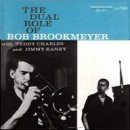
Teddy Charles is back from the West Coast, where he stayed away from the musicians of the emerging West Coast school, like Brubeck and Mulligan, because he "didn’t want to do the West Coast cool jazz thing that was so popular then. Frankly I didn’t care for the West Coast style of playing... Not enough urgency." And the first thing he does on his return to the East is to get together with Bob Brookmeyer, who was just about to decamp for the West Coast and some memorable collaborations with Mulligan.
Actually, I suspect that Charles and Mulligan would have been a great combination, partly because Mulligan could play with anyone, partly because Charles brought out something new and interesting in anyone he teamed up with--and actually, Brookmeyer brought some of that same experimental spirit with him when he joined forces with Mulligan.
Brookmeyer came out of the Claude Thornhill orchestra, which seems to have been an exceptional proving ground for important jazz arrangers. Mulligan and Gil Evans also started with Thornhill. But for most jazz chroniclers, Brookmeyer's careeer begins in earnest when he joined Mulligan on the West Coast. This session with Teddy Charles seems to be overlooked, which is too bad. He shares co-leader credit with the more established jazzman, and deserves it. The lead passes back and forth between the two, and a real conversation is created.
Nancy Overton, wife of Charles's mentor Hall Overton, appears as vocalist on "Nobody's Heart," playing the role of Haunted Hipster, in a vocal performance that owes more to Ken Nordine than Annie Ross or June Christy. In an odd followup, Overton was soon to join the perky, sweet barbershop harmony stylings of the Chordettes, though not in time for "Mr. Sandman."
"Nobody's Heart" was released on a 78 along with "So Long Broadway" from the West Coast group with Wardell Gray. All four were released on a ten-inch under the dual leadership banner, and later on 12-inch under Brookmeyer's name twice: once on Prestige and once on New Jazz.
As I go back over my earlier entries, thinking about preparing them for a book, I run across a few sessions that I wasn't able to find and listen to at the time, but have since been able to rectify that problem. Moody worked with a lot of Swedish musicians during this period, and most of them were pretty good -- certainly all must have benefitted from playing with him, and the other Americans who made Sweden a second home during this period. Dave Liebman, in an article on European jazz, says "the typical Swedish jazz musician is the best overall equipped craftsman around." By 1953 Prestige would have released 11 albums made in Sweden and featuring Swedish musicians, either with or without an American star such as Moody or Stan Getz or Lee Konitz, and in 1954 Lars Gullin, who I don't believe ever toured the US, won the Down Beat award as best new talent. And the Swedish musicians brought a lot of Swedish folk music into jazz, most notably the tune originally known as "Ack Värmeland, du sköna"/"Värmlandsvisan," perhaps better known by the title Stan Getz, Miles Davis, John Coltrane and others recorded it under: "Dear Old Stockholm."
James Moody, after a three-year apprenticeship in Dizzy Gillespie's big band, went to Europe in 1949. New York, the road, and the jazz life of the late 40s had put him in harm's way, and his mother was worried about his drug use. She had an uncle in Paris, and she asked him if he would take young James in and get him away from bad influences. He stayed in Paris until September of 1949, then decamped for Sweden, then Switzerland, then Paris again, and then Sweden again in the fall of 1951 before returning to the United States. He did a lot of recording in Europe. These were his first sessions as a leader, and a powerful period of growth and maturity for him, from age 23 to 25. Sweden wasn't necessarily the best place to escape drugs -- Lars Gullin had a lifetime heroin, and then methadone, addiction, which ultimately led to his death from a heart attack at age 48.
But people find different ways to their creative voices, and Moody found his among blond-haired Vikings. His most famous recording, the one that came to be known as "Moody's Mood for Love," was cut on his first visit to dear old Stockholm.
This session, or rapid-fire series of sessions, came in January of 1951, shortly before he returned to the States. He was into the studio for three days, with a virtual revolving door of Swedish musicians (well, what else was there to do in Sweden in January?) , including a string section. Charlie Parker With Strings had first been released in 1950, and records didn't travel as easily back then as mp3s do today, but the idea of playing modern jazz with a classical string section certainly started with Bird, and if Moody hadn't heard the records, certainly he must at least have heard of them. There are some who question Parker's decision to record with strings, though not too many by now. And if there were more people to hear Moody's two cuts (they're pretty hard to find), there might be those who'd question them too, but actually it's hard to see how. He does some of his strongest soloing and improvising on "Cherokee." And the interplay between Moody and the string section on "Pennies From Heaven" is inspired -- witty, imaginative, musical. There's also a wonderful piano solo from Rolf Larsson, a musician whose reputation never traveled far beyond Sweden.
All of these were originally released on Sweden's Metronome label, but all of them were picked up pretty quickly by Prestige and issued on 78 and 10-inch LP -- a plucky call on a young and relatively unknown expatriate. Although by 1951, he wasn't quite so unknown, was he? Not after the jukebox success of "I'm in the Mood for Love."
What were some of the highlights of 1953 on Prestige for me? It continues to be all good--hard to choose. I continued to have the pleasure of acquainting myself with Teddy Charles, on both coasts --and on his first West Coast session, I had to say goodbye to one of my jazz heroes, Wardell Gray, making his last record for Prestige. Billy Taylor entered the picture, including an album with Joe Holiday.The Modern Jazz Quartet was back in the studio, making some of their finest records, and backing up Sonny Rollins. And also (minus Milt Jackson) backing up King Pleasure on "Parker's Mood," which has to get the nod as my favorite of the year. Django Reinhardt died. A late December issue of Billboard reports that as the year drew to a close, Hoagy Carmichael had filed suit to recover the rights to 14 of his songs, including Stardust. I hope he won. And a package tour featuring Stan Kenton, Errol Garner, Dizzy Gillespie and Slim Gaillard, called "Festival of Modern American Jazz," prepared to hit the road. Highlights of the year in jazz would have to include the Massey Hall concert, later to be reissued as "the greatest jazz concert ever," and you could make a strong case for that: an all-star cast of the progenitors of bebop. Of course, you could also make the same case for any gig by Louis Armstrong's Hot Five.
Can someone talk DownBeat into digitizing their archives and making them available online? I'd still like to be able to put what's happening in the clubs into this year-end wrapup, but that information is not available online anywhere I can find. Billboard archives are mostly available through Google Books (although not easy to search) but their jazz coverage is surprisingly sparse. Variety's archives are online, but they're only available by subscription, and it's pricey.
Downbeat's polls are online, so here they are:
Readers' Poll
Critics' Poll
Hall of Fame: Glen Miller
Best Record-Popular: Ray Anthony, Dragnet (Capitol)
Best Record-Jazz: Woody Herman, Moten Stomp (Mars)
Best Record-Rhythm and Blues: Ruth Brown, Mama, He Treats Your Daughter Mean (Atlantic)
Best Record-Classical: Arturo Toscanini, NBC Symphony, Respighi:Fountains of Rome/Pines of Rome (Victor)
Dance Band: Les Brown
Jazz Band: Stan Kenton
Big Band: Duke Ellington
Combo-Instrumental: Dave Brubeck
Acoustic Jazz Group: Dave Brubeck
Vocal Group: Four Freshmen
Alto Saxophone: Charlie Parker
Alto Sax: Charlie Parker
Tenor Saxophone: Stan Getz
Tenor Saxophone: Stan Getz
Baritone Saxophone: Gerry Mulligan
Baritone Sax: Harry Carney
Trumpet: Chet Baker
Trumpet: Louis Armstrong
Trombone: Bill Harris
Trombone: Bill Harris
Clarinet: Buddy DeFranco
Clarinet: Buddy DeFranco
Drums: Gene Krupa
Drums: Buddy Rich
Vibes: Terry Gibbs
Bass: Ray Brown
Bass: Oscar Pettiford
Guitar: Les Paul
Guitar: Barney Kessel
Piano: Oscar Peterson
Piano: Oscar Peterson
Accordion: Art Van Damme
Miscellaneous Instrument: Don Elliot-Mellophone
Arranger: Ralph Burns
Male Singer (Not Band): Nat Cole
Male Vocalist: Louis Armstrong
Girl Singer (Not Band): Ella Fitzgerald
Female Vocalist: Ella Fitzgerald
Male Singer (With Band): Tommy Mercer
Girl Singer (With Band): Lucy Ann Polk
The New Yorker covers the NYC club scene, but they still have a kick against modern jazz. They list every club in New York featuring Dixieland or trad jazz, but none of the modern clubs except for Birdland (their New Year's acts are Count Basie and Terry Gibbs).
We do have the quirky and hard-to-figure list of Best Albums of 1953 from rateyourmusic.com. I can't figure out how they compile their lists -- they're member-voted, but how they compile the votes remains a puzzle. Anyway, I like quirky, and their list of the top 400 albums of the year, any genre, gives a pretty complete picture of the jazz that was released that year. I've pulled the jazz albums out of the complete list, which includes classical, pop, folk and spoken word. No easy listening, because that category didn't exist yet. There was, however, mood music, like Jackie Gleason Presents Music for Lovers Only--one of those albums to which Gleason gave his name for the album cover, along with two martinis, two cigarettes in ashtray, a clutch purse and --woo woo!--a room key. And nothing else. Gleason didn't exactly play an instrument, compose or conduct music. No Rhythm and Blues or country, because no one was putting them on albums yet.
Here's the list.
2. Duke Ellington and His Orchestra -- Ellington Uptown (Columbia) 4. Thelonious Monk Trio -- Thelonious (Prestige) 5. Peggy Lee --Black Coffee With Peggy Lee (Decca) 7. Jay Jay Johnson Sextet -- Jay Jay Johnson With Clifford Brown (Blue Note) 8. The Dave Brubeck Quartet --Jazz at Oberlin (Fantasy) 9. Duke Ellington --The Duke Plays Ellington: Piano Reflections (Capitol) 13. Bud Powell --Jazz at Massey Hall: Volume Two (Debut) 14. The Gerry Mulligan Quartet plus Lee Konitz --The Gerry Mulligan Quartet Plus Lee Konitz, Vol. 3 (Swing) 17. Erroll Garner--Erroll Garner (Columbia) 18. Charlie Parker--Charlie Parker (Clef) 20. Miles Davis --Miles Davis, Vol. 2 (Blue Note) 21. Laurindo Almeida & Bud Shank --Brazilliance Vol. 1 (World Pacific) 22. Stan Kenton--New Concepts of Artistry in Rhythm (Capitol) 24. The Quintet--Jazz at Massey Hall: Volume One (Debut) 25. Chet Baker--Chet Baker Quartet Featuring Russ Freeman (Pacific Jazz) 26. The Quintet--Jazz at Massey Hall: Volume Three (Debut) 27. Oscar Peterson --Plays Duke Ellington (Mercury) 28. Billie Holiday --An Evening With Billie Holiday (Clef) 29. Oscar Peterson --Plays George Gershwin (Mercury) 30. Buddy DeFranco --Mr Clarinet (Verve) 32. Elmo Hope Trio --New Faces - New Sounds (Blue Note) 34. Dizzy Gillespie --Dizzy in Paris (Contemporary) 36. Gerry Mulligan--Gerry Mulligan Quartet (Fantasy) 37. Miles Davis --Young Man With a Horn (Blue Note) 41. Gerry Mulligan--Gerry Mulligan Quartet (Pacific Jazz) 42. Stan Kenton --This Modern World (Capitol) 44. Gerry Mulligan --Gerry Mulligan Quartet (Pacific Jazz) 47. George Lewis --Jazz Funeral in New Orleans 50. Miles Davis --Blue Period (Prestige) 52. Wynton Kelly --New Faces - New Sounds (Blue Note) 53. Stan Kenton --Sketches on Standards (Capitol) 55. Django Reinhardt --Quintet of the French Hot Club, Vol. 1 (Dial) 60. Kenny Drew Trio --New Faces - New Sounds (Blue Note) 61. Miles Davis --Miles Davis Plays the Compositions of Al Cohn (Prestige) 62. Stan Kenton --Portraits on Standards (Capitol) 63. Oscar Peterson --Plays Cole Porter (Mercury) 67. Horace Silver Trio --New Faces - New Sounds (Blue Note) 70. Louis Armstrong --Louis Armstrong & Earl Hines (Philips) 74. Sidney Bechet --Dixie by the Fabulous Sidney Bechet (Blue Note) 85. Gerry Mulligan --Gerry Mulligan and his Ten-Tette (Capitol) 96. Lee Konitz / Gerry Mulligan Quartet --Lee Konitz Plays With the Gerry Mulligan Quartet 98. Stan Kenton --Popular Favorites (Capitol) 99. Hank Jones --Urbanity (Clef) Shorty Rogers, Gil Mellé, Harry James, Charles Mingus & Spaulding Givens, Stan Getz, Howard McGhee, Billy Taylor, Benny Carter, Flip Phillips, George Wallington, Johnny Smith, Sarah Vaughan, Jimmy Raney, Art Tatum, Gene Krupa, Wilbur De Paris, Sonny Stitt, Benny Goodman,Shelly Manne, Lionel Hampton, Jelly Roll Morton, Quincy Jones, George Shearing, Howard Rumsey, Count Basie, Jackie and Roy, Teddy Charles, Pete Johnson, Don Byas, Cal Tjader, Charlie Mariano, Mongo Santamaría, Woody Herman, Carmen McRae and Harry Edison also made the list.
I would probably have put Jazz at Massey Hall higher on the list. Probably Peggy Lee lower. I'm not sure why I kept Lee on but dropped singers like Nat "King" Cole and Jo Stafford. I just did. Blue Note introduced a number of young performers, one of whom--Horace Silver--became a linchpin of their label. And how many Stan Kenton albuns could Capitol release?
Getting near the end of the 78 and the 10-inch LP eras, but they're still making the scene a Prestige. On to 1954, where, although I don't really look ahead to see who's coming into the studio, I can tell you that we'll see an important addition to the Prestige family.
My 100th blog entry in this Prestige project, and the last session of 1953. Still loving the music, still privileged to be able to write about it. The year ends with another session by Billy Taylor and his trio. Given that Prestige, or the companies that later acquired the Prestige catalog, reissued nearly everything, and given Billy Taylor's continuing popularity, these are surprisingly difficult to find, but they're worth the effort.
Taylor was going for tuneful on this set, and he succeeds. "That's All" is a melody by Bob Haymes, brother of crooner Dick Haymes, and in 1953 it was still a new song. It had been recorded by Nat "King" Cole but hadn't really become a hit. Ben Webster also did a jazz version of it in 1953, but certainly Billy Taylor was one of the first to discover its possibilities as a jazz vehicle. The Wikipedia entry on the song insists a little too stridently that it is a part of the Great American Songbook, which it really isn't. The pages were closing on that volume by 1952, and Bob Haymes didn't make much of a mark in the history of American popular music. But Alec Wilder loved the song enough to include it in his American Popular Song: The Great Innovators, 1900-1950, even though it doesn't actually make the cutoff, and he gives his reasons eloquently.
First, it is one of the last free-flowing, native, and natural melodies in the grand pop style. Second, it has had a curious career insofar as it went through no initial hit phase but became an immediate standard...“It is verseless and of conventional A-A1-B-A form. The use of octave jumps in the release should produce monotony, there are so many of them. But, due to the mysteries of creation, they don’t. ...It’s one of the warmest, most natural, and least ‘studied’ songs I know.”
"Nice Work if You Can Get It" is a favorite of mine and of many jazz musicians. Hip and tuneful, it's a Gershwin melody introduced in 1937 by Fred Astaire, and almost immediately a standard of both pop and jazz. Teddy Wilson's was probably the first jazz recording, with Billie Holiday and Buck Clayton. Taylor gives it the respect it deserves and the swing it demands.
In a sense, any jazz rendition of "Nice Work" is an homage to Teddy Wilson, who made it his own. "The Little Things" is a Teddy Wilson tune, and on it Taylor shows that he knows where he came from, and that he knows who he is.
"The Surrey With the Fringe on Top," a homey paean to a white small-town yesteryear by Rodgers and Hammerstein, is an unlikely jazz standard. That it has become one is generally credited to Miles Davis's ultra-cool 1957 version, but Billy Taylor beat him to it by a few years, and was the first to show how the tune can swing.
The songs were released on two 78s, and under two different titles on EP -- Billy Taylor and Billy Taylor Trio, Vol. 2. Also on a 10-inch LP called Billy Taylor Trio Vol. 3 -- go figure -- and later on a 12-inch 7000-series LP called Billy Taylor Trio, Vol. 2. Since then, there have been no reissues, which is just wrong.
King Pleasure's version of "Parker's Mood" is one of my favorite records of all time. I've let it be known that it's the song I want played at my memorial service, assuming anyone wants to organize one for me. It is so close to my heart that it's difficult to write about it.
And right up there alongside it is Charlie Parker's recording of his own mood. It's one of the few--perhaps the only one of Bird's original compositions that he only recorded once, so that one recording stands as the perfect, the Platonic ideal representation of this tune. And deservedly so.
Other musicians have recorded "Parker's Mood." There's an odd but enjoyable swing version by Jimmie Lunceford, a respectful tribute by Roy Hargrove and Christian McBride, a somewhat less respectful but eminently listenable version by James Moody on a 70th birthday live album. Supersax was a strange and fascinating Parker tribute band that played note-for-note replications of Parker's recordings with five saxophones and brass.
But the two recordings that count are Bird and King Pleasure. Bird emotionally searing, technically a wizard, and it is possible to accomplish both at the same time. Novelist John Barth said "“In art as in lovemaking, heartfelt ineptitude has its appeal and so does heartless skill, but what you want is passionate virtuosity.” And that's what you got, one recording after another, from Charlie Parker.
King Pleasure puts words to what needed no words, and it turns out that the words really do add something. His voice is smooth but passionate, his words familiar but memorable. He creates an elegy by pulling lyrics, magpie-like, from a variety of sources including "Going to Chicago Blues" and "Careless Love," adding words of his own, and leaving us with the unforgettable reminder that "through thick and thin / On up to the end / Parker's been your friend."
One artist played the same role on both of these recordings: John Lewis. Lewis headed a trio with beboppers par excellence Curley Russell and Max Roach on the 1948 Savoy recording with Parker, and led his MJQ-mates Percy Heath and Kenny Clarke in 1953 for Prestige. He's masterful in both, with his reflective little figure following the opening cadenza, his solo that fully captures Parker's and Pleasure's moods, and his laconic but heartfelt summing-up figure at the end.
"Parker's Mood" stayed with Lewis as it did for everyone else who's heard it and opened up to -- probably more so for the great pianist. Some five decades later, at age 80, he revisited again with his "One of Parker's Moods," as he faced his own mortality - he would go to his own Kansas City less than a year later.
Prestige released "Parker's Mood" and "What Can I Say Dear" on 78 and 45. I don't mean to give such short shrift to "What Can I Say Dear," which is a fine recording, but "Parker's Mood" is special. It came out on a second 45 b/w "Jumpin' With Symphony Sid," on the 10-inch LP, and on the great King Pleasure Sings/Annie Ross Sings 12-inch LP.
Billy Taylor, during this period, was developing quite a reputation for Latin rhythms, so it made sense to put him together with Joe Holiday, the king of mambo jazz. Taylor brings with him his regular rhythm section of Earl May and Charlie Smith, plus the musicians from Machito's band that he had used on his last session, including Machito himself, this time apparently under his own name.
Taylor was at the beginning of a long and distinguished career, of which Latin jazz was only a small part. Holiday would record very little after this. He would do one more session with Billy Taylor, nearly a year after this one. He made an album for Decca, Holiday for Jazz, in 1957, and played on a couple of tracks for keyboardist Larry Young's debut album on Prestige.
And there were a few singles for Federal, in 1951. Federal was an odd little label. They released some jazz recordings. They had some rhythm and blues classics, including the Midnighters' "Annie" series, and Billy Ward and the Dominoes' "Sixty Minute Man," and James Brown's "Please, Please, Please." They released a number of singles by the Platters, including a mambo and the "Beer Barrel Polka," before finally finding their romantic R&B sound with "Only You," after which the Platters moved on to bigger and better things. Federal was owned by Syd Nathan, out of Cincinnati, as a subsidiary to his King label. So it's no surprise that in 1951, the same year they recorded Joe Holiday, Marian McPartland, Red Callender and Memphis Slim, they were primarily a country and western label.
Anyway, Holiday should have been recorded much more.
Machito's men cook up a storm on this session, especially on "Sleep." I'd say they add a touch of authenticity, but I don't really think it's appropriate here. Everyone on this session is authentic. Italy-born Joe Holiday and North Carolina-born Billy Taylor play mambos that have a good beat -- you can dance to them. And you can listen to them. Holiday had the rhythmic sureness, the tonality, the musical skills and the inventiveness of Stan Getz, another gringo who would make a name for himself in later years for playing a Latin American dance rhythm.
So it all adds up to total pleasure -- and I haven't even talked about Billy Taylor's contribution yet--not his piano work, and not his organ playing on "Besame Mucho," a hoary chestnut of Latin orchestras and singers which these turn into something exciting and moving. The organ is a perfect choice for it.
"Sleep" was released on both 78 and 45, b/w "My Funny Valentine" from the March octet session. "Besame Mucho" and "Fiesta" were a 78, and "I Don't Want to Walk Without You" also paired up with a song from the earlier session, "Martha's Harp," on 78 and 45. All four tunes, along with the later Holiday/Taylor session, were included on a 10-inch LP.
Looking back over the fall of 1953 at Prestige, I'm seeing a sort of mini-unit, starting with Sonny Rollins and a cerebral, groundbreaking pianist, going through a couple of other piano stylists, and ending up with a cerebral, groundbreaking pianist of a very different mindset, and Sonny Rollins.
All significant jazz musicians are innovators, finding new expression in every solo, adding to the vocabulary and the lore of America's music, but some are a little farther out in the forefront. It was great to listen to Billy Taylor's intonation and richness of tone, his way of developing and enriching a ballad. It was wonderful and surprising to hear Bengt Hallberg and realize that even in the early 50s, Europe was producing expressive talents whose technique made even Miles Davis sit up and take notice. But John Lewis was taking jazz composition in a direction no one had thought of. And Thelonious Monk had taken it, and was continuing to take it, in directions no one else could possibly have thought of. Lewis took everything that he had thought about while playing on gigs and sessions with some of the giants of his era, including his contribution to the gamechanging Miles Davis nonet, and decided that he could go his own way and take it further. Monk never went any way except his own.
The earlier session is a Sonny Rollins gig, the current one is a Monk gig. The difference is more historical than aesthetic. They're both great to listen to, and if you were there at the time, that's pretty much all you'd be thinking about.
Time changes your perspective. When I was teaching college courses in the early 2000s, and I'd show The Wild One, my students would invariably fix on a scene that I would scarcely have noticed as a teenager. It's after the mob catches up with Brando. They take him to a garage, put him down in a chair, and the chief bully starts beating him. Brando snarls back, "My old man used to hit me harder than that." The lines my friends and I remembered, and recited back and forth to each other, were lines like, "What're you rebelling against, Johnny?" "Whaddya got?" Or "I don't like...cops." Or "Write my mother and tell her I'm in jail! Tell her to send me a case of beer!" When I would ask my students, "What do we know about Johnny?" They'd say "His father beat him." And yeah, it's there. It is one key to his personality. But the emphasis is different.
And so with these two recording sessions. Listening to Rollins and the MJQ, it's hard not think they won't be making too many more like this. They'd record with other soloists again, including Rollins. Just three years later, they'd record a live concert at Music Inn in Massachusetts with Jimmy Giuffre, and again two years after that with Sonny Rollins. Both of those feature great performances by two great reedmen, but they're both MJQ concerts.
All of which is a distraction from the session at hand, which is terrific. How can it not be? Monk and Rollins at top form. Actually, one member of the MJQ, Percy Heath, who always adds something special.
There are a bunch of Willie Joneses in jazz, two of whom are drummers, and none of whom are related, although the current one, a drummer who's played with Horace Silver, Herbie Hancock, Artuo Sandoval and others, calls himself Willie Jones III, to distinguish himself from Monk's drummer, who was sometimes called Willie Jones, Jr., to distinguish him from Willie Jones the piano player, sometimes known as "the piano wrecker" because he could play an upright piano so hard it would vibrate, who recorded with Gene Ammons and Clark Terry, among others. Willie Jr. is playing his first recording gig here with Monk. He would have a short career but agood one, including Charles Mingus's classic Pithecanthropus Erectus.
Julius Watkins was almost certainly the first significant French horn player in jazz, and there have been precious few since. Another of Detroit's seemingly endless stream of jazz greats, he heard a French horn when he was nine, fell in love with it, and the horn was life from there on. Jazz came later, as it became clear that there were not going to be openings for black hornists in major symphony orchestras. Also, he wanted to solo, and that meant jazz.
He does solo on this date with Monk, to particularly powerful effect on the ten-and-a-half minute "Friday the Thirteenth," and when he and Rollins play together, the tonal quality is wonderful, and very appropriate for Monk's music.
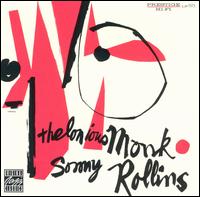
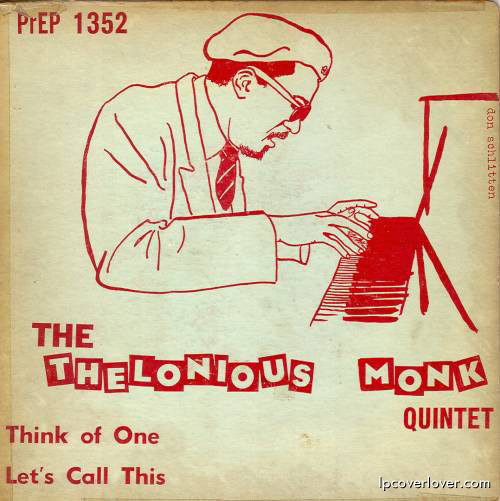
No 78s for these five and ten-minute cuts."Let's Call This" and "Think of One" were released on EP. The whole session was on a 10-inch called Thelonious Monk Blows for LP, and later on 12-inchers: Monk and Thelonious Monk and Sonny Rollins.
(Going back, from time to time, and finding sessions I had not been able to listen to before.)
If there's a missing link, this is it. This is bebop, and this is rhythm and blues, with Eddie "Lockjaw" Davis, a cat who could play both, and who didn't appear to see the need to make any distinction between the two. And I'm not sure anyone else much cared about the distinction, either. Bob Weinstock did make a few half-hearted attempts to establish a rhythm and blues label (half-hearted in the marketing: there was never anything half-hearted about the music). The thing was, in the 40s, everyone who played an instrument was influenced by Charlie Parker. You couldn't not be. He had changed music. And everyone who played the tenor sax was influenced by Lester Young. If you put a little more honk in the tenor and little more back in the beat, you called it rhythm and blues, and people got up to dance to it. If you took your solos a little farther off the beaten track, if as an improvisational soloist you were more than halfway to being a composer, you called it bebop and people sat and listened to it. Or maybe you didn't call it anything. You just showed up and played it, because it was your vocation and your life.
It was the intersection of some different musical lives on this session. Eddie "Lockjaw" Davis was 28 years old when he made these records. He had come to bebop as musicians of his generation did, through swing as it was played by African American bands on the chitlin circuit, the touring bands booked by TOBA, the Theater Owners' Booking Association, better known as Tough On Black Asses, best remembered by performers as low wages and flea-ridden dressing rooms, by lovers of American music as the breeding ground for some of the best. He'd played with Cootie Williams, Lucky Millinder, Andy Kirk. He would go on, in the 50s, to stints in both Louis Armstrong's and Count Basie's bands. But the first group he put together under his own name, in 1946, had a strong bebop tilt, with Fats Navarro, Gene Ramey, Al Haig and Denzil Best.
This 1950 group cut two sides with rhythm and blues shouter "Chicago" Carl Davis, not to be confused with another Chicagoan named Carl Davis, who became one of the great producers of the soul era. Davis was a rough, forceful singer, and on "If the Motif is Right" he starts out with a mock gospel sermon on which he sounds like a cross between Screamin' Jay Hawkins and Lord Buckley.
But this group wasn't just gotten together to back up a singer. The two instrumental tracks are the strongest, with Lockjaw bringing his honker and bopper sides together, with a remarkable ensemble behind him. Covering a lot of jazz history.
Representing the future, 19-year-old Wynton Kelly. I'd wondered if this was Kelly's first session, but in fact he had recorded at 16, with tenor sax star Hal Singer, on Singer's chart-topping "Cornbread." So these were his formative years, the years of small-group jazz developing from the influences of Charlie Parker and Lester Young, branching into rhythm and blues and bebop, but cross-pollinating, with the mongrel strength and innovation and intensity that makes American music what it is.
Representing a previous generation, Al Casey. 35 years old when this record was made, he had started as young as Wynton Kelly, but his beginnings were with Fats Waller, and this session was a rare foray into bebop for him. He accompanied Billie Holiday and Chuck Berry, and played into his 80s with the Harlem Blues and Jazz Band.
Drummer Lee Abrams was either 25 or 30 when he made this date, depending on which birth certificate you believe, so he fit somewhere along this timeline, and he made a lot of gigs, including some important ones later on with Wynton Kelly, after he had graduated -- and this came pretty quickly -- to leading his own groups.
These were released on 78 on the short-lived Birdland label -- the collaboration between Bob Weinstock and Mo Levy -- with the two vocals on one disc, the two instrumentals on the other. The instrumental cuts were also released, under their alternate titles, on a Prestige 78.

:format(jpeg):mode_rgb():quality(96)/discogs-images/R-5030038-1391033468-9319.jpeg.jpg)


:format(jpeg):mode_rgb()/discogs-images/R-3845422-1346750128-1039.jpeg.jpg)


:format(jpeg):mode_rgb()/discogs-images/R-3556904-1340579941-5969.jpeg.jpg)






:format(jpeg):mode_rgb()/discogs-images/R-2673501-1367731058-9779.jpeg.jpg)