Sunday, April 24, 2022

Listening to Prestige 628: Lightnin' Hopkins


LISTEN TO ONE: Let's Go Sit on the Lawn

 Bluesville is gone, but Prestige is not quite done with the blues, so here is Lightnin' Hopkins back in the studio for two days, and two albums' worth of songs.

The details of many early blues recordings under hastily thrown-together conditions and often for obscure fly-by-night labels are shrouded in mystery, but this is hardly an early recording or a fly-by-night label, and a certain amount of confusion abides.

Wikipedia's entry for for the first-released album,


Down Home Blues, lists it as a Bluesville release, and gives a catalog number, BVLP 1086. Stefan Wirz, the German blues discographer, lists it in his Bluesville discography, with a catalog number of 1086. Jazzdisco, the Japanese jazz discographical site, lists it as a Prestige release, catalog number PR 1086. 

Wirz's illustrated discography shows the album cover, and the same album cover can be found on the Wikipedia site and the Discogs site, so it would seem to be the only album cover. All of these covers bear the Prestige logo and not the Bluesville logo. Further, the Discogs site also shows the back cover, with the Prestige logo and the words Prestige 1086. Which should settle the matter...except...

Prestige has no PR 1000 line. And Prestige Bluesville did, and BVLP 1086, were it anywhere on the label or the packaging, would fit quite nicely into it, as the last Bluesville recording (save only BVLP 1089, the belated release of a 1961 session with Scrapper Blackwell protégé Shirley Griffith).

The rest of it is fairly straightforward. Well, maybe not. The sessions were recorded in New York City (Jazzdisco) or Englewood Cliffs (Wikipedia) with Ozzie Cadena producing (Discogs) or Sam Charters (Wikipedia). The sleeve of Soul Blues lists Ozzie as producer. 

Chris Albertson, a frequent Prestige producer who wrote the liner notes to both albums, says that:

The rhythmic accompaniment is supplied by bassist Leonard Gaskin who has recorded with Hopkins before but whose wide range of musical associations also include Miles Davis, Dizzy Gillespie, Charlie Parker and Eddie Condon, and drummer Herbie Lovell who counts Earl Hines, Arnett Cobb, Teddy Wilson and Buck Clayton among his past associates.

Which would seem to suggest that Gaskin and Lovell are once again recording with Hopkins. But The Penguin Guide to Blues Recordings posits that "Gaskin and Lovelle's parts were probably added at overdub sessions." That would not have been Prestige's normal way of doing things.


The recording took place over two days, with all of the songs that would appear on Down Hone Blues  and some that were destined for Soul Blues recorded on May 4, and the rest on May 5 -- Monday and Tuesday.

Hopkins was probably the most-recorded of all the country blues singers, under his own name and a variety of others. He has appeared on seven earlier Prestige recordings -- as a solo, with other Houston bluesmen, with New York jazz musicians. One would have to be awfully dedicated to collect everything he ever recorded. But if one wanted to start listening to Hopkins, or add a little to an ongoing collection, any of these Prestige recordings would be good. These two albums, or the Double Blues reissue put out by Fantasy on LP or CD, with Rudy Van Gelder's sound engineering, would be excellent.

Two 45 RPM singles came from this session: "Let's Go Sit On The Lawn" / "I Like To Boogie" and "I'm Going To Build Me A Heaven Of My Own," Parts 1 & 2.

Friday, April 22, 2022

Listening to Prestige 627 - George Benson, Jack McDuff


LISTEN TO ONE: The Sweet Alice Blues

 In an interview many years later, sometime in the 1990s, George Benson begins a story by telling the interview that a long time ago, he played in a band led by a guy named Jack McDuff. The interview must have been with a non-jazz publication, as by that time Benson was a crossover star, since McDuff continued to tour and record into the 90s, and in fact Benson rejoined his old boss to play on two cuts of a McDuff album in 1992, recorded in Germany and released on Concord Jazz.

The story, as with all of Benson's stories about his days with McDuff, was about how much he had learned from the veteran organist. But it seems that Prestige was already recognizing, if not that student would outstrip the master, at least that the fledgling was ready to spread his wings and leave the nest. Benson would record a few more times with McDuff, and then go on to superstardom beyond Prestige.


In one of Benson's reminiscences about his early days with McDuff (others are referenced here), he says:

Due to the fact that I couldn’t play very well, he would only give me one or two choruses in any song. So whatever I could play, I had to cram it into a chorus or two—which made me learn to fire up very early in my solo. I said: “Well, this is gonna be short”, and I’d just rumble away at a lot of notes, and throw in funky things, pretty things, every kind of thing I could think of. And it was good for records, because when I got in the studio I could do that naturally.

McDuff himself had been mentored by Willis "Gator Tail" Jackson, who encouraged him to switch from the bass to the organ. Jackson was, by some accounts, a particularly hard man to get along with, but he had a way of discovering and shaping young talent, from McDuff and Bill Jennings in the 1950s to Pat Martino in the mid-1960s, and he seems to have passed the torch on to McDuff.

And young George Benson clearly learned a thing or two from playing those one or two choruses. 

Red Holloway and McDuff join Benson here, but the rest of the rhythm section is different, and interesting. Bassist Ronnie Boykins was just in the process of branching out after having spent seven years with Sun Ra. Roger "Montego Joe" Sanders had played on Prestige sessions before, with Willis Jackson, Ted Curson, and Ahmed Abdul-Malik.

And another instrument is added to the mix on the first two cuts, "Shadow Dancers" and "The Sweet Alice Blues." McDuff's organ and piano are absent from these two cuts, and in their place is some very active work on the bongo drums--according to Chris Albertson's liner notes, "presumably...being played by McDuff." 


McDuff stays on organ the rest of the way, with the exception of "Easy Living," where he switches to piano.  Benson gives a lot of solo space to Holloway, but ultimately this is his album, and putting his name out front does make a difference. Listening to this music from the point of view of history, we're immediately aware of Benson from the first time his name appears on a Jack McDuff album, and we immediately start to track his development. But Albertson, who of course could have had no idea of the breakout future that awaited Benson, says in the liner notes:

It is highly probable that you are unfamiliar with the name of George Benson although it is very likely that you have heard hum play, either in person or on records, as a member of organist Jack McDuff's group.


And Albertson is not about to go out on a limb and say "A star is born!", either. He hedges that bet:

The Brother Jack McDuff quartet is a highly democratic one,  allowing each member a chance to record under his own name, with leader McDuff taking on the role as sideman.

Neither is Benson about to dominate the session. Holloway has as much solo space as he does. But it is clearly an important step. He would appear on five more Prestige albums in 1964-65: Three of them under McDuff's name, one under Joe Dukes', one under Red Holloway's. The Holloway album was produced by Lew Futterman, but neither McDuff nor Dukes appear on it (the organ part is played by Lonnie Smith). Then he was on to Columbia, where they had a better star-making machine, and where he began singing as well as playing.

This album was entitled The New Boss Guitar Of George Benson With The Brother Jack McDuff Quartet. "Shadow Dancers" and "Just Another Sunday" were the 45 RPM single release. Lew Futterman produced.   


Wednesday, April 20, 2022

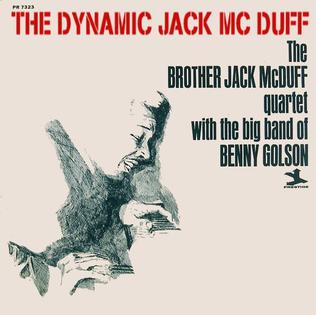
Listening to Prestige 625: Jack McDuff - Benny Golson


LISTEN TO ONE: The Pink Panther

 Jack McDuff's manager Lew Futterman, in the liner notes for the next session, describes how he got Golson and McDuff together:

McDuff had opened [at Birdland], and I was down there to see him...Benny and I ended up at the same table. While I was well aware of his writing, playing and arranging, we had never before met. I asked him how he liked McDuff. He said, "Great!" Since he was unaware what my relationship was to Jack, I pushed him a little farther by telling him I didn't like Jack's playing. His response was immediate. "You're entitled to your opinion. But I've never heard a jazz organist play with the feeling this man has. He shows such a great emotional quality, such a sympathy for the music that I could listen to him all night."


...He proceeded to say what I had felt since first hearing Jack play but had never been able to verbalize so succinctly--namely, that Jack McDuff exhibits a rare intuitive understanding of jazz, and of music in general. Nothing he plays seems stiff or structured, moving instinctively from one musical idea to the next, with no apparent disparity between what he feels he wants to play and what he can play. The excitement he generates is organic, rather than forced, as if he were thinking with his fingers.

At that point, Futterman outed himself to Golson, and asked if he'd consider writing some arrangements for McDuff.

"Only if I can write what I want to." I started to give him a qualified "yes," but decided better of it. A man with Golson's talent...deserves a free hand.

It seems quite certain that Golson had a free hand, because how else explain Henry Mancini's "Pink Panther Theme" on a jazz album? Or such was my first thought, on hearing it. But "Pink Panther" was a huge hit in 1964, the year of the movie's release, and a few different jazz artists covered it. There was a rhythm and bluesy version by Earl Bostic, another organ interpretation by Jimmy McGriff, and another big band arrangement by Quincy Jones.


As it turns out, they're all worth a listen. As a composer, Henry Mancini may have been a master of the obvious, but the operative word there is "master." The tune may have been perky and ubiquitous to have even become the punch line of a joke (What did the Pink Panther say when he stepped on an ant? --Dead ant...dead ant...dead ant dead ant dead ant....), but it was brilliant in its own silly way, and it responded nicely to the big band treatment, and to McDuff's bravura organ work.

The album's cover, however, promotes another movie tie-in--the theme from The Carpetbaggers, which is odd, in that although The Carpetbaggers was a blockbuster movie, its score, by the redoubtable Elmer Bernstein, was not a breakout success. Secondhandsongs, the website that keeps track of cover versions of nearly everything, cannot find a single one for the Carpetbaggers theme. YouTube turns up one other, by Jimmy Smith. Still, it's Elmer Bernstein, which means it's bound to be a decent tune (if a little too reminiscent of Bernstein's more popular theme from The Man With the Golden Arm), and Golson and McDuff certainly make it worth listening to. 

Golson takes two from the movies, two from Broadway. The Broadway tunes are both from musicals of the 1960s. "Once in a Lifetime," by Leslie Bricusse and Anthony Newley, was one of the breakout hits from the musical Stop the World--I Want to Get Off, the star vehicle for Newley which had opened in 1962 and was still running. "You Better Love Me" was from the just-opened High Spirits, composed by Hugh Martin (best known for the songs from Meet Me in St. Louis) and Timothy Gray. One has to figure that all of these not-exactly-standards were chosen by Golson for how they'd sound with Jack McDuff counterpointed against an orchestra, and the proof is in the pudding. Golson was right.

McDuff brings his regular group. Golson brings an orchestra, personnel unidentified. The four tunes were all they recorded, and the B side of the album comes from McDuff's earlier date on the West Coast. Lew Futterman produced both sessions. The album is entitled The Dynamic Jack McDuff. "Pink Panther" and "Carpetbaggers" were released on 45. The version I've linked to on "Listen to One" is the 45 RPM version. Weighing in at 3:20, as opposed to the album's 5:15, which means more theme and less improvisation, but hey, it's the Pink Panther! Dead ant...dead ant...."Once in a Lifetime" was also released on 45, as the flip side of "Rail Head," from the earlier session.


Monday, April 18, 2022

Listening to Prestige 624: Kenny Burrell


LISTEN TO ONE: Soul Call

Kenny Burrell was certainly no stranger to Prestige's album shelf, but it had been a while since the label had given him the leader's baton -- seven years. He had recently worked with Jack McDuff, Shirley Scott, Gildo Mahones, Jimmy Witherspoon.

This a slightly unusual lineup in that it's a quintet with no horns. The basic rhythm section, and Burrell's guitar, are augmented by the always-welcome Ray Barretto. The other musicians on the date are less well-known. Bill English played on a few Prestige sessions; the other two are newcomers to Prestige, but members of Burrell's working group.


Will Davis, new to Prestige, had seniority in the jazz world. Born in 1926, he joined Howard McGhee's early West Coast bebop ensemble and recorded with McGhee in 1948. Then relocating to Detroit, he became a part of that city's high-flying jazz scene. As the house pianist at the Crystal Bar, he worked with many of bebop's royalty, including Charlie Parker and Miles Davis. After his move to New York in the late 1950s, he worked often with Burrell, although this was their only recording together. 

If Davis represented the Old Guard of modern jazz, Martin Rivera had something of a different background, making his first recordings with Les Jazz Modes, the experimental group organized by Julius Watkins and Charlie Rouse. He also worked frequently with Junior Mance, recording with him as a duo, and made a few albums with Burrell, although this would be the only one on Prestige.

So it's fair to say that Burrell was looking for a flexible sound--not the trendy sound of soul jazz, although the album's title, Soul Call, would seem to suggest otherwise. But any casual jazz fancier, picking up the 45 RPM single for a jolt of the popular soul jazz of the day, might have been sorely disappointed.


Any real jazz fan, not so. "Soul Call," over a rock solid (but not aggressively funky) riff from the rhythm section, is a is a wonderful rhythmic/melodic/improvisational interplay between two masters, Burrell and Barretto.

It's a Burrell composition, as is "Kenny's Theme," which is the flip side of the 45, and another opportunity for Burrell and Barretto to interweave their talents, with rhythmic delights by Bill English and Martin Rivera thrown in.

"Mark I" was written by Will Davis, and there's room for some piano-guitar interaction, but mostly it's a vehicle for some bravura work by Burrell.

Standards comprise the rest of the album, and one not-quite-standard: "Oh Henry," written by Gil Fuller and Ernie Henry. Henry was a talented saxophone player whose promising career was cut short by heroin overdose in 1957. Fuller, though his name is not quite a household word, was a gifted composer and arranger particularly known for his work with Dizzy Gillespie. He was co-composer and arranger on "Manteca," "Tin Tin Deo" and "One Bass Hit." He gives Burrell and company a spirited beboppish romp here, to cap off an album of much originality, much virtuosity, and if the group doesn't entirely answer the soul call, they provide a refreshing change of pace.

Ozzie Cadena produced.

Friday, April 01, 2022

Listening to Prestige 623: Shirley Scott and Stanley Turrentine


LISTEN TO ONE: The Funky Fox

 By this time Shirley Scott and Stanley Turrentine are as blissfully united musically as we hope they are in their marriage life, though their marriage was destined not to last beyond 1971. But hey, you never know with marriages, and the music they recorded together remains an enduring testament to the best days of their relationship.

But just because they're perfectly attuned to each other, that doesn't mean they're slipping into too-familiar grooves. They're playing soul jazz to appeal to anyone with a pulse, but the way they play off each other gives each of them the opportunity for creativity and new discoveries. Scott, in particular, is always going to find new ways of approaching, and taking off from, a solid swinging musical idea.


Bob Cranshaw makes his Prestige debut here. He's best known for his five-decade association with Sonny Rollins, beginning in 1959, but he was always in demand for other sessions, including a number for Prestige throughout the decade with a variety of artists. One of his first recording gigs had been with Scott on a 1959 album for Impulse!, and although this is only Prestige session with her, he played with her on other albums for Impulse! and Atlantic.

"Flamingo" was first recorded by Duke Ellington in 1941, and taken to the top of the rhythm and blues charts in 1951. It became a crowd pleaser for club dates, and in fact was part of the Willis Jackson night that Prestige recorded live. "A Night at the Five Spot," a tribute to the great New York jazz club, was written by Benny Golson and recorded by Curtis Fuller and Art Farmer separately, and then by Golson, Farmer and Fuller together as the Jazztet in 1961. Scott and Turrentine made the next recording of it three years later, and after that it entered into the jazz standard repertoire. Bob Cranshaw may have brought along Sonny Rollins's "Grand Street."

The other tunes are by Scott, and they do an excellent job of showcasing the great organist and her talented husband. I particularly liked "The Funky Fox" -- perhaps a self-reference?

The album was released by Prestige as Blue Flames. Ozzie Cadena produced.


Tuesday, March 29, 2022

Listening to Prestige 622: Willis Jackson


LISTEN TO ONE: Gator Tail

 This would seem to be some indication of how well Prestige was doing with Willis Jackson in the mid-1960s. A night at a New York club, four sets captured live, released on four different albums over the next three years. Jackson's popularity didn't endure--you won't find his name on any contemporary list of best jazz saxophone players, perhaps because he's too closely identified with rhythm and blues, and jazz snobbery still exists. This is wrong, of course. Rhythm and blues is jazz. for one thing, and for another, Jackson's many Prestige albums were squarely in the mainstream hard bop tradition. A quick glance at the set lists


for this live date makes the point: He plays a couple of his rhythm and blues favorites, like "Gator Tail" and "Blue Gator," but a lot more jazz standards: "Polka Dots and Moonbeams," "Jumpin' with Symphony Sid," "Perdido."

And of these four albums, only a handful of tracks have been posted by jazz aficionados on YouTube. So Jackson is still collected, but assiduously.

And probably, Jackson's recordings from this era are mostly remembered for the presence of a very young Pat Martino, at the beginning of his career, still calling himself Pat Azzara, on guitar. The CD reissues of these and other recordings are all billed as Willis Jackson with Pat Martino. That's understandable -- Martino was already a standout guitarist, at the threshold of a great career. But the fervent Martino collector who finds these albums will be treated to a fine band, led by a very fine sax man.

Even at the time, Jackson's defenders faced something of an uphill battle. In the liner notes for Live! Action, Kansas City radio personality Tom Reed quoted Michael Gold's liner notes to an earlier Jackson album:

This music from a jazz critic's standpoint has been unjustly rated on many occasions. Many critics have confused the initial intent and purpose of the music which they evaluate with their own ideals and standards of merit. It is often startling to read that a record which is obviously aimed at the amusement and entertainment of the listener is mistaken and evaluated by the standards which should be used for work which projects itself with a different and contradictory intent.

Today many musicians have only contempt for critics. It is very difficult for an artist to have respect for a man who makes such obvious errors out of a profound ignorance or through a mistaken belief in the purpose of the music."

It's the old artists vs. critics battle. NBA star George "Iceman" Gervin said it well, and I'm paraphrasing from memory, when he explained why he didn't have much use for sportswriters: He said that he goes out every night and tests himself against some of the greatest athletes who ever lived, and who are these writers testing themselves against? Shakespeare? Hemingway? Not likely,

And there's something to be said for critics being in the vanguard, calling attention to new artists like Ornette Coleman and Eric Dolphy before the listening public at large is ready to give something so new a chance. And something to be said for pointing out that sometimes mass taste is just wrong, wrong, wrong, and saxophone players with one initial for a last name aren't really offering anything musically rewarding.


But there's very often something to be said for music that people like to listen to. Especially when it's being played by a pro's pro who knows how to give the people what they want in a hard-driving, sweet sounding, musically fulfilling way. Especially when the old pro has taken under his wing a 19-year-old guitarist who's already making people prick their ears up and take notice. The two hot young guitarists who were starting to play around town and make people sit up and take notice were Martino and George Benson, and Benson has talked about going to hear Martino and being turned on by him.

A live album, or series of albums, covering four sets on the same night, is a good place to put this theory to the test, as the band is going to be playing a lot of familiar material, the tunes that a live club audience is going to want to hear. Jackson, Martino and company pass that test with flying colors.

The four Prestige albums to issue from this night of live music (with "Blue Gator" on two of them) are Jackson's Action! Recorded Live, Live! Action (with Pat Martino pinning a new tail on the Gator with his solo on Jackson's signature song), Soul Night/Live!, and Tell It... Ozzie Cadena produced, and Prestige got good value out of an evening at the Allegro.


Wednesday, March 23, 2022

Listening to Prestige 621: Sonny Stitt


LISTEN TO ONE: Shangri-La

 Two 45 RPM singles were released off this session: "My New Baby" / "Misty" and "Shangri-La" / "Soul Shack," the last-named actually coming from a different Stitt-organ session, that one with Jack McDuff from 1963. I hope they got a their share of radio play and jukebox spins, because they're super-listenable, the kind of music that could have made some listeners want to hear more jazz. It's interesting that they didn't put out a 45 of "Mama Don't Allow," the ever-popular warhorse attributed to Cow Cow Davenport, which features a vocal by Stitt as well as a killer tenor sax solo and a crowd-pleasing drum solo by Billy James.


If that all adds up to something that sounds like a commercial venture, rest assured that I do not mean this in any way as a put-down. Some of America's greatest music was made for the masses, and while it's important to encourage experimentation, and give voice to the people who are ahead of the curve, there's nothing wrong with giving the people what they want, especially if it's a master like Sonny Stitt serving it up.

Prestige was getting ready to break Don Patterson out as its next big organ star. He and Billy James, along with guitarist Paul Weeden, had been working as a trio mostly in Chicago when they were hired to back up Eddie "Lockjaw" Davis on a 1973 Prestige session. Here, although Stitt got top billing, Patterson was also featured on the cover, preparing him for his next session, in two months' time, when he would be the session leader, he'd have Booker Ervin alongside him, and the album would be titled The Exciting New Organ of Don Patterson.

The marketing campaign apparently worked, because Patterson became one of Prestige's top talents for the next several years.


Good for Prestige, good for Patterson. If this album was part of the strategy, good for it. And good for the listener, too, that casual listener who might have heard a cut on Listening to Lacy and then plunked a nickel into the jukebox to hear it again, and the serious jazz fan for whom good music is always welcome.

I'm sure if you were playing--or even working as a server--in a lounge six nights a week, you could get pretty sick of "Misty" -- and a few other tunes. But as a music lover who listens to a lotta this and a lotta that, it's a familiar melody, and it's possible to appreciate that it's as familiar as it is because it's a beautiful melody, and when you have Sonny Stitt playing it, and improvising on it, it becomes a treat for the ears. The other offering from the standard catalog, not nearly as familiar, is "Shangri-La," written in 1946 by Matty Malnick and first introduced by his orchestra. It was a minor hit in 1957 for the Four Coins, one of those "safe to listen to, we're not rock and roll" groups that still hung onto the Top Forty in those days. While it's been widely recorded over the years, it's been mostly by groups whose sound is more at home in elevators than smoky basements. But it provides a good vehicle for Stitt and Patterson to blend their sound, and makes a good introduction to Patterson.

There are three Stitt originals on the album, all good listening, and two more that were recorded on the session and released later, along with some cuts from Patterson's May session with Booker Ervin, under the title Patterson's People: Don Patterson with Sonny Stitt and Booker Ervin. 

Shangri-La was the title of this Prestige release. Ozzie Cadena produced.

Tuesday, March 22, 2022

Listening to Prestige 620: Ahmed Abdul-Malik


LISTEN TO TWO: Spellbound
Never on Sunday

Ahmed Abdul-Malik's recording career was brief--a total of six albums as leader between 1958 and 1964, the last four on Prestige. And this was his swan song. He never led a group again, and played on only a small handful of other recordings, although he would reappear on record in 2005, more than a decade after his death and half a century after this momentous recording, when the John Coltrane/Thelonious Monk Town Hall concert of 1957 was finally releas

I don't know why this sudden halt, and I haven't been able to find out much more about it. Abdul-Malik lived into the 1990s, taught in the New York City school system, but doesn't seem to have been interviewed, and doesn't seem to have rated much in the way of obituaries. Curious neglect for such a striking talent.

Certainly this final album leaves one wishing for more, because it's so good, but also because it's so unusual. That he continued to create a fusion between Western jazz and Middle Eastern music is expected, and welcome. But to take as his source material theme music from Hollywood movies? That's not at all the choice that most of us would have made.


And what musicians would you go looking for if you were planning a session of jazz/Middle Eastern fusion? An oud player, certainly, Abdul-Malik, himself a master of the oud, had a keen ear for talent on the instrument, and he picked Hamza Aldeen, an Egyptian composer and oud master from Nubia, the upper Nile region where the oud originated. As Hamza El Din, he performed in the summer of 1964 at the Newport Folk Festival, and recorded an album for Vanguard entitled Music of Nubia, followed by a second Vanguard album in 1965. He has been cited as a major influence by avant garde composers Steve Reich and Terry Riley, and has recorded with the Grateful Dead and the Kronos quartet.

This was his only recording session with a jazz group, but his contribution is outstanding. He plays on two tracks, "Never on Sunday" and "Song of Delilah."

A musician with plenty of jazz credentials, but not one you'd immediately think of if you were planning an album of Middle Eastern music, is Ellington alumnus Ray Nance. Nance had joined the Ellington orchestra in 1940, and remained with them through 1963, leaving just before being tabbed to join Abdul-Malik for this session, As Ellington's first trumpet, he recorded one of the most famous trumpet solos in jazz, the Duke's original 1940 recording of "Take the A Train." He plays cornet here, on "Body and Soul" and "Cinema Blues."

Nance, of course, also became known as the only violin soloist in the Ellington orchestra, and he brings his violin to "Spellbound" and "Song of Delilah." Again, if you were putting together a cutting edge group to play an new kind of world music fusion, you might not immediately think to bring a sort of old school violin guy.


I have to assume that Abdul-Malik was completely given his head in assembling this group, because no one--not Bob Weinstock, not Don Schlitten--was going to say "World music fusion? Right. You'll need a violin, and an old school rhythm and blues guy on tenor sax."

That would be Seldon Powell. No, the choices must have been Abdul-Malik's own. And the choice of movie music? Who else would dream that up?

Anyway, assuming my assumptions are right, thank Providence they let Ahmed do it his way, because this is a wonderful album, and one is only left regretting that he didn't make any more. What would he have thought of next time?


Pianist Paul Neves was one of those local legends, in his case in two locales -- Boston and Puerto Rico. A fine player who didn't make it to New York, didn't tour with a New York or LA-based name band, didn't record -- this is his only recording date with a name group. It's good that we have him here.

I should give "Song of Delilah" as my Listen to One. It has some strong soloing by everyone. And if I didn't choose it, I'd be torn between the wonderful violin work by Ray Nance on "Spellbound," and the electrifying oud playing of Hamza Aldeen on "Never on Sunday." Well, I can't choose, and I can't reconcile. They're two such different cuts, with two such different musicians. So it's Listen to Two.

Another odd thing about this album: it was released on Prestige's lightly used and lightly distributed budget label, Status. I don't know why. Don Schlitten produced.

Tuesday, March 15, 2022

Listening to Prestige 619 - Reverend Gary Davis


LISTEN TO ONE: Maple Leaf Rag

This is the fourth and final album (not counting repackagings) by the Reverend Gary Davis, Harlem street singer and preacher. and mentor to nearly every young guitar player in New York. The first three were released on Bluesville, but Bluesville was no more, shelved along with Prestige's other jazz subsidiaries, New Jazz, Swingville and Moodsville. 

There were still some smaller subsidiary labels: Prestige International, Prestige Lively Arts and Prestige Folklore, more in competition with smaller independents like Folkways and Caedmon than with the other jazz independents. I haven't included them in my history/reminiscence of Prestige Records.


But since I have been following Gary Davis on Prestige, I'm including this Folklore release, which is an interesting addition to the Davis catalog, in that it's all instrumental. Davis was one of the great blues guitar stylists as well as one of the great teachers, and here plays some ragtime and some folk styles as well as blues, and also plays banjo and harmonica on this unaccompanied field recording by Sam Charters.

His harmonica (on "Coon Hunt") is reminiscent of Sonny Terry's, on "Fox Chase." He's really adept on banjo, which he plays on "Devil's Dream" and "Please Baby." His finger picking banjo style is reminiscent of nothing so much as his guitar style. And his guitar mastery is sufficient to make one glad that he put out an all-instrumental album. He has tempos from "Slow Drag" to "Fast Fox Trot," and from ragtime ("Maple Leaf Rag") to march ("United States March"), and a tribute to multitasking with "The Boy Was Kissing the Girl (And Playing the Guitar at the Same Time)."

This would be Davis's last recording for Prestige, but he continued performing, and recording, right up to his death in 1972. A performance at the Newport Folk Festival in 1965 brought him to the attention of new audiences, and his last years were some of his most successful ones.

Friday, March 11, 2022

Listening to Prestige 618 - Eddie Chamblee with Dayton Selby


LISTEN TO ONE: The Honeydripper

 The second track of Eddie Chamblee's album is Rodgers and Hammerstein's "You'll Never Walk Alone," and if you had gotten up and tried to dance your way through the first track, "The Honeydripper," you might well be thinking of it as "You'll Never Walk Again." There's an urgency that's seldom matched on record to kickstart "The Honeydripper," and that urgency never lets up, as Chamblee, organist Dayton Selby and drummer Al Griffin keep kicking it down the road. Truth be told, although "You'll Never Walk Alone" is a breather, that's only in comparison with "The Honeydripper." This may not have been the sensitive approach that Rodgers and Hammerstein intended for their inspirational lyric and quasi-operatic melody, but who asked them?


They actually do slow down and take "Softly, as I Leave You" as a sweet ballad, Chamblee was a tenor player of the old school, and the old rhythm and blues school called for a tenor man to slow the tempo down and play sweet for make-out time for the dancers.

Chamblee was definitely one of those old school guys. Born in Atlanta, raised in Chicago, his pre-law studies at the historically Black Chicago State College were interrupted by service in World War II, and after the war he went back to the weekend gig he had held down during his college days--playing the tenor saxophone in clubs. His breakthrough came when he recorded the tenor sax solo on pianist Sonny Thompson's R&B hit "Long Gone." The song became his signature and his nickname, like Willis "Gator Tail" Jackson or Frank "Floorshow" Culley. Or Joe "The Honeydripper" Liggins, but that tune outgrew its composer to become a rhythm and blues and soul jazz standard, Chamblee's ass-kicking version being just one of many.

He led his own groups in the Chicago area before joining Lionel Hampton's band for its celebrated European tour in the mid-1950s, and he had an association with Dinah Washington that lasted musically for eight years and five albums (including some vocal duets in the style she would later perfect with Brook Benton), romantically a good deal shorter (he was briefly her fifth husband).

Dayton Selby was another veteran of the rhythm and blues era--his style is more suggestive of Bill Doggett than Jimmy Smith. He did record a couple of albums for for small labels, but this session with Chamblee is what he's best known for.


Al Griffin's obituary gives a sterling resume for a life in the music business: 

He trained in NYC with the world famous Cozy Cole & Gene Krupa at their music studio just before he started his career on the road touring and playing with Dinah Washington, Clark Terry, Eddie Chamblee, Henry "Red" Allen, Bob Crosby, Paul Anka, Dayton Selby, Milt Buckner, Billy Eckstine, Illinois Jacquet, Timmy Rogers, Redd Foxx, The Nat King Cole Show, The Sammy Davis Jr. Show, just to name a few, he was also part of the house band (drummer) for then Heavyweight Champion Sugar Ray Robinson at his club in Harlem "Sugar Ray's."

 And the Asbury Park African American Music Project quotes Griffin, who returned to Asbury Park as his music career wound down, to take over his father's dry cleaning business, on how he got his start in his home town:

I was sitting outside, and this fellow came by, a friend of mine, with some drumsticks. I said, “Where are you going with those drumsticks?” He said, “Just messing around.” I said, “Where’d you get them?” He said, “I got them at the West Side Community Center” – which was right around the corner from me. He said, “They’re starting up a drum and bugle corp,” so I’m going to try to get over there. And that’s what I did.

Bob Weinstock's record of commercial success with the rhythm and blues veterans he signed to capitalize on the soul jazz craze was hit or miss: a lot of success with Willis Jackson, not so much with some of the others, including Eddie Chamblee. But his record of recording damn good music continues triumphant. The Rocking Tenor Sax Of Eddie Chamblee With Dayton Selby At The Organ is a rocking good time for listening, and would make a super album for dancing, with its driving uptempo numbers, slowed down in the middle with "Softly as I Leave You." and winding up the evening with a "goodnight sweetheart" special: the 1950s ballad hit "Little Things Mean a Lot." Ozzie Cadena produced.

Saturday, March 05, 2022

Listening to Prestige 617: Booker Ervin


LISTEN TO ONE: The Lamp is Low

 This is the second of the "Books" compiled by "the Book," Booker Ervin, for Prestige, the first being The Freedom Book of the previous December. That one had Jaki Byard on piano, with Richard Davis (bass) and Alan Dawson (drums) rounding out the quartet. Davis and Dawson would remain on board for the whole series of books, but other instrumentation would vary, and here it's Tommy Flanagan on the keyboard. Flanagan makes an excellent consort, as Ervin continues to cement his place as the hottest new sound on the tenor sax.


He starts off the session by putting his imprint on "The Lamp is Low," a old tune that may never have had quite the wakeup call Ervin gives to it. The melody was taken from a piece by Maurice Ravel, "Pavane pour une Infante Défunte" (Pavane for a Dead Child). A part of Ravel's longer work was adapted by Peter DeRose and Bert Shefter,with lyrics by Mitchell Parish. Originally recorded by Mildred Bailey in 1939, covered a week later and turned into a big hit. the song takes Ravel's solemn dirge and turns it into a dreamy torch song, with lyrics about melting into the lover's arms and dreaming while the lamp is low. It's generally done to match that dreamy mood, but not always--Sarah Vaughan made it swing, and raised a few goose bumps with a thrilling interpretation. Ervin picks up where Vaughan left off, kicking into high gear almost immediately, with soaring, daring solos that are taken up and kicked again and again by Flanagan, Davis and Dawson.

The moody, introspective tone which Ervin might have adopted in "The Lamp is Low" gets its due in 
"Come Sunday," the churchy section from Duke Ellington's Black, Brown and Beige suite. "Come Sunday" is also the newest song in Ervin's Song Book, dating from 1943. All the others go back to the 1930s, although "Just Friends," written in 1931, is indelibly, in every jazz fan's mind, the song newly created from the bones of the of the original by Charlie Parker in 1949. There's no nostalgia in Ervin's treatment of any of these old chestnuts -- there's no danger of this album being released on Swingville, even if that fine series had not recently been closed down by Prestige. This was a solid Booker Ervin session, a musician very much aware of tradition, very much aware of his time, and in the full maturity of his own sound.

Ervin was at the midpoint of his tenure with Prestige, which is the same as saying the midpoint of his career, since the 1960s were the summit of his achievement and his reputation, and by 1970 he would be dead of a kidney disease. He had clearly marked himself by this time as one of the most distinctive stylists of his generation--critic Gary Giddins has remarked that 

you know it’s him after two notes...he is completely himself...It is not avant-garde jazz — he’s playing changes — yet it has the kind of freedom and velocity you might associate with Coltrane...though Booker didn’t sound anything like Trane. He was one of the few tenors of his generation who didn’t. 

But his reputation remained mostly within the jazz community. Music producer and historian Michael Cuscuna has pointed out that his Prestige recordings

had caused a lot of excitement in New York, but New York isn't America...which meant that his triumphs were mixed with incomprehensible dry spells.

His basic quartet for the "Book" sessions was Richard Davis and Alan Dawson on all of them, Jaki Byard on two of them, and yet this tight-knit and sympathetic group was not Ervin's regular touring band--they may never have played together outside of the studio. The economics of jazz in the 1960s, at least the sort of jazz that Ervin played, didn't allow for the maintaining of a regular group.

And what was that? It wasn't free jazz (although the commercial outlets for that were limited too). It wasn't soul jazz. Hard bop may have become old hat to the critics, but it certainly still had its followers. But that wasn't what Ervin played either. As a result, it was easy for Ervin to get lost in the pack. As Giddins puts it:

Everybody was talking about Coltrane and Shorter and Rollins and the big guns, and Ervin was really something of a cult figure. Those Prestige records were hardly best sellers.

 Ervin's early death meant that he didn't stay around to become an elder statesman of jazz, lionized by Jazz at Lincoln Center or the NEA Jazz Masters. To modern listmakers, he generally doesn't crack anyone's list of the 50 greatest jazz saxophonists. But he should. 

This second "Book" album was called The Song Book. Don Schlitten produced.


Friday, March 04, 2022

Listening to Prestige 616: Jimmy Witherspoon


LISTEN TO ONE: I Wonder

 I love it that Jimmy Witherspoon starts off this set with "I Wonder." This song, written and originally performed by Cecil Gant, is frequently credited with being the first rhythm and blues hit. Gant recorded it in 1944, first for the tiny Black-owned Bronze label, and then, as it started to catch with another small but not quite so small label, the whine-owned Gilt Edge, with better chances at distribution. Appealing to WWII patriotism, Gant is "Pvt. Cecil Gant" on the label, and that underscored the poignancy of the song, with its lyric that suggested a lonely GI wondering if his girl friend back home was with another man. But "I Wonder" didn't need anything but itself. It was a winner, a beautiful blues ballad with Gant accompanying himself on the piano.


Nothing's ever entirely new, and Gant's soft, sensitive approach to the blues had been pioneered in the 1920s by Leroy Carr. But "I Wonder" ushered in a new era and a new sound--a sound that was so new it didn't have name in 1944, so when the record went to the top of the Billboard charts, the chart was the Harlem Hit Parade. It did not become rhythm and blues till 1949.

Gant's record was a hit, but "I Wonder," the song, was huge. Roosevelt Sykes recorded it for Bluebird, and with Sykes's popularity and RCA Victor's distribution, he had a Number One hit. And in an unusual moment in chart history, the record it replaced at Number One was Pvt. Cecil Gant's version of "I Wonder." Louis Armstrong recorded a gorgeous version of it in 1945, with the song giving Armstrong a vehicle for one of his most poignant and sensitive vocals. His recording went to number three on the charts, and "I Wonder" has been a staple ever since, right down to a recent duet by Tony Bennett and k. d. lang. We've heard an earlier version of the song on Prestige, by Etta Jones.

"I Wonder" represented a new era in music in more ways than one. The post-WWII manufacturing boom extended to record pressing plants, and small independent labels--the labels that pioneered rhythm and blues and modern jazz--had the ability, for the first time, to get records made on a large scale. And Gant's smooth, blues-inflected crooning style caught on. Rhythm and blues was a big umbrella, encompassing the raucous jump blues of Louis Jordan, the Delta-goes-electric of Muddy Waters, the New Orleans horns behind Fats Domino, Lloyd Price and Little Richard, but the crooning ballad style of Cecil Gant gave birth to a whole generation who came to be known as the "sepia Sinatras." Billy Eckstine and Nat "King" Cole were the mega-stars of this new style, but there were so many others, Sonny Til and Clyde McPhatter and Tony Williams and all the other wonderful voices who created the street corner harmonies known as doowop, on to Johnny Mathis and Sam Cooke.

To make a great record of "I Wonder," all you have to do is sing it, and let its magic come through you. That's exactly what Jimmy Witherspoon does, Ozzie Cadena has given him some extraordinary musicians to back him on this session, and they do their job too.


And, of course, 'Spoon doesn't stop there. Ever the aggregator of wonderful material, he does it again here. "Nobody Knows You When You're Down and Out" was written in 1923 by Jimmie Cox, made unforgettable in 1929 by Bessie Smith, and became an anthem for the Depression. But its lyrics have resonated beyond its time. Again, as with "I Wonder," as is his approach, Witherspoon respects the song, and lets it express itself as only he can.

I won't go through the whole album, but the selections are eclectic and rewarding. One, "Blues in the Morning," is credited to Kenny Burrell, and features some wonderful playing by Burrell, Gildo Mahomes and Roy Haynes.

The Prestige release is entitled Blue Spoon. 

Tuesday, March 01, 2022

Listening to Prestige 615: Shirley Scott and Kenny Burrell


LISTEN TO ONE: Call it Stormy Monday

Prestige puts two of its most creative talents of the 1960s together, and the results are as beautiful, as creative, and as unique as you might have predicted. The two of them challenge each other, complement each other. They put together a good selection of tunes, and they make music that's a joy to listen to. They're joined by bassist Eddie Khan, heard once before on Prestige with Ronnie Mathews and Freddie Hubbard, and drummer Otis "Candy" Finch, borrowed by Scott from husband Stanley Turrentine's group. Finch, from Detroit, was the son of Otis Finch Sr., tenor saxophone player with John Lee Hooker.


"Trav'lin Light" was written by Jimmy Mundy and Trummy Young, and brought by Young to a 1942 session Paul Whiteman was doing for the newly formed Capitol Records. Young had also brought along his then girlfriend, Billie Holiday, and not wanting to miss an opportunity, Capitol's co-founder Johnny Mercer took Young's tune, wrote a lyric to it, and put Holiday in front of a microphone with the new song. She was under contract to Columbia, so she was "Lady Day" for the recording. 

"Solar" is the famous Miles Davis composition, now a jazz standard, over 200 versions of it recorded, the first few bars of the melody engraved on Miles' tombstone...and almost certainly written by Chuck Wayne, not Miles. Be that as it may, it's a great romp for jazz musicians, Burrell playing it mainstream and wholly satisfying, Scott using the tune for one of her excursions to test the possibilities of the Hammond. They bring it off together, with some nice soloing by Eddie Khan.

"Nice 'n Easy" was a recent hit, written by Hollywood songwriters Alan and Marilyn Bergman for Frank Sinatra, and an instant standard, equally popular with crooners, swingsters, and jazz groups (Willis Jackson had brought the tune out to Englewood Cliffs just a month before Scott and Burrell). It's a catchy tune, and they catch hold of something, and swing it to life.


T-Bone Walker's "They Call it Stormy Monday" is a blues you can sink your teeth into. Blues singers love it, but jazz musicians have largely left it alone. Before Scott and Burrell, only Woody Herman had recorded it. Burrell actually had done it on record before, with Junior Mance, but that was backing up a blues singer, Billie Poole. Very few instrumental jazz renditions of it have been done since, and if Scott and Burrell (and Eddie Khan) are any guide, this is a mistake. This is the highlight of the album, a terrific blues--not soul jazz, the real blues.

"Baby, It's Cold Outside" has become a controversial song in recent years, with many decrying its lyric, but it's hard to find anything wrong with the sassy, tuneful Frank Loesser melody, and whatever you may think of the various male-female vocal duets, there's nothing at all wrong with the Scott-Burrell duet. It's delicious.

And speaking of songs that aren't normally done by jazz groups. this is probably the only jazz rendition you'll ever hear of the traditional Irish "Kerry Dance." It, too, is a delight, with some fancy stick work by "Candy" Finch.

What would you have released as your 45 RPM single? I think I would have gone with "Stormy Monday" and "Baby, It's Cold Outside," but Bob Weinstock and the marketing boys at Prestige chose "Travelin' Light" and "Kerry Dance." I can't complain. Anything from this album that I ever saw on a jukebox would get my nickel. Travelin' Light also became the album's title. Ozzie Cadena produced.

Sunday, February 27, 2022

Listening to Prestige 614: Jack McDuff, Red Holloway


LISTEN TO ONE: Wives and Lovers

Red Holloway, Jack McDuff, Joe Dukes and George Benson found themselves in Los Angeles--they were one of the most popular touring jazz groups in the country at this point, and they could have been found almost anywhere on any given date. But they were in LA, along with Lew Futterman, McDuff's manager and producer, and with no shortage of recording studios in the city of angels, Futterman brought them in for two days of recording in various formats, and under various names. 


LISTEN TO ONE: What's New

First came a session that would be released under Holloway's name, as it was largely a showcase for his gifts as a composer. It was the basic quartet, plus West Coast bassist Wilfred Middlebrooks, and it began with two ballads before moving on to Holloway's various variations on jazz funk.

"This Can't Be Love" was a familiar Rodgers and Hart standard from the 1930s. A ballad taken at a brisk tempo, it featured McDuff moving over to piano for the first time on record.


"Wives and Lovers," a recent hit by Burt Bacharach and Hal David, was on its way to becoming as popular as any ballad from the Great American Songbook. A 1963 release that would win crooner Jack Jones a 1964 Grammy, it would go on to become a favorite of lounge singers, and a wide assortment of instrumental aggregations, from Lawrence Welk and Jerry Murad's Harmonicats to Stan Getz and Thad Jones / Pepper Adams. It was a song in a sort of new genre, the "exploitation song." Wives and Lovers was a movie with Janet Leigh and Van Johnson, and Bacharach had been engaged to write a song, but not for the movie's soundtrack. The producers wanted--and got--a top 40 hit that would get the movie's title out there, and draw attention to it. Bacharach had done this once before, for movie that seemed an even more unlikely inspiration for a hit song, The Man Who Shot Liberty Valance.

Holloway demonstrated some nice versatility as a composer, keeping the blues a thematic base. His compositions took front and center for Prestige's two 45 RPM single releases from the album, "Denise / Wives and Lovers" and "No Tears" / "Shout Brother." Billing was "Red Holloway with the Jack McDuff Quartet," and the album was entitled Cookin' Together.


LISTEN TO ONE: Redwood City

The Holloway session is listed as having taken place on February 6 (a Thursday), the other two on February 6-7. Which seems odd. For the middle session, the quartet, they drop the bass player and go back to their regular quartet lineup. For the final session, a bass player returns, but a different one, and they add another horn. It seems unlikely that they would have done a little with the quartet and a little with the sextet on Thursday (after having done a seven-tune set with the quintet) then called it a day, then a little more with both lineups on Friday. In any event, all this music was made in two days. The last lineup, the sextet, recorded as the Nomos, which may well have meant "No mo' of this jive, we're getting back on the road."

The quartet sounds good, as always, with each member getting ample solo space, and young George Benson sounding better and better. The material is a standard, Bob Haggart and Johnny Burke's "What's New?" and two originals by McDuff.


It seems each soloist gets a session as composer. The Nomos do two tunes by Benson, "Redwood City," a long and a short version, and "Step Out and Get It." A third, "Long Distance," presumably also by the guitarist, was canned. The quartet is augmented by a bassist, Tommy Shelvin, and New Orleans native Alvin "Red"Tyler on baritone sax. Tyler was a veteran of Cosimo Matassa's studio in New Orleans, and had played on recordings by Little Richard and Fats Domino, and he adds a richness to the sound. Benson would record "Redwood City" again with his own group. 


The quartet sessions would be added to a second session with Benny Golson and a full orchestra. "Rail Head" would be on a 45 RPM single, with one of the tunes from the Golson session on the flip side. The Nomos didn't get an album. The long version of "Redwood City" would be included on a 1970 release, Gene Ammons/Richard "Groove" Holmes/Eddie "Lockjaw" Davis With Shirley Scott/Willis Jackson/The Nomos/Brother Jack McDuff - The Soul/Jazz Giants (Previously Unissued Material). The short version, and "Step Out and Get It," became a 45 RPM single. Futterman handled the production for both days and all lineups.


Tuesday, February 22, 2022

Listening to Prestige 613: Willis Jackson


LISTEN TO ONE: Shoutin'

This is more of the same from Willis Jackson -- the same group he's been working with, which includes a young Pat Martino on guitar (interesting that he had his old bandmate Jack McDuff were both bringing along young guitarists who would become giants over the next couple of decades), the same rhythm and blues derived jazz funk sound, the same mix of funky originals and standard ballads. And why not? Good for listening, good for dancing. A lot of parties in the mid-sixties rolled back a lot of rugs and dropped a lot of needles within the grooves of a Willis Jackson record. The man was a pro, and he delivered.


Most unusual track on the oblm, and the source for half the album's title -- "Boss St. Louis Blues," which sets down a bossa nova and then blows some solid funk over it, with Jackson in top form. Once they get the beat down, they can get wild...and they do. Best for my money, the other half of the title. "Shoutin'" is what you want to hear from this band -- the good old rhythm and blues, the hot new funk, some fleetfooted guitar styling by Martino.

Boss Shoutin' is the name of the album. No 45 RPM single releases from this one, maybe because they tended to go long on the individual cuts. Or maybe they knew Prestige wasn't planning a single, so they figured they could stretch out. Either way, it works, as the playing heats up, the deeper they get into a tune. Ozzie Cadena produced.

Saturday, February 19, 2022

Listening to Prestige 612: Homesick James


LISTEN TO ONE: Crawlin'

 This is another of Prestige Bluesville's presentations of lesser-known Chicago blues figures, as they prepared to close down their subsidiary labels: Bluesville, Swingville and Moodsville. All three of them, but especially Bluesville and Swingville, were hugely important in their documenting of musicians who would otherwise have remained undocumented in midcentury America--and in many cases giving them the finest producing and sound engineering they had ever received.

Homesick James, like Billy Boy Arnold before him, was recorded in Chicago by pioneering blues folklorist Samuel Charters. Arnold was recorded first,


but James's album was released first, so it gets the title Blues on the South Side, and Arnold's album became More Blues on the South Side.

Also like Arnold, James was a veteran of the Chicago blues scene who had scuffled, and stayed on the scene, without ever quite managing to break through. He was born in Tennessee and learned his trade all over the South, where he may have played with a number of the blues greats of the early part of the century--his history is basically untraceable--and may have known Robert Johnson.

Arriving in Chicago in 1932, he found work in that city's music community, including some recording sessions-- even a couple under his own name in 1952 for Chance Records, one of Chicago's early independent labels. One of them, "Homesick," gave him the name he would use for the rest of his life. He worked with Sonny Boy Williamson II and with Elmore James, whom he claimed as his cousin.

As with the Billy Boy Arnold session, Samuel Charters called on the cream of Chicago's commercial rhythm and blues scene to back up James. Lafayette Leake was back again. Clifton James (no relation--he was a native Chicagoan) was Bo Diddley's drummer, and in the eyes of many, the true innovator of the Bo Diddley beat. Eddie "Big Town Playboy" Taylor, as a young man in Mississippi, taught his younger friend Jimmy Reed to play the guitar, and later, when they had both made the Great Migration, worked in Reed's band. Equally adept on both guitar and bass. he also worked with John Lee Hooker, Big Walter Horton, Sam Lay and others.

James was an interesting anomaly in 1964, with as much of the Delta in him as the South Side. His most


significant modern influence was probably John Lee Hooker, the most primitive of the rhythm and blues modernists. When he essays a number like Robert Johnson's "Stones in My Passway," he's recalling Johnson's era, at a time when his cousin Elmore was reinterpreting Johnson's music through the new dynamic of Sweet Home Chicago in the 1950s, and British guitarists like Eric Clapton were reinterpreting it for yet a newer generation. Even with modernists like Leake and Clifton James, Homesick James is who he is.

It was an honest sound, and if it didn't make James rich, it still served him well. He continued to play blues festivals, and make records, into the 21st century. But Blues on the South Side, with Prestige's distribution and a later CD reissue on Original Blues Classics, remained his best known recording.

Although Bluesville still existed, this series of Charters-produced Chicago blues recordings were issued on Prestige in album form. They they were, however, released as Bluesville 45s-- "The Woman I'm Lovin'" and "Crawlin'" from this session. "Crawin'" is one of three instrumental tracks from the session, and features some nice interplay between James and Leake.


Monday, February 14, 2022

Listening to Prestige 611: Sonny Stitt


LISTEN TO ONE: Baion Baby

Sonny Stitt had recorded a soul jazz album (with Jack McDuff) for Prestige in September of 1963, and then moved over to Latin in November with an album for Verve, featuring a young Chick Corea in at the beginning of his career (he had made one earlier recording with Mongo Santamaria) and Latin percussionists. For this New Year's Eve celebration of an album, whoever decided on the the title--Primitivo Soul!--seems to have been trying to bring the two together, which is legitimate. The Latin element is once again in the ascendent here, but Stitt is always soulful. And most of the tunes here are his, and while the percussionists give them a delicious Latin rhythm, Stitt can hardly be described as a Latin composer.


Stitt comes by his soul credentials organically. Regarded by many as the quintessential bebopper and heir to the mantle of Charlie Parker, Stitt cut his blues teeth with Tiny Bradshaw, and the blues was always at the heart of his playing. And in a era marked by the startling experimentalism of the free jazz players, Stitt preferred to stay close to the source. "I don't like strange music." he told a Down Beat interviewer (quoted on the liner notes to Prmitivo Soul!):

I'm not on "Cloud Nine." Music should be a flowing melodic thing. I think you should always be around the basic melody. Improvise, but stick to the basic melody. Bird was always 85% to 90% around the melody.

Stitt had been one of Prestige's mainstay recording artists throughout the 1950s, most frequently paired with Gene Ammons, another bebopper who loved the melody, and played the blues. But outside of his long association with Ammons, he preferred to keep moving, and to play with a wide variety of musicians. Here he links up with newcomer Ronnie Mathews, fresh from his debut as leader, and the veteran rhythm tandem of Leonard Gaskin and Herbie Lovelle. To that basic group are added two percussionists, Marcelino Valdez on congas and Osvaldo "Chihuahua" Martinez on bongos.


At this point in jazz history, Latin percussionists were still pretty anonymous to the jazz listening public as a whole--Down Beat had still to recognize "percussion" as a separate category in its annual jazz polls--but these two were certainly known to the Latin community, having worked with Ray Barretto, Willie Bobo and Mongo Santamaria, among others. Martinez, who also appeared on Stitt's Verve album, was featured on Santamaria's classic "Watermelon Man."

The two non-Stitt compositions on the date are "Slave Maidens," by Nato Lima, writing under the pseudonym Mussapere, and "Estrellita," by Manuel Ponce.

It's hard to imagine an instrumental composition being entitled "Slave Maidens" today (just as it's hard to imagine an album of any form of world music being labeled "primitivo"), but the choice of tune is certainly a good one. Nato Lima was one of the two brothers, both guitar virtuosos, who formed the Brazilian folk/classical duo Los Indios Tabajaras, and had a huge stateside hit with their arrangement of a Brazilian folk tune, "Maria Elena." Manuel Ponce was was a composer primarily in the classical field, educated in Europe at the École Normale de Musique. Like his fellow student, Brazilian Hector Villa-Lobos, he was a pioneer in creating a composed music based on the indigenous folk traditions of his country. "Estrellita" has not become ubiquitous in the jazz repertoire, but it has won the attention of some major figures, with recordings by Benny Goodman, Charlie Parker, Dave Brubeck and others. Stitt had also recorded it the previous June for Impulse!

The rest of the session is devoted to tunes written by Stitt for the date, and blending bebop, blues and Latin. Ronnie Mathews contributes some fine solos. Sonny Stitt was one of the most prolific of the major jazz soloists, and his explorations, and his collaborations, cover a wide range. We can only be grateful that these sojourns south of the border were included.


Sunday, February 13, 2022

Listening to Prestige 610: Billy Boy Arnold


LISTEN TO ONE: Goin' by the River

This album, recorded in Chicago has Chess Records written all over it, yet the Chess brothers and their label had nothing to do with it. It was originally issued by Bellaphon Records, a German label that partnered with a number of American labels including Chess/Checker/Cadet, but not generally Prestige. Nonetheless, Prestige licensed the American rights, and released it on the Prestige label, although the 45 RPM single off the album was put out on Bluesville, which released very few 45s, and which was pretty much on its last legs.

Leonard and Phil Chess, as 1963 rolled over into 1964, had seen the handwriting on a couple of different walls, as the market for their urban rhythm and


blues was shrinking. One was the folk music craze, of coffee shops, festivals and college campuses. The other was the British Invasion, spearheaded by the Beatles, but also made up of a number of young groups--chief among them the Rolling Stones--who had been profoundly influenced by the electric blues of the Chess recording artists. They were retrenching, deciding what to do with their existing roster of artists. They would soon repackage Muddy Waters, Howlin' Wolf and Sonny Boy Williamson as The Real Folk Blues, starting a trend that would culminate in those performers being recognized as major American artists. They weren't much interested in a new urban blues artist just trying to get a start.

Samuel Charters was. Charters, one of the most important pioneers in bringing the blues to mainstream (that is to say, white) America, had produced a number of sessions for Prestige, generally in tandem with Kenneth L. Goldstein, blues scholar and executive with Bluesville Records. Charters' association with Prestige/Bluesville began in 1961 with Memphis Willie B., and included Furry Lewis, Pink Anderson, Blind Willie McTell, and Tampa Red. Charters was an old school believer in the blues, and the sort to champion the career of a newcomer who had that old feeling.

Arnold, a protégé of Sonny Boy Williamson at a youthful age--Williamson gave harmonica lessons and


encouragement to the 12-year-old Billy Boy just before his death-- had seen his career start and sputter in the mid-1950s. He had actually been featured on an important Chess recording--he had played the harmonica on Bo Diddley's "I'm a Man," released on the Checker subsidiary. On the same day, he recorded one tune of his own, but it languished in the Chess vaults until included on an anthology CD in the 1990s. He made a couple of recordings for Chicago's Vee-Jay records, an attempt subjected to blistering scorn by jazz historian Pete Welding, in his liner notes for the Bellaphon/Prestige album:

...A series of undistinguished efforts that scarcely permitted the gifted young performer to indicate what he was capable of doing. The recordings, at best, were mediocre examples of modern Chicago blues...

Most of the blame...must be laid at the feet of the record label. Irrespective of their suitability to his talents, the tunes were selected for him by the label's A&R director, as were the supporting musicians. All the ingredients came together for the first time in the cold, intimidating atmosphere of the recording studio (alas, all too often the case in commercial rhythm and blues recordings), and it is hardly surprising that the results were the slight, inconsequential records they were.

Welding and Charters were, it must be said, caught up in the turf wars of the time, blues purists vs. commercial exploiters. Vee-Jay records, one of the first African American-owned record labels, recorded John Lee Hooker, Jimmy Reed and Memphis Slim, as well as Chicago's best doowop groups. In the 1960s, its roster included Jerry Butler, Gene Chandler, Dee Clark, and Betty Everett, and it was the first American label to take a chance on a group of white kids from England, the Beatles. And in fact, Arnold's sides for Vee-Jay are not bad at all (they would later be covered by another group of white boys from England: the Yardbirds).


Be that as it may, they didn't do much for Billy Boy Arnold, though that may more have been due to distribution and marketing (and payola?) than the quality of the music. And be that as it may, when Charters and Welding brought Arnold into the studio, they surrounded him with musicians who had been the backbone of that giant of commercial rhythm and blues recordings, Chess Records.

Lafayette Leake provided the piano accompaniment for Chess rhythm and blues artists Sonny Boy Williamson, Otis Rush, Junior Wells, and Little Walter, but his greatest prominence came in what many folk and blues purists regarded as the ultimate commercial betrayal--what Welding referred to as "the cheap, empty banalities of the popular rock and roll form," with an artist now regarded as one of America's greatest. He was the pianist on most of Chuck Berry's early hits (Johnny Johnson being Berry's other piano mainstay).

Jerome Arnold, Billy Boy's younger brother, was Howlin' Wolf's bass player, and later became a mainstay of a newer generation of Chicago blues players, the Paul Butterfield blues band. He was part of the group that backed up Bob Dylan in the wildly controversial "Dylan goes electric" set at the 1965 Newport Folk Festival.  Junior Blackman recorded with Howlin' Wolf, Sonny Boy Williamson and Magic Sam. Mighty Joe Young never recorded for Chess, but worked with Magic Sam, Otis Rush, Jimmy Rogers, Willie Dixon and other Chicago blues stars, before establishing himself as a solo performer in the 1970s.

The musicians, and Arnold on harmonica and vocals, deliver some solid, old-school (for 1963) Chicago blues. Most of the cuts are Arnold originals, with nods to Jimmy Reed ("Goin' by the River"). B. B. King ("Get Out of Here") and Junior Parker ("I'll Forget About You"). There's one smokin' instrumental, "Billy Boy's Blues."

 Arnold has continued to tour and record well into the 21st century, and in 2021 his memoir, The Blues Dream of Billy Boy Arnold, was published by University of Chicago Press.

The album was called More Blues on the South Side. "You're My Girl" and "School Time" were the  single on Bluesville.