Saturday, March 05, 2022

Listening to Prestige 617: Booker Ervin


LISTEN TO ONE: The Lamp is Low

 This is the second of the "Books" compiled by "the Book," Booker Ervin, for Prestige, the first being The Freedom Book of the previous December. That one had Jaki Byard on piano, with Richard Davis (bass) and Alan Dawson (drums) rounding out the quartet. Davis and Dawson would remain on board for the whole series of books, but other instrumentation would vary, and here it's Tommy Flanagan on the keyboard. Flanagan makes an excellent consort, as Ervin continues to cement his place as the hottest new sound on the tenor sax.


He starts off the session by putting his imprint on "The Lamp is Low," a old tune that may never have had quite the wakeup call Ervin gives to it. The melody was taken from a piece by Maurice Ravel, "Pavane pour une Infante Défunte" (Pavane for a Dead Child). A part of Ravel's longer work was adapted by Peter DeRose and Bert Shefter,with lyrics by Mitchell Parish. Originally recorded by Mildred Bailey in 1939, covered a week later and turned into a big hit. the song takes Ravel's solemn dirge and turns it into a dreamy torch song, with lyrics about melting into the lover's arms and dreaming while the lamp is low. It's generally done to match that dreamy mood, but not always--Sarah Vaughan made it swing, and raised a few goose bumps with a thrilling interpretation. Ervin picks up where Vaughan left off, kicking into high gear almost immediately, with soaring, daring solos that are taken up and kicked again and again by Flanagan, Davis and Dawson.

The moody, introspective tone which Ervin might have adopted in "The Lamp is Low" gets its due in 
"Come Sunday," the churchy section from Duke Ellington's Black, Brown and Beige suite. "Come Sunday" is also the newest song in Ervin's Song Book, dating from 1943. All the others go back to the 1930s, although "Just Friends," written in 1931, is indelibly, in every jazz fan's mind, the song newly created from the bones of the of the original by Charlie Parker in 1949. There's no nostalgia in Ervin's treatment of any of these old chestnuts -- there's no danger of this album being released on Swingville, even if that fine series had not recently been closed down by Prestige. This was a solid Booker Ervin session, a musician very much aware of tradition, very much aware of his time, and in the full maturity of his own sound.

Ervin was at the midpoint of his tenure with Prestige, which is the same as saying the midpoint of his career, since the 1960s were the summit of his achievement and his reputation, and by 1970 he would be dead of a kidney disease. He had clearly marked himself by this time as one of the most distinctive stylists of his generation--critic Gary Giddins has remarked that 

you know it’s him after two notes...he is completely himself...It is not avant-garde jazz — he’s playing changes — yet it has the kind of freedom and velocity you might associate with Coltrane...though Booker didn’t sound anything like Trane. He was one of the few tenors of his generation who didn’t. 

But his reputation remained mostly within the jazz community. Music producer and historian Michael Cuscuna has pointed out that his Prestige recordings

had caused a lot of excitement in New York, but New York isn't America...which meant that his triumphs were mixed with incomprehensible dry spells.

His basic quartet for the "Book" sessions was Richard Davis and Alan Dawson on all of them, Jaki Byard on two of them, and yet this tight-knit and sympathetic group was not Ervin's regular touring band--they may never have played together outside of the studio. The economics of jazz in the 1960s, at least the sort of jazz that Ervin played, didn't allow for the maintaining of a regular group.

And what was that? It wasn't free jazz (although the commercial outlets for that were limited too). It wasn't soul jazz. Hard bop may have become old hat to the critics, but it certainly still had its followers. But that wasn't what Ervin played either. As a result, it was easy for Ervin to get lost in the pack. As Giddins puts it:

Everybody was talking about Coltrane and Shorter and Rollins and the big guns, and Ervin was really something of a cult figure. Those Prestige records were hardly best sellers.

 Ervin's early death meant that he didn't stay around to become an elder statesman of jazz, lionized by Jazz at Lincoln Center or the NEA Jazz Masters. To modern listmakers, he generally doesn't crack anyone's list of the 50 greatest jazz saxophonists. But he should. 

This second "Book" album was called The Song Book. Don Schlitten produced.


Friday, March 04, 2022

Listening to Prestige 616: Jimmy Witherspoon


LISTEN TO ONE: I Wonder

 I love it that Jimmy Witherspoon starts off this set with "I Wonder." This song, written and originally performed by Cecil Gant, is frequently credited with being the first rhythm and blues hit. Gant recorded it in 1944, first for the tiny Black-owned Bronze label, and then, as it started to catch with another small but not quite so small label, the whine-owned Gilt Edge, with better chances at distribution. Appealing to WWII patriotism, Gant is "Pvt. Cecil Gant" on the label, and that underscored the poignancy of the song, with its lyric that suggested a lonely GI wondering if his girl friend back home was with another man. But "I Wonder" didn't need anything but itself. It was a winner, a beautiful blues ballad with Gant accompanying himself on the piano.


Nothing's ever entirely new, and Gant's soft, sensitive approach to the blues had been pioneered in the 1920s by Leroy Carr. But "I Wonder" ushered in a new era and a new sound--a sound that was so new it didn't have name in 1944, so when the record went to the top of the Billboard charts, the chart was the Harlem Hit Parade. It did not become rhythm and blues till 1949.

Gant's record was a hit, but "I Wonder," the song, was huge. Roosevelt Sykes recorded it for Bluebird, and with Sykes's popularity and RCA Victor's distribution, he had a Number One hit. And in an unusual moment in chart history, the record it replaced at Number One was Pvt. Cecil Gant's version of "I Wonder." Louis Armstrong recorded a gorgeous version of it in 1945, with the song giving Armstrong a vehicle for one of his most poignant and sensitive vocals. His recording went to number three on the charts, and "I Wonder" has been a staple ever since, right down to a recent duet by Tony Bennett and k. d. lang. We've heard an earlier version of the song on Prestige, by Etta Jones.

"I Wonder" represented a new era in music in more ways than one. The post-WWII manufacturing boom extended to record pressing plants, and small independent labels--the labels that pioneered rhythm and blues and modern jazz--had the ability, for the first time, to get records made on a large scale. And Gant's smooth, blues-inflected crooning style caught on. Rhythm and blues was a big umbrella, encompassing the raucous jump blues of Louis Jordan, the Delta-goes-electric of Muddy Waters, the New Orleans horns behind Fats Domino, Lloyd Price and Little Richard, but the crooning ballad style of Cecil Gant gave birth to a whole generation who came to be known as the "sepia Sinatras." Billy Eckstine and Nat "King" Cole were the mega-stars of this new style, but there were so many others, Sonny Til and Clyde McPhatter and Tony Williams and all the other wonderful voices who created the street corner harmonies known as doowop, on to Johnny Mathis and Sam Cooke.

To make a great record of "I Wonder," all you have to do is sing it, and let its magic come through you. That's exactly what Jimmy Witherspoon does, Ozzie Cadena has given him some extraordinary musicians to back him on this session, and they do their job too.


And, of course, 'Spoon doesn't stop there. Ever the aggregator of wonderful material, he does it again here. "Nobody Knows You When You're Down and Out" was written in 1923 by Jimmie Cox, made unforgettable in 1929 by Bessie Smith, and became an anthem for the Depression. But its lyrics have resonated beyond its time. Again, as with "I Wonder," as is his approach, Witherspoon respects the song, and lets it express itself as only he can.

I won't go through the whole album, but the selections are eclectic and rewarding. One, "Blues in the Morning," is credited to Kenny Burrell, and features some wonderful playing by Burrell, Gildo Mahomes and Roy Haynes.

The Prestige release is entitled Blue Spoon. 

Tuesday, March 01, 2022

Listening to Prestige 615: Shirley Scott and Kenny Burrell


LISTEN TO ONE: Call it Stormy Monday

Prestige puts two of its most creative talents of the 1960s together, and the results are as beautiful, as creative, and as unique as you might have predicted. The two of them challenge each other, complement each other. They put together a good selection of tunes, and they make music that's a joy to listen to. They're joined by bassist Eddie Khan, heard once before on Prestige with Ronnie Mathews and Freddie Hubbard, and drummer Otis "Candy" Finch, borrowed by Scott from husband Stanley Turrentine's group. Finch, from Detroit, was the son of Otis Finch Sr., tenor saxophone player with John Lee Hooker.


"Trav'lin Light" was written by Jimmy Mundy and Trummy Young, and brought by Young to a 1942 session Paul Whiteman was doing for the newly formed Capitol Records. Young had also brought along his then girlfriend, Billie Holiday, and not wanting to miss an opportunity, Capitol's co-founder Johnny Mercer took Young's tune, wrote a lyric to it, and put Holiday in front of a microphone with the new song. She was under contract to Columbia, so she was "Lady Day" for the recording. 

"Solar" is the famous Miles Davis composition, now a jazz standard, over 200 versions of it recorded, the first few bars of the melody engraved on Miles' tombstone...and almost certainly written by Chuck Wayne, not Miles. Be that as it may, it's a great romp for jazz musicians, Burrell playing it mainstream and wholly satisfying, Scott using the tune for one of her excursions to test the possibilities of the Hammond. They bring it off together, with some nice soloing by Eddie Khan.

"Nice 'n Easy" was a recent hit, written by Hollywood songwriters Alan and Marilyn Bergman for Frank Sinatra, and an instant standard, equally popular with crooners, swingsters, and jazz groups (Willis Jackson had brought the tune out to Englewood Cliffs just a month before Scott and Burrell). It's a catchy tune, and they catch hold of something, and swing it to life.


T-Bone Walker's "They Call it Stormy Monday" is a blues you can sink your teeth into. Blues singers love it, but jazz musicians have largely left it alone. Before Scott and Burrell, only Woody Herman had recorded it. Burrell actually had done it on record before, with Junior Mance, but that was backing up a blues singer, Billie Poole. Very few instrumental jazz renditions of it have been done since, and if Scott and Burrell (and Eddie Khan) are any guide, this is a mistake. This is the highlight of the album, a terrific blues--not soul jazz, the real blues.

"Baby, It's Cold Outside" has become a controversial song in recent years, with many decrying its lyric, but it's hard to find anything wrong with the sassy, tuneful Frank Loesser melody, and whatever you may think of the various male-female vocal duets, there's nothing at all wrong with the Scott-Burrell duet. It's delicious.

And speaking of songs that aren't normally done by jazz groups. this is probably the only jazz rendition you'll ever hear of the traditional Irish "Kerry Dance." It, too, is a delight, with some fancy stick work by "Candy" Finch.

What would you have released as your 45 RPM single? I think I would have gone with "Stormy Monday" and "Baby, It's Cold Outside," but Bob Weinstock and the marketing boys at Prestige chose "Travelin' Light" and "Kerry Dance." I can't complain. Anything from this album that I ever saw on a jukebox would get my nickel. Travelin' Light also became the album's title. Ozzie Cadena produced.

Sunday, February 27, 2022

Listening to Prestige 614: Jack McDuff, Red Holloway


LISTEN TO ONE: Wives and Lovers

Red Holloway, Jack McDuff, Joe Dukes and George Benson found themselves in Los Angeles--they were one of the most popular touring jazz groups in the country at this point, and they could have been found almost anywhere on any given date. But they were in LA, along with Lew Futterman, McDuff's manager and producer, and with no shortage of recording studios in the city of angels, Futterman brought them in for two days of recording in various formats, and under various names. 


LISTEN TO ONE: What's New

First came a session that would be released under Holloway's name, as it was largely a showcase for his gifts as a composer. It was the basic quartet, plus West Coast bassist Wilfred Middlebrooks, and it began with two ballads before moving on to Holloway's various variations on jazz funk.

"This Can't Be Love" was a familiar Rodgers and Hart standard from the 1930s. A ballad taken at a brisk tempo, it featured McDuff moving over to piano for the first time on record.


"Wives and Lovers," a recent hit by Burt Bacharach and Hal David, was on its way to becoming as popular as any ballad from the Great American Songbook. A 1963 release that would win crooner Jack Jones a 1964 Grammy, it would go on to become a favorite of lounge singers, and a wide assortment of instrumental aggregations, from Lawrence Welk and Jerry Murad's Harmonicats to Stan Getz and Thad Jones / Pepper Adams. It was a song in a sort of new genre, the "exploitation song." Wives and Lovers was a movie with Janet Leigh and Van Johnson, and Bacharach had been engaged to write a song, but not for the movie's soundtrack. The producers wanted--and got--a top 40 hit that would get the movie's title out there, and draw attention to it. Bacharach had done this once before, for movie that seemed an even more unlikely inspiration for a hit song, The Man Who Shot Liberty Valance.

Holloway demonstrated some nice versatility as a composer, keeping the blues a thematic base. His compositions took front and center for Prestige's two 45 RPM single releases from the album, "Denise / Wives and Lovers" and "No Tears" / "Shout Brother." Billing was "Red Holloway with the Jack McDuff Quartet," and the album was entitled Cookin' Together.


LISTEN TO ONE: Redwood City

The Holloway session is listed as having taken place on February 6 (a Thursday), the other two on February 6-7. Which seems odd. For the middle session, the quartet, they drop the bass player and go back to their regular quartet lineup. For the final session, a bass player returns, but a different one, and they add another horn. It seems unlikely that they would have done a little with the quartet and a little with the sextet on Thursday (after having done a seven-tune set with the quintet) then called it a day, then a little more with both lineups on Friday. In any event, all this music was made in two days. The last lineup, the sextet, recorded as the Nomos, which may well have meant "No mo' of this jive, we're getting back on the road."

The quartet sounds good, as always, with each member getting ample solo space, and young George Benson sounding better and better. The material is a standard, Bob Haggart and Johnny Burke's "What's New?" and two originals by McDuff.


It seems each soloist gets a session as composer. The Nomos do two tunes by Benson, "Redwood City," a long and a short version, and "Step Out and Get It." A third, "Long Distance," presumably also by the guitarist, was canned. The quartet is augmented by a bassist, Tommy Shelvin, and New Orleans native Alvin "Red"Tyler on baritone sax. Tyler was a veteran of Cosimo Matassa's studio in New Orleans, and had played on recordings by Little Richard and Fats Domino, and he adds a richness to the sound. Benson would record "Redwood City" again with his own group. 


The quartet sessions would be added to a second session with Benny Golson and a full orchestra. "Rail Head" would be on a 45 RPM single, with one of the tunes from the Golson session on the flip side. The Nomos didn't get an album. The long version of "Redwood City" would be included on a 1970 release, Gene Ammons/Richard "Groove" Holmes/Eddie "Lockjaw" Davis With Shirley Scott/Willis Jackson/The Nomos/Brother Jack McDuff - The Soul/Jazz Giants (Previously Unissued Material). The short version, and "Step Out and Get It," became a 45 RPM single. Futterman handled the production for both days and all lineups.


Tuesday, February 22, 2022

Listening to Prestige 613: Willis Jackson


LISTEN TO ONE: Shoutin'

This is more of the same from Willis Jackson -- the same group he's been working with, which includes a young Pat Martino on guitar (interesting that he had his old bandmate Jack McDuff were both bringing along young guitarists who would become giants over the next couple of decades), the same rhythm and blues derived jazz funk sound, the same mix of funky originals and standard ballads. And why not? Good for listening, good for dancing. A lot of parties in the mid-sixties rolled back a lot of rugs and dropped a lot of needles within the grooves of a Willis Jackson record. The man was a pro, and he delivered.


Most unusual track on the oblm, and the source for half the album's title -- "Boss St. Louis Blues," which sets down a bossa nova and then blows some solid funk over it, with Jackson in top form. Once they get the beat down, they can get wild...and they do. Best for my money, the other half of the title. "Shoutin'" is what you want to hear from this band -- the good old rhythm and blues, the hot new funk, some fleetfooted guitar styling by Martino.

Boss Shoutin' is the name of the album. No 45 RPM single releases from this one, maybe because they tended to go long on the individual cuts. Or maybe they knew Prestige wasn't planning a single, so they figured they could stretch out. Either way, it works, as the playing heats up, the deeper they get into a tune. Ozzie Cadena produced.

Saturday, February 19, 2022

Listening to Prestige 612: Homesick James


LISTEN TO ONE: Crawlin'

 This is another of Prestige Bluesville's presentations of lesser-known Chicago blues figures, as they prepared to close down their subsidiary labels: Bluesville, Swingville and Moodsville. All three of them, but especially Bluesville and Swingville, were hugely important in their documenting of musicians who would otherwise have remained undocumented in midcentury America--and in many cases giving them the finest producing and sound engineering they had ever received.

Homesick James, like Billy Boy Arnold before him, was recorded in Chicago by pioneering blues folklorist Samuel Charters. Arnold was recorded first,


but James's album was released first, so it gets the title Blues on the South Side, and Arnold's album became More Blues on the South Side.

Also like Arnold, James was a veteran of the Chicago blues scene who had scuffled, and stayed on the scene, without ever quite managing to break through. He was born in Tennessee and learned his trade all over the South, where he may have played with a number of the blues greats of the early part of the century--his history is basically untraceable--and may have known Robert Johnson.

Arriving in Chicago in 1932, he found work in that city's music community, including some recording sessions-- even a couple under his own name in 1952 for Chance Records, one of Chicago's early independent labels. One of them, "Homesick," gave him the name he would use for the rest of his life. He worked with Sonny Boy Williamson II and with Elmore James, whom he claimed as his cousin.

As with the Billy Boy Arnold session, Samuel Charters called on the cream of Chicago's commercial rhythm and blues scene to back up James. Lafayette Leake was back again. Clifton James (no relation--he was a native Chicagoan) was Bo Diddley's drummer, and in the eyes of many, the true innovator of the Bo Diddley beat. Eddie "Big Town Playboy" Taylor, as a young man in Mississippi, taught his younger friend Jimmy Reed to play the guitar, and later, when they had both made the Great Migration, worked in Reed's band. Equally adept on both guitar and bass. he also worked with John Lee Hooker, Big Walter Horton, Sam Lay and others.

James was an interesting anomaly in 1964, with as much of the Delta in him as the South Side. His most


significant modern influence was probably John Lee Hooker, the most primitive of the rhythm and blues modernists. When he essays a number like Robert Johnson's "Stones in My Passway," he's recalling Johnson's era, at a time when his cousin Elmore was reinterpreting Johnson's music through the new dynamic of Sweet Home Chicago in the 1950s, and British guitarists like Eric Clapton were reinterpreting it for yet a newer generation. Even with modernists like Leake and Clifton James, Homesick James is who he is.

It was an honest sound, and if it didn't make James rich, it still served him well. He continued to play blues festivals, and make records, into the 21st century. But Blues on the South Side, with Prestige's distribution and a later CD reissue on Original Blues Classics, remained his best known recording.

Although Bluesville still existed, this series of Charters-produced Chicago blues recordings were issued on Prestige in album form. They they were, however, released as Bluesville 45s-- "The Woman I'm Lovin'" and "Crawlin'" from this session. "Crawin'" is one of three instrumental tracks from the session, and features some nice interplay between James and Leake.


Monday, February 14, 2022

Listening to Prestige 611: Sonny Stitt


LISTEN TO ONE: Baion Baby

Sonny Stitt had recorded a soul jazz album (with Jack McDuff) for Prestige in September of 1963, and then moved over to Latin in November with an album for Verve, featuring a young Chick Corea in at the beginning of his career (he had made one earlier recording with Mongo Santamaria) and Latin percussionists. For this New Year's Eve celebration of an album, whoever decided on the the title--Primitivo Soul!--seems to have been trying to bring the two together, which is legitimate. The Latin element is once again in the ascendent here, but Stitt is always soulful. And most of the tunes here are his, and while the percussionists give them a delicious Latin rhythm, Stitt can hardly be described as a Latin composer.


Stitt comes by his soul credentials organically. Regarded by many as the quintessential bebopper and heir to the mantle of Charlie Parker, Stitt cut his blues teeth with Tiny Bradshaw, and the blues was always at the heart of his playing. And in a era marked by the startling experimentalism of the free jazz players, Stitt preferred to stay close to the source. "I don't like strange music." he told a Down Beat interviewer (quoted on the liner notes to Prmitivo Soul!):

I'm not on "Cloud Nine." Music should be a flowing melodic thing. I think you should always be around the basic melody. Improvise, but stick to the basic melody. Bird was always 85% to 90% around the melody.

Stitt had been one of Prestige's mainstay recording artists throughout the 1950s, most frequently paired with Gene Ammons, another bebopper who loved the melody, and played the blues. But outside of his long association with Ammons, he preferred to keep moving, and to play with a wide variety of musicians. Here he links up with newcomer Ronnie Mathews, fresh from his debut as leader, and the veteran rhythm tandem of Leonard Gaskin and Herbie Lovelle. To that basic group are added two percussionists, Marcelino Valdez on congas and Osvaldo "Chihuahua" Martinez on bongos.


At this point in jazz history, Latin percussionists were still pretty anonymous to the jazz listening public as a whole--Down Beat had still to recognize "percussion" as a separate category in its annual jazz polls--but these two were certainly known to the Latin community, having worked with Ray Barretto, Willie Bobo and Mongo Santamaria, among others. Martinez, who also appeared on Stitt's Verve album, was featured on Santamaria's classic "Watermelon Man."

The two non-Stitt compositions on the date are "Slave Maidens," by Nato Lima, writing under the pseudonym Mussapere, and "Estrellita," by Manuel Ponce.

It's hard to imagine an instrumental composition being entitled "Slave Maidens" today (just as it's hard to imagine an album of any form of world music being labeled "primitivo"), but the choice of tune is certainly a good one. Nato Lima was one of the two brothers, both guitar virtuosos, who formed the Brazilian folk/classical duo Los Indios Tabajaras, and had a huge stateside hit with their arrangement of a Brazilian folk tune, "Maria Elena." Manuel Ponce was was a composer primarily in the classical field, educated in Europe at the Ã‰cole Normale de Musique. Like his fellow student, Brazilian Hector Villa-Lobos, he was a pioneer in creating a composed music based on the indigenous folk traditions of his country. "Estrellita" has not become ubiquitous in the jazz repertoire, but it has won the attention of some major figures, with recordings by Benny Goodman, Charlie Parker, Dave Brubeck and others. Stitt had also recorded it the previous June for Impulse!

The rest of the session is devoted to tunes written by Stitt for the date, and blending bebop, blues and Latin. Ronnie Mathews contributes some fine solos. Sonny Stitt was one of the most prolific of the major jazz soloists, and his explorations, and his collaborations, cover a wide range. We can only be grateful that these sojourns south of the border were included.


Sunday, February 13, 2022

Listening to Prestige 610: Billy Boy Arnold


LISTEN TO ONE: Goin' by the River

This album, recorded in Chicago has Chess Records written all over it, yet the Chess brothers and their label had nothing to do with it. It was originally issued by Bellaphon Records, a German label that partnered with a number of American labels including Chess/Checker/Cadet, but not generally Prestige. Nonetheless, Prestige licensed the American rights, and released it on the Prestige label, although the 45 RPM single off the album was put out on Bluesville, which released very few 45s, and which was pretty much on its last legs.

Leonard and Phil Chess, as 1963 rolled over into 1964, had seen the handwriting on a couple of different walls, as the market for their urban rhythm and


blues was shrinking. One was the folk music craze, of coffee shops, festivals and college campuses. The other was the British Invasion, spearheaded by the Beatles, but also made up of a number of young groups--chief among them the Rolling Stones--who had been profoundly influenced by the electric blues of the Chess recording artists. They were retrenching, deciding what to do with their existing roster of artists. They would soon repackage Muddy Waters, Howlin' Wolf and Sonny Boy Williamson as The Real Folk Blues, starting a trend that would culminate in those performers being recognized as major American artists. They weren't much interested in a new urban blues artist just trying to get a start.

Samuel Charters was. Charters, one of the most important pioneers in bringing the blues to mainstream (that is to say, white) America, had produced a number of sessions for Prestige, generally in tandem with Kenneth L. Goldstein, blues scholar and executive with Bluesville Records. Charters' association with Prestige/Bluesville began in 1961 with Memphis Willie B., and included Furry Lewis, Pink Anderson, Blind Willie McTell, and Tampa Red. Charters was an old school believer in the blues, and the sort to champion the career of a newcomer who had that old feeling.

Arnold, a protégé of Sonny Boy Williamson at a youthful age--Williamson gave harmonica lessons and


encouragement to the 12-year-old Billy Boy just before his death-- had seen his career start and sputter in the mid-1950s. He had actually been featured on an important Chess recording--he had played the harmonica on Bo Diddley's "I'm a Man," released on the Checker subsidiary. On the same day, he recorded one tune of his own, but it languished in the Chess vaults until included on an anthology CD in the 1990s. He made a couple of recordings for Chicago's Vee-Jay records, an attempt subjected to blistering scorn by jazz historian Pete Welding, in his liner notes for the Bellaphon/Prestige album:

...A series of undistinguished efforts that scarcely permitted the gifted young performer to indicate what he was capable of doing. The recordings, at best, were mediocre examples of modern Chicago blues...

Most of the blame...must be laid at the feet of the record label. Irrespective of their suitability to his talents, the tunes were selected for him by the label's A&R director, as were the supporting musicians. All the ingredients came together for the first time in the cold, intimidating atmosphere of the recording studio (alas, all too often the case in commercial rhythm and blues recordings), and it is hardly surprising that the results were the slight, inconsequential records they were.

Welding and Charters were, it must be said, caught up in the turf wars of the time, blues purists vs. commercial exploiters. Vee-Jay records, one of the first African American-owned record labels, recorded John Lee Hooker, Jimmy Reed and Memphis Slim, as well as Chicago's best doowop groups. In the 1960s, its roster included Jerry Butler, Gene Chandler, Dee Clark, and Betty Everett, and it was the first American label to take a chance on a group of white kids from England, the Beatles. And in fact, Arnold's sides for Vee-Jay are not bad at all (they would later be covered by another group of white boys from England: the Yardbirds).


Be that as it may, they didn't do much for Billy Boy Arnold, though that may more have been due to distribution and marketing (and payola?) than the quality of the music. And be that as it may, when Charters and Welding brought Arnold into the studio, they surrounded him with musicians who had been the backbone of that giant of commercial rhythm and blues recordings, Chess Records.

Lafayette Leake provided the piano accompaniment for Chess rhythm and blues artists Sonny Boy Williamson, Otis Rush, Junior Wells, and Little Walter, but his greatest prominence came in what many folk and blues purists regarded as the ultimate commercial betrayal--what Welding referred to as "the cheap, empty banalities of the popular rock and roll form," with an artist now regarded as one of America's greatest. He was the pianist on most of Chuck Berry's early hits (Johnny Johnson being Berry's other piano mainstay).

Jerome Arnold, Billy Boy's younger brother, was Howlin' Wolf's bass player, and later became a mainstay of a newer generation of Chicago blues players, the Paul Butterfield blues band. He was part of the group that backed up Bob Dylan in the wildly controversial "Dylan goes electric" set at the 1965 Newport Folk Festival.  Junior Blackman recorded with Howlin' Wolf, Sonny Boy Williamson and Magic Sam. Mighty Joe Young never recorded for Chess, but worked with Magic Sam, Otis Rush, Jimmy Rogers, Willie Dixon and other Chicago blues stars, before establishing himself as a solo performer in the 1970s.

The musicians, and Arnold on harmonica and vocals, deliver some solid, old-school (for 1963) Chicago blues. Most of the cuts are Arnold originals, with nods to Jimmy Reed ("Goin' by the River"). B. B. King ("Get Out of Here") and Junior Parker ("I'll Forget About You"). There's one smokin' instrumental, "Billy Boy's Blues."

 Arnold has continued to tour and record well into the 21st century, and in 2021 his memoir, The Blues Dream of Billy Boy Arnold, was published by University of Chicago Press.

The album was called More Blues on the South Side. "You're My Girl" and "School Time" were the  single on Bluesville.   

Friday, February 11, 2022

Listening to Prestige 609: Jack McDuff


LISTEN TO ONE: A Kettle of Fish / Carry Me Home

A big band backing a soul jazz organ combo is a unique idea, but these are the guys to make it work.

I'm always interested in the guys who are part of the rich fabric of jazz, even though their names aren't in the forefront. Here's what I could find about the musicians Benny Golson gathered for this session. Jerry Kail we've seen before as a member of Oliver Nelson's orchestra for his 1961 recordings. Billy Byers was on the same session, and made an earlier Prestige date as a member of Hal McKusick's quintet in 1957. Danny Stiles was on TV with the Merv Griffin show's orchestra, and played in two of the best big bands, Woody Herman's and Gerry Mulligan's. He also stepped out of the sections to make one album as co-leader with Bill Watrous, for the Famous Door label. 


Burt Collins was tabbed for inclusion--usually on trumpet-- by virtually everyone who ever put together a big band, including, surprisingly enough, Albert Ayler. In the 1970s, he formed a group with Joe Shepley, and one of their albums was a jazz tribute to Paul McCartney. He also cut albums for Music Minus One.

Tom McIntosh hardly belongs in this group of background figures. A distinguished composer as well as a trombonist, he was named and NEA Jazz Master in 2008. 

Don Ashworth joined the Tonight show orchestra when Johnny Carson took over its helm in 1962 and, like Johnny, remained there for the next 30 years. 

Bob Northern, after working as a session musician for many of the top names in jazz during the 1950s and 1960s, became interested in world music in the 1970s, went to Africa to study, and released several albums during that decade.

Marvin "Doc" Holliday can be heard playing and talking about his career in music on YouTube


George Marge, on baritone sax here, played nearly every reed instrument and was in wide demand as s a session musician, not just with the jazz greats but also with pop stars like Paul Simon and John Denver.

Put them all together with McDuff's usual group, plus Mel Lewis joining Joe Dukes on drums, and Benny Golson leading the band, and one can only be surprised that no one thought of it before. Golson's arrangement and some serious professionalism from the musicians provide a rich and full-throated backing for McDuff, who is solidly equal to the task of fronting this aggregation. The classic big bands were about good time music, soul jazz is about good time music, and between them, they let the good times roll.

The session was produced by Lew Futterman and Peter Paul, who had previously given us Brother Jack live in San Francisco, and away from the friendly confines of Rudy Van Gelder's studio. The album was entitled Prelude, after the Benny Golson tune which was on the album, along with McDuff originals and standards. "Prelude" was also on one of the two 45 RPM singles, along with "Oh, Look at Me Now," composed by Joe Bushkin, made famous by Frank Sinatra. The other 45 was two McDuff tunes, "A Kettle of Fish" and "Carry Me Home."

Listening to Prestige 608: Ronnie Mathews - Freddie Hubbard


LISTEN TO ONE: The Thang

Ronnie Mathews debut album as a leader might have been the start of a distinguished career -- and it was, actually, but most of that career was under the radar, and when he died (of pancreatic cancer, in 2019) most of his obituaries took note of the fact that he was not as well known as he might have been, considering the significance of his accomplishment. The New York Times gave us both sides of that picture:

Mr. Matthews spent most of his career out of the spotlight. But he was highly valued by many noted fellow musicians for his harmonic acuity, his imagination as an improviser and his sensitivity as an accompanist.


And his friend and colleague Cedar Walton said:

I like to equate Ronnie to a great character actor who may be well known in the business but not so well known outside of the business. If you go back, you could equate him to actors like Peter Lorre or Sydney Greenstreet. They were always around but not in the forefront so much. And the time that they had on the screen made an impact. That was Ronnie. He may have been underappreciated by the general public, but I’ll certainly never forget him. 

It';s a good bet that Cedar had recently watched The Maltese Falcon. Mathews would not record again as a leader until the mid-1970s, and then his output was on tiny labels with limited distribution. But as a sideman he continued to be in demand, and not altogether unnoticed. Reviewing a 1981 appearance at the Village Vanguard by Johnny Griffin, with whom Mathews worked frequently, New York Times critic John S. Wilson commented on "the dashing flair that [Griffin] brings to his playing, and then went on to say that:

His pianist, Ronnie Matthews, reflects [that flair] so well that he is a constant and provocative challenge to Mr. Griffin.

Even more than Mr. Griffin, Mr. Matthews is the energizer of the group, developing solos that rise out of preliminary single-note noodling to become swinging, swirling juggernauts. 

At the same that Mathews was poised to embark on four decades of respected obscurity, his partner for


this session, Freddie Hubbard, was on the brink of a career in the jazz limelight, appearing on some of the most important albums of the 1960s (Ornette Coleman's Free Jazz, Oliver Nelson's Blues and the Abstract Truth, Herbie Hancock's Maiden Voyage), and then attaining jazz superstardom in the 1970s.

You can hear all of that on this session: Mathews's power as a composer, improviser, and the glue holding the session together, Hubbard's untrammeled, hair-raising virtuosity. They make for a great combination--sort of what John S. Wilson heard that night at the Vanguard with Mathews and Johnny Griffin.

The rhythm section is rounded out by Eddie Khan and Albert "Tootie" Heath, another pair whose reputations were to go in opposite directions. Heath was a member of the gifted musical family who would perform together as the Heath Brothers in the 1970s. In 2020 he was honored as an NEA Jazz Master. Jazz buffs have had a hard time tracking down any information on Khan, who stopped playing in the 1970s, and died of cancer some years later in California. He is believed to have worked as a cameraman for CBS News in Los Angeles.


And baritone saxophone player Charles Davis made his mark on an instrument that doesn't get the headlines too often, so even though he won best baritone sax player in Down Beat's 1954 International Critics Poll, his name is hardly a household word, even in jazz households. But he had a long association with both Sun Ra and Kenny Dorham, and he was noteworthy as a producer of jazz events.

The tunes are Mathews's except for Duke Ellington's "Prelude to a Kiss" and one Charles Davis composition, "1239-A." Ozzie Cadena produced, and the Prestige release was entitled Doin' That Thang.


Wednesday, February 09, 2022

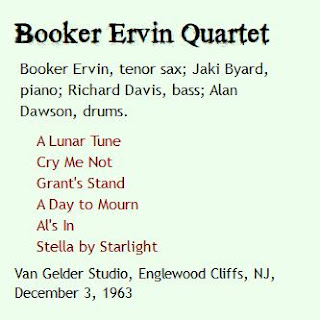
Listening to Prestige 607: Booker Ervin


LISTEN TO ONE: Grant's Stand

 Before free jazz became the universally agreed upon name for the music that was being pioneered in the early 1960s by Ornette Coleman, John Coltrane, Eric Dolphy and others, it had other names. Arthur Taylor, in his book Notes and Tones, a collection of interviews with fellow musicians conducted between 1968 and 1972, frequently discusses "freedom music." Musicians don't always get to decide what their albums are going to be called, but it's likely that Booker Ervin had some input into The Freedom Book the title for this one, as he edges from bop toward freedom music, paying his tuition to both schools, and establishing himself as one of the distinctive voices of this period.


The quartet Ervin assembled for this session was to stay with him throughout his career with Prestige, and the three sidemen would work as a trio under Jaki Byard's leadership on a series of Prestige albums. They were the right group for where Ervin was going, eclectic musicians who could play in any style, even styles that hadn't been invented yet, and that Ervin was maybe making up as he went along.

Jaki Byard was as wide-ranging a talent as you're likely to find, from working with Eric Dolphy to playing the music of James P. Johnson and Fats Waller. Ervin was mostly unfamiliar with Byard's work before hiring him for this session on the strong recommendation of producer Don Schlitten. Schlitten was right, as their continued association would prove.

Richard Davis's credentials range from Dolphy (the great Dolphy-Booker Little Quintet) to Frank Sinatra to Van Morrison (he was on Morrison's groundbreaking Astral Weeks album). New on the New York scene after several years on the road with Sarah Vaughan, he had been making his mark all over town when tabbed for this gig.

Alan Dawson made  his Prestige debut back in 1953 when, as a member of Lionel Hampton's European touring band, he joined Quincy Jones for a session in Sweden. An educator of note (Tony Williams was a student), he was teaching at Berklee in Boston when Ervin called him for this session, explaining:

Yeah, Alan's a bitch...I played with Alan in Boston about ten years ago and it was one of the greatest experiences I've had in music...with Alan you can forget about the time, go beyond it. He's got drive but he also knows how to build a climax, then take it down to a different level where you can get yourself together and then build it back up again. Man, with Alan you can play forever!


He followed his stint with Ervin by replacing Joe Morello in the Dave Brubeck quartet, where almost certainly did not duplicate his stick work with the Booker Ervin quartet.

It's no accident that a musician of Ervin's gifts, and Ervin's vision, would put together a group this gifted, and it's a blessing that he was able to keep them together. This is an amazing album, that gets better every time you listen to it. I'm hard-pressed to pick a "Listen to One." The uptempo numbers, "A Lunar Tune," "Grant's Stand" and "Al's In," push the freedom envelope a little more. The ballads. especially "A Day to Mourn" have some fine ensemble playing and some remarkable individual virtuosity. You should really listen to the whole album. If the freedom sound sort of passed you by, and you think you ought to have given it more of a shot, but it was just too far out for you, you'll love this album. If you're a free jazz devotee, you'll love this album. Go out and buy it on vinyl.

Randy Weston wrote "Cry Me Not." All the others on the album are Ervin's compositions. They also recorded the standard, "Stella by Starlight," but that was held back, and appeared on a 1966 album. Groovin' High, which was the extras from all his previous sessions.  


Tuesday, February 08, 2022

Listening to Prestige 606: Jimmy Witherspoon


LISTEN TO ONE: S.K. Blues

Jimmy Witherspoon was the most eclectic of blues singers. In that, he reminds me of Jerry Lee Lewis, who could and did take songs from every genre of American popular music, and -- without perverting their essence--turn them into Jerry Lee Lewis songs. 'Spoon did much the same, taking schmalzy pop, Delta blues, urban rhythm and blues, Kansas City Blues (he had four years with Jay McShann to internalize that genre), and making them into Witherspoon blues. When he joined McSha, early in his career, he replaced the hugely popular Walter Brown. McShann, Witherspoon would reminisce, told him there were three songs that had become signature songs for Brown: "Confessin' the Blues," "Hootie Blues" and "Lonely Boy." Audiences would


expect to hear them the way Brown sang them, and Witherspoon was to sing them just the Brown had. Beyond that, he was on his own, and he could find his own interpretation. Which is what he did with McShann, and what he did for the rest of his career.

This session shows the full range of Witherspoon's eclecticism. He starts out with Big Bill Broonzy's "I Had a Dream." Broonzy was from the Delta, but had built a career as a jazz guitarist in Chicago during the 1930s-40s. Then when folk music became popular in the 1950s, Broonzy reinvented himself as a "folk blues" artist. "Folk blues" was a term with wandering definitions. Sometimes it was synonymous with "country blues," which referred to the acoustic, primarily guitar-based blues of the Mississippi Delta and other rural regions, distinct from the "classic blues" of Bessie Smith and other jazz-based performers. In the 1950s it meant, more or less, the blues singers who played the folk festival and coffee house circuit, to largely white audiences. In the 1960s, as the rhythm and blues musicians from Chicago and Detroit, largely centered around Chess Records, began to decline in popularity with black audiences, while at the same time the sound they had pioneered was sweeping the globe as interpreted by young British musicians, the Chess brothers made a move to market their electric blues sound to a new audience by issuing a series of records by Muddy Waters, Howlin' Wolf and others entitled The Real Folk Blues.

Big Bill Broonzy reached his peak of popularity as a folk blues performer and composer. His best-known composition, "Black, Brown and White," took on racial prejudice, but "I Had a Dream," also known as "Just a Dream," ran it a close second, with shifting lyrics in different performances, but the same song at root. Witherspoon had recorded it earlier with Ben Webster, for Frank Sinatra's Hollywood-based Reprise Records; here he gives a straight, pretty much folk blues reading, albeit with some first rate jazz musicians following his lead.

It's jazz all the way with Count Basie's "Goin' to Chicago," brought into the 1960s and organ-based soul jazz by King Curtis organist Paul Griffin.

"You Made Me Love You" is a music hall tune from 1913, written by James Monaco and Joseph McCarthy and popularized by Al Jolson, later to become a beloved classic when sung by Judy Garland in Meet Me in St, Louis. Witherspoon gives it his best blues crooner rendition.

"My Babe" and "Around the Clock" are from two of the leading figures of the golden age of rhythm and blues in the 1940s and 1950s, Little Walter Jacobs and Wynonie Harris. "My Babe" was a huge hit and Little Walter's signature song, "Around the Clock" lesser known but still tasty. 'Spoon knows how to sing that rhythm and blues.


"S.K. Blues" is from 1942, the beginning of that golden age, when it was a hit on the Race Records charts for Saunders King. There have been a lot of blues singers named King, and Saunders may not have been as well known as B. B., Albert or Freddie, but he deserves to be. "S. K. Blues" became a hit again in 1945, in perhaps the definitive version by Big Joe Turner, with a band including Pete Johnson, Don Byas and Frankie Newton, and it became a favorite of Witherspoon's, who first recorded in 1959, and was to record it for a third time in 1967 with Brother Jack McDuff. "S. K. Blues" is a singer's song--you can put your individual stamp on it without distorting it, and Witherspoon does just that.

"Goin' Down Slow" is from the same era. Like Saunders King, St. Louis Jimmy Oden is not remembered as well as he should be. And as with King, if he's not quite remembered, his most famous song certainly is. "Goin' Down Slow" has been recorded by nearly everyone who ever sang the blues


(including a reprise on Prestige by St. Louis Jimmy in 1960), and it's had instrumental jazz treatments by Hank Crawford and Archie Shepp. This is just a great song. Singers love to sing it, audiences love to hear it, and Witherspoon does it justice. It's another one that he has recorded a number of times: with Eric Burdon, with Ben Webster, with Robben Ford, and with Duke Robillard.

Finally, the session included three originals by Witherspoon, himself no slouch as a blues composer,

Ozzie Cadena produced the session. The Prestige LP was entitled Blues Around the Clock. It spun off two 45 RPM singles,  "I Had a Dream" / "S. K. Blues" and "You Made Me Love You" / "Goin' to Chicago Blues."


Tuesday, February 01, 2022

Listening to Prestige 605: Shirley Scott-Stanley Turrentine


LISTEN TO ONE: Soul Shoutin'

Stanley Turrentine's fourth recording session with wife Shirley Scott found the tenor saxophonist at his soul shaking peak, perhaps best realized on his own composition, "Soul Shoutin'," which made enough of an impact that it was included on a Prestige 60th anniversary double album.

Scott and Turrentine went out for this session with a stripped-down quartet, just bass and drums. Not every jazz organ album includes a bassist--frequently the Hammond B-3 takes over the responsibility of the bass line, and in those days part of the organ's growing popularity stemmed from the fact that if a bandleader hired an organist instead of a pianist, he wouldn't have to also pay a bass player. But including a bass here meant that Scott didn't have to shoulder that responsibility, so she and Turrentine could handle all the front line stuff. 


And they do. Scott is amazing, as she always is, but this is Turrentine's session primarily. Of the five tunes, two are Turrentine's, and those are the two that became the 45 RPM single of the album. "Soul Shoutin'" is the title cut, and on it Turrentine lets go, and shows just how rich and subtle soul jazz can be in the hands of a musician who is a jazzman first and a soul man second. The soul is not neglected--this is still jazz with a beat, and you can dance to it, but Turrentine gives so much more.

"Soul Shoutin'" is the uptempo side of the single. Turrentine's "Deep Down Soul," on the reverse, is a beautiful blues ballad. If Turrentine's solo on "Soul Shoutin'" puts Scott to some degree in the shade (nothing could completely do that), she comes back strong on "Deep Down Soul," with all her usual hallmarks -- experimental sound shadings, inventive improvisation, melody, and, yes, soul.

The other selections for the session are a varied grouping, and all of them interesting, if not with the immediate impact of the Turrentine compositions. "Gravy Waltz" was written by Ray Brown and Steve Allen, and became an instant jazz standard, in part due to Allen playing it on his TV show, although he contributed the lyrics, which are rarely sung. Seventeen different versions of it were recorded in 1963 alone. 


"Serenata" is by Leroy Anderson, a composer of light orchestral pieces such as "Sleigh Ride" and "The Syncopated Clock," many of them written expressly for Arthur Fiedler and the Boston Pops Orchestra. "Serenata" was one such, and it was premiered on record by the orchestra in 1949. His work would seem to lend itself more to the Boston Pops than to a jazz combo. But jazz musicians have an ear for the good tunes, and "Serenata" had been recorded by George Shearing, Cannonball Adderley, Art Farmer and Benny Golson, and Jonah Jones, before Scott and Turrentine picked it up. Its orchestral lilt makes it an odd choice for a soul jazz recording, but Turrentine gives it that soul drive. Scott, in her extended solo, explores some textures that the Boston Pops never thought of.

Cole Porter is more of a mainstream choice for jazz musicians, amd Scott and Turrentine take "In the Still of the Night" for a good romp.

Earl May, for many year's Billy Taylor's bass player, had worked with Shirley Scott before, and Grasella Oliphant had first joined them for their January date.

Ozzie Cadena produced.

Monday, January 31, 2022

Listening to Prestige 604: Jack McDuff


LISTEN TO ONE: Jive Samba

Prestige Records, Ozzie Cadena and Rudy Van Gelder took a bit of a breather in the fall of 1963, between the September 17th date of Jack McDuff, without his group, joining Sonny Stitt for a session, and October 10, when McDuff regular Red Holloway recorded a date without Brother Jack. 

But in the interim, one of Prestige's mainstays was recorded live out in San Francisco, and the results released on Prestige. The club was the Jazz Workshop, and the headliner none other than Brother Jack.


San Francisco, especially the North Beach area, was a hot epicenter for jazz in the 1960s, with such a cluster of clubs that Dizzy Gillespie, playing one night at the Jazz Workshop, could tuck his horn under his arm, walk across the street to a club where Carmen McRae was headlining, and accompany her on a swinging version of "I Left My Heart in San Francisco." The Workshop was particularly fertile ground. Barry Harris recorded a live album there in 1960, and he was followed by Charles Mingus, Cannonball Adderley, James Moody, Larry Coryell, and perhaps most famously, Thelonious Monk, whose 1964 appearance was recorded but unreleased. When it finally saw the light of day in 1983, it was hailed as one of Monk's finest efforts.

Jack McDuff hit Frisco with a big sound, including his two tenormen of the moment (usually he used one or the other), Harold Vick and Red Holloway, and his hot new guitar find, George Benson, and they all came ready to play to a responsive audience.

The date included four originals by McDuff, including "Grease Monkey," a staple of his live sets, and a tune previously recorded on an album with Kenny Burrell

"Somewhere in the Night" was written by noted arranger Billy May as the theme music for the gritty New York-based police drama Naked City, and it had become a crowd pleaser for jazz ensembles.

"Passing Through" was from a young West Coast musician who was starting to make a name for himself as a sax player/composer/arranger with Chico Hamilton. Charles Lloyd would go on to become one of the biggest jazz stars of the rest of the century, and into the next millennium. 

Finally, "Jive Samba"  had recently been recorded by Cannonball Adderley, from the pen of his brother Nat. It had already become a hit in jazz circles, and has remained a staple of the jazz repertoire for major artists and school groups alike.

Jazz Workshop was a great place to play, and its knowledgeable and enthusiastic audiences drew the best out of the musicians that played there. This album, entitled Brother Jack at the Jazz Workshop--Live!,  produced by Lew Futterman and Peter Paul, yielded two 45 RPM singles off the initial release, "Passing Through" / "Somewhere In The Night" and  "Dink's Blues / Grease Monkey." A third single,  "Rock Candy / Grease Monkey" was released in 1969. The group is identified as the Brother Jack McDuff Quartet, despite the presence of five musicians.


Friday, January 28, 2022

Listening to Prestige 603: Sonny Stitt, Jack McDuff


LISTEN TO ONE: Soul Shack

 Back in February of 1962, Prestige put Sonny Stitt and Jack McDuff together, that time along with Gene Ammons. Stitt was already considered one of the legends of jazz, going back to Charlie Parker and bebop's golden days in the 1940s. Ammons was probably Prestige's most consistent seller, and McDuff one of its hottest new stars. In a way, they represented three generations of jazz styles, although they were very close to the same age.

When Stitt and McDuff got together again in September, Ammons was already in prison on drug charges; but, as with the previous session, the


legend was the center, the hot new guy the support. McDuff had his own tight-knit group, with drummer Joe Dukes, considered by many to be the pulse of soul jazz, and a young George Benson, a future supernova in the jazz world. Instead, the quartet was filled out with two solid professionals--the versatile Leonard Gaskin, and the perhaps even more versatile Herbie Lovelle. Lovelle was becoming one of the drummers Prestige liked to call, with six previous sessions for the label. But calls for his sticks and brushes were far-flung, and by the time he was finished, he had played drums for everyone from Hot Lips Page to Teddy Wilson to Bob Dylan to the Monkees.

So this is essentially a Sonny Stitt album. Stitt is everything one looks for in a jazz legend--swinging, melodic, inventive, endlessly listenable. McDuff, even in his solos, is a part of that sound--tasteful, not overpowering, yet still individualistic.

And soulful. We can't forget soulful. The name of the album is Soul Shack, and the title track, composed by Stitt but certainly with McDuff in mind, is the soul highlight of the session, with the two of them getting free to get down, and never let up.


Three of the tunes chosen for the album are much-recorded standards dating back to the 1920s-30s, played by this group with fond familiarity, but given their own stamp. "Sunday" was written by Chester Conn in 1926, and has had 500-odd recordings, most often by vocalists, but with many pure jazz variations, from the original version by Jean Goldkette through Benny Carter, Gerry Mulligan and Ben Webster, Tommy Flanagan and Jaki Byard. "For You" comes from a Mack Sennett movie in 1930 and has also entered the lexicon of American song, from jazz vocalists to Ricky Nelson, as well as a few jazz interpretations. "Love Nest" also dates back to 1930, and as Dan Morgenstern comments in his liner notes, "most modernists race through this as though it were an establishment built for rabbits, but not so Sonny...he sets a calm yet springy pace...Jack McDuff waxes lyrical."

"Hairy" and "Shadows" were also written by Stitt, and "Shadows" is a blues and pure beauty, with lyrical playing by both Stitt and McDuff.

Soul Shack was a Prestige release, Ozzie Cadena producing. I can find no record of  A 45 RPM single,  unusual for a McDuff session of the time, but YouTube has a three minute edit of the track, so maybe there was a single.

Sunday, January 16, 2022

Listening to Prestige 602: Roy Haynes


LISTEN TO ONE: Modette

 Elvin Jones once said:

 The greatest contribution jazz has made in music has been to replace the role of the conductor with a member of the ensemble who, instead of waving his arms to keep time and convey mood, is an active member of the musical statement. That person is the drummer. 

Jones did, of course, see the world through a drummer-centric prism, but that doesn't make him wrong. And in sessions led by a drummer, the argument is made forcefully. Art Blakey's Jazz Messengers set the tone for so much of Blue Note's


catalog. Max Roach and Tony Williams showed new directions in jazz through groups that they led. Across the Atlantic, expatriate Kenny Clarke showed how a drummer could conduct a large ensemble with the Clarke-Boland big band.

Roy Haynes was one of the most prolific drummers of his era, and his era is virtually an eon. He came on the jazz scene in the early 1940s, recording with Lester Young, then with Charlie Parker. As the 21st century entered its third decade, he was still playing, well into his 90s. I can never hear his name without hearing Sarah Vaughan, on her great 1950s recording of "Shulie a Bop," announcing her musicians, ending with "Roy (drumroll)....Haynes!" (drumroll). He is one of the most prolifically recorded drummers of all time, with 28 previous sessions on Prestige.

These include three previous sessions as leader. In 1958 he recorded We Three, a trio album with Paul Chambers and Phineas Newborn, Jr., and in 1960 he followed it with Just Us, this time with Richard Wyands on piano and Eddie de Haas on bass. While Elvin Jones's statement is meant to apply to the importance of the drummer in a large ensemble, you can hear it more plainly in a small group session where the drummer is the leader, and Haynes makes a powerful impression with these trio sessions.


In April of 1963, just five months before this session, he co-led a quartet featuring Booker Ervin. Ervin was really starting to establish himself as one of the major new jazz stars of the decade. Here he's back with the quartet format again, including worked with Ronnie Mathews and Larry Ridley, from the Ervin session, and Frank Strozier, who was heard once earlier on Prestige, playing alto sax in a group led by Booker Ervin. Here he plays flute as well as alto.

All three of these guys were young, near the beginning of their careers, and Haynes gives them all ample opportunity to shine. This includes the playing of their compositions--"Modette" and "La Palomeinding" were written by Strozier; "Go 'n' Git It" is by Mathews. All of them get the substantial benefit of Haynes's leadership on drums. Another Strozier composition, "Hag" (one of Haynes's nicknames) is included as part of a medley, unusual but not unheard of for a jazz album, and actually a frequent concluding number for Haynes's live sets, always including his own (with Richard Wyands) composition "Cymbalism," which had previously been on the Just Us album. Here they finish up with Sonny Rollins's jazz standard "Oleo."

"Cymbalism" becomes the title track for this LP, which was issued by New Jazz, and was the last album to be recorded for New Jazz, although several reissues followed it before the label was finally put to rest. Ozzie Cadena produced.


Tuesday, January 04, 2022

Listening to Prestige 601: Red Holloway


LISTEN TO ONE: Monkey Sho' Can Talk

 Red Holloway first came to Prestige as part of a large ensemble put together by Oliver Nelson for a Gene Ammons session, then appeared on a session with Brother Jack McDuff, with whom he was to remain for several years. But Bob Weinstock liked his stuff, both musically and commercially, enough that he was to bring out four albums with Holloway as leader over the next few years, with an emphasis on "jazz with a beat" -- the liner notes to this album emphasize, a touch melodramatically, that this music has a good beat and you can dance to it.

Although he was born in Arkansas, Holloway was a true musical son of Chicago, where his family moved when he was still in school. He attended DeSable High School, that cradle of jazz education, where one of his classmates was Johnny Griffin. He left Chicago for the army, but returned to


spend his formative years there, playing with a wide range of musicians. He was active in Chicago's blues and rhythm and blues scene, joining Roosevelt Sykes's band, and playing with Chuck Berry, Willie Dixon, Junior Parker, Lloyd Price, and Bobby Bland. He accompanied a range of visiting jazz stars, including Dexter Gordon, Yusef Lateef, Ben Webster, Sonny Rollins, Wardell Gray, and many more. He worked with vocalists -- Billie Holiday, Dakota Staton, Joe Williams, Aretha Franklin. He toured with Sonny Stitt, Memphis Slim, and Lionel Hampton. 

And all of this -- the rhythm and blues, the modern jazz, the entertainers, the soul jazz -- can be heard in Holloway's own sound, making him a good fit for Jack McDuff, and a good bet for recordings under his own name. To quote the teenage record reviewers on Dick Clark's American Bandstand, Holloway's records had a good beat. You could dance to them.

Holloway first brought a group to Rudy Van Gelder's studio on August 27. It was a quiet time (for Prestige, not for Rudy, who rarely had down time) between the two Gildo Mahones sessions, but even so, they did not spend much time with Red. He recorded two tunes, one a standard "Moonlight in Vermont") and one an original ("Miss Judie May"). 

Some of the musicians on this date shared a Chicago connection. Thomas "Tiaz" Palmer worked with a number of Chicago doowop and rhythm and blues groups as well as jazz groups, and in the 1980s would reunite with another ex-Chicagoan, Amina Claudine Myers, for a recording. He also toured and recorded with the Coasters frequently. Trumpeter Hobart Dotson was a music veteran, having been a member of Billy Eckstine's big band in the 1940s. He had also been a stalwart on the Chicago jazz scene, recordint with a number of groups. 


Bob Durham also had his start in doowop, working with the Orioles at 16, He went on to a long and distinguished jazz career, highlighted by an an association with Norman Granz that found him playing with many of Granz's artists, including Oscar Peterson, whose regular drummer he was through much of the 1960s.

But two sides were all that this group cut, and only one of them was used. "Miss Judie May" was shelved, to be recorded again when Holloway convened a completely different group on October 10.

This one was anchored by two Prestige mainstays, Leonard Gaskin on bass and Herbie Lovelle on drums. The other players were all new--and again, relying on his Chicago connections.

Paul Serrano made his mark on the Chicago music scene not only as a trumpeter but also as a recording engineer. After playing with Woody Herman, and appearing on hundreds of recordings for Chess and other Chicago-based record labels, Serrano opened his own South Side P. S.  Recording Studios in 1966. In 1992, as he began to suffer from Parkinson's disease, he closed his studio and went to work for Delmark Records as their head engineer. Ramsey Lewis, who recorded frequently with Serrano, remembered that "being a musician, he knew what the instruments were supposed to sound like." Lewis also recalled Serrano's generosity with musicians who couldn't afford to pay.

Big John Patton, like many organists, started on piano, accompanying Lloyd Price as a teenager. Switching to organ in the 1960s, he cut two records with Lou Donaldson, then served an apprenticeship of sorts with Jimmy Smith, playing tambourine on an early session by the soulmaster. By the middle of the year he was fronting his own group for Blue Note. He became one of their soul jazz stalwarts throughout the decade, then had a resurgence of his career in the 1980s with avant-gardist John Zorn.

This is a very early session for guitarist Eric Gale (he had made his Prestige debut on a King Curtis session), who wouldn't really hit his stride until the 1970s, when he became one of the most sought-after session guitarists around. His recordings with supergroup Stuff are some of the best examples of 1970s jazz-funk.

The album was released on Prestige as The Burner. "Monkey Sho' Can Talk" and "Crib Theme" were the 45 RPM single, the latter a rare composition credit for Ozzie Cadena, who produced both sessions.


Sunday, December 19, 2021

Listening to Prestige 600: Gildo Mahones


LISTEN TO ONE: Water Blues Fall

 Gildo Mahones would certainly vie for the dubious distinction of being the most overlooked of the great bebop pioneers, but he was there, and making his mark. In 1949, which was a little after the legendary jam sessions at Minton's Playhouse which birthed bebop, but at a time when Minton's sessions were still a vital creative force in the jazz world, Mahones became the pianist in the club's house trio, joining Percy Heath and Kenny Clarke. 

It was heady company for a 20-year-old, providing the accompaniment for whoever got up on the stand, from the veteran lords of jazz like Charlie


Parker and Coleman Hawkins to rising stars like Eddie "Lockjaw" Davis. It was "fast company, and I was trying to get it together," Mahones recalled in a 2013 interview with Berkeleyside, a Bay Area alternative newspaper:

I was learning something new every day. They’d start calling songs I’d never heard of and I’d go home every night and woodshed.

That's how jazz masters are made, and Mahones absorbed the lesson well. That trio, in addition to providing the underpinning for the after hours jam sessions, also formed part of a sextet in their upstairs room with Milt Jackson, Sonny Rollins, and Jesse Drakes.

By the time, nearly a decade and a half later, that he became one of the Prestige regulars, he had compiled a resume that any musician would be proud of, even if he never got the name recognition to go with it. He had worked with Joe Morris's rhythm and blues ensemble. Drakes, who worked a lot with Lester Young, brought Mahones into Young's group. He recalled, in an interview for the liner notes to I'm Shooting High:

Working from 1953 to 1957 with Lester was like going to school every night. It was really wonderful. At that time the group consisted of Lester Young, Jesse Drakes, Connie Kay and John Ore.


Working with Les Jazz Modes (Julius Watkins and Charlie Rouse) followed. It was a new sounding group trying something quite different and was not publicly accepted at the time. Maybe it could stand a better chance at the present time. After a few years with the Modes, I did a short stretch with Benny Green. It was on this job that I met Ike Isaacs and it was through Ike that I met Lambert, Hendricks and Ross who I have been working with since that time.

Lester Young took some getting used to. In his Berkeleyside interview, Mahones recalled:

He’d start calling songs, but he had a different title for every song. I didn’t know what he was talking with. Connie Kay had to translate.


Mahones made his Prestige debut in December 1962 with Ted Curson, and also worked with Willis Jackson, Frank Wess, Jimmy Witherspoon and Pony Poindexter. He had made a brief debut as a leader back in February of 1963, a brief session with Larry Young, George Tucker and Jimmie Smith, all of whom had been booked for an Etta Jones date which featured a different piano player. Perhaps Mahones was in the studio that day for some other reason, and they wrapped up the Jones session early and decided to give him a shot. Who knows, at this late date? Anyway, they cut three tunes, one of which was never released. The other two ended up on the album which resulted from these next two sessions, both also short, one in August and the other in September. Two of the August songs were discarded, although one eventually made it onto a Kenny Burrell reissue on Original Classics.

The tunes are mostly standards, with two Mahones originals. "Standards" in 1963 still mostly meant the tunes that have come to be identified as the Great American Songbook, with some songs from more recent Broadway musicals thrown in. The new songwriters who were to shape popular music so significantly in the 1960s had mostly not come onto the radar of the jazz community, but Mahones includes a number by Gerry Goffin and Carole King ("Hey Girl"). His "Stormy Monday Blues" is not the familiar one written by T-Bone Walker, but a completely different song written by Earl Hines and Billy Eckstine, originally recorded by Hines in 1942, and later, in 1959, by Eckstine with Count Basie. The lyrics to Eckstine's version don't actually mention stormy Monday at all. 

George Tucker and Jimmie Smith, Etta Jones's rhythm section who stayed on to work with Mahones and Larry Young for the February 4 session, are back with him for both the August and September sessions. Kenny Burrell and Leo Wright were there on August 15, but since two of their tunes were not included, and they were not included on "Hey Girl," which featured a vocal, they are really only on one track, "Tales of Brooklyn," making this essentially a trio album. "Hey Girl" is sung by newcomer Ozzie Beck, for whom I can find no other recording credits.

I'm Shooting High was to be Mahones' debut album, apparently on New Jazz, but this was around the time that Bob Weinstock folded New Jazz. The album was released in 1964 on Prestige's short-lived 16000 series, and this may have been a sort of afterthought, because by then a new album, The Great Gildo, was in the works, and when it was released as a double album, five songs from I'm Shooting High were also put on The Great Gildo. So whether much of anyone actually heard I'm Shooting High seems an open question.

"Hey Girl" was released as a 45 RPM single, along with "Bali Ha'i" from a later session.

Ozzie Cadena produced all the sessions.


'