Sunday, November 29, 2020

Listening to Prestige 530: Jaki Byard


LISTEN TO ONE: Blues in the Closet

Jaki Byard’s importance was always recognized by the jazz community, not l.ways by the general public. That he was so widely recorded — at least 35 albums as leader, more than 50 as sideman - are a testimonial to the willingness of jazz record labels to want to record the best people, even if not many people are buying those records. That almost all of these records were made for tiny labels suggests that maybe the majors and major independents aren’t all that willing to record artists who don’t sell a lot.

That the sole exception to that generalization was Prestige—12 albums over 8 years, from 1961 to 1969–is a pretty solid testimonial to Bob Weinstock’s

commitment to excellence in jazz. And one should include the Prestige front office team in general—5 more of Byard’s albums were made for Muse and High Note, labels started by Joe Fields, who had been an executive with Prestige through most of the 1960s (although the three High Note albums were only released after Byard’s death).


This was Byard’s second Prestige album as leader (there had also been two with Eric Dolphy and one with Don Ellis). Like the first, it was a trio album, and like the first, it featured Ron Carter on bass. For this session, Pete La Roca replaces Roy Haynes on drums, for his only Prestige session.

La Roca was in demand as a drummer throughout most of the decade. Later, he decided he would no longer work as a sideman, and since opportunities to record as a leader were sparse, he also followed other pursuits, including studying for a law degree. This education came in handy when a record company which had released one of his two dates as leader rereleased it under Chick Corea’s name. He sued them and won.

This session was made up of three originals, four covers, and one sort of odd attribution. I'll concentrate for today on the non-originals, because they tell a story of their own.

The odd attribution is "Excerpts from Yamecraw." Yamecraw was a symphonic piece written in 1928 by James P. Johnson, orchestrated by Willian Grant Still, and premiered with Fats Waller as pianist. Byard, interviewed by Nat Hentoff for the liner notes, describes being approached by music publisher Perry Bradford, who had been making the rounds trying to find a jazz pianist interested in doing the piece, with no takers. 

That was perhaps not surprising. Bradford had been an important figure, as a performer and composer, but primarily as one of the first Black music industry executives. It was Bradford who convinced Okeh records to take a chance on recording his song, "Crazy Blues," with a Black singer, when the conventional wisdom of the day was that no one would buy a record by a Black singer. Mamie Smith's recording of "Crazy Blues" was a surprise hit, and ushered in the recorded blues craze of the 1920s.

But by the 1960s, Bradford was a hanger-on, a forgotten figure, and no one was much listening to him. It's probably more surprising that Byard did. But Byard was one of the great students of piano jazz of every era, and Johnson and Waller were two of his heroes. The curiosity is that "Excerpts from Yamecraw," which is described by Hentoff as "Jaki excerpted a 12-bar phrase from the suite and constructed his own absorbing variations on that base" is listed as a Byard composition.

And there's nothing wrong with that. Brahms did the same thing, and his "Variations on a Theme by Haydn" or "Variations and Fugue on a theme by Handel" are unquestionably the work of Brahms. But isn't this pretty much what all jazz musicians do? Coleman Hawkins famously ushered in the modern jazz era with his recording of "Body and Soul," where he basically never plays the melody. But it's "Body and Soul," and Johnny Green gets composer credit and royalties. Eddie Jefferson's "Moody's Mood For Love" is his lyrics to James Moody's improvisation, not to the original tune, but Jimmy McHugh sued and won a share of the composer credit and royalties. 


Often jazz musicians have successfully gotten around the royalty issue by taking the chord changes to a song they liked and building a completely new melody around them -- much the same as what Hawkins did with "Body and Soul," except that they also changed the name of the piece, like Charlie Parker's "Ornithology." built on the changes to "How High the Moon," or the dozens of pieces written to the chord changes of George Gershwin's "I Got Rhythm." 

So when does the invention of a jazz musician (or a classical composer, like Brahms) become a new composition? It does matter, because songwriters get screwed out of royalties all the time. But it also sorta doesn't.

What's important about "Excerpts from Yamecraw" is Byard's homage to Johnson and Waller. And the other outside compositions in Hi-Fly provide insights into his mind and his musicality, starting with the title track, composed by Randy Weston. 

About "Lullabye of Birdland," Byard told Hentoff, "I know it's fashionable to put down George Shearing, but I feel he's made a contribution, and this tune of his has certainly lasted." Shearing had come over from England as one of the most original modern jazz pianists around, had jammed with Charlie Parker, and had gradually tempered his style to more accessible "cocktail jazz." At the time, with modern jazz so identified with rebellion, playing in a cocktail lounge was considered the very definition of selling out. Ahmad Jamal had the same label hung on him, until Miles Davis revealed that he was a fan of Jamal's rich improvisational skills. So it's no surprise that Byard, who listened to everything, picked up on Shearing.

"Round Midnight" is Monk, and here's what Byard had to say about the great pianist/composer:
For me, the most astounding thing about Monk as a composer is his lyric sense. Monk's pieces could be show tunes. You take a bunch of his originals, and you'd have a good musical. His melodic sense is so strong that you can sing anything he writes, and always, you know it's him.
"Blues in the Closet" was written by Oscar Pettiford, but it's still a tribute to another piano hero of Byard's--Bud Powell, for whom it became a signature piece. Of Powell, Byard told Hentoff:
Bud was the main influence for all of us in terms of showing what could be done with single-line playing,

So many influences--and in Byard's case, "influences" doesn't do his art justice. Generally an influence is one overriding master whom the artist works through to find his or her own style. Byard absorbed and used and created something new and original and constantly changing, out of so many different voices.

I've chosen "Blues in the Closet" for my "Listen to One." Each piece on the album is a distinctive look into Jaki Byard, but "Blues in the Closet' also showcases Carter and La Roca effectively.

Was Byard always destined to be underappreciated? Nat Hentoff seemed to think so as early as 1962, when he wrote this on the liner notes to Hi-Fly:  "Whether or not it is true that the thunderbolt of sudden fame has missed Jaki...."

Hentoff goes on to hedge his bet a little:
I expect that his reputation will continue to grow on so solid a base of accomplishment that in a few years, it will suddenly occur to many jazz listeners that Jaki has been a major jazz figure for quite a long time, no matter what the polls have said.

And still today, "Jaki Byard" and "underappreciated" seem to be almost synonymous. On one recent online list of the 50 greatest jazz pianists, this one compiled by a critic, Byard is listed at #41, and critic Charles Waring had this to say:

Though revered by the critics, Byard’s unique sound was less well-received by the public.

In Ranker.com. reflecting today's jazz listening public, with votes open to everyone who chooses to participate, Byard is nowhere to be found, in a list of 150 piano players. One might question the collective judgment of the Rankers (Bill Evans #72?), but it is what it is. Much of today's jazz audience has forgotten Jaki Byard. Rateyourmusic.com's voters are often quirkier and more perspicacious than Ranker's, but they rate Hi-Fly well below the top 200 albums of 1962 (again, voter  polls on the internet are always subject to change, especially on the lower levels).

Should he have been higher than 41 in the critic's judgement? Higher than whom? It's not for me to say. In the 530 entries I've written to Listen to One, you've never seen me use the word "overrated." I never have, and never will, deprecate the contributions of any of the gifted and dedicated musicians who have contributed to this great American art form. But surely Jaki Byard was one of the very best. 

 Hi-Fly was released on New Jazz. Esmond Edwards produced.

Friday, November 27, 2020

Listening to Prestige 529: Jack McDuff - Gene Ammons


LISTEN TO ONE: Mellow Gravy

 One day after Smith and Powell shook the cathedral rafters of Rudy Van Gelder's New Jersey studio. another organ-sax combo took up residence, with no sign of slackening the intensity. And these were two of Prestige's top moneymakers. Jack McDuff was challenging Jimmy Smith for pre-eminence in the organ department (sexism still held Shirley Scott back, as good as she was and as popular as she was). Gene Ammons was probably the most popular artist in Prestige's history. Drugs were to catch up with Ammons before the year was out, and he was back in prison, this time for seven years. When he was finally


released in 1969, he signed again with Prestige, the most lucrative contract Bob Weinstock had ever given to an artist. And even after Weinstock sold Prestige to Saul Zaentz of Fantasy, and it became strictly a reissue label, they put out a couple of new Ammons albums.

So these guys were not going to let any other organ-sax combo steal a march on them. Smith and Powell had unleashed a killer album? Kill this, motherfuckers!

I'm making that up, of course. But it was one day later. Esmond Edwards was at the controls for both sessions. And McDuff and Ammons were smoking hot.

McDuff used the group that he had made into a super-tight ensemble. Harold Vick and Joe Dukes had been with him for a few albums, and would be sticking around for a while -- especially Dukes, regarded by many as the ideal jazz-funk drummer. Eddie Diehl would be around for a while longer, before getting  off the road and entering a new career as a guitarmaker. He had also worked before with Ammons, so they were no strangers to each other, either. 
The album. Brother Jack Meets the Boss, was a Prestige release. "Mellow Gravy" was a two-sided 45 RPM release, and the album was also released as Mellow Gravy, with a different cover but the same catalog number.


Thursday, November 26, 2020

Listening to Prestige 528: Johnny "Hammond" Smith - Seldon Powell


LISTEN TO ONE: Upset

 Johnny "Hammond" Smith was one of the most hard-driving, no holds barred jazz funk organists out there, and it's no surprise that when teamed with rhythm and blues veteran Seldon Powell, he churns up some high-powered excitement on this session. Perhaps a little more surprising is that they included a vibes player in the mix, and that he adds another dimension of heat to an already combustible mix.

The vibes player was Clement Wells, and although Powell would work again with Smith on a number of occasions, this is Wells's only recording date with the organist, and apparently his last recording session altogether. He seems to have been one of those who preferred a settled life to the vagaries of the road.


Wells's settled life was in Washington, DC, which must have had a pretty decent, if unheralded jazz scene in those days. Guitarist Charlie Byrd was the best known Washingtonian. He became nationally known while playing a regular gig at the Showboat Lounge in Washington, much the same as Ahmad Jamal at the Pershing Lounge in Chicago. But others who had gotten out of the rat race chose Washington as their home, including another Prestige veteran, trumpeter Webster Young. Percussionist Buck Clarke, who did actively pursue a career (including several Prestige sessions with Willis Jackson) was another Washingtonian, and he used Wells on his Argo album Drum Sum, the vibist's only other record date.

Wells did live on, however, in the form of a tune given to Oscar Peterson by Seymour Lefco, best known as "the jazz dentist," among whose many musical patients were Peterson and Ray Brown. "You Look Good to Me" became a staple of Peterson's repertoire, It's credited to Lefco and Wells, but it's pretty certainly Wells's tune.


Guitarist Wally Richardson was a versatile player whose credits included jazz, rhythm and blues, funk, and even Motown. As an on-call session player for Prestige, he recorded with  Oliver Nelson , Sam “The Man” Taylor, Buddy Tate, Al Sears, Groove Holmes, Etta Jones and Betty Roche. Leo Stevens was Smith's regular drummer.

The album was titled Look Out!  and it came out on New Jazz. Esmond Edwards produced. 

Monday, November 23, 2020

Listening to Prestige 527: Walt Dickerson


LISTEN TO ONE: It Ain't Necessarily So

 It's been said that jazz is the only musical genre in which the vibraphone is used as a lead instrument, and that's probably not exactly true, especially if you extend the discussion to all mallet-played melodic-percussive instruments. French composer Camille Saint-Saëns was perhaps the first classical composer to write for the instrument (in his case a xylophone) for his 1874 Danse Macabre. Handel and Mozart (most famously The Magic Flute) wrote parts for the glockenspiel, which is similar to the vibraphone but tuned to a higher pitch. Modernist composer Darius Milhaud wrote a Concerto for Marimba and Vibraphone in 1947. The marimba, probably African in origin, further developed as an instrument in Latin America, has become a staple of Japanese music, particularly in the work of composer Keiko Abe.


But the instrument certainly has a special prominence in jazz, starting with Lionel Hampton. Hampton, the story goes, was playing a gig on drums in the NBC radio studios. NBC always had a vibraphone on hand to make the three-note NBC call signal; Hampton noticed it, started fooling around on it, and was hooked.

After Hampton, Milt Jackson created a new vibraphone model for the bebop era, and the instrument has stayed relevant in jazz, as Gary Burton brought it into the jazz fusion era, and Stefon Harris (also a renowned classical musician) into the 21st century. 

Burton, Dickerson and Bobby Hutcherson were probably the three most prominent vibraphonists of the 1960s. Dickerson, signed to Prestige as they lost their vibe star Lem Winchester in a handgun incident, was the first of the three to gain prominence, as he was named New Star of the Year by DownBeat. But Burton's and Hutcherson's careers extended longer, and Dickerson has faded into an undeserved obscurity, as he left the jazz scene in the mid-1960s, and never recovered that lost momentum. On his return, he focused a lot on solo playing and music as part of an ongoing spiritual quest, the latter following the example of John Coltrane, with whom he had played as a young man in Jimmy Heath's big band. Coltrane's and Philly Joe Jones's recommendations had gotten him his recording deal with Prestige.


Dickerson used a special kind of mallet that gave him what he described as a "plush" sound, softer than that of most vibraphone players. He described the sound in more detail in an interview with Mike Johnston:

My approach has always been to be physically close to the instrument, very close. This is different than the approach that is taught on the instrument. I was unable to play intricate things on the instrument with the commonly taught approach. The music that the creator sends me is not of a cosmetic nature; it seems to come as streams of intricate passages of flowing imagery. This means that I can’t use the common approach to the instrument in order to perform these passages. So I’ve modified a complete personal style or technique so I can play the music I receive. So, in adapting my personal approach to playing my instrument my sound has adapted as well. Both are a part of the projection.

That unique sound is heard to excellent advantage on this album, consisting of three standards (one by Gershwin, two by Vernon Duke) and four originals. Dickerson is the principal voice throughout, but the musicians playing with him are awfully good, and very attuned to him. Austin Crowe is sensitive throughout. His work with Dickerson is so good that one can only wonder why he didn't do more--Dickerson in a later interview suggested that the jazz life on the road may not have agreed with him. Ahmed Abdul-Malik has a wonderful solo on "It Ain't Necessarily So," and Andrew Cyrille is consistently arresting, but I'll single out his work on "Relativity," the title track.

Relativity was released on New Jazz. Esmond Edwards produced.


Tuesday, November 10, 2020

Listening to Prestige 526: King Curtis


LISTEN TO ONE: Low Down

 King Curtis made his reputation with his thrilling solos to recordings by Atlantic rhythm and blues and doo wop performers in the 1950s. Then, later in 1962, he made a recording, "Soul Twist," for Harlem entrepreneur Bobby Robinson's Enjoy label, which hit Number One on the Billboard R&B charts, number 17 on the pop charts, and established Curtis as a star in his own right, with several more chart singles,  culminating in the monster hit, Memphis Soul Stew, for Atlantic in 1967. 

In between, he made six albums for Prestige, three of them for the "contemporary rhythm and blues" label, Tru-Sound. He worked on a number of other sessions, including several backing up singers for Bluesville. He worked with jazz musicians like Nat Adderley, or with his own working group, as here. This is the second of two sessions to include another rhythm and blues tenor legend, Sam "the Man" Taylor.


It was his association with the twist that brought stardom to Curtis, but really, "Soul Twist" was just a rhythm and blues number, and a good one--Curtis was one of the best R&B tenormen around. You could actually do the twist to any peppy tune with a back beat--it wasn't like the samba or the rhumba or the mambo, or even the bunny hop.

And the same with the tunes on this album. "The Twist" is the most Pavlovian response-inducing cultural phenomenon in American history. Hear Chubby Checker's voice singing "Come on bab-eeee..." even today, and a roomful of people will start gyrating and moving their arms as if drying their butts with an imaginary towel. Same probably with the Isley Brothers of the Beatles singing "Shake it up baby." Not so much with King Curtis's instrumentals, although I'm sure people were twisting the night away to them back then. Now they could still be for dancing to, if you chose, or you could just sit back and listen and snap your fingers and tap your feet. It's King Curtis's regular band, tight as can be, with a second star of the rhythm and blues firmament, Sam "the Man" Taylor (on all but two tracks).


These tunes all went onto the Tru-Sound album It's Party Time, along with four tracks from July 11, 1961, which utilized the same personnel, including Taylor. "Free for All," with "When the Saints Go Marching In" from a session in February 1962, was the first 45 RPM single to come from the session, followed by "Low Down" / "I'll Wait for You."

Thursday, November 05, 2020

Listening to Prestige 525: Coleman Hawkins


LISTEN TO ONE: That's All Right

 This Moodsville collection finds Coleman Hawkins bringing the Hawkins touch to Broadway, and a collection of show tunes plucked from, for the most part, not the most obvious of sources, but from some very good composers, and, given Hawkins's ear and chops. some very good results.

Sigmund Romberg. composer of old-fashioned operettas, seems an unlikely source for jazz inspiration, but he's proved surprisingly fertile, particularly from The New Moon, his final Broadway production, in 1928. "Lover, Come Back" has proved an enduring standard, and "Softly, as in a Morning Sunrise" has been nearly as popular an inspiration. The other best known composition from The New Moon is "Stout Hearted Men," and it would take indeed a stout


hearted jazzman to try to make something out of that one. "Wanting You" has been pretty nearly completely passed over. Roger Williams, not exactly a jazz pianist (although he did study with Lennie Tristano and Teddy Wilson) recorded it, as did Mario Lanza, who drew much of his repertoire from operetta. And no one else.

Except Coleman Hawkins, and he makes you wonder why it hasn't found more champions. It's a very good melody, and Hawkins finds all the right ways of developing it.

Another lightly recorded song from a powerful composer is Kurt Weill's "Here I'll Stay" from a 1948 musical, Love Life, which had a not-terrible run on Broadway in 1948-49, 252 performances. It sounds as though it would have been worth seeing. Book and lyrics by Alan Jay Lerner, directed by Elia Kazan (who knew he directed musicals?), choreography by Michael Kidd. And an intriguing plot: a couple get married in 1791 and stay married through 1948, during which time they never age, but undergo marital differences that reflect different times and mores.

"Here I'll Stay" was the most successful song from the show, unless you count the number that Lerner reworked, with new music by Frederick Loewe, for the 1958 movie Gigi -- "I Remember it Well." And it's had a modest but continuing life as a vehicle for pop singers, but no jazz artist had ever taken it on between its inception in 1948 and this 1962 recording. Gerry Mulligan must have liked what he heard from the Hawk, because he recorded it in 1963, after which it mostly fell back into jazz oblivion.


Most of the rest of the tunes were recognizable standards, as befits a tribute to Broadway, although one is a ringer -- the Harold Arlen/Ira Gershwin "The Man that Got Away," from the movie A Star is Born. 

This was an exciting time for jazz, with Ornette Coleman and John Coltrane and Eric Dolphy--tremendously exciting to hear sounds that pushed the envelope, that took music to places it had never been before. But there's always a place for great old tunes, played by a master.  Two masters, as Tommy Flanagan takes the piano chair for the date.

And we have two newcomers to Prestige, both seasoned veterans from the jazz cauldron of Detroit. Major Holley was an instrumental prodigy from a musical household and a graduate of Cass Technical High School, which bred so many jazz greats. Holley took up the bass in the Navy, then jumped right into the mainstream of jazz upon his return to


civilian life, playing with Dexter Gordon, Charlie Parker and Ella Fitzgerald, doing duets with Oscar Peterson, The 1950s were an expat time for him, but not Paris or Sweden like many others: he moved to London, where he worked at the BBC for a few years before returning to America. Though he developed a trademark sound of vocalizing along with a bowed bass (a style pioneered by Slam Stewart), he was also much in demand because he could work as an asset to any musicians in any situation. As he put it, 

When I was in Duke Ellington’s band, I sounded like Duke’s bass players. I remained applicable to the circumstances of where I was - whether it was Coleman Hawkins or a Broadway show or Judy Collins.″


 Eddie Locke came to New York in 1954, worked with a number of swing and trad musicians, became a protégé of Jo Jones, then joined Roy Eldridge in 1959. His associations with Eldridge and Hawkins are what he is best known for, as he, Flanagan and Holley became Hawkins's regular partners for the next several years, after which Locke returned to work again with Eldridge.

Esmond Edwards produced Good Old Broadway for Moodsville.


Thursday, October 29, 2020

Listening to Prestige 524: Wrapping up 1961

 First an apology. A regular feature of my year-end wrapup is a discussion of the DownBeat poll winners for the year.   I usually count on the amazing folks at the NY Public Library music division, but they are on skeleton staff for the duration of the pandemic. And once again, as I do every year, I bemoan the fact that the DownBeat archives have not been digitized. This is a national treasure. What's wrong with the Smithsonian?

When I am able to get hold of them, I will add an addendum to the wrapup. Meanwhile....

The year in Prestige saw the addition of a couple more short-lived Prestige subsidiaries that had nothing to do with jazz or blues, so I'll list them here briefly for the record. 

On Prestige International, Spero Spyros and His Modern Greek Ensemble. I have no further information on them. And--oddly for the International imprint -- Ramblin' Jack Elliott, the Brooklyn cowboy and Woody Guthrie follower who became a beloved elder statesman of American folk music, accompanied by brilliant folk instrumentalists Ralph Rinzler and John Herald.

On Prestige Lively Arts, two albums. One was by Hermione Baddeley, a British actress best known, according to Wikipedia, for playing "brash, vulgar characters," and for her boisterous parties which included mixed naked bathing in the goldfish pond. Her songs included "I Changed My Sex a Week Ago Today" and "Poor Little Cabaret Star." The other was by Billy Dee Williams, a decade before he became Gale Sayers in Brian's Song, and two decades before he was Lando Carissian in The Empire Strikes Back, He was breaking in to theater and television then. If he had a singing career other than this album, there's no record of it that I could find, and his stage work did not include musicals other than an appearance with Lotte Lenya at age ten. Probably concentrating on dramatic roles was the right decision, although his singing voice isn't bad, his style owing debts to Sammy Davis Jr. and Mel Tormé. Some very good jazzmen, including Frank Socolow and longtime Nina Simone accompanist al Schackman, back him up.

Back to jazz. The year some greats from the old guard passing, including New Orleans' Alphonse Picou and Nick LaRocca, and trombone pioneer Miff Mole. Also Wilber Sweatman, one of the first black bandleaders to have hit records (going back to the beginnings of recorded music, in the first decade of the 20th century), and the executor of Scott Joplin's estate.  And Stick McGhee, whose "Drinkin' Wine Spo-Dee-O-Dee" was an early rhythm and blues hit for Atlantic records.

A couple were taken before their time. Bassist Scott LoFaro was 25. He died in an auto accident on July 6, four days after appearing with Stan Getz at Newport, but his closest musical collaboration was with Bill Evans, with whom he had played a two week engagement at New York's Village Vanguard in late June (the albums Sunday at the Village Vanguard and Waltz for Debby, both on Riverside, came from those sessions). Evans was so distraught at the young bassist's death that he could not play again for several months.

Booker Little died of uremia on October 5 at age 23. His performances with Eric Dolphy at the Five Spot in the summer of 1961 were captured on two New Jazz releases, Eric Dolphy at the Five Spot Vols. 1 and 2, which promised greater things to come...a promise never fulfilled.


1961 was a year in which the bifurcation of jazz was in full flight. The new sounds of modal jazz, or free jazz, which moved away from bebop's structure of improvising around a series of chords in a certain key. allowed for a music that some found liberating, others confusing. But it was here to stay, and artists who chose this experimental route were producing records that could not be ignored. And the funky sounds of soul jazz provided an earthy and satisfying alternative. Jazziz magazine, looking back and choosing the five most important albums of the year, shows this bifurcation in action.  Their top spot goes to John Coltrane's My Favorite Things, followed by Ornette Coleman, Free Jazz, Oliver Nelson, Blues and the Abstract Truth, Eric Dolphy, Out There, and Art Blakey, A Night in Tunisia.

David Brent Johnson, in his Night Lights blog for Indiana Public media, sums up the years highlights like this:

Pianist Bill Evans and saxophonist John Coltrane led groundbreaking groups at the Village Vanguard in New York City, saxophonist Stan Getz and trumpeter Dizzy Gillespie recorded challenging orchestral LPs, and clarinetist Jimmy Giuffre and pianist George Russell fronted small, progressive ensembles, while West Coast bop hero Dexter Gordon returned to the scene, and jazz giants Louis Armstrong and Duke Ellington teamed up for a memorable studio encounter.

He adds:

Tenor saxophonist Sonny Rollins began to re-emerge from his self-imposed two-year sabbatical, just as avant-garde pioneer Ornette Coleman began a long retreat from the recording studio... 

The Village Vanguard would play host to another notable gig later in the year, by tenor saxophonist John Coltrane. Coltrane was pushing musical boundaries with a quintet that included the cutting-edge, liquid-flame sound of alto saxophonist, bass clarinetist and flutist Eric Dolphy. The group would inspire one of the most famous, or infamous, critical attacks in jazz history, when writer John Tynan. In the November 23, 1961 issue of Downbeat, Tynan wrote:

Go ahead, call me a reactionary. I happen to object to the musical nonsense currently being peddled in the name of jazz by John Coltrane and his acolyte, Eric Dolphy. They seem bent on pursuing an anarchistic course in their music that can but be termed anti-jazz.

The article provoked such a pro-and-con storm that Coltrane and Dolphy sat down with Downbeat several months later to respond at length to the charge that they were out to destroy swing, tonality, and other elements of the music.

Johnson's entry is so good it should be read in its entirety. He touches on the Armstrong/Ellington collaboration, albums by Dizzy Gillespie and Stan Getz "with orchestral backing that ventured into the realm of the Third Stream" (Gunther Schuller conducted the brass ensemble for Dizzy); Jimmy Giuffe's trio with Paul Bley and Steve Swallow within which, as Giuffre told DownBeat, "traditional functions of the instruments have been eliminated...what we do is a matter of collective improvisation wherein individual roles are constantly shifting from dominant to subordinate;" Dexter Gordon's return to jazz with a new, forward look; and George Russell's 1961 album Ezz-thetic, featuring (once again) Eric Dolphy.

And although I can't do the DownBeat poll, with its snapshot of what jazz fans were thinking then, I can look at the rateyourmusic.com list of the top albums of 1961. There are a lot of top this and top that fan-voted lists on the internet, and they don't all demonstrate good taste, but rateyourmusic's is consistently the quirkiest, most eclectic, and most interesting. It's a contemporary take on music made 60 years ago, as voted on by Lord knows who. Well, who knows who voted in the DownBeat poll, or the Esquire poll, or the Playboy poll, back then? Rateyourmusic lists all genres of music together in one glorious hodgepodge, but jazz enthusiasts tend to dominate. Here are the top forty, with other genres culled out, and only the jazz remaining. Since this is an ongoing vote, the rankings can change from day to day, but the ones at the top have enough votes that they stay pretty stable. 


1 My Favorite Things, John Coltrane (Atlantic)
Coltrane was starting to emerge as The Man even then. His reputation has only grown in succeeding years.


2 Olé Coltrane, John Coltrane (Atlantic)
As I said, his reputation has only grown. Rateyourmusic's subscribers really like Coltrane. With Freddie Hubbard, McCoy Tyner, Reggie Workman, Elvin Jones.

3 Africa / Brass, The John Coltrane Quartet (Impulse!)
They really really like Coltrane. With a large ensemble.


5 Free Jazz, The Ornette Coleman Double Quartet (Atlantic)
The double quartet, one in each stereo channel. 


6      We Insist! Max Roach's Freedom Now Suite
A collaboration with Oscar Brown Jr. Roach was one of the first to use jazz to make an overtly political statement.


7 The Blues and the Abstract Truth, Oliver Nelson (Impulse!}


10 Out There, Eric Dolphy (New Jazz)


11 A Night in Tunisia. Art Blakey & The Jazz Messengers (Blue Note)
With Lee Morgan and Wayne Shorter, one of his best groups. But they were all good.

13 Out of the Cool, The Gil Evans Orchestra (Impulse)
Surely showing this group of voters' gift for eclecticism (and their good taste).

14 Explorations, Bill Evans Trio (Riverside)

16 This Is Our Music, The Ornette Coleman Quartet (Atlantic)
Ornette, Don Cherry, Charlie Haden, Ed Blackwell. This is the Ornette I remember, from the Five Spot.

17 Thelonious Monk With John Coltrane (Riverside)
Not just Coltrane. You also get Coleman Hawkins and Gigi Gryce.

18 Roll Call, Hank Mobley (Blue Note)

20 Ezz-thetics, George Russell Sextet (Riverside)

21 The World of Cecil Taylor (Candid)

22 Steamin' With the Miles Davis Quintet (Prestige)
 From the Contractual Marathon sessions.

23 Leeway, Lee Morgan (Blue Note)
Perhaps the Lee Morgan bio on Netflix and other streaming services influenced contemporary voters.

24 Percussion Bitter Sweet, Max Roach (Impulse!)

25 Charles Mingus Presents Charles Mingus (Candid)

26 Out Front, Booker Little (Candid)

28 Ella Fitzgerald Sings the Harold Arlen Song Book (Verve)

29 Whistle Stop, Kenny Dorham (Blue Note)

30 Flight to Jordan, Duke Jordan (Blue Note)

31 Undercurrent, Kenny Drew (Blue Note)

32 Straight Ahead, Oliver Nelson with Eric Dolphy (Prestige)

 33 Time Further Out, The Dave Brubeck Quartet (Columbia)

35 Motion, Lee Konitz, Verve

36 Bags & Trane, Milt Jackson & John Coltrane (Atlantic)

39 Green Street, Grant Green  (Blue Note)

40 João Gilberto (Odeon)
 You can bet that this wouldn't have been on a list of the top 40 jazz albums of the year back in 1961. Even the greatest Latin jazz musicians like Tito Puente were not getting any consideration from DownBeat readers (not even in the dance band poll). And Gets/Gilberto was still two years in the future. Probably Giberto's death in 2019 resulted in a spike of interest in him that held over to 2020--if I check this page two years from now, good chance he will have slipped back down. But this is terrific music in the Brazilian style which came to be so defined by Gilberto and Antonio Carlos Jobim.

What's missing from this top 40 that surely would have been part of a comparable list in 1961? There are no organ combos. That was such a hot sound back then, but its popularity faded. For 2020's jazz enthusiasts, the top organ album--something of a surprise to me--is Baby Face Willette at number 66. Hard to believe he's remembered today ahead of Jimmy Smith or Jack McDuff, but Smith only rates 74 and again 85 on the list, and after him Richard (Groove) Holmes at 141 (with Gene Ammons), McDuff at 143 (with Roland Kirk). Grant Green is featured on the Willette album.

Here are some other names in jazz and blues that were worth a mention by the newer generation of listeners in 2020: 
Freddie Redd, Django Reinhardt, Nina Simone, Henry Mancini, Booker Ervin. Dexter Gordon, Blind Gary Davis, Steve Lacy, Wes Montgomery (surprised he's not higher), Dizzy Gillespie. Frank Sinatra, Stanley Turrentine, Coleman Hawkins, John Lee Hooker, Straight Ahead, Louis Armstrong & Duke Ellington, Jimmy Reed, Lightnin' Hopkins, Gunther Schuller & Jim Hall, Jimmy Giuffre, Jimmy Smith, Charles Mingus, Freddy King, Gerry Mulligan and Johnny Hodges, Buddy Rich, Sarah Vaughan, B. B. King, Roy Eldridge, Jo Jones, Ray Charles, Hampton Hawes, Jackie McLean, Robert Pete Williams, Cannonball Adderley, Paul Desmond, Clark Terry, Mal Waldron, Pink Anderson, Etta James, Carmell Jones, Ahmed Abdul-Malik, Bo Diddley, Gil Evans Orchestra, Mark Murphy, Slim Harpo, Johnny Griffin, Joe Harriott, Ron Carter, J.J. Johnson, Lou Donaldson, Eddie Harris, Art Taylor, Kai Winding, Jimmy Heath, the Jazztet, Peggy Lee, Paul Gonsalves, Latin Jazz Quintet, Helen Humes, Pepper Adams, Donald Byrd, Howard McGhee, Don Friedman, Ahmad Jamal, Duke Pearson, Teddy Edwards, Wynton Kelly, Dorothy Ashby, Terry Pollard, Pee Wee Russell...

and a lot more.


A side note on the incredible cross-pollination of jazz at mid-century. An album called Newport Rebels (Candid) is described as "avant garde jazz." It features Charles Mingus, Max Roach and Eric Dolphy, all with impeccable avant-garde credentials...and Roy Eldridge and Jo Jones.

On to 1962!


Monday, October 26, 2020

Listening to Prestige 523: Tampa Red


LISTEN TO ONE: How Long

 When Samuel Charters sought out Tampa Red in Chicago in the late 1950s, he found a singer whose commercial viability had dried up under shifting musical tastes, but who, unlike some of the others Charters found, had not given up on the idea of a recording career, and was itching for the chance to get back in the studio/ In the liner notes to this album, Charters reports that when he first spoke to Tampa (he got the nickname "Tampa" when he arrived in Chicago from Florida; "Red" came later): 

As he talked about the situation, sitting in his small room on Chicago's south side, he said again and again that he could still play the blues and get new songs together if he had a chance to record.


Sadly, for all his enthusiasm, Tampa would not record again after this, his second Bluesville album. although he lived another 20 years.

Neither Bluesville album represented his own choice for recording options. He was presented as a solo act, with just acoustic guitar (and kazoo!), but he had always preferred to work with a partner or even a group, going back as far as his widely popular recordings in the 1920s with "Georgia Tom." particularly "It's Tight Like That." Georgia Tom would become Thomas A, Dorsey, composer of some of America's  most beloved gospel songs. His most frequent partner, Big Maceo Meriwether, had died in 1953, and most of his old bandmates had died or left the business. If this had been ten years later, Tampa would have had no trouble finding young blues enthusiasts, most of them white, dying to play with an authentic blues legend, Even a couple of years later, young Chicagoans like Paul Butterfield, Elvin Bishop and Nick Gravenites were falling in love with the blues and forming a new generation of blues bands. But Tampa went into the studio with no amplified guitar and no fellow musicians.

Into which studio? That's a little unclear. The back cover of the first Bluesville album, at least one pressing of it, says "recorded in Chicago," and the usually reliable jazzdisco.org also gives Chicago as the site of the recording. But the back cover also says "recorded by Rudy Van Gelder," and Rudy wasn't known for taking road trips. The second Bluesville album also lists Van Gelder as the recording engineer. Stefan Wirz, the German blues discographer whose website is remarkably complete, has


Chicago listed as the recording site for both albums--and for both albums, has crossed out Chicago and written in Englewood Cliffs. That's a little odd--why not cut Chicago completely, rather than just crossing it out? Tampa Red's is one of the few pages on Wirz's site that's still marked "Under Construction," so maybe he's still researching this issue. Conceivably, whoever typed up the copy for the back cover could have put Van Gelder's name down by force of habit.

For now, we'll go with the preponderance of evidence and assign the recording site to Englewood Cliffs. If Esmond Edwards were still producing for Bluesville, he might have brought in some musicians to work with Tampa, but Kenneth Goldstein was more of the new breed of folklorist.

Charters quotes Tampa Red as saying:

My theory of a song is that it should have some kind of meaning to it. If it doesn't a man goes to two or three different meanings before he knows what the song is about.

Of course, in his younger hokum days, double entendre songs were exactly what he was about. But he'd mostly outgrown that by this time  (he does give us a little of the old hokum in "Jelly Whippin' Blues"), and he gives us the blues, straight, no chaser. It's too bad he never got to record again. 

The Bluesville album is entitled Don't Jive Me.


Listening to Prestige 522: Shirley Griffith


LISTEN TO ONE: In the Evening

 Indianapolis's great contributions to the blues were Leroy Carr and Scrapper Blackwell, so something of a blues scene grew up in their wake, with its own boosters. According to Indianapolis bluesman Guitar Pete (quoted by Arthur Rosenbaum in his liner notes to Indiana Avenue Blues), the Indianapolis part of the Great Migration brought musicians from the border states of Kentucky and Tennessee, where "the best blues musicians come from, because 'they are far enough South to have the feeling, and far enough North to play it right, to get their changes right.'"


One of the best of this group was Shirley Griffith. Griffith was from the Mississippi Delta, where he was mentored by the legendary Tommy Johnson. He came to Indianapolis in 1928, where met and became a protege of Carr and Blackwell. Carr was reportedly in the process of setting up a New York recording date for him when he died in 1935.

Indianapolis may have had a fine tradition of blues music, in local beer halls and fish frys, but it was not much of a town for recorded blues, so the musicians there toiled pretty much in obscurity. Just how much obscurity they were toiling in was revealed when Art Rosenbaum, then a local kid and college student, told a more knowledgeable friend about a terrific guitar player he'd met who "said he made some records back in the old days. His name is Scrapper Blackwell."

So Rosenbaum, who went on to become a professor at the University of Georgia and a distinguished folklorist, accidentally rediscovered Scrapper Blackwell. That not only brought Blackwell back to the attention of the newly renascent blues public, it also began Rosenbaum's reputation as a folklorist, which brought him to the attention of Bluesville's Kenny Goldstein. Rosenbaum recorded Blackwell's comeback sessions for Bluesville, and they in turn led to these two sessions with Griffith, the first one also featuring Griffith's frequent partner, Kentucky transplant J. T. Adams.

The album with Adams, Indiana Ave. Blues, features a couple of  their own songs, including instrumentals, and some popular recorded blues, staples of their party and beer joint repertoire, including Jim Jackson's "Kansas City" and "In the Evening," one of Leroy Carr's most famous songs.

Saturday Blues is perhaps more of a traditional folklorist's album, as it features Griffith alone, singing traditional blues from his youth in the Mississippi Delta, including Tommy Johnson's "Big Road Blues," one of the most widely celebrated widely covered Delta blues songs.

All of the recording was done in Indianapolis by Rosenbaum.

Wednesday, October 14, 2020

Listening to Prestige 521: Smoky Babe


LISTEN TO ONE: Hottest Brand Goin'

 Smoky Babe (Robert Brown) made his brief but real imprint onto the consciousness of blues cognoscenti when Harry Oster dropped into a party at the home of Robert Pete Williams's sister Mable Lee in Scotlandville, Louisiana, a community just outside of Baton Rouge. Brown showed up a little later, with a "big glittering gay smile and a hat sat rakishly on the side of his head," in Oster's recollection. 

And no guitar. His was in the pawnshop. He borrowed one from Oster, and proceeded to wow the veteran folklorist. Oster came back to Scotlandville with a tape recorder and recorded Smoky Babe over several sessions in 1960 and 1961. The songs were released on two albums, one on Oster's Folk Lyric label and one on Bluesville. After that the singer faded back into obscurity. He may have died in Scotlandville in 1973.


He was probably born in 1927, in Mississippi which would make him of Chuck Berry's generation. So his blues are not the blues of the preceding generation's rural sharecropper life like the early Muddy Waters, nor are they the blues of the sophisticated urban cat like Berry. Smoky Babe was more the small town kid who worked at the gas station, and as such he filled a niche that no one else really did, and that makes him a valuable addition to the blues canon. One of his most striking songs, "Hottest Brand Goin'," is one of the few blues to give voice to that sort of life:

    Well, I say I work at the Conoco Station, 1668 Plank Road
I work for Mr. Dumaine, I say now
Conoco, oil station, happy motor, super service,
You know they got the hottest brand goin'.

On these recordings, he is backed up by two local harmonica players, Henry Thomas (not the early blues singer who influenced Bob Dylan and Taj Mahal) and Clyde Causey. Hottest Brand Goin' was also the title of the Bluesville LP.

Listen to Prestige 520: Memphis Slim


LISTEN TO ONE: Churnin' Man Blues


 One tends to think of Memphis Slim as blues pioneer, and he was only four years younger than Robert Johnson, but actually he was second generation blues within his own family. His father, Peter Chatman, led a band that featured pianist Roosevelt Sykes, young John Chatman's earliest piano mentor. 

Chatman moved to Chicago in 1939, began playing with Jazz Gillum, Big Bill Broonzy and others, and by the mid 1940s was leading his own rhythm and blues/jump blues band with some success, particularly the record he called "Nobody Loves Me," but has become better known as "Every Day (I Have the Blues)." Versions of this song had been around for a while, but Slim's reworking of it became the standard version, and he is generally given composer credit. That is to say, "Peter Chatman" is given composer credit, because Slim usually used his father's name as his songwriting pseudonym.

As the rhythm and blues market dried up. and the folk music/folk blues market began to open up, Slim followed the path of his jazz mentor Big Bill Broonzy and became a folk musician, playing solo or with bassist Willie Dixon. And a European tour convinced him that this was the way to go. Not long after the release of this record, he decamped for Paris, which remained his expatriate home until his death in 1988. In 1986, he was made a Commander in the Ordre des Arts et des Lettres by the Ministry of Culture of the Republic of France.

This album is called All Kinds of Blues, and we do get a bunch of varieties, all of them well known to fans of Memphis Slim. There's the patter intro, over a slow boogie or piano blues feature. In "Blues is Troubles." we get that, and we also get that Slim is talking and singing to an audience of European or white folk festival fans--he wouldn't need to explain to home folks what the blues are. And Slim is generous in his inclusion here: "That's what I like about the blues. No discrimination. Everybody have the blues."  It was, of course, discrimination that drove Slim and so many other African American musicians to an expatriate life in Europe.

Slim was no stranger to the dirty blues, and we get them here in "If You See Kay" (no explanation necessary) and "Grinder Blues." We get the patter song and the dirty blues together in "Churnin' Blues." One of the enjoyable things about double entendre songs is that anything can be used as a metaphor for sex. Here it's farm work. Churnin' is a familiar metaphor--Wynonie Harris uses it in "Keep on Churnin' till the Butter Comes." In this song, Slim shows that he's not only skilled with the double entendre, he also knows his way around actual churning on the farm - "I put my dasher in, and then I turn it around and around." And challenges to fellow artists didn't start with the rappers. In this song, Slim tells us that Willie Dixon, Big Maceo and Muddy Waters are all in awe of his churning ability.

It was Big Bill Broonzy who encouraged Slim to stop imitating Roosevelt Sykes and find his own style, and he certainly did that. He became one of the foremost piano blues and boogie-woogie stylists, and he shows it here with three instrumentals, "Three-in-one Boogie, "The Blacks," and "Frankie and Johnny Boogie." 

"Letter Home" is more sentimental than most blues, and it has a psychological subtlety more commonly associated with modern performer/writers like Chuck Berry.

All Kinds of Blues was Slim's fourth and last for Prestige Bluesville. "Churnin' Blues" and "If You See Kay" were also included on Bluesville's Bawdy Blues compilations.


Sunday, October 11, 2020

Listening to Prestige 519: Pink Anderson


LISTEN TO ONE: I Got a Woman

There's a reason why a street singer like Snooks Eaglin, or a medicine show performer like Pink Anderson, played songs they'd heard on the radio. They were playing for the people, and their livelihood depended on catching and holding the attention of passersby, who might be factory workers or street sweepers, waiters or chefs, doctors or lawyers or teachers, Black or white. And the one thing these disparate groups had in common was the radio. If you wanted to hook them into stopping and listening, you played songs that they'd respond to.

This is Anderson's third album for Bluesville, and in many ways his most representative one. Rediscovered by


Sam Charters, the great folklorist whose work spurred the blues revival, he made two albums for Bluesville that were mostly blues, although, as Charters observed in the liner notes to the first collection, 

he didn't think of himself as a blues singer. He had spent most of his life as a medicine show entertainer, and he had sung the blues only when he was playing at small parties, or just for himself when the long hours of his job were over. It was only when he began singing that he realized how fully he had developed his own personal blues style.

Anderson was doing what he had done all his life, singing for the people. And if the people was one person, a dedicated folklorist who wanted to hear the blues, then then the blues were what he would give.

In this session, once again in Anderson's Spartanburg home, he sang the repertoire he was most familiar with -- the medicine show favorites, and some songs from the radio. Charters describes their recording technique -- 

Pink and I did all the recording for his Prestige albums in the front room of his house. The only problem we had was refreshing his memory on some of the songs he hadn't been performing. Usually he would get the first line or so, then we'd strain some more of the corn whiskey, and the rest of the song would come back a verse at a time...I had a large, heavy Ampex tape that went in the trunk of [my] old Plymouth coupe. As always, I did the recording with the microphone held in my hand, so I could pull it back if he leaned too close, and I could move it down to the guitar for his solos.

A far cry from Rudy Van Gelder's studio, but it got the job done. 

For this session, he sang old favorites from the medicine show circuit, some patter songs and some hokum, and some songs from the radio (which Charters, deep as he was in his blues collecting, did not seem to recognize as popular hits). He sang "In the Jailhouse Now," the Jimmie Rodgers classic which had recently been a hit again for country singer Webb Pierce, and one that had also made Snooks


Eaglin's list, Ray Charles's "I Got a Woman," a song that was well on its way to becoming a standard in almost every genre. Blues singers like Eaglin and Anderson, and Brownie McGhee and Sonny Terry, recorded it. So did  rock and rollers (Elvis Presley, Bill Haley), doowoppers (Maurice Williams and the Zodiacs, the Dells), contemporary pop singers (Sammy Davis Jr., Bobby Darin), traditional pop singers (Jo Stafford, as "I Got a Sweetie"), country singers (Carl Perkins, the Everly Brothers). Jazz versions were recorded by Jimmy Smith, Herbie Mann, Johnny "Hammond" Smith. Anderson gives it that comfortable, well-worn version of an old pro singing what the people want to hear.

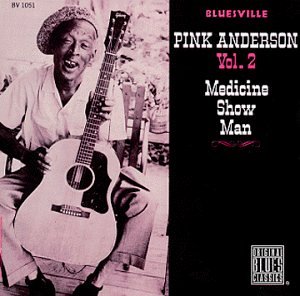
The Bluesville album was called Medicine Show Man, Vol. 2. It was rereleased many years later by Folkways, and Charters reminisced: 

It's been more than twenty years since I saw Pink Anderson for the last time, but if I close my eyes I can still remember his long, lanky body looming in his shadowy doorway when he came to answer a knock, and I can still hear his deep, pleased laugh when he told me one of his old medicine show jokes.


Listening to Prestige 518: Reverend Gary Davis


LISTEN TO ONE: Say No to the Devil

Prestige commissioned or licensed a number of Bluesville releases over the course of the year for which limited session information is available.

Many of the Reverend Gary Davis's fans, and this certainly would have been true of the typical Prestige and Prestige Bluesville collector, were not drawn to him by his gospel message, but by his blues-based singing style and, particularly, his instrumental prowess. The number of guitarists who came to prominence in the 1960s and 1970s after studying with Gary Davis is remarkable, and when you add to that those who bought and studied his records,  it's not stretching a point much to say that he influenced a generation.


Those acolytes, and the music lovers who bought the records or heard him perform at blues festivals or in the streets and storefront churches of Harlem, were most drawn by his prowess on "Miss Gibson," his acoustic six-string guitar, but on this album he expands his repertoire, playing the twelve-string guitar on some tracks and harmonica on others. To a blues musician, especially a New York-based blues musician, Lead Belly was the standard for the twelve-string and Sonny Terry for the harmonica. Davis goes his own way on both of these instruments, and shows that there's more than one way to achieve virtuosity.

The gospel hymns are his own, with one traditional. called here "Itty Bitty Baby," elsewhere "Children, Go Where I Send Thee."


The Bluesville release was called Say No to the Devil. Kenneth S. Goldstein produced. The recording was made at Rudy Van Gelder's studio, so it's a little unusual that we don't have a date for it. It was Davis's third album for Bluesville.


Saturday, October 03, 2020

Listening to Prestige 517: Blind Snooks Eaglin


LISTEN TO ONE: That's All Right

This is listed on the jazzdisco site as being a 1961 recording in New Orleans, with no further recording details. It was issued by Bluesville in 1962, but definitely recorded earlier--mostly in 1959 and 1960 by folklorist Harry Oster, and certainly in New Orleans, Eaglin's home town. In 1960 he had signed with Imperial, but the Oster recordings were leased to various labels, and Bluesville was probably the most substantial of them, with the best distribution network, so this vinyl release was an important part of the Snooks Eaglin story.

The Snooks Eaglin story, as told by writers of the time, is an interesting window onto the landscape of music writing, and especially writing about the blues, at mid-20th century, before the blues explosion of the


1960s. Folklorists like Samuel Charters and Kenny Goldstein were rediscovering for white America the blues as an art form, and the folk music revival had swept up acoustic blues in its net.

Electric blues and rhythm and blues were still regarded with suspicion, especially as purists, both of the jazz and folk persuasion, recoiled from rock and roll. 

Ray Charles was a litmus test of sorts. Joe Goldberg, in his book, Jazz Masters of the Fifties, recalls how jazz DJ Symphony Sid would blow off callers who asked for Ray with "We don't play rock and roll."  Big Bill Broonzy, the jazz guitarist turned folk blues singer, was noted for his hospitality to all sorts of music ("Is rock and roll folk music?" "I ain't never heard no horses singin' it"), but even he, in his memoir Big Bill Blues, draws a line: "Ray Charles is a mess. He's got the blues and gospel all mixed up" (quoting from memory). 

Snooks Eaglin, who at one time called himself "Little Ray Charles," was something of a conundrum to the folklorists who were the early champions of the blues. Modeling themselves on John and Alan Lomax, early folklorists like Charters and Oster traveled the back roads, seeking out singers and instrumentalists who sang and played songs handed down in their families or churches or communities. Harry Smith was the exception. His Anthology of American Folk Music, released by Folkways in 1952, was entirely composed of commercial 78 RPM records that Smith had collected over the years, though the performers who sang and played on those recordings were mostly singing songs that had been handed down to them. Jimmie Rodgers, known as the father of country music, was another exception. When he went to audition for Ralph Peer and the Victor Talking Machine Company, he played popular sentimental tunes, and was told that they weren't interested in that, they wanted authentic folk music. Rodgers didn't know any authentic folk songs, so that night he and his sister-in-law wrote a bunch of songs that were as authentic as any that have ever been sung or recorded.

Eaglin was younger. He was born in 1937, the year after Robert Johnson made his recordings. As a New Orleans teenager in 1952, he played electric guitar in a rhythm and blues band called the Flamingoes (along with 14-year-old Alan Toussaint). And he learned his songs (he claimed to know over 2500) from the radio, from rhythm and blues and country and, yes, rock and roll. From Ray Charles and Elvis Presley ("That's All Right Mama," which he did for the Oster session, was written and originally recorded by Arthur "Big Boy" Crudup, but made most famous in Elvis's Sun Records version). And yet, singing on the streets of New Orleans, playing an acoustic guitar, he was unquestionably an authentic blues voice, at a time when authenticity was often questioned and closely scrutinized. 


Kenneth Goldstein, in his liner notes to Folkways' 1959 release of some of Oster's sessions with Eaglin, attempted to come to grips with this new phenomenon: 

All too little research has been done in the area of studying the effects of commercial and standardized music upon tradition...Listening to Snooks' recordings one is immediately aware that, though learned from radio and recordings, his material has undergone a process of change not unlike material in actual oral circulation. Learning a song from having heard it once or twice on radio, or from recordings, is little different from having learned it orally from another singer.

 So, is it really authentic folk music? You bet. No horses did any singing or playing on this record. Instead, Eaglin was joined by a couple of real folks. Harry Oster, in the liner notes to New Orleans Washboard Blues on his own Folk-Lyric label (later re-released on Arhoolie Records) describes them:

Percy (Brother) Randolph, a French Quarter junkman who pushes around a primitive wooden cart, and Lucius Bridges, and auto mechanic.

The blues were not native to Great Britain, and British awareness of them developed a little differently. Lonnie Donegan, who changed his first name from Tony after hearing Lonnie Johnson play a concert at London's Royal Festival Hall, adapted the songs of Lead Belly and Josh White to his own skiffle beat. But the real blues awakening in Britain came with Muddy Waters' 1959 British tour. So it's not surprising that when music critic Tony Standish brought out a Snooks Eaglin record, which overlapped the Bluesville release, on his tiny (sales in the three figures were a real breakthrough for him) but influential Heritage label, his view of authentic blues included the Chess Records stars who were still scorned as rock-and-rollers by the folk blues purists (that would change in the 1960s), although--perhaps surprisingly, but maybe not if your idea of blues purity starts with Muddy Waters--he drew the line at Ray Charles:

Anyone who relied on solely on today's jazz press for his information could hardly be blamed for thinking the folk blues of the American Negro was a dying art...the blues as a continuing folk art is treated superficially if at all...an average, slipshod singer like Ray Charles is hailed as the epitome of down-homeness; contemporary blues singers such as Bo Diddley, Muddy Waters, Chuck Berry, Little Willie John are dismissed as worthless rock 'n rollers

But we live in a postmodern world where the battles of authenticity and purity are long since forgotten. Harry Oster's Snooks Eaglin recordings were picked up by Folkways and Bluesville. Harry Oster, in his liner notes to the Bluesville release, describes his approach vividly:

Although Snooks Eaglin's sources are diverse, spanning country blues, pop standards, rhythm and blues and rock-and-roll--in fact every type of music that circulates in a city Negro environment, he transforms them all into something characteristically his own; the voice is an extraordinary blend of hoarseness and velvet subtlety, roughness and wistfulness; the guitar technique is always brilliant, marked by short, fast, intricate swingy runs

 Oster could not completely shake his folkie purist's distrust of rhythm and blues. In his liner notes to the Bluesville album, he wrote of "Don't You Lie to Me":

Although Snooks is here following the general pattern of rhythm-and-blues...he turns dross into gold through the dazzling brilliance of his guitar playing.

Eaglin made rhythm and blues records for Imperial, one of the two West Coast labels (Specialty was the other) that specialized in New Orleans rhythm and blues from 1960 to 1962, as Snooks Eaglin and as Ford Eaglin (an alteration of his given name Fird). In my youthful rhythm and blues collecting days (no mean feat for a small-town upstate boy) I had a Ford Eaglin 45 on Imperial. Then he seems to have faded into a temporary oblivion. Tony Standish, in the liner notes to Heritage album in 1963, lamented that Eaglin had disappeared and no one, including his father. seemed to where he was.

He can't have gone too far, because he was pretty much of a New Orleans fixture, and Standish in the same notes reported that some thought they had seen him playing rhythm and blues in a bar. In any event, he did turn up again, and enjoyed a long and fruitful career. He died in 2009.

The Bluesville album is entitled That's All Right.


Wednesday, September 30, 2020

Listening to Prestige 516: Yusef Lateef


LISTEN TO ONE: Rasheed

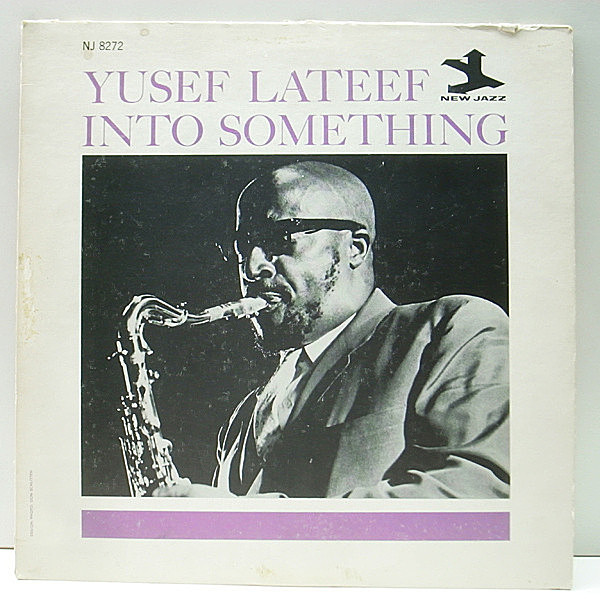
 Into Something consists of three trio and four quartet tracks, the latter featuring Barry Harris on piano. On the album, these are intermingled, starting with the quartet piece “Rasheed,” and it’s a good place to start, with some of everything that made Lateef unique — the unusual lead instrument (in this case, oboe), the Middle Eastern influence, the blues roots. But actually the recording session started with the three trio pieces, so perhaps Harris was a little late for the gig, and they had to start without him. We know that Bob Weinstock didn’t believe in rehearsals, and valued spontaneity, so why not go with what have? Barry’ll be here soon enough, what works without him? Lateef had brought along three standards to go with his four originals—tunes he chose, he told Nat Hentoff who wrote the liner notes, because he particularly liked them, for various reasons. 


The one he started the session with, “When You’re Smiling,” was a favorite of his father, who used to sing it often. It was a good memory, and he liked the message of the song. Do modern jazz musicians, whose improvisatory lines wander way outside the melody, think of the yrics of a song as they play it? Some do, some don’t. Bill Evans has said that he never did. Lateef, by his account to Hentoff, was thinking of the lyrics to “When You’re Smiling,” and thinking of them in a context. 

Written in 1928, the first recording of the song (by Seger Ellis) featured a lead-in verse, almost universally ignored in later versions, about a blind man and a legless man who take care of each other, and go through life smiling. Louis Armstrong cut what is still the classic version in 1929, and his version is illuminated by the famous Armstrong style.

Jazz musicians have recorded it: Dave Brubeck, Errol Garner and Dick Hyman, Urbie Green and Sonny Stitt, all with a lilt. Lee Konitz recorded it, and even with Billy Bauer and a quartet of Tristano acolytes, he sounds positively jaunty. Who knows if they were thinking of the words? It's hard to believe that Konitz wasn't.

But Lateef apparently was thinking of the lyrics, but maybe not so much singing or reciting the lyrics in his head as he played. He may have been thinking more about his father's voice, because his version is gentle and pensive as he states the melody, then becomes fragmented and searching.

Lateef's original tunes express the range of his passions. "Koko's Tune," as the title suggests, is in the bebop vein, though gentled down somewhat from the lightning tempo of Charlie Parker's "Ko-Ko." But if the tempo is gentled, the intonation certainly isn't, going seamlessly from gutbucket blues growls to hard-edged modernity, spurred on by the driving complexity of Elvin Jones's drumming (Jones, Harris, and bassist Herman Wright make up the all-Detroit rhythm section).

"Water Pistol" is in much the same vein, with Jones demonstrating that he really is the new face of jazz drumming. He had been working steadily and had recorded widely since his 1955 arrival in New York. He had recorded as a leader on albums for Atlantic and Riverside, and he had already joined John Coltrane's great quartet, with whom he had worked on several sessions, including the ones that made up his My Favorite Things. 


"P. Bouk" shows more of the Middle Eastern influence, and also includes an effective solo by Wright. And "Rasheed," with Lateef on oboe, shows him at full fusion strength, blending blues, bop, and the Middle East. 

Also blending Middle Eastern voicing with classic Western melody is his flute-led "I'll Remember April," the Gene dePaul-composed jazz standard that made its debut in an Abbott and Costello film. It was the 45 RPM single from the session, with "Blues for the Orient" on the flip side.

It's hard to choose a "Listen to One" from this superior session, in which every song has something particular to reommend it, from Lateef's command of the blues to blistering solos by Jones, but I'll go with "Rasheed," as perhaps being the most distinctively Lateefesque.

Esmond Edwards produced. The album was released on both New Jazz and Prestige, with "I'll Remember April" / "Blues for the Orient" as a Prestige single.