Tad Richards' odyssey through the catalog of Prestige Records:an unofficial and idiosyncratic history of jazz in the 50s and 60s. With occasional digressions.
George Wallington chose two of the staunchest beboppers to accompany him on this trio session, the most stripped-down of all jazz groupings, for what turned out to be something other than a classic bebop session. Wallngton has the drive and the instrumental virtuosity of the beboppers here, but he brings to it an unashamed romanticism, full of gorgeous tone and musical flourishes. It's a winning combination.
Prestige was famous for not doing too many takes, but they must have really breezed through these tunes, because they got seven done in one session. Perhaps it made a difference that they're mostly Wallington originals ("I Married an Angel" is Rodgers and Hart, "Ours" is Leonard Feather), so he was familiar with the material. And it was less complicated, perhaps, with only three instruments and basically only one soloist, but good jazz is never uncomplicated.
Still, the floor belongs to Wallington here, because that's the kind of music it is--a setting for Wallington's stylish piano. No real space for Max Roach to stretch out, and Curly Russell never soloed.
And I wonder if that's part of the reason Russell's star started to fade. He would play one more session with Wallington, and a few more sessions on other labels, but by the mid-50s he was mostly gone from the jazz scene and into rhythm and blues, and then he retired from music altogether. The role of the bass was changing. Charles Mingus, of course, was in a category all his own: leader, composer, soloist. But other virtuoso bass players like Paul Chambers and Ray Brown were also changing the role of the instrument, making it more melodic, taking solo space.
Was this partly because recording techniques were changing, and the bass could be picked up better? Could be. And the mechanisms for playing music were changing, too. The long playing record made longer cuts possible, with more room for a variety of solos. And sound reproduction was better. I remember when I got my first high-fi record player, and a set of good--not great--speakers. The first album I put on was Gerry Mulligan and Chet Baker, the famous Mulligan experiment with a pianoless quartet. And I was entranced. Wow...I could hear all the instruments! I could hear what Larry Bunker and Chico Hamilton were doing, all the way through.
In this session, you actually can hear what Curly Russell is doing. Max Roach less so, but you know he's there, providing the rhythmic propulsion and complexity for Wallington's virtuoso work.
These were released on a 10-inch LP, and then on much later reissues.
A ballad session with Miles Davis and a group of great musicians. What more is there to say? There's a quote from Miles somewhere, which I can't find, to the effect that what he loved most was playing ballads, and he would have been happy to spend his whole life playing them. Which, of course, is why he couldn't. Miles had a restless, searching genius which was never about being happy or comfortable.
When I lived in New York in the late 70s, WKCR, the Columbia Univeraity station, did a week-long Miles Davis marathon, in which they played everything that Miles had ever recorded, in chronological order. I made it my business to stay home and listen to all of it, so you can see that this blog isn't the first crazy jazz-related thing I've ever done. I didn't totally succeed -- I'm not that crazy -- but my girl friend at the time, who'd been out of town, came back in the middle of the week and called me, and I told her she could come over if she wanted to, but that I was preoccupied.
So...I didn't listen to all of it, but I listened to enough that I got a real sense of Miles's progression. I felt like I could understand how bebop with Bird led to the Nonet sessions to the quintet to Kind of Blue to Filles de Kilimanjaro to On the Corner to Big Fun, and I could understand how he had to do all of it, even if I wasn't going to listen to Big Fun as often as I listened to Dig or Relaxin'.
And I could listen to this session many times, which of course I have, because that's how I'm doing this blog, immersing myself in each session, but I could listen to it many times more. Miles playing ballads, a Benny Carter tune and three originals, with a group of great musicians. "Tune Up" is credited to Miles, "Miles Ahead" to Miles and Gil Evans, "Smooch" to Miles and Charles Mingus. Mingus appears on "Smooch," replacing John Lewis on piano rather than Percy Heath on bass. Lewis is on the first three cuts, Heath and Max Roach on all four.
Bob Weinstock, in an interview, talked about those early Miles sessions:
So, our basic idea was just to make records with different people, to record with the best people around. That's what we did until the end, when he had the quintet with John Coltrane, Red Garland, Paul Chambers, and Philly Joe Jones. But everything up to that point developed from where we would sit down and talk about it. Miles would mention who was in town, who he would like to record with. I'd say who I'd like to hear him record with.
Yes, I would have loved to be a fly on the wall for those cpnversations. Fly on the wall? Hell, I would have loved to be a part of the,. "Hey, Miles and Bob, why don't we get..."
These were released on singles, on an EP, and as part of a 10-inch LP. And of course, in many reissue packages.
Have you noticed that the fun has gone out of names in the jazz world? No more bop-punning titles like "Flight of the Bopple Bee." No more group names like "J. J. Johnson's Boppers" or "Terry Gibbs New Jazz Pirates" (oh...Terry and the Pirates. I just got it!) Now if anyone even thought of calling this group "Billy Taylor and his Mambo Maniacs" ... but no. Nobody did.
Billy Taylor was a good choice for Prestige's latest mambo jazz entry. There's the fact that he could play anything, from bop to swing and all points in between. More to the point, much of his early background had been Latin, with Candido and Mario Bauza.
It's very hard to find any of this album to listen to on the Internet. Spotify nothing, although Taylor's later Latin work is represented. YouTube is better. I found one track -- "Early Morning Mambo" -- on a site called Office Naps, which has a whole page on Prestige and Latin jazz, and it's a very good page, although the guy does stoop to giving the inevitable backhanded compliment to Bob Weinstock (Prestige "operated on a dizzyingly prolific schedule, occasionally at the expense of quality and fidelity"). He also mildly chastises Prestige for its commercial aspirations:
Prestige Records had an eye attuned to commercial markets from the start, perhaps more than any other jazz-oriented label in its day, with many bop singles issued, a handful of them – including sides by King Pleasure (“Moody’s Mood for Love,” 1952), Stan Getz (“Four and One More,” 1949), Sonny Stitt (“All God’s Chillun Got Rhythm,” 1949) and Annie Ross (“Twisted,” 1952) – achieving some modest chart success.
Come on. In the first place, commercial success is not a bad thing. It was a healthy thing for American popular music that great jazz of the bebop era made the charts. In the second place, this
was a label for which the very first recording session was Lennie Tristano, which put Miles Davis and Lee Konitz back together, after the commercial failure of the nonet recordings, for an even more experimental session, which gave Teddy Charles his head and predated the electronic experiments of LaMonte Young and Steve Reich.
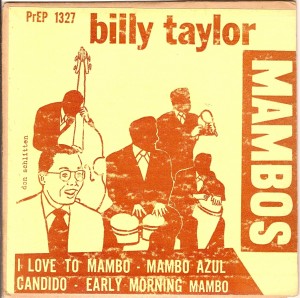
Anyway, thanks to Office Naps for some good information, and most of all for "Early Morning Mambo," and the cover art.
These four sides were released as two singles, and as an EP. Once again, all great stuff. I suppose if I were stuck on a desert island and could only take one, I'd go with "Mambo Azul" (below, from YouTube). Hard to choose, though.
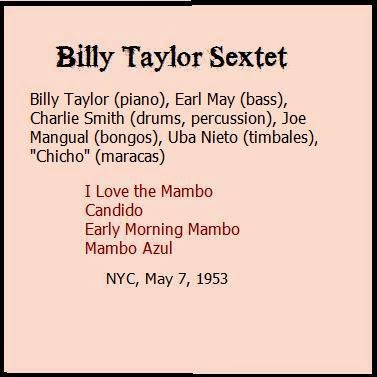
A little disagreement on the personnel. The Japanese site jazzdisco.org, which I'm using as my Bible for this whole project, lists the three percussionists as Chico Guerrero, Jose Mangual, and Ubaldo Nieto (bongos, congas). The YouTube uploader credits the group as "Billy Taylor Trio with Machito's Rhythm Section," and lists the three percussionists as Joe Mangual (Bongos), Uba Nieto (Timbales ), Machito (Maracas ). Looks as though the YouTube guy was right. a faded 45 RPM lists Mangual Nieto, and "Chicho" on maracas (undoubtedly Chicho was a cousin of Charlie Chan and Sven Coolson). The record label and the EP cover omit both "Trio" and "Sextet" and simply go with Billy Taylor Mambos.
Just as with Charlie Parker, an alias doesn't do much to hide the sound of Stan Getz. The aliases were necessary because the artists had exclusive deals with other record companies. This can't have fooled anyone. If it happened today, there'd be lawsuits, injunctions, records pulled from the shelves.
Hall Overton is back, with his other protege, Jimmy Raney, but a session with Stan Getz on it is going to be a Stan Getz session. Still, not quite like any other Stan Getz session. Do the avant-garde leanings of Raney and Overton pull Getz a little farther out into left field? I think so. He's lyrical as only he can be, but he's edgier, too.
This is an incredibly interesting session. It has the structure of a bebop blowing session, but a different dynamic. Or maybe that's not so. Maybe bebop had a lot more flexibility, a lot more nuance, a lot more room for growth than a lot of people gave it credit for. Maybe this wasn't the death throes of bebop that so many back then were predicting, and that so many since then have taken as an article of faith. Maybe this was bebop. Listen to Hall Overton's solo in "Lee." He's soloing in the bebop tradition, taking it to some strange but logical places, trading some great stuff with bassist Red Mitchell, then setting up Getz to take it out.
I've listened to this one a lot, and every time I listen, I appreciate more and more how these musicians worked with each other. Only in jazz, and maybe especially in the jazz of this era, do you find this kind of collective experimentation, and at this high level, and with this expectation of success. Putting Stan Getz together with Jimmy Raney and Hall Overton is more than just throwing a bunch of stuff at a wall and seeing what sticks. It's an inspiration.
The songs are "Round Midnight" and three Raney compositions. I had thought that "Lee" might have been a tribute to Konitz, but it's named after Raney's wife.
It's damned hard, even in the age of Google, to track down composer credits for jazz tunes, unless you happen to have the record in front of you. My ability to give credit has been, and will be, spotty at best.
New to Prestige, and perhaps new to recording -- I haven't found anything earlier -- are Red Mitchell and Frank Isola, although they had been playing and making significant names for themselves since the late forties.
Mitchell came to New York in 1948, just out of the army, and was to leave for the West Coast not long after this recording, where he made most of his career, and where he became an important innovator, tuning his bass in fifths -- the tuning used on a violin or cello -- instead of the conventional fourths. He would later join the expatriate jazz community in Stockholm.
There's a great chapter on Frank Isola, who came to New York around the same time as Mitchell, but didn't stay in the jazz world for long, in a book called Fifties Jazz Talk by Gordon Jack (Scarecrow Press). I would love to have a copy of it, but it costs 50 bucks, so it's on my gift list. Meanwhile, it is excerpted at Google Books, so we can get part of the story. We know Isola walked away from the jazz scene in 1957, after having established an important reputation as a modern jazz drummer. He worked a lot with Stan Getz, which may explain his presence on this session, and was involved in some important Prestige recordings, so we'll see him again.
In 1942, at age 17, he won the Detroit division of a national Gene Krupa drumming contest, and would have gone on to the finals in New York, if he hadn't been disqualified as an amateur for having joined the union. Had he gone, he would have given stiff competition to the eventual winner of the contest -- Louis Bellson.
He seems to have made a number of recordings that didn't quite happen, before the Prestige date. He was with a group including Don Lanphere and Teddy Kotick that backed up Babs Gonzalez on a demo for Capitol. Babs got the contract, but they didn't use the group. He made some sides with Lanphere and Herb Geller for a nascent label that never got off the ground. And in 1950, he acompanied Charlie Parker on a private session that was recorded, but I can't find a record of its having been released.
Just as he was getting ready to leave the music biz behind in the late 50s, he got a call from the Tommy Dorsey orchestra, wanting to hire him. His response: "No, thanks. Tell Tommy I'm not in a sentimental mood."
These sessions -- Raney's first as leader -- seem not to have been released as singles. Strange if true, given Stan Getz's popularity, but then his name wasn't on them. They came out on an album called Jimmy Raney Plays, with cover art by David X. Young of the Hall Overton / W. Eugene Smith jazz loft fame, one of the first Prestige albums to take cover art seriously.
Today, they're most available because of Getz, appearing on a reissue package called Early Stan.
The big band era ended with World Wat II, and a combination of social and economic factors, and some aesthetic factors as well --people liked the supple acrobatics of the great bebop soloists in a small group setting -- a rhythm section and one or two -- at the most, three -- soloists. But there's still something about the texture, and the power,that can come out of a larger group of musicians, and there was always the temptation to try and recreate it. Dizzy Gillespie put together a big band. Others tried to capture theflavor of the big bands in different ways. Louis Jordan came from the Chick Webb orchestra, and his search for a way to capture the spirit of Chick Webb with a smaller group led to the sound that we now know as one of the cornerstones of rhythm and blues.
Others tried different approaches,and in the early '50s, in what was coming to be known as the poat-bebop era, perhaps the most influential sound of a group that was larger than a sextet was the Miles Davis nonet, which I know I keep coming back to, but you can't help it. And although there were several arrangers for the Birth of the Cool sessions, including John Lewis, who take his search for the new sound in a different direction, perhaps the most influential were two of the greatest arrangers jazz has ever produced: Gerry Mulligan and Gil Evans.
So it's hard to hear a group of this size without thinking of the nonet, and ruminating on what they took from that seminal sould. Joe Holiday, of course, had taken jazz in his own direction, back toward dance music, with his mambo jazz, but this was different. He was coming back toward the mainstream, and although the general public didn't know it yet, that mainstream was flowing from the Royal Roost in 1948, and the records that Ira Gitler described as "the sound heard 'round the world," that were still four years away from being released on an LP by Capitol. I loved the Joe Holiday mambo stuff, but it's easy to see why any jazz musician would want to try putting together this sort of small big band. I hear an Evans influence more than Mulligan in these arrangements.
An octet is an ambitious undertaking, the more so when you remember Bob Weinstock's prohibition on rehearsal time. You have to be be pretty good to hold it together, and Holiday proves himself pretty good, especially when you consider the disparate group of musicians he put together.
It helps to start with Max Roach, the consummate drummer of the era, and a mainstay of many a Prestige recording session. And one of the fathers of bebop.
John Acea was of Cuban ancestry, but not a mambo man. He was born in Philadelphia, and grew up in that city's musical scene. He was gifted on nearly every, but settled on piano after he got out of the army, and played on a wide range of sessions, behind vocalists from Dinah Washington to Patti Page, with jazz groups from Cootie Williams to Zoot Sims. He was one of those guys you're glad to get for a session.
I can't find much on Franklin Skeete, but he was on the scene. There's a Lester Young session with Horace Silver and Connie Kay, a session with Cecil Payne. They're earlier, and it could be that after this session he sort of faded out of the scene.
Payne played up and down the sax scale, but when he settled on baritone, he became one of the leading boppers on the instrument. He was essentially a child of the bebop era, getting his start with J. J. Johnson and Dizzy Gillespie, although he did play a stint with Roy Eldridge, and made some hot R&B sides (with Franklin Skeete) for Decca in 1949.
Idris Sulieman was one of the first jazz musician/Islam converts, with Art Blakey (Abdullah Ibn Buhaina) being the most famous. His early credits show the range in a jazzman's life: studied at the Boston Conservatory of Music, then got his first professional experience with the Carolina Cotton Pickers. Like Cecil Payne, he came up in the bebop era of the 40s, became an important figure in the hard bop era of the 50s. Like Payne, he is treasured by jazz enthusiasts, not really known to the casual listener.
Earle Warren (misspelled on the session list) was from a different source altogether. He was a longtime member of the Basie band, and played some rock and roll with Alan Freed.
So how indebted is Joe Holiday to the Birth of the Cool nonet? I think a lot, especially in the two ballad numbers, "And Now it is Love" and "My Funny Valentine," in their exploration of the tonal and textural possibilities of a medium sized band. I confess I was a little disappointed on first listening not to hear more mambo jazz, and I responded more to the uptempo numbers, "Cotton Candy" and "Martha's Harp." But on repeated listenings, the ballads grew on me, and the disappointment fled.
These came out on 78, 45, and 45/EP; not in album form till many years later, in the reissue days.
Teddy Charles arrived on the West Coast in February of 1953 as Bob Weinstock's emissary, and immediately started putting together some extraordinary musicians.
Why Teddy Charles? Why expand to the West Coast? Probably because the jazz world was small and close-knit, and people did things because it seemed like a good idea at the time. Probably because Weinstock liked Charles, and Charles had mentioned that he'd love to go out to California. The other alternative is that Weinstock thought it through carefully, and said to himself, "I know! I'll take the most avant-garde musician I can find, and send him out to California! After all, look how well that worked seven years ago, the last time the most advanced musician of his day went out to California!"
In this case, unlike Charlie Parker's ill-fated West Coast debut at Billy Berg's, the world was probably ready for this incarnation of Teddy Charles, and Charles could hardly have put together a better group of West Coasters--including one musician who'd recorded with Bird during that West Coast sojourn, after Parker had relaxed at Camarillo.
This would be Wardell Gray's last recording session for Prestige. Two years later he was dead, his body found alongside a highway several miles outside of Las Vegas. It's quite possible -- probable -- that he was murdered, but the viciously racist Vegas of the 50s, no one cared. There was no investigation.
But this was an active period in Gray's life, and since we're saying goodbye in this blog to one of my favorite jazz artists, let's look at some of the recording gigs he made in the last part of '52 and '53, for an idea of his range and versatility.
A gig with Dexter Gordon, his partner on the famous "The Chase" recording.
A live recording at The Haig with Art Farmer, Hampton Hawes and Shelley Manne,
A Shorty Rogers big band concert at the Rendezvous Ballroom in Balboa Beach, with June Christy on vocals, and a band that included Chet Baker, Art Pepper, Gerry Mulligan, and Hampton Hawes. 21 songs were recorded on an Ampex reel to reel by Rogers's wife, and according to the Wardell Gray web page, they have only recently been released on 2 CDs available only to members of the Los Angeles Jazz Institute. A couple more dates with Baker, Pepper, Mulligan and Hawes were recorded during the fall. One has been issued but is, according to the website, of poor quality; the other unissued. It would have been a treat to follow that band around.
A four-song date for Norman Granz with a Louis Bellson big band, including Harry "Sweets" Edison, Maynard Ferguson, Benny Carter and Barney Kessel.
A Norman Granz jam session which included Benny Carter, Sweets Edison, Buddy DeFranco, Stan Getz, Count Basie, Freddie Green and Buddy Rich.
A Little Willie Littlefield R&B date for Federal.
A Billy Eckstine session for MGM, with an orchestra that included Gray and Harry "Sweets" Edison.
A line that has stuck in my head for years: Annie Ross, in her vocalese rendition of Art Farmer-composed, Wardell Gray-influenced "Farmer's Market," sends her heroine from the sticks and her crew-cut cat with the crazy goatee off "touring the country with Wardell Gray." Somewhere, in some better place, they are still touring.
Back to Teddy Charles.
This was Frank Morgan's first recording session.
Most of Morgan's career took place late in his life, after he had finally overcome more than 30 years of addiction, Between his first arrest in 1955 and his final release from prison in 1986, he spent much of his time behind bars, and pretty much all of it in the clutches of heroin. And his late career was such a productive one, it's pretty much overshadowed his brief early days, including his very early days.
I had known that Morgan, like every alto player of his generation, was deeply influenced by Charlie Parker, but I hadn't known that he was actually a protege of Bird's. At age seven, his guitar playing father (sometime accompanist for the Ink Spots) had already started him on guitar, but when they went to hear Jay McShann's orchestra play in Detroit, and he heard Charlie Parker play the alto, that was all he wanted to do in life.
Not many 7-year-olds have that kind of epiphany, but even fewer have the followup. As a musician with some reputation, Stanley Morgan was able to go backstage with his son, where little Frank was introduced to Charlie Parker, and where Bird took an immediate interest in the boy. He arranged to meet him at a music store the next day, and picked out an instrument for him--a clarinet, as better suited to develop a 7-year-old's embouchure. He and Parker remained in touch.
Morgan was precocious in more ways than one. When he was 14, and living with his grandmother in Milwaukee, he was caught smoking pot,and sent to live with his father in Los Angeles -- presumably because his grandmother felt she couldn't handle him, not because LA was thought to be a more drug-free environment. There, he immediately was thrown into jam sessions with the likes of Wardell Gray and Dexter Gordon, and age 15 was offered Johnny Hodges's spot in Duke Ellington's Orchestra, but his father decided he was too young to be touring with a band, For the next several years, his credentials are stellar. And in 1955, the same year Charlie Parker died, the 22-year-old's career was shut down.
This may have been a tough session for Teddy Charles to put together. Wardell Gray was sinking into addiction, after resisting it for a long time. 20-year-old Frank Morgan and 22-year-old Sonny Clark were already addicted. Morgan finally overcame it; Clark never did. Ten years later he was dead. The Paris Review, in 2011, ran a two-partprofile of Clark which is beautiful, devastating, and complete, so I'll refer you to it.
And move on to the music, which is inspired. Who knows what Bob Weinstock had in mind when he sent Teddy Charles out to Los Angeles, but what he got was a meld of talent and style between New York's most intellectual and avant-garde stylist this side of Lennie Tristano, and the West Coast's equally intellectual but earthy and crowd-pleasing giant of the tenor sax. The cover of their 45 RPM EP is posed, of course, but the way it shows all of them gathered around Charles, discussing a point of music, rings true.
I love all the songs on this session, but let me linger for a bit on "The Man I Love." I have a special weakness for bebop treatments of ballads from the Great American Songbook, and this one is no exception. Sonny Clark starts it off with a dense and moody piano intro, heavy on the sustain pedal, Wardell Gray comes in on top with an emotional statement of the melody, and then Teddy Charles comes in, under the piano at first, then above the piano but under the sax, then the two of them, Gray and Charles, improvising in tandem, one or the other of them taking the lead, or neither of them, with the tempo increasing, until it's time for a very young alto player, his head and heart full of Charlie Parker, to come an joyously take us into heart of Bebop Nation. There's no restatement of theme at the end--the tempo and the mood have gone too far beyond the aching plea for Mr. Right to come along. These guys are Mr. Right.
I could listen to this all day. In fact, I did. For the last couple of days.
It's more difficult than it should be to find composer credits for jazz compositions. AllMusic used to be good on this score, but they changed their format. "Lavonne"was pretty definitely written by Sonny Clark. I've seen "Paul's Cause" and "So Long Broadway" credited to both Charles and Gray, but the site that credited Charles also gave composer credit for the Gershwin classic "The Man I Love" to Davis, Sherman and Ramirez, who actually wrote "Lover Man." Still, Charles was the one who had recently said so long to Broadway, so there's a good chance it's his. Sonny Clark, much later, deeply in the throes of addiction, stole a tune from Thelonious Monk and recorded it as his own, but that was much, much later.
"So Long Broadway" was released as a single b/w a tune from a later West Coast session. All four tunes came out on a 45 RPM EP, and later on the Wardell Gray Memorial LP, Much later -- 2006 -- all the Teddy Charles California sessions were gathered on an CD, Adventures in California, but not issued by Prestige.
What was it with Prestige and King Pleasure? Was he really difficult to work with? Did Bob Weinstock just not like him very much? Maybe it was the former. He never had the success that a singer of his caliber should have. He had given Prestige its biggest hit, but there seemed to be no hurry to get him back into the studio to record more, or to surround him with A-list musicians. The King Pleasure Sings / Annie Ross Sings album is a jewel of my collection, and I wouldn't change a song on it, but it exists because Prestige didn't have enough Pleasure, or enough Ross, to fill awhole 12-inch album.
Instead, they brought in singers like Billy Valentine, who was good in the Charles Brown, although not quite Charles Brown (and the demand for Brown's style of music was fading by 1953). Valentine's records, like so many of Prestige's vocal blues albums, faded into obscurity.
Then, this session with Eddie Jefferson. Jefferson is by any measure a giant of modern jazz. He invented vocalese. He wrote many songs that have become classics, including "Moody's Mood for Love."
This session of duets with otherwise unknown vocalist Irv Taylor yielded one single -- "Stop Talkin', Start Walkin' / Strictly Instrumental" on both 78 and 45. The other songs weren't released till much later, on a compilation album called The Bebop Singers.
Jefferson would record more for Prestige, but this one wouldn't make much of a mark. I was only able to listen to "Strictly Instrumental," which shows Jefferson's brilliance in all sorts of ways. First, how about his choice of material? There's a certain sauciness, not to say chutzpah, in choosing to put lyrics to a song called "Strictly Instrumental." And what an interesting choice! Instead of going with Miles, or Bird, or Kenton, or whoever had the hot modern jazz record out at the time, he chose a swing-era tune by Jimmie Lunceford, vocalesed it, bebopped it, and turned into what certainly should be a bebop vocal classic. Second, who's Irv Taylor? I don't know. Google doesn't know. Probably not many people around today do know. But Eddie Jefferson knew, and he was right. Their voices mesh wonderfully in what has to be a two-voice arrangement.
Again, the vocalist is given less than A-list musicians, but as we know, New York has never lacked for talent. I once interviewed Valery Pomonarev, and asked him what surprised him most when he first came to New York. He said that of course he knew about the greats like Art Blakey and Bobby Timmons, but he was absolutely floored by the number of brilliant, talented, dedicated musicians that no one had ever heard of. There's a sax solo on this number by Seldon Powell, primarily an R&B player who'd worked with Tab Smth and Lucky Millinder,. Later, in the 60s, when soul jazz became a hot sound, he worked with jazz leaders like Clark Terry and Lou Donaldson. He's given solo space here, and is completely satisfying.
There's a session in between these two very different Miles Davis sessions. Bob Weinstock never had much luck with rhythm and blues, and maybe it's just as well. He might have yielded to the temptation to become another rhythm and blues label, and while there were many labels putting out great R&B, there were very few who can boast the jazz catalog Prestige put together.
Billy Valentine cut four sides on
February 6—Valentine on piano and vocals, Mickey Baker on guitar.
Two were issued on PAR Presentation, two never issued. Of the two that were issued, I can't find a trace. Too bad. I'm a huge Mickey Baker fan, although I wasn't familiar with Billy Valentine. A little research turns up one cut with Johnny Moore's Three Blazers. He must have replaced Charles Brown, because Valentine's "Walking Blues" is a direct remake of Brown's hit "Drifting Blues." Valentine is no Charles Brown, but he's pretty good.
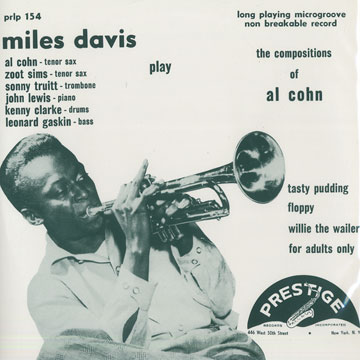
So on to Miles, and an unusual lineup, and an unusual--but very good--record. John Lewis and Kenny Clarke are on board. They'd just made one record with a new group, but hey, who knows if a new group will stay together? Best get work while you can. Sonny Truitt is another one of those unsung pros who can be counted on to do the job. The only bio I can find for him says he's mostly known for his work with Miles. Al Cohn and Zoot Sims, separately and together, but most famously together, had a major impact on the jazz of the 40s and 50s. Davis brought them into this gig together, but it's Cohn who made the major contribution. These tunes were released by Prestige in various configurations, but one of them was a 10-inch LP called Miles Davis Plays the Compositions of Al Cohn. All four were written by Cohn, and all except "Tasty Pudding" specifically for this group. Why is this session, in all its LP configurations, not better known? I think the answer may lie to some degree in the liner notes by Ira Gitler to the Compositions of Al Cohn release (Gitler by this time was regularly producing for Prestige, as well as writing the liner notes):
Since the "records heard 'round the world," GODCHILD, JERU, MOVE et al, Miles Davis has made many other fine recordings to enhance his position as top modern trumpeter, but in the main they have been three horn groups (including himself) with an emphasis on solo work. After the original melody, usually stated in tight unison, each hornman played again only when his solo turn came. The soloists had to be good to sustain interest, and they were, but it was felt Miles needed a change of pace for his next recording date: compositions and arrangements which would suit him and result in a happy composition of arranged music and solo work.
With all due respect to Gitler, whose liner notes for Prestige. as well as his work for Down Beat, Metronome and other jazz publications, provide an invaluable and insightful narrative of some of jazz's greatest years, this is mostly bullshit. Let's leave aside "each hornman played again only when his solo turn came." That's an oversimplfication--it leaves out trading fours, interpolated notes, and even concurrent solos, but it's a short piece, and the oversimplication is still more or less accurate. But why was everyone who wrote about it, in that era, so eager to put down, and put to rest, the classic bebop formulation? Gitler is better than most. The New Yorker, in every "Goings On About Town" mention of jazz, gives the back of the hand do bebop's death throes. John Lewis and Miles Davis are both described as being frustrated by the confines of the theme-solos-theme format. But made for so much great jazz, and not just in the Forties. OK, it's not mostly bullshit. He's not really wrong about anything. And I'm nitpicking way too much about a far greater jazz writer than myself. But what about the "records heard 'round the world"? That's a problem. The Birth of the Cool sessions are among the most important in jazz, and Gitler was perceptive enough to realize it, but at the time he was writing this, they were only the records heard 'round the world to a discerning few. Probably most musicians, probably not that much of the public. The Royal Roost sessions had not drawn fans, the 78s hadn't sold well. So maybe as good as this session is, and as good as the Lee Konitz session was,. there wasn't an audience for it yet, and even over time it hasn't gotten the traction to pull it even with the other Davis LPs on Prestige. The Konitz session was probably more experimental than the Birth of the Cool sessions, this probably less. But it's beautifully played, and brilliantly written. I'm not sure one would immediately think of Miles Davis and Al Cohn as the most likely of musical partners, but whoever thought this one up was inspired. Miles himself? Bob Weinstock? Ira Gitler? Cohn?: Some combination of all four?
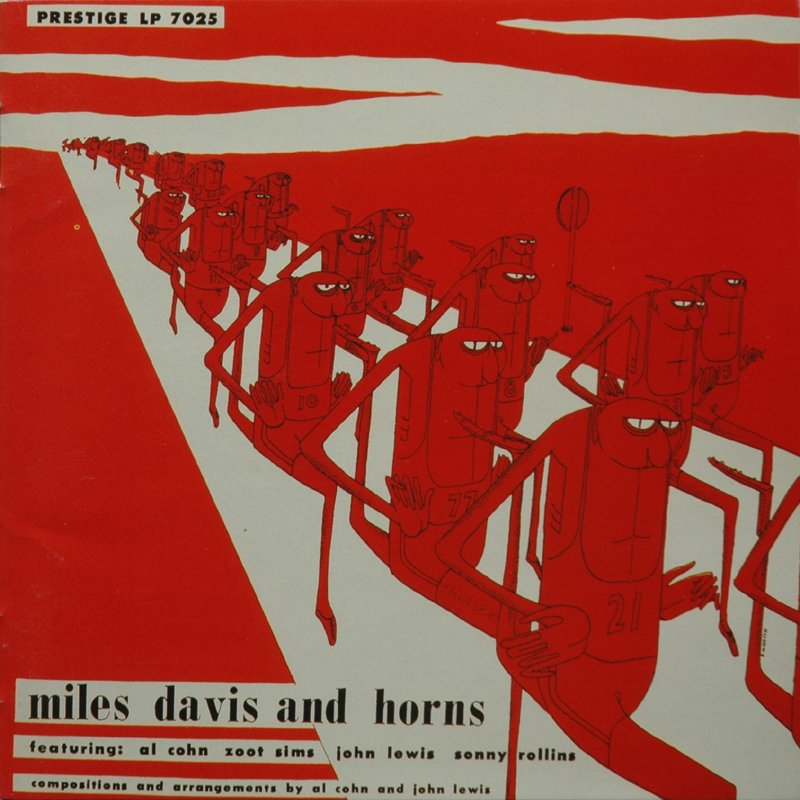
Maybe Gil Evans had a hand in it? He's not credited with any part of the Davis oeuvre from Birth of the Cool to Miles Ahead, but Evans didn't take credit for a lot of things he was involved in, and he and Miles were always close. In any event, this is a terrific album, and one that deserves a higher spot in the Davis canon than it probably has. "For Adults Only" has a very familiar melody. Is it also called something else? Or is it just really catchy? "Tasty Pudding" was released as 78; Miles Davis Plays the Compositions of Al Cohn was the 10-inch. A later reissue was on a 12-inch 7000-series as Early Miles 1951 & 1953, and on a 1955 reissue called Miles Davis and Horns, which is interesting not only for its music but for its cover art, by Don Martin, of Mad fame. Mad and Miles seem an odd combination, but Martin did several covers for Prestige. I don't comment on the post-1972 reissues for the most part, but there is a reissue called Dig - Miles Davis and Sonny Rollins, which includes the sides from the Al Cohn session, which is a good thing, but has what may be the world's worst cover art, replacing the dark, atmospheric, supercool young Miles with a bad photo of heavy equipment at a construction site.
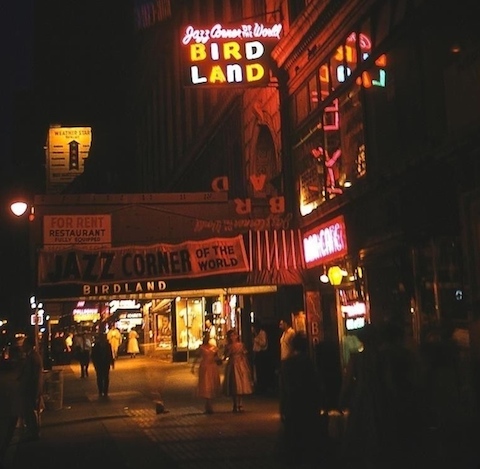
Bob Weinstock said that when he fell in love with bebop and decided to start his own record company, his "first choice, naturally, would have been Charlie Parker and Dizzy Gillespie but they were under contract to various companies." But it turned out he did get Charlie Parker, which means I get to listen to Bird as part of my project. Parker was under contract to both Savoy and Dial, which caused legal problems enough, but when he really wanted to do a session and he was contractually banned from it, he just changed his name to Charlie Chan, using the first name of his common-law wife. His name on the famous Jazz at Massey Hall album was Charlie Chan. It can't have been much of a secret--no one sounded like Bird, even when he's playing tenor sax, as on this occasion. But I suppose at that point his record labels had more to worry about than whether he was stepping out on them--after all, he was stepping out on each of them with the other. And he was falling under the terrible grip of heroin, and his behavior was becoming erratic. It was not long after this that he was banned from Birdland, the club named after him.
So this was a treat--three of the greatest improvisers in jazz, with a great rhythm section behind them.
Percy Heath, at this point, had no way of knowing that the group he had just recorded an album with would stay together for the next forty years and become one of the best known ensembles in modern music. Walter Bishop, Jr., was always a favorite of mine--I used to hear him at clubs in the 70s, if my memory for decades is still sharp. He seems to have always had music in his life--his father composed hits for Billie Holiday, Louis Jordan and Frank Sinatra, and his high school friends included Kenny Drew, Art Taylor and Sonny Rollins, with whom he's reunited on this album. With soloists like Parker, Davis and Rollins, one might think there would not be a lot of solo time left over, but Bishop gets his licks in, especially in "Compulsion," and he more than holds his own.
I think this is Philly Joe Jones's first recording with Miles, and he makes his presence felt immediately, with a drum roll to lead off "Compulsion." He sounds like a man who's come to stay. And it turns out that he was, even though the first classic quintet was not to come together for another three years. But in the interim, Davis and Jones found their own way of working (from Drummerworld)
The two would travel around the US stopping in cities to do a gig with the local talent. "Philly Joe Jones and I would go from city to city playing with local musicians. Philly would go ahead of me and get some guys together and then I would show and we’d play a gig. But most of the time this shit was getting on my nerves because the musicians didn’t know the arrangements and sometimes didn’t even know the tunes"(Miles’ Autobiography 179).
Now, the main course. This is a classic Prestige blowing session, classic unrehearsed spontaneity, counting on the players to make it work, and they do. They are so attuned to each other. Bebop was built on the idea of the virtuoso soloist, for a number of reasons -- not the least of them, the wartime tax on establishments that had dancing, so a lot of small clubs found it necessary to hire virtuoso soloists whom the audience would want to sit and listen to. At any rate, amazing virtuosity was developed. And a common language was developed, so these guys -- three of them here -- could volley musical innovations back and forth -- a language better than spoken language, because they always know when to come in, and exactly what to say.
Still, you have to have somewhere to start. I'm guessing that "Compulsion" was a tune they all knew well, and had all played before, because they play the opening unison statement of the theme for a few choruses, and "The Serpent's Tooth" is a little newer to them, because their unison segment is a lot shorter. This theory falls apart when we get to "'Round Midnight," because everyone knows that, and there's no unison statement of the theme at all. Maybe they just figure they don't need to. It starts with Bird playing the chorus alone, and Miles finding his way around and into Bird's mood..
Here's what Ira Gitler had to say about the session:
"Compulsion" is a swinging Davis opus with two choruses apiece by Miles, Charlie and Sonny with the group riffing at intervals during Miles' and Charlie's choruses. Then Walter Bishop, a most flowing modern pianist, plays two more choruses before the theme is restated.
"The Serpent's Tooth" is presented in two takes. Take one is medium tempo and the solo order is Miles, Sonny and Charlie for two choruses apiece followed by Walter Bishop for one. Then Miles engages conversation with Philly Joe Jones. On take two the tempo moves up a bit. The solo order and their length is the same except that in the conversation with Philly Joe, Charlie and Sonny, in that order, jump in after Miles.
"'Round About Midnight" was 'round 6 p.m. when it was recorded on this particular day
and due to circumstances, new sadnesses were injected into Monk's already melancholy air. For various reasons the date had not jelled to expectations. The engineer, who hadn't helped much, went off duty and told us that the studio would close at 6, and that another engineer would take over for the last half hour.After a few unsuccessful attempts at "Well You Needn't," it was decided to close with "Midnight." This at a quarter to six. Miles and Charlie are the horns with the latter playing obligatos to the melody statement and crossing the bridges alone at both beginning and end. His opening solo is full of the pain and disappointment he knew too well and is an emotionally moving document as such. Miles cries some too.
I'm not sure that the circumstance of only having fifteen minutes to cut a tune is one that promotes sadness. Tension, yes. Pressure, yes. But maybe Gitler is right. No time to be clever, no time to intellectualize it. Just go with the emotions closest to the surface, and for Parker pain was never far below.
Not much more you can say.
Except that maybe having a brilliant virtuoso soloist isn't always enough to stop people from dancing. I was at Jazzfest in New Orleans one year, and Dave Brubeck was booked on one of the main stages, in between Ernie K-Doe and another rhythm and blues act. So a lot of the audience hung out there, and they were a crowd that had come to boogie. Brubeck was playing "Take Five" and other undanceable music, but this crowd didn't know you couldn't dance to it, and they were boogieing up a storm. I was close enough to see Brubeck's face, and he was loving it. He was having the time of his life.
And another thought. What happened to the big bands? Well, for one thing, they didn't go away completely. You still had the society bands like Lester Lanin and Meyer Davis. You still had the radio and Hollywood bands like Les Brown and Ray Anthony. But the music business pros had figured out that to get people dancing, you didn't need great soloists like Lester Young. You could hire a bunch of union musicians when you had a dance gig, pay them scale, give them charts, dress them up in tuxedos, and everyone was happy. And they'd play a waltz, and a couple of fox trots, and a cha-cha-cha, and a Lindy hop, and the bunny hop. Hard to imagine Pres playing the bunny hop.
Also, times change. People were ready for a different kind of music. We know that during the big band era, singers -- even singers like Sinatra -- were secondary. The bandleaders were the stars. But during the Petrillo strike, when the bands couldn't record but singers could, the vocalists became the stars.
And maybe it was part of the same shift. People wanted to listen to personalities, individual virtuosi, whether they were instrumental virtuosi like Parker and Davis and Rollins, or vocal virtuosi like Frank Sinatra and Jo Stafford. And people tend to like singers. That's why King Pleasure, and H-Bomb Ferguson, and later Mose Allison were the biggest sellers for Prestige.
This session was released on a 7000-series, Collector's Items.
Several January 1953 sessions are unlocatable. Sam Most Sextet -- he's best known for an album with Herbie Mann. A Zoot Sims session with an organist -- very hard to find, much sought after by organ aficionados. Two recording sessions in Boston with Boston jazz legends Al Vega aand Charlie Mariano. Too bad. I would have liked to have heard all of them.
I finished up 1952 with a curious but oddly satisfying "Best of" list from rateyourmusic.com. The rateyourmusic raters had a lot of jazz for their best of the year in music, a lot of classical, some ethnic folk, some spoken word. No rhythm and blues. Their list of best singles of 1952, on the other hand, was full of rhythm and blues, full of country. And eventually it struck me: of course. Who was putting out rhythm and blues LPs in 1952?
My own 1952 on Prestige was full of wonderful surprises. I had never really listened to George Wallington or Teddy Charles. Or Hampton Hawes, who blew me away. I had never heard of Joe Holiday, and I loved his mambo jazz. I revisited King Pleasure and Annie Ross, two all-time favorites. I got reacquainted with the great Wardell Gray (and with his daughter, on Facebook), with Zoot Sims. I got to hear more of Sonny Stitt and Gene Ammons, and they continued to give pleasure. I heard the first recordings by the Modern Jazz Quartet (I'd played this one many times on vinyl), the first recordings of some of Thelonious Monk's greatest compositions, the first really extensive recording sessions by Billy Taylor.
I finished up my first four years of listening to Prestige Records, session by session, and came into 1953 ready to revisit old favorites and encounter new surprises. And my first 1953 session was very new, and very much a surprise.
My first thought in listening to this remarkable session of four original compositions was to wonder if Teddy Charles had been influenced by electronic minimalist composers like LaMonte Young. My chronology was a little vague, so I looked up Young, and discovered that if anything, it was just the reverse. Young, and Steve Reich and Philip Glass and Terry Riley, all came later, so if there was an influence--and I think there must have been -- it was in the other direction. My guess is that every avant-garde musician coming along in the 1950s listened to Teddy Charles's New Directions album.
I wasn't familiar at all with Hall Overton, so I did some research there, and found that he is most famous for orchestrating Thelonious Monk's piano compositions (Monk chose him for the job) for a groundbreaking Town Hall concert. But in the early 1950s, Overton was an incredibly influential figure, though virtually as little known then as he is now.
Did he influence electronic music? Well, as it turns out, yes. Steve Reich was a student of Overton's at Juilliard.
And so were Teddy Charles and Jimmy Raney. It must have been a thrill for Charles to make this album with his mentor, and he must have known he was about to go in even newer directions.
Almost all of what anyone knows about Hall Overton, beyond the Monk concert, can be found in a Internet article by Art Lange, written in 2009, because Lange was frustrated by the fact that basically, no one knew anything about Overton. So here, thanks to Art Lange, is what I know about Hall Overton (I do recommend reading his piece).
He shared the weird and notorious 6th Avenue loft with David X. Wilson, which I've written about briefly before. Photographer W. Eugene Smith also lived at the loft, and (this and all subsequent quotes are from the Lange article, and you should really read the whole article):
Between 1957 and ’65 he made approximately 4,000 hours of surreptitious tape recordings at the loft, everything from hours of cats meowing and random street sounds to historically invaluable jam sessions, rehearsals, and conversations – most importantly, those in preparation for the Town Hall concert...the tapes of Monk and arranger/orchestrator Overton discussing the music and sounding out details at two pianos reveal just how much of a collaboration it was, and the intimate and thorough working relationship the two shared.
Lange also gives a detailed description of the New Directions session, which is so much better than anything I could write that I'll quote from it at length here.
remarkable because they’re not really jazz, but constructions that
explore new methods
of organization from an improvisational
perspective, equally informed by classical procedures. (You can’t call
them Third Stream, Gunther Schuller wouldn’t coin the term for several
years.) Though all four pieces are attributed to Overton, liner note
annotator Ira Gitler said that one, “Metalizing,” was devised by
Charles. None of the pieces “swing” in a conventional way; the rhythms
are sometimes regulated by a snare drum pattern or predetermined
melodic material, but for the most part jostle through freely phrased
development of motifs, which provides momentum. Typically, the piano
(Overton) and vibes (Charles) engage in complimentary linear
counterpoint; in “Antiphony” their lines take on a modal cast, with the
kind of large intervals favored by Webern and Eric Dolphy, and in
“Decibels” the three-part interaction never resolves into a
single-minded composition, but maintains its jazz identity as a trio
conception. “Metalizing” includes timbral juxtapositions – the piano is
pedaled so chords resonate, Shaughnessy focuses on cymbal washes,
Charles switches from vibes to xylophone and glockenspiel to alter
colors. Nothing in jazz was comparable at the time.
I don't know that anything in jazz has ever been comparable. This music is mesmerizing, difficult, intellectual, and somehow straight to the gut. This from Prestige, the label that gave us hard bop, the early Miles, Sonny Stitt and Gene Ammons, King Pleasure and Annie Ross (and which started out with Lennie Tristano). This from Ed Shaughnessy, who spent 30 years providing rimshots for Johnny Carson and Doc Severinsen (and engaging in titanic drum battles with Buddy Rich). This is the vast richness of American music.
On Hall Overton's Wikipedia page, there's this quote from Overton about his music.
Since I am both a composer and active jazz musician, my work reflects
both of these sources of musical experience. As a composer, my main
interest has been in the exploration of non-systematic, intuitive
harmony, both tonal and dissonant from which other elements—melody,
counterpoint and form—can be derived. I am not particularly concerned
whether this places me in the middle of the road, left or right. Or even
if there is such a thing as a road to be on or off. There are
only individual expressions for which we must find the right language.
Some are good, some are bad. My attitude towards jazz is one of deep
respect. Having attempted to master this difficult and exacting art for
several years, with some small degree of success, I feel that I have
come to know it in a way that is possible only through actually
performing and creating in this idiom. Jazz has had a strong influence
on my compositional style, but purely on a subconscious level. For I am
opposed to the practice of trying to make jazz respectable through the unnatural imposition of classical forms or materials.
These were released on a 10-inch LP, New Directions, Vol 2, and then not again until a much later reissue with volume 1 as simply New Directions.
All these selections are on Spotify, and deserve to be listened to. They represent an important and influential direction in modern music. None are on YouTube.
Prestige recorded a bunch of blues singers during the year. They don't seem to have kept the same meticulous records for their blues sessions, because there are no dates on any of them. Rudy Ferguson and Bobby Harris were both in for two more songs each. They were released on 78, but no trace of them now. No information on the session musicians. Piney Brown, who took his name from the legendary Kansas City speakeasy proprietor remembered in a classic Big Joe Turner blues, was a legend in his adopted home town of Dayton, Ohio, and was remembered fondly when he died in 2009.
Bob Kent was another bluesman who seems to have left little trace behind, and might have left even less, except that his session for Prestige actually did have one musician whose name was recorded on the session notes -- a young tenor sax player from Lionel Hampton's road band who had just just arrived in New York to try and make a living as a session musician. His name was King Curtis. So this one can be found on a compilation album called Wail, Man,Wail -- all of Curtis's recordings from the 1950s, from well-known tunes like those of the Coasters to obscure artists like Bob Kent to surprising choices like Waylon Jennings. Kent's "Korea, Korea" is one of many blues songs about that war, perhaps because it was the first to be fought since the armed services had been integrated. Good blues, good King Curtis.
What else? Rateyourmusic.com, an always interesting site for user-voted lists of this and that, has a number of jazz albums on their list of best albums of 1952. I can't exactly figure out how the ratings on rateyourmusic are calculated, and I can't begin to figure out who does the rating. They're jazz fans -- 21 of their top 50 records are jazz. But who else are they? The others are some classical, some ethnic folklore from Mexico, Africa, Europe and Haiti, Dylan Thomas, some folk blues (no rhythm and blues), and Charity Bailey singing for first graders. Nonetheless, it's an interesting reflection of jazz in the year, so here it is -- the jazz selections from their top 50.
3. Nat "King" Cole
Unforgettable
Capitol

4. Milt Jackson
Wizard of the Vibes
Blue Note

5. Billie Holiday
Billie Holiday Sings
Mercury

8. Stan Kenton
City of Glass
Capitol

12. Erroll Garner
Body & Soul
Columbia

14. Gerry Mulligan and Allen Eager
The New Sounds
Prestige


15. Milt Jackson Quartet
Dee Gee

16. Charlie Parker
South of the Border
Mercury

18. Nat "King" Cole
Penthouse Serenade: Nat 'King' Cole at the Piano
Capitol
21. Louis Armstrong
Satchmo Serenades
Decca

23. Miles Davis
The New Sounds
Prestige


24. The Fabulous Sidney Bechet and His Hot Six
The Fabulous Sidney Bechet
Blue Note

28. Norman Granz
Norman Granz' Jam Session #1
Mercury

20. Stan Getz
Jazz at Storyville
Roost

30.Lee Wiley
Sings Irving Berlin
Columbia

31. Anita O'Day
The Lady Is a Tramp
Verve

39. Peggy Lee
Rendezvous With Peggy Lee
Capitol

42. Sidney Bechet & Mugsy Spanier
Duets
Atlantic

44. Jeri Southern
You Better Go Now!
Decca

45. Howard McGhee's All Stars
Howard McGhee
Blue Note

47. Sidney Bechet
Ambiance Bechet
Vogue

48. Anita O'Day
Singin' and Swingin'
Coral
These, of course, are 1952 releases, and my list is of recording dates. I'm a little surprised that Prestige isn't represented more vigorously, but you can't really complain about what is there. Other artists further down on the list are Art Pepper, Art Hodes, Ralph Burns, George Wallington, Sonny Rollins, Wardell Gray, Oscar Peterson, Dave Brubeck, Barbara Carroll, Sonny Stitt, Dinah Washington and Johnny Hodges.
Billboard called 1952 the best year for jazz, economically, since the '30s, as evidenced by
the increasing number of jazz platter served up by the established and new diskeries, the great success of the jazz road packages, and the healthy grosses racked up by top jazz artists as night club attractions.
Billboard notes that new club, the Bandbox, has opened in midtown in competition with Birdland, that an Illinois Jacquet album, straddling jazz and rhythm and blues, has sold over 100,00 units, Benny Goodman's newest has sold over 75,000, and "the average 78 RPM jazz release of quality can now sell between 5,000 and 10,000 a year, a much better figure than a number of years ago."
So maybe the story of bebop killing jazz as a viable commercial form were a little exaggerated. Of course, the story of the decline of the big bands seems to carry more weight. From Billboard again:
What is most important here, to the record company on one side and the dealer on the
other, is that most jazz platters use a small group and the diskery can get off the nut quickly, and that jazz disks continue to sell for many years.
I miss that old show biz journalism. Where are the diskeries of yesteryear? Billboard notes the success of Norman Granz's Jazz at the Philharmonic and other package tours, and the advent of the LP record.
A second article heralds the arrival of the Bandbox as neighbor and rival to Birdland.The Band Box is featuring JATP stars Flip Phillips, Gene Krupa, Buddy Rich, Charlie Ventura, Oscar Peterson with Ray Brown and Barney Kessel, Charlie Shavers, Hank Jones and Teddy Napoleon. Or you could walk over to Birdland and catch the Lester Young Quintet, the Stan Getz Quintet and the Dave Brubeck Quartet...on the same bill. Think you could afford it? The Bandbox offered free admission and a $1.25 minimum. Birdland had a $1.25 admission and no minimum.
In 1953 Prestige was to have more of a presence on the West Coast, as
Bob Weinstock sent Teddy Charles out to act as his A&R man, but
in 1952, not much. So there's this one session some time in December --
exact date uncertain -- with Hampton Hawes as leader, and Larry Bunker,
Clarence Jones and Lawrence Marable.
They recorded eight songs, which
were released on a 10-inch LP. None of the selections made it to either Spotify
or YouTube, but I was able to find them and listen to them. This is almost certainly not one of Teddy Charles's sessions -- although there's no specific date on it, it is labeled as December 1952, and Charles didn't go out to the Coast until late January of '53. But it may well have been one of the things that made Bob Weinstock decide he needed a West Coast presence.
Thoughts on this session: (a) this is the third straight session we've had featuring vibes, and what are the odds of that? (b) with all the talk by John Lewis and Teddy Charles about how it's time to move away from the head-solos-head format, not everyone agrees, and thank goodness for that. This is the structure that modern jazz was built on, and it allows for great freedom, great improvisation, great listening.
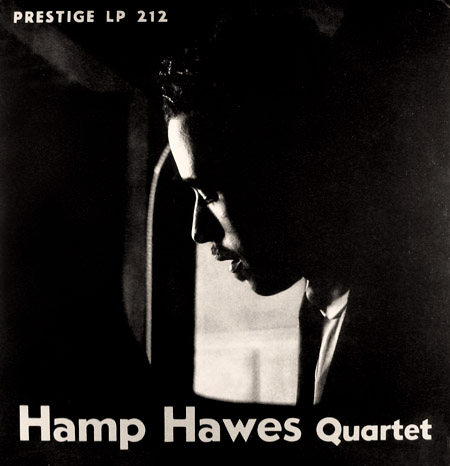
This is Hampton Hawes's second recording for Prestige, and his first as a leader. He had played on the Wardell Gray/Art Farmer session that introduced "Farmer's Market," and he had opened my eyes on that one. I knew of Hampton Hawes, but had never sat down and listened to him closely. My loss. My gain now, and my delight. Hawes was a unique piano player. intense and playful, musically advanced, a solid swinger.
Here he's with Larry Bunker, equally well-known on drums and vibes. He had only come to the vibes fairly recently, but it hadn't taken him very long to master them. From a 1994 interview with Mal Sands:
It was 1950. I was
21 or 22 and I was playing drums with a trio that included the Hammond
organ and the guitar. The organist, who was the leader, asked me if I’d
ever played the vibraphone and I said, “No, I’ve never played one in my
life.” He said, “Well, the fact that you know harmony and are an
improvising player and know the keyboard and drums, it’s a natural for
you. I’ve got an old set of vibes in my garage. Why don’t you take it
home and work out a couple of tunes and we’ll see what happens.” Now I
was aware of Lionel Hampton and just beginning to get into Milt Jackson.
So I took the thing home, figured out how to put it together and spent
three days just doing exercises and playing scales.
So I went
on the job and did the first set on drums and then the guys asked:
“What have you worked out?” I said that I had worked out a solo on a
song and when he asked me what I wanted to play I said just play
anything. So we played a couple of standard ballads and then some
up-tempo things and got screaming applause from the audience. We came
off the bandstand and there were people in the audience, musicians I had
worked with who came up to me and said: “Geez, Larry, I didn’t know you
played the vibes. How long have you been doing that?” I said: “Three
days.”
Also interestingly, and unexpectedly for two West Coast musicians, both of them played with Bird. At 19, Hawes played an 8-month gig at the Hi-De-Ho Club in LA, for Howard McGhee's quintet with Charlie Parker. And Bunker? Well, let him tell it (from the same interview):
I did actually get
to play once with Charlie Parker when I played a couple of tunes on
piano at a dance job with him in L.A. at a place called the “Five-Four
Ballroom. Some guys I knew where playing with them so I went down to
catch the gig. There was a tune they wanted to play and the piano player
didn’t know it. Larance Marable saw me and called me up to the stand
and said: “You know that tune, don’t you?” I said: “Sure.” So I sat in
and comped for Bird.
Every tune from this session is a treat, with two virtuosos trading solos, running up each other's backs, never missing a beat or a cue or a challenge. It's hard to single
out one, but what about "Move," the Denzil Best composition made famous
by Miles Davis, John Lewis and Co. on the Birth of the Cool album. The Davis nonet, escaping from the strictures of bebop, plays it at about two and a half minutes. Hawes and Bunker, making it into their own speed-dialed bebop classic, play about the same number of notes and choruses, and bring it home in a minute and half.
Prestige put this out on a 10-inch, and later on a 7000-series 12 inch LP, the latter combined with a Freddie Redd session as Hampton Hawes/Freddie Redd -- Piano: East/West. How's that for an orgy of overused punctuation marks?
By the end of 1952, Teddy Charles Cohen had heeded his booking agent's warning that he couldn't book a jazz act with a Jewish name, and had become Teddy Charles full time.
This didn't exactly mean that he was going all out for popular approval. You don't name your latest tune "Composition for Four Pieces" if you're looking to compete on the jukeboxes with "Open the Door, Richard." And if you title another tune "Edging Out." you aren't sending a message that you intend to place yourself square in the center.
On two consecutive days, Bob Weinstock went into the studio with vibraphonists, and for the second straight day, with musicians who were edging out of the bebop orbit, but in different directions. Teddy Charles was lighting out for a territory close to that staked out by Lennie Tristano -- cool, cerebral, imaginative, the work of a serious and innovative composer. Wait a second -- that does sound like John Lewis, doesn't it? And in fact Charles's biographer, Noal Cohen, describes his approach to jazz very much the way Percy Heath described John Lewis's -- "he had developed a compositional approach to jazz performance that
attempted to transcend the standard theme statement/solos/theme
restatement format." But it's different.
A lot of people were ready to bury bebop by the closing days of 1952, but it was still more than just the musical innovation that had transformed American culture: it was still a vibrant and vital force, deeply influencing even those who were edging out of it. There's no John Lewis, no Teddy Charles, without bebop, and there's still plenty of bebop in what they're playing -- in Charles's case, the lightning fast tempi. As Chuck Berry was to say, "I have no kick against modern jazz / Except they try to play it too darn fast." But speed is exciting, especially when it's executed with the virtuoso precision of a Teddy Charles.
There are three originals here (two by Charles and one, "Composition for Four Pieces" by Jimmy Raney), and one standard -- a bebop standard, that is: Dizzy Gillespie's "A Night in Tunisia." As with the recent Monk outing and the very recent MJQ outing, the mixture of the familiar with originals by three of the most original composers in jazz serves to ground the session, and give new insight into the compositional abilities of each.
The interplay between Charles and Raney is wonderful, with Charles edging Raney further out, and
Raney keeping Charles in touch with his inner bebopper. Dick Nivison seems to have no other recording credits besides those with Teddy Charles, but Charles must have really liked him, because when Bob Weinstock, in 1953, sent Charles out to La-la-land to be his West Coast A&R man, he seems to have taken Nivison with him.
Ed Shaughnessy might have been the kind of drummer that everyone in the business wants, but no one outside of the business remembers. He did a lot of anonymous studio work for TV personalities like Steve Allen and Garry Moore. But then one of those TV studio gigs became 30 years as perhaps the most visible drummer on television, when Doc Severinsen hired him for the Tonight Show orchestra.
The tunes for this session were released on the appropriately named 10-inch LP New Directions, Vol 1, and also on a 45 RPM EP with the same title.
No selections from this session have been posted on YouTube.
The first sound you hear, on the first tune of the first recording session by the Modern Jazz Quartet, is the driving walking bass of Percy Heath, punctuated explosively by Kenny Clarke's drums. And there's a surprise, not just because Clarke was the only musician to leave the group, but because you don't exactly think of the MJQ as a drum-dominated group. But here's Clarke, front and center on "All The Things You Are" - and perhaps, even more so on "La Ronde," the second tune to be recorded that historic day. Does that mean that the MJQ didn't start out as the ensemble-driven sound that we associate with them? Not at all. But they were, first and always, an ensemble of individuals. A lot of critics of the MJQ in later years, those who,complained that the group was too stodgy, too careful, too polite, tended to except Milt Jackson from this criticism, and say that he was a real individual, and what was he doing letting himself be tied down? Let's Bags be Bags! But they were all individuals, all powerful players all creators and improvisers and strong personalities.
Percy Heath, in an interview by Mike Zwerin in Paris in 2003, recalled the founding of the Modern Jazz Quartet from four musicians who had come together as the rhythm section of Dizzy Gillespie's big band. Gillespie had featured them separate from the band, and they had also started playing club gigs as the Milt Jackson Quartet (originally with Ray Brown on bass).
In 1951 the Milt Jackson Quartet - Heath, John Lewis and Kenny Clarke (soon replaced by Connie Kay) - was driving home to New York after performing in some sad and disagreeable outlying club. All four of them - they were big men - were squeezed into Milt Jackson's tired old gilded Cadillac, which they had named the "golden dragon." Lewis said he was weary of this kind of life, and of the same old head-solos-head rhythm section format that went with it. He wanted to form a band that would be like a chamber group with four independent contrapuntal lines going simultaneously and be accepted in theaters and concert halls where jazz had never before been heard. The Modern Jazz Quartet was named then and there in the golden dragon.
So this was a powerful zeitgeist as the 40s turned into the 50s. Miles Davis, who had been a protege of Charlie Parker, was feeling it. John Lewis, playing in the Dizzy Gillespie big band, was feeling it. There had to be more than just the same old head-solos-head formula. It was time to break out of bebop.
As it turned out, bebop had a lot more life, and a lot more creativity, to share with the world, but these questing musicians were right too. John Lewis had been an integral part of the music that came out of those all-night sessions at Gil Evans's apartment, had played on the Birth of the Cool sessions and contributed three tunes. The nonet had failed commercially, but the idea that jazz could move in new directions was still a vivid one.
The quartet recorded two standards and two Lewis originals on that first session, both of which were to become staples of their repertoire. "La Ronde" was expanded into "La Ronde Suite," about which more later. "Vendome" is perhaps the most representative of the direction the group would become famous for, classical in structure and tightly arranged.
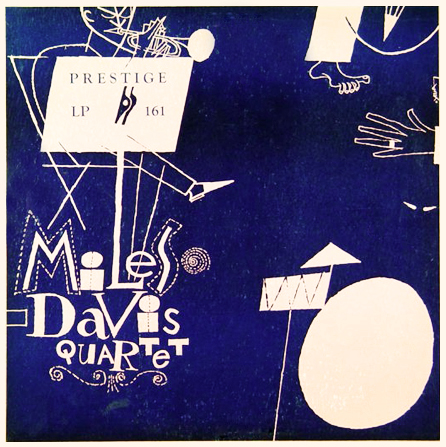
All four songs were released on 78 RPM and on a 10-inch LP -- one of the first Prestige LPs to take cover art seriously.The cover was designed by David X. Wilson, noted not only for his jazz album art, but for jam sessions at his illegal loft. From his obituary in the New York Times:
The loft, in an industrial building at 821 Avenue of
the Americas, near 28th Street, became a gathering place for the greats
of jazz, including Miles Davis, Charles Mingus, Thelonious Monk and
Dizzy Gillespie, as well as for utter unknowns who simply yearned to
play.
Known simply as ''the Sixth Avenue loft,'' it was
one of maybe a half-dozen places where musicians gathered at a time when
various strains of jazz -- mainstream, bebop and cool, among others --
were percolating. Situated in the heart of the flower district, it was
the epicenter of what became known as loft jazz.
''By most accounts, it drew the biggest names,
showcased the latest talent and lasted the longest,'' said an article in
the fall 1999 issue of Double Take magazine.
''Guys played with people they'd never seen
before,'' Bob Brookmeyer, a trombone player, said in the article.
''Whites, blacks, old guys, young guys. Nobody cared about that stuff.
We were all outlaws. Our profession wasn't considered respectable. There
was a sense we were all in it together.''
There was no lock on the loft's front door, and it
was considered bad form to arrive before 11 p.m. There always seemed to
be many pretty young women present, and ample bourbon and marijuana. It
was a spot where Salvador Dali, Norman Mailer or Willem de Kooning might
show up, entourage in tow. ''The locus of mad freedoms,'' Mr. Young
once called the scene that his rent bargain made possible.