Thursday, November 27, 2014

Listening to Prestige Records Part 54 - Joe Holiday

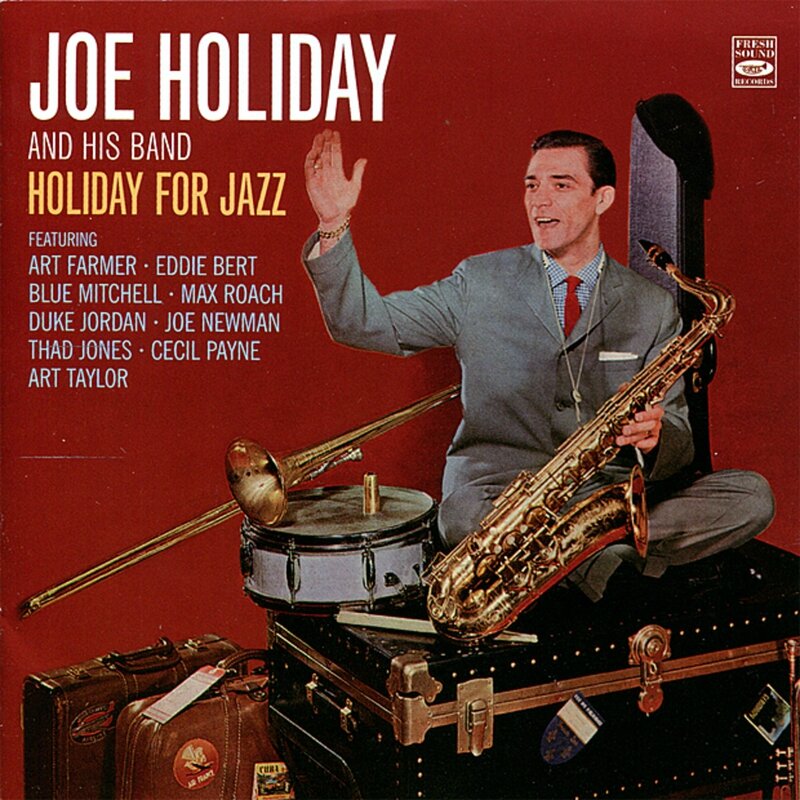
Another unexpected delight -- another musician I had not heard of at all, and clearly it was my loss. Holiday made a few albums for Prestige, and then pretty much nothing else. This one was with otherwise unknown musicians (I did find out that Clarence Johnson played bass on Lloyd Price's recording of "Stagger Lee"), and although he did record later with some of the big names in jazz, this session is a solid introduction.

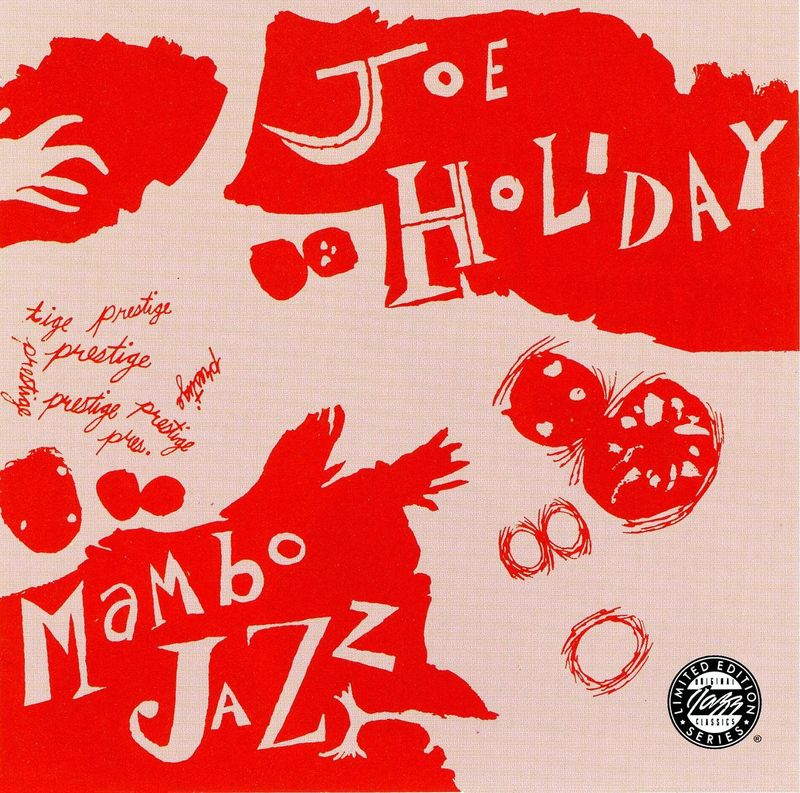
A word of advice on finding him -- I did a Spotify search on "Joe Holiday" and found nothing except a country singer named Joey Holiday. Looked on YouTube, found a few things, but none from this session (ultimately I did, so it's linked to here). Continuing to research Holiday, I discovered that he'd had a hit in 1951 with "This is Happiness," so I went back to Spotify, searched on "This is Happiness," and found the whole session and more. A lot of Holiday's work was reissued on Original Jazz Classics, one of the Prestige reissue labels, and Spotify has that, with album cover art that looks
like the art for mambo album of the 50s, for which I give them credit. Actually, looking a little farther, I find a second cover, also with the OJC logo, that must certainly be from the early 50s.

On this session, Holiday plays some bebop, some rhythm and blues riffs, some ballads -- eveything that adds up to what we now call straight-ahead jazz. And he plays some mambos, the musical form with which he came to be associated, which is why he achieved a measure of popularity in the 50s, and probably why he was mostly overlooked afterwards.

Latin jazz has never gotten its full due -- if you don't believe me, look at anybody's list of the greatest jazz trumpeters ever, and see if you find Mario Bauza's name. You won't. and he was the equal of anyone you will find on those lists. Or look at anyone's list of the best jazz albums of the 1980s and '90s, and see if you find anything by Tito Puente. And his jazz recordings during that period were better than anything else being recorded.

The mambo craze hit New York in 1951 -- I would have guessed later, but that's because I grew up as a white kid in the sticks, and although I was able to find my way to blues and rhythm and blues, I was totally ignorant of Latin popular music, so all I knew of the mambo were the mid-50s pop tunes by people like Perry Como and Vaughan Monroe -- and Perez Prado's 1955 hit, "Cherry Pink and Apple Blossom White," which by some reckonings was the most popular record of the decade.

But it was Prado who actually brought the mambo to New York in 1951, with "Mambo Jambo" and "Mambo #5," the latter of which would become a huge hit again in 1999. And Joe Holiday was one of the few jazzmen who embraced the genre -- which, as I say, marginalized him a jazz musician.

And shouldn't have. Holiday proves his bebop credentials with "Hello to You" and "Nice and Easy," but he really comes into his own with his jazz mambos -- "This is Happiness," which was his hit on the Latin charts, and especially "Mambo Holiday," an extended piece at just over five minutes, which made it a two-sided single, on both 78 and 45, and which, yeah, you have to listen to.

Joe Holiday is still around. From Wikipedia:

Holiday also does abstract painting. Joe and his wife, Kelly Holiday are president and vice-president, respectively, of the St. Lucie Professional Arts League based in Port St. Lucie, FL, where he has presented annual "Art & All That Jazz" events, which have included Linda Cole, Jazz singing daughter of Nat King Cole; Miami musicians Ira Sullivan, violinist Nicola Yearling and pianist Lenore Raphael.

Tuesday, November 25, 2014

Listening to Prestige Records Part 53 - Gene Ammons

There were two other autumn sessions for Prestige that seem to have sunk without a trace. On October 16, alto player Lem Davis, a swing specialist, led a quartet that resulted in three 78s. Also in October, pianist Al Vega made some trio recordings in Boston. Vega spent his career in Boston, where he played with many of the greats as they passed through town, and also coached Little League. The trio recorded ten songs that day, of which four were released, on two 78s.

I probably don't have a lot more to say about the Sonny Stitt - Gene Ammons Septet, except that they made a lot of really good music, and I'm always glad to come back to them. But at least one of the song selections is interesting. "Undecided" has a jazz history -- a New York jazz history, a 52nd Street history. It was co-written by Charlie Shavers, and originally recorded in 1938 by John Kirby and the Onyx Club Boys, a group that presumably coalesced at The Street's Onyx Club, and included Shavers, Buster Bailey, Billy Kyle and Russell Procope (there was also a group of Onyx Club Boys that recorded with Stuff Smith, with Buster Bailey the only member of both groups). Chick Webb and Ella Fitzgerald also made a record of it in 1939, and then it lay mostly dormant until 1951, when the Ames Brothers had a huge hit with it, riding the charts for 20 weeks. It was certainly not unusual back in those days for cover recordings of hit songs to crop up, but maybe not that many beboppers covering current pop hits.

We can assume it went out to the jukeboxes -- these four tunes were released on two 78s, and on a 10-inch LP. -- then not again until the Fantasy reissue days.

Friday, November 21, 2014

Listening to Prestige Records Part 52: Teddy Charles

Perhaps he went into the studio a Teddy Cohen and came out as Teddy Charles? Anyway, this is how jazzdisco credits the album, although certainly all later issues have him as Teddy Charles, and 1951 was the year that the gentleman changed his name.

I wasn't familiar with Teddy Charles's music -- I may have heard it, but never really sat down and listened to it, so this was an opportunity to get acquainted with someone I'd overlooked, and the acquaintanceship proves to be well worth it. 
He's working here with a trio, featuring two other unfamiliar names. I can't find any information on Don Roberts, and the only other credit I've found for Kenny O'Brien is a Jackie and Roy album. But with only three instruments, and none of them a piano, they're all able to get close to the mike, so although O'Brien may not have been one of the biggest names in modern jazz, he becomes the first bassist to take extended solos on a Prestige album. The album is fascinating. Charles shows his avant garde credentials on "This is New," but then he plays an odd selection of material for an avant-gardist -- mostly standards. And while some of them, like "the Lady is a Tramp" and "I'll Remember April" are the kind of tunes one would expect to hear a bebopper improvising on, others, like "Old Man River" and especially "Basin Street Blues" seem to belong to a whole different musical sensibility. And Charles, while he always moves toward the inventive and experimental, is very respectful of all these melodies.

Teddy Charles left music in the 1960s to become a charter boat captain in the Caribbean, and according to one source Charles observed that there was plenty in common between the uncompromising demands of seafaring and the spontaneous challenges of jazz." He came back to music late in life, and continued playing and recording until his death in 2012, at age 84.

 A couple of tunes from this session -- "I Got it Bad" and "Liza" -- were never released. The rest came out on a 10-inch LP, and two sides -- "I'll Remember April" and "The Lady is a Tramp," which are, as it happens, the ones I picked out as most bebop-friendly -- were released on a New Jazz 78, with the leader being identified as Teddy Cohen, though he's Teddy Charles on the LP. All the selections are short enough to fit on 78, but at this point Weinstock appears to be edging away from that format. There's a good representation of Teddy Charles on YouTube, but nothing from this album. Spotify has the whole thing,

Sunday, November 16, 2014

Listening to Prestige Records Part 51: Miles Davis Sextet

I keep finding myself drawn back to the nonet and the 1948-49 Birth of the Cool sessions, because they were so important, and because no one seemed to know it at the time. Certainly no one one in New York. The engagement at the Royal Roost had been a flop, in good part, perhaps, because Count Basie was headliner, and Basie's audience might not have been the most receptive to the cool sound. And hardly anyone had listened to, or cared much about, the 78 RPM records that came out of the studio sessions for Capitol. Gerry Mulligan took the sound as far away from New York as he could, to California, where he developed it and adapted it for smaller groups, and created West Coast jazz -- or, as many said, gave birth to a new, cool jazz sound. Gil Evans seems to have gone fairly quiet-- we do know that he was always in touch with Miles.

Miles is thought to have completely turned his back on the experimental sound of the Nonet, bitter and disillusioned by the failure of the Jazz public and critics to appreciate what he had done for them, and that's mostly true, but not completely. He did make that one very experimental recording session with Lee Konitz. And, like Mulligan, he went as far away from New York as possible, but in the other direction, to Paris. 

I knew Miles had been embittered by the nonet's reception, but I didn't realize how much. He stayed away from New York -- first Paris, then the Midwest, where the answer to how you gonna keep them down on the farm, after they've seen Paree? seemed to be, in part, a lot of heroin, but another was just that...staying out on the farm. Plenty of first class musicians came through Chicago, and we've already talked about the Detroit scene.

Bob Weinstock, in an interview, recalls tracking him down.

 Miles had vanished after he did those Capitol sides with the (Birth of the Cool) Nonet. Nobody knew where he was. Somebody had said that he may be at home in East St. Louis, so while I was in Chicago on business I tracked him down. His father was a dentist, so I knew that his number would be in the phone book. I had met Miles at a Dial session where he recorded with Bird, but he didn't remember me. Anyway, he said if I'd send him money to get to New York, he'd be happy to record. I said that I was interested in doing a series of recordings, and that I wanted to sign him to a contract. He said alright, just get him to New York and we'd talk about it then. So, our basic idea was just to make records with different people, to record with the best people around. That's what we did until the end, when he had the quintet with John Coltrane, Red Garland, Paul Chambers, and Philly Joe Jones. But everything up to that point developed from where we would sit down and talk about it. Miles would mention who was in town, who he would like to record with. I'd say who I'd like to hear him record with. We'd kick ideas around.

His first studio album for Prestige was the January session with Bennie Green, Sonny Rollins and John Lewis. 

This time it was Sonny Rollins, who, like Miles, was just hitting his stride as a major jazz figure, and who, like Miles, would become a colossus of American music. Tommy Potter and Art Blakey were veterans of bebop and of Prestige recording session. Walter Bishop, Jr., had made a couple of records, and had played at Minton's for a variety of people, idolizing Charlie Parker, learning from Bud Powell.

His bio in Allmusic.com says that he was "a valuable utility pianist on many a modern jazz session during the bebop era," which means what, exactly? A valuable utility infielder in baseball is someone who's not quite good enough to make the starting lineup, but can fill in at any position if the regular guy can't play that day. Doesn't seem to fit Bishop too well.

Jackie McLean was making his first record. He was in some impressive company--and it's said that he was more than a little nervous, because Charlie Parker was hanging out in the studio that day. So was Charles Mingus.and though he's not credited, it's generally accepted that Mingus played bass on "Conception."McLean definitely made a good impression, and not just with his alto sax playing. It's believed by many that he wrote "Dig." 

Jazz blogger Peter Spitzer asked McLean about it.

I asked him about “Dig.” He said that he had brought that tune to a recording session with Miles, in 1951. Sonny Rollins was there too, and had brought a tune called “Out of the Blue.” When the album came out, Miles was listed as the composer of both tunes. Jackie was willing to consider it an error by the recording engineer. He later talked to a lawyer about getting proper credit, but was told that the returns would not justify the cost of pursuing it, so he just let it go.

Spitzer mentions several other tunes credited to Miles that were probably written by other artists, and then he says,

Some people have pointed out that in those years, it was not unusual for leaders to take credit for the work of their sidemen. 

Now, I'm not here to defend Miles, who (a) doesn't need my defense, and (b) is guilty anyway, but I did wonder about that last statement, because it makes a certain amount of sense, because what exactly is jazz composition? Contemporary jazzman Steve Coleman has this to say about Charlie Parker:
I view Parker as a major composer, albeit primarily a spontaneous composer. His written compositions, similar to many other very strong spontaneous composers, were mainly jumping-off points for his spontaneous discussions.
Bird was noted for "spontaneous composition" -- that is, his improvised solos were actually original compositions, created on the spot. And what is a jazz composition, exactly? It's a tune, or a riff, or a series of riffs, that's played for one or two choruses at the beginning of a performance, and then played again at the end. In the interim, the musicians -- that's Davis, Rollins, McLean himself, Bishop, even Blakey -- are improvising, leaving the melody behind and creating their own musical units, in a piece that lasts for 7 1/2 minutes. The improvised solos are based on the chord structure of the opening chorus (at least until Ornette Coleman came along), and while they do follow that chord structure, it is, in many jazz compositions, the chord structure of an existing song. In the case of "Dig," it's "Sweet Georgia Brown." This is based on research -- I can't listen to "Dig" and say, "Oh, yeah, that's 'Sweet Georgia Brown.'" So maybe it's not so far-fetched for the leader to take composition credit. Or maybe it is.

That being said, "Dig" is a hell of a tune -- draws you in right away. But in spite of that,  McLean's lawyer was probably right about the returns not justifying the cost of pursuing it. I haven't been able to find any other recordings.

And yes, it's 7 1/2 minutes long. In fact, all the tunes from this session are more than five minutes -- "My Old Flame" and "Out of the Blue" came out on 78s, each split up into Part 1 and Part 2. "Only a Paper Moon" and "Dig" the same, but also on 45. "Bluing" was too long even for that, so Parts 1 and 2 were on one 78, and Part 3 on the flip side of "Conception," which at 4:02 must have been just short enough to squeeze onto a disc.They were also all released on 45 RPM EPs. and "Dig" / "It's Only a Paper Moon" also came out as Prestige 45-321, which must also have been an EP, although not labeled as such, and also must have been much later. The 300 series of 45s includes later-generation jazzers like Yusef Lateef, and even rockers like Manfred Mann, as well as a lot of blues artists like Eddie Kirkland.

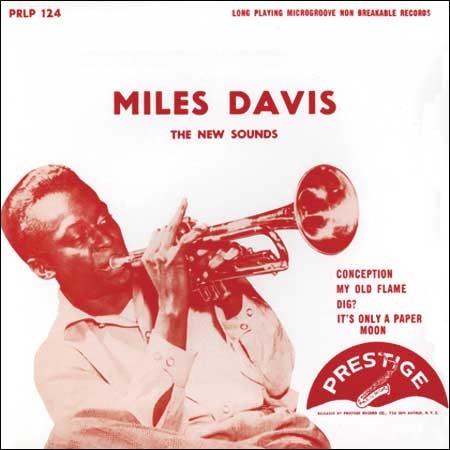
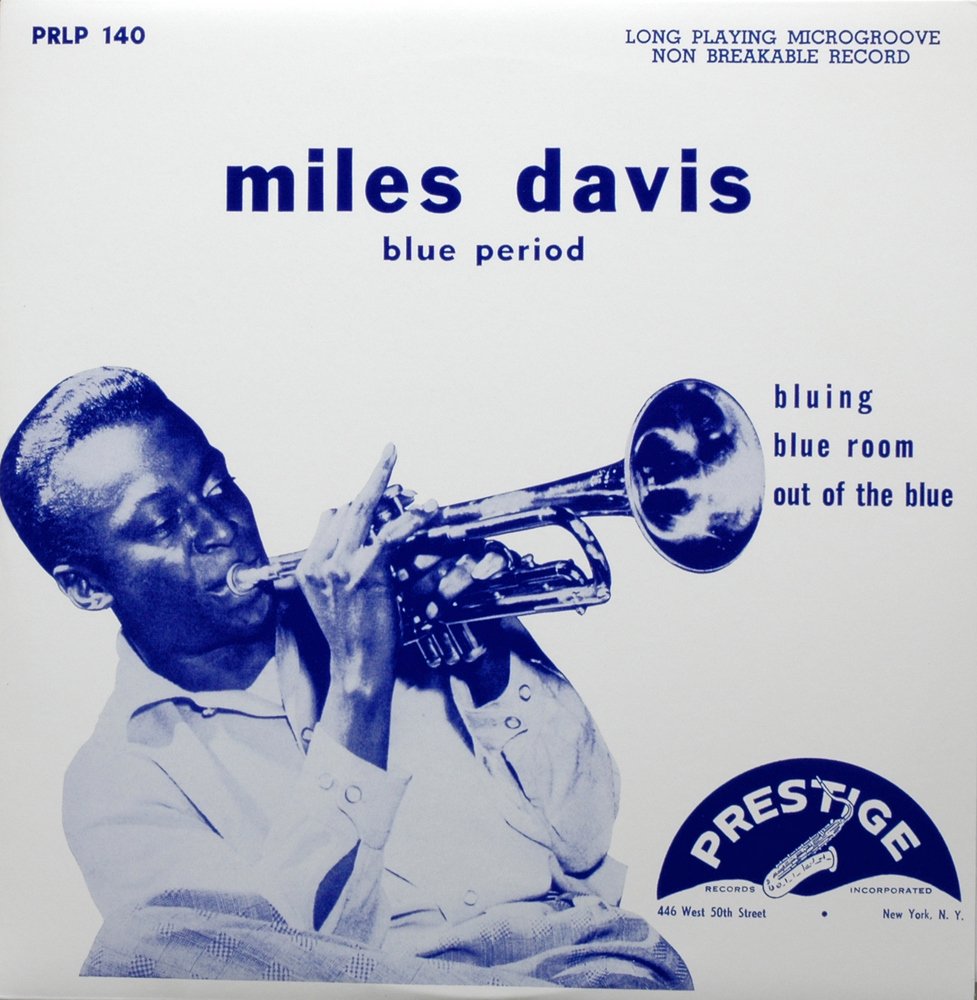
But this may have been the first Prestige session directly aimed at the LP format, and it was released in a few different formats -- as PRLP 124 - Miles Davis: The New Sounds (Conception/Dig/My Old Flame/It's Only a Paper Moon) and PRLP 140 - The Blue Period ("Bluing" and "Out of the Blue," along with the alternate take of "Blue Room" from the previous session). Ira Gitler was writing the album cover notes by that time, and here's what he had to say (liner notes thanks to the Plosin website, very complete on Miles).

THE NEW SOUNDS
When an artist is simultaneously recognized, by critics, fellow artists, and the public analogous to his art, as the foremost in his particular field, the work of the artist invariably substantiates the status given him by this audience. Such is the position of Miles Davis as the most important creative trumpeter today. Acknowledged first by musicians, Miles, soon drew the ears of discerning critics into appreciative attentiveness and finally the jazz public accorded him their appreciation in the Metronome and
Downbeat polls.
Of course, Miles is to be appreciated for bringing a new sound and conception to the trumpet but what really gives him his greatness are the intangibles he possesses, which enable him to transmit sweeping joy with his "wailing" solos and reflective beauty in the delicacy of his ballads.
This album gives Miles more freedom than he has ever had on record for time limits were not strictly enforced. There is opportunity to build ideas into a definite cumulative effect. These ideas sound much more like air-shots than studio recordings.
Upon the wonderful rhythmic foundation of Art Blakey's drums, Tommy Potter's bass, and Walter Bishop's piano, tenorman Sonny Rollins and altoman Jackie McLean are able to enjoy some of the unlimited time for their solo efforts. Rollins demonstrates the impact of the intangibles, again, with his solo on "Paper Moon". The way in which the solo is constructed and the feeling and time with which it is played, overshadow the marring reed trouble. McLean, still in his teens, is heard only on "Dig". He need not apologize for his youth after his work here. Walter Bishop appears in solo for a brief moment on "Conception" which gives only an inkling of his marvelous playing.
Here are New Sounds at greater length. Listen to them at great length.


and

MILES DAVIS - BLUE PERIOD
An album by Miles Davis represents modern jazz at its best. In this album as in Miles' PRESTIGE LP 124, the length of time for each selection is not restricted to the usual limits except in the case of BLUE ROOM, which was cut at a more conventional session. BLUING, the high spot of this set, is over nine minutes of freedom of expression on
modern blues chord changes. At the very end, Art Blakey continues playing after everyone else has stopped. If you listen closely, you will hear Miles say something like, "You know that ending man, let's do it again", but why do it again when you've captured the feeling in the solos of Walter Bishop, Miles, Sonny Rollins, Jack McLean, and the inventive drumming of Art Blakey. The advantage given by LP, of not having to make a "product" for the juke bokes, allowed us to keep this take. OUT OF THE BLUE (Miles' plea to get happy) was done at the same session and although not as lengthy as BLUING, still provided ample time for relaxed improvisation.
This album is a must to those who appreciate our modern jazzmen. I know that people who have missed hearing these musicians in person, will be especially gratified, because this is what they have been missing.

But the major release of this one came in 1956, remastered by recording genius Rudy Van Gelder, and issued as a 12-inch LP as Dig. This, with the moody, dark cover image of Miles in shadow, and the terse title, was one of the benchmarks of hip in my young life.

And here's Gitler on the reissue:

These are some of the first "longer playing" recordings made possible by the advent of the LP. Recorded on October 5, 1951, this entire session has been remastered by top engineer Rudy Van Gelder. (The two remaining selections from this date, Conception and My Old Flame, are included in CONCEPTION, PRLP 7013)
Miles Davis and Sonny Rollins form one of the most empathetic and powerfully moving duos in jazz. Although they had recorded together before (Morpheus, Down, Whispering, Blue Room) this was their first chance to "stretch out" together on records.
These recordings have much warmth. The emotions jut out of all the solos. On Paper
Moon and Bluing this is especially true, but it is in evidence on the upper tempos too. Dig is fluid. The chord changes lend themselves to the long melodic lines that the soloists employ. There is also a continuity of feeling from one soloist to another which points up the aforementioned empathy.
The group is made a sextet by altoman Jackie McLean on all numbers but Paper Moon. Jackie, in his teens when these recordings were made, was then a disciple of Charlie Parker. The Bird influence is still with him but the light of it is partly directed through the prism of Sonny Rollins.
Incidentally, Bird was present for part of this record sort of visiting with his children: Miles who gained his greatest experience and had his largest pleasures playing with him; Jackie, the young disciple; and Sonny, the reed voice who has become the foremost standard bearer and advancer of the Parker tradition.
The swinging rhythm here features the explosive drive of Art Blakey, the subtle power of Tommy Potter and the sensitive accompaniment and solos of the unduly underrated Walter Bishop.


More credit to Jackie McLean for those chord changes (even if they are the chord changes to "Sweet Georgia Brown") that lend themselves to long melodic lines. And more credit given to McLean by Gitler, who had said on the previous liner note that he only appeared on "Dig."

And by the way, a busy day for Art Blakey. He played on the Bennie Green session as well.


Saturday, November 08, 2014

Listening to Prestige Records Part 50: Bennie Greene

Bennie Green could play anything, and he pretty much proves it on this set of six songs (Prestige didn't release "Jumpin' Journey").

Green got his start with traditional jazz master Earl Hines, worked with moderns like Miles Davis and Dizzy Gillespie, and avant-gardists like Randy Weston, and he could play rhythm and blues. For this session, he teamed up with sidemen who were as versatile as he was in Davis and Nicholas, and they proceeded to prove it by putting together a set in which they never played the same thing twice.

""Green Junction" is big band swing (or it's rooted there -- nothing on this session quite fits any pigeonhole). "Flowing River" sounds more like something that might have been recorded by George Winston on Windham Hill than like the gutbucket blues it is, with the dirty blues sound that only a trombone can deliver. "Whirl-a-Licks" is supercharged bebop, with some R&B honking thrown in for good measure. "Bennie's Pennies" is a standard, the only one of the day, with a bebop treatment. "Tenor Sax Shuffle"is a honk-a-thon with two classic honkers, and "Sugar Syrup" could be rhythm and blues if the rhythm section were a little more predictable, but it's not. What else could you possibly want?

Teddy Brannon is the new name here for me, and his blues lick sets the tone for "Flowing River." He played up and down 52nd Street, recorded with a number of jazz greats, accompanied  Dinah Washington, Ruth Brown, Billie Holiday, and his cousin Babs Gonzales,and played on a lot of doowop records. My kinda guy.

What else is happening on the jazz scene in October of 1951? We haven't checked in with the New Yorker in a while, and they've added a couple more trad jazz clubs to Condon's and Jimmy Ryan's in their "Mostly for Music" listings, while still mostly ignoring the modern clubs. Birdland, in a somewhat rare move, is featuring Bird -- Charlie Parker, trading off with Terry Gibbs. And they list The Embers, where "some of the best music on the North American continent is being turned loose by the prankish Red Norvo Trio, which has Tal Farlow on guitar." Bud Freeman is scheduled to follow Norvo, and then Erroll Garner's trio with Shadow Wilson.

I'm wondering if this session was set up with an eye toward different markets. I'm guessing not -- Weinstock doesn't seem to have been that commercially focused. But the 78s seem to be put together with a sense of what goes with what --  "Tenor Sax Shuffle" and "Sugar Syrup" on one 78, the two beboppers, "Whirl-a-Licks" and  "Bennie's Pennies" on another, the two more traditional sounds on a third. The EP leaves off  "Tenor Sax Shuffle" and "Sugar Syrup." and the same grouping goes onto the 10-inch LP Modern Jazz Trombones, Vol. 2, with cuts by Green and J. J. Johnson.

Friday, November 07, 2014

Listening to Prestige Records Part 49: Ralph Willis

A few strikeouts as summer of 1951 turns into fall. Weinstock recorded Johnny Green "and others" on September 3. Four songs were recorded, only two released, on the Par Presentation label, which was mostly blues. I can't find anything on Johnny Green, nor on Gene Harris (piano and vocals), recorded on September 24. Harris cut a bunch of standards, including couple of jazz standards -- "Flying Home" and "Jumping With Symphony Sid," and a tune called "Dedication to Albert Ammons," which suggests that boogie-woogie was his metier. None of them were released, except for two cuts, "Make Believe" and "Late Hour Boogie," on a Prestige 78. I found a note in a December issue of Billboard identifying it as a new rhythm and blues release on Prestige, but can't find the songs, or any other mention of Gene Harris.

 Next a more surprising omission -- a session by Red Rodney. in which eight songs were recorded and six were released, first on 78, then on a 24000-series reissue when Prestige was owned by Fantasy, and on a Fantasy reissue. But none of them to be found on Spotify or YouTube. The sessions featured Charlie Parker sound-alike Jummy Ford on alto and vocals, and it seems to have been pretty good -- Eugene Chadbourne on Allmusic says A few years later some of the best recorded documentation of this saxophonist was created when trumpeter Red Rodney, a young protégé from Parker's later groups, convened a small group for tracks originally issued as Prestige and Fantasy 78s. Which proves that Allmusic isn't infallible -- Fantasy didn't put out 78s -- but is good info anyway. But no luck hearing the tracks.

 Which brings us to October 3, and another blues session, this one by Ralph Willis. Nine songs cut, two of them issued on a 78. Available on Spotify. Very nice Piedmont blues. Willis didn't get the sort of recognition that Blind Boy Fuller or Brownie McGhee got, but he had a pretty good recording career -- all of which is on Spotify.

Thursday, November 06, 2014

Listening to Prestige Records Part 48: Gerry Mulligan New Stars

What do you do when it's 1951, and you've already made the most important record of the decade, but no one knows it yet, and in fact you made it last decade with a group that's since been disbanded, and no one paid it much attention at the time?

For some of the key members of the Birth of the Cool nonet, it seems to have meant taking a step backward, and that's not meant as a criticism.

An important part of the impetus to forming the nonet was a dissatisfaction, especially on the part of Gil Evans and Gerry Mulligan, to the overemphasis on the flamboyant virtuoso soloist that was bebop. They came from big bands, particularly the Claude Thornhill band, which played dance music but encouraged some experimentation, and brought from some important jazz musicians...and arrangers.

And in fact the Miles Davis nonet, in its historic Royal Roost engagement, included its arrangers on the marquee -- Gil Evans, Gerry Mulligan, John Lewis. Mulligan and Lewis were also featured musicians, but giving marquee prominence to Evans may have been a first -- and was certainly deserved.

So what do you do? Lewis would move in a new direction with the Modern Jazz Quartet, but not for a couple of years. During this period, he continued to work as a sideman with boppers. Davis was to retrench, sort of, in his Prestige and Columbia albums of the 50s, playing bebop with a difference, creating the style called hard bop that became the most significant jazz style of the 50s. Konitz stayed out in left field, but then he really had no mainstream to go back to -- he'd come from left field, with Tristano.

Mulligan, in this session for Prestige, goes a certain way toward the bebop mainstream -- there are some powerful improvisatory and virtuoso solos -- but his retrenchment is more in a Thornhill direction, with some big band arrangements and full sound that touches back to swing in the way Thornhill and Herman did, while still staying decidedly modern.

Mulligan's New Stars didn't quite manage to become stars. Allan Eager and George Wallington are the only two whose names have remained with some resonance in jazz history.

I found this mention of two of Mulligan's men in an online essay called "Names of the Forgotten":

Where are Jerry' Lloyd, George Syran, and Phil Raphael and Phil Leshin? Jerry Lloyd was around in the 1940s and 1950s and recorded with Gerry Mulligan, Zoot Sims, and George Wallington, though he never became well-known and worked as a cab-driver even when he was featured on records with such artists... [Phil Leshin] worked with Red Rodney in 1951, but what else?

Nick Travis, according to this essay, played on 350 jazz recording sessions, so if he never quite broke through to serious name recognition, he clearly made a name as a guy you could count on. Here's Hal McKusick on Travis:


"Nick was a great player and a great  guy. He was so busy in the 1950s. He'd get done with work at 2 a.m., head off to his home in New Jersey and be back the next day in a New York studio at 8 a.m. Zoot told me a funny story. Nick was so tired one day that he slept in. His phone rang early that morning. Nick sleepily answered: "Hello?" "Hi Nick, it's Zoot." Nick paused and said, groggily, "Zoot who?"
"I remember Nick as being quiet and intelligent. He spent a lot of time with his instrument. When you’re working the way we did, you didn't have a lot of time to practice, so work was practice. He was a great lead horn player and quite a soloist. Nick was always there on a date in every way. Efficient, on time and he never hit a bad note.
"Ultimately, Nick probably had too much work. We all did. Nick was in such great demand by so many different orchestrators and contractors at the time that he probably had a hard time handling the stress internally. He kept a lot of it bottled up, I guess. I didn't realize he had passed from ulcer troubles.
"As sounds go, Nick's was down the middle. You'd hear his horn and if you didn't know who was playing you'd say, 'Wow, who is that? That sure sounds good.' He caught your attention. Nick also was a wonderful reader, which was why he was in such demand. Nick played caringly."


There's less on Ollie Wilson and Mac McElroy. Wilson was in Woody Herman's Second Herd, and highly regarded. Mulligan used McElroy on at least one other recording.

I found this on Gail Madden, from a reminiscence by Bill Crow in a book called Fifties Jazz Talk: An Oral Retrospective by Jack Gordon.

I began by asking him if he knew a lady named Gail Madden, who had been a pianist and a model in California before becoming active in New York jazz circles in the early fifties. She appeared on Mulligan’s first album as a leader in September 1951, playing maracas on some numbers, and Gerry has credited her with suggesting the idea of a pianoless rhythm section to him before they left New York for California later that year.  When they arrived in Los Angeles, it was thanks to Gail and her previous relationship with Bob Graettinger that Mulligan was introduced to Stan Kenton, who very soon bought some of Gerry’s arrangements. She also suggested hiring Chico Hamilton for Mulligan’s first quartet, so Gail Madden was clearly a significant, if unseen, influence on his early career.

"I met Gail before I knew Gerry very well, thanks to a drummer friend of mine by the name of Buzzy Bridgford. He introduced us at an apartment in Greenwich Village owned by a lady named Margo, who was apparently a $100 a night hooker and was bankrolling Gail, who wanted to be a therapist and save all the junky jazz musicians in New York. Charlie Parker had agreed to go along with all this and was first on her list. Gail’s plan was that, with Margo’s money, she would buy a brownstone and start a clinic and all the guys would come and live there so she could straighten them out and get them off junk. Buzzy, who knew all the inside jazz gossip, claimed that Joe Albany, Serge Chaloff, J. J. Johnson, Stan Levey, and Gerry were also going to be involved, but unfortunately for Gail, she had an argument with Margo over money and the whole idea collapsed. Soon after, she and Gerry became a “couple,” so we figured that if she couldn’t save everyone on her list, she would concentrate on him. She started turning up on his gigs out at Queens, playing maracas, and I remember her being there when Gerry was rehearsing a band in Central Park on the shore of the 72nd Street lake. Around that time they both disappeared from the New York scene, and the next thing we heard was that they were on the road, hitching to California, and we all laughed because that was exactly the sort of wild thing they would do. They made it, all right, and then those wonderful records that Gerry made with Chet Baker started coming out."  

So this was Mulligan's first session as a leader. One other interesting thing about this recording
session, The first six songs are standard song length, about three minutes, and all of them were released on 78 and 45 -- "Mullenium" is pushing it at 4:05, but they managed to get it onto one side of a single. "Mulligan's Too" is over 17 and a half minutes long -- who recorded anything that long in those days? And it's Mulligan's first session as a leader, but he was able to talk Weinstock into it. It became a 10-inch LP, which you can now buy on eBay for $250.


Wednesday, November 05, 2014

Listening to Prestige Records Part 47: Zoot Sims


A  busy day for Bob Weinstock, with this Zoot Sims set following Sonny Stitt and Gene Ammons -- and they weren't short sessions,either. This one has six songs, and at least three different versions of "Trotting" were kept -- one released on 78, and the other two saved in the vaults until they were finally released by Fantasy in one of their Prestige reissue packages.

And not these easiest session to sift through, because Zoot recorded most of these songs more than once, and while it was pretty clear that some of them -- like the 11-minute version of "Zoot Swings the Blues" -- were not from 1951. it was sometimes not so easy to figure out which ones were definitely from that session. I did finally find a couple I was sure of, on YouTube--"I Wonder Who" and "It Had to Be You," and one on Spotify -- "Trotting." Whether it's the 78 RPM original release or one of the alternate takes, I can't say.

Sims spent a lot of time in big bands, from the swing units of Benny Goodman and Artie Shaw to the modern sounds of Woody Herman and the Four Brothers to the ultra-progressive stylings of Stan Kenton, and perhaps the Goodman and Shaw experiences give him that swinging assurance, but it's his own lyricism and musical vision that allowed him to develop the extended solos that made him such a great leader of small groups over such a long period of time.

I'm interested, too, in what Weinstock was doing in the studio on August 14,1951. We're still a few years away from Rudy Van Gelder's engineering genius, but Weinstock is learning a few things. I said in my last entry that I hadn't yet heard a bass solo on a Prestige recording, and now here -- still historically on the same day -- we're finding, if not quite a lengthy solo, at least some strong bass presence.

The bassist is Clyde Lombardi -- like Sims, a swing-to-bop veteran, and a guy who could really play this kind of music. The pianist is Harry Biss, who sounds great, and has next to no biography. His Wikipedia entry states that "he performed and recorded with Georgie Auld, Billie Rogers, George Shaw, Herbie Fields, Buddy Rich, Brew Moore, Gene Roland, Zoot Sims, Terry Gibbs, Allen Eager, and Eddie Bert." That should be an impressive enough list of credentials, but the one reference listed on the Wiki page is to a 2007 Jazz Journal International article called "The Forgotten Ones," which seems to sum him up pretty well. Wiki also says that his career flourished between 1944 and 1952, and that he died in 1997, making him another one of those guys who should have been interviewed a lot more than he was.

If anyone should be irrepressible on drums,, it would be Art Blakey, but we've heard him featured on several Prestige recording sessions already, and he's been pretty repressed -- no bravura drum solos.

I know that drumming was historically hard to record. Baby Dodds was one of the great innovators on drums, but when he was recording in the Twenties, he could only use a wooden block, because the reverberations of a real drum kit would knock the stylus out of the groove of a wax cylinder recording. He was able to record his drum solos as a demonstration in the 1940s, but the issue of recording drums was far from solved.

I found this history of drum recording techniques online. In 1950, it says, there existed "very basic techniques when it comes to recording drums, most of the time positioning all instruments around one mic leaving the drums at the back as ambient sounds."

Here's a much more detailed history of the recording of drums, but what interests me right now is Bob Weinstock scheduling three recording sessions on August 14, 1951, and beginnings of new sound mixtures. Blakey doesn't take off into extended drum improvisations here, but he has his moments, just as Clyde Lombardi has his. And as we move forward into the 1950s, we'll see how this affects recorded small group jazz.

That sounds ridiculously formal. I'm not giving a lecture, I'm finding stuff out as I go along, and listening to music, and sometimes wondering and making guesses about what things were like back then.


Saturday, November 01, 2014

Listening to Prestige Records Part 46: Sonny Stitt--Gene Ammons

This time, separate quartet sessions. Maybe Bob Weinstock wanted to get twice as many songs while still only paying the rhythm section for one day in the studio.
  
Or maybe the day went something like this.

"Hey, daddy-o, whatcha got for today."

"I thought I'd blow a little 'When the Saints Go Marching in." 

"Oh,man, you are on your own,"

Certainly it's not high on the Most Requested list for hipster bebop fans, but Ammons makes it work.

And Stitt makes his session work -- three riff-built originals, and "Confessin'," another tune with deep traditionalist associations, going back to Fats Waller and early Louis Armstrong. Stitt makes it fir perfectly with this session. On the one hand, it's a familiar melody, giving a nice anchor to the session. On the other hand, while Stitt stays quite close to the melody throughout most of the number, he gives it that riffing feeling.

One thing I've noticed about all these sessions so far in our Prestige history. We have yet to hear a bass solo. Not much solo drum work. And not even all that much in the way of piano solos.

I'm guessing these sessions were all done with one mike. Certainly, they were all in mono, and
Weinstock was teaching himself how to produce and engineer a recording session -- don't forget how young he was when he started Prestige. The Rudy Van Gelder years were yet to come, but this stuff still sounds good, and we're lucky to have it. But for this session, perhaps he figured out a different mike placement, because there are some real piano solos by Clarence Anderson on both the Stitt and Ammons sessions -- some great call-and-response stuff, and a couple of very tasty extended solos.


All of these were released on 78 and on 10-inch LPs/


Monday, October 27, 2014

Listening to Prestige Records Part 45: The Cabineers


I can only find the Cabineers' Prestige sessions on YouTube, but they're worth checking out there.

In 1951 Bob Weinstock announced that Prestige was starting a rhythm and blues line, and this session was its premiere offering -- unless you count the Gene Ammons session of few days before?

What's the line between bebop and rhythm and blues? But then, why draw lines at all?  The genius of American music is the way it colors outside the lines, and dances between the lines--and in a second line.Here's a  quote from an interview with Bob Weinstock that I just discovered.

JR: Tenor saxophonist Gene Ammons must have had an impact on the soul jazz market.

BW: Gene Ammons was the father of soul and funk. He started that music in 1950. I liked R&B. I heard a lot of bands play and I knew there had to be room for an update, a modernization of Rhythm and Blues with a jazz flavor. Black people needed something to relate to besides all the singers and vocal groups. Everything we did had a good rhythm section and swung. Nothing was ever phony to make sales. Even when we got heavy into the funk, with organ groups and guitar and all of that, they were like the blowing sessions we did before but with a different groove. They cooked.
Nice that Weinstock thought the same way that I did about R&B -- that it was an important part of jazz, including modern jazz. As much as bebop may have sounded strange and discordant to many listeners at the time -- including Nancy of the comic strip with her reaction to Sluggo's "beep-bop" -- it doesn't sound that way now. Jazz of the 20s may be labeled "trad" jazz, but as Arthur Blythe put it in the title to one of his postmodern albums, it's all "in the tradition."

Classic rhythm and blues instrumentals like Red Prysock's "Hand Clappin'" show the influence of Lester Young. Ray Charles' musicians like David "Fathead" Newman and Hank Crawford made important contributions to the jazz canon. Paul Williams popularized Charlie Parker's "Now's The Time" as "The Hucklebuck."

So Weinstock, who famously did not rehearse before sessions because he thought jazz should have the spontaneity of a live session, put the Cabineers together with a pretty impressive group of jazz musicians, led by Duke Ellington's son Mercer.

Billy Taylor had played with Ben Webster, Machito and Don Redman before becoming the house pianist at Birdland, and had written a book on bebop piano. He would go on to get his doctorate in music from UMass Amherst, thus shattering any myths that you can't be an academic and also swing.

Sal Salvador's birthdate is variously given as 1925 and 1928, but certainly this is early in his career -- the first mention I can find of him on a small group session, although he became part of the house band for Columbia Records and Radio City Music Hall in the late 40s. Like Dr. Taylor, he would go on to an academic career.

I could find nothing on Sam Bell -- finally, a listing for Aaron Bell, full name Samuel Aaron Bell, who must be the same guy. As Aaron Bell, he has a pretty impressive career -- here's his Wiki entry in full.

Samuel Aaron Bell (April 24, 1922, Muskogee, Oklahoma - July 28, 2003) was an American jazz double-bassist.

As a child, Bell played piano, and learned brass instruments in high school. He attended Xavier University, where he began playing bass, and graduated in 1942; following this he joined the Navy, completing his service in 1946. He was a member of Andy Kirk's band in 1946 but enrolled at NYU in 1947. After completing a master's degree he joined Lucky Millinder's band and then gigged with Teddy Wilson.

In the 1950s, Bell appeared on Billie Holiday's album Lady Sings the Blues and with Lester Young, Stan Kenton, Johnny Hodges, Cab Calloway, Carmen McRae, and Dick Haymes. In 1960 he left Hayes' band after being offered a position in the Duke Ellington Orchestra, opposite drummer Sam Woodyard. He left in 1962, spending time with Dizzy Gillespie before taking jobs on Broadway as a pit musician. He and Ellington collaborated once more in 1967, on a tribute to Billy Strayhorn.

Bell held a residence at the La MaMa Experimental Theatre Club in New York City from 1969 to 1972. He also began teaching at Essex College in Newark in 1970, remaining there until 1990. Later in the 1970s he toured with Norris Turney, Harold Ashby, and Cat Anderson; in the 1980s he returned to piano playing, and retired from active performance in 1989. He died in 2003.

I thought this was going to be a short entry -- silly me. And I haven't even gotten to the Cabineers yet. Bob Weinstock, in the interview linked to above, says that Prestige had its best sales with vocal records, and names them as one of his commercial successes. The most complete bio I could find for them is from Marv Goldberg, noted for his profiles of R&B and doowop groups. The Cabineers are one of those 1940s groups who were bluesier than the Ink Spots or Mills Brothers, but didn't last long enough to be part of the doowop scene. Their Prestige recordings were pretty much their last, and boy, do they deserve to be better known.

Jazz or rhythm and blues? Billy Taylor is playing figures that are much more inventive than the triplets that Stan Freberg mocks on his parody of "The Great Pretender," but "Each Time" (lead vocals on all the cuts except "Lost" by Maggie Furman)would be not out of place in any doowop or R&B collection. Sal Salvador contributes some great figures on "My, My, My," where the harmonies are reminiscent of The Clovers.

Of course, a lot of jazz greats played on R&B recordings, but they
weren't always given as free a hand as Weinstock allowed this group.

"Baby. Where'd You Go" is much closer to a Mills Brothers-style harmony. "Lost," which has a lead vocal by Bill Westbrook, is closer to an Ink Spots lead and a Modernaires harmony. I like Maggie's leads better, but I love all of it.

These were released on 78 and 45 by Prestige, and the label reads "Rhythm and Blues Series." The songs are attributed to "The Cabineers - vocal quartet accompanied by Mercer Ellington Quartet." Marv Goldberg offers a more complete discographical history:

 "My, My, My" and "Baby Where'd You Go" were paired for a July 1951 release. When this failed to take off, Prestige released the pretty "Each Time," backed with "Lost" on its Par Presentation subsidiary in September; it was re-issued on Prestige in early October. "Each Time" was rated "good" and "Lost" was given a "fair" the week of October 20, when other reviews went to Charles Brown's "Seven Long Days," Dinah Washington's "Be Fair To Me," and the Red Caps' "Boogie Woogie On A Saturday Night."

This is the first reference I've seen to a Par Presentation subsidiary. Jazzdisco has a brief list of Par Presentation 78s, all R&B, none of them by the Cabineers.


Saturday, October 25, 2014

Listening to Prestige Records Part 44: Gene Ammons

Not many bebop-era tunes have the word "blues" in the title, and even fewer have the word "boogie." The beboppers came from a deep tradition steeped in the blues, but standards, and original compositions often based on standards, were more their steady fare.The standards offered more complex chord structures, more possible improvisatory variations. So one blues and one boogie (the only two tunes from this session available on Spotify or YouTube) is an indication of the direction that Gene Ammons is moving in -- to that fascinating fuzzy area between bebop and rhythm and blues.
"Ammons Boogie" was actually written for Gene Ammons by his trumpet-playing right hand in the Septet recordings, Bill Massey, but the words "Ammons" and "Boogie" go together like Ellington and Strayhorn -- Gene's father, Albert Ammons, was one of the legendary boogie-woogie pianist Albert Ammons. 

This version of the septet has a couple of new names. Once again, a new trombonist, Eli Dabney, who doesn't seem to have done any other recording with major groups, but who fills Ammons's septet sound nicely. 

Rudy Williams takes Sonny Stitt's place on baritone saxophone. Williams played with many of the greats. Here's a partial list: Hot Lips Page, Luis Russell, Tadd Dameron, Illinois Jacquet, Howard McGhee, Don Byas, Babs Gonzales, Eddie "Lockjaw" Davis, Eddie Vinson, Bennie Green, and Johnny Hodges. Almost as interesting -- his lineage. His father was swing-era bandleader Fess Williams, and his cousin was Charles Mingus, who wrote and recorded "Eulogy for Rudy Williams" when the sax player died in a drowning accident in 1954.

Clarence "Sleepy" Anderson is on piano, and I can't find much about him, either, except that jazz fans can be a snotty bunch. On a jazz organ discussion forum, someone asks if anyone knows anything about Anderson, and someone else responds, "You can find out about him on Google" (which you can't). If Guy #2 knows something about Anderson, why not help Guy #1 out?
Nice tribute to bassist Earl May here, including the information that he was a left-handed bassist playing a right-handed bass.

One of the tracks I can't find has a vocalist, Sally Early, about whom I can find absolutely nothing. She doesn't even get a mention on allmusic.com. Which makes me curious, but I'm afraid that way lies frustration. In any event, it seems that Weinstock may have thought adding a vocalist to Ammons might help with the jukeboxes, but he didn't seem to try very hard to find the top names -- at least not in 1951.

All four of these were issued on 78 by Prestige. The vocal cut appears to have been one of the B sides, so perhaps Weinstock's commitment to attracting the rhythm and blues nickels with a vocal was less than 100 percent. They were also issued on a 10-inch, but then not again until the 24000-series reissue package.

Friday, October 24, 2014

Listening to Prestige Records Part 43b: Lee Konitz

Finishing up the March Lee Konitz session, Konitz was back in the Prestige studios five days later, this time with only Billy Bauer.

Specialized listeners may have different experiences, but for the jazz generalist and all-purpose fan, listening to a jazz ensemble primarily means listening to the soloist. There'll be exceptions -- you'll here a punctuating note from the second horn, an arpeggio from the piano, a sudden distinctive riff from the bass or a succession of paradiddles from the drums. And as you listen to a piece over and over, as I've been doing on my Prestige Odyssey, you'll start to hear more and more of these. But essentially, you're listening to the soloist, and there's a reason for that. He's the soloist, and the rest of the ensemble is there to provide support for him, not to compete with him.

A duo is a whole different story, especially when the duo is two Lennie Tristano acolytes, each a master of his instrument, each coming from one of the most advanced musical schools of the day. Then you listen to both. You listen to how they play around each other, with each other, moving apart and coming together like two strands in a double helix, making up a new and unique DNA molecule.

"Duet for Saxophone and Guitar" is a Konitz composition, and Konitz was one of the best composers in his idiom. "Indian Summer" is by Victor Herbert.

It's not unusual that the bebop masters went so often to the Great American Songbook. Composers from Kern and Gershwin on were influenced by jazz, and really became part of that distinctive American patchwork of music that all goes back to the blues and ragtime. It's a little more surprising that they were able to craft jazz masterpieces out of the work of operetta composers whose roots are solidly European, like Sigmund Romberg ("Lover Come Back"). Or, in this case, Victor Herbert. "Indian Summer" was composed in 1919, and was a staple of village orchestras and the like. In 1939 Glenn Miller picked it up, but it really entered the jazz canon in 1940, when Sidney Bechet made it swing harder than anyone could have imagined. Duke Ellington's recorded it, Dave Brubeck's recorded it (and Paul Desmond recorded it on his own, in one of the definitive versions). And it works. And here, Konitz and Bauer. Delicious.

On the subject of what we hear when we listen to music, no one ever captured it better than Marcel Proust:

At first he had appreciated only the material quality of the sounds which those instruments secreted. And it had been a source of keen pleasure when, below the delicate line of the violin-part, slender but robust, compact and commanding, he had suddenly become aware of the mass of the piano-part beginning to emerge in a sort of liquid rippling of sound, multiform but indivisible, smooth yet restless, like the deep blue tumult of the sea, silvered and charmed into a minor key by the moonlight. (I,294)
Then they were silent; beneath the restless tremolos of the violin part which protected it with their throbbing sostenuto two octaves above it–and as in a mountainous country, behind the seeming immobility of a vertigious waterfall, one descries, two hundred feet below, the tiny form of a woman walking in the valley–the little phrase had just appeared, distant, graceful, protected by the long, gradual unfurling of it transparent, incessant and sonorous curtain. (I,374-375)
When, after that first evening at the Verdurins’, he had had the little phrase played over to him again, and had had sought to disentangle from his confused impressions how it was that, like a perfume or a caress, it swept over and enveloped him, he had observed that it was to the closeness of the intervals between the five notes which composed it and to the constant repetition of two of them that was due that impression of a frigid and withdrawn sweetness; but in reality he know that he was basing this conclusion not upon the phrase itself, but merely upon certain equivalents, substituted (for his mind’s convenience) for the mysterious entity of which he had become aware, before ever he knew the Verdurins, at that earlier party when for the first time he had heard the sonata played. He knew that the very memory of the piano falsified still further the perspective in which he saw the elements of music, that the field open to the musician is not a miserable stave of seven notes, but an immeasurable keyboard (still almost entirely unknown) on which, here and there only, separated by the thick darkness of its unexplored tracts, some few among the millions of keys of tenderness, of passion, of courage, of serenity, which compose it, each one differing from all the rest as one universe differs from another, have been discovered by a few great artists who do us the service, when they awaken in us the emotion corresponding to the theme they have discovered, of showing us what richness, what variety lies hidden, unknown to us, in that vase, unfathomed and forbidding night of our soul which we take to be an impenetrable void. Vinteuil had been one of those musicians. (I,496-497)
How beautiful the dialogue which Swann now heard between piano and violin, at the beginning of the last passage! The suppression of human speech, so far from letting fancy reign there uncontrolled (as one might have thought), had eliminated it altogether; never was spoken language so inexorably determined, never had it known questions so pertinent, such irrefutable replies. At first the piano complained alone, like a bird deserted by its mate; the violin heard and answered it, as from a neighbouring tree. It was as at the beginning of th world, as if there were as yet only the two of them on the earth, or rather in this world closed to all the rest, so fashioned by the logic of its creator that in it there should never by any but themselves: the world of this sonata. (I,499-500)
 This is just the tip of the iceberg of what Proust says about listening to music, as inspired by the "little phrase" of the fictional Vinteuil - perhaps its real-life counterpart was Camille Saint-Saens' Sonata #1, perhaps Cesar Franck's Sonata in A Major, or some combination of the two. No one wrote about the experience of listening to music -- or, indeed, anything -- like Proust.

The two Konitz-Bauer cuts were released on both New Jazz and Prestige 78s, each with cuts from the March 8 session on the other side. Interestingly, the two standards -- "Indian Summer" and Jerome Kern's "Yesterdays" -- are paired with two challenging originals -- "Duet" and "Odjenar." They also came out on the Konitz 1o-inch mentioned in the last blog entry, and on an EP combined with two Stan Getz tunes.

Just for a change, and to highlight the assertion that jazz, like Vinteuil and his little phrase, has entered the serious repertory of classical music, here's a version of "Duet For Saxophone and Guitar" by a contemporary duo, Anastasiya Dumma and Jessi Lee. They're very good, and they make us understand what a good piece of music "Duet" is. But they don't play like Konitz and Bauer. The originals are avaliable from Spotify.


Sunday, October 19, 2014

Listening to Prestige Records Part 43a: Lee Konitz with Miles Davis


The guy in the bar in Harlem, or 18th and Vine in Kansas City, putting his nickels into a jukebox, was most likely going to be playing Amos Milburn or Louis Jordan – or the Ink Spots or Nat “King” Cole or Mr. B. if his tastes ran smoother – but there’d be nickels for Sonny Stitt and Gene Ammons, too.  Jazz was no longer America’s popular music, but it was hip, and it was hot, and once you got used to the rapid tempi and counterintuitive melodic twists (as Chuck Berry was to put it a few years later, “I have no kick against modern jazz / Except they try to play it too darn fast / And change the beauty of the melody / Until it sounds just like a symphony”), it sounded good. And today, to the jazz lover at least, that music is mainstream. It remains fresh and inventive, but it’s familiar, just like home.

On those same jukeboxes, very  few nickels would summon up Lee Konitz and Miles Davis. Over sixty years later, this music still presents a challenge to the ears.

Don’t forget, while the Birth of the Cool recordings had been made two years earlier, they didn’t get widely heard until Capitol released the album in 1958, and even then the music sounded advanced. Don’t forget that Miles was not able to keep his nonet together, to get more club dates or recording sessions, because their gig at the Royal Roost was not a big draw.

And this session, with Lee Konitz and the Lennie Tristano gang (Sal Mosca playing the Tristano role), is actually even harder to listen to than Birth of the Cool, which itself sounds mainstream these days. Possibly the difference is no Gerry Mulligan arrangements. Possibly Davis and Konitz, stung by the rejection of what is now generally regarded as their masterpiece, decided to go for an even more intensely challenging experience.

In any case, one has to be fairly certain that Bob Weinstock knew he was not getting a Gene Ammons jukebox toe-tapper when he brought these guys into the studio, so more credit to him. Anyway, if Weinstock had been looking to make money more than he was looking to make jazz, he would have been out signing up the next Amos Milburn, or maybe some of these new vocal harmony groups like the Orioles or the Clovers.Or maybe it came to him in a dream that Miles was shortly to form a quintet with John Coltrane and make music that was advanced and intoxicatingly listenable all at the same time.


Digressing once again, and back to the jazz and race topic I’d been addressing in a couple of these blog entries, I was thinking about my first experience hearing jazz in a club – the Donald Byrd-Pepper Adams Quintet at Small’s Paradise in Harlem --  and I started wondering how many other jazz ensembles had been co-led interracially. J. J. and Kai were the first that came to mind. The Thad Jones-Mel Lewis Orchestra. The Clarke-Boland Big Band, if one extends the search to France. And those were all I could think of. Certainly there has never been a shortage, at least since Benny Goodman broke the color barrier, of groups made up of both black and white musicians, but not many, that I could come up with at least, with a black-white co-leadership.*

This one is under the nominal label of Lee Konitz Sextet, so maybe it shouldn’t count either, but certainly Miles is a coequal partner. The tracks from this session have also been released, at varying times, under the Davis name, and allmusic.com lists it as the Miles Davis / Lee Konitz Sextet. In fact, Konitz and Davis collaborated a lot -- the 1948 nonet sessions are sometimes listed as the Miles Davis/Lee Konitz Nonet, and they also recorded some sides in '48 as the Lee Konitz/Miles Davis Quintet. 

Anyway, the music. On my blog entry for the January 17 Miles Davis Sextet, I noted that it seemed to me that Miles, although playing on an essentially bebop-oriented session, he was introducing something different, something more from the “Birth of the Cool” tonality. I wasn’t exactly sure how to describe that, and I’m still not, but I found this master’s thesis  online, from Leonardo Camacho Bernal, a student at the University of North Texas (noted for its jazz program). I learned a lot from reading it, and I  plan to go back and read more of it. It’s called MilesDavis: The Road to Modal Jazz, and it traces the development of the sound that would come to fruition on the Kind of Blue album. Here’s what Bernal has to say about Birth of the Cool:


 At the end of the 1940s, the Miles Davis nonet unified all the experimental approaches in the 1949-50 recording sessions that later became the album Birth of the Cool (1954). Davis brought together some of the most talented and vanguard jazz musicians, such as Gil Evans,Gerry Mulligan, John Lewis, and Lee Konitz, to create the new style.

Most of the bases of the cool style were not common in jazz small ensembles: the
classical Western music influence; the instrumentation and orchestration; the fusing of variedtones of the instruments. The influence of classical composers such as Stravinsky and Debussy helped Evans, Mulligan and Lewis, arrangers on this project, to create that sound density and color richness in their arrangements that started to be identified as the sound of the cool style.

Moreover, all the musicians who performed in this project had their particular and personalfeatures, which were extremely important to the creation of a new jazz style. Each had his own tone color, articulation, rhythm, and an individual approach to improvisation. Their playing also featured the plain sound with no vibrato, smoother timbre, and dry tone. Most of the players had been formed by Thornhill’s and Herman’s bands, and had been influenced by musicians like Young and Tristano, which gave them the perfect tools to start a new style.

On the other hand, Miles Davis came from the best of the bebop school. After being in
New York for a while, he started working with Parker’s quintet where he was playing trumpetwith some of the masterminds that created and developed bebop: the alto saxophonist Charlie Parker and the trumpeter Dizzy Gillespie. They taught him how to approach the virtuosic features of the style. At the same time, Davis was jamming and hanging out with musicians such as Evans, Mulligan, and George Russell, a theorist and composer who started introducing Davis to classical Western music. At that time, Davis’s project was the best approximation of cool style. “Davis’s nonet was originally seen as the smallest unit capable of reproducing the flavor of Thornhill’s big band of the mid-1940s,” according to Mark Gridley. This was the starting point for Davis to pull together musicians and concepts to create a new way to play jazz in his quest for new colors, textures, and a new sound.

So, we're not at the modal point yet -- that's still a few years away -- but we're starting out on the road to it, with a way of combining sounds that's new and groundbreaking, with Miles's unique and visionary approach to music -- he's not quite 25 at this point, but that's well past prodigy age and into his mature period as a jazzman -- and the influence of Gil Evans, of Lennie Tristano, and of the composer of two of the tunes recorded on this session, George Russell.

Russell composed "Odjenar" and "Ezz-Thetic," the latter of which became one of Konitz/s signature
pieces. Konitz composed "Hi-Beck," and the fourth song, "Yesterdays" (Max Roach sitting this one out) is a Jerome Kern standard.

The interplay between Konitz and Davis is intense, intricate and in a way simple, with one of them taking the sort-of-boppish melody line, and the other playing a somewhat discordant and always compelling harmony. The contributions of Tristano protege Sal Mosca and Billy Bauer are also notable.

They may not have been prime jukebox fodder, but they were released on 78 under both the Prestige and New Jazz labels, mixed in with Konitz/Bauer duo sides. Also on a 10-inch (as Lee Konitz with Miles Davis), and as part of a Prestige 7000 / New Jazz 8000-series LP (as Lee Konitz and Miles Davis).


* Afterthought -- you'd probably have to include the "Mulligan meets..." sessions - Monk. Ben Webster.