OK, now I'm getting a little obsessive.
But leading the website hit parade is not Opus 40, oddly enough, but "stackolee poem," which got three hits, all from Memphis State University, and the Memphis student do stick around for over three minutes -- long enough to follow the link to Anny Ballardini's page and read the poem.
opus 40 comes in second -- actually tied for first with 3 hits, but way ahead on time -- someone from New Jersey, credited with over 22 hours dallying on my site. Musta fallen alseep...?
Next "Ozymandias," and the Shelley lover from Indonesia, searching for images of Ozzy, spent 20 seconds on me, which is long enough to look at a picture.
"tad richards poetry" -- that has to be me, doesn't it? So you'd think whoever did that search would actually spend some time looking at the poems, but no. Zero seconds. This is that Reston, Virginia address that keeps accessing my websites - probably some sort of data mining tool.
"poetry portraits" -- I know people do access the poetry portraits page from time to time, but this guy from Groningen in the Netherlands apparently didn't find what he was looking for.
Other intriguing hits that added up to nothing: "poems about moles" and "hanging judge stories from appalachia."
Who could have been looking for "richard hale curtis," one of my more obscure pseudonyms? Probably a genealogist.
"mole richards" makes equipment for theatrical lighting. Who knew?
Friday, September 29, 2006


OK, Who Else Reads This Blog?
After Opus 40 and Microsoft Paint art, we have:
So...does anyone ever read my blog? My visitor's pie chart says 75% no, which means that the glass is one quarter full...25% at least glance at it.
- Bly Richards
- Someone looking for Robert Bly and me? That can't be. And apparently, it wasn't. Both "Bly Richards" hits (one from Virginia and one from Florida) stayed on my site for zero seconds.
- What could they have actually been looking for? Aha! Actually I'm fourth on the "Bly Richards" Google page, but the first three belong to a dancer named Bly Richards, "the winner of the reality dance show Bump'n'Grind II which aired on Trouble TV in May, 2006." Bly's measurements are listed as 34-30-32, and she wears a size 8 shoe. Wait...
Bly's a he. But you gotta figure he can bump and grind.

- Nude wives
- With all the nude wife sites out there, they ended up on my blog? Has to have been a mistake, and sure enough, it is. Zero seconds. The weird thing is, there are two "Nude Wives" hits in two consecutive days, both from British Columbia. Did the guy forget what a washout I was the first day?
- I'm on page 2 of Google's search.
- if i had a girl and she dance
- This goes to my post about square dancing at Wilgus's. I'm guessing I have a shot at this one...the person really was looking for an old square dance call?
- Nope. Another zero seconds. What could this searcher actually have been looking for? It's hard to figure it out, but the most popular result seems to be an altogether different song lyric, probably not square danced to all that much:
If I had a girl and she was mine I'd paint her tits with iodine...
- what does memories of west street and lepke poetry mean?
- Zero seconds, and although it would be nice if someone would stop and read me for at least a second or two, I'm just as glad not to be lingered over here, by some guy who can't figure out what "Memories of West Street and Lepke" is all about, and wants someone else to write his paper for him. "What does poem X mean?" is the wrong question, anyway.
- Famous poems about first kiss
- I guess my student's wasn't famous enough. Or maybe this searcher didn't like poems with bats in them. But it was better than this one, from near the top of the list: "For each moment which passes, I will forever remember the first kiss, the first time our lips touched and ..."
- the plantation by george mcneill
- No seconds. This person was probably looking for the book, and more power to them...my old friend George deserves to be read.
- subtle power of language
- Sigh...zero seconds. You'd think someone would want to find out what I thought about the subtle power of language.
So...does anyone ever read my blog? My visitor's pie chart says 75% no, which means that the glass is one quarter full...25% at least glance at it.
Thursday, September 28, 2006
Who Reads This Blog?
Or...why? What draws people to it?
I use a service called StatCounter, which gives all sorts of interesting information, like Keyword Analysis. Keyword Analysis tells you what people were looking for, when they found you.
Unsurprisingly, 11 of the 47 keywords tracked were "Opus 40."
After that, with 9 hits, is "blog using microsoft paint computer art." Who knew anyone made searches that specific? Using the "drill down" tool, I discover that this searcher came from Australia. There's someone in Australia who also uses Microsoft Paint for computer art, too.
Also interesting is what else you find when you google "blog using microsoft paint computer art." I'm at the top of the list, right after Microsoft. There's Tom Moody, who does some neat stuff, and who, like me, started out using MSPaintbrush, which no longer exists.
Another blog discusses pixel art, which it defines as "anything drawn in the medium of computer pixels - these are usually created one pixel at a time at small scale to reduce the time taken to create the images." Which I guess is what I do. The blog also praises "The beauty of Pixel Art [for] the clean and unique image they can create," which doesn't describe me...I go for just the opposite effect.
It also says that "Creating Pixel Art seems to be a slow process, mainly in MS Paint, drawing pixel by pixel," which is certainly true.
It also links to another site which offers a tutorial on pixel art, which is fascinating, but not at all relevant to what I do.
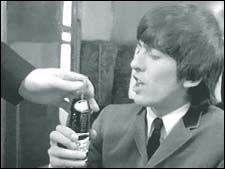
So I guess I'm not a pixel artist. Which means I still don't really have a name for what I do. Maybe I should use George Harrison's paradigm:
"What do you call that haircut?"
"Arthur."
Well, I've gotten distracted, and lost the "Who Reads This Blog?" thread, but I'll get back to it.
I use a service called StatCounter, which gives all sorts of interesting information, like Keyword Analysis. Keyword Analysis tells you what people were looking for, when they found you.
Unsurprisingly, 11 of the 47 keywords tracked were "Opus 40."
After that, with 9 hits, is "blog using microsoft paint computer art." Who knew anyone made searches that specific? Using the "drill down" tool, I discover that this searcher came from Australia. There's someone in Australia who also uses Microsoft Paint for computer art, too.
Also interesting is what else you find when you google "blog using microsoft paint computer art." I'm at the top of the list, right after Microsoft. There's Tom Moody, who does some neat stuff, and who, like me, started out using MSPaintbrush, which no longer exists.
Another blog discusses pixel art, which it defines as "anything drawn in the medium of computer pixels - these are usually created one pixel at a time at small scale to reduce the time taken to create the images." Which I guess is what I do. The blog also praises "The beauty of Pixel Art [for] the clean and unique image they can create," which doesn't describe me...I go for just the opposite effect.
It also says that "Creating Pixel Art seems to be a slow process, mainly in MS Paint, drawing pixel by pixel," which is certainly true.
It also links to another site which offers a tutorial on pixel art, which is fascinating, but not at all relevant to what I do.
So I guess I'm not a pixel artist. Which means I still don't really have a name for what I do. Maybe I should use George Harrison's paradigm:
"What do you call that haircut?"
"Arthur."
Well, I've gotten distracted, and lost the "Who Reads This Blog?" thread, but I'll get back to it.
Sunday, September 17, 2006
Dylan's Frail Flowers
The hot news on the Internet concerns the question of plagiarism and Bob Dylan - the discovery by an Albuquerque disk jockey that some of the lyrics in Dylan's new album, Modern Times, appear to derive from the work of a 19th Century southern oet, Henry Timrod. I probably shouldn't label someone as obscure just because I haven't heard of him, but this log is a Molecentric world, so OK, an obscure poet.
The Greenwood Encyclopedia of American Poets and Poetry, a pretty complete reference book (and one I contributed to, but on 20th Century poets, doesn't have an entry on him and they're pretty exhaustive (and right now, I'd guess, kicking themselves for not including Timrod).
He was better known in his day. Tennyson lauded him as "the poet laureate of the Confederacy."
Anyway, here's the story:
Plagiarism? I'd be hard pressed to say yes, though it raises some interesting questions.
I've stolen larger chunks than the ones Dylan took from Timnrod to put into poems, but they weren't from other poems.
Here's one:
THE CROCODILE PEOPLE
They used to practice cannibalism, until
they went away from the river
when the colonists came. It’s said
they have some power over the crocodiles.
But since they pulled back, humans are scarce,
reptiles live in trees. Oh, you’ll still hear
the odd story – a child crunch’d, a maiden bathing
surprised by one, two, three, shuffling from the bank.
Mostly, though, things change. You lose the taste
for long pig, and make a virtue of it.
Crocodiles, neglected, no longer smile for you.
Their memory is ancient, but shallow.
The entire first stanza of that comes from a Johnny Weissmuller "Jungle Jim" movie, watched on TV one Saturday morning. I heard that line, grabbed the nearest envelope I could find, and wrote it down, knowing that it had some power over me, though I didn't know what. But that's "found poetry," finding the poetic in something that wasn't meant to be poetic. Dylan is finding the poetic in something that was meant to be poetic.
The great blues composers, like Robert Johnson and Leadbelly, borrowed all the time from earlier songs -- it was an accepted practice. I've heard Leadbelly criticized because "Goodnight Irene" was -- in the critic's view -- essentially a rewrite of a sentimental 19th century lyric. And I've seen the poem in question, not that I could find it right now. It's terrible, and "Goodnight Irene" is a masterpiece.
Christopher Ricks, author of “Dylan’s Visions of Sin,” a book I liked, saidto the NY Times,
I probably shouldn't quote from myself twice in the same blog entry, but this is maybe relevant in a different way. It's a -- not exactly a translation, because I was translating a memory of something I hadn't read in thirty years.
A PAINTER OF REALITY
‑‑adapted from the memory of a poem by
Jacques Prevert, read 30 years earlier
There's a story about a painter
of reality in the South of France
or one of those islands
like Ibiz or Majorca
where the sun's ego runs wild
and color is a riot
of civil disobedience
In front of this painter is an apple
on a white plate
on a window sill
the color the sun decreed
the painter of reality
addresses the apple sternly
orders it to reveal
its external core
But the apple spins
in its molecules
prismatic to the sun's reality
hermetic to the painter
of reality
He breaks for lunch
bread and cheese
white wine
a boiled potato
leaving the apple
to reflect on its self‑absorption
At just that time
along comes Picasso
a spectral swirl
a many‑hued presence
always where he's needed
And Picasso eats the apple
and the apple says thanks
and Picasso walks down to the ocean
leaving a shower of seeds
strewn across the plate
Prevert had the painter, and the apple, and Picasso, and the apple thanking Picasso for eating it; I'm not sure how much else. I credited him in my epigraph, but my poem was later set to music and recorded by Fred Koller (here's the song), and he didn't include the epigraph. I don't know if the frail flowers are going to be thanking Dylan, but I don't think they'll be cursing him.
The Greenwood Encyclopedia of American Poets and Poetry, a pretty complete reference book (and one I contributed to, but on 20th Century poets, doesn't have an entry on him and they're pretty exhaustive (and right now, I'd guess, kicking themselves for not including Timrod).
He was better known in his day. Tennyson lauded him as "the poet laureate of the Confederacy."
Anyway, here's the story:
While experts have not directly accused Dylan of plagiarism over the songs on his latest album, Modern Times, which is number one in the US charts, they say there appears to be little doubt that he has liberally "borrowed" from the works of the Confederate poet Henry Timrod.
For instance, the lines in his song "When the Deal Goes Down", in which Dylan sings: "More frailer than the flowers, these precious hours", bear a striking resemblance to lines contained in Timrod's "A Rhapsody of a Southern Winter Night", which reads: "A round of precious hours, Oh! Here where in that summer noon I basked, And strove, with logic frailer than the flowers." Elsewhere in the same song, Dylan sings "Where wisdom grows up in strife" - very similar to a line in Timrod's poem "Retirement", which reads: "There is a wisdom that grows up in strife."
Walter Cisco, author of a biography of the poet...said he was certain that Dylan had borrowed from the writer... "It's amazing. There is no question that is where it came from. It's too much to be a coincidence. I'm just delighted that Timrod is getting some recognition."
Plagiarism? I'd be hard pressed to say yes, though it raises some interesting questions.
I've stolen larger chunks than the ones Dylan took from Timnrod to put into poems, but they weren't from other poems.
Here's one:
THE CROCODILE PEOPLE
They used to practice cannibalism, until
they went away from the river
when the colonists came. It’s said
they have some power over the crocodiles.
But since they pulled back, humans are scarce,
reptiles live in trees. Oh, you’ll still hear
the odd story – a child crunch’d, a maiden bathing
surprised by one, two, three, shuffling from the bank.
Mostly, though, things change. You lose the taste
for long pig, and make a virtue of it.
Crocodiles, neglected, no longer smile for you.
Their memory is ancient, but shallow.
The entire first stanza of that comes from a Johnny Weissmuller "Jungle Jim" movie, watched on TV one Saturday morning. I heard that line, grabbed the nearest envelope I could find, and wrote it down, knowing that it had some power over me, though I didn't know what. But that's "found poetry," finding the poetic in something that wasn't meant to be poetic. Dylan is finding the poetic in something that was meant to be poetic.
The great blues composers, like Robert Johnson and Leadbelly, borrowed all the time from earlier songs -- it was an accepted practice. I've heard Leadbelly criticized because "Goodnight Irene" was -- in the critic's view -- essentially a rewrite of a sentimental 19th century lyric. And I've seen the poem in question, not that I could find it right now. It's terrible, and "Goodnight Irene" is a masterpiece.
Christopher Ricks, author of “Dylan’s Visions of Sin,” a book I liked, saidto the NY Times,
I may be too inclined to defend, but I do think it’s characteristic of great artists and songsters to immediately draw on their predecessors.” He added that it was atypical for popular musicians to acknowledge their influences.
Mr. Ricks said that one important distinguishing factor between plagiarism and allusion, which is common among poets and songwriters, is that “plagiarism wants you not to know the original, whereas allusion wants you to know.”
“When Eliot says, ‘No! I am not Prince Hamlet, nor was meant to be’ — to have a line ending ‘to be’ when the most famous line uttered by Hamlet is ‘to be or not to be’ — then part of the fun and illumination in the Eliot poem is that you should know it,” he said. But he added: “I don’t think Dylan is alluding to Timrod. I don’t think people can say that you’re meant to know that it’s Timrod.”
I probably shouldn't quote from myself twice in the same blog entry, but this is maybe relevant in a different way. It's a -- not exactly a translation, because I was translating a memory of something I hadn't read in thirty years.
A PAINTER OF REALITY
‑‑adapted from the memory of a poem by
Jacques Prevert, read 30 years earlier
There's a story about a painter
of reality in the South of France
or one of those islands
like Ibiz or Majorca
where the sun's ego runs wild
and color is a riot
of civil disobedience
In front of this painter is an apple
on a white plate
on a window sill
the color the sun decreed
the painter of reality
addresses the apple sternly
orders it to reveal
its external core
But the apple spins
in its molecules
prismatic to the sun's reality
hermetic to the painter
of reality
He breaks for lunch
bread and cheese
white wine
a boiled potato
leaving the apple
to reflect on its self‑absorption
At just that time
along comes Picasso
a spectral swirl
a many‑hued presence
always where he's needed
And Picasso eats the apple
and the apple says thanks
and Picasso walks down to the ocean
leaving a shower of seeds
strewn across the plate
Prevert had the painter, and the apple, and Picasso, and the apple thanking Picasso for eating it; I'm not sure how much else. I credited him in my epigraph, but my poem was later set to music and recorded by Fred Koller (here's the song), and he didn't include the epigraph. I don't know if the frail flowers are going to be thanking Dylan, but I don't think they'll be cursing him.
Monday, September 11, 2006
Lying Still Like Stones or Wool
Here are two versions of a powerful poem by the great Chilean poet Pablo Neruda -- the first by Robert Bly, the second by Ben Belitt. I use the two translations as an exercise to discuss the potential of poetic language.
What I try to get at in class is not so much which one is better, but how Belitt and Bly have written two completely different poems, and how quickly they veer away from each other. By the end of the first line, they're already as different as night and day. Bly declares total hopelessness, total nihilism, whereas Belitt may be tired of being a man, but he holds out a hope of transcendence of his "just a man" state.
That difference is continued and magnified as the two poems continue into the second stanza. Bly wants nothing less than total annihilation -- not death, but the elimination of any connection to life or humanity -- to lie still like stones or wool. Belitt can be rejuvenated by a little vacation from things. And the mundane things that tie us to the life of human society -- Bly wants only not to see them. Belitt's not so total in his rejection -- he'd just rather not look at them.
So the violent fantasy that's Bly's only connection to life is less than that for Belitt. It's part of his vacation -- Violent Fantasyland.
Bly doesn't want to go on being sentient. For him, being alive is like being a root in the dark. The life of the senses is shivering with sleep in the moist guts of the earth.
For Belitt, that kind of sentience isn't the sum total of life, just of the kind of life that he no longer wants to have.
And finally, Bly comes to a kind of accomodation with life. He accepts total nihilism, and he can stroll serenely through it. Belitt strolls through it too, but playing it cool, still looking for an out -- that presumably, by playing it cool, one should be able to find.
So there you have it. How much more different can two poems be?
Personally, I like the uncompromising nihilism of Bly's version. My class this week was evenly divided, and there's no right or wrong choice. But mostly, I love how the comparison illustrates the subtle power of language.
Why do we have language? What's the advantage of it as a system of communication? Language allows us to distinguish between things. Written language, with its complexity, allows us to make more complex distinctions. And the language of poetry allows us to make distinctions that are at once subtle and immense.
Here is Neruda's original.
What I try to get at in class is not so much which one is better, but how Belitt and Bly have written two completely different poems, and how quickly they veer away from each other. By the end of the first line, they're already as different as night and day. Bly declares total hopelessness, total nihilism, whereas Belitt may be tired of being a man, but he holds out a hope of transcendence of his "just a man" state.
That difference is continued and magnified as the two poems continue into the second stanza. Bly wants nothing less than total annihilation -- not death, but the elimination of any connection to life or humanity -- to lie still like stones or wool. Belitt can be rejuvenated by a little vacation from things. And the mundane things that tie us to the life of human society -- Bly wants only not to see them. Belitt's not so total in his rejection -- he'd just rather not look at them.
So the violent fantasy that's Bly's only connection to life is less than that for Belitt. It's part of his vacation -- Violent Fantasyland.
Bly doesn't want to go on being sentient. For him, being alive is like being a root in the dark. The life of the senses is shivering with sleep in the moist guts of the earth.
For Belitt, that kind of sentience isn't the sum total of life, just of the kind of life that he no longer wants to have.
And finally, Bly comes to a kind of accomodation with life. He accepts total nihilism, and he can stroll serenely through it. Belitt strolls through it too, but playing it cool, still looking for an out -- that presumably, by playing it cool, one should be able to find.
So there you have it. How much more different can two poems be?
Personally, I like the uncompromising nihilism of Bly's version. My class this week was evenly divided, and there's no right or wrong choice. But mostly, I love how the comparison illustrates the subtle power of language.
Why do we have language? What's the advantage of it as a system of communication? Language allows us to distinguish between things. Written language, with its complexity, allows us to make more complex distinctions. And the language of poetry allows us to make distinctions that are at once subtle and immense.
Here is Neruda's original.
Saturday, September 09, 2006
I Still Love Baseball
I'm just trying out creating a link to an mp3 file, which is not exactly complicated code, but I'd never gotten around to doing it before.
As a Mets fan, I should be embarrassed about writing a pro-Braves song, and I am, slightly, but I did write it with an audience in mind, namely the country music audience, so I set it in the South. Anyway, I'm not embarrassed by the song, which I still like. Here it is:
As a Mets fan, I should be embarrassed about writing a pro-Braves song, and I am, slightly, but I did write it with an audience in mind, namely the country music audience, so I set it in the South. Anyway, I'm not embarrassed by the song, which I still like. Here it is:
I Still Love Baseball
Thursday, August 31, 2006
Two Nudes
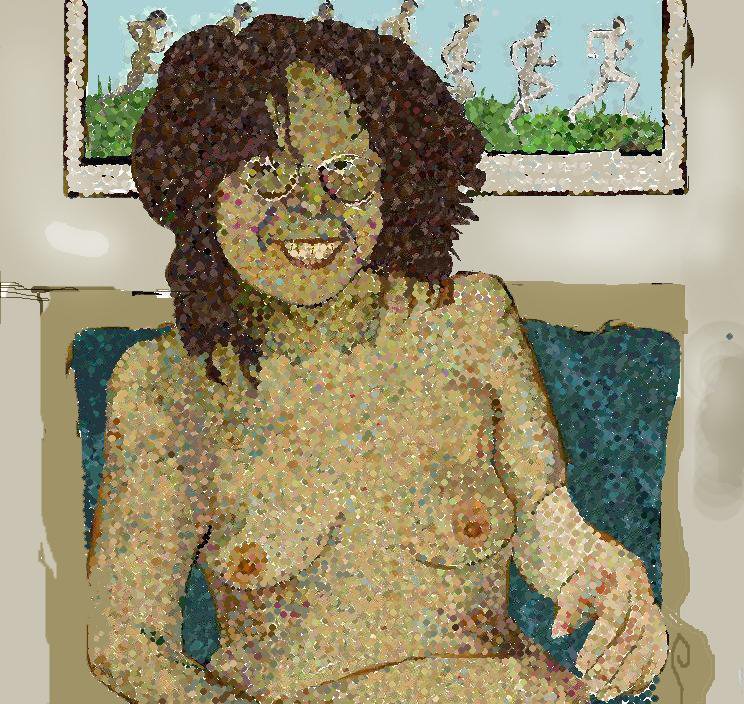
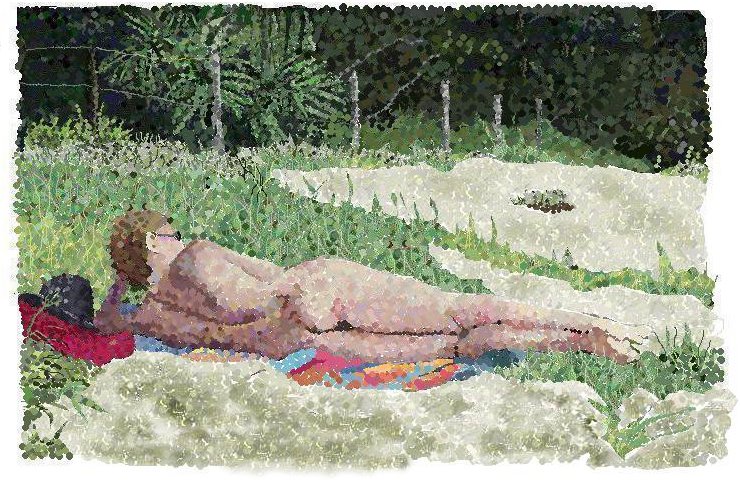
People ask me from time to time how long it takes me to complete one of these pointillist pieces, so I've started noting when I start and when I finish them. "Nude on Chair With Muybridge Figures" took close to four weeks; "Nude on Blanket With Sand," amazingly, only one week, but I was working pretty intently. Because of the way I do these -- working in Microsoft Paint, and building in the color deterioration that happens in Paint -- I always do two paintings at a time, because in order to get the full effect of the color breakdown, I have to constantly save and reopen an image. That's why the pointillism -- I work in dots of color which will break down as long as there's empty space around them, then build in more and more dots until they finally come together in an area of color. I've been working on a large and complex one, and I finished the Muybridge nude in the middle of it, so I had to start another, and the nude in the sand got the call. She's now finished too, and I still have a little more to do on the other picture. So, yes, I've started a new one.
Newsweek
I had no idea this was online -- it's last year's Newsweek article on the Hudson Valley, and if anyone is interested, you can check out my photo credit in Newsweek.
Saturday, August 26, 2006
Naming things
An article by Kandy Harris in the Saugerties Times quotes me -- correctly -- as using Microsoft Paint 'to create something he calls - with tongue firmly planted in cheek - '21st century pointillism.'" (She also slightly misreprents me in saying "Richards claims he is the only artist working in the genre," a claim I would never make. I think I said I was the only artist that I knew of working with Microsoft Paint in just this way. There are many artists doing interesting work "painting" with graphics programs, and you can see some of them at Don Archer's Museum of Computer Art. But this is a quibble with a very good article.)
Anyway, I digress. My point was the firmly-in-cheek tongue placing for "21st century pointillism," a term offered to me by James Cox of the James Cox Gallery -- thanks, Jim. I present the label with tongue firmly planted in cheek, but not the art. I take what I do seriously, even though I'm a little shy about labeling it seriously.
My stepfather, Harvey Fite, had the same problem, of course. His line in the sand came even earlier -- he didn't just resist categorizing his great masterwork, even resisted naming it. For years he called it "High Woods," after his beloved community where he had chosen to settle and create. As it started growing in reputation, people started looking for a name. The brilliant photographer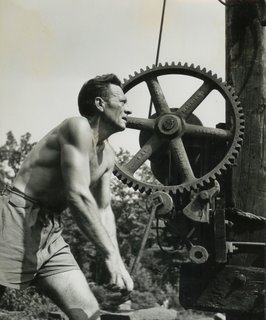
Maria Layacona, did an article on Harvey in the early Fifties, and called it "Fite's Acropolis in the Catskills" (photos by Maria included here).
Harvey was honored, but a little embarrassed, and eventually he realized he was going to have to give his work a name.
"Composers have it easy," he would joke. "They don't have to name things, they just number them -- Opus 1, Opus 2, and so forth." From the joking came a name -- Opus 40. Not Harvey's fortieth work, but forty years of work.
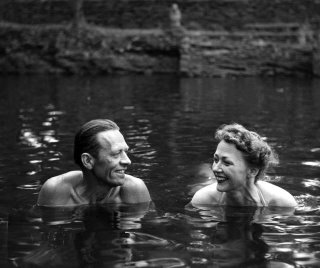
As for "environmental sculpture," "earthwork," or similar genre-defining names, Harvey never considered them. In subsequent years, it's occurred to me that Harvey was working within two artistic concepts that didn't have names while he was doing the work, but have acquired names since. One, of course, is "environmentalism." Harvey was very much aware of nature as Opus 40 developed under his hands": the lines of the mountain that became its backdrop, natural pools, trees. He was aware that the quarrymen who were his High Woods forefathers had carved a life and a living out of the native bluestone, but they had not left nature the way they found it. And with respect for them, but also respect for nature, he set out to make amends to nature for what human beings had inflicted on her.
The second name that Harvey never heard or used was "multiculturalism." But Opus 40, the first glimmerings of which stirred in Harvey during his residency in Copan, contains within it Harvey's sweeping love for, and awareness of, so many sculptural traditions.
How much are we limited by naming what we do? In many ways not much, and all too often artists who say "my work resists category" mean, whether they know it or not, "my work is too formless and uninteresting to have a category." Certainly "landscape," or "sonnet," or "concerto" don't limit an artist in any important way, and they do give him or the boundary and structure that art needs. Even Opus 40, which really is sui generis, can be categorized as "dry key stone masonry" or probably even "environmental sculpture," though it wasn't a current phrase during Harvey's lifetime.
Other labels are more problematic. The Beats mostly chafed against being called Beats. Pound founded Imagism and then disavowed it. The Impressionists exhibited together because no one else would have them, but I don't think they thought of themselves as having a clubhouse and a secret handshake.
So what's wrong with "21st Century Pointillism"? Maybe the same thing that's wrong with "claims he is the only artist working in the genre." Too self-aggrandizing? A lot of poets, myself included, are nervous about calling themselves "poets." "Poet" is something we aspire to be, something that Keats and Dante were.
Anyway, I digress. My point was the firmly-in-cheek tongue placing for "21st century pointillism," a term offered to me by James Cox of the James Cox Gallery -- thanks, Jim. I present the label with tongue firmly planted in cheek, but not the art. I take what I do seriously, even though I'm a little shy about labeling it seriously.
My stepfather, Harvey Fite, had the same problem, of course. His line in the sand came even earlier -- he didn't just resist categorizing his great masterwork, even resisted naming it. For years he called it "High Woods," after his beloved community where he had chosen to settle and create. As it started growing in reputation, people started looking for a name. The brilliant photographer
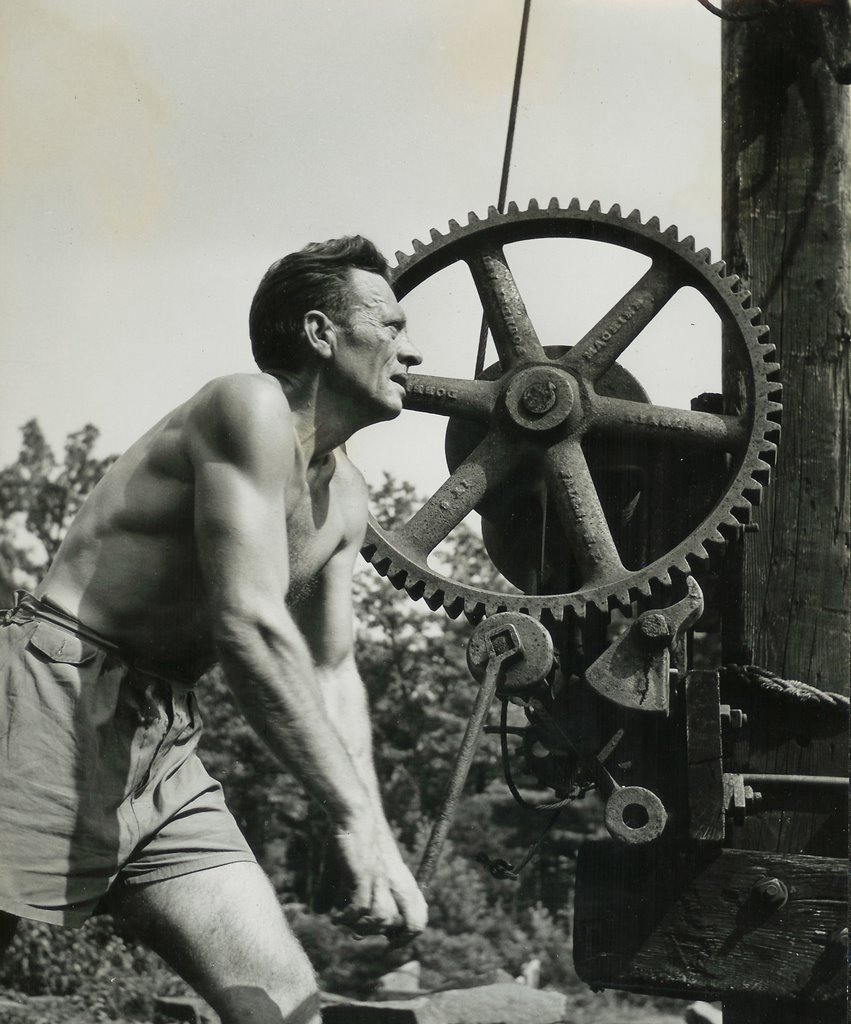
Maria Layacona, did an article on Harvey in the early Fifties, and called it "Fite's Acropolis in the Catskills" (photos by Maria included here).
Harvey was honored, but a little embarrassed, and eventually he realized he was going to have to give his work a name.
"Composers have it easy," he would joke. "They don't have to name things, they just number them -- Opus 1, Opus 2, and so forth." From the joking came a name -- Opus 40. Not Harvey's fortieth work, but forty years of work.
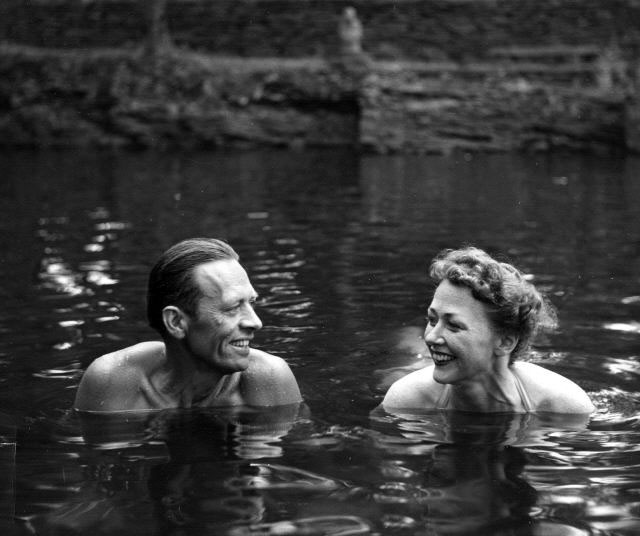
As for "environmental sculpture," "earthwork," or similar genre-defining names, Harvey never considered them. In subsequent years, it's occurred to me that Harvey was working within two artistic concepts that didn't have names while he was doing the work, but have acquired names since. One, of course, is "environmentalism." Harvey was very much aware of nature as Opus 40 developed under his hands": the lines of the mountain that became its backdrop, natural pools, trees. He was aware that the quarrymen who were his High Woods forefathers had carved a life and a living out of the native bluestone, but they had not left nature the way they found it. And with respect for them, but also respect for nature, he set out to make amends to nature for what human beings had inflicted on her.
The second name that Harvey never heard or used was "multiculturalism." But Opus 40, the first glimmerings of which stirred in Harvey during his residency in Copan, contains within it Harvey's sweeping love for, and awareness of, so many sculptural traditions.
How much are we limited by naming what we do? In many ways not much, and all too often artists who say "my work resists category" mean, whether they know it or not, "my work is too formless and uninteresting to have a category." Certainly "landscape," or "sonnet," or "concerto" don't limit an artist in any important way, and they do give him or the boundary and structure that art needs. Even Opus 40, which really is sui generis, can be categorized as "dry key stone masonry" or probably even "environmental sculpture," though it wasn't a current phrase during Harvey's lifetime.
Other labels are more problematic. The Beats mostly chafed against being called Beats. Pound founded Imagism and then disavowed it. The Impressionists exhibited together because no one else would have them, but I don't think they thought of themselves as having a clubhouse and a secret handshake.
So what's wrong with "21st Century Pointillism"? Maybe the same thing that's wrong with "claims he is the only artist working in the genre." Too self-aggrandizing? A lot of poets, myself included, are nervous about calling themselves "poets." "Poet" is something we aspire to be, something that Keats and Dante were.
Tuesday, August 22, 2006
Poetry's Rat Pack
I was thinking, for no traceable reason, of the Rat Pack, and particularly of Sammy Davis, Jr's version of "Mr Bojangles," which is not the most satisfying version of that song, because Sammy puts that hard shell on everything he sings--he marches Mr. Bojangles out to the exercise yard and orders him to dance, which is not really what the song calls for. Jerry Jeff Walker sits quietly in that drunk tank with the old dancer, lets him wake up and get his bearings, and then asks, Please...
Sammy sings with that authority that's imposed on a song. Frank, on the other hand, has an authority that's just there...he never has to show it. I'm not sure I'm saying one way is better than the other, but since Frank was the greatest pop singer of all, I suppose I am. Dean doesn't concern himself with authority at all; he's an egalitarian sort of guy, as he approaches a song.
Wondering how much further I could stretch this, I considered the some of the other ballad singers of the era. Elvis, who at his best approached a song more as a supplicant than an authority. Johnny Mathis, who pretends to supplicate, but actually holds the whip hand -- the Uriah Heep of singers, without the whininess.
We look to find and establish a voice in whatever art form we practice, and this issue of relationship to the material is part of that establishment of voice. I wonder if one could look at poets the same way? Frost our Frank, Stevens our Sammy, Williams our Dean?
Sammy sings with that authority that's imposed on a song. Frank, on the other hand, has an authority that's just there...he never has to show it. I'm not sure I'm saying one way is better than the other, but since Frank was the greatest pop singer of all, I suppose I am. Dean doesn't concern himself with authority at all; he's an egalitarian sort of guy, as he approaches a song.
Wondering how much further I could stretch this, I considered the some of the other ballad singers of the era. Elvis, who at his best approached a song more as a supplicant than an authority. Johnny Mathis, who pretends to supplicate, but actually holds the whip hand -- the Uriah Heep of singers, without the whininess.
We look to find and establish a voice in whatever art form we practice, and this issue of relationship to the material is part of that establishment of voice. I wonder if one could look at poets the same way? Frost our Frank, Stevens our Sammy, Williams our Dean?
Friday, August 18, 2006
Some heartfelt thanks
To those Opus 40 members who have responded to our recent membership renewal request by upgrading their memberships, sending us more than they have in the past. I can't tell you how much we appreciate this.
Sunday, August 13, 2006
Who's That Nude?
This weekend, the Saugerties Artists’ Studio Tour, in which I have been a participant fpr the last three years.
A comment from one studio tourist: “I don’t like nudes as a rule, but I do like these.”
It’s always nice to have someone like your work, and you probably shouldn’t question why, but it’s hard not to theorize a little, so I started wondering what sets my nudes apart from others.
I know that when I work in graphic arts, I feel it as a total break from writing. I don’t think with words; I don’t think about theme or symbol; I give myself up completely to eye and hand.

But I wonder if that’s as true as I’ve always assumed it was. Maybe my nudes are, to some extent, a writer’s nudes, in that I’m always, to some degree, creating character. I suspect the same is true with my animals.

I work mostly from photographs. I don’t necessarily follow the photographs literally, and sometimes I’ll grab images from more than one source. But I don’t have much in the way of a visual memory. I can’t remember exactly how a head fits on a neck if I’m not looking right at it, or how an arm hangs at someone’s side. I don’t remember what color people’s eyes are, or how someone’s hairline looks. And because, at least with the pointillist works, I spend a lot of time on each image, it would be wildly costly to work from a model.
Besides, while there are things you can get from a live model that you could never get from a photograph – depth, real color, and, well, life – there are things you can get from a photograph that you won’t necessarily get from a live model. A photograph is a moment in time, and sometimes that moment will reveal something unexpected.
I probably shouldn’t admit this, but I get a lot of my models by surfing those Internet sites where people post nude pictures of their wives and girlfriends. They work for me because they’re bad photographs, so I don’t have to work through someone else’s aesthetic vision, and because sometimes they’ll reveal something unexpected. You might have to look through a hundred pictures, which is a lot less fun than it sounds like, to find that unexpected revelation. But they’re there, and you know them when you see them.
A comment from one studio tourist: “I don’t like nudes as a rule, but I do like these.”
It’s always nice to have someone like your work, and you probably shouldn’t question why, but it’s hard not to theorize a little, so I started wondering what sets my nudes apart from others.
I know that when I work in graphic arts, I feel it as a total break from writing. I don’t think with words; I don’t think about theme or symbol; I give myself up completely to eye and hand.

But I wonder if that’s as true as I’ve always assumed it was. Maybe my nudes are, to some extent, a writer’s nudes, in that I’m always, to some degree, creating character. I suspect the same is true with my animals.
I work mostly from photographs. I don’t necessarily follow the photographs literally, and sometimes I’ll grab images from more than one source. But I don’t have much in the way of a visual memory. I can’t remember exactly how a head fits on a neck if I’m not looking right at it, or how an arm hangs at someone’s side. I don’t remember what color people’s eyes are, or how someone’s hairline looks. And because, at least with the pointillist works, I spend a lot of time on each image, it would be wildly costly to work from a model.
Besides, while there are things you can get from a live model that you could never get from a photograph – depth, real color, and, well, life – there are things you can get from a photograph that you won’t necessarily get from a live model. A photograph is a moment in time, and sometimes that moment will reveal something unexpected.
I probably shouldn’t admit this, but I get a lot of my models by surfing those Internet sites where people post nude pictures of their wives and girlfriends. They work for me because they’re bad photographs, so I don’t have to work through someone else’s aesthetic vision, and because sometimes they’ll reveal something unexpected. You might have to look through a hundred pictures, which is a lot less fun than it sounds like, to find that unexpected revelation. But they’re there, and you know them when you see them.
Saturday, August 12, 2006
Art and Perception
A story that’s always interested me comes from early Woodstock history, and the effect that growing success and reputation had on the band of brothers and sisters who came to the Maverick to follow their dreams. Some of that success came during the 1930s, the WPA Artists Project years, and with success came friction, most notably in the nationwide competition for commission to paint a mural at the Rincon Annex Post Office in San Francisco. As fate would have it, the finalists for the competition were two Woodstock artists, Anton Refregier and Wendell Jones. And Refregier was ultimately chosen to paint the mural.
Ironically, I can’t find a link to Ref’s mural online, but Wendy Jones’s studies can be found here,
The competition caused some serious rents in the Woodstock community, and the destruction of friendships. Many thought that Wendy Jones should have won, and that Ref’s work was more facile, less profound.
I don’t want to comment on that. I held both men in the deepest regard, personally and professionally. Wendy died when I was still a teenager, but his sons were my best friends, and his surviving son, Peter, remains my oldest and closest friend. Ref was a mentor and role model to me; he influenced me profoundly.
But I’ve been thinking recently about the assignation of roles to them: Wendy the depth and nuance, Ref the flash and commercialism. Was this real? Did Ref win the competition because his work was flashier and more commercial?
Or is his work seen as flashier and more commercial because he won?
Did winning competitions and commissions turn Ref into an artist who began to play it safe? And if Wendy had won this hugely prestigious commission, and Ref had lost it, would Wendy have been the one to start to play it safe?
I don’t believe any of this. But I believe the perception exists, and not just in this long-forgotten example. I don’t believe Ref’s burning artistic integrity was compromised by success, and I don’t believe Wendy’s would have been (he did enjoy success and prestige during his career). But I suspect that although the work would not have changed, the perception would have—that Wendy would have been categorized as the facile one, Ref the unjustly overlooked soulful one. And none of this perception would have had anything to do with art.
Ironically, I can’t find a link to Ref’s mural online, but Wendy Jones’s studies can be found here,
The competition caused some serious rents in the Woodstock community, and the destruction of friendships. Many thought that Wendy Jones should have won, and that Ref’s work was more facile, less profound.
I don’t want to comment on that. I held both men in the deepest regard, personally and professionally. Wendy died when I was still a teenager, but his sons were my best friends, and his surviving son, Peter, remains my oldest and closest friend. Ref was a mentor and role model to me; he influenced me profoundly.
But I’ve been thinking recently about the assignation of roles to them: Wendy the depth and nuance, Ref the flash and commercialism. Was this real? Did Ref win the competition because his work was flashier and more commercial?
Or is his work seen as flashier and more commercial because he won?
Did winning competitions and commissions turn Ref into an artist who began to play it safe? And if Wendy had won this hugely prestigious commission, and Ref had lost it, would Wendy have been the one to start to play it safe?
I don’t believe any of this. But I believe the perception exists, and not just in this long-forgotten example. I don’t believe Ref’s burning artistic integrity was compromised by success, and I don’t believe Wendy’s would have been (he did enjoy success and prestige during his career). But I suspect that although the work would not have changed, the perception would have—that Wendy would have been categorized as the facile one, Ref the unjustly overlooked soulful one. And none of this perception would have had anything to do with art.
Thursday, August 10, 2006
Harvey at St. Stephens
Helene Teiger, an archivist at Bard College, informs me that she has located a St. Stephens yearbook -- "amazing," she says, "since we only have a few
(Bard/St. Stephen's never seems to have produced many of these)." She passes on information about Harvey that I never knew: "Apparently, he was in a fraternity, and played la crosse."
(Bard/St. Stephen's never seems to have produced many of these)." She passes on information about Harvey that I never knew: "Apparently, he was in a fraternity, and played la crosse."
Thursday, June 29, 2006
Grumman taxonomy update
My previous note referencing June 2 was wrong -- it should be June 1. Here's the exact link.
Yahoo spyware
If, like me, you made the mistake of installing Yahoo Messenger version 7.5, and suddenly discovered that it made Yahoo your default search engine, there's a way of fixing it, but it's not easy. You can find the solution at the Simple Thoughts blog, but their solution didn't do the whole job for me. Nick Jones figured out the rest of it, and I added his solution to the "comments" section, so read all the way down.
Sunday, June 25, 2006
Carved Sculpture
It was brought to my attention recently that I don't have any examples of Harvey's carved work, either here or on the website. So here are a couple, and I'll be adding them to the website too. These are both stone -- I'll be posting some of the work in wood as well.
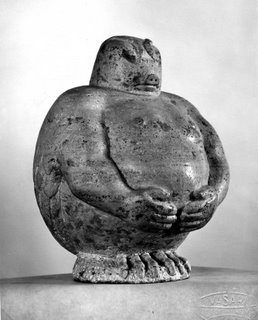 Gluttony, 12"x9"x9", travertine. We're not sure of the dates of any of these. A guess on this would be late 40s-early 50s.
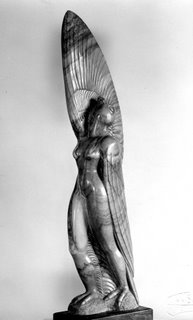 Megalomania, 30.5"x7"x4", marble. I'd place this one in the early 50s, possibly carved in 1950 when Harvey and Barbara spent a year in Rome.
Both of these are in my collection, in the house at Opus 40.
Thanks to Cindy Bell for cataloging all the carved pieces we have records of.
 Gluttony, 12"x9"x9", travertine. We're not sure of the dates of any of these. A guess on this would be late 40s-early 50s.
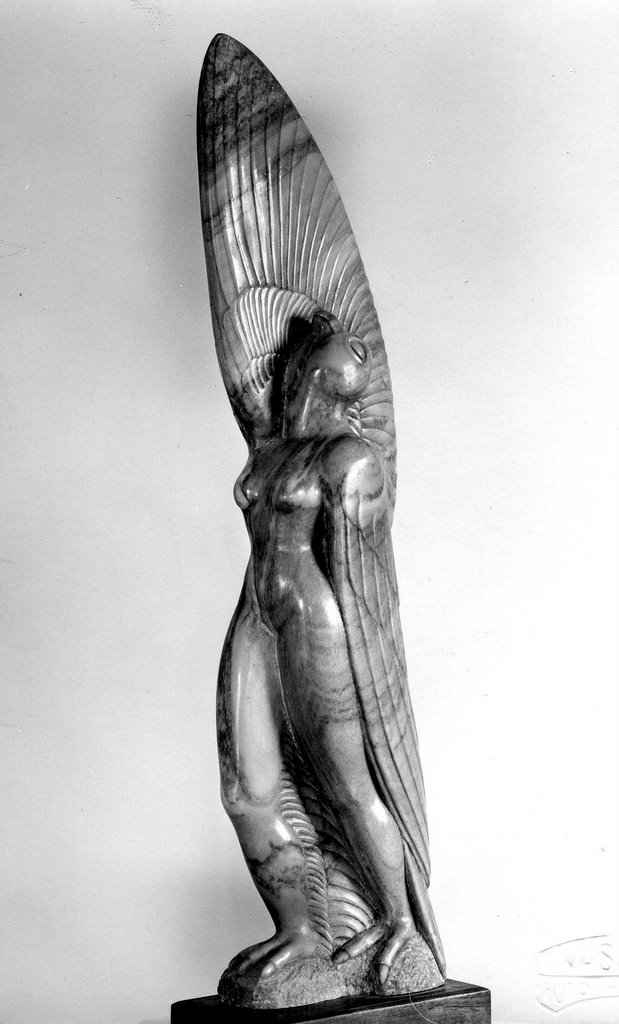 Megalomania, 30.5"x7"x4", marble. I'd place this one in the early 50s, possibly carved in 1950 when Harvey and Barbara spent a year in Rome.
Both of these are in my collection, in the house at Opus 40.
Thanks to Cindy Bell for cataloging all the carved pieces we have records of.
Friday, June 23, 2006
Opus 40 in the News
More press coverage of Opus 40. Boston.com, which incorporates the Boston Globe and other media, has picked up the New York Times story. And in this week's Woodstock and Saugerties Times, a very nice article by Paul Smart, about the tribute to Harvey Fite which was held here last week, organized by Lyn Thoman.
Friday, June 02, 2006
Richards Pushes Grumman's Taxonomy to the Breaking Point
Bob Grumman makes his long-awaited exigesis of my hay(na)ku today (well, that link will work if you read it today; otherwise go to his archives and check for June 2), after first wondering
But he stays with it, and Grumman as theorist is always weird and interesting. So I recommend it. I think.
why I don't just junk my taxonomy on the grounds that it must be worthless if it has any problem with an obvious poem like Richards's piece.
But he stays with it, and Grumman as theorist is always weird and interesting. So I recommend it. I think.
A Patrician Baritone
We're in the New York Times today. A very good article, with the odd sidelight that I am described as someone
who speaks in a patrician baritone and resembles a stockier, long-haired George Plimpton.
Subscribe to:
Posts (Atom)