Sunday, October 19, 2014

Listening to Prestige Records Part 43a: Lee Konitz with Miles Davis


The guy in the bar in Harlem, or 18th and Vine in Kansas City, putting his nickels into a jukebox, was most likely going to be playing Amos Milburn or Louis Jordan – or the Ink Spots or Nat “King” Cole or Mr. B. if his tastes ran smoother – but there’d be nickels for Sonny Stitt and Gene Ammons, too.  Jazz was no longer America’s popular music, but it was hip, and it was hot, and once you got used to the rapid tempi and counterintuitive melodic twists (as Chuck Berry was to put it a few years later, “I have no kick against modern jazz / Except they try to play it too darn fast / And change the beauty of the melody / Until it sounds just like a symphony”), it sounded good. And today, to the jazz lover at least, that music is mainstream. It remains fresh and inventive, but it’s familiar, just like home.

On those same jukeboxes, very  few nickels would summon up Lee Konitz and Miles Davis. Over sixty years later, this music still presents a challenge to the ears.

Don’t forget, while the Birth of the Cool recordings had been made two years earlier, they didn’t get widely heard until Capitol released the album in 1958, and even then the music sounded advanced. Don’t forget that Miles was not able to keep his nonet together, to get more club dates or recording sessions, because their gig at the Royal Roost was not a big draw.

And this session, with Lee Konitz and the Lennie Tristano gang (Sal Mosca playing the Tristano role), is actually even harder to listen to than Birth of the Cool, which itself sounds mainstream these days. Possibly the difference is no Gerry Mulligan arrangements. Possibly Davis and Konitz, stung by the rejection of what is now generally regarded as their masterpiece, decided to go for an even more intensely challenging experience.

In any case, one has to be fairly certain that Bob Weinstock knew he was not getting a Gene Ammons jukebox toe-tapper when he brought these guys into the studio, so more credit to him. Anyway, if Weinstock had been looking to make money more than he was looking to make jazz, he would have been out signing up the next Amos Milburn, or maybe some of these new vocal harmony groups like the Orioles or the Clovers.Or maybe it came to him in a dream that Miles was shortly to form a quintet with John Coltrane and make music that was advanced and intoxicatingly listenable all at the same time.


Digressing once again, and back to the jazz and race topic I’d been addressing in a couple of these blog entries, I was thinking about my first experience hearing jazz in a club – the Donald Byrd-Pepper Adams Quintet at Small’s Paradise in Harlem --  and I started wondering how many other jazz ensembles had been co-led interracially. J. J. and Kai were the first that came to mind. The Thad Jones-Mel Lewis Orchestra. The Clarke-Boland Big Band, if one extends the search to France. And those were all I could think of. Certainly there has never been a shortage, at least since Benny Goodman broke the color barrier, of groups made up of both black and white musicians, but not many, that I could come up with at least, with a black-white co-leadership.*

This one is under the nominal label of Lee Konitz Sextet, so maybe it shouldn’t count either, but certainly Miles is a coequal partner. The tracks from this session have also been released, at varying times, under the Davis name, and allmusic.com lists it as the Miles Davis / Lee Konitz Sextet. In fact, Konitz and Davis collaborated a lot -- the 1948 nonet sessions are sometimes listed as the Miles Davis/Lee Konitz Nonet, and they also recorded some sides in '48 as the Lee Konitz/Miles Davis Quintet. 

Anyway, the music. On my blog entry for the January 17 Miles Davis Sextet, I noted that it seemed to me that Miles, although playing on an essentially bebop-oriented session, he was introducing something different, something more from the “Birth of the Cool” tonality. I wasn’t exactly sure how to describe that, and I’m still not, but I found this master’s thesis  online, from Leonardo Camacho Bernal, a student at the University of North Texas (noted for its jazz program). I learned a lot from reading it, and I  plan to go back and read more of it. It’s called MilesDavis: The Road to Modal Jazz, and it traces the development of the sound that would come to fruition on the Kind of Blue album. Here’s what Bernal has to say about Birth of the Cool:


 At the end of the 1940s, the Miles Davis nonet unified all the experimental approaches in the 1949-50 recording sessions that later became the album Birth of the Cool (1954). Davis brought together some of the most talented and vanguard jazz musicians, such as Gil Evans,Gerry Mulligan, John Lewis, and Lee Konitz, to create the new style.

Most of the bases of the cool style were not common in jazz small ensembles: the
classical Western music influence; the instrumentation and orchestration; the fusing of variedtones of the instruments. The influence of classical composers such as Stravinsky and Debussy helped Evans, Mulligan and Lewis, arrangers on this project, to create that sound density and color richness in their arrangements that started to be identified as the sound of the cool style.

Moreover, all the musicians who performed in this project had their particular and personalfeatures, which were extremely important to the creation of a new jazz style. Each had his own tone color, articulation, rhythm, and an individual approach to improvisation. Their playing also featured the plain sound with no vibrato, smoother timbre, and dry tone. Most of the players had been formed by Thornhill’s and Herman’s bands, and had been influenced by musicians like Young and Tristano, which gave them the perfect tools to start a new style.

On the other hand, Miles Davis came from the best of the bebop school. After being in
New York for a while, he started working with Parker’s quintet where he was playing trumpetwith some of the masterminds that created and developed bebop: the alto saxophonist Charlie Parker and the trumpeter Dizzy Gillespie. They taught him how to approach the virtuosic features of the style. At the same time, Davis was jamming and hanging out with musicians such as Evans, Mulligan, and George Russell, a theorist and composer who started introducing Davis to classical Western music. At that time, Davis’s project was the best approximation of cool style. “Davis’s nonet was originally seen as the smallest unit capable of reproducing the flavor of Thornhill’s big band of the mid-1940s,” according to Mark Gridley. This was the starting point for Davis to pull together musicians and concepts to create a new way to play jazz in his quest for new colors, textures, and a new sound.

So, we're not at the modal point yet -- that's still a few years away -- but we're starting out on the road to it, with a way of combining sounds that's new and groundbreaking, with Miles's unique and visionary approach to music -- he's not quite 25 at this point, but that's well past prodigy age and into his mature period as a jazzman -- and the influence of Gil Evans, of Lennie Tristano, and of the composer of two of the tunes recorded on this session, George Russell.

Russell composed "Odjenar" and "Ezz-Thetic," the latter of which became one of Konitz/s signature
pieces. Konitz composed "Hi-Beck," and the fourth song, "Yesterdays" (Max Roach sitting this one out) is a Jerome Kern standard.

The interplay between Konitz and Davis is intense, intricate and in a way simple, with one of them taking the sort-of-boppish melody line, and the other playing a somewhat discordant and always compelling harmony. The contributions of Tristano protege Sal Mosca and Billy Bauer are also notable.

They may not have been prime jukebox fodder, but they were released on 78 under both the Prestige and New Jazz labels, mixed in with Konitz/Bauer duo sides. Also on a 10-inch (as Lee Konitz with Miles Davis), and as part of a Prestige 7000 / New Jazz 8000-series LP (as Lee Konitz and Miles Davis).


* Afterthought -- you'd probably have to include the "Mulligan meets..." sessions - Monk. Ben Webster.

Wednesday, October 15, 2014

Listening to Prestige Records Part 42: Kenny Graham's Afro-Cubists

Well, this is a surprise. Not only someone I'd never heard of, but a musical style that I didn't know existed: British bebop. I had always thought that British jazz of this era and well beyond it was strictly neo-trad -- Johnny Dankworth, Humphrey Lyttleton, Chris Barber. But here's a guy not only playing bebop, but playing Afro-Cuban -- and doing it well. I found out a lot about him from this obituary (he died in 1997), all of it impressive -- he was commissioned, in 1960, to write a series of pieces which were performed by a group of Ellingtonians, led by Harry Carney and Paul Gonsalves.

These two cuts showcase Graham as writer and arranger. I wish he'd showcased his own tenor playing a little more -- he sounds good. And one could wish the session had been engineered a little better. Still, another unexpected pleasure from Prestige's vaults. The two songs were released on 78 under both the Prestige and New Jazz labels, and on a 10-inch showcasing Sonny Rollins and Sonny Stitt along with Graham, and titled "Mambo Jazz."

You can find a nice selection of Graham on Spotify, including the two Prestige cuts. Neither tune is on YouTube, but here's a movie score by Graham from 1960, in which he out-Mancinis Mancini.


Tuesday, October 14, 2014

Listening to Prestige Records Part 41: Sonny Stitt - Gene Ammons


Prestige must have gotten a lot of jukebox play out of Sonny Stitt and Gene Ammons to keep bringing them back into the studio, and why not? They had the bebop chops, and they had the popular touch. Nowadays, bebop and its offspring are mainstream jazz, the sounds we know and love. Back then, it was still new, still controversial, still associated with shades and berets and goatees and jokes about the square who walks up to a hipster and says "Can you tell me how to get to Carnegie Hall?" It was right around this time that Nancy,as she washed the dishes, was muttering to herself that Sluggo was driving her crazy listening to beep-bop. Just then, she dropped a huge armload of dishes on the floor, and Sluggo called out from the next room, "Hey! Play some more of that beep-bop!"

 So you had to be hip to love beep-bop, but maybe you needed a little help, too, and these guys were as hip as they come, and as good as they come, but also user-friendly. Stitt started out the end of January with his quartet, cutting three tunes, then joined Ammons and the septet for three more. He was back the next day with the quartet (Teddy Stewart replacing Blakey on drums). The first quarter session featured three ballads, one slow ("Can't We Be Friends?") and two medium tempo. "Liza" utilizes the upper register of the tenor sax,* "Friends" the middle, and "Can't Be Love" the lower register.

All are beautiful. "Can't We Be Friends," a 1929 song by Paul James and Kay Swift, is an especially beautiful melody. Kay Swift was the first woman ever to write the entire score for a Broadway musical. She was George Gershwin's protege and lover, and after his death she was chosen to complete and arrange some of his unpublished works. She also composed music for George Balanchine's first American ballet.. The lyrics to "Can't We Be Friends" were written by her husband, James Warburg, using a pseudonym so as not to embarrass his very proper banking family, and they contain one of my favorite unintentionally risque lyrics: "I thought I'd found a girl I could trust...what a bust..."

But the rich, deep tones of Stitt's saxophone on "This Can't Be Love" may the the best of a very good lot.

The second session that day, the septet session, adds weight to the speculation that these were jukebox favorites. You don't release "New Up and Down Blues" so soon after "Up and Down Blues" unless you've gotten some solid play on the first one.

The septet is essentially the same. The one new face is Chippy Outcalt on trombone, another guy about whom I can find out nothing except that he also did a stint in Dizzy Gillespie's big band. And again, goes to show that there have always been a hell of a lot of good musicians in New York who don't make the record dates, and aren't well known, but other musicians know them, and know they can call on them in a pinch. When I lived in Manhattan in the '70s, I would often walk home down Broadway from the upper West Side to my apartment on East 23rd Street, and when I passed through Times Square at two in the morning, there was always a guy playing saxophone under the marquee of of the movie theaters -- always the same one, though I forget now which one it was. And I would always stop and listen, because he was that good. And if one waited there long enough, musicians from the Broadway shows or the supper clubs or wherever there were paying gigs would stop on their way home to jam with him, because he was that good.

Larry Townsend is back on vocals again, so there must still have been a demand on the jukeboxes for Mr. B. acolytes. He's not bad, although it's a style that hasn't lasted, and he's singing two songs that didn't quite become standards. If "The Thrill of Your Kiss" was recorded by anyone else, I can't find it. The song was written by Richard Carpenter -- not the 60s songwriter with the sister, but, according to the jazz blog Jazz Portraits, " the OTHER Richard Carpenter, a noted jazz shyster, who according to James Gavin, ripped off Chet Baker so badly that Chet literally wanted to kill the man."

The next day's session is Stitt with quartet again, this time with Teddy Stewart on drums, redoing "This Can't Be Love," and one other tune. I only knew ".P.S. I Love You" from the syrupy Jimmy  Sacca and the Hilltoppers version from the mid-50s, and I confess I couldn't imagine it as the basis for a great jazz improvisation. Stitt proves me wrong.

Oddly, no luck with these on YouTube, although they have a lot of Stitt. You can find all these selections on Spotify. All of these were released on 78 by Prestige, some with songs from different sessions on the flip sides.As near as I can make out, there were two alternate pressings of Prestige 831, each using a different version of "This Can't Be Love." I have no idea which one I was listening to.

* Hold everything. The Jazzdisco information on this session may have been wrong. Ebay has the 78
of "Liza" for sale, and it's possible that the upper register of the tenor sax was in fact an alto sax -- that's the information on the label of the 78, which also lists Teddy Stewart as the drummer. On the other hand, the label from Prestige 739, also offered for sale on Ebay, has Stitt listed as playing alto on "Can't We Be Friends," where he's certainly playing tenor -- and it misspells Charles Bateman's name, so maybe there was some carelessness on the part of whoever designed the labels for Prestige.

Sunday, October 12, 2014

Listening to Prestige Records Part 40a: Roy Eldridge

Jazz musicians wintering in Sweden in 1951. My choice would be Mexico, and that's where I actually will be this January, but I guess if you're planning a January in Stockholm, not much else to do except hit the recording studio, and that's what James Moody and Roy Eldridge seem to have done. Several Moody sessions in January, none of which I can find on Spotify, and then Eldridge back again, with a different group, still including Charles Norman on piano. I wondered if he was another American expat in Sweden, so I looked him up, and it turns out only his name is non-Swedish -- changed from Karl-Erik Albert Norman. According to his Wiki page, he was Sweden's foremost boogie-woogie piano player, and he also had a sense of humor that has been compared to Victor Borge. Maybe a part of the session was spent listening to Charlie Norman's wry humor, because only two songs were cut. This time two instrumentals, Eldridge in excellent form. They were released on a Prestige 78, but not on LP -- that was reserved for EmArcy.

Listening to Prestige Records Part 40: Roy Eldridge


Back to Sweden, this time with Roy Eldridge, one of the swing era greats to still command respect in the modern era. There's a bit of an oompah feeling to the Swedish rhythm section, especially on "Echoes of Harlem," but they give Little Jazz a chance to play, and that's always worth listening to.

Once again, what was it with the jazz musicians of the 40s and nursery rhymes? Was it to prove that they were so hip that they could even make nursery rhymes sound cool? I don't know, but cleverness doesn't always stand the test of time, and this isn't just an interpolated quote from a nursery rhyme -- the whole number is Eldridge singing one nursery rhyme after another. As usual, I had my Spotify Prestige playlist on for auto trips -- you can listen to everything through a couple of times on one trip to Sam's Club and back, and usually this is perfect -- some quiet alone time for serious listening, a chance to really focus on the music, and fifteen or twenty minutes each way of sheer pleasure. But this time, after about the first three listens, I found myself skipping over "School Days."

"Saturday Night Fish Fry" is Eldridge on vocals again, this time with a great Louis Jordan novelty number, and Eldridge handles it just fine, although the trumpet solo after the vocals is really the best part. The Swedish backup vocalists do an interesting and not unpleasant job with a phonetic reading of "It was rockin'."

"The Heat's On" is back to a solid instrumental, great Little Jazz, and the best work by the Swedes. Excellent cut, and one hopes the heat was on, in Stockholm in January,

Two days later, the same group recorded two blues numbers with Eldridge in fine form both on vocals and trumpet, and one blistering instrumental cut.

 These were released on the Swedish Metronome label, and Prestige put them out on 78, concentrating on the vocals -- "School Days" was the A side of one, and "Saturday Night Fish Fry," in two parts, on both sides of the second. The two sessions were also released on a Prestige 10-inch as Roy Eldridge in Sweden, and apparently at pretty much the same time by EmArcy, Mercury's jazz label, as Roy's Got Rhythm.

 No one seems to have posted videos for any of these, but they're all on Spotify in a collection called The Heat's On.


Friday, October 10, 2014

Listening to Prestige Records Part 39: Miles Davis / Sonny Rollins

There's a reason why Ken Burns followed up his Civil War documentary with documentaries about baseball and jazz, even though he was an authority on neither subject, and he pissed off a lot of aficionados on both subjects because he made rookie mistakes, but there was a reason why he chose baseball and jazz to follow the Civil War, because his real subject was always race.

And even if your subject is purely music, as mine is, you can't talk for very long about jazz without talking about race. I put up a litle quiz on Facebook a few days ago, asking anyone interested to take a guess as to the Down Beat Readers Poll winners for 1950, the year we've just finished listening to.It was an interesting time for jazz. Bebop was solidly established, but there were still plenty of moldy figs who didn't dig it. A lot of the players we think of as titans of modern jazz were just starting to establish themselves -- or had yet to establish themselves. Anyway, the winners:

Big Band - Stan Kenton
Trumpet -- Maynard Ferguson
Alto - Charlie Parker
Tenor -- Stan Getz
Baritone-- Serge Chaloff
Trombone -- Bill Harris
Clarinet -- Buddy deFranco
Piano -- Oscar Peterson
Bass -- Eddie Safranski
Drums -- Shelley Manne
Vibes -- Terry Gibbs
Guitar -- Billy Bauer

One interesting thing about that list is how white it is. And this is not just by chance. According to the book Race Music: Black Cultures From Bebop to Hip-Hop,by Guthrie P. Ramsay, Esquire Magazine created something of a firestorm in 1943, when it began its Critics' Poll, because it made the unusual move of including black critics on its panel. Their winners included Louis Armstrong, Coleman Hawkins, Art Tatum, Billie Holiday and Cootie Williams. They had a fair selection of white winners too, but even so, they were attacked. One publication, Jazz Record, accused them of practicing reverse Jim Crow,and added that "the top men for small hot-jazz band work today are predominantly white men!" And Stan Kenton, of all people -- he who won far more polls than he probably deserved to -- complained that the 1956 Down Beat critics' poll had created "a new minority group, white jazz musicians."

The 1956 Readers' Poll was still heavily white, although Kenton was no longer winning. One example of the difference -- Critics' sax section Benny Carter, Lester Young, Harry Carney. Readers' section Paul Desmond, Stan Getz, Gerry Mulligan. No argument at all with either set of selections, but one can't help but note the difference, At least it's not the Playboy jazz poll, where Doc Severinsen regularly beat out Miles and Dizzy.

Back to January of 1951. Last I looked at the New Yorker's jazz listings in their Goings On About Town section, They only listed Eddie Condon's and Jimmy Ryan's. Now they include Birdland, but none of the other modern jazz spots like the Royal Roost. They do include the Village Vanguard,but it was not an exclusively jazz spot in those days. Their feature that week was arty-folky tenor Richard Dyer-Bennett. Birdland was featuring a Dizzy Gillespie Sextet, a Lester Young quartet, and Dinah Washington, in what their commentator described as "what may be the death throes of bebop" It's hard to figure out exactly what he meant by that, but I'm guessing this was not a forward-looking jazz savant who had heard the Miles Davis Nonet and seen the future. More likely the wishful thinking of a moldy fig who would really rather have been in the company of Jimmy Ryan or Eddie Condon, who famously said, referring to one of bebop's more adventurous chordal variations, "We don't flat our fifths -- we drink 'em."

And in the Apex Studios in New York - not Prestige's home studio - two groups, mostly the same musicians, one with Miles Davis as leader and one with Sonny Rollins.

As bebop was bopping its last throes at Birdland, Miles Davis was in the studio, doing his bit to help
it along. Now, it is not my intention to draw a series of lines in the sand -- bebop here, hard bop here, cool school here. I couldn't if I wanted to, and I wouldn't want to anyway. My belief is that the great strength of the American Century in music lay in its blurred lines. The dialog was ongoing and insistent, the voices sometimes clashing, sometimes harmonizing, but always in the family. That's why Paul Williams was able to take Bird's "Now's the Time" riff and interpret it as the rhythm and blues classic "The Hucklebuck," why Ornette Coleman would learn his trade playing rhythm and blues, why the subtle drum master of the MJQ, Connie Kay, was able to propel the rock 'n roll sessions at Atlantic Records, why Charlie Parker could play with Machito, Danny Barker could play with everyone from Eubie Blake to Charlie Parker and Garvin Bushell from Fletcher Henderson to Eric Dolphy, In this session, Rollins is playing solidly within the bebop tradition -- and so are the others, even John Lewis, who had been with Miles for Birth of the Cool and was shortly to chart his own independent course. But Miles, particularly on "Morpheus," is going very much in the direction he had started to chart with the nonet.
And this doesn't make for a mismatch. All these musicians are on the same page, albeit with sometimes different calligraphy. That's the beauty of a small group framework with strong individual soloists -- each can add a different voice. And one would be remiss not to comment on the work of  yet another important hand on Morpheus -- Roy Haynes.

Even in jazz, where the melody gets left behind quickly for the uncharted roads of improvisation, a good melody matters a whole lot. "The Blue Room" is a 1926 composition by Rodgers and Hart, most notably recorded before this by the Dorsey Brothers, Benny Goodman and Perry Como, is given a new look by Miles (no Rollins on these two cuts), and he makes it achingly beautiful on both takes. He goes back even farther in time for "Whispering," a 1920 composition by Vincent Rose (best known for "Avalon" and "Blueberry Hill"), and brings it beautifully into the modern era, too.

The last cut on the January 17th session (at Apex Studios rather than Prestige's home base, where Tom Dowd was an engineer, though it's not known if he did this session) featured Sonny Rollins as leader of a quartet with Heath and Haynes, and Miles Davis on piano. A side thought -- who else has recorded on both trumpet and piano? Mose Allison comes to mind...any others?

It seems to have just been tossed in, although it's a terrific recording. Prestige never released it as a single, but included it later on a 10-inch LP, PRLP 137, which is basically an entirely different session which we'll get to later.

The Davis tunes were released on two 78s,734 and 742; on an EP, PREP 1320, on a couple of 10-inch LPs, one a trumpet compilation and one called Miles Davis Blue Period. All of these cuts appeared later on 7000-series LPs, including "The Blue Room" on an LP called Miles Davis and John Coltrane Play Richard Rodgers.


Wednesday, October 01, 2014

Listening to Prestige Records Part 38: Gene Ammons / Sonny Stitt

Well, here's one reason why Prestige might have scheduled so many Ammons-Stitt sessions: They weren't standing still. They must have kept this septet together for a while, no easy feat in those days. 1950 was the year that both the Count Basie and Dizzy Gillespie big bands were to disband for financial reasons. The Jazz Tour Database website has them playing at Birdland on March 10, 1951.

And they kept developing the septet sound. There's no arranger listed for this date -- presumably it's either Ammons or Stitt, or both -- but the arrangements are the best I've heard, and I've been listening to a lot of this band. "Wow!" is almost all ensemble work. It is tight and adventurous."Jug" does amazing call-and-response work between the soloists and the ensemble, at that breakneck pace that only the top beboppers could handle -- and the pace is just as fast, the changes just as tricky, when the ensemble is playing. And don't forget these are Prestige sessions, so Weinstock was paying for no rehearsal time, and precious few retakes.

How do you sing bebop? Well, here's one answer, from the unnamed singer on "Around About One A.M." -- with no evidence one way or another, I'll guess it's Gene Ammons. You just sing the blues. "One A.M." is a basic 12-bar blues, sung more or less straight, but with a jazzman's edge. And it's great.

In Clint Eastwood's "Bird," Forrest Whittaker, as Charlie Parker, tells white trumpeter Red Rodney (Michael Zelniker) that when they play in the segregated South, he'll be billed as Albino Red, the World's Greatest Blues Singer. "But I don't know how to sing the blues," Rodney says. "Don't worry," Parker says with a laugh, "anyone can sing the blues."

Well, not quite. But Gene Ammons -- or whoever it is -- sings the hell out of the blues on this one, and he is most likely not a professional singer, or he'd be credited, as Larry Townsend was on the last session.

Off the subject, I don't know if Red Rodney could actually sing the blues, but to play alongside Bird he surely had to play the blues. Which brings up an interesting aside, on the place of race in jazz in the 1940s -- an era in which segregation was still very much the norm. Benny Goodman was able to break the color barrier because he had such clout in the entertainment industry at that time -but a good part of the reason why he had such clout is that he was white. White musicians like Bix Beiderbecke and Artie Shaw and Benny Goodman played jazz because they loved it, but their commercial success went way beyond the success of equally talented blacks because of their race.

For that reason -- and because blacks were often forced to clown and play the "coon show darkie"-- young African American musicians like Charlie Parker, Dizzy Gillespie, Max Roach and others found themselves drawn to playing a music that was so difficult that whites couldn't play it, and so intellectually and aesthetically challenging that it could not be associated with clowning. That having been done, Bird and others were then remarkably welcoming to whites who loved the music and wanted to play it -- and could keep up. Musicians like Al Haig, Stan Levey, Teddy Kotick and Red Rodney all played with Parker, and all played bebop, at the same time that musicians like Teddy Wilson, Lionel Hampton and Billie Holliday were being integrated into Benny Goodman's swing band.

The American Century in music is one of the greatest cultural flowerings the world has ever known -- right up there with Elizabethan drama, Renaissance painting, the Victorian novel. And it is different from all of those in its mongrel nature. There's nothing pure about American music. The blues had a baby, Muddy Waters tells us, and they called it rock and roll. The blues had lots of babies, and lots of mistresses, and lots of fathers and sons and daughters, a wild orgy of miscegenation and crossbreeding like no other artistic renaissance has ever seen. And we were there. We were so fortunate.

This time, no hits on YouTube or Grooveshark, but you can get all these cuts on Spotify, and you  should.

Tuesday, September 30, 2014

Listening to Prestige Records Part 37: Wrapping up 1950

This winds up the second year of Prestige's prestigious history. Only 20 more to go, and I'm already starting to get the feeling they're going too fast -- that's the grandparent syndrome.


 The last two albums of the year are Sonny Stitt (December 17) with Junior Mance, Gene Wright and Art Blakey, and Jimmy McPartland (December 21) with a sextet including Vic Dickenson and Marian McPartland, so they closed out the year with a rising bebop star and a tip of the hat back to an older jazz style. The McPartland sides were issued on 78 as part of Prestige's 300 series, which appears to consist entirely of four 78 RPM records, all of them by Jimmy McPartland, one session in early 1949 and the other at the end of 1950 -- apparently Bob Weinstock's entire foray into trad jazz. Neither the Stitt nor the McPartland sessions can be found on Spotify, but you can get the Stitt session on Grooveshark --"Nevertheless" and "Jeepers Creepers here  and "Cherokee" here. "Nevertheless" is not exactly a bebop staple -- this is the only recording of it by a modern jazz group that I've found -- but listening to Stitt's version, one can't help but think that maybe it should be.

Prestige was certainly starting to make its mark in 1950. The scorecard: recording sessions with Stan Getz (2), Sonny Stitt and Gene Ammons (9), Eddie "Lockjaw" Davis,  Al Haig, Chubby Jackson, Lee Konitz,  Zoot Sims (4), Wardell Gray (2, one with Dexter Gordon), Leo Parker, Dizzy Gillespie, James Moody (recorded in France, released later as a 7000-series LP), and Jimmy McPartland. 


The major labels actually had the two most important jazz releases of 1950 -- one looking ahead, the other backward. Capitol put out eight songs from the Miles Davis Birth of the Cool sessions on 78. The LP wouldn't be released until 1957, although some songs from it came out on various Capitol 10 inch LPs. Nobody realized quite how important these sessions were at the time -- Miles wasn't able to make a commercial success of his nonet, and had to disband it. However, pretty much everyone knew how important the other recording was -- the recently rediscovered originals of the Benny Goodman 1938 Carnegie Hall concert, released by Columbia as a 12-inch LP -- in fact, their first double LP set.

Charlie Parker recorded with strings.

Fats Navarro died in 1950. Thelonious Monk was arrested on drug charges, lost his cabaret card, and couldn't play again in New York for six years.

Birdland, which actually opened its doors in late December of 1949, was in its first full year of operation.

On to 1951.

Monday, September 29, 2014

Listening to Prestige Records Part 36: Sonny Stitt - Gene Ammons

1950 seems to have been the year of Sonny and Jug, and no complaints here. We're fortunate to have so much from these two guys whose different styles melded so well. Ammons is taking his turn on the baritone in the first of these two sessions. On the second, it's two tenors on "Stringin' the Jug," parts 1 and 2, then Jug alone on the last two, "A Lover is Blue" and "When I Dream of You," both of them romantic ballads in the Earl Bostic mode of R&B-tinged pop, except a lot more musically original.

The session credited to Ammons is really an Ammons session. "Stringin' the Jug," with Stitt  and Junior Mance (his first professional gig was in Ammons's band, in 1947) providing magnificent support, is pure Jug -- Ammons proving you don't have to be from Texas to blow a Texas tenor.

The septet session, with Ammons taking his turn on the baritone, has four songs: "After You've Gone," "Our Very Own," "'S Wonderful" (not on Spotify) and "To Think You've Chosen Me." The last has a vocal by Larry Townsend, about whom I can find no information. Townsend, like so many of the vocalists chosen by beboppers in the late 40s (think Kenny "Pancho" Hagood on the Birth of the Cool sessions), was from the Billy Eckstine school, and that was style that was going to prove to fade from fashion very soon. The rich, mellifluous baritone gave way, as the voice of male sex appeal, to the soulful tenor, as epitomized by Sam Cooke. That's why you can find next to nothing (well, nothing, actually) about a middle-of-the-pack Mr. B like Larry Townsend, and relatively easy to find information on a middle-of-the-pack rhythm and blues singer like Larry Darnell.

But why reach out to singers like Townsend and Hagood? There were other vocalists around in the late 40s who were more attuned to the bebop idiom. Dave Lambert was one -- he was one of the pioneers in the development of a style of singing that used bebop chord changes and inversions. Sarah Vaughan was the quintessential bebop singer -- she had a contract with Columbia in 1950, and they were trying to turn her into a pop singer, so she probably wasn't available. Jackie and Roy were already starting to make a name for themselves in the late 40s. Jackie Paris had done some major work with Charlie Parker and others, and he continued to be committed to jazz, as opposed to pop singing, which is probably why he's now considered a cult figure rather than a major singer.

The Kenton singers -- June Christy, Chris Connor, and especially Anita O'Day -- were around. Blossom Dearie had not yet moved to Paris.Dinah Washington was singing both jazz and R&B in the 40s, and in 1954 she would make one of the greatest bebop vocal albums ever, "Dinah Jams," with a band led by Clifford Brown and Clark Terry.

King Pleasure, Eddie Jefferson and Annie Ross were creating their own kind of bebop vocals, but they were all working musicians, and certainly would have stepped in to record with musicians like Stitt and Ammons if asked.

So why did beboppers choose the vocalists they chose? Or why did their producers choose them? Here's a theory -- because Mr. B, in addition to still being hugely popular, was the guy who became a kind of godfather of bebop with his mid-40s band featuring Charlie Parker and Dizzy Gillespie, so although he was never really a bebop singer, he was still closely associated with the music.

A friend of mine who was there back in the day, told me why he stopped going to Amateur Night at the Apollo in the late 40's -- "All the girls were trying to sound like Sarah, and all the boys were trying to sound like Billy Eckstine."


Saturday, September 27, 2014

Listening to Prestige Records Part 35: Dizzy Gillespie Sextet


Another rough one to find. Nothing at all on Spotify, and only one track -- "She's Gone Again" -- is available on YouTube. You can find them on iTunes, on a collection called Dizzy Gillespie 1949-50, but there's something wrong with my iTunes connection, and I can't download them. Amazon doesn't have them at all. Grooveshark does. All of which means the wrong balance between digging for the music and digging the music.

And this must have been some kind of a session. No two tracks are remotely alike. Dizzy sings on two of them, and those two songs are not remotely alike."She's Gone Again"is a robust rhythm-and-bluesy vocal that without missing a beat sails into a series of burning bebop solos by some masters you know well (Dizzy, Milt Jackson, Jimmy Heath), and some masters you may never have heard of, at least I hadn't (Jimmy Oliver). The beboppers for some reason loved nursery rhymes, and here we have the complete "One, two, buckle my shoe" as part of the lyric. "She's Gone Again" made it to YouTube as part of a collection called "The Bebop Singers," but while the instrumental part is bebop of the highest order, the vocal isn't, particularly. I'm not sure the beboppers quite knew what to do with vocals, but I'll dwell on that more in my next blog entry. Stay tuned.

The second vocal track is "Too Much Weight," and it's a pure calypso number, although I haven't yet found a pure calypso version. In fact, the only other version of it that I have found is by Mickey and Sylvia, who give it a rhythm and blues touch. Presumably they recorded it in the late 50s, when Harry Belafonte had ushered in the calypso craze, and presumably they found in on this record of Dizzy's.

The Gillespie version is rhythmically amazing. Dizzy was, of course, a pioneer of Afro-Cuban jazz, and he had long been working with Latin rhythms. The star of this song is drummer Joe Harris, another artist I was unfamiliar with, but he did a lot of work with Dizzy in the 1940s, was the drummer for the house band at the Apollo, and worked steadily through the decades. YouTube has a live Sonny Rollins date from 1959 in Sweden. And as recently as last year, in his late 80s, he was still playing. Harris is also the subject of a play, Clean Drums, by Pittsburgh playwright Joe Penny, which was originally performed with Harris playing himself, and more recently revived with Dennis Garner (Errol's nephew) playing Joe.

I'm guessing that Harris has to make the "Played with Bird" list that Peter Jones and I put together, of living musicians who played with Charlie Parker.

Jimmy Oliver, who burns up "She's Gone Again," recorded very little. He was a Philadelphia resident, and he preferred to stay in Philly, where he played with nearly everyone, but he rarely made it to New York. For this session with Dizzy, he made an exception, subbing for a young friend from the Philly jazz scene (and a musician very much influenced by Oliver at the time), who had gotten sick and couldn't make the date. The younger musician's name was John Coltrane.

The two instrumental tracks also go off in different directions -- :"Nice Work If You Can Get It" boisterous, "Thinking of You" pensive,

Prestige put out "She's Gone Again" b/w "Nice Work if You Can Get It" on a 78, and "Thinking of You" on the flip side of a Sonny Stitt 78. All four cuts were on a New Jazz LP which also featured Miles Davis and Fats Navarro, and the same album was also reissued as a Prestige 16000 series, of which there were only a handful in the early 60s. The Gillespie session was also included on Prestige (J) SLP 47   Various Artists - Early Prestige Sessions 1949/50. I can't quite figure out when it was released.


Thursday, September 25, 2014

Listening to Prestige Records Part 34: Zoot Sims Quartet

We're coming to a bit of a dark night of my Prestige soul, where I'm starting not to be able to find things. The very next session listed on Jazzdisco.org's discography is Oscar Pettiford with his Cello and Quartet, featuring Duke Ellington, Billy Strayhorn, Lloyd Trotman and Jo Jones, so I guess that means Oscar Pettiford plus a quartet. It's one of those not-really-Prestige sessions, only released on their 24000 series reissues. But I listened to it anyway, because I'd be crazy not to.

The next real Prestige session is this one with Zoot Sims. Four tracks -- "My Silent Love," "Jane-O," "Dancing in the Dark" and "Memories of You." Only "Jane-O" is on Spotify, and that's because it was included on the soundtrack of a short film called Bottle Rocket. YouTube has both "Jane-O" and "Memories of You." They're both pure delight -- Zoot at his lyrical best.

Lewis was still two years away from forming the Modern Jazz Quartet, although he was already working a lot with Ray Brown and original MJQ drummer Kenny Clarke. He does some nice but limited soloing here.


Saturday, September 20, 2014

Listening to Prestige Records Part 33: Wardell Gray - Dexter Gordon


This one really shouldn't be hard to find. Who doesn't want to hear Dexter Gordon and Wardell Gray, one of the legendary tenor sax pairings of all time, in their natural element, Los Angeles, and with a great supporting cast? But they're nowhere to be found on Spotify, and only sparsely on YouTube.

Which means no quiet listening time in my car, which is part of the reason for the delay in getting this entry up. The other part is that I've been going through a fairly painful period of writer's block, during which the only thing I could really write was this blog. Now I've broken through, at least a little, so this is competing with the writing I actually have to do.

So this is a live album, which is perhaps a first for Prestige (not sure about all their European albums). Wardell Gray did a live recording in Detroit, but it seems never to have been released. Certainly the first West Coast recording -- who knows what Weinstock's deal was on this one? -- and unquestionably an all-star session. Dexter Gordon is on board for "Jazz on Sunset," not for "Kiddo."

Sonny Criss, and especially Clark Terry, are stars in the jazz firmament, although Criss arguably never got the recognition he deserved. Jazz Profiles has an excellent appreciation of him as an "overlooked giant," including this assessment from early cohort and R&B giant Big Jay McNeely:

 Sonny Criss and I played together quite a while until I went to study with Joseph Cadaly [a first chair saxophonist at RKO Studies who taught reeds, harmony and solfège]. That’s when Sonny and I split up. He continued into progressive Jazz, and I went and studied.

When we split, he started going all up and down the Coast playing and going to Europe. But I don't know, it just didn't happen. He'd get records. People said he was great. They played his stuff. But it just didn't happen for him, and I think that kind of disturbed him. Especially when you put your whole soul and your whole life and just wrap up everything into something and it doesn't happen.

He was pioneering and when you're pioneering, it's kind of more difficult to get recognition …. You have to suffer when you're a pioneer. So that's what hap­pened, really, I think, with Sonny. He was just early.

Criss stayed on the West Coast, and West Coast jazz
was not a scene he fit into. It had moved away from bebop to the explorations of Gerry Mulligan and Dave Brubeck, the orchestrations of Henry Mancini and Andre Previn. And it was mostly white.

At the peak of his creative genius in the mid-50s, he recorded three albums for Imperial. But Imperial was mostly a rock and roll label (Fats Domino, Ricky Nelson), and secondarily a country label(SLim Whitman), and it didn't have the expertise or the inclination to do any serious marketing of modern jazz.

He did record for Prestige again, so we'll meet him again -- but much later.

In 1977, suffering from stomach cancer, he killed himself.

Jimmy Bunn, who also played piano on the famous Dexter Gordon/Wardell Gray recording of "The Chase," was arrested on drug charges, served hard time in San Quentin (where he played in the prison jazz band with Art Pepper), and was never able to restart his career.

Billy Hadnott, I find from the great rhythm and blues blog Bebop Wino, was very active on the West Coast R&B scene, playing with T-Bone Walker and Lloyd Glenn.

Chuck Thompson played in Hampton Hawes' great trio in the mid-50s.

This is wonderful music, with three great soloists (four when Gordon is added) challenging each other in the way only live recording allows. They're all individual as hell, they all surprise the listener (and, one would guess, each other) and they come together.

"Jazz on Sunset" is a reworking of Denzil Best's "Move," and "Kiddo" a version of Charlie Parker's "Scrapple from the Apple," itself deriving from a mashup of "Honeysuckle Rose" and "I Got Rhythm."

The YouTube recordings are full of surface noise, but for those of us who collected vinyl -- and collected it to play, and play again, not as an investment -- this is not really a drawback.


Here's parts one and two of "Kiddo":


And here's parts three and four of "Jazz on Sunset":


Tuesday, September 16, 2014

Listening to Prestige Records Part 32: Leo Parker

On July 20, 1950, baritone saxophonist Leo Parker went into the Prestige studios with an all-star rhythm section of Al Haig, Oscar Pettiford and Max Roach. He recorded six tunes, and came away with almost nothing. The first, "Bewitched, Bothered and Bewildered," was never released. "Mona Lisa," "Who's Mad" and "Darn That Dream" only saw the light of day in the 1970s, as part of the Fantasy/Prestige 24000 series, which was theoretically all reissues, even though in this case the initial issue never happened. We aren't counting 24000-series releases in this history, but these were originally recorded for Prestige, so they'd count. "I'll Cross My Fingers" and "Mad Lad Returns" were released as a 78 RPM single, so they would definitely count, but for one small detail. None of them are available on Spotify or YouTube, or any of the other video sites, so I wasn't able to listen to them.
Leo Parker made his first recording in 1944, at age 18, with Coleman Hawkins, on alto. After that, it was baritone all the way. Some say he abandoned the alto when he joined the legendary Billy Eckstine big band, so as not to be confused with the better-known alto player named Parker in the same organization. More likely, Eckstine needed a baritone player, handed the instrument to Leo, and said "You're it."

If that was the way it was, Eckstine made a wise decision, but Parker was not able to build the career his talent merited. The heroin scourge of the Fifties claimed him. He did make a comeback in 1961, making two albums for Blue Note -- one of which, one again, went unissued until 1986. Parker died of a heart attack in 1963, at the age of 38.

Searching Spotify for the Prestige sides, I entered "Leo Parker Darn That Dream," and came up with something that deserves a side excursion, which I was more than willing to make: a road trip to the intersection of Bebop and Rhythm and Blues Avenues, one of the neighborhoods that interest me most.
Bill Jennings made a whole series of recordings for King Records in Cincinnati in the 1950s. King was one of the great indie labels of the Fifties, recording rhythm and blues (James Brown, Wynonie Harris), country (Grandpa Jones, Cowboy Copas), and rock and roll (The 5 Keys, the "5" Royales, even the Platters' first records). Very little jazz.

And not all that many people share my enthusiasm for this first fusion music, so Bill Jennings has languished in obscurity, but you have got to listen to this stuff. It's been collected in a 2-CD set called Bill Jennings - Architect of Soul Jazz 1951-57. His band includes Leo Parker, Bill Doggett and Willis "Gator Tail" Jackson.
You can also find "Mad Lad Returns" on Spotify and YouTube, but it's from the 1961 Blue Note, not 1950 Prestige session. It's worth a listen to--talk about rhythm and blues meets bebop...and beyond. Wow.

Here's Leo Parker with Bill Jennings:

 And here's the 1961 version of "Mad Lad Returns":


Saturday, September 13, 2014

Listening to Prestige Records, Part 31: Sonny Stitt -Gene Ammons

Sonny Stitt, Gene Ammons, three-piece rhythm section...a quartet? Is this one of those odd numerical quirks, like the great R&B/Doowop group the "5" Royales, who rarely had five guys in their lineup? No, as it turns out, the June 28 session was a quartet, though not always the same quartet -- Jug on two cuts, Sonny on the rest.

Stitt's tunes: "Count Every Star," "Nice Work if You Can Get It," "There Will Never Be Another You," and "Blazin'." Ammons had two: "I Wanna Be Loved" and "I Can't Give You Anything But Love," but only the latter is included on Spotify.

Why? Lost to history. Maybe they couldn't both show up at the same time. Maybe they weren't talking to each other that day. Maybe Weinstock was only paying for four musicians at a time. Maybe each of them wanted the full length solo space. Not unlikely, listening to the tunes. Each of them solos all the way through. Stitt barely gives Duke Jordan a vamp at the beginning -- no vamp at all on "Count Every Star."

And he's quite sufficient to satisfy. Generally the bebop paradigm is play the melody for one or two choruses, then take off on improvisatory flights. As Ronny Graham says in his comedy routine about a commencement address to a school for progressive jazz musicians, "When you cats came here, all you could play was the melody. Now you wouldn't know a melody if it hit you in the mouthpiece." But Stitt stays around the melody in his improv, especially on "Count Every Star

I would have thought of "I Can't Give You Anything But Love" as more of a 1920s vo-de-o-do kind of song, more suited for a raccoon coat and ukulele (or for Cary Grant and Katharine Hepburn to sing to a leopard) than a gutbucket, blues-based bebopper like Gene Ammons. In fact, it was written in 1928, by Jimmy McHugh and Dorothy Fields, for their Broadway hit musical Blackbirds of 1928. McHugh and Fields had already made their major contribution to Prestige Records history -- they wrote the original "I'm in the Mood for Love." At any rate, Ammons takes it over and does what he wants with it -- jaunty and rakish, but in the style of 52nd Street, not Broadway.
They gathered the septet again a week later for another session -- Bill Massey again on trumpet, this time Matthew Gee on trombone.

It's hard to find much about Bill Massey, who anchored all of these septet recordings. "Bill Massey Jazz" on Google mostly brings up references to the classic Jazz at Massey Hall album, but adding to the confusion, there's another jazz musician named Bill Massey,who gets the Google hits because he's more contemporary and has a website. 

Replacing Duke Jordan on piano is Charlie Bateman. There's not much on him, either, but a 2004 obituary from the Orlando Sentinel tells us that he played with Louis Armstrong at Carnegie Hall in 1947, moved to Orlando to play bridge, and moved there permanently after the World Trade Center bombing. More on Charlie here. He does get some solo space with the septet, and the cat can play.

Stitt is listed on baritone again for this session, but we're told that both Stitt and Ammons would double on baritone in larger ensemble settings, while the other was soloing, and I think that may be happening here.

There's another vocal -- on "Sweet Jennie Lou." On this one, there's a lead vocalist, uncredited, and I can only guess as to who it is, so I'll guess Gene Ammons. The rest of them sound not so much like drunken Irishmen as like drunken Irishmen trying to imitate the Modernaires. Actually, they sound a little like Dooley Wilson's band doing the call-and-response with him in "Knock on Wood" at Rick's Cafe Americain.

Their "Seven-Eleven" is not the same as Buddy Lucas' R&B classic "7-11," with the Gone All-Stars, but it rocks. Charlie Bateman is hot on this one, as is drummer Wes Landers (another two-generation drum family -- his son was jazz/soul drummer Wally "Gator" Watson).

They did "La Vie en Rose" on this session, and I'd love to hear it, but I can't find it on Spotify. A Google search for "Gene Ammons la Vie en Rose" says that it is on Spotify, but clicking through leads to a dead end.

Songs from all these Stitt/Ammons sessions were mixed and matched on various 78s, and on several different 10-inch LPs, Surprisingly, no 45s, though you'd have thought many of these cuts would have been naturals.

There's really no such thing as a representative track from these sessions, so I'll use "Count Every Star," because I love it.


Tuesday, September 09, 2014

Listening to Prestige Records, Part 3o: Zoot Sims

Zoot Sims continued his European swing with a recording session in Paris, this one kicked ahead by the drumming of Kenny Clarke, house drummer at Minton's during the original bebop days, and a longtime Paris expat, although in 1950 he was not yet a full-time resident -- he would be back in New York in 1952 to become the original drummer for the Modern Jazz Quartet. And here's something I didn't know -- he and Annie Ross had a child, Kenny Clarke, Jr., himself now a drummer.

Anyway, Zoot Sims in Paris -- a notable session, but one that's only tangentially related to Prestige. Certainly Bob Weinstock had close relationship between Vogue Records in Paris and Metronome Records in Stockholm (I've leapfrogged over a couple of all-Swedish sessions to get to Zoot), but he
seems for some unaccountable reason to have given this session short shrift. Nine songs were cut that day -- "Night and Day," "The Big Shot," "Slinging Hash," "I Understand," "Tenorly," "Don't Worry 'Bout Me," "Crystal's," "Zoot and Zoot," and "Toots Suite." Of those, none were released on 78, 45 single, 45 EP, or 10-inch LP. Only "Night and Day"(two takes), "Slingin' Hash" (two takes), "I Understand," "Tenorly" and "Don't Worry 'Bout Me" made it to a Prestige 7000-series reissue.

But...on a couple of occasions, Edgar Villchur, the genius behind the contemporary loudspeaker, reminded me of why he did what he did, and why he didn't spend a lot of time talking about it: "I'm not a technology lover...I'm a music lover." And in this blog, I'm using a historically accurate timeline (as far as I can) as a structure for listening to a lot of good music, which is the main goal, after all. And making up the rules as I go along. I didn't include the Charlie Parker 1949 session because that was only put out on the Prestige 24000 series, long after Prestige had been sold to Fantasy and had become purely a reissue label. The Zoot Sims Paris sessions are 7000-series, which is still the real Prestige.

It's not clear what Gerald Wiggins (Gerry Wiggins on this session) was doing in Paris in 1950. A graduate of New York's Music and Art High School with classical training, he was Los Angeles-based -- he is probably the only serious jazz musician to have worked with both Stepin Fetchit and Marilyn Monroe. He wasn't touring Europe with Sims -- this is their only recording together. Best guess -- he was there with Lena Horne. He was her accompanist in 1950-51, and she made a number of European tours.

Zoot Sims was probably the second most famous of the Four Brothers. He didn't achieve the superstardom of Stan Getz, and there's no signature song that's associated with him, but he had an outstanding career over four decades, recording swing, bebop, cool jazz, backing up singers (and Jack Kerouac!), playing with virtually everybody, recording prolifically as leader and co-leader with Al Cohn, and if he ever made a bad record, I haven't heard it.


Saturday, September 06, 2014

Listening to Prestige Records, part 29: Sonny Stitt/Gene Ammons Septet

Stitt and Ammons are back in the studio with a septet, with only a few changes. Bennie Green replaces Eph Greenlea (about whom I can find no information and no more discography), and Jo Jones is replaced by the younger and more boppish Art Blakey, who makes his presence felt immediately. The biggest change, though, is Sonny Stitt switching from tenor to baritone (he'd already, in his career, switched from alto to tenor).

I've mentioned that Gerry Mulligan, in 1950, was still better known as an arranger than an instrumentalist, and he had not yet established himself as the voice on the baritone sax. You don't hear anything in Stitt's playing to suggest he'd spent much time listening to Mulligan -- rather, that he wanted to show that he could play bebop on any saxophone. The baritone also adds a richness to the ensemble parts, and according to this jazzophile:
 He had small ensemble w/ Gene Ammons during this period where they switched on baritone-- Stitt would play bari in the section when Gene played and vice-versa.

This is an odd session. The songs are "Chabootie," "Who put the sleeping pills in Rip Van Winkle's Coffee?", "Gravy (Walkin')," and "Easy Glide." The first two are the odd ones -- the long ensemble intro in "Chabootie," longer than it probably needs to be, and the vocal, if you can call it that, on "Sleeping Pills," where it sounds as though the whole band is singing along, and they're making no attempts at harmonizing or jazz styling -- they sound like a bunch of Irishmen in a pub.

If this sounds negative, it is and it isn't. My guess is that these were aimed at jukeboxes -- the Basie-style ensemble piece and the novelty vocal. Prestige probably needed some jukebox play -- I doubt that they'd had a hit since "Moody's Mood," although they'd put out some great music.

George Benson, when he was criticized by jazz purists for his pop records, maintained he was still playing jazz -- he said that if he put strong, poppish hooks at the beginning and end, he could play anything he wanted in the middle. And that's true of both of these songs.

After the ensemble choruses on "Chabootle," Stitt enters with one of Charlie Parker's signature riffs, given a new timbre on the baritone sax, and they're off from there, with some absolutely lovely solo work, and some pepper from Blakey. The same is true on "Sleeping Pills" -- the solos on that number are definitely not the work of drunken Irishmen.

What was it with beboppers and Mrs. Murphy and her overalls? Harry "the Hipster" Gibson had a huge hit (and got himself in a lot of trouble) with "Who Put the Benzedrine in Mrs. Murphy's Ovaltine?"

OK, if these were meant for the jukebox crowd, and I'm betting they were, there was some serious bet-hedging on Bob Weinstock's part. "Chabootie" was put out on 78 and 45 on the flip side of Gene Ammons playing "Blue and Sentimental," "Sleeping Pills" on 78, on the flip side of "La Vie en Rose."

I can't find any of these cuts on YouTube or any of the other video sites, but you can get them all on Spotify.

Thursday, September 04, 2014

Listening to Prestige Records, part 28: Wardell Gray

Benny Goodman was right about Wardell Gray. He was wonderful. He gets better every time I listen to him, and this session, recorded in Detroit, is a treasure -- because of the music, and because of the story behind it. There is much to say about Wardell Gray, and I'll say more as he comes up again in the Prestige story, but the story is Detroit, and the rhythm section that backed Wardell on this session, and the Bluebird Inn, where they were the house band.

J. R. Monterose was born in Detroit. So was Pepper Adams, who said of those heady days when bebop was young,
In Detroit, the standards were so high that to compete for local gigs you had to really play awful goddamn good! If you were good enough to be competitive in Detroit, you were ahead of what the rest of the world’s standards were.
And there were more. Here's Wikipedia's list of jazz musicians from Detroit (perhaps incomplete -- I know that J. R. had been omitted, so I added him:  Elvin Jones, Hank Jones, Thad Jones, Howard McGhee, Tommy Flanagan, Lucky Thompson, Louis Hayes, Barry Harris, Paul Chambers, Yusef Lateef, Marcus Belgrave, Milt Jackson, Kenny Burrell, Ron Carter, Curtis Fuller, Julius Watkins, Hugh Lawson, Frank Foster, J. R. Monterose, Doug Watkins, Sir Roland Hanna, Donald Byrd, Kenn Cox, George "Sax" Benson, Sonny Stitt, Alice Coltrane, Dorothy Ashby, Roy Brooks, Phil Ranelin, Faruq Z. Bey, Jaribu Shahid, Hakim Jami, Pepper Adams, Tani Tabal, Charles McPherson, Frank Gant, Billy Mitchell, Kirk Lightsey, Lonnie Hillyer, James Carter, Geri Allen, Ralph Armstrong, Ali Jackson Jr., Rick Margitza, Kenny Garrett, Betty Carter, Sippie Wallace, Robert Hurst, Geri Allen, Rodney Whitaker, Clarence Penn, Karriem Riggins, Harold McKinney, Ray McKinney, and Carlos McKinney.

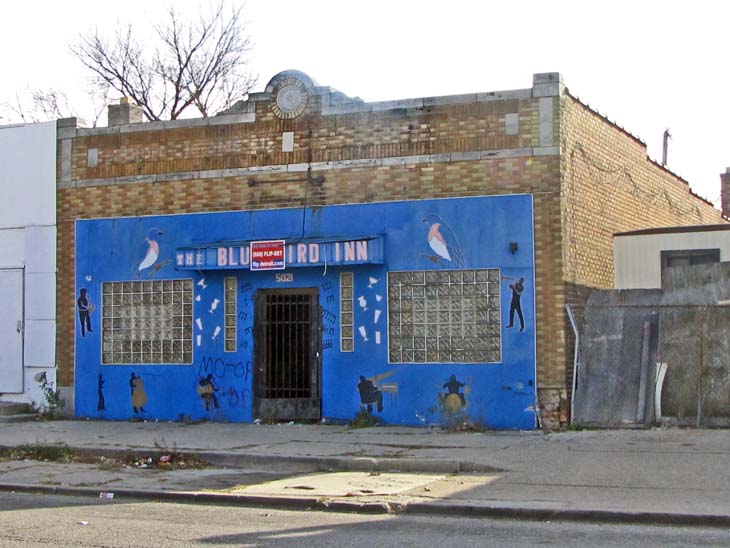
Jazz at the Blue Bird Inn in Detroit "started in 1948 when the Blue Bird hired pianist Phil Hill and told him to assemble a house band specializing in the newest thing from New York City - bebop." Here's the full story, from Lars Bjorn and Jim Gallert.

Here's a photo of the Blue Bird from 2010, with a history of the building, and a sad story at the end of it:
Use in 2010:  Vacant building ready for sale
City of Detroit Designated Historic District: Not listed
State of Michigan Registry of Historic Sites: Not listed
National Register of Historic Places: Not listed


The songs on this session are "A Sinner Kissed an Angel," "Blue-Gray," "Grayhound," and "Treadin' with Treadwell." "Treadin'" is Wardell's tribute to jazz DJ and historian Oscar Treadwell, also celebrated by Charlie Parker in "An Oscar for Treadwell" and Thelonious Monk in "Oska T."

Phil Hill is a jazz legend who seems to have almost never recorded. I can only find two listings -- this album. and a live session with Wardell Gray the previous year, which may never have been released. The bassist on the Prestige session is listed as John Richardson. On the unreleased live recording, it's James "Beans" Richardson, who has to be the Jimmy Richardson of the Blue Bird poster (subsequent house bands at the Blue Bird included Elvin Jones, Frank Foster and Yusef Lateef). I can't tell whether the John and Beans are the same person, but it seems likely -- a mistake on the Prestige session notes. In any event, here's a nice tribute to Beans by his niece. Art Mardigan played with Woody Herman, Pete Rugolo and Stan Getz after his Blue Bird days, ultimately returning to Detroit and the Detroit music scene.

Here's a nice tribute to the Blue Bird:


And here's Wardell Gray with his Detroit trio:


And this beautiful ballad:


Wednesday, September 03, 2014

Listening to Prestige Records, part 27: Zoot Sims


A few days off from Prestige blogging, mostly because no quiet solo driving time with my Jambox and my latest Prestige session. Just as well, in a way, because it gave me a little break between Stan Getz and Zoot Sims, two of the Five Brothers, and with brotherly similarities, although Getz is definitely moving farther away from the brother days.

And...back to Sweden. If it was at one time widely known that Sweden was a hotbed for bebop, that seems to have mostly faded into oblivion, but more than a couple of American musicians it became a home for several years, or even a permanent home. (And it's still happening -- my friend Billy Troianni is now a full time resident of Norway, with a Norwegian blues band.) And Prestige, through an association with the Swedish Metronome Records, reaped the benefits.

Zoot Sims made it over to Sweden in April of 1950, and did two sessions in two days, with two different groups. Spotify has four cuts from those sessions, and the Swedes and expats do a solid job of backing up Zoot.

Toots Thielemans is actually Belgian, and he was to become an important part of the American jazz scene. He didn't move to the States until 1952, but by then he had already established himself as an outstanding jazzman. His early Paris sessions included one with Charlie Parker, which means he gets added to the "Played with Bird" log that Peter Jones and I put together of still-living musicians who played with Parker. Toots is still very much with us. He announced his retirement earlier this year at age 91, but then came out of retirement again last month.

He joins Sims here for one cut, "All the Things You Are," and contributes some very neat stuff, both in playing together on the opening chorus, and later in a solo. Harmonica and tenor sax maybe shouldn't mesh, but here they do -- oddly, but they do.


 Sims also pays his homage to the master, Lester Young, with Young's composition "Tickle Toe." I went back and listened to the song by Lester and the Basie Band, and Zoot definitely takes it and makes it his own, putting it into a quartet session, and bringing it into the bebop era.


In my early days of jazz addiction, in the late Fifties, one of my first experiences of live jazz was Al Cohn and Zoot Sims with a quintet the Half Note, with my fellow Bard student Leonard Rosen, then my main man, and now back on my horizon after being AWOL for about forty years -- you'll remember this night, Lenny. Mose Allison was playing piano for Al and Zoot then, and the two of us had just fallen under the spell of Mose's first release, Back Country Suite.

Zoot knew how to play. He'd cut his teeth with the Woody Herman band, played on Stan Getz's Five Brothers session, and on Chubby Jackson's outstanding big band sessions, and this was his first outing as a leader. He had a long and impressive career ahead of him. He could swing, he could experiment, he could make you feel good about jazz.