Monday, July 14, 2014

Listening to Prestige Records Project - Part 6

Part of the springboard for starting this project was a series of conversations I'd had over time with my Peter Jones, about growing up in love with jazz in the 50s. Peter turned to jazz as an early teen. I came to it later, in college. I remember the night vividly. My dorm room in the World War II barracks that still served as dorms at Bard College then, no roommates around, a little too much to drink (probably - this was something else I'd just learned to do.) AM radio, middle of the night, those odd clear channel stations from all over. Twisting the dial, looking for some late night rhythm and blues. Suddenly hearing the sound I'd been waiting to hear all my life, without knowing it. Standing there, looking at the radio (we did that in those days) transfixed. It was John Coltrane with the Red Garland Trio -- Paul Chambers and Art Taylor. It was the first jazz record I bought, and it was on Prestige -- as were three of my first four jazz records. The other two were Mose Allison's Back Country Suite, and King Pleasure Sings - Annie Ross Sings. The outlier was Gerry Mulligan and Chet Baker on World Pacific.

That night with Trane and Red many years later became a poem, although with poetic license Trane became Miles, and I created a scene that never happened with an older brother I never had. But the poem is true to the heart of experience.


I'M NOT SO OLD

I was just fifteen when Charlie Parker died
My older brother took me aside
And said, Kid, it's a bad day
It's a sad day
Well, I didn't know why and I had to be told
Hey, but I grew up
And I learned my stuff
And I learned enough
And I'm not so old

When I was a kid just starting to move
I filled my soul with that rhythm and blues
And I listened to the Clovers
And the Coasters
And I couldn't get enough of that rock and roll
I was growing up
And the beat was mine
And it still sounds fine
And I'm not so old

Then one night I turned on the radio
Looking for some of that rock and roll
And I heard some bebop
Brought me to a full stop
Didn't know what it was but it moved my soul
I was almost grown
And they said it was Miles
I still dig his style
And I'm not so old

I saw Monk dance around the Five Spot floor
And a cat from Texas made the Five Spot roar
His sax was plastic
His sound fantastic
And I went back again to hear Ornette blow
I was all grown up
And he made jazz free
Still sounds good to me
And I'm not so old

Once they said that jazz had passed away
But I go down to hear the young cats play
They play in the tradition
They've got a mission
They play sweet and strong and free and bold
Well, I may be grown
But the cats blow on
And the music's young
And I'm not so old
Anyway, that's my particular love affair with Prestige. Shared by everyone? I'm not sure. Prestige, as I've noted before, has been somewhat the forgotten stepbrother to Blue Note. The New York Times' obituary for Bob Weinstock was a little backhanded -- " Prestige releases...weren't known for perfection. Mr. Weinstock generally set up recording sessions with no rehearsal time."

Well, perfection is overrated. And Peter Jones and I, talking about those days, have commented on what we remember as the incredible level of quality of those independent jazz labels -- it was all good.

Was it? I guess that's what I'll be finding out with this blog project. Next up, April 8, 1949, the Stan Getz Octet, including Five Brothers.

We think of the guys like Getz who became such giants in their field as having been born leading a group, playing "Desafinado" on TV, but Stan was 22 and newly graduated from the Woody Herman band, in one of his first sessions as a leader. Even at 22, he was a veteran - he'd joined the Jack Teagarden band at 16, when he was so young that Teagarden made him his ward.

An octet is big for a small jazz group, small for a big band, and this album is not big band jazz, certainly -- it's the combo format,a stated theme followed by virtuosic soloing, that was the hallmark of the bebop era. The most famous large small combo of the era -- or what came to be the most famous, since it was pretty much ahead of its time, was the Miles Davis "Birth of the Cool" nonet. Getz's octet was more straight-ahead -- I guess in the Prestige tradition of getting a bunch of guys together to blow with no rehearsal (although actually alternate takes don't seem to be so rare).

Getz was best known at this time as one of the Herman Herd's "four brothers," the four-saxophone section of Getz, Serge Chaloff, Zoot Sims and Herbie Steward -- and later Al Cohn. Sims and Cohn are the carryovers from those brothers, joined now by Alan Eager (a Herman alum but not a brother) and Brew Moore -- four tenor players, with Getz choosing baritone for this session. There's actually a sixth saxophone-playing brother involved, and this one makes them stepbrothers, in a way, to Miles' nonet -- Gerry Mulligan is listed as arranger.

I am writing this blog as a fan, as an archivist, not as a music critic or musicologist. I'm not that good. I can't tell you who's soloing when. I'd be a washout on a Leonard Feather blindfold test. In his allmusic.com bio of Brew Moore, critic Scott Yanow suggests that as a quintet of Lester Young acolytes, they all pretty much sounded the same on that session, so maybe I'm not the only one.

I can tell you that this is real Prestige jazz, the kind that makes you glad you're a jazz fan, and you get to sit still and listen to it, or snap your fingers to it, or stand still in the middle of the night and stare at whatever your contemporary equivalent to an old AM radio is. YouTube and Spotify both have this
session completely represented, including the alternate takes.
Both takes of "Battleground" were actually released on 78, one as Prestige release and the other as a New Jazz. So I was able to listen to all of it.

All the brothers were young. Al Cohn and Zoot Sims were 24,  Brew Moore was 25, Alan Eager like Getz a junior member at 22. But all were seasoned veterans. And all the brothers were valiant. Having five brothers in a small combo means succinct solos, and they make it work brilliantly. Generally a string of solos means a cutting contest. Here it's brotherly love, and wonderful cooperation to make a unified sequence.

In "Battle of the Saxes" (the only one without an alternate take) one gets the feeling that if they'd had just a little rehearsal time, they might have learned the tune, but once they start soloing, it could matter less.

With all those horns, there's not a lot of space for solos from the rhythm section, but Walter Bishop, Jr. has a few nice moments on piano. The others are Gene Ramey (bass) and Charlie Perry (drums). I wasn't at all familiar with Perry, but research reveals he's considered one of the great teachers of drumming technique, and one of his books on jazz drumming (co-authored with Jack deJohnette) is available (excerpted) online.

Saturday, July 12, 2014

Listening to Prestige Records Project - Part 5


Didn’t know Prestige had a Dixieland line? They did. Their entire 300 series of 78 RPM records was devoted to Dixieland. Of course, their entire 300 series was Prestige 301-304, and it consisted of four records by Jimmy McPartland, this session from March, 1949, and a second session September 21,1950. Both of them, appropriately, in Chicago, where Jimmy had cut his teeth as a musician, one of the


Austin High Gang of young white cats who got together to play in high school, discovered New Orleans jazz and Bix Beiderbecke, and never looked back.


Spotify doesn't have any of these sessions; YouTube has the first one, with Jmmy McPartland (cornet) Harry Lepp (trombone) Jack O'Connel (clarinet, alto saxophone) Marian Page (piano) Ben Carlton (bass) Mousie Alexander (drums). By the 1950 session, young Marian Turner, who had used the name Marian Page when she played jazz in Europe, so as not to disgrace her classical music-loving family, had taken the name of the dashing young hero of Normandy whom she had met and married in Europe when they were both playing USO shows.


"Royal Garden Blues" is a New Orleans standard written by Spencer Williams, and if traditional Dixieland was getting a little tired in 1949 (certainly Bob Weinstock must have thought so, as fast as he shut down this Dixieland line, you can't tell it from these cats. "In a Mist" is a Bix Beiderbecke composition, so one would think a natural to feature Jimmy, but Bix composed it for piano and played it on piano, so it becomes a very early showcase for Marian, and a lovely one.


Prestige 303 and 304 has an entirely different lineup, including Vic Dickenson. Well, entirely different if you count replacing Marian Page with Marian McPartland, the name she would use for the rest of her life, and make famous and beloved.

Friday, July 11, 2014

Listening to Prestige Records project - Part 4

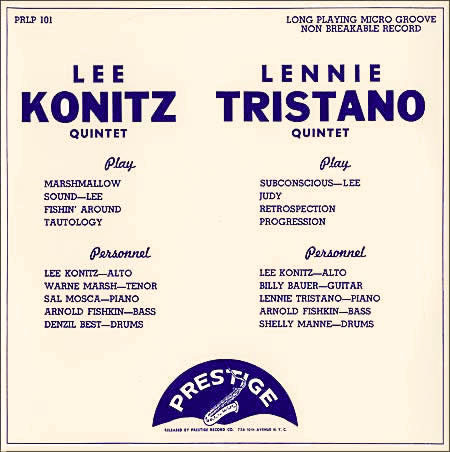
I'm finding out a little more about Prestige's very early days. The Bill Coleman- Don Byas recording from Paris, though it was later released on Prestige's 7000 series, was not actually a Prestige recording. The January 11, 1949, Tristano session, which was my second blog entry, was the first actual recording for then-20-year-old Bob Weinstock's label, then called New Jazz, although it appears not to have been the label's first release. It appears as New Jazz 832 -- the 800 series were mostly 78s, though some were issued on 45. Not many, I'd guess, and certainly not in 1949. The 45
RPM record was only invented that year, by RCA Victor (the 33 1/3 RPM long playing record had only debuted the year before, from Columbia). But the Tristano session did become the label's first LP release -- New Jazz 101. The great cover art that was to become one of the hallmarks of 1950s jazz -- not just on Prestige -- was still in the future.

The actual first release -- New Jazz 800 -- came from the session we're about to explore. Weinstock apparently had access to a bunch of Woody Herman's Herdsmen, and recorded them in different groupings. Perhaps the Herd was playing a series of dates at the Metropole Cafe. Bill Crow remembers a later version of the band playing there, lined up along the runway.

In any event, Terry Gibbs, Bill Swope, Stan Getz and Shorty Rogers (playing trumpet this time - he's just listed as arranger on the Serge Chaloff date) were back in the studio on March 14, 1949, four days after the Chaloff sessions, with a different but equally potent rhythm section -- George Wallingford (p), Curly Russell (b), Shadow Wilson (d).

LP records were originally thought of as a vehicle for classical music, pop (and jazz) songs being of a length that a 78 RPM record could accommodate easily. If a composition was longer, it was generally structured in such a way that it could have a break in the middle, and be presented as "part one" and "part two," sometimes with a different arrangement or emphasis. Bill Doggett's R&B classic "Honky Tonk," with the two sides showcasing, respectively, Billy Butler's guitar solo and Clifford Scott's saxophone solo.

Something similar occurs on this 1949 recording date, in "Michelle, parts 1 and 2." The first part is completely structured around Terry Gibbs on vibes, with a horn section providing an atonal cushion for him that sounds more Kenton than Herman, while the second part gives some serious solo space to Stan Getz -- which is really why these sessions are remembered today. They've been rereleased in the Concord Original Jazz classics series as "Early Stan", along with another recording date led by Jimmy Raney. The Getz solos really are the best part. This album is also available on Spotify, though not on YouTube. The Spotify release is not really well labeled -- all the cuts are listed as Terry Gibbs/Jimmy Raney.

Weinstock was famous for recording everything in one take, so what makes this session particularly unusual is the existence of alternate takes. "Michelle"and "Terry's Tune" both have two alternate takes (and the latter has an alternate title - it's also called "Terry's Blues"). Both alternate takes are of Part One, so neither has the Getz solo. The final cut from the session appears to have had alternate mentalities at work, at least for the titling of the number: "Cuddles (Speedway)."

Almost all the takes got released, though, and sooner rather than later. "T and S" and "Terry's Blues" were the first release on the New Jazz 78 RPM series (NJ 800), and "Cuddles" became one side of NJ 802 (the other was a J. J. Johnson cut, about which more later. "Michelle" parts one and two were New Jazz 804, and the first alternate take became a Prestige 78 (Prestige 729) and later part of a 45 RPM EP (PREP 1312). I still haven't figured out when Prestige started issuing 45s, but the first of the series (PREP 1301) was an Annie Ross set (actually the classic Annie Ross set, with "Twisted" and "Farmer's Market), recorded in 1952.

Terry Gibbs is not only still around, but still playing. Along with Shorty Rogers, he decamped for the West Coast (after a stint with Benny Goodman), and left the Prestige circle. Something that surprised me: he was one of the first bandleaders to employ Alice McLeod, later much better known as Alice Coltrane.

Thursday, July 03, 2014

Listening to Prestige Records project - Part 3


During the 1950s, when I started to become aware of jazz (actually late into the 50s for me, on a journey through rock and roll and rhythm and blues), there were two independent labels at the heart of that era: Blue Note and Prestige. Of the two, Blue Note has become the most famed, perhaps because it’s still around. Books have been written about it, its history chronicled.

The moment I turned from rhythm and blues to jazz (no, never turned—the moment I opened up to include jazz) came at two in the morning, in my dorm room at Bard College, twisting through the dial of my AM radio, looking for some R&B, and suddenly my hand stopping, my heart stopping, my world pausing to let in a sound that transfixed me. It was John Coltrane with the Red Garland Trio, and it was the first jazz record I ever bought. And it was on Prestige.

To the extent that Prestige and Blue Note were the Beatles and the Stones of the 50s to a jazz fan, I was a Prestige guy. I bought many records on both labels, of course, but when I look back at my vinyl collection, it leans heavily toward Prestige.

But there’s been no history of Prestige Records. Wikipedia doesn’t have much. There’s a photo book of Prestige album covers, but that’s all I’ve been able to find. And this blog won’t be it, either, because I don’t know enough. Not unless someone who was there on the scene, like Chris Albertson or Bill Crow, can fill in some of the gaps.

I’m using jazzdisco.org as my guide through this Prestige listening project, and I’m going chronologically by recording date, starting in 1949, the year Bob Weinstock started the label, first as New Jazz, then a year later as Prestige. I’m going by jazzdisco’s session index, because I can’t really figure out any other way to do it. The most famous Prestige album line, their 7000 series, seems to have started in 1955, so what was Prestige issuing before that? I hope someone will straighten me out.

Anyway, the third 1949 session – Serge Chaloff and the Herdsmen, March 10, 1949. The group is made up of Woody Herman veterans, as Serge was, and he’s most famous as one of Herman’s Four Brothers saxophone section, and the Jimmy Giuffre composition of that name, featuring Stan Getz, Zoot Sims, Herbie Steward, and Chaloff. Of the four, Chaloff was the only baritone sax, and he was pretty close to the only baritone sax player in jazz (Ellington’s Harry Carney his precursor) until Gerry Mulligan came along and made the instrument his own.

And Chaloff had the shortest career of the four. He succumbed to Charlie Parker’s Disease – the heroin addiction that claimed so many in the bebop era. He did kick the habit, but his life was cut short anyway, as he died in 1957 of cancer. So unlike Sims and Getz, he was not able to build very much on the Four Brothers foundation, but he did make some good music.


Here’s “Bopscotch” from that session. Personnel:  Oscar Pettiford b, Red Rodney tp, Earl Swope tb, Al Cohn ts, Serge Chaloff bs, Barbara Carroll p, Terry Gibbs vib, Denzil Best d, Shorty Rogers arr.

With not a lot of rehearsal time, there was no guarantee that a group of musicians assembled for a recording date were going to mesh, though sessions like the Minton’s and Monroe’s jam sessions gave a strong common language to the beboppers. But these were a group of musicians who’d spent some time together in the Woody Herman band, and you can hear it in the seamless blend of solos on this recording.

Saturday, June 21, 2014

Examiner 001: Start where you can get your foot in the door.

In 2009 and 2010, I started writing a series of columns on writing for Examiner.com. I eventually stopped out of a conviction that no one was reading them, but the handful of people who did read them seemed to like them, so I've decided to repost them here, where once again, no one will read them.


If you’re looking to begin a career freelancing to magazines, start where you can get your foot in the door. You won't be able to march into the office of the editor of Vogue, or PC World, or Family Circle, but a smaller magazine may only have a staff of half a dozen people, and there may be only one receptionist (if that) between you and the editor.


You may even be able to walk right in, if you have the personality to pull it off. If not, who do you know? Specialized fields are small. If you know about crafts and hobbies, or fly fishing, or restoring old cars, you know people who share your interest, and somewhere you’ll find two or three degrees of separation between you and an editor.

Editors of small-budget magazines are always looking for writers. They want ideas, and most of all they want reliability. Frankly, these are more important than top-notch writing skills. They can teach you how to write for their market; they expect to. They can’t teach you to meet deadlines.

So your job in that face-to-face meeting is to exude professionalism, to inspire confidence. Come in with a can-do attitude and a list of ideas, convince the editor that you’re reliable, and you may well walk out with an assignment.

Wednesday, June 18, 2014

Listening to Prestige Records project -- part 2

I've decided to take this by recording date, because with reissues, partial issues, compilations, anything else is too complicated. The major Prestige album series, the 7000 series, begins in 1955, but Prestige was around since 1949, first as New Jazz, then very soon after as Prestige. The Bill Coleman - Don Byas date was recordedon January 5, 1949, but the first to be actually recorded in Prestige's studios was a Lennie Tristano session,  on January 11 . I haven't been able to find out where those first sessions were recorded - the Rudy Van Gelder era came later. The company's offices were located on W. 50th Street, and grew from a record store Bob Weinstock owned next to the Metropole Cafe (my Wikipedia entry).

The date is listed as the Lennie Tristano Quintet, but Warne Marsh wasn't there for the January ll session -- it's Lee Konitz on alto and Billy Bauer on guitar, two Tristano mainstays. Shelley Manne is the drummer, but he'll be taking off for the West Coast shortly. Arnold Fishkind, here known as Arnold Fishkin, is on bass.

It's interesting to note where these guys came from. Billy Bauer had a swing and big band background, having played with Jerry Wald, Woody Herman, Benny Goodman and Jack Teagarden -- as did most of the beboppers, really. That was their apprenticeship. Shelley Manne started in a big band, then played and recorded with a number of Ellington sidemen, as well as with Coleman Hawkins and Don Byas. Arnold Fishkind played with Jack Teagarden, Bunny Berigan, even Les Brown, who was more dance music than jazz. And even during the years of his association with Tristano, he was also playing with Charlie Barnet and Benny Goodman.

Tristano and Konitz came to modern jazz pretty much straight on. Konitz grew up admiring Benny Goodman, but his first big band job, as a temporary replacement for Charlie Barnet in the Teddy Powell orchestra, reportedly made Barnet bang his head against a wall in anguish when Konitz started playing. He was not cut out to be a swing musician. And Tristano really was always the cerebral, difficult modernist he's famous for being.

So in a way Bauer, Fishkind and Manne had to learn not to swing, or not to rely on swinging.

This session isn't as far out as Tristano's famous next session, in May of 1949, when the group was joined by Warne Marsh, and they recorded :"Intuition," arguably the first free jazz piece, played with no charts at all -- no prearranged melody, harmony, or rhythm.  But that came out on Capitol.

The Prestige session is represented on YouTube by "Subconscious-Lee," by its title a vehicle for Konitz, but it would be hard to explain that to a Billy Bauer fan. Bauer, whose ideas are as advanced as anyone's, still swings hard on his solo. Konitz has that cool sound that he would bring to the more famous Miles Davis nonet sessions.

Tristano has a reputation for being unapproachably difficult, that he's never really shaken. I'm only the 22nd person to like this cut on YouTube. Perhaps that comes from playing free jazz over a decade before Ornette Coleman and Don Cherry, John Coltrane and Eric Dolphy, brought it into the mainstream. I've never felt he got the acclaim he deserved, and he's not remembered as much as some of his contemporaries, though he's good enough to be.

Saturday, June 14, 2014

Prestige 1 --Bill Coleman/Don Byas

My new project -- listen to at least one track from every album recorded on Prestige Records during the 40s and 50s.

The Prestige catalog has tracks that go back to the early 30s -- early Ellington, and other good stuff. But those are reissues of recordings for other labels. Prestige actually started in 1949. Bob Weinstock -- like Milt Gabler with Commodore Records -- started out as a record store proprietor, his store next to the legendary Metropole Cafe. Musicians took to stopping by there, and jamming, and Weinstock got the idea of paying them to record some sides.

So the story goes, but actually the first Prestige recording appears to have been two expatriates who led a group in Paris. This was 1949, the heyday of bebop, the year oft Miles Davis's Royal Roost sessions that became Birth of the Cool, but Bill Coleman was a traditional trumpet player, contemporary of Louis Armstrong, stylistically close to guys like Roy Eldridge. Don Byas, a perhaps under-appreciated great, was one of those transitional figures like Ben Webster, with one foot in swing, one in bebop.

This is a pretty traditional album, heavy on popular blues and standards. Nothing from it on YouTube, and the only cut from it that I could find on Spotify is St. Louis Blues, taken as an uptempo stomper, and swinging like crazy. Spotify does have a very good selection of Coleman and Byas from this era. Worth checking out.