Here are two versions of a powerful poem by the great Chilean poet Pablo Neruda -- the first by Robert Bly, the second by Ben Belitt. I use the two translations as an exercise to discuss the potential of poetic language.
What I try to get at in class is not so much which one is better, but how Belitt and Bly have written two completely different poems, and how quickly they veer away from each other. By the end of the first line, they're already as different as night and day. Bly declares total hopelessness, total nihilism, whereas Belitt may be tired of being a man, but he holds out a hope of transcendence of his "just a man" state.
That difference is continued and magnified as the two poems continue into the second stanza. Bly wants nothing less than total annihilation -- not death, but the elimination of any connection to life or humanity -- to lie still like stones or wool. Belitt can be rejuvenated by a little vacation from things. And the mundane things that tie us to the life of human society -- Bly wants only not to see them. Belitt's not so total in his rejection -- he'd just rather not look at them.
So the violent fantasy that's Bly's only connection to life is less than that for Belitt. It's part of his vacation -- Violent Fantasyland.
Bly doesn't want to go on being sentient. For him, being alive is like being a root in the dark. The life of the senses is shivering with sleep in the moist guts of the earth.
For Belitt, that kind of sentience isn't the sum total of life, just of the kind of life that he no longer wants to have.
And finally, Bly comes to a kind of accomodation with life. He accepts total nihilism, and he can stroll serenely through it. Belitt strolls through it too, but playing it cool, still looking for an out -- that presumably, by playing it cool, one should be able to find.
So there you have it. How much more different can two poems be?
Personally, I like the uncompromising nihilism of Bly's version. My class this week was evenly divided, and there's no right or wrong choice. But mostly, I love how the comparison illustrates the subtle power of language.
Why do we have language? What's the advantage of it as a system of communication? Language allows us to distinguish between things. Written language, with its complexity, allows us to make more complex distinctions. And the language of poetry allows us to make distinctions that are at once subtle and immense.
Here is Neruda's original.
Monday, September 11, 2006


Saturday, September 09, 2006
I Still Love Baseball
I'm just trying out creating a link to an mp3 file, which is not exactly complicated code, but I'd never gotten around to doing it before.
As a Mets fan, I should be embarrassed about writing a pro-Braves song, and I am, slightly, but I did write it with an audience in mind, namely the country music audience, so I set it in the South. Anyway, I'm not embarrassed by the song, which I still like. Here it is:
As a Mets fan, I should be embarrassed about writing a pro-Braves song, and I am, slightly, but I did write it with an audience in mind, namely the country music audience, so I set it in the South. Anyway, I'm not embarrassed by the song, which I still like. Here it is:
I Still Love Baseball
Thursday, August 31, 2006
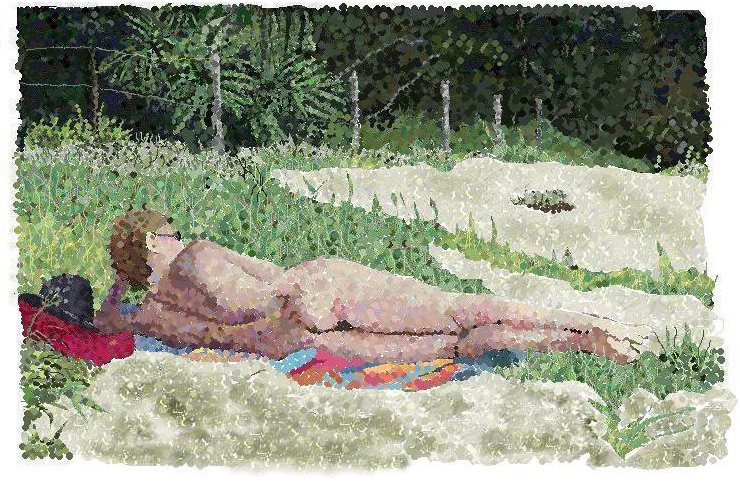
Two Nudes
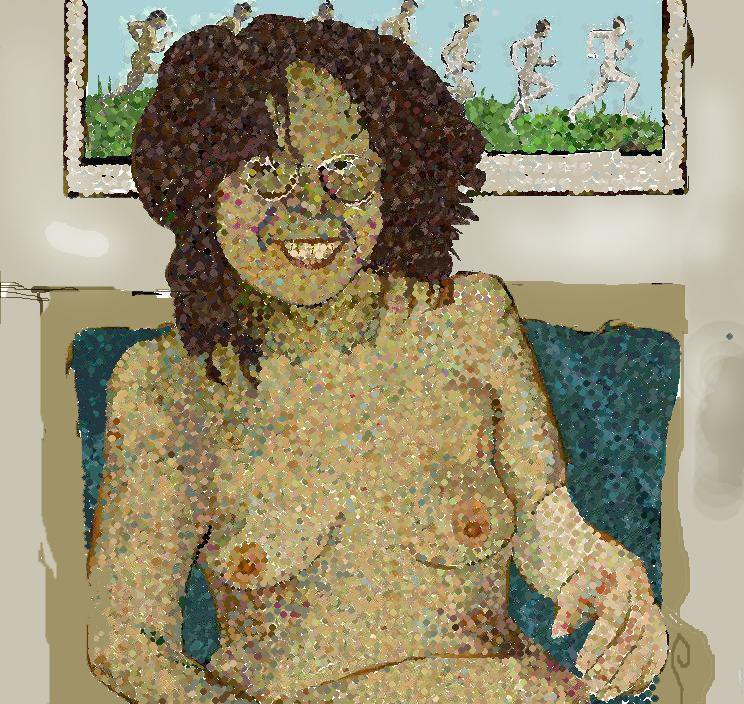
People ask me from time to time how long it takes me to complete one of these pointillist pieces, so I've started noting when I start and when I finish them. "Nude on Chair With Muybridge Figures" took close to four weeks; "Nude on Blanket With Sand," amazingly, only one week, but I was working pretty intently. Because of the way I do these -- working in Microsoft Paint, and building in the color deterioration that happens in Paint -- I always do two paintings at a time, because in order to get the full effect of the color breakdown, I have to constantly save and reopen an image. That's why the pointillism -- I work in dots of color which will break down as long as there's empty space around them, then build in more and more dots until they finally come together in an area of color. I've been working on a large and complex one, and I finished the Muybridge nude in the middle of it, so I had to start another, and the nude in the sand got the call. She's now finished too, and I still have a little more to do on the other picture. So, yes, I've started a new one.
Newsweek
I had no idea this was online -- it's last year's Newsweek article on the Hudson Valley, and if anyone is interested, you can check out my photo credit in Newsweek.
Saturday, August 26, 2006
Naming things
An article by Kandy Harris in the Saugerties Times quotes me -- correctly -- as using Microsoft Paint 'to create something he calls - with tongue firmly planted in cheek - '21st century pointillism.'" (She also slightly misreprents me in saying "Richards claims he is the only artist working in the genre," a claim I would never make. I think I said I was the only artist that I knew of working with Microsoft Paint in just this way. There are many artists doing interesting work "painting" with graphics programs, and you can see some of them at Don Archer's Museum of Computer Art. But this is a quibble with a very good article.)
Anyway, I digress. My point was the firmly-in-cheek tongue placing for "21st century pointillism," a term offered to me by James Cox of the James Cox Gallery -- thanks, Jim. I present the label with tongue firmly planted in cheek, but not the art. I take what I do seriously, even though I'm a little shy about labeling it seriously.
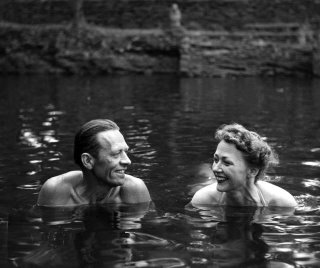
My stepfather, Harvey Fite, had the same problem, of course. His line in the sand came even earlier -- he didn't just resist categorizing his great masterwork, even resisted naming it. For years he called it "High Woods," after his beloved community where he had chosen to settle and create. As it started growing in reputation, people started looking for a name. The brilliant photographer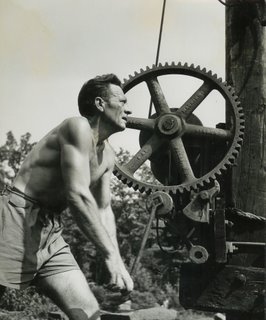
Maria Layacona, did an article on Harvey in the early Fifties, and called it "Fite's Acropolis in the Catskills" (photos by Maria included here).
Harvey was honored, but a little embarrassed, and eventually he realized he was going to have to give his work a name.
"Composers have it easy," he would joke. "They don't have to name things, they just number them -- Opus 1, Opus 2, and so forth." From the joking came a name -- Opus 40. Not Harvey's fortieth work, but forty years of work.
As for "environmental sculpture," "earthwork," or similar genre-defining names, Harvey never considered them. In subsequent years, it's occurred to me that Harvey was working within two artistic concepts that didn't have names while he was doing the work, but have acquired names since. One, of course, is "environmentalism." Harvey was very much aware of nature as Opus 40 developed under his hands": the lines of the mountain that became its backdrop, natural pools, trees. He was aware that the quarrymen who were his High Woods forefathers had carved a life and a living out of the native bluestone, but they had not left nature the way they found it. And with respect for them, but also respect for nature, he set out to make amends to nature for what human beings had inflicted on her.
The second name that Harvey never heard or used was "multiculturalism." But Opus 40, the first glimmerings of which stirred in Harvey during his residency in Copan, contains within it Harvey's sweeping love for, and awareness of, so many sculptural traditions.
How much are we limited by naming what we do? In many ways not much, and all too often artists who say "my work resists category" mean, whether they know it or not, "my work is too formless and uninteresting to have a category." Certainly "landscape," or "sonnet," or "concerto" don't limit an artist in any important way, and they do give him or the boundary and structure that art needs. Even Opus 40, which really is sui generis, can be categorized as "dry key stone masonry" or probably even "environmental sculpture," though it wasn't a current phrase during Harvey's lifetime.
Other labels are more problematic. The Beats mostly chafed against being called Beats. Pound founded Imagism and then disavowed it. The Impressionists exhibited together because no one else would have them, but I don't think they thought of themselves as having a clubhouse and a secret handshake.
So what's wrong with "21st Century Pointillism"? Maybe the same thing that's wrong with "claims he is the only artist working in the genre." Too self-aggrandizing? A lot of poets, myself included, are nervous about calling themselves "poets." "Poet" is something we aspire to be, something that Keats and Dante were.
Anyway, I digress. My point was the firmly-in-cheek tongue placing for "21st century pointillism," a term offered to me by James Cox of the James Cox Gallery -- thanks, Jim. I present the label with tongue firmly planted in cheek, but not the art. I take what I do seriously, even though I'm a little shy about labeling it seriously.
My stepfather, Harvey Fite, had the same problem, of course. His line in the sand came even earlier -- he didn't just resist categorizing his great masterwork, even resisted naming it. For years he called it "High Woods," after his beloved community where he had chosen to settle and create. As it started growing in reputation, people started looking for a name. The brilliant photographer
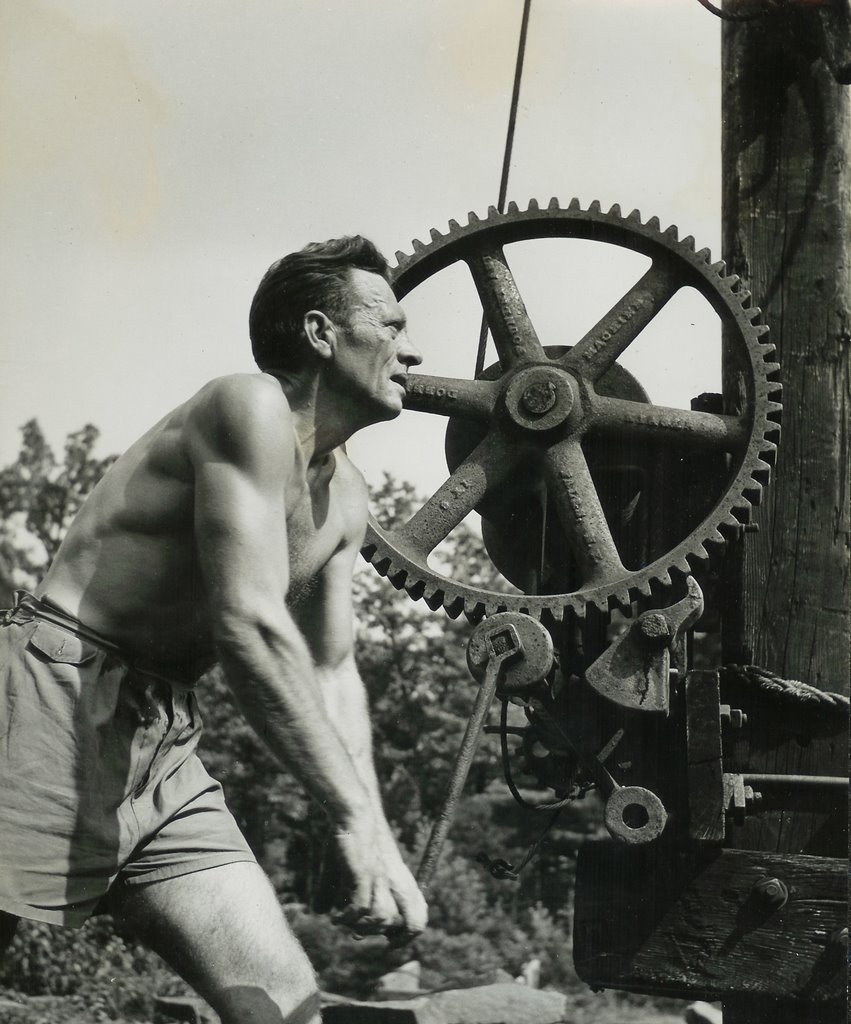
Maria Layacona, did an article on Harvey in the early Fifties, and called it "Fite's Acropolis in the Catskills" (photos by Maria included here).
Harvey was honored, but a little embarrassed, and eventually he realized he was going to have to give his work a name.
"Composers have it easy," he would joke. "They don't have to name things, they just number them -- Opus 1, Opus 2, and so forth." From the joking came a name -- Opus 40. Not Harvey's fortieth work, but forty years of work.
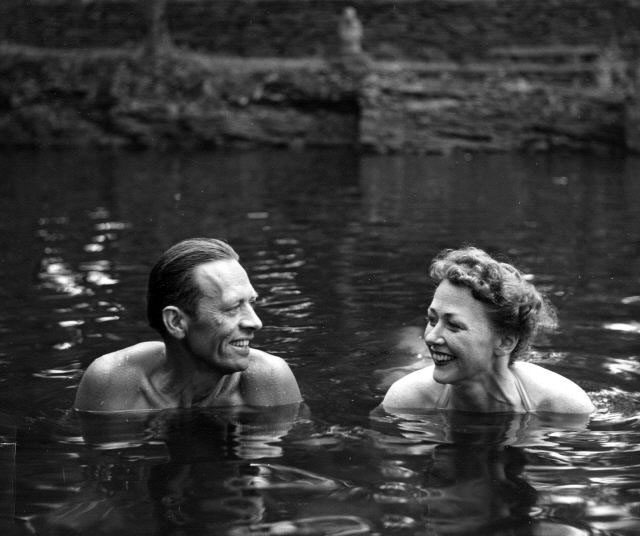
As for "environmental sculpture," "earthwork," or similar genre-defining names, Harvey never considered them. In subsequent years, it's occurred to me that Harvey was working within two artistic concepts that didn't have names while he was doing the work, but have acquired names since. One, of course, is "environmentalism." Harvey was very much aware of nature as Opus 40 developed under his hands": the lines of the mountain that became its backdrop, natural pools, trees. He was aware that the quarrymen who were his High Woods forefathers had carved a life and a living out of the native bluestone, but they had not left nature the way they found it. And with respect for them, but also respect for nature, he set out to make amends to nature for what human beings had inflicted on her.
The second name that Harvey never heard or used was "multiculturalism." But Opus 40, the first glimmerings of which stirred in Harvey during his residency in Copan, contains within it Harvey's sweeping love for, and awareness of, so many sculptural traditions.
How much are we limited by naming what we do? In many ways not much, and all too often artists who say "my work resists category" mean, whether they know it or not, "my work is too formless and uninteresting to have a category." Certainly "landscape," or "sonnet," or "concerto" don't limit an artist in any important way, and they do give him or the boundary and structure that art needs. Even Opus 40, which really is sui generis, can be categorized as "dry key stone masonry" or probably even "environmental sculpture," though it wasn't a current phrase during Harvey's lifetime.
Other labels are more problematic. The Beats mostly chafed against being called Beats. Pound founded Imagism and then disavowed it. The Impressionists exhibited together because no one else would have them, but I don't think they thought of themselves as having a clubhouse and a secret handshake.
So what's wrong with "21st Century Pointillism"? Maybe the same thing that's wrong with "claims he is the only artist working in the genre." Too self-aggrandizing? A lot of poets, myself included, are nervous about calling themselves "poets." "Poet" is something we aspire to be, something that Keats and Dante were.
Tuesday, August 22, 2006
Poetry's Rat Pack
I was thinking, for no traceable reason, of the Rat Pack, and particularly of Sammy Davis, Jr's version of "Mr Bojangles," which is not the most satisfying version of that song, because Sammy puts that hard shell on everything he sings--he marches Mr. Bojangles out to the exercise yard and orders him to dance, which is not really what the song calls for. Jerry Jeff Walker sits quietly in that drunk tank with the old dancer, lets him wake up and get his bearings, and then asks, Please...
Sammy sings with that authority that's imposed on a song. Frank, on the other hand, has an authority that's just there...he never has to show it. I'm not sure I'm saying one way is better than the other, but since Frank was the greatest pop singer of all, I suppose I am. Dean doesn't concern himself with authority at all; he's an egalitarian sort of guy, as he approaches a song.
Wondering how much further I could stretch this, I considered the some of the other ballad singers of the era. Elvis, who at his best approached a song more as a supplicant than an authority. Johnny Mathis, who pretends to supplicate, but actually holds the whip hand -- the Uriah Heep of singers, without the whininess.
We look to find and establish a voice in whatever art form we practice, and this issue of relationship to the material is part of that establishment of voice. I wonder if one could look at poets the same way? Frost our Frank, Stevens our Sammy, Williams our Dean?
Friday, August 18, 2006
Some heartfelt thanks
To those Opus 40 members who have responded to our recent membership renewal request by upgrading their memberships, sending us more than they have in the past. I can't tell you how much we appreciate this.
Sunday, August 13, 2006
Who's That Nude?
This weekend, the Saugerties Artists’ Studio Tour, in which I have been a participant fpr the last three years.
A comment from one studio tourist: “I don’t like nudes as a rule, but I do like these.”
It’s always nice to have someone like your work, and you probably shouldn’t question why, but it’s hard not to theorize a little, so I started wondering what sets my nudes apart from others.
I know that when I work in graphic arts, I feel it as a total break from writing. I don’t think with words; I don’t think about theme or symbol; I give myself up completely to eye and hand.

But I wonder if that’s as true as I’ve always assumed it was. Maybe my nudes are, to some extent, a writer’s nudes, in that I’m always, to some degree, creating character. I suspect the same is true with my animals.

I work mostly from photographs. I don’t necessarily follow the photographs literally, and sometimes I’ll grab images from more than one source. But I don’t have much in the way of a visual memory. I can’t remember exactly how a head fits on a neck if I’m not looking right at it, or how an arm hangs at someone’s side. I don’t remember what color people’s eyes are, or how someone’s hairline looks. And because, at least with the pointillist works, I spend a lot of time on each image, it would be wildly costly to work from a model.
Besides, while there are things you can get from a live model that you could never get from a photograph – depth, real color, and, well, life – there are things you can get from a photograph that you won’t necessarily get from a live model. A photograph is a moment in time, and sometimes that moment will reveal something unexpected.
I probably shouldn’t admit this, but I get a lot of my models by surfing those Internet sites where people post nude pictures of their wives and girlfriends. They work for me because they’re bad photographs, so I don’t have to work through someone else’s aesthetic vision, and because sometimes they’ll reveal something unexpected. You might have to look through a hundred pictures, which is a lot less fun than it sounds like, to find that unexpected revelation. But they’re there, and you know them when you see them.
A comment from one studio tourist: “I don’t like nudes as a rule, but I do like these.”
It’s always nice to have someone like your work, and you probably shouldn’t question why, but it’s hard not to theorize a little, so I started wondering what sets my nudes apart from others.
I know that when I work in graphic arts, I feel it as a total break from writing. I don’t think with words; I don’t think about theme or symbol; I give myself up completely to eye and hand.

But I wonder if that’s as true as I’ve always assumed it was. Maybe my nudes are, to some extent, a writer’s nudes, in that I’m always, to some degree, creating character. I suspect the same is true with my animals.
I work mostly from photographs. I don’t necessarily follow the photographs literally, and sometimes I’ll grab images from more than one source. But I don’t have much in the way of a visual memory. I can’t remember exactly how a head fits on a neck if I’m not looking right at it, or how an arm hangs at someone’s side. I don’t remember what color people’s eyes are, or how someone’s hairline looks. And because, at least with the pointillist works, I spend a lot of time on each image, it would be wildly costly to work from a model.
Besides, while there are things you can get from a live model that you could never get from a photograph – depth, real color, and, well, life – there are things you can get from a photograph that you won’t necessarily get from a live model. A photograph is a moment in time, and sometimes that moment will reveal something unexpected.
I probably shouldn’t admit this, but I get a lot of my models by surfing those Internet sites where people post nude pictures of their wives and girlfriends. They work for me because they’re bad photographs, so I don’t have to work through someone else’s aesthetic vision, and because sometimes they’ll reveal something unexpected. You might have to look through a hundred pictures, which is a lot less fun than it sounds like, to find that unexpected revelation. But they’re there, and you know them when you see them.
Saturday, August 12, 2006
Art and Perception
A story that’s always interested me comes from early Woodstock history, and the effect that growing success and reputation had on the band of brothers and sisters who came to the Maverick to follow their dreams. Some of that success came during the 1930s, the WPA Artists Project years, and with success came friction, most notably in the nationwide competition for commission to paint a mural at the Rincon Annex Post Office in San Francisco. As fate would have it, the finalists for the competition were two Woodstock artists, Anton Refregier and Wendell Jones. And Refregier was ultimately chosen to paint the mural.
Ironically, I can’t find a link to Ref’s mural online, but Wendy Jones’s studies can be found here,
The competition caused some serious rents in the Woodstock community, and the destruction of friendships. Many thought that Wendy Jones should have won, and that Ref’s work was more facile, less profound.
I don’t want to comment on that. I held both men in the deepest regard, personally and professionally. Wendy died when I was still a teenager, but his sons were my best friends, and his surviving son, Peter, remains my oldest and closest friend. Ref was a mentor and role model to me; he influenced me profoundly.
But I’ve been thinking recently about the assignation of roles to them: Wendy the depth and nuance, Ref the flash and commercialism. Was this real? Did Ref win the competition because his work was flashier and more commercial?
Or is his work seen as flashier and more commercial because he won?
Did winning competitions and commissions turn Ref into an artist who began to play it safe? And if Wendy had won this hugely prestigious commission, and Ref had lost it, would Wendy have been the one to start to play it safe?
I don’t believe any of this. But I believe the perception exists, and not just in this long-forgotten example. I don’t believe Ref’s burning artistic integrity was compromised by success, and I don’t believe Wendy’s would have been (he did enjoy success and prestige during his career). But I suspect that although the work would not have changed, the perception would have—that Wendy would have been categorized as the facile one, Ref the unjustly overlooked soulful one. And none of this perception would have had anything to do with art.
Thursday, August 10, 2006
Harvey at St. Stephens
Helene Teiger, an archivist at Bard College, informs me that she has located a St. Stephens yearbook -- "amazing," she says, "since we only have a few
(Bard/St. Stephen's never seems to have produced many of these)." She passes on information about Harvey that I never knew: "Apparently, he was in a fraternity, and played la crosse."
(Bard/St. Stephen's never seems to have produced many of these)." She passes on information about Harvey that I never knew: "Apparently, he was in a fraternity, and played la crosse."
Thursday, June 29, 2006
Grumman taxonomy update
My previous note referencing June 2 was wrong -- it should be June 1. Here's the exact link.
Yahoo spyware
If, like me, you made the mistake of installing Yahoo Messenger version 7.5, and suddenly discovered that it made Yahoo your default search engine, there's a way of fixing it, but it's not easy. You can find the solution at the Simple Thoughts blog, but their solution didn't do the whole job for me. Nick Jones figured out the rest of it, and I added his solution to the "comments" section, so read all the way down.
Sunday, June 25, 2006
Carved Sculpture
It was brought to my attention recently that I don't have any examples of Harvey's carved work, either here or on the website. So here are a couple, and I'll be adding them to the website too. These are both stone -- I'll be posting some of the work in wood as well.
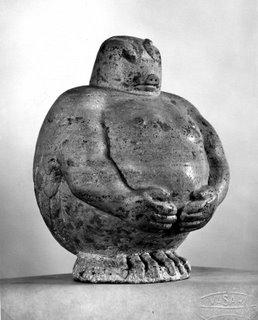 Gluttony, 12"x9"x9", travertine. We're not sure of the dates of any of these. A guess on this would be late 40s-early 50s.
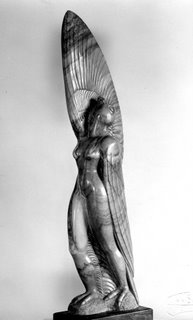 Megalomania, 30.5"x7"x4", marble. I'd place this one in the early 50s, possibly carved in 1950 when Harvey and Barbara spent a year in Rome.
Both of these are in my collection, in the house at Opus 40.
Thanks to Cindy Bell for cataloging all the carved pieces we have records of.
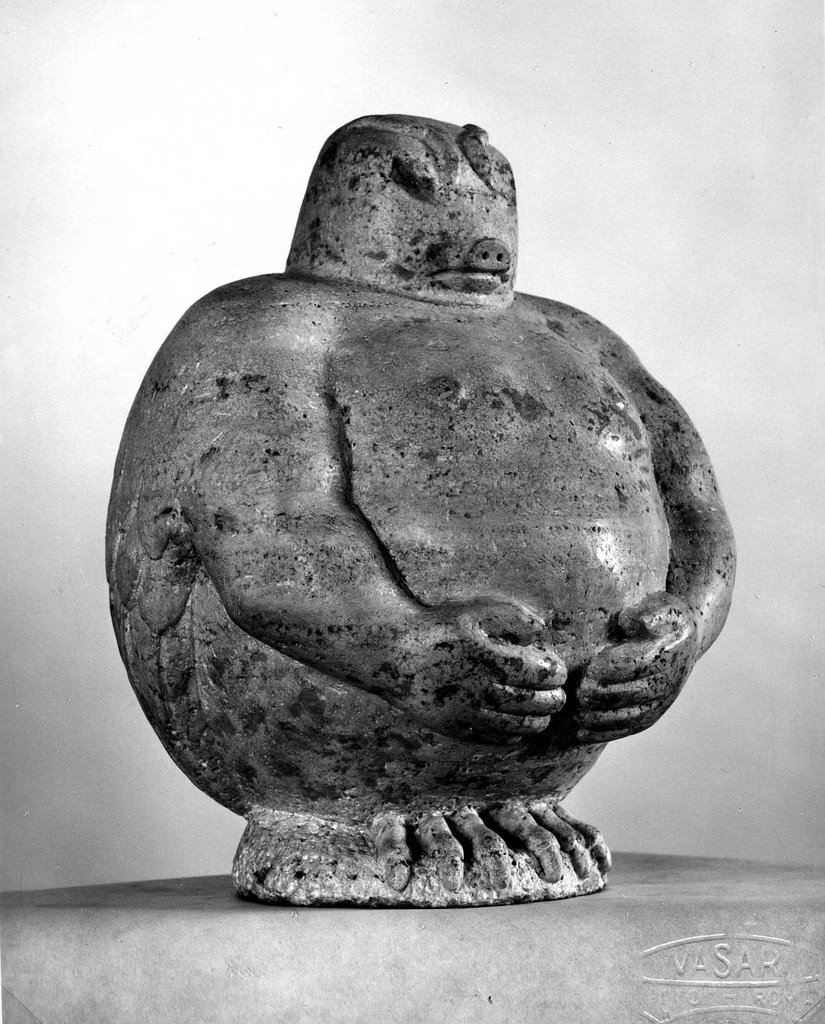 Gluttony, 12"x9"x9", travertine. We're not sure of the dates of any of these. A guess on this would be late 40s-early 50s.
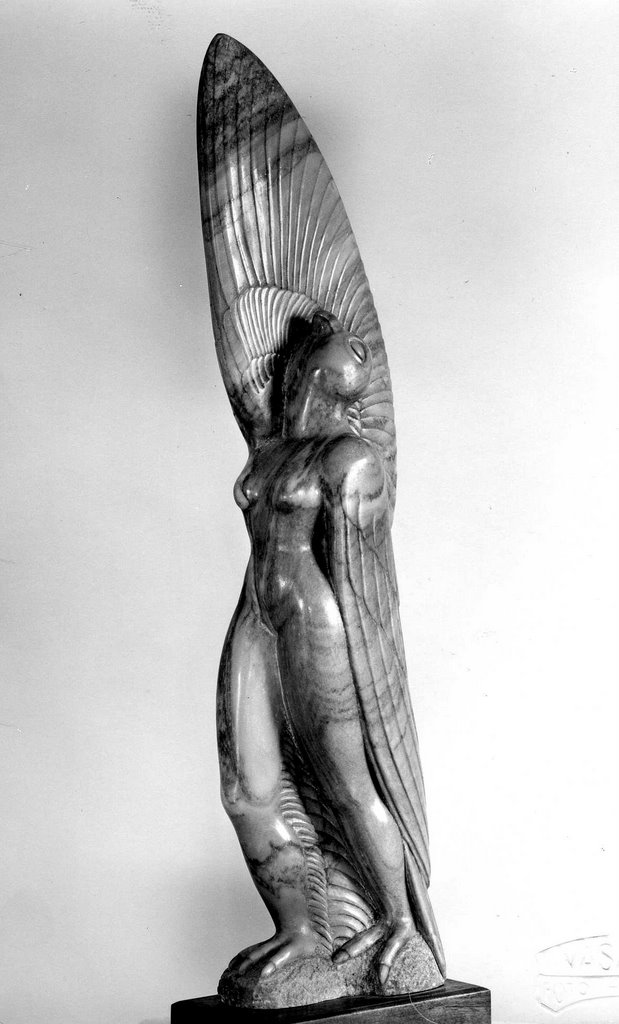 Megalomania, 30.5"x7"x4", marble. I'd place this one in the early 50s, possibly carved in 1950 when Harvey and Barbara spent a year in Rome.
Both of these are in my collection, in the house at Opus 40.
Thanks to Cindy Bell for cataloging all the carved pieces we have records of.
Friday, June 23, 2006
Opus 40 in the News
More press coverage of Opus 40. Boston.com, which incorporates the Boston Globe and other media, has picked up the New York Times story. And in this week's Woodstock and Saugerties Times, a very nice article by Paul Smart, about the tribute to Harvey Fite which was held here last week, organized by Lyn Thoman.
Friday, June 02, 2006
Richards Pushes Grumman's Taxonomy to the Breaking Point
Bob Grumman makes his long-awaited exigesis of my hay(na)ku today (well, that link will work if you read it today; otherwise go to his archives and check for June 2), after first wondering
But he stays with it, and Grumman as theorist is always weird and interesting. So I recommend it. I think.
why I don't just junk my taxonomy on the grounds that it must be worthless if it has any problem with an obvious poem like Richards's piece.
But he stays with it, and Grumman as theorist is always weird and interesting. So I recommend it. I think.
A Patrician Baritone
We're in the New York Times today. A very good article, with the odd sidelight that I am described as someone
who speaks in a patrician baritone and resembles a stockier, long-haired George Plimpton.
Wednesday, May 31, 2006
Happy Birthday Walt Whitman (etc.)
Happy birthday to:
I know what you're thinking. "Did six lilacs last in the dooryard bloom, or only five?" Well, to tell you the truth, with all these house calls to make and all these Christmas seals to sell up and down Allen's Alley, I kind of lost track myself. But being as I'm large and contain multitudes, you've got to ask yourself a question: Do I think positively? Well, do ya, punk?
1819 Walt Whitman, West Hills NY, poet (Leaves of Grass)
1821 Elizabeth Blackwell, Hastings, 1st woman doctor of medicine
1861 Emily Perkins Bissell, welfare worker (1st christmas seal drive, 1907)
1894 Fred Allen, Cambridge MA, comedian (Fred Allen Radio Show)
1898 Norman Vincent Peale Ohio, clergyman (Power of Positive Thinking)
1930 Clint Eastwood, San Fransisco CA, actor (Dirty Harry)/mayor (Carmel CA)
I know what you're thinking. "Did six lilacs last in the dooryard bloom, or only five?" Well, to tell you the truth, with all these house calls to make and all these Christmas seals to sell up and down Allen's Alley, I kind of lost track myself. But being as I'm large and contain multitudes, you've got to ask yourself a question: Do I think positively? Well, do ya, punk?
Tuesday, May 30, 2006
Time and Tide Wait for No Man, But We Wait for The Times
The article was postponed a week. It'll be this Friday's Escapes.
Hay(na)ku, hay(na)ku, It's Finger Poppin' Time
The hay(na)ku, according to a recent post on the New-Po list, "is a tercet where the first line consists of one word, the second line of two words, and the third line of three words." An unpromising form, says I, who thinks that a haiku is already too short for my Western mind, but I tried one anyway, and lo and behold it turns up on Bob Grumman's blog, along with a promise to analyze it in the future. If this happens, I will link to it once again.
Sunday, May 21, 2006
Opus 40 in the NY Times
A photographer from the NY Times was here today, taking pix for a story that should run this Friday. It's a story that a Times reporter came up here to do last fall, but then it never ran. He told us that they were planning to put it off till this spring, and apparently that was the case. According to the photog, this is going to be a big story, on the front page of their Weekend Getaway section. So let's hope. Look for it.
Tuesday, May 16, 2006
Poets' Corner
A recently discovered -- by me -- treasury of public domain poems, pictures and bios of poets, at a site called Poets' Corner, put together over the past ten years by four gentlemen, Bob Blair in Texas, Jon Lachelt< in Colorado, Nelson Miller in Georgia, and Steve Spanoudis in Florida. Offering particular pleasure -- the "Faces of the Poets," but all of it worth a look.
Thursday, May 11, 2006
Net Neutrality
This is a post that every blogger, no matter how small his readership, needs to make. Because today you can find my blog with no trouble. You can find poetry blogs by experimentalists like Ron Silliman and formalists like Mike Snider, or international poetry blogs like Anny Ballardini's, from Italy (and look for my page on Anny's Fieralingue anthology of contemporary poets). You can find the Academy of American Poets or Poetry Daily, which features a new contemporary poet every day--today's is Victoria Chang, with a poem originally published in Ploughshares. Here's a taste:
You can find tiny online poetry magazines like Snakeskin from England (look for me in Issue 118), or larger ones like Jacket from Australia (here's my review of Calendars, by Annie Finch), or Cortland Review (look for me here and here). You can buy books directly from small presses like Ye Olde Font Shoppe, which has published my books, along with those of Dennis Doherty and, most recently, an anthology of poems from Erie, PA; or from McPherson and Co., or the University of Georgia press (publisher of Rachel Loden's Hotel Imperium. Or you can find Powell's Books or the Gotham Book Mart or the Grolier Poetry Bookshop, if you prefer an alternative to Amazon.
You can find the Woodstock Artists Association or the Town of Saugerties, or the Saugerties Artists Studio Tour or the Saugerties Lighthouse, or, of course, Opus 40. You can link to blogs by Nick Jones or Jerilyn Dufresne.
And you can do all this as easily as you can access IBM or Amazon or anything published by Rupert Murdoch. But this could change, if Congress goes through with its plan to create a two-tiered internet, one (fast) for the haves, the other (slow or nonexistent) for the havenots. Here's what MoveOn.org has to say about it.
Proof
They say my great-uncle read foreign books
in a mud house in Nanking,plowed his twenty acres, listened to
rare birds, disobeyedthe tides' yes and no. One day he knelt in the street,
sign around his neckthat said: Traitor. Little Red Book spread like wax
beech trees turned.
over him, even
You can find tiny online poetry magazines like Snakeskin from England (look for me in Issue 118), or larger ones like Jacket from Australia (here's my review of Calendars, by Annie Finch), or Cortland Review (look for me here and here). You can buy books directly from small presses like Ye Olde Font Shoppe, which has published my books, along with those of Dennis Doherty and, most recently, an anthology of poems from Erie, PA; or from McPherson and Co., or the University of Georgia press (publisher of Rachel Loden's Hotel Imperium. Or you can find Powell's Books or the Gotham Book Mart or the Grolier Poetry Bookshop, if you prefer an alternative to Amazon.
You can find the Woodstock Artists Association or the Town of Saugerties, or the Saugerties Artists Studio Tour or the Saugerties Lighthouse, or, of course, Opus 40. You can link to blogs by Nick Jones or Jerilyn Dufresne.
And you can do all this as easily as you can access IBM or Amazon or anything published by Rupert Murdoch. But this could change, if Congress goes through with its plan to create a two-tiered internet, one (fast) for the haves, the other (slow or nonexistent) for the havenots. Here's what MoveOn.org has to say about it.
Congress is now pushing a law that would end the free and open Internet as we know it. Internet providers like AT&T and Verizon are lobbying Congress hard to gut Network Neutrality, the Internet's First Amendment and the key to Internet freedom. Net Neutrality prevents AT&T from choosing which websites open most easily for you based on which site pays AT&T more. So Amazon doesn't have to outbid Barnes & Noble for the right to work more properly on your computer.The above link will take you t0 MoveOn's petition. It should be signed and sent in.
Saturday, April 15, 2006
Richards and Grumman - a standoff
Poet Bob Grumman, who is more than a little strange but whose essay on Mnmlst Poetry (which does not include "f u cn rd ths u cn gt a gd jb") is one of the most fascinating reads on the Internet, recently informed the NewPo list of a site called Googlefight , where you can pit two names or words or phrases against each other to see who gets the most Google hits. He had tried himself against Master Poetry Blogger Ron Silliman , and found to his surprise that after being thoroughly trounced by Silliman, he had come back and beaten him a few days later.
Bob's theory:
Here are a few others I tried:
T. S. Eliot -- 38 million Tad Richards 484,000
Marvin Bell -- 6 million Tad Richards 484,000 (of course, this may include Marvin Bell the standup comic, but then again it may also include Tad Richards the champion bass fisherman, although I think he may be in semi-retirement, since you don't see too many hits on him any more.
But here's one I liked
Tad Richards -- 484,000 Jorie Graham -- 200,000
Bob's theory:
Chris Lott said something good about me, which in less than a day multiplied my Internet popularity by 9! I just went up against William Shakespeare. I forget what he scored, but the graph comparing his total to mine was so large, to get the proportions right in the small space allotted, mine was barely visible--but it represented the same 548,000 I got against Silliman. Now if the Mole says something good about me, I may catch up with the Bard!Well, I didn't want to say anything too good about Bob, because I lost to him 548,000 to 484,000, and while this may not put him ahead of the Bard, it'll probably soar him way, way past me.
Here are a few others I tried:
T. S. Eliot -- 38 million Tad Richards 484,000
Marvin Bell -- 6 million Tad Richards 484,000 (of course, this may include Marvin Bell the standup comic, but then again it may also include Tad Richards the champion bass fisherman, although I think he may be in semi-retirement, since you don't see too many hits on him any more.
But here's one I liked
Tad Richards -- 484,000 Jorie Graham -- 200,000
Thursday, April 13, 2006
In Perhaps the Oxymoron of All Time...
Happy Samuel Beckett's 100th birthday.
And in tribute, this section from Situations:
A country road. A tree. It’s evening. Bob
Sits on a hillside, taking off his shoes,
Trying to tell himself he’s done his job,
Fulfilled his destiny, and paid his dues,
Of Carlene’s lips. Only her eyes that glowed
Beyond desire, pure as an infant,
Sans peur et sans reproche, her heart bestowed
What has he done? How long has he been walking?
Did they beat him again? What is this place?
Someone is drawing near; it’s Stephen Hawking.
Hawking says, “mine is the fate of chicks.
I wait at home, while she’s the new Perot
Generalissima, Grand Inquisitrix.”
Plead with her for my darling’s life, or sorrow
Will dog my footsteps. Will she come here?” “Just
Wait,” says Hawking. “Soon.Or else tomorrow.”
Life upon my conscience. On reflection,
I think my best course is to hang myself.”
Says Hawking, “It might give you an erection.”
“Let’s wait and sey what she says.” “Even so,
There must be something we came all this way for.
What do we do?” “We wait for Mary Jo.”
Wednesday, April 12, 2006
The Page
This is as good a site as I've seen for a roundup of poetry on the net. It's called The Page, and you can find it at http://thepage.name/
Down the center, it has links to recent articles about poetry, with one-sentence quotes from the article, sort of like Arts and Letters Daily but focused on poetry. Here are the ones at the top today:
Over on the left, also like A&L Daily but po-specific, a list of links to poetry-relevant sites. An excellent list.
And on the right -- and this is a little different -- Links to "New Poems" that can be found on the web, referenced by author and publication.
This is a good one to have on your favorites list -- you could do worse than having it as your home page.
Down the center, it has links to recent articles about poetry, with one-sentence quotes from the article, sort of like Arts and Letters Daily but focused on poetry. Here are the ones at the top today:
I referenced the Michael Schmidt piece yesterday, in the process getting the name of the festival wrong -- it's not St. Anza, it's StAnza, with a capital "A" in the middle.
"There was Creeley the bohemian and the dyed-in-the-wool Yankee, the approachable and the avant-garde, the laconic writer and the blue-streak talker, the gentle pigeon-raiser and the high-strung Young Turk." D. H. Tracy • The New York Times
"Why has our age become so enamored of a poet who almost to the end of her life required a special taste?" William Logan on Elizabeth Bishop • The New Criterion
"I thought it was okay for poems in some crucial way to be part of the world of everyday entertainment, and that it would do the academy no great harm to acknowledge this." Bill Manhire talks to Nick Twemlow • Poets And Writers
"Down with the poetry cheerleaders, I say! Readers don’t need to be talked down to." Michael Schmidt • The StAnza lecture 2006"In the beginning you write for the high of finishing it, of getting through. Now the reward is feeling that you're on the right track and can work at it." Seamus Heaney talks to Sam Leith • The Daily Telegraph
Over on the left, also like A&L Daily but po-specific, a list of links to poetry-relevant sites. An excellent list.
And on the right -- and this is a little different -- Links to "New Poems" that can be found on the web, referenced by author and publication.
Eavan Boland The New Republic
This is a good one to have on your favorites list -- you could do worse than having it as your home page.
Monday, April 10, 2006
Is She Really This Small?
 From Michael Schmidt, author of one of my favorite books, Lives of the Poets, in a lecture at St. Anza, Scotland's Poetry Festival:
The other anecdote puts Picasso in the frame with an American GI at the end of the Second World War. The soldier says he dislikes Picasso’s kind of art with its distortions and stylisations and dislocations. ‘What sort of art do you like?’ asked Picasso. The GI pulled out a photograph of his girlfriend and presented it to the artist, who gazed at it and asked, ‘Is she really this small?’ It is about the conventions we are prepared to accept, about conventions so ingrained that we do not recognise them as such; it is about becoming conscious of them, of what is conventional, and understanding why, and what that convention includes and excludes.


Sunday, April 09, 2006
The Tragic Polka
THE TRAGIC POLKA
First you kill your father, then you off the king
Doing the tragic polka
Then your mistress checks out while she’s wearing your ring
Doing the tragic polka
Watch your lover sinking in a bottomless descent
He’s robbed and cheated for you but the money’s all been spent
He’s sacrificed his honor and disgraced his regiment
Doing the tragic polka
Step it when you find out that you’re married to your mother
Doing the tragic polka
Twirl it while they tell you that you can’t inter your brother
Doing the tragic polka
Your son has snatched your wife away and laid her in the shade
You could have won the duel except for poison on the blade
Your husband is a loser but attention must be paid
Doing the tragic polka
Thursday, March 30, 2006
I'M WITH YOU ON THE LAST TRAIN TO ROCKLAND
I'm not exactly sure what inspired this, and maybe it's best that I don't plumb it too much. But it may have somehow started with the fact that Pat and I went on a cruise for spring break -- our first vacation in forever -- and, well, you'll do things on a cruise that you wouldn't do in real life. For example...I went to a Mickey Dolenz concert. And that may have done terrible things to my psyche.
Then, looking to find the second half of "Howl" online, I Googled "I'm with you in Rockland." And you know how when you type in a few letters in a google search, Google will guess what you're trying to find? Well, I typed in "I'm with you in," and let Google guess the rest. And it did, in fact, guess "Rockland." But here's the weird part. A search for "I'm with you in Rockland" produced all sorts of hits, none of them related to Allen Ginsberg or Howl. Go figure. But as a strange, horrible result of all this, Ginsberg and the Monkees began to inextricably entwine in my mind.
Anyway, here it is:
I’M WITH YOU ON THE LAST TRAIN TO ROCKLAND
Take the last train to Rockland,
And I’ll meet you in the lobby.
You’ll be in the soup of time
so don’t forget to bring kohlrabi,
oh, no, no, no!
Oh, no, no, no!
’cause the angelheaded hipsters
left for balls and endless cock
We’ll overturn one pingpong table
’til the morning brings us shock
And I must glow, oh, no, no, no!
Oh, no, no, no!
And I don’t know if I’m ever coming home.
Take the last train to Rockland,
And I’ll see you in a bit.
We’ll have dreams and adorations
And that sensitive bullshit
I wanna blow. oh, no, no, no!
Oh, no, no, no!
And I don’t know if I’m ever coming home.
Wednesday, February 15, 2006
52nd Street
Here’s a thought. Why not use a blog that no one reads to discuss a book that no one will have read, and damn few will be interested in reading?
The book is Fifty-Second Street: Street of Jazz, by Arnold Shaw. I’ve been a fan of Shaw’s for years, ever since I read Honkers and Shouters: The Golden Years of Rhythm and Blues, his great history of the R&B of the 40s and 50s, my favorite music.
Shaw was a music business industry professional -- song plugger, pubishing company executive, a little bit of everything, and ultimately the founder and first director of the Popular Music Research Center at University of Nevada-Las Vegas, later named the Arnold Shaw Popular Music Research Center in his honor. So he has an insider's knowledge of the business, and Honkers and Shouters is not just about the performers, but the behind the scenes people too—the guys like Art Rupe of Specialty and Lew Chudd of Imperial and Herman Lubinsky of Savoy, and producers and arrangers and songwriters and the whole panoply of people in the music business.
I knew Shaw had written a bunch of other music books, and I’m finally getting around to them. I ordered Fifty-Second Street: Street of Jazz, and The Jazz Age: Popular Music in the 1920s, and I've started on the former.
All I knew about 52nd Street was that bebop started there – in the 52nd Street clubs and the after-hours sessions at Minton’s in Harlem, So I had innocently expected to read about the 40s, and the beboppers but this being Shaw, I'm getting so much more. It's a history of The Street from the speakeasy days, and it covers not just the jazz musicians, but the club owners, and the cabaret singers, and the strippers, and the insult comics, and the clientele. I hadn't know anything about that early history of The Street--the Dixieland players, and the swing guys -- people like Louis Prima, and Art Tatum, and the early guys who integrated jazz even before Benny Goodman -- Joe Marsala, a white player from New Orleans, needs a hot trumpet player, so he goes out and hires Henry "Red" Allen, and no one thinks twice about it, even though it's never been done before. And songs that got their start on The Street, and became huge hits -- like "The Music Goes Round and Round," which was first performed by these guys -- I can't think of their names now -- who played at one of the clubs, and people came flocking to that club to hear them. Great stuff. I'm more than halfway through the book now, and just starting to get to Dizzy Gillespie arriving on The Street.
Thursday, February 09, 2006
Poets of World War II
I’ve just started reading an anthology called Poets of World War II, from the American Poets Project of the Library of America. I’m finding that I’m enjoying the experience much more than I’d be enjoying reading a comparable anthology of contemporary poets, and not necessarily because I think the poets are better than contemporary poets would be.
No, it’s because there’s a powerful and not always realized connection between poetry and history. This sort of cross-section of poetry of an era, and poetry about that era, opens a window of insight into that time. Poets are first of all human, and individual, and the good ones connect to that collective humanity and express that individuality, but we all know that. It’s now they use that to mirror history that so interests me here.
So here’s Witter Bynner making a simple but poignant commentary on racism in the middle of a fight for freedom, and Robinson Jeffers’ angry isolationism, and Lincoln Kirstein’s clunky but oddly lyrical evocation of General Patton, whose driver he was for a while. And the combat poets like Jarrell and Dickey and Hecht and Nemerov and Ciardi -- I’m just getting into that group
And the old warhorses of the era – the widely anthologized poems like Auden’s “September 1, 1939,” and Lowell’s “Memories of West Street and Lepke” take on an new resonance by being in this context.
I ordered the book for inclusion in my American Lit survey course, and I’m glad that I did.


Editor Harvey Shapiro, then and now
No, it’s because there’s a powerful and not always realized connection between poetry and history. This sort of cross-section of poetry of an era, and poetry about that era, opens a window of insight into that time. Poets are first of all human, and individual, and the good ones connect to that collective humanity and express that individuality, but we all know that. It’s now they use that to mirror history that so interests me here.
So here’s Witter Bynner making a simple but poignant commentary on racism in the middle of a fight for freedom, and Robinson Jeffers’ angry isolationism, and Lincoln Kirstein’s clunky but oddly lyrical evocation of General Patton, whose driver he was for a while. And the combat poets like Jarrell and Dickey and Hecht and Nemerov and Ciardi -- I’m just getting into that group
And the old warhorses of the era – the widely anthologized poems like Auden’s “September 1, 1939,” and Lowell’s “Memories of West Street and Lepke” take on an new resonance by being in this context.
I ordered the book for inclusion in my American Lit survey course, and I’m glad that I did.


Thursday, January 19, 2006
A Crack in the Universe
A good poem is a contribution to reality. The world is never the same once a good poem has been added to it. A good poem helps to change the shape of the universe, helps to extend everyone's knowledge of himself and the world around him.
--Dylan Thomas
I think this is true. I want a poem to do more than be what I call “Andy Rooney poetry” – poetry that asks, wryly or sentimentally or iconoclastically or philosophically, “Didja ever notice…?” I look for poems that are a conduit to a different and unsettling reality. I want a poem to open a crack in consciousness and change the world, one reader’s perception at a time. Nothing else is worth writing.
Monday, January 16, 2006
Harvey, India, Cambodia, and not quite China
In 1956, Harvey Fite took a sabbatical from Bard College to travel in Southeast Asia, primarily India and Cambodia, to study the sculpture of those cultures. He was also invited to visit China, but this was 1956, and there was no way any American was going to get permission from the American government to go to China.
However, he remained on the Christmas card list -- can that be right? -- but if memory serves, it is -- of the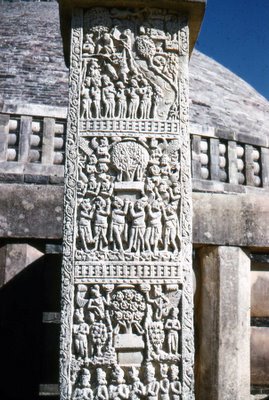 Chinese People's Cultural Commissar. And he was given a complimentary subscription to the official arts magazine of the People's Republic. This came to the Postmaster in San Francisco every month, and every month Harvey would receive a card from the postmaster: Subversive material addressed to you has been received by this post office. Did you order it? Do you want it?
Every month, Harvey would send the card back, with Did you order it? checked No, and Do you want it? checked Yes.
I remember hearing at the time that Harvey was, because of this, ranked Number 35 on the government's list of subversives, but that can't have been right. It was the dawning of Top 40 radio in those days, but there can't have been a numbered list like that.
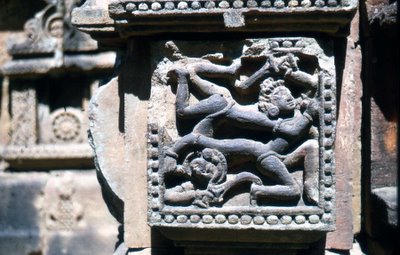
Anyway, I just acquired an Epson scanner with color transparency capability, and I'm beginning a project of scanning, Photoshopping and archiving all the slides I can find squirreled around Opus 40. I'm starting with the India and Cambodia slides -- two boxes of the former, three of the latter. I've done the India boxes, so here are a few pictures. I'll be getting to Cambodia next, and I'm really excited about those, because I know Harvey visited Angkor Wat and Angkor Thom when they were really unspoiled.

Anyway, here are a few from India.
However, he remained on the Christmas card list -- can that be right? -- but if memory serves, it is -- of the
 Chinese People's Cultural Commissar. And he was given a complimentary subscription to the official arts magazine of the People's Republic. This came to the Postmaster in San Francisco every month, and every month Harvey would receive a card from the postmaster: Subversive material addressed to you has been received by this post office. Did you order it? Do you want it?
Every month, Harvey would send the card back, with Did you order it? checked No, and Do you want it? checked Yes.
I remember hearing at the time that Harvey was, because of this, ranked Number 35 on the government's list of subversives, but that can't have been right. It was the dawning of Top 40 radio in those days, but there can't have been a numbered list like that.
Anyway, I just acquired an Epson scanner with color transparency capability, and I'm beginning a project of scanning, Photoshopping and archiving all the slides I can find squirreled around Opus 40. I'm starting with the India and Cambodia slides -- two boxes of the former, three of the latter. I've done the India boxes, so here are a few pictures. I'll be getting to Cambodia next, and I'm really excited about those, because I know Harvey visited Angkor Wat and Angkor Thom when they were really unspoiled.

Anyway, here are a few from India.

Saturday, January 14, 2006
Leadbelly, Finkel and Calvino
I didn’t realize just how true this was until a few years ago, when I started teaching my course in the blues, although I guess I always knew it. My first important poetic influence, and to this day still the most important, was Leadbelly.
Second would be my great mentor, Donald Finkel, but I don’t think Don would mind playing that particular solo on second fiddle.
I discovered Leadbelly when I was around 16, and my idea of poetry was still hear-on-sleeve sophomoric, which it was to remain for many years, while his lessons lay dormant somewhere. But they were there, nonetheless. I was haunted, amazed, drawn in irrevocably by the stories he wasn’t telling, the stories that hovered just behind the words.
Black girl, black girl, don't lie to me
Tell me where did you sleep last night
In the pines, in the pines
Where the sun never shines
I shivered the whole night through
Black girl, black girl, where will you go
I'm going where the cold wind blows
In the pines, in the pines
Where the sun never shines
I shivered the whole night through
My husband was a railroad man
Just about a mile from here
His head was found in a driver’s shaft
And his body has never been foundBlack girl, black girl, where’d you sleep last night
Not even your momma knows
You caused me to weep, you caused me to moan
You caused me to leave my home
So much left unsaid, so much suggested. Stuff I didn’t understand till years later – the railroad man living in a company town, the house repossessed after his death. Stuff that was suggested, then reversed – the girl sleeping where she shouldn’t be, not because of sexual wanderlust, but because of tragedy. The first interpretation doesn’t feel right, even in the beginning – shivering the whole night through could be sexual ecstasy, but you know it isn’t. “The cold wind” is not a wind of passion. And then the horrendous story, sketched so starkly in so few words, of the husband’s death. A power that comes from a glimpse that gives us a world.
Italo Calvino described that glimpse, in his Under The Jaguar Sun. This is the best definition of art I have ever read:
Both in art and in literature, the function of the frame is fundamental. It is the frame that marks the boundary between the picture and what is outside. It allows the picture to exist, isolating it from the rest; but at the same time, it recalls--and somehow stands for--everything that remains out of the picture. I might venture a definition: we consider poetic a production in which each individual experience acquires prominence through its detachment from the general continuum, while it retains a kind of glint of that unlimited vastness.
Friday, December 23, 2005


Monday, December 19, 2005
The Bat Test -- Results
A long time away from blogging...I'll try to regain focus here.
I wanted to post a few of the results from the "bat test" assignment with my current crop of Creative Writing students at SUNY New Paltz. This is Creative Writing I -- theoretically, these are beginning students, at the bottom rung of the program's ladder. But they've done some wonderful work for me.
I wanted to post a few of the results from the "bat test" assignment with my current crop of Creative Writing students at SUNY New Paltz. This is Creative Writing I -- theoretically, these are beginning students, at the bottom rung of the program's ladder. But they've done some wonderful work for me.
Mountain in the room where
Nobody’s looking
Only mother bat soaring crazily
Across the moon can
Detect the cardboard cliffs
Grandfather trees
Wilted dizzy flaming leaves covering
Car wreck on the red rocks, charred from
Desert fire last December
After night when air disappeared
Everyone was caught walking with heads
Down hoods up
Hands pocketed eyes
Sideways mouths
Pinned open when Mountain was revealed
-- Jessica Ritacco
On the bed:
his sweatshirt and my black bag.
There’s an email on the computer screen,
a letter in my hand.
How did this happen?
Don’t ask. Just pack.
For the city:
I’d want my going-out
clothes: tiny top and tight pants.
Underwear of the sexiest order,
kick-ass boots,
black eyeliner.
Going farther south?
Pack less and more,
good books to read.
Don’t worry about what you’ll wear to bed.
Forget the eyeliner, take lipstick instead
and your favorite flavor of tea.
To stay here
all you have to do is
shove that black bag
back under the bed.
Put his sweatshirt back on.
Step into the night.
A bat soars crazily
across the moon,
her mouth full of insects.
You watch her flight
and the blue clouds
bluer because you’re by the Mobil sign.
It's a warm night.
You don't really need the sweatshirt.
-- Jennifer Whitton
Tapping an ordinary pen
It looks blue, against her chin
This child of a bat soars
Crazily across the moon
Moving nimble fingers
Through hair tinged in a wheat colored hue
Her mouth full of insects
Spewing forth the flies as a foam
Cracking knuckles, coupled with scratching on a pad
Those studious contemporaries
Resting their heads on hands
While with legs crossed her foot played out a beat
A solitary crimson star
Stitched by hand, on a pant seam
This swirling motion can draw you in
As the muted boy attempts to speak
There must be so much more
Yet all I know are these
Aesthetic things, Lives of aesthetic dreams
She’s turning to leave, walking slowly.
-- Keith Donnelly
Monday, November 21, 2005
Zen Blurs
How much do I have the courage of my convictions?
A while after this incident, I was mentoring a poet online, by email -- a poet who developed, and turned out to be very good. But at this point, everything she was writing was still labored, mannered, even tortured. She couldn't progress beyond sounding like someone who wanted to write Poetry.
Then in a depressed moment, writing me an email about her frustration and doubts, she tossed in a story about another time in her life when she was balancing self-confidence and self-doubt, between her first and second marriage, when she was testing out her sexuality and her ability to attract men. I started looking at the note, and there was a sureness to the language that I didn't see in her poetry, even a rhythmic sureness.
I started breaking it into lines, maybe dropping a word here and there, but otherwise not altering anything, and I was right. It worked. A found poem.
I sent it back to her...hey, take a look at my latest poem.
If I were a real Zen master of a teacher, I would have stuck to it...and it probably would have been a good lesson.
But...I ultimately gave her the poem.
Tuesday, November 15, 2005
Whose Blur Is It, Anyway?
This was several years ago. I was visiting photographer Dan McCormack, and he invited me to go out and do some landscape shooting with him. I told him that I didn’t do photography at all any more…I had decided that I was either going to make a total commitment to it or nothing, and I’d chosen nothing. I didn’t even own a camera any more.
He said “Come on, it’ll be fun, I’ll loan you a camera,” and finally I said OK. So we went out, shooting B&W, walking through the woods. At one point I tripped over a root and the shutter was tripped. At the end of the day Dan ran the film and printed some contacts for me. It was as I had thought…I had some pretty but conventional images. You don’t develop an eye in one day. And there was one negative which was just a blur of squiggly lines.
So we fast forward a few months. Dan has an opening in a good gallery, and I go to it, and there on the wall, matted and framed, is my blur. And it looks great.
Tuesday, November 01, 2005
A Voice Heard Once In a Lifetime

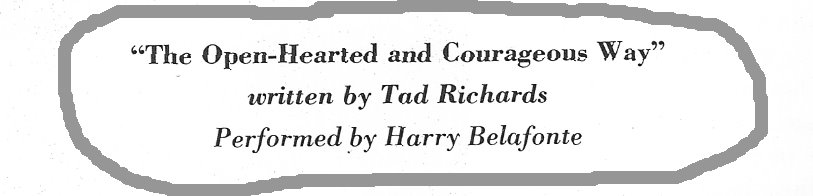
Unearthed in a box of stuff while looking for something else, something I'm kinda proud of. The program for the dedication of the Marian
 Anderson Theater at Aaron Davis Hall, CUNY:

Monday, October 31, 2005
The Bat Test
This is a student poem from a few years ago – the first draft of a poem that went on to become much, much better – bright and sensual and well-realized.
First Kiss
The surf rushes forward,
falling with fury into a fluid fusion.
Waves whirl and intertwine.
Surges of synergic seduction plunge deeper
as they rise and tumble.
Ripples diminish, and bliss licks the shore.
The ocean’s caress recedes
and I, standing barefoot in the sand
know.
And my response, or the relevant part for this blog entry:
You’ve already let us know that the poem is going to be about a romantic, breathtaking moment, by titling it “First Kiss.” So you don’t need to explain that.
You also don’t need to explain to the reader that surf is a crashing, exciting phenomenon. So ANYTHING you say about the waves will carry that. Which means that’s the one thing you DON’T want to say, because you’re saying it already. Adding anything about rushing, or fury, is going to be redundant, and will feel like overkill.
Richard Hugo, in The Triggering Town, talks about "writing off the subject." I'd add another, similar suggestion: "Writing away from the subject."
Not only do you not need to say what you've already said, you don't need to say what you've already suggested. It’s close to impossible to write total non sequiturs. If something pops into your head, no matter how disconnected it may seem from what went before, it's connected because your head is the one it popped into.
So the connections are there. They can’t help but be. And that means you need to trust us as readers to make those connections. We will make them...sometimes even better than you, the poet, will, because we expect them to be there. If we know a poem is called "First Kiss," we'll connect anything that follows to the experience of a first kiss (whatever our experience of a first kiss is). So write away from it. Don't describe a first kiss. Describe something else.
Here's a stanza from a poem called “Summer Haiku” by Alicia Ostriker. You can find the whole poem at http://www.poems.com/summeost.htm. The stanza reads
A mother bat soars
Crazily across the moon,
Mouth full of insects.
Now, instead of “Summer Haiku,” let’s call the poem
FIRST KISS
That night, a bat soared
Crazily across the moon,
Mouth full of insects.
Once we see the title "First Kiss," we're going to relate whatever comes after to the idea of a first kiss. We may read this and think -- this is a kiss she shouldn't have gotten into. This is a dangerous first kiss -- irresistible because of its crazy danger, because of the moonlight...but dangerous.
Let’s put the same stanza under another title from another student poem: AFTER AN ARGUMENT WITH MY GIRLFRIEND, I QUESTION MY LOVE FOR HER
A bat soars
Crazily across the moon,
her mouth full of insects.
Uh oh. We're in the present tense now -- not looking back at the first kiss from a distance of time, but right there with the guy as his girl friend storms away, and his mind is full of doubts. Why is he looking at the sky, and not at her? Maybe because of the doubts. He wants to shut her out, at least for the moment. But he can't shut her out -- anything he sees is going to be relevant. And he sees a bat flying crazily across the moon -- the symbol of romantic love being crossed by the symbol of vampirism -- the creature who will first appear sexual and enticing, but will then suck the blood and the soul out of you. And in the speaker's mind -- because there's no way he could actually know this -- the bat is a woman.
Now let's stick it under a couple of other titles, drawn from poems.com (and without reading the poems, just grabbing the titles).
A DOG'S GRAVE
A mother bat soars
Crazily across the moon,
mouth full of insects.
He's visiting the dog's grave at night. He must be very lonely. And the solitary bat makes him feel even lonelier. But...it's a mother bat. Her mouth is full of insects for her babies. Even this world, bereft of a beloved dog, is full of life and nurturing in the strangest places...maybe? We have to read on. FAMILY REUNION
A mother bat soars
Crazily across the moon,
mouth full of insects.
You make the interpretation.
Or how about this? Ezra Pound's famous two-line poem.
IN A STATION OF THE METRO
The apparition of these faces in the crowd,
Bats flying crazily across the moon.
So that's the bat test. What happens to your poem if you stick the bat stanza into it? Does it derail the poem, or is it still strangely on track? If it derails the poem, maybe you're too locked into literal meaning. If it doesn't, then think about where else you can go.
Wednesday, October 26, 2005
A meme for today
Fortunately, I didn't have to look it up, because the person who gave me this meme also supplied me with the definition of a meme, and it's not like mê mê , as in my wonderful French-Canadian mother-in-law. This is pronounced meem, and it means "an idea, behavior, style, or usage that spreads from person to person within a culture." In this case, the culture is the blog culture, and here's the meme, gotten from writers Jerilyn Dufresne and Anne Frasier.
1. Take the first five novels from your bookshelf.
2. Book 1 -- first sentence.
3. Book 2 -- last sentence on page 50.
4. Book 3 -- second sentence on page 100.
5. Book 4 -- next to the last sentence on page 150.
6. Book 5 -- final sentence of the book.
7. Make the five sentences into a paragraph.
8. Feel free to "cheat" to make it a better paragraph.
9. Name your sources.
10.Post to your blog.
And here's my pargraph.
I found Elizabeth waiting at the door of my office, standing at a respectful distance and watching as two men sat together in the evening and pored over maps and charts and tables. They looked up, and I could tell they considered me some kind of strange wild animal, as I laid on my American accent and my all-round toughness with a heavy hand. I knew I’d have to send the girl away. It troubled me in some mysterious way, yet also made me happy.
And my sources:
Ross MacDonald, The Ivory Grin.
Jessica Richards (me), Mistress of the Western Wind.
Wilfrid Sheed, Transatlantic Blues
George McNeill. The Plantation (an old friend I’ve sadly lost touch with).
D. M. Thomas, The White Hotel.
Monday, October 24, 2005
National Book Award Nominees
The Poetry Portraits page of my website currently features the five National Book Award finalists for poetry: John Ashbery, Vern Rutsala, W. S. Merwin, Frank Bidart, Brendan Galvin.
Monday, October 17, 2005
Rain

With all the rain last week, the pool level was up over its banks. Which was good news for Big George and the rest of the fish -- they could come up on shore and start nibbling at the grass.
Wednesday, October 05, 2005
I got interrupted in the middle of my post on this.
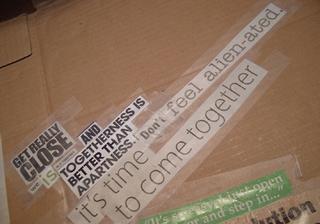
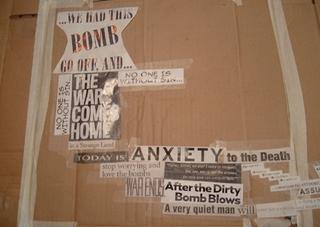
Daniel's Clamor Contender will be up through the end of October, which means that this year we'll be staying open through the end of the month, so that people can get a chance to see it and participate in it. (If the weather is really cold and rainy and awful on a weekend day, we probably won't open).
For more information, check out Daniel's Clamor Contender wegsite at http://www.clamorcontender.com/
and here are a couple more images.
Daniel's Clamor Contender will be up through the end of October, which means that this year we'll be staying open through the end of the month, so that people can get a chance to see it and participate in it. (If the weather is really cold and rainy and awful on a weekend day, we probably won't open).
For more information, check out Daniel's Clamor Contender wegsite at http://www.clamorcontender.com/
and here are a couple more images.


Monday, October 03, 2005
Clamor Contender
Daniel Helmstetter's Clamor Contender installation went up this weekend, to enthusiastic participation. Here are a few pictures:


Thursday, September 29, 2005


Sunday, September 04, 2005
First Concert Note, and a Thank You
The Orleans concert was wonderful. The group was at the top its form, and driven by three percussionists, they had the crowd dancing and cheering. I'll be posting some photos here, but I'll start with the thank you.
One thing we do each year at the concert is a 50-50 raffle -- makes a few extra bucks for Opus 40, and Lord knows we need it. Raffle tickets for a dollar, we keep half, the winner keeps half. But yesterday I kept thinking...if we're going around collecting a buck here and there, there are people who need it more. So I checked with Laurie and Pat from our board, got their thumbs up, and I when I went to do the drawing, I announced that Opus 40 would give half of its share to the Red Cross.
There was $500 total, so the winner would be getting $250. When we called out the winning number, a guy in the audience held up his winning ticket, and called out "Give my share to the Red Cross."
We caught up with the guy afterwards. His name is Bob Ryan, from Kingston, and Bob's wonderful and spontaneous generosity...well, we had to match it. The whole amount will be going to the Red Cross, in the names of Opus 40 and Bob Ryan.
Saturday, August 27, 2005
The Narcissiad
A heads-up for a wonderful new mock-epic in the manner of Pope, by R. S. Gwynn. It's called The Narcissiad. For a sample, check out Anny Ballardini's Poets Corner.
Here's a smaller sample:
Here's a smaller sample:
The Education of Narcissus
From the jacuzzi, wreathed in scented foam,
He steps with his blow-dryer and his comb
To face that altar where all things are clearer,
To wit, his dressing table and his mirror.
He takes his inspiration and direction
By summoning the muse, his own reflection,
The which, in gratitude, he sweetly kisses,
This self-made-god, our latter-day Narcissus.
The poetry he writes, and thus inspires
Among his postulants, no more requires
A love of words or duty to the past
Beyond the headlines of the Tuesday last,
No binding strictures such as rhyme or meter
Or any length in excess of his peter,
The one tool of his trade he thinks so rare
He keeps it to himself, and will not share.
Thursday, August 25, 2005
Memories of High Woods
My daughter Caitlin called me from New Mexico last week. An old Santa Fe buddy of hers, whom she's known for years, had just found out that she's Harvey Fite's granddaughter...it had somehow never come up. It turns out that Dewey lived in High Woods for several years back in the 70s, and worked for Bill Johnson, our neighbor, who did some backhoe work for Harvey, clearing out some of the areas in the back.

So Dewey was visiting in the east this week, and he stopped by yesterday. We shared reminiscences of Bill Johnson, one of the great characters of this area. I told him that my first recollection of Bill came from when I was a small boy, and my parents warned me to never, ever, take a ride with Bill in his truck. Bill was a cowboy, they said, and he drove his truck as though he were riding a horse.
Sadly, the occasion never came up. I would have hopped in that truck in a heartbeat.
Bill actually did know a great deal about motorized vehicles, since he made his living owning and operating heavy equipment. The sign in his yard read BULLDOZING, and my brother and I always pictured a large bovine creature catching forty winks. And he may have been from High Woods, but he was a real cowboy. I've never seen anyone, including Gary Cooper, who looked so much like a cowboy -- tall, blond, weatherbeaten, laconic, totally comfortable with himself.
Thinking about Bill made me think about High Woods when I was growing up. A tiny community of neighbors, neighbors who embraced with pride and affection the strange sculptor who was building this strange thing in their midst.
High Woods back then consisted of the church and the general store. The general store was owned by Henry Wilgus. The store was in the front of the building, and you could get Necco wafers or milk and eggs or fishing tackle.
Behind the store area was a kitchen where short-order meals were prepared. The rest of the building was a huge room which contained a dance floor surrounded by tables. The tables were used for eating, drinking beer, and playing euchre. Little notes on paper plates on the wall told who had been skunked by whom. The dance floor had a jukebox that played 78 RPM records -- chosen, I believe, by Henry Wilgus. There was no rock and roll. The names of the songs were written in ballpoint pen, in Henry's handwriting, all capital letters, with dashes in between each word: SHRIMP-BOATS, MOCKINGBIRD-HILL, DAVY-CROCKETT, THE-YELLOW-ROSE-OF-TEXAS.
But the dancing was done on Saturday night, to live music. It was square dancing. There was a fiddler -- Perce Hill. And a square dance caller. One tune remains in my head fifty years later:
The first two ladies cross over, and by the opposite standThis same verse and chorus were repeated four times, but it's not as repetitious as it sounds. In every square dance which calls for partnering up with your corner lady, and the opposite ladies crossing over, a repetition of four means that by the end of the dance, you will have danced with every lady in your set, and be back with your partner.
The second two ladies cross over, and you all join hands
You bow to your corner lady, and honor your partners all
You swing your corner lady, and you promenade the hall
If I had a girl, and she wouldn't dance, I tell you what I'd do
I'd buy her a boat, and set her afloat, and paddle my own canoe
Wilgus's General Store is gone now, and with it, the ferryboat life preserver, painted white, that Henry hung from a tree as one came up the hill toward High Woods from Mount Marion, which read
And nothing has replaced Wilgus's. No convenience store--nor are we looking for one. So High Woods is now the church, and a wonderful church it is. They have an Easter sunrise service every year at Opus 40, weather permitting. And every Labor Day they have their church fair, with a bazaar and delicious roast beef luncheon.
HIGH WOODS
HIGH AND HEALTHY
Gone, also, is the handpainted wooden sign across Dutchtown Road from Henry's house and the store, the honor roll of High Woods residents who had served in World War II.
We go to the fair every year...but back in the days I'm remembering, the 1940s and '50s, things were a little different. High Woods is small now, but it was smaller then, and Glasco Turnpike was a little-traveled country road. So on the morning of Labor Day, the whole community would turn out at the corner of Glasco Turnpike and High Woods Road...in costume. Everyone in homemade costumes, even some homemade floats. We would parade around the High Woods block -- High Woods Road to Wrolsen Drive, back around to Glasco Turnpike and then to Church Road, where the fair would begin.
Here's a picture of some of the revelers in the parade. Dad carrying the groceries is Larry Risdal, Mom pushing the baby carriage is me, the baby is my brother Jonathan Richards.

The picture is courtesy of DJ Boggs, Henry's granddaughter, whose wonderful blog with memories of Wilgus's can be found here.
In the early 1950s, Harvey Fite bought Bard College's old Model A fire engine. He needed it for the pump, to empty out his pools for fall cleaning. But he restored it beautifully -- new paint, polished brass, and the insignia, in gold paint against the fire engine red: HIGH WOODS NO. 1.
It worked. It ran, it pumped water. Harvey and Bert Wrolsen and a few others even took it and helped out at fires.
But I remember it most from the Labor Day parades. There were two unofficial grand marshals: Harvey in his fire engine, Bill Johnson on his palomino. A community that took pride in its church and its great, strange work of art, in its sculptors and its cowboys, its farmers and quarrymen and old ship's carpenters. A community where a farm boy from Texas, on his way to becoming an internationally renowned sculptor, could woo and win an elegant lady from New York and Rome, taking her square dancing on Saturday night at the general store.
Tuesday, August 09, 2005
Huth Visits Opus 40, Finds No Penguins
From poet Geof Huth, a not-so-favorable review of a visit to Opus 40.
Friday, August 05, 2005
Opus 40 in the New York Times
A New York Times feature writer, David Wallis, has been up to interview me, and talk to Opus 40 visitors, for an article on Opus 40 which will appear in the Times sometimes this month.
David, who writes about Weekend getaways, has recently profiled the towns of Catskill and Saugerties for the Times, and excellent articles they were.
We only know that this piece will appear on a Friday, sometime this month. I'll post more when I hear.
David, who writes about Weekend getaways, has recently profiled the towns of Catskill and Saugerties for the Times, and excellent articles they were.
We only know that this piece will appear on a Friday, sometime this month. I'll post more when I hear.
Saturday, July 30, 2005
Saugerties Art Tour Preview
Windows on Main Street in Saugerties are starting to bloom with work by artists from Saugerties Artists' Studio Tour. I am featured in the window of Smith Hardware, on the corner of Main and Partition Streets. An honor to be in the company of Barbara Bravo, Diana Bryan and Ellen Perantoni. An honor to be in the window of one of the great locally owned hardware stores anywhere...the sort of place that could well have inspired the Hudson Valley's Nancy Willard to write her poem, "A Hardware Store as Proof of the Existence of God."
I praise the brightness of hammers pointing east
like the steel woodpeckers of the future,
and dozens of hinges opening brass wings,
and six new rakes shyly fanning their toes,
and bins of hooks glittering into bees,
and a rack of wrenches like the bones of horses,
and mailboxes sowing rows of silver chapels,
and a company of plungers waiting for God
to claim their thin legs in their big shoes
and put them on and walk away laughing.
In a world not perfect but not bad either
let there be glue, glaze, gum, and grabs,
caulk also, and hooks, shackles, cables, and slips,
and signs so spare a child may read them,
Men, Women, In, Out, No Parking, Beware the Dog.
In the right hands, they can work wonders.
Catskill Animal Sanctuary
Another worthwhile thing about our hometown of Saugerties is a place Arick and I visited this week: the Catskill Animal Sanctuary, located on Old Stage Road between Kingston and Saugerties. These people

Now, people who love animals -- especially animals that have been abuse by people -- don't always love people, and there's no reason why they should, necessarily. But the complete and genuine warmth of everyone there, and their graciousness to two people who showed up when they weren't supposed to be there, won our gratitude. Now, I don't recommend testing their patience by showing up on an off day. I know what that's like for us at Opus 40. But I do recommend going, and seeing the wonderful work they've done, and are doing, with abused animals.
We'll be going back (on a weekend), and we'll be supporting them with a membership. I think Arick is going to want to go back every weekend. I wonder if they can use a 5-year-old volunteer?
provide a safe and loving haven for abused and abandoned horses and farm animals—animals who have never known warm shelter, spacious pastures, good food, or the touch of a kind hand. Since 2001, CAS has provided refuge for close to 400 such animals, including horses, ponies, cows, goats, sheep, donkeys, pigs, rabbits, and a variety of birds.We were there on Friday, which turned out to be a mistake...they're actually open only on Saturday and Sunday. I know from out experience at Opus 40 that it can be maddening to have people show up on the wrong day, just to look around, but the people at the farm could not have been nicer...all of them. They welcomed us, let us look around, even let Arick feed tomatoes to the pigs, including their newest one, Ozzie, a 4 month old Vietnamese potbellied pig.

Now, people who love animals -- especially animals that have been abuse by people -- don't always love people, and there's no reason why they should, necessarily. But the complete and genuine warmth of everyone there, and their graciousness to two people who showed up when they weren't supposed to be there, won our gratitude. Now, I don't recommend testing their patience by showing up on an off day. I know what that's like for us at Opus 40. But I do recommend going, and seeing the wonderful work they've done, and are doing, with abused animals.
We'll be going back (on a weekend), and we'll be supporting them with a membership. I think Arick is going to want to go back every weekend. I wonder if they can use a 5-year-old volunteer?
Saturday, July 23, 2005
RIP John Herald
One of Woodstock's great musical voices, John Herald, dead at 65, apparently by his own hand. His group, the Greenbriar Boys, was one of the finest of the New Traditionalist bluegrass groups of the 60s. They memorably backed up Joan Baez on "Banks of the Ohio," and their own debut album on Vanguard spent a lot of time on my turntable. I particularly loved their rendition of "Amelia Earhart's Last Flight" and "We Need a Whole Lot More of Jesus (and a Lot Less Rock and Roll)." John also wrote "Stewball," based on a classic Leadbelly folk song, which was a big hit for Peter, Paul and Mary.
Here's his obit from the New York Times, and here is his page and the Greenbriar Boys page at AllMusic Guide.
Here's his obit from the New York Times, and here is his page and the Greenbriar Boys page at AllMusic Guide.
Monday, July 18, 2005
Forty Years of Work
So often the first reaction to Opus 40 is incredulity...how could one man have done it, even over forty years?
And I understand the reaction. It is mind-boggling to imagine one man doing it, even over forty years. And Lord knows it makes a lot more sense than my all-time favorite comment, which was dumb enough that only an art critic could have made it:
"I see such anger there!"
Well, OK. It's forty years of a man's life, and every emotion he ever felt has to have found its way there to some degree. You want to see anger, you can probably find it. But it's not going to be the first thing that leaps to everyone's mind.
And as immense as the undertaking seems, it's even more so when you consider how much of it was worked and reworked.
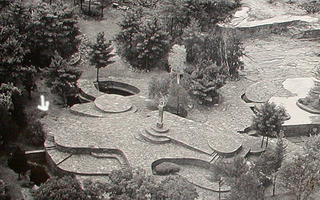 If you walk around to the south side of Opus 40 (marked with the arrow in the picture) you'll see an area where the stonework is more rough-hewn, without the lapidary precision that marks most of Opus 40. So you'd assume that represents early work, while he was still learning his craft, and you would of course be correct.
But why start there? Why not with the front ramp, or the central circles? And the answer, of course, is that he did start with the front ramp and the central circles. And as he developed his technique, he tore down those walls and rebuilt them.
Also, since his work was organic, not conceptual -- it grew from the work itself, not from a preconceived plan or architectural renderings -- he would sometimes find that the curve of a line, or the placement of a wall, was not quite right. So he'd tear it down, and rebuild it. The painter Peter Jones, who, like me, grew up hanging out at Opus 40, described it as: "In a way, Harvey was like a painter, and Opus 40 was his canvas. But where a painter will look at his work for a while, then take a palette knife and scrape off a little bit of paint from here and move it to there, Harvey would do the same thing with ten tons of stone."
And I understand the reaction. It is mind-boggling to imagine one man doing it, even over forty years. And Lord knows it makes a lot more sense than my all-time favorite comment, which was dumb enough that only an art critic could have made it:
"I see such anger there!"
Well, OK. It's forty years of a man's life, and every emotion he ever felt has to have found its way there to some degree. You want to see anger, you can probably find it. But it's not going to be the first thing that leaps to everyone's mind.
And as immense as the undertaking seems, it's even more so when you consider how much of it was worked and reworked.
 If you walk around to the south side of Opus 40 (marked with the arrow in the picture) you'll see an area where the stonework is more rough-hewn, without the lapidary precision that marks most of Opus 40. So you'd assume that represents early work, while he was still learning his craft, and you would of course be correct.
But why start there? Why not with the front ramp, or the central circles? And the answer, of course, is that he did start with the front ramp and the central circles. And as he developed his technique, he tore down those walls and rebuilt them.
Also, since his work was organic, not conceptual -- it grew from the work itself, not from a preconceived plan or architectural renderings -- he would sometimes find that the curve of a line, or the placement of a wall, was not quite right. So he'd tear it down, and rebuild it. The painter Peter Jones, who, like me, grew up hanging out at Opus 40, described it as: "In a way, Harvey was like a painter, and Opus 40 was his canvas. But where a painter will look at his work for a while, then take a palette knife and scrape off a little bit of paint from here and move it to there, Harvey would do the same thing with ten tons of stone."
Tuesday, July 05, 2005
Rachel Loden
A note from my friend Bob Berner.
So yeah, for anyone else I haven't told, Rachel Loden is very much worth checking out, and here's a link to the poem Bob saw on Poetry Dailly, "Miss October."
There's not a powerful tradition of political poetry in America, and the kinds of political poetry that can be so vivid in other cultures -- Yevtushenko, Szymborska, Neruda -- don't seem to work when translated into ours. They almost inevitably get soggy, and turn into cliche. Loden has found a distinctive approach which is the American voice we didn't know we had.
Dear Tad,
Shame on you for not telling me years ago about Rachel Loden. I "discovered" her today at Poetry Daily, and I followed that up by checking out the Wild Honey Press website, then an interview of Rachel from Jacket magazine in Feb., 2003, in which she mentions working with you. Wow. All this time and you hipped me to her stuff. Shame on you. I like her stuff
a lot, as you might expect, and wish I'd known about her earlier. So it goes. In any case, it's nice to see that stuff like hers CAN get published and it's for damn sure livelier and more fun to read than most of the stuff that gets posted on P D or Verse Daily, or in most littery mags for that matter.
So yeah, for anyone else I haven't told, Rachel Loden is very much worth checking out, and here's a link to the poem Bob saw on Poetry Dailly, "Miss October."
There's not a powerful tradition of political poetry in America, and the kinds of political poetry that can be so vivid in other cultures -- Yevtushenko, Szymborska, Neruda -- don't seem to work when translated into ours. They almost inevitably get soggy, and turn into cliche. Loden has found a distinctive approach which is the American voice we didn't know we had.
Monday, July 04, 2005
The Penning Show

We went up today to see the Tomas Penning show at the James Cox Gallery. Here are some pictures, but they don't do the work justice, of course. Sculpture, especially that of a great sculptor like Penning, is so physical, as much about the stone as about the images made from it or cut into it. Penning was a master of textures, and his understanding of the relationship between stone and image passes understanding. I've been starting to work just a little with stone, and it does not encourage dabbling.
Cox saved these pieces from destruction, and posterity owes him a debt. If you live in the Woodstock area, see this show.


Saturday, July 02, 2005
Memories of Opus 40
I remember a story my mother told, about when she first arrived in Woodstock some 60-odd years ago, a recent divorcee with two small boys, a baby and a toddler. We lived in a rented house in the village, behind Twin Gables; Woodstock was cheaper in those days. Barbara Fairbanks had been born, if not with a silver spoon in her mouth, at least to a life of urbane and material comfort. Now she was trying to make a new life for herself in unfamiliar surroundings.
She met a handsome young sculptor at a party, their paths crossed at another one, and one night he suggested that they go and see his place in the moonlight. This would have been around 1943.
As incredible as is Harvey Fite's accomplishment of forty years, it's equally staggering to consider how much had been done in the first five years. The center ramp and the central pedestals finished. "Flame" and "Tomorrow" carved and in place.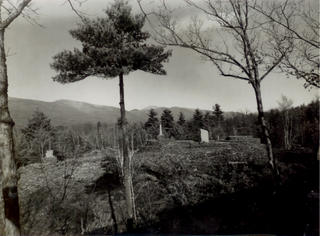
And all of it in the center of this 6-acre expanse of rubble, this huge abandoned quarry.
Did Harvey plan Opus 40 in advance? No, it grew organically from pedestals rising out of rubble, to a network of ramps and terraces, to a vast sculpture. But the sea of stone was there, surrounding this new work of nascent majesty, and Barbara could sense the mission of the young sculptor beside her. As she was to relate years later, the only thing she could think as she stood on that balcony, in that moonlight, was There'll never be room in this man's life for me.
And I've always imagined Harvey standing next to her, thinking, I'll never be able to get this beautiful, elegant woman to come and share my rough and ready life.
They were married not long after, and Barbara and her two boys moved into the house with rudimentary electricity and no indoor plumbing, and they began a life together.
She met a handsome young sculptor at a party, their paths crossed at another one, and one night he suggested that they go and see his place in the moonlight. This would have been around 1943.
As incredible as is Harvey Fite's accomplishment of forty years, it's equally staggering to consider how much had been done in the first five years. The center ramp and the central pedestals finished. "Flame" and "Tomorrow" carved and in place.

And all of it in the center of this 6-acre expanse of rubble, this huge abandoned quarry.
Did Harvey plan Opus 40 in advance? No, it grew organically from pedestals rising out of rubble, to a network of ramps and terraces, to a vast sculpture. But the sea of stone was there, surrounding this new work of nascent majesty, and Barbara could sense the mission of the young sculptor beside her. As she was to relate years later, the only thing she could think as she stood on that balcony, in that moonlight, was There'll never be room in this man's life for me.
And I've always imagined Harvey standing next to her, thinking, I'll never be able to get this beautiful, elegant woman to come and share my rough and ready life.
They were married not long after, and Barbara and her two boys moved into the house with rudimentary electricity and no indoor plumbing, and they began a life together.
Subscribe to:
Posts (Atom)